Overview
The decay factor is a fundamental mathematical concept that describes how quantities decrease over time through repeated multiplication by a constant value less than one. On the SAT math section, understanding decay factors is essential for solving problems involving exponential decay, percentage decreases, depreciation, population decline, and radioactive decay scenarios. While students often focus on growth problems, decay questions appear with nearly equal frequency and require the same level of mastery.
The SAT decay factor questions test whether students can translate real-world decrease scenarios into mathematical expressions and manipulate exponential functions. These problems typically involve identifying the decay factor from a percentage decrease, writing exponential decay equations, or calculating values after multiple time periods. The concept bridges percentage understanding with exponential functions, making it a critical connection point in the SAT Math curriculum.
Mastery of decay factors strengthens overall mathematical reasoning by reinforcing the relationship between percentages, decimals, and exponential expressions. This topic connects directly to growth factors (its mathematical counterpart), linear versus exponential change, and function interpretation—all high-yield areas on the SAT. Students who understand decay factors gain a powerful tool for approaching word problems systematically and can quickly eliminate incorrect answer choices by recognizing the mathematical structure of decrease scenarios.
Learning Objectives
- [ ] Identify key features of decay factor in mathematical expressions and word problems
- [ ] Explain how decay factor appears on the SAT in various question formats
- [ ] Apply decay factor to answer SAT-style questions involving exponential decay
- [ ] Convert percentage decreases into appropriate decay factors
- [ ] Distinguish between decay factor and decay rate in problem contexts
- [ ] Construct exponential decay equations from verbal descriptions
- [ ] Calculate final values after multiple decay periods using decay factors
Prerequisites
- Percentage calculations: Understanding how to convert between percentages, decimals, and fractions is essential because decay factors are derived from percentage decreases
- Basic exponent rules: Decay problems involve repeated multiplication, which requires understanding how exponents represent repeated operations
- Function notation: SAT decay problems often present exponential functions using f(x) or y notation, requiring comfort with function representation
- Order of operations: Correctly evaluating exponential expressions with decay factors requires proper application of PEMDAS
Why This Topic Matters
In real-world applications, decay factors model countless phenomena including vehicle depreciation, medication concentration in the bloodstream, radioactive half-life, population decline in endangered species, and the cooling of hot objects. Financial planners use decay factors to calculate asset depreciation for tax purposes, while scientists rely on them to predict the remaining quantity of radioactive materials. Environmental scientists model pollution reduction and resource depletion using exponential decay functions.
On the SAT, decay factor questions appear in approximately 2-4 questions per test, representing roughly 5-8% of the Math section. These questions most commonly appear in the calculator-permitted section and are distributed across multiple-choice and student-produced response formats. The College Board consistently includes at least one exponential decay scenario in the Problem Solving and Data Analysis domain, and decay factors frequently appear in Heart of Algebra questions involving function interpretation.
Decay factor problems on the SAT typically manifest in three ways: (1) word problems requiring students to construct an exponential decay equation from a verbal description, (2) function interpretation questions asking students to identify what specific values or expressions represent in context, and (3) calculation problems requiring students to determine a quantity after a specified time period. The SAT particularly favors scenarios involving depreciation, population decline, and substance decay, often embedding these concepts within multi-step problems that test multiple skills simultaneously.
Core Concepts
Understanding the Decay Factor
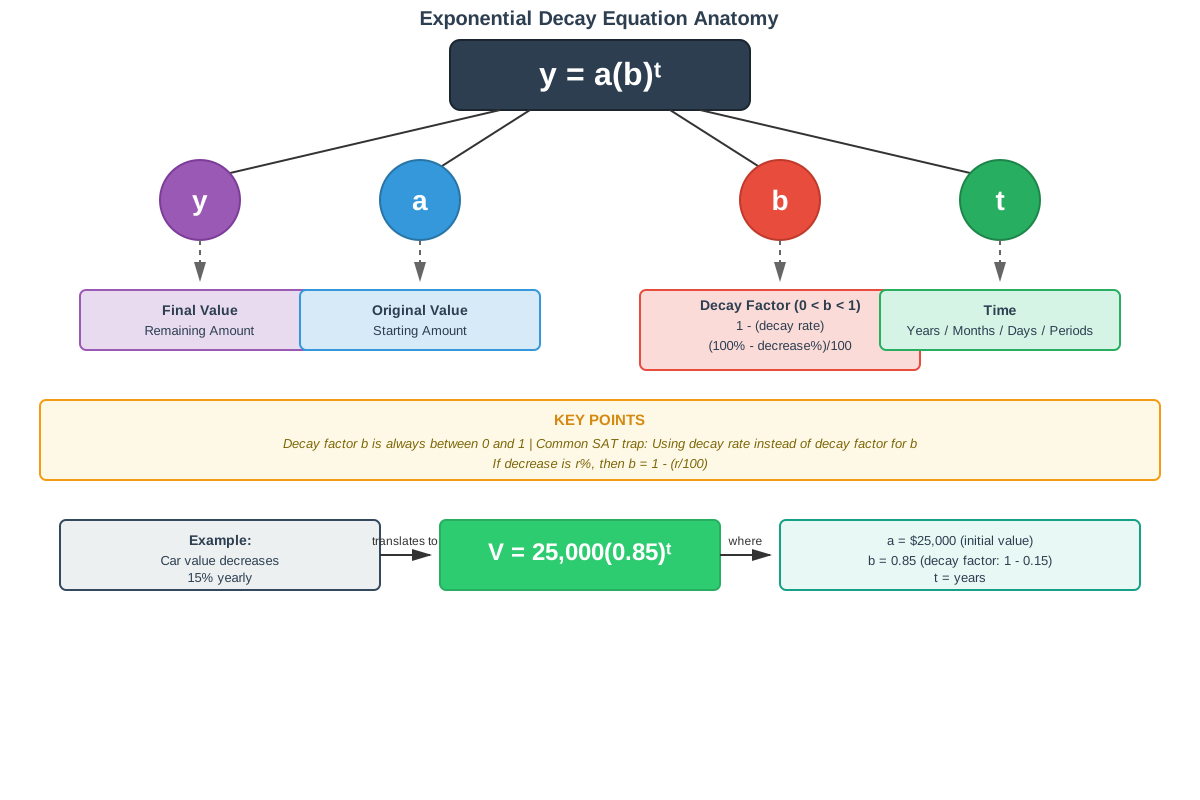
The decay factor is the multiplier used in exponential decay that represents the fraction of a quantity remaining after each time period. Mathematically, if a quantity decreases by r% each period, the decay factor equals (1 - r), where r is expressed as a decimal. For example, if a car's value decreases by 15% annually, the decay factor is 1 - 0.15 = 0.85, meaning 85% of the value remains after each year.
The decay factor always falls between 0 and 1 (exclusive) for true decay scenarios. A decay factor of 0.85 means that after each time period, the quantity is multiplied by 0.85, or equivalently, retains 85% of its previous value. This multiplicative nature distinguishes exponential decay from linear decrease, where a constant amount (rather than a constant percentage) is subtracted each period.
Decay Factor versus Decay Rate
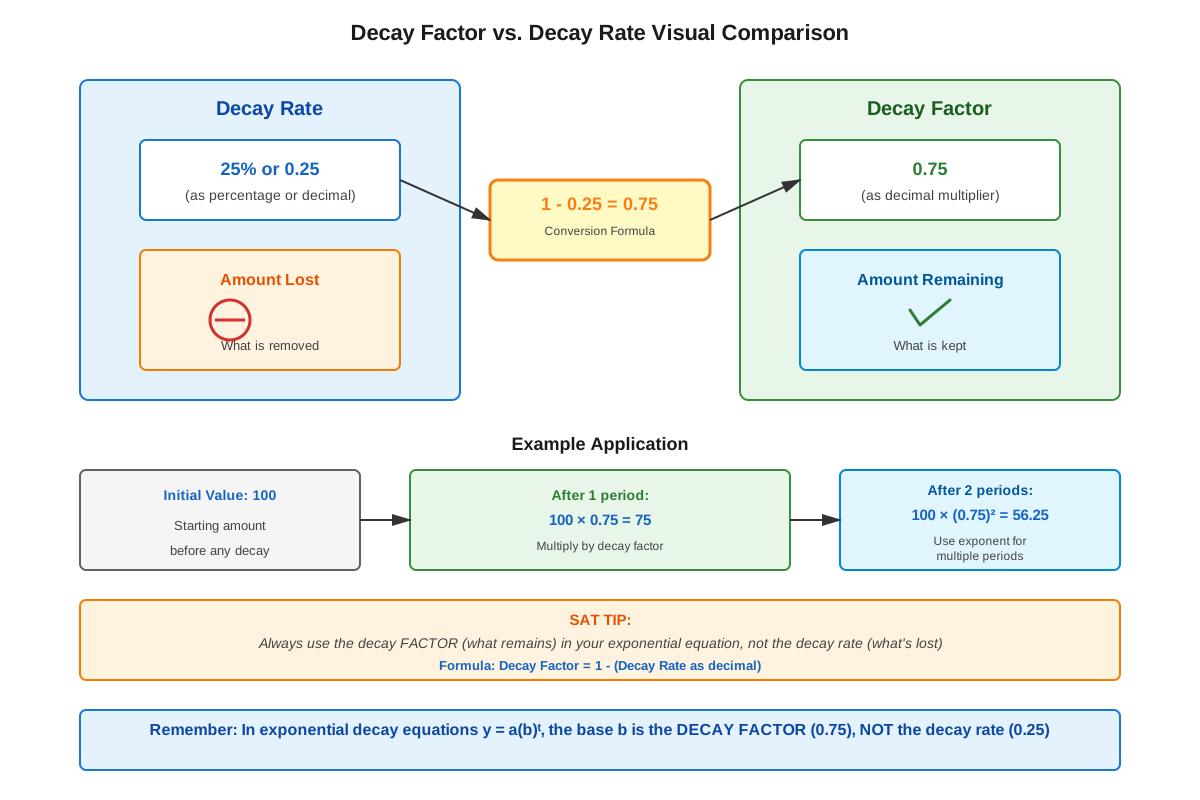
Students must distinguish between the decay rate and the decay factor. The decay rate represents the percentage decrease per time period, while the decay factor represents the multiplier. These are complementary values: decay factor = 1 - decay rate (when the rate is expressed as a decimal).
| Term | Definition | Example (15% decrease) | Relationship |
|---|---|---|---|
| Decay Rate | Percentage lost per period | 0.15 or 15% | The amount that disappears |
| Decay Factor | Fraction remaining per period | 0.85 or 85% | The amount that remains |
| Mathematical Relationship | decay factor = 1 - decay rate | 0.85 = 1 - 0.15 | Always sum to 1 |
The Exponential Decay Formula
The standard exponential decay formula is:
A(t) = A₀(decay factor)^tWhere:
- A(t) = the amount remaining after time t
- A₀ = the initial amount (at t = 0)
- decay factor = (1 - r), where r is the decay rate as a decimal
- t = the number of time periods elapsed
This formula can also be written as A(t) = A₀(1 - r)^t, making the decay rate explicit. On the SAT, students must recognize both forms and understand that they represent the same relationship.
Identifying Decay Factors in Context
SAT problems present decay scenarios using various phrasings that students must recognize:
- "decreases by 20% each year" → decay factor = 0.80
- "loses 8% of its value annually" → decay factor = 0.92
- "retains 75% of its amount each hour" → decay factor = 0.75 (directly stated)
- "half-life of 5 years" → decay factor = 0.50 per 5-year period
The key skill is translating verbal descriptions into the appropriate mathematical multiplier. Words like "decreases," "declines," "loses," "depreciates," and "decays" signal that a decay factor is needed.
Multiple Time Periods and Exponents
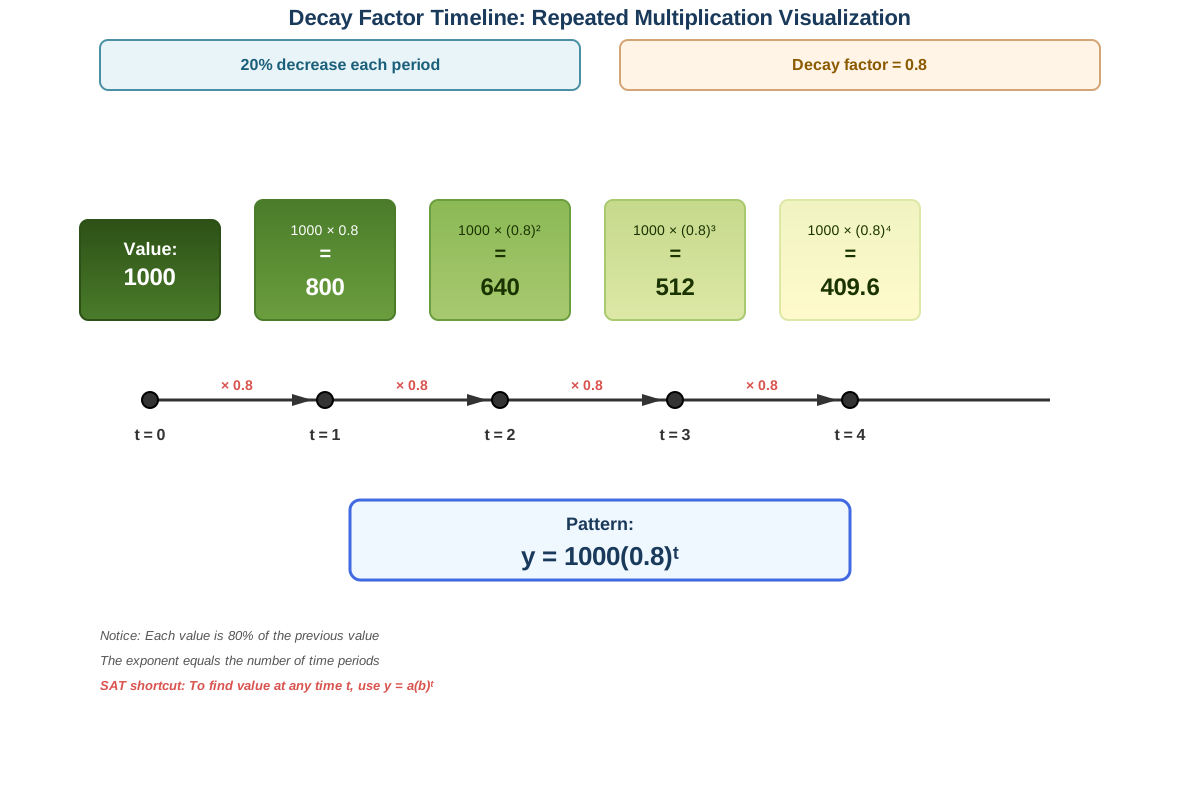
The exponent in the decay formula represents how many times the decay factor is applied. If a population decreases by 10% each year (decay factor = 0.90), then:
- After 1 year: Population = Initial × 0.90¹
- After 2 years: Population = Initial × 0.90²
- After 3 years: Population = Initial × 0.90³
- After t years: Population = Initial × 0.90^t
This exponential structure means the decrease accelerates in absolute terms (though the percentage remains constant). A $10,000 car losing 15% annually loses $1,500 the first year but only $1,275 the second year (15% of $8,500), demonstrating how exponential decay differs from linear decrease.
Working Backwards from Decay Factors
Some SAT questions provide the decay factor and ask students to determine the decay rate or percentage decrease. If a problem states that a quantity is multiplied by 0.88 each month, students must recognize that:
- Decay factor = 0.88
- Decay rate = 1 - 0.88 = 0.12
- Percentage decrease = 12% per month
This reverse process is equally important and frequently tested, particularly in function interpretation questions where students must explain what specific values represent in context.
Compound Decay Periods
Advanced SAT problems may involve decay factors applied over different time intervals than requested. For example, if a substance decays by 20% every 3 hours (decay factor = 0.80 per 3-hour period), finding the amount after 9 hours requires recognizing that 9 hours = 3 periods of 3 hours each, so the calculation uses (0.80)³.
The general principle: match the exponent to the number of decay periods, not necessarily the number of time units. This requires careful attention to how the decay rate is stated versus what time period the question asks about.
Concept Relationships
The decay factor concept builds directly on percentage understanding, as students must convert percentage decreases into decimal multipliers. This conversion skill (percentages → decimals) is prerequisite knowledge that becomes operational when constructing decay factors.
Decay factors connect inversely to growth factors: where growth uses factors greater than 1 (like 1.05 for 5% growth), decay uses factors less than 1 (like 0.95 for 5% decay). Both follow the same exponential function structure, making them parallel concepts with opposite directional effects.
Within exponential functions, the decay factor serves as the base of the exponential expression. Understanding function notation and evaluation allows students to interpret what A₀, the base, and the exponent represent in context—a common SAT question type.
The relationship map flows as follows:
Percentage decrease → converts to → Decay rate (decimal) → subtracted from 1 to yield → Decay factor → serves as base in → Exponential decay function → evaluated using → Exponent rules → produces → Final amount after decay
This chain demonstrates how decay factor sits at the center of multiple mathematical concepts, serving as the bridge between percentage reasoning and exponential function application.
Quick check — test yourself on Decay factor so far.
Try Flashcards →High-Yield Facts
⭐ The decay factor always equals 1 minus the decay rate (when expressed as a decimal)
⭐ For exponential decay, the decay factor must be between 0 and 1 (exclusive)
⭐ A decay factor of 0.85 means 85% remains, not that 85% is lost
⭐ The exponent in A(t) = A₀(b)^t represents the number of decay periods, not necessarily the number of time units
⭐ When a quantity "decreases by r%," the decay factor is (1 - r/100)
- The decay factor is the base of the exponential expression in decay functions
- Multiple decay periods require raising the decay factor to the power of the number of periods
- A 50% decrease per period corresponds to a decay factor of 0.50 (half-life scenario)
- Decay factors can be expressed as decimals, fractions, or percentages (though decimal form is most common in formulas)
- The initial amount A₀ is the value when t = 0, before any decay has occurred
- Compound decay (decay applied multiple times) uses exponents, not multiplication of the rate
- If a decay factor is given directly (e.g., "multiplied by 0.92 each year"), no conversion from percentage is needed
Common Misconceptions
Misconception: A 20% decrease means the decay factor is 0.20 → Correction: A 20% decrease means 20% is lost, so 80% remains; the decay factor is 0.80, not 0.20. The decay factor represents what remains, not what is lost.
Misconception: Applying a 10% decrease three times is the same as applying a 30% decrease once → Correction: Exponential decay is multiplicative, not additive. Three 10% decreases yield (0.90)³ = 0.729 (27.1% total decrease), not 0.70 (30% decrease). Each decrease applies to a smaller base.
Misconception: The decay factor can be greater than 1 if the decrease is large → Correction: The decay factor must always be less than 1 for decay scenarios. Even a 99% decrease yields a decay factor of 0.01. Values greater than 1 represent growth, not decay.
Misconception: In A(t) = A₀(0.85)^t, the exponent t can be ignored for small values → Correction: The exponent is essential regardless of its size. When t = 1, the expression equals A₀(0.85)¹ = 0.85A₀. When t = 0, it equals A₀(0.85)⁰ = A₀. The exponent must always be included in calculations.
Misconception: Decay factor and decay rate are interchangeable terms → Correction: These are distinct concepts. The decay rate is the percentage lost (r), while the decay factor is the fraction remaining (1 - r). They are complementary but not equivalent.
Misconception: A decay factor of 0.5 means the quantity decreases by 0.5 units each period → Correction: A decay factor of 0.5 means the quantity is multiplied by 0.5 (halved) each period. This is a 50% decrease, not a decrease of 0.5 units. Exponential decay involves multiplication, not subtraction.
Worked Examples
Example 1: Constructing a Decay Function
Problem: A new car purchased for $28,000 depreciates by 18% each year. Write a function that models the car's value V(t) after t years, and determine the car's value after 4 years.
Solution:
Step 1: Identify the initial value.
- A₀ = $28,000 (the purchase price)
Step 2: Determine the decay rate and convert to decay factor.
- Decay rate = 18% = 0.18
- Decay factor = 1 - 0.18 = 0.82
Step 3: Write the exponential decay function.
- V(t) = 28,000(0.82)^t
Step 4: Calculate the value after 4 years by substituting t = 4.
- V(4) = 28,000(0.82)⁴
- V(4) = 28,000(0.45212176)
- V(4) ≈ $12,659.41
Answer: The function is V(t) = 28,000(0.82)^t, and the car's value after 4 years is approximately $12,659.
Connection to Learning Objectives: This problem requires identifying the decay factor (0.82) from a percentage decrease, constructing an exponential decay equation, and applying it to calculate a specific value—demonstrating mastery of all core learning objectives.
Example 2: Working Backwards from a Function
Problem: A scientist models the amount of a radioactive substance remaining using the function A(t) = 500(0.94)^t, where A is measured in grams and t is measured in days. What percentage of the substance decays each day?
Solution:
Step 1: Identify the decay factor from the function.
- The function is in the form A(t) = A₀(decay factor)^t
- Comparing: A(t) = 500(0.94)^t
- Decay factor = 0.94
Step 2: Determine the decay rate.
- Decay factor = 1 - decay rate
- 0.94 = 1 - decay rate
- Decay rate = 1 - 0.94 = 0.06
Step 3: Convert the decay rate to a percentage.
- Decay rate = 0.06 = 6%
Answer: 6% of the substance decays each day.
Connection to Learning Objectives: This problem tests the ability to identify the decay factor within an exponential function and explain what it represents in context—specifically, working backwards from the decay factor to determine the percentage decrease, a common SAT question format.
Exam Strategy
When approaching SAT decay factor questions, first identify whether the problem provides a percentage decrease or directly states the decay factor. If given a percentage, immediately write "decay factor = 1 - (percentage as decimal)" to avoid confusion. This simple step prevents the most common error of using the decay rate as the decay factor.
Watch for trigger words that signal decay scenarios: "decreases," "depreciates," "declines," "loses," "decays," "reduces," and "diminishes." These words indicate that the multiplier should be less than 1. Conversely, if you calculate a decay factor greater than 1, immediately recognize that an error has occurred—this is mathematically impossible for decay.
For multiple-choice questions, use the answer choices strategically. If asked to write a decay function and the choices show different bases, identify which base is less than 1 and matches your calculated decay factor. Eliminate any choices with bases greater than 1 immediately, as these represent growth, not decay.
Time management for decay problems: spend 30-45 seconds identifying the decay factor and writing the function, then 45-60 seconds performing calculations. If a problem requires calculating a value after many periods (like 10 or 20 years), use your calculator efficiently by entering the entire expression at once rather than calculating step-by-step. For example, enter "28000 × 0.82^4" directly rather than calculating 0.82^4 separately.
When questions ask what a specific value "represents" in a decay function, remember this pattern: the coefficient (A₀) is always the initial amount, the base is always the decay factor (representing the fraction remaining per period), and the exponent is always the number of time periods. The SAT frequently tests whether students can identify these components in context.
Memory Techniques
Mnemonic for Decay Factor Calculation: "One Minus Rate Gives Factor" (OMRGF) - Remember that you take One Minus the decay Rate to Get the decay Factor.
Visualization Strategy: Picture a melting ice cube. Each hour, it retains 90% of its previous mass (decay factor = 0.90), meaning 10% melts away (decay rate = 0.10). The ice cube gets smaller each period, but the percentage that melts stays constant. This concrete image helps distinguish between the amount remaining (decay factor) and amount lost (decay rate).
The "Less Than One" Rule: Create a mental checkpoint: "Decay factors are always less than one, growth factors are always more than one." Before finalizing any answer, verify that your decay factor falls between 0 and 1.
Acronym for Function Components: BIG - Base (decay factor), Initial amount (coefficient), Growth periods (exponent). This helps remember what each part of A(t) = A₀(b)^t represents.
The Complement Connection: Think of decay factor and decay rate as complements that always sum to 1 (when expressed as decimals). If you know one, you automatically know the other by subtraction from 1. Visualize them as two pieces of a pie that together make the whole.
Summary
The decay factor is the multiplicative constant less than one that represents the fraction of a quantity remaining after each time period in exponential decay scenarios. On the SAT, students must convert percentage decreases into decay factors using the relationship decay factor = 1 - decay rate, construct exponential decay functions in the form A(t) = A₀(decay factor)^t, and evaluate these functions for specific time periods. The decay factor always falls between 0 and 1 for true decay, distinguishing it from growth factors which exceed 1. SAT questions test decay factors through word problems requiring function construction, interpretation questions asking what specific values represent in context, and calculation problems requiring evaluation after multiple periods. Mastery requires recognizing verbal cues that signal decay, accurately converting between percentages and decimal multipliers, understanding the exponential structure where the exponent represents the number of decay periods, and distinguishing between decay rate (what's lost) and decay factor (what remains). Success on decay factor questions depends on systematic conversion of percentages, careful attention to what values represent in context, and proper application of exponent rules when calculating final amounts.
Key Takeaways
- The decay factor equals 1 minus the decay rate (expressed as a decimal) and always falls between 0 and 1 for decay scenarios
- Decay factor represents the fraction remaining after each period, not the fraction lost
- The standard exponential decay formula is A(t) = A₀(decay factor)^t, where t is the number of decay periods
- Converting "decreases by r%" requires calculating decay factor = 1 - (r/100)
- The exponent in decay functions represents the number of times the decay factor is applied, requiring careful attention to time period matching
- Multiple decay periods involve exponentiation, not multiplication—three 10% decreases do not equal one 30% decrease
- SAT questions frequently test the ability to identify what specific values represent in decay functions and to work backwards from functions to determine decay rates
Related Topics
Growth Factors: The mathematical complement to decay factors, where quantities increase by a constant percentage each period using multipliers greater than 1. Mastering decay factors provides the foundation for understanding growth factors, as both follow identical exponential function structures with opposite directional effects.
Exponential Functions: The broader category encompassing both growth and decay, including transformations, graphing, and comparing exponential versus linear change. Understanding decay factors is essential for interpreting exponential function behavior and characteristics.
Compound Interest: A specific application of growth factors in financial contexts, where interest is calculated on both principal and accumulated interest. The mathematical structure mirrors exponential decay but with growth factors, making decay factor mastery transferable to interest calculations.
Half-Life Problems: A specialized decay scenario where the decay factor equals 0.5, commonly appearing in science contexts involving radioactive decay or medication concentration. These problems extend decay factor understanding to situations requiring logarithmic reasoning.
Percentage Change: The foundational skill underlying both growth and decay factors, including calculating percentage increase/decrease and distinguishing between absolute and relative change. Strengthening percentage skills enhances decay factor problem-solving efficiency.
Practice CTA
Now that you understand decay factors comprehensively, challenge yourself with the practice questions to reinforce these concepts and build exam confidence. The practice problems mirror actual SAT question formats and difficulty levels, providing essential experience with the various ways decay factors appear on test day. Work through each problem systematically, checking your decay factor calculations and verifying that your answers make contextual sense. Use the flashcards to memorize key formulas and relationships, ensuring instant recall during timed testing conditions. Remember: mastery comes through deliberate practice, and decay factor questions are highly predictable once you recognize their patterns. You've built a strong foundation—now apply it!
Sign up free to keep reading
Create a free AnvayaPrep account to finish this SAT guide on Decay factor — plus flashcards and practice questions.