Overview
Fraction percent conversion is a fundamental mathematical skill that appears frequently throughout the SAT Math section, serving as a bridge between different numerical representations. This topic involves the ability to seamlessly translate between fractions, decimals, and percentages—three different ways of expressing the same proportional relationship. Mastering this conversion process is not merely about memorizing formulas; it requires understanding the underlying relationships between these numerical forms and being able to apply them quickly and accurately under test conditions.
On the SAT, fraction percent conversion questions rarely appear in isolation. Instead, they are embedded within word problems, data interpretation questions, ratio problems, and algebraic expressions. The College Board expects students to perform these conversions automatically while solving more complex problems involving proportional reasoning, statistics, or real-world applications. A student who struggles with converting 3/8 to a percentage will lose valuable time and accuracy on questions involving discounts, tax calculations, population changes, or data analysis—all high-frequency question types on the exam.
Understanding fraction percent conversion strengthens overall mathematical fluency and connects directly to numerous other math concepts tested on the SAT. This skill underpins work with ratios and proportions, probability calculations, statistical analysis, and even some algebraic manipulations. The ability to recognize that 0.75, 75%, and 3/4 all represent the same value allows students to choose the most efficient form for any given problem, often revealing shortcuts that save crucial seconds during the timed exam.
Learning Objectives
- [ ] Identify key features of fraction percent conversion
- [ ] Explain how fraction percent conversion appears on the SAT
- [ ] Apply fraction percent conversion to answer SAT-style questions
- [ ] Convert any proper or improper fraction to its equivalent percentage with accuracy
- [ ] Recognize common fraction-percent equivalents instantly without calculation
- [ ] Determine which numerical form (fraction, decimal, or percent) is most efficient for solving a given problem
- [ ] Apply conversion skills within multi-step SAT problems involving real-world contexts
Prerequisites
- Basic fraction operations: Understanding numerators, denominators, and simplification is essential because conversion requires manipulating fractional forms
- Decimal place value: Recognizing tenths, hundredths, and thousandths enables accurate conversion between decimals and percentages
- Multiplication and division by powers of 10: These operations form the mechanical basis of most conversion procedures
- Understanding of percentage as "per hundred": This conceptual foundation explains why conversion methods work mathematically
Why This Topic Matters
In real-world applications, fraction percent conversion appears constantly in financial literacy (calculating tips, interest rates, discounts), data interpretation (understanding statistics in news reports), cooking (scaling recipes), and professional fields from medicine to engineering. The ability to fluidly move between these representations allows for clearer communication and more intuitive understanding of quantitative information.
On the SAT specifically, fraction percent conversion appears in approximately 10-15% of Math section questions, either as the primary skill being tested or as a necessary step within a larger problem. The College Board includes these conversions across both the calculator and no-calculator portions, testing whether students have internalized these relationships rather than relying solely on computational tools. Questions may appear as straightforward conversion problems worth 1 point, or as components of multi-step problems worth significantly more.
Common SAT question formats include: word problems requiring students to convert a described situation into mathematical form; data interpretation questions where percentages must be converted to fractions for calculation; comparison problems asking which of several options represents the greatest or least value; and applied problems involving percent increase/decrease where fractional thinking provides computational advantages. The topic also appears in grid-in questions where students must enter numerical answers, requiring precise conversion accuracy.
Core Concepts
Understanding the Fundamental Relationship
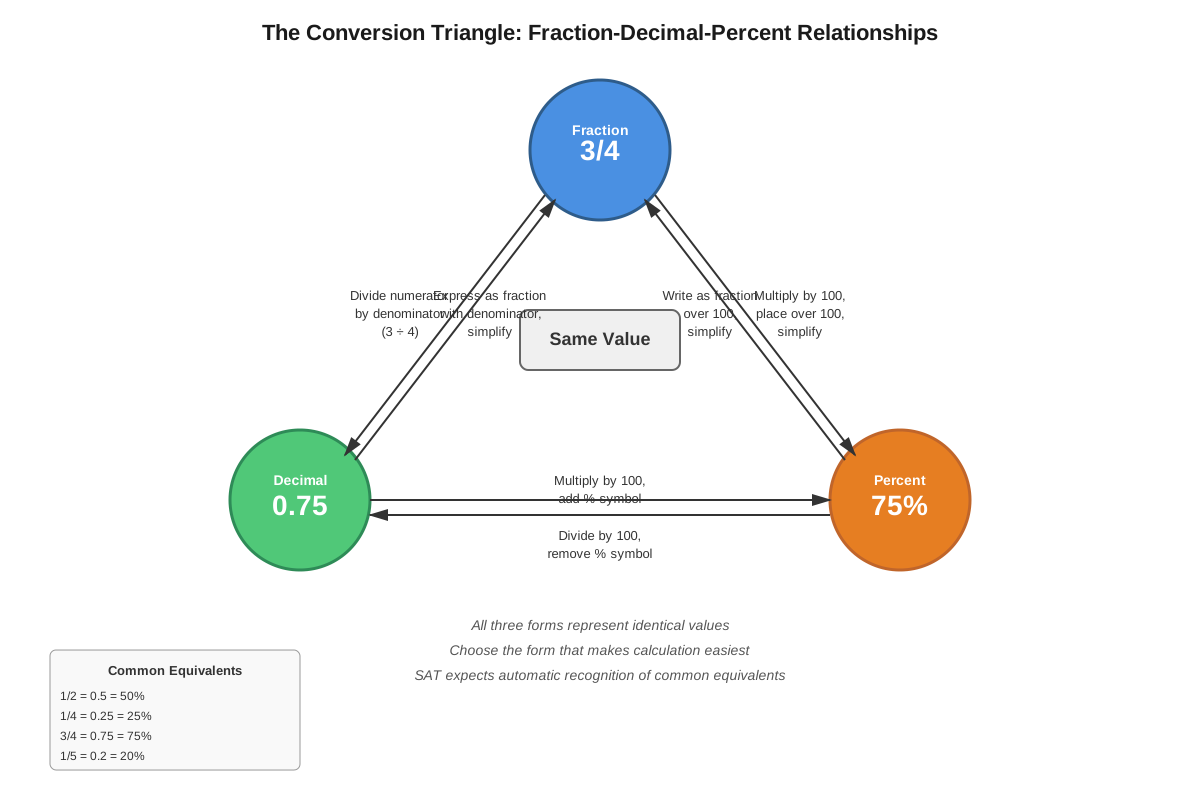
Percent literally means "per hundred" or "out of 100," derived from the Latin "per centum." This etymological root reveals the core concept: any percentage is simply a fraction with 100 as the denominator. When converting between fractions and percentages, students are essentially changing the denominator to or from 100 while maintaining the same proportional value.
A fraction represents a part-to-whole relationship expressed as a numerator divided by a denominator. To convert any fraction to a percentage, the goal is to determine what that fraction equals when expressed "out of 100." This can be accomplished through two primary methods, each with distinct advantages depending on the specific fraction involved.
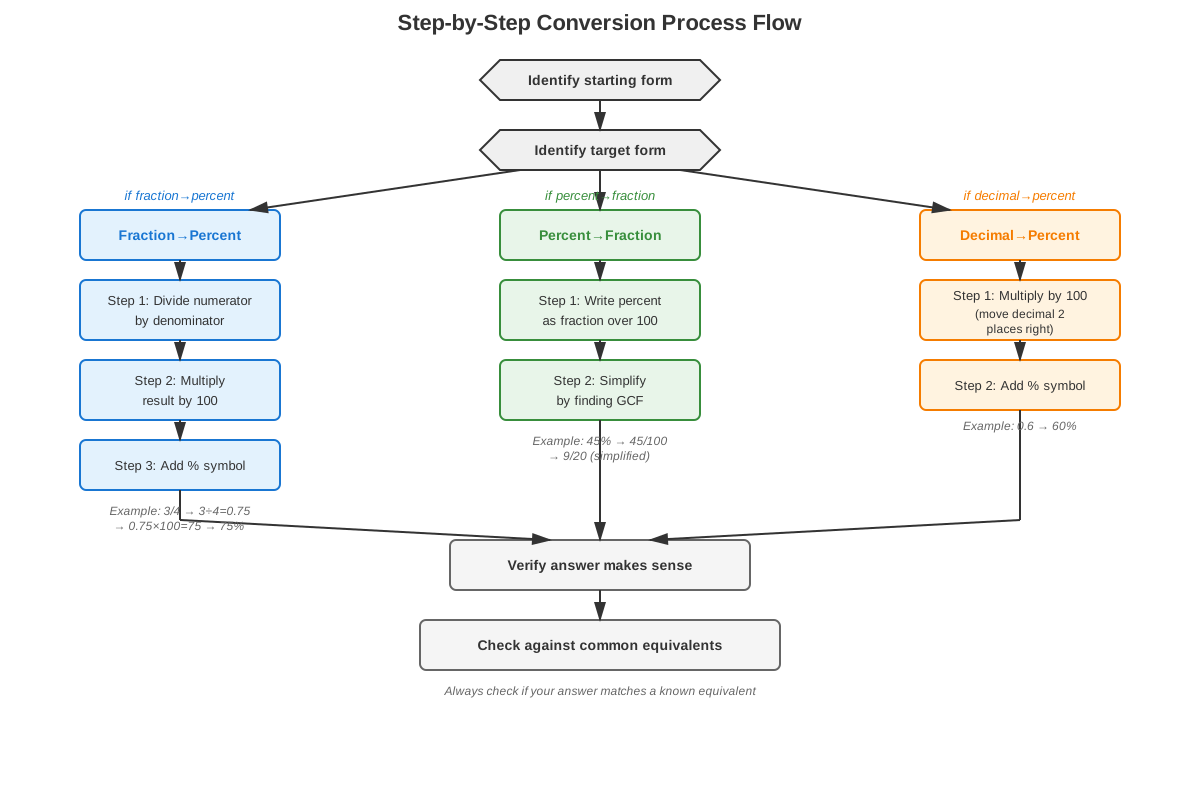
Method 1: Multiply by 100%
The most universally applicable conversion method involves multiplying the fraction by 100%. Since 100% equals 1 (the multiplicative identity), this operation doesn't change the value—only its form.
Steps:
- Take the given fraction
- Multiply by 100
- Add the percent symbol (%)
Example: Convert 3/5 to a percentage
- 3/5 × 100% = (3 × 100)/5 % = 300/5 % = 60%
This method works for all fractions and is particularly efficient when the denominator divides evenly into 100 or when using a calculator.
Method 2: Convert to Decimal First
Many students find the two-step process of converting fraction → decimal → percent more intuitive, especially for fractions that don't have denominators that are factors of 100.
Steps:
- Divide the numerator by the denominator to get a decimal
- Multiply the decimal by 100 (or move the decimal point two places right)
- Add the percent symbol (%)
Example: Convert 7/8 to a percentage
- 7 ÷ 8 = 0.875
- 0.875 × 100 = 87.5
- Answer: 87.5%
Converting Percentages to Fractions
The reverse process—converting percentages to fractions—follows a logical inverse procedure:
Steps:
- Write the percentage as a fraction with denominator 100
- Simplify the fraction to lowest terms
Example: Convert 45% to a fraction
- 45% = 45/100
- Simplify by dividing both numerator and denominator by 5: 9/20
For percentages with decimals, first eliminate the decimal by multiplying both numerator and denominator by the appropriate power of 10:
Example: Convert 12.5% to a fraction
- 12.5% = 12.5/100
- Multiply both by 10: 125/1000
- Simplify by dividing by 125: 1/8
Common Fraction-Percent Equivalents
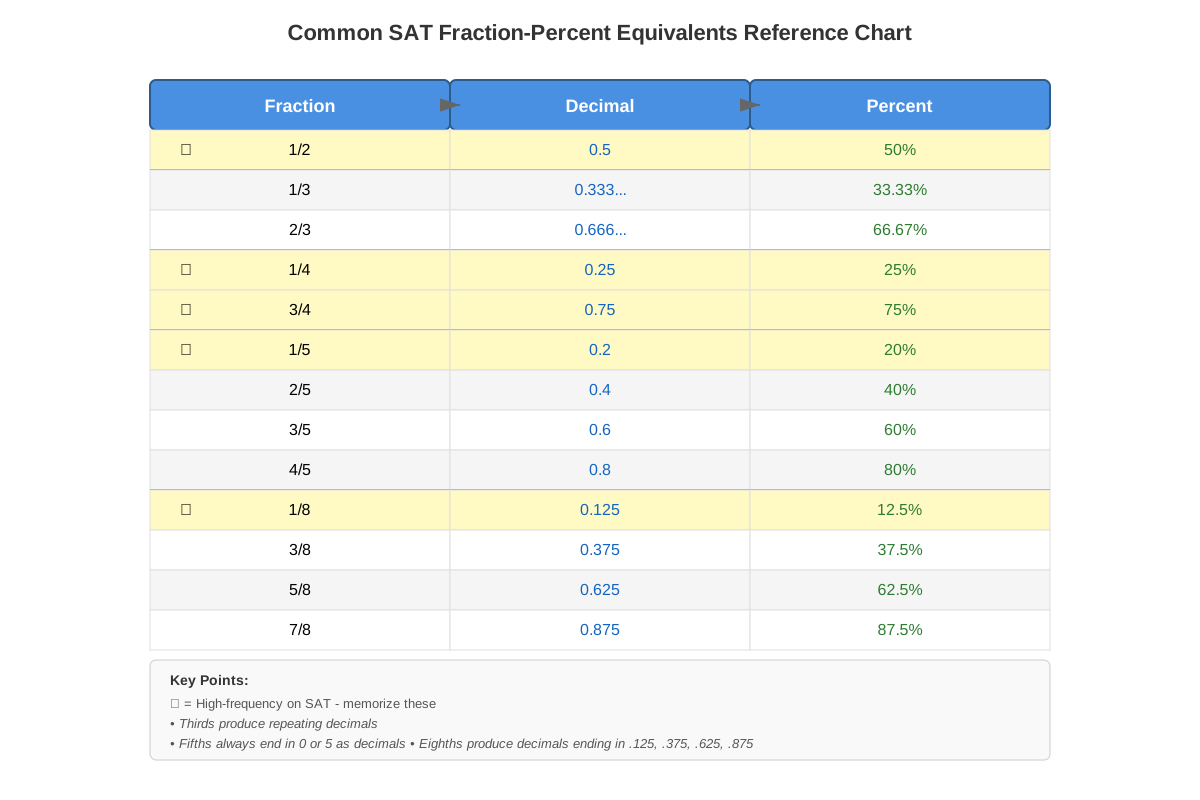
Memorizing frequently occurring conversions dramatically increases SAT efficiency. These equivalents appear repeatedly across multiple question types:
| Fraction | Decimal | Percent |
|---|---|---|
| 1/2 | 0.5 | 50% |
| 1/3 | 0.333... | 33.33...% |
| 2/3 | 0.666... | 66.66...% |
| 1/4 | 0.25 | 25% |
| 3/4 | 0.75 | 75% |
| 1/5 | 0.2 | 20% |
| 2/5 | 0.4 | 40% |
| 3/5 | 0.6 | 60% |
| 4/5 | 0.8 | 80% |
| 1/8 | 0.125 | 12.5% |
| 3/8 | 0.375 | 37.5% |
| 5/8 | 0.625 | 62.5% |
| 7/8 | 0.875 | 87.5% |
| 1/10 | 0.1 | 10% |
Working with Improper Fractions and Mixed Numbers
When converting improper fractions (where numerator > denominator) to percentages, the result will exceed 100%—a perfectly valid outcome that students sometimes doubt.
Example: Convert 5/4 to a percentage
- 5/4 × 100% = 500/4 % = 125%
For mixed numbers, convert to an improper fraction first, then proceed with standard conversion methods.
Example: Convert 2 1/3 to a percentage
- 2 1/3 = 7/3
- 7/3 × 100% = 700/3 % = 233.33...%
Percentages Greater Than 100% and Less Than 1%
The SAT occasionally tests whether students understand that percentages can extend beyond the 0-100% range. A percentage greater than 100% indicates a value greater than the whole, while percentages less than 1% represent very small fractions.
Example: 0.003 = 0.3% (not 3%)
Example: 3/2 = 150% (not 15%)
Concept Relationships
The conversion between fractions and percentages relies fundamentally on understanding that both are different representations of the same proportional relationship. Fractions express this relationship as a division operation (numerator ÷ denominator), while percentages express it relative to a standard base of 100. Decimals serve as the intermediate form that bridges these two representations.
This topic connects directly to prerequisite knowledge of fraction operations and decimal place value. Without understanding how to divide to create decimals or how to multiply fractions, the conversion process becomes mechanical memorization rather than conceptual understanding. The relationship flows: Fraction Operations → Decimal Understanding → Fraction-Percent Conversion.
Within the broader SAT Math curriculum, fraction percent conversion enables work with ratios and proportions (expressing ratios as percentages), probability (converting probability fractions to percentages), statistics (interpreting data), and percent change problems (which require converting the change ratio to a percentage). The relationship map looks like:
Fraction Percent Conversion → enables → Percent Change Calculations → enables → Growth and Decay Problems
Fraction Percent Conversion → enables → Probability as Percentage → enables → Data Interpretation
Fraction Percent Conversion → combines with → Ratio and Proportion → enables → Scale Factor Problems
Quick check — test yourself on Fraction percent conversion so far.
Try Flashcards →High-Yield Facts
⭐ To convert any fraction to a percent, multiply by 100 and add the % symbol
⭐ To convert any percent to a fraction, write it over 100 and simplify
⭐ 1/2 = 50%, 1/4 = 25%, 3/4 = 75%—these three conversions appear in approximately 40% of SAT questions involving fraction-percent conversion
⭐ Moving a decimal point two places to the right converts a decimal to a percent (0.45 → 45%)
⭐ Percentages can exceed 100% when representing values greater than the whole
- 1/3 = 33.33...% and 2/3 = 66.66...% (repeating decimals are acceptable SAT answers)
- When a percentage contains a decimal (like 12.5%), it often converts to a fraction with 8 in the denominator
- 1/5 = 20%, making all fifths easy to convert (2/5 = 40%, 3/5 = 60%, etc.)
- Percentages less than 1% represent fractions less than 1/100
- Converting to the same form (all fractions or all percentages) before comparing values prevents errors
- The fraction 1/8 = 12.5%, making eighths valuable for mental math with percentages
- Any fraction with denominator 100 already shows its percentage in the numerator (37/100 = 37%)
Common Misconceptions
Misconception: When converting 0.45 to a percent, the answer is 0.45%
Correction: Moving the decimal two places right (or multiplying by 100) gives 45%, not 0.45%. The decimal point movement accounts for the "per hundred" in percent.
Misconception: 1/3 equals exactly 33% or 0.33
Correction: 1/3 = 33.333...% (repeating infinitely). While 33% is an approximation, on the SAT, answers involving thirds should be left as fractions or expressed with the repeating decimal notation when precision matters.
Misconception: A percentage greater than 100% is impossible or indicates an error
Correction: Percentages above 100% are mathematically valid and represent values greater than the original whole. For example, if a population doubles, it has increased by 100% and is now 200% of its original size.
Misconception: To convert a fraction to a percent, just add a % symbol to the fraction
Correction: The fraction must be converted to an equivalent form out of 100. Simply writing 3/4% means "three-fourths of one percent" (0.75%), not 75%.
Misconception: All fractions convert to percentages with whole numbers
Correction: Many fractions produce percentages with decimals (like 1/8 = 12.5% or 1/6 = 16.666...%). This is normal and correct.
Misconception: When converting 25% to a fraction, the answer is 25/100 and that's the final answer
Correction: While 25/100 is correct, SAT answers should be simplified to lowest terms unless otherwise specified. The complete answer is 1/4.
Worked Examples
Example 1: Multi-Step SAT Problem
Question: In a survey of 240 students, 3/8 of the students said they prefer online learning. What percent of students prefer online learning, and how many students does this represent?
Solution:
Step 1: Convert the fraction to a percent
- We need to convert 3/8 to a percentage
- Method: Multiply by 100%
- 3/8 × 100% = 300/8 % = 37.5%
Step 2: Calculate the number of students
- 37.5% of 240 students
- Convert percent to decimal: 37.5% = 0.375
- 0.375 × 240 = 90 students
Answer: 37.5% of students prefer online learning, representing 90 students.
Connection to Learning Objectives: This problem requires applying fraction percent conversion within a real-world context (survey data), demonstrating how conversion is rarely tested in isolation but rather as part of multi-step reasoning.
Example 2: Comparison Problem
Question: Which of the following represents the greatest value?
A) 7/12
B) 58%
C) 0.585
D) 11/20
Solution:
Step 1: Convert all values to the same form (percentages work well here)
- 7/12: Divide 7 by 12 = 0.5833... = 58.33...%
- 58%: Already in percent form = 58%
- 0.585: Multiply by 100 = 58.5%
- 11/20: Multiply by 100% = (11 × 100)/20 % = 1100/20 % = 55%
Step 2: Compare the percentages
- 58.33...% (option A)
- 58% (option B)
- 58.5% (option C)
- 55% (option D)
Step 3: Identify the greatest
- 58.33...% is the greatest value
Answer: A (7/12)
Connection to Learning Objectives: This demonstrates the strategic advantage of converting to a common form for comparison and shows how sat fraction percent conversion appears in multiple-choice format where recognizing equivalent forms is essential.
Exam Strategy
When approaching SAT questions involving fraction percent conversion, first determine whether the question requires an exact conversion or whether estimation will suffice. For multiple-choice questions where answers are spread apart, rough estimation (knowing 1/3 ≈ 33%, 1/2 = 50%, 2/3 ≈ 67%) can eliminate wrong answers quickly.
Trigger words and phrases that signal conversion needs include: "what percent," "express as a fraction," "what portion," "out of," and any comparison between fractional and percentage values. When a problem provides information in one form but asks for an answer in another, conversion is required.
For process of elimination, convert answer choices to the same form as the given information. If the problem provides a fraction, convert all percentage answer choices to fractions for direct comparison. This prevents conversion errors and makes relationships clearer. Additionally, eliminate any answer that seems unreasonably large or small—if converting 3/8, an answer of 3.8% or 380% should immediately seem wrong.
Time allocation for pure conversion questions should be 30-45 seconds maximum. If spending more time, the approach may be inefficient. For conversion embedded in multi-step problems, allocate 1.5-2 minutes total. Practice the common conversions (halves, thirds, fourths, fifths, eighths) until they're automatic, saving 10-15 seconds per question.
On no-calculator sections, favor fractions with denominators that are factors of 100 (2, 4, 5, 10, 20, 25, 50) because these convert mentally without long division. On calculator sections, don't hesitate to divide numerator by denominator to get the decimal, then multiply by 100.
Memory Techniques
Mnemonic for the conversion process: "Fractions Multiply Hundred" (FMH) reminds students to multiply fractions by 100 to get percentages.
Visualization strategy: Picture a percentage as a grid of 100 squares. When converting 3/4 to a percent, visualize dividing the grid into 4 equal parts and shading 3 of them—this shows 75 squares shaded out of 100, making 75% intuitive.
The "Decimal Dance": Remember that converting between decimals and percents involves moving the decimal point two places. Going from decimal to percent, the decimal "dances right" two steps (0.45 → 45%). Going from percent to decimal, it "dances left" two steps (45% → 0.45).
Benchmark fractions: Memorize the "Big Five" fraction families:
- Halves (1/2 = 50%)
- Thirds (1/3 = 33.33...%, 2/3 = 66.66...%)
- Fourths (1/4 = 25%, 3/4 = 75%)
- Fifths (1/5 = 20%, 2/5 = 40%, 3/5 = 60%, 4/5 = 80%)
- Eighths (1/8 = 12.5%, 3/8 = 37.5%, 5/8 = 62.5%, 7/8 = 87.5%)
Acronym: HTFFE ("Hot Five") for the five most important fraction families.
Summary
Fraction percent conversion is an essential SAT Math skill that involves translating between different representations of proportional relationships. The core principle is that percentages express values "per hundred," making conversion a matter of changing denominators to or from 100. Students can convert fractions to percentages by multiplying by 100% or by first converting to decimals, then multiplying by 100. The reverse process—converting percentages to fractions—involves writing the percentage over 100 and simplifying. Mastery requires both understanding the conceptual basis of these conversions and memorizing common equivalents (particularly halves, thirds, fourths, fifths, and eighths) for rapid recall. On the SAT, these conversions rarely appear in isolation but are embedded within word problems, data interpretation, and comparison questions. Success requires recognizing when conversion is needed, choosing the most efficient method, and maintaining accuracy with both whole number and decimal percentages. Students who internalize these relationships gain significant advantages in speed and accuracy across multiple question types.
Key Takeaways
- Multiply any fraction by 100% to convert it to a percentage; divide any percentage by 100 (or write over 100 and simplify) to convert to a fraction
- Memorize common conversions (1/2 = 50%, 1/4 = 25%, 3/4 = 75%, 1/5 = 20%, 1/8 = 12.5%) to save time on the SAT
- Percentages can be greater than 100% (representing values larger than the whole) or less than 1% (representing very small fractions)
- Convert all values to the same form (all fractions, all decimals, or all percentages) before comparing or performing operations
- Moving a decimal point two places right converts decimals to percentages (0.45 → 45%); moving two places left converts percentages to decimals (45% → 0.45)
- On the SAT, fraction percent conversion appears in approximately 10-15% of questions, often embedded within larger problems rather than tested in isolation
- Always simplify fractional answers to lowest terms unless the question specifies otherwise
Related Topics
Percent Change and Percent Increase/Decrease: Building on basic conversion skills, these topics involve calculating how much a value has changed relative to its original amount, expressed as a percentage. Mastering fraction percent conversion makes these calculations more intuitive.
Ratios and Proportions: Ratios can be expressed as fractions and converted to percentages for easier interpretation. Understanding conversion enables students to move fluidly between ratio notation and percentage representation.
Probability: Probability values are fractions (favorable outcomes/total outcomes) that are often expressed as percentages for clarity. Conversion skills allow students to present probability in the most appropriate form.
Data Interpretation and Statistics: Graphs, charts, and tables frequently present data as percentages that must be converted to fractions or decimals for calculations. This topic is essential for the data analysis questions that comprise a significant portion of SAT Math.
Decimal Operations: Deepening understanding of decimal place value and operations strengthens the intermediate step in many conversion processes and improves overall numerical fluency.
Practice CTA
Now that you've mastered the core concepts of fraction percent conversion, it's time to solidify your understanding through active practice. Attempt the practice questions designed specifically for this topic, focusing on both speed and accuracy. Use the flashcards to drill the common fraction-percent equivalents until they become automatic—this investment of a few minutes will save you valuable seconds on every SAT Math section. Remember, the difference between a good score and a great score often comes down to efficiency with fundamental skills like these. Challenge yourself to complete conversions in under 30 seconds, and watch your confidence soar as these relationships become second nature!
Sign up free to keep reading
Create a free AnvayaPrep account to finish this SAT guide on Fraction percent conversion — plus flashcards and practice questions.