Overview
The growth factor is a fundamental mathematical concept that appears frequently on the SAT Math section, representing the multiplier by which a quantity changes over time or through repeated operations. When a value increases by a certain percentage, the growth factor captures this change as a single multiplicative value greater than 1. For example, if a population grows by 20%, the growth factor is 1.20, meaning the new population equals the original population multiplied by 1.20. This concept streamlines calculations involving repeated percentage changes and compound growth, making it an essential tool for solving SAT problems efficiently.
Understanding growth factors is critical for SAT success because these problems appear in multiple question formats across both the calculator and no-calculator sections. The College Board frequently tests students' ability to translate between percentage language and multiplicative relationships, recognize exponential growth patterns, and apply growth factors to real-world scenarios involving population dynamics, financial investments, and scientific measurements. Students who master growth factors can solve complex multi-step problems in seconds rather than minutes, providing a significant competitive advantage on test day.
The growth factor concept bridges several important mathematical domains tested on the SAT. It connects percentage calculations to exponential functions, links algebraic manipulation to practical problem-solving, and provides the foundation for understanding decay factors (values less than 1). Within the broader math curriculum, growth factors serve as the gateway to exponential modeling, compound interest calculations, and geometric sequences—all topics that appear regularly on standardized tests and in college-level coursework.
Learning Objectives
- [ ] Identify key features of growth factor, including how to recognize when a problem requires growth factor reasoning
- [ ] Explain how growth factor appears on the SAT, including common question formats and contexts
- [ ] Apply growth factor to answer SAT-style questions involving single and multiple percentage changes
- [ ] Convert between percentage increase/decrease and corresponding growth/decay factors with accuracy
- [ ] Construct exponential expressions using growth factors to model real-world scenarios
- [ ] Distinguish between simple percentage change and compound growth factor applications
- [ ] Solve multi-step problems involving sequential growth factors through multiplication
Prerequisites
- Basic percentage calculations: Understanding how to find a percentage of a number and calculate percentage increase/decrease is essential because growth factors are an alternative representation of percentage changes
- Decimal and fraction operations: Proficiency with multiplying decimals and converting between fractions, decimals, and percentages enables quick growth factor calculations
- Order of operations: Knowing how to evaluate expressions with multiple operations ensures correct application of growth factors in complex problems
- Basic algebraic manipulation: The ability to work with variables and solve simple equations allows students to set up and solve growth factor problems algebraically
Why This Topic Matters
Growth factors appear in countless real-world applications that students encounter daily. Financial institutions use growth factors to calculate compound interest on savings accounts and loans. Epidemiologists apply growth factors to model disease spread and predict infection rates. Businesses employ growth factors to project revenue increases and market expansion. Environmental scientists use them to track population changes in ecosystems. Understanding growth factors empowers students to make informed decisions about investments, interpret news about economic trends, and comprehend scientific data presented in media.
On the SAT, growth factor questions appear with remarkable consistency. Approximately 3-5 questions per test directly or indirectly involve growth factor reasoning, accounting for roughly 5-9% of the total Math score. These questions appear in both multiple-choice and grid-in formats, across calculator and no-calculator sections. The College Board particularly favors growth factor problems because they efficiently test multiple skills simultaneously: percentage comprehension, algebraic thinking, and practical application.
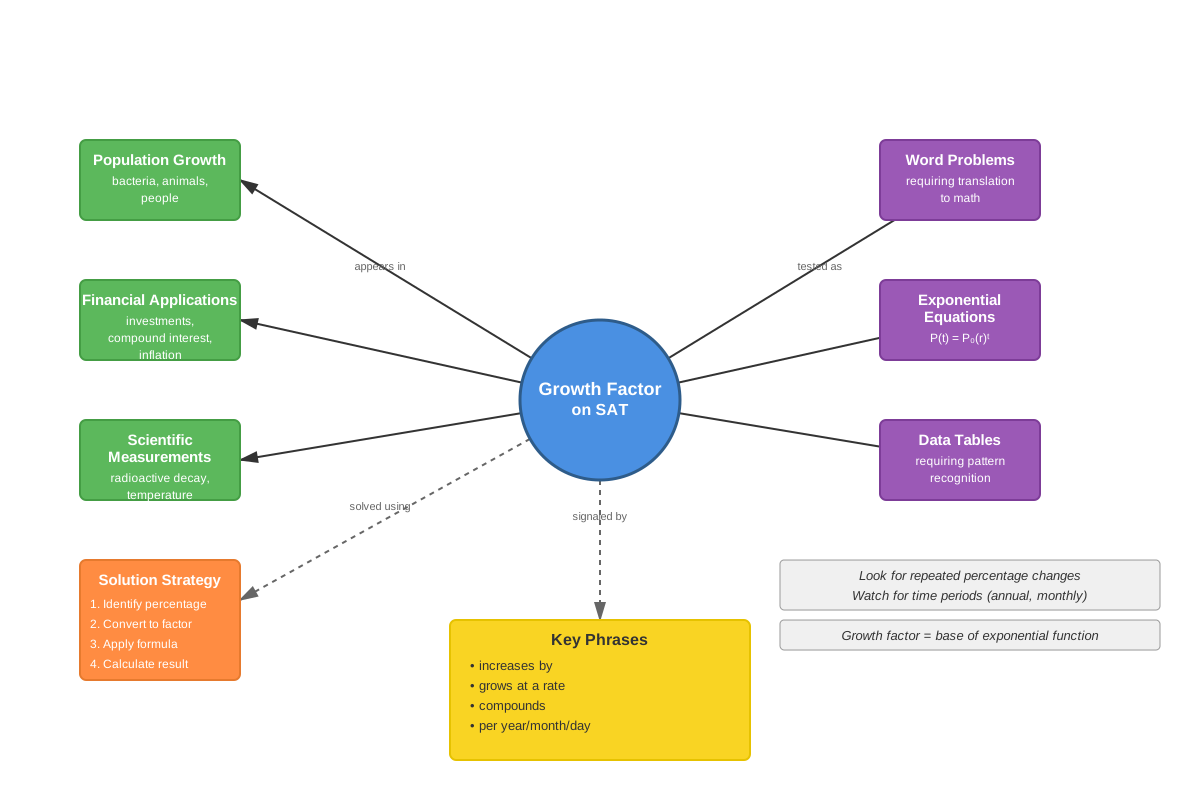
Common SAT contexts for growth factor problems include: population growth scenarios (bacteria cultures, wildlife populations, human demographics), financial situations (investment returns, price increases, salary raises), measurement changes (temperature variations, distance calculations), and scientific applications (radioactive decay, chemical concentrations). Questions may present growth factors explicitly ("increases by a factor of 1.15") or implicitly ("increases by 15% each year"), testing whether students can translate between representations.
Core Concepts
Definition and Basic Structure
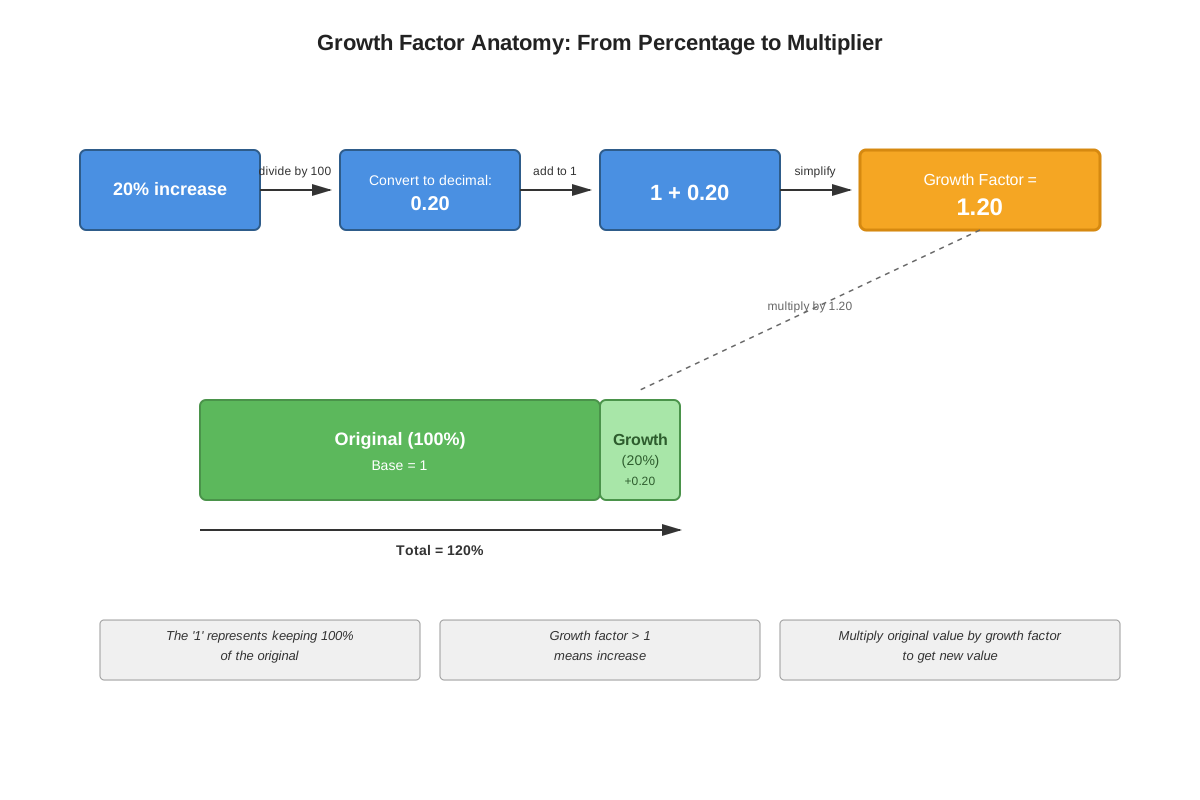
A growth factor is the multiplier applied to an original quantity to obtain a new quantity after a percentage increase. Mathematically, if a value increases by r percent, the growth factor equals 1 + (r/100). The formula for calculating a new value after growth is:
New Value = Original Value × Growth Factor
New Value = Original Value × (1 + r/100)
The number 1 in the growth factor represents the original 100% of the quantity (keeping what you started with), while r/100 represents the additional percentage being added. For instance, a 35% increase corresponds to a growth factor of 1.35, meaning the new value is 135% of the original—the original 100% plus an additional 35%.
Converting Between Percentages and Growth Factors
The conversion between percentage increases and growth factors follows a consistent pattern that students must master for SAT efficiency:
| Percentage Increase | Growth Factor | Calculation |
|---|---|---|
| 5% increase | 1.05 | 1 + 0.05 |
| 12% increase | 1.12 | 1 + 0.12 |
| 25% increase | 1.25 | 1 + 0.25 |
| 50% increase | 1.50 | 1 + 0.50 |
| 100% increase (doubling) | 2.00 | 1 + 1.00 |
| 150% increase | 2.50 | 1 + 1.50 |
To convert from a growth factor back to a percentage increase, subtract 1 and multiply by 100. For example, a growth factor of 1.08 represents (1.08 - 1) × 100 = 8% increase.
Decay Factors (Negative Growth)
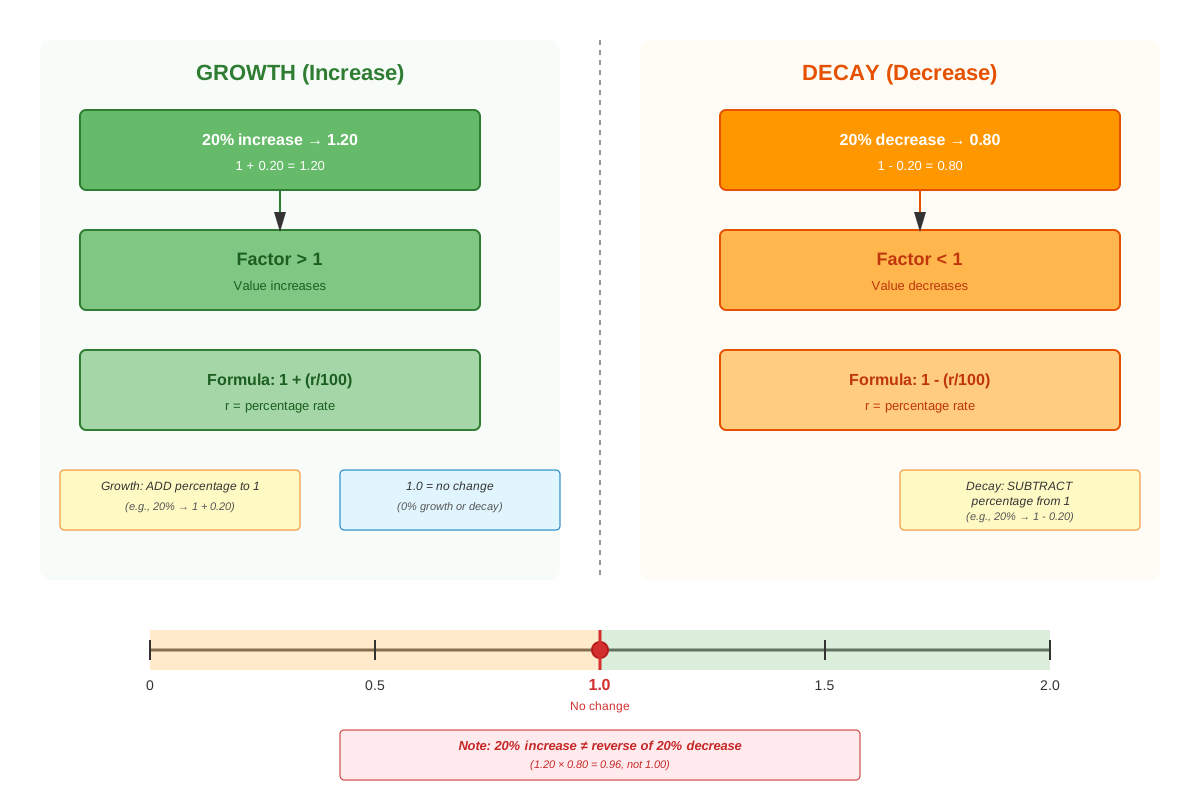
When quantities decrease rather than increase, the concept extends to decay factors, which are values less than 1 but greater than 0. For a decrease of r percent, the decay factor equals 1 - (r/100). This represents keeping the original 100% and removing r% of it:
| Percentage Decrease | Decay Factor | Calculation |
|---|---|---|
| 10% decrease | 0.90 | 1 - 0.10 |
| 20% decrease | 0.80 | 1 - 0.20 |
| 35% decrease | 0.65 | 1 - 0.35 |
| 50% decrease (halving) | 0.50 | 1 - 0.50 |
| 75% decrease | 0.25 | 1 - 0.75 |
Understanding that decay factors are simply growth factors less than 1 unifies the conceptual framework and prevents students from needing separate formulas for increases versus decreases.
Compound Growth and Sequential Applications
The true power of growth factors emerges when dealing with repeated percentage changes over multiple time periods. Rather than calculating each period's change separately, students can multiply growth factors together. For n periods of growth at rate r, the formula becomes:
Final Value = Initial Value × (Growth Factor)^n
Final Value = Initial Value × (1 + r/100)^n
This exponential relationship is crucial for SAT problems involving compound interest, population growth over multiple years, or any scenario with repeated percentage changes. For example, if an investment grows by 8% annually for 3 years, the total growth factor is (1.08)³ = 1.2597, representing approximately 25.97% total growth—not simply 3 × 8% = 24%.
Sequential Different Growth Rates
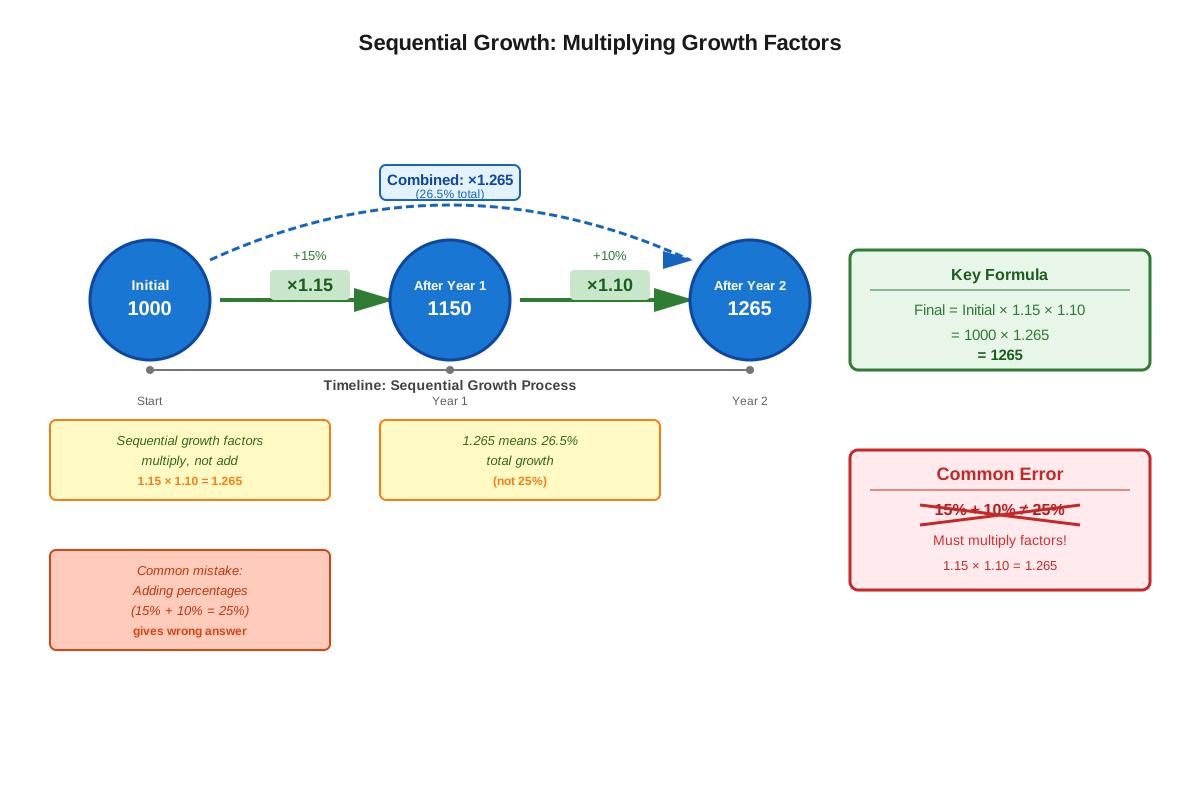
When different growth rates apply in sequence, multiply the individual growth factors together. If a quantity increases by 20% then increases by another 15%, the combined growth factor is 1.20 × 1.15 = 1.38, representing a 38% total increase. This demonstrates why sequential percentage changes don't simply add together—the second percentage applies to an already-changed base value.
Solving for Unknown Growth Factors
SAT questions frequently provide initial and final values, asking students to determine the growth factor or percentage change. The approach involves setting up an equation:
Final Value = Initial Value × Growth Factor
Growth Factor = Final Value ÷ Initial Value
Once the growth factor is calculated, subtract 1 and multiply by 100 to find the percentage change. If the growth factor is less than 1, the result represents a decrease.
Concept Relationships
Growth factors serve as the bridge between percentage concepts and exponential functions. The foundational relationship flows: percentage understanding → growth factor representation → exponential modeling. Students first learn that percentages describe proportional changes, then discover that growth factors provide a multiplicative shortcut for these changes, and finally recognize that repeated applications create exponential patterns.
Within the topic itself, the concepts build hierarchically. Basic growth factor definition forms the foundation, supporting conversion between percentages and factors. This conversion skill enables single-period applications, which then extend to compound growth over multiple periods. The framework further expands to include decay factors (parallel to growth factors but for decreases) and sequential different rates (combining multiple growth factors).
Growth factors connect backward to prerequisite topics: they rely on percentage calculations for initial understanding, require decimal operations for computation, and utilize algebraic manipulation for solving equations. They connect forward to advanced topics including exponential functions (where growth factors become bases), geometric sequences (where growth factors are common ratios), and logarithms (used to solve for time periods in growth equations).
The relationship map: Percentage Change → Growth Factor Representation → Single Application → Multiple Applications (Exponential) → Complex Modeling. Simultaneously, Growth Factors (>1) parallels Decay Factors (<1), both feeding into unified exponential thinking.
High-Yield Facts
⭐ A growth factor equals 1 plus the decimal form of the percentage increase (e.g., 15% increase = 1.15 growth factor)
⭐ To find total change from multiple periods, raise the growth factor to the power of the number of periods, not multiply the percentage by the number of periods
⭐ Sequential percentage changes multiply their growth factors together; a 20% increase followed by 10% increase gives 1.20 × 1.10 = 1.32 (32% total increase, not 30%)
⭐ A decay factor equals 1 minus the decimal form of the percentage decrease (e.g., 25% decrease = 0.75 decay factor)
⭐ Doubling corresponds to a growth factor of 2 (100% increase), while halving corresponds to a decay factor of 0.5 (50% decrease)
- Growth factors greater than 1 represent increases; factors between 0 and 1 represent decreases
- To convert a growth factor to percentage change: subtract 1, multiply by 100, and add a % sign
- The formula for compound growth is: Final = Initial × (1 + r)^n, where r is the rate as a decimal and n is the number of periods
- When a quantity increases then decreases by the same percentage, it does not return to the original value (e.g., increase 20% then decrease 20%: 1.20 × 0.80 = 0.96, ending at 96% of original)
- Growth factors can be applied to any measurable quantity: money, population, distance, temperature, concentration, etc.
- Finding an unknown growth factor requires dividing the final value by the initial value
- A growth factor of 1 means no change (0% increase or decrease)
- Percentage changes are additive only when applied to the same base; growth factors handle changing bases automatically
- The order of multiplication doesn't matter when combining growth factors: 1.10 × 1.20 = 1.20 × 1.10
- SAT problems often disguise growth factors in word problems using phrases like "increases by," "grows at a rate of," or "appreciates by"
Quick check — test yourself on Growth factor so far.
Try Flashcards →Common Misconceptions
Misconception: Adding percentages gives the total percentage change for sequential increases.
Correction: Sequential percentage changes must be handled by multiplying growth factors. A 10% increase followed by a 20% increase is 1.10 × 1.20 = 1.32 (32% total), not 10% + 20% = 30%. The second percentage applies to an already-increased base.
Misconception: A 50% increase followed by a 50% decrease returns to the original value.
Correction: The growth factor calculation shows 1.50 × 0.50 = 0.75, meaning the final value is 75% of the original (a 25% net decrease). The decrease applies to the larger increased value, removing more absolute quantity than was added.
Misconception: To find the growth factor for a 5% increase, multiply the original value by 0.05.
Correction: Multiplying by 0.05 gives only the amount of increase, not the new total. The growth factor is 1.05, which when multiplied by the original gives the original plus the increase (100% + 5% = 105% of original).
Misconception: Growth factors only apply to increases, requiring different formulas for decreases.
Correction: The same growth factor framework handles both increases (factors > 1) and decreases (factors < 1, called decay factors). A 30% decrease uses factor 0.70, calculated the same way: 1 - 0.30 = 0.70.
Misconception: When solving for an unknown percentage change, dividing final by initial gives the percentage directly.
Correction: Dividing final by initial gives the growth factor, not the percentage. To find the percentage change, subtract 1 from the growth factor, then multiply by 100. For example, if final/initial = 1.25, the percentage increase is (1.25 - 1) × 100 = 25%.
Misconception: A growth factor of 2.5 means a 2.5% increase.
Correction: A growth factor of 2.5 means the new value is 2.5 times the original, representing a 150% increase (2.5 - 1 = 1.5 = 150%). The growth factor is the multiplier, not the percentage.
Misconception: Compound growth over n periods equals n times the single-period percentage.
Correction: Compound growth requires exponential calculation: (1 + r)^n, not linear multiplication. Three years of 10% growth gives 1.10³ = 1.331 (33.1% total), not 3 × 10% = 30%.
Worked Examples
Example 1: Sequential Growth with Different Rates
Problem: A bacterial colony initially contains 500 bacteria. The population increases by 40% in the first hour, then increases by 25% in the second hour. How many bacteria are present after two hours?
Solution:
Step 1: Identify the growth factors for each period.
- First hour: 40% increase → growth factor = 1 + 0.40 = 1.40
- Second hour: 25% increase → growth factor = 1 + 0.25 = 1.25
Step 2: Recognize this is a sequential growth problem requiring multiplication of growth factors.
- Combined growth factor = 1.40 × 1.25 = 1.75
Step 3: Apply the combined growth factor to the initial population.
- Final population = 500 × 1.75 = 875 bacteria
Step 4: Verify the answer makes sense.
- The population increased by 75% total (growth factor 1.75 means 175% of original, which is 75% more)
- This is greater than 40% + 25% = 65%, which confirms that sequential percentages compound rather than add
Answer: 875 bacteria
Connection to Learning Objectives: This problem demonstrates applying growth factors to answer SAT-style questions and distinguishing between simple percentage addition and compound growth factor multiplication.
Example 2: Finding Unknown Growth Rate
Problem: An investment account grows from $2,400 to $3,132 over a certain period. What was the percentage increase?
Solution:
Step 1: Set up the growth factor equation.
- Final Value = Initial Value × Growth Factor
- 3,132 = 2,400 × Growth Factor
Step 2: Solve for the growth factor.
- Growth Factor = 3,132 ÷ 2,400
- Growth Factor = 1.305
Step 3: Convert the growth factor to a percentage increase.
- Percentage increase = (Growth Factor - 1) × 100
- Percentage increase = (1.305 - 1) × 100
- Percentage increase = 0.305 × 100 = 30.5%
Step 4: Check the answer.
- 2,400 × 1.305 = 3,132 ✓
- The account grew by 30.5%, meaning it reached 130.5% of its original value
Answer: 30.5% increase
Connection to Learning Objectives: This problem illustrates identifying key features of growth factors (the relationship between initial and final values) and applying algebraic manipulation to solve for unknown rates.
Example 3: Compound Growth Over Multiple Periods
Problem: A city's population is 80,000 and grows at a rate of 3% per year. What will the population be after 5 years? (Round to the nearest hundred.)
Solution:
Step 1: Identify the growth factor and number of periods.
- Annual growth rate: 3% → growth factor = 1.03
- Number of periods: n = 5 years
Step 2: Apply the compound growth formula.
- Final Population = Initial Population × (Growth Factor)^n
- Final Population = 80,000 × (1.03)^5
Step 3: Calculate (1.03)^5.
- (1.03)^5 = 1.159274...
Step 4: Complete the calculation.
- Final Population = 80,000 × 1.159274
- Final Population = 92,741.92
Step 5: Round to the nearest hundred.
- Final Population ≈ 92,700
Answer: 92,700 people
Connection to Learning Objectives: This problem demonstrates constructing exponential expressions using growth factors to model real-world scenarios and applying growth factors over multiple periods.
Exam Strategy
When approaching SAT growth factor questions, begin by identifying whether the problem involves a single change or multiple changes over time. Look for temporal language like "each year," "per month," or "every hour" that signals compound growth requiring exponents. Circle or underline the percentage values and immediately convert them to growth factors before attempting calculations—this prevents errors from mixing percentage and decimal representations.
Trigger words and phrases that indicate growth factor problems include: "increases by," "grows at a rate of," "appreciates by," "rises by," "gains," "expands by," "multiplies by," "compounds," "per period," and "each time interval." For decreases, watch for: "decreases by," "declines by," "depreciates by," "falls by," "loses," "shrinks by," and "reduces by." The phrase "by a factor of" explicitly provides the growth factor rather than a percentage.
For process-of-elimination on multiple-choice questions, immediately eliminate answers that result from common errors: adding percentages instead of multiplying growth factors, using the percentage as the growth factor (e.g., using 0.15 instead of 1.15 for 15% growth), or applying simple rather than compound growth. If a problem involves a 20% increase followed by 10% increase, eliminate any answer showing 30% total growth—the correct answer must be slightly higher due to compounding.
Time allocation for growth factor problems should be approximately 60-90 seconds for straightforward single-step applications and 90-150 seconds for multi-step compound growth problems. If a problem requires calculating a growth factor raised to a power without a calculator (in the no-calculator section), the SAT typically designs the numbers to work out cleanly—look for patterns like doubling (factor of 2) or simple bases like 1.1 or 1.2.
When stuck, work backward from answer choices by testing each as a potential growth factor. Multiply the initial value by each answer choice and see which produces the given final value. This strategy is particularly effective when the problem asks for a percentage change and provides specific numerical values.
Memory Techniques
Mnemonic for Growth Factor Formula: "One Plus Rate" reminds students that growth factor = 1 + rate (as decimal). The "one" represents keeping the original 100%, and "plus rate" represents adding the increase.
Visualization Strategy: Picture a growth factor as a photocopier zoom setting. A growth factor of 1.25 means making a copy at 125% size—you keep the entire original (100%) and add 25% more. A decay factor of 0.80 means copying at 80% size—you keep only 80% of the original.
Acronym for Sequential Changes: MGM = "Multiply Growth Multipliers" reminds students to multiply growth factors together when changes occur in sequence, never add percentages.
The "One Test": To remember whether a factor represents growth or decay, ask "Is it bigger than one?" If yes, it's growth (increase). If no (but positive), it's decay (decrease). This simple test prevents confusion about which direction the change goes.
Finger Counting for Compound Growth: For problems involving repeated growth over n periods, hold up n fingers to remember you need the growth factor raised to the nth power, not multiplied by n.
Summary
Growth factors provide a powerful mathematical tool for handling percentage changes efficiently, representing the multiplier applied to an original quantity to obtain a new value after increase or decrease. The fundamental principle—that a growth factor equals 1 plus the decimal form of a percentage increase (or 1 minus for a decrease)—enables students to convert between percentage language and multiplicative calculations seamlessly. On the SAT, growth factor problems appear frequently in contexts ranging from population dynamics to financial scenarios, testing students' ability to recognize when to apply growth factors, convert between representations, and handle both single-period and compound multi-period changes. The key distinction between simple percentage addition and growth factor multiplication becomes critical when dealing with sequential changes, where growth factors must be multiplied together to account for compounding effects. Mastery of growth factors requires understanding that they unify increases (factors > 1) and decreases (factors < 1) under a single framework, that sequential applications require exponential thinking rather than linear addition, and that the relationship between initial and final values always involves multiplication by the appropriate growth factor. Students who internalize these principles can solve complex percentage problems in seconds, providing a significant advantage on test day.
Key Takeaways
- Growth factor = 1 + (percentage increase as decimal); decay factor = 1 - (percentage decrease as decimal)
- Sequential percentage changes require multiplying growth factors, not adding percentages—compounding creates exponential rather than linear growth
- For n periods of the same growth rate, use the formula: Final = Initial × (growth factor)^n
- To find an unknown percentage change: divide final by initial to get the growth factor, subtract 1, multiply by 100
- Growth factors > 1 indicate increases; factors between 0 and 1 indicate decreases; a factor of exactly 1 means no change
- SAT problems frequently test whether students incorrectly add percentages instead of properly multiplying growth factors
- The same framework applies to all contexts: money, population, measurements, concentrations—making growth factors a universal problem-solving tool
Related Topics
Exponential Functions: Growth factors serve as the base in exponential functions of the form f(x) = a(b)^x, where b is the growth factor. Mastering growth factors provides the foundation for understanding exponential modeling, graphing exponential curves, and solving exponential equations—all topics that appear on the SAT Math section.
Geometric Sequences: A geometric sequence is a list of numbers where each term is found by multiplying the previous term by a constant ratio—which is precisely a growth factor. Understanding growth factors enables students to work with geometric sequences, find nth terms, and calculate sums of geometric series.
Compound Interest: Financial mathematics extensively uses growth factors to calculate compound interest, where money grows by a fixed percentage each compounding period. The compound interest formula is a direct application of the growth factor concept to monetary contexts.
Logarithms: When solving for the number of time periods required to reach a certain growth level, logarithms become necessary. Growth factor mastery prepares students for logarithmic thinking by establishing the exponential relationships that logarithms help solve.
Practice CTA
Now that you've mastered the core concepts of growth factors, it's time to solidify your understanding through active practice. Attempt the practice questions to test your ability to recognize growth factor scenarios, convert between percentages and factors, and solve multi-step compound growth problems under timed conditions. Use the flashcards to drill the essential conversions and formulas until they become automatic. Remember: growth factor problems are among the most predictable on the SAT—students who practice these patterns consistently see immediate score improvements. Your investment in mastering this topic will pay dividends not only on test day but throughout your academic and professional life whenever you encounter percentage changes and exponential growth. You've got this!
Sign up free to keep reading
Create a free AnvayaPrep account to finish this SAT guide on Growth factor — plus flashcards and practice questions.