Overview
Mixture percent problems are a critical category of quantitative reasoning questions that appear regularly on the SAT Math section. These problems involve combining two or more substances, solutions, or groups with different percentage compositions to create a new mixture with a specific percentage characteristic. Students encounter these questions in contexts ranging from chemical solutions and food ingredients to financial investments and population demographics.
Understanding mixture percent problems is essential for SAT success because they test multiple mathematical competencies simultaneously: percentage calculations, algebraic equation setup, proportional reasoning, and logical problem-solving. These questions typically appear 1-2 times per SAT administration and often serve as medium-to-hard difficulty questions that separate high scorers from average performers. The College Board values these problems because they assess real-world quantitative literacy—the ability to analyze situations involving rates, concentrations, and weighted averages.
Within the broader landscape of math concepts tested on the SAT, mixture percent problems connect directly to linear equations, systems of equations, ratios and proportions, and weighted averages. Mastering this topic strengthens algebraic thinking and provides a framework for approaching complex multi-step problems that require translating verbal descriptions into mathematical models. The skills developed here transfer directly to data analysis questions, word problems involving rates, and even some geometry problems involving combined measurements.
Learning Objectives
- [ ] Identify key features of mixture percent problems, including the initial quantities, their concentrations, and the desired final concentration
- [ ] Explain how mixture percent problems appears on the SAT, including common contexts and question formats
- [ ] Apply mixture percent problems to answer SAT-style questions using algebraic methods and logical reasoning
- [ ] Set up and solve equations representing the conservation of the pure substance across mixtures
- [ ] Distinguish between different mixture problem types (combining mixtures, dilution, replacement, and evaporation)
- [ ] Verify solutions by checking whether the final mixture's properties align with the problem constraints
Prerequisites
- Basic percentage calculations: Converting between percentages, decimals, and fractions is fundamental to expressing concentrations and calculating amounts of pure substances in mixtures
- Linear equation solving: Mixture problems require setting up and solving first-degree equations, often with one or two variables
- Proportional reasoning: Understanding how ratios scale and how parts relate to wholes underlies all mixture calculations
- Word problem translation: Converting verbal descriptions into mathematical expressions is the critical first step in mixture problems
Why This Topic Matters
Mixture percent problems reflect authentic quantitative reasoning scenarios encountered in science laboratories, cooking, pharmacy, environmental science, and business. A chemist diluting acid solutions, a barista mixing coffee blends, a financial analyst combining investment portfolios, or a farmer mixing fertilizers all use the mathematical principles tested in these SAT questions. This real-world applicability makes mixture problems valuable for assessing practical mathematical literacy.
On the SAT, mixture percent problems appear with moderate frequency—typically 1-2 questions per test administration, most commonly in the calculator-permitted section. These questions usually carry medium to medium-hard difficulty ratings and often appear in positions 10-18 of the 22-question sections, where they serve to differentiate students scoring in the 600-700 range from those achieving 700+. The College Board presents these problems in various contexts: chemical solutions (salt water, acid concentrations), food mixtures (juice blends, alloy compositions), financial scenarios (investment portfolios with different returns), and population statistics (demographic percentages).
The most common SAT formats include: (1) combining two mixtures to achieve a target concentration, (2) determining how much of one substance to add to another to reach a desired percentage, (3) calculating the concentration of a final mixture after combining known quantities, and (4) working backward from a final mixture to determine initial conditions. Questions may ask for the amount of a substance, the percentage concentration, the ratio of components, or the total quantity of the final mixture.
Core Concepts
The Fundamental Mixture Equation
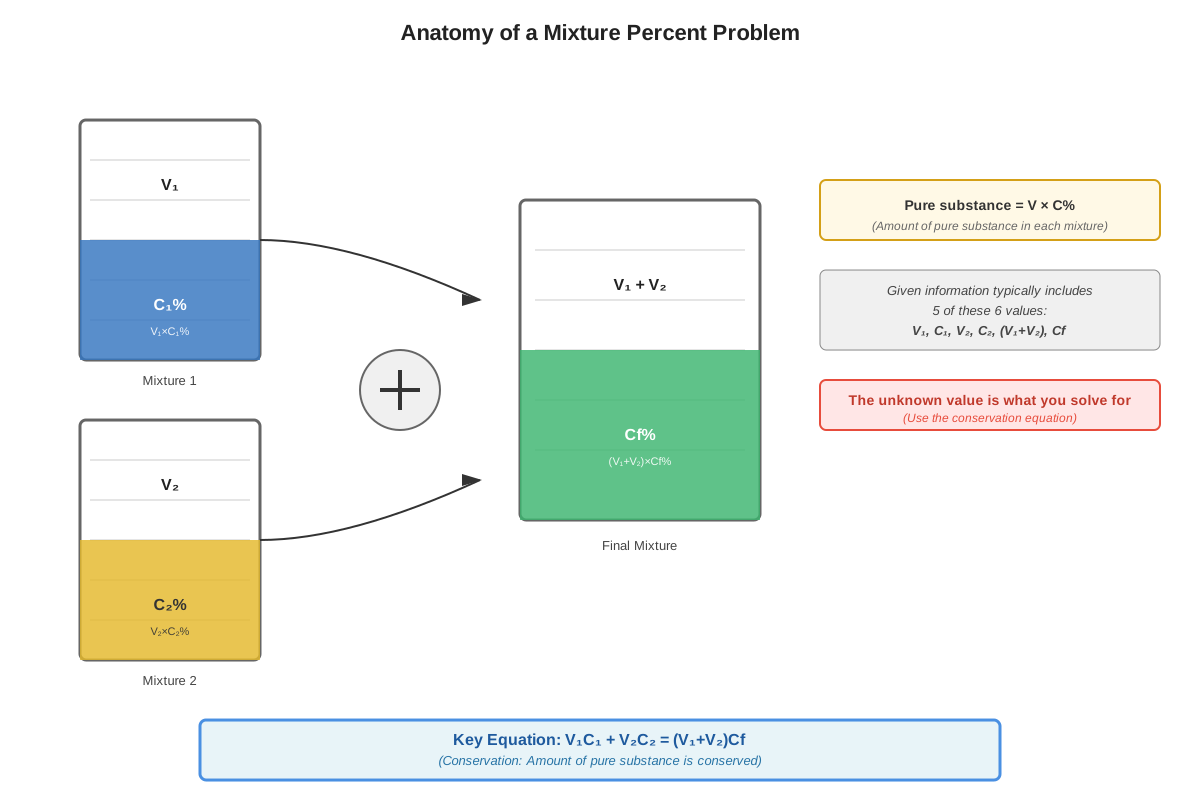
The cornerstone of all mixture percent problems is the principle of conservation: the total amount of the pure substance before mixing equals the total amount after mixing. This translates into the fundamental equation:
(Amount₁)(Concentration₁) + (Amount₂)(Concentration₂) = (Amount_final)(Concentration_final)Where concentrations are expressed as decimals (e.g., 20% = 0.20). This equation represents that the pure substance from the first mixture plus the pure substance from the second mixture equals the pure substance in the combined mixture.
For example, if mixing 10 liters of 30% salt solution with 20 liters of 60% salt solution:
- Pure salt from first solution: 10 × 0.30 = 3 liters
- Pure salt from second solution: 20 × 0.60 = 12 liters
- Total pure salt: 3 + 12 = 15 liters
- Total volume: 10 + 20 = 30 liters
- Final concentration: 15/30 = 0.50 = 50%
Types of Mixture Problems
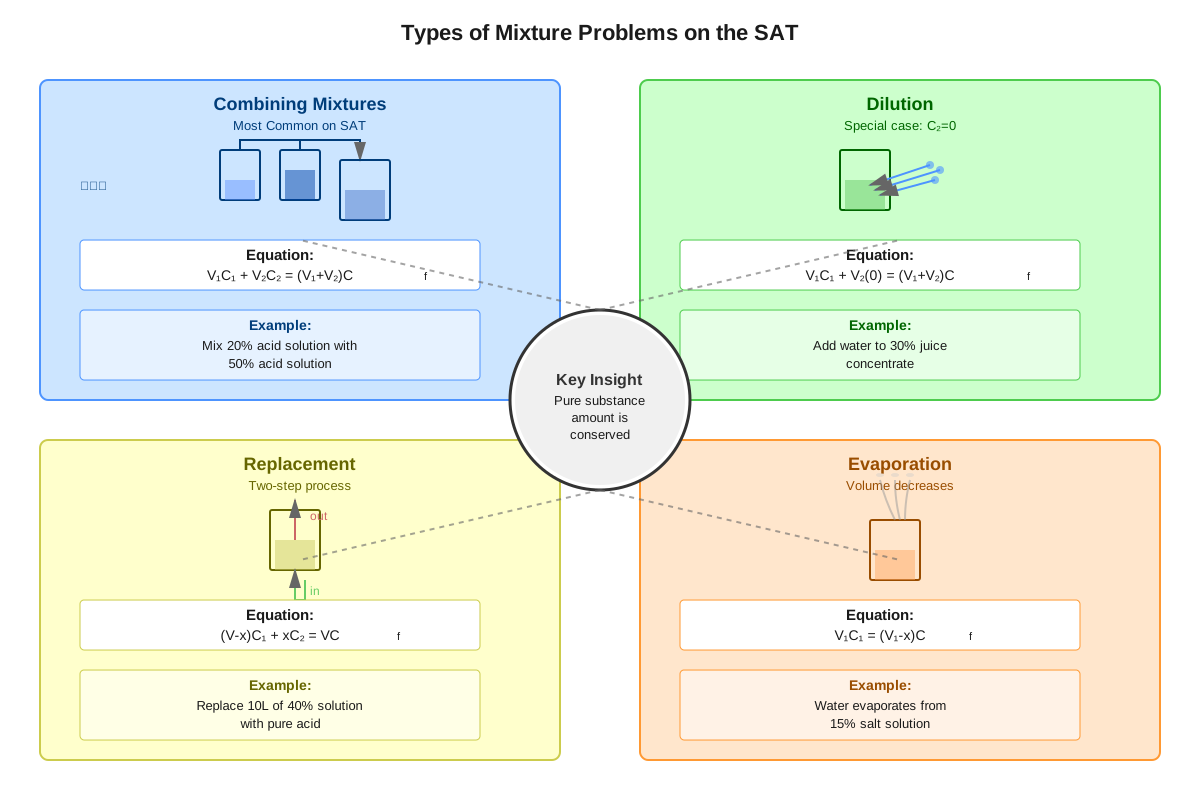
SAT mixture percent problems fall into several distinct categories, each requiring slight variations in approach:
| Problem Type | Characteristics | Equation Setup |
|---|---|---|
| Combining Two Mixtures | Mix two solutions with known concentrations and amounts | Standard mixture equation with all terms known except final concentration |
| Dilution Problems | Add pure solvent (0% concentration) to reduce concentration | One concentration term equals zero |
| Concentration Problems | Add pure substance (100% concentration) to increase concentration | One concentration term equals 1.00 |
| Replacement Problems | Remove some mixture and replace with different concentration | Requires two-step calculation: removal then addition |
| Unknown Quantity Problems | Determine how much of one mixture to add to another | Set up equation with one amount as variable |
Setting Up Mixture Equations
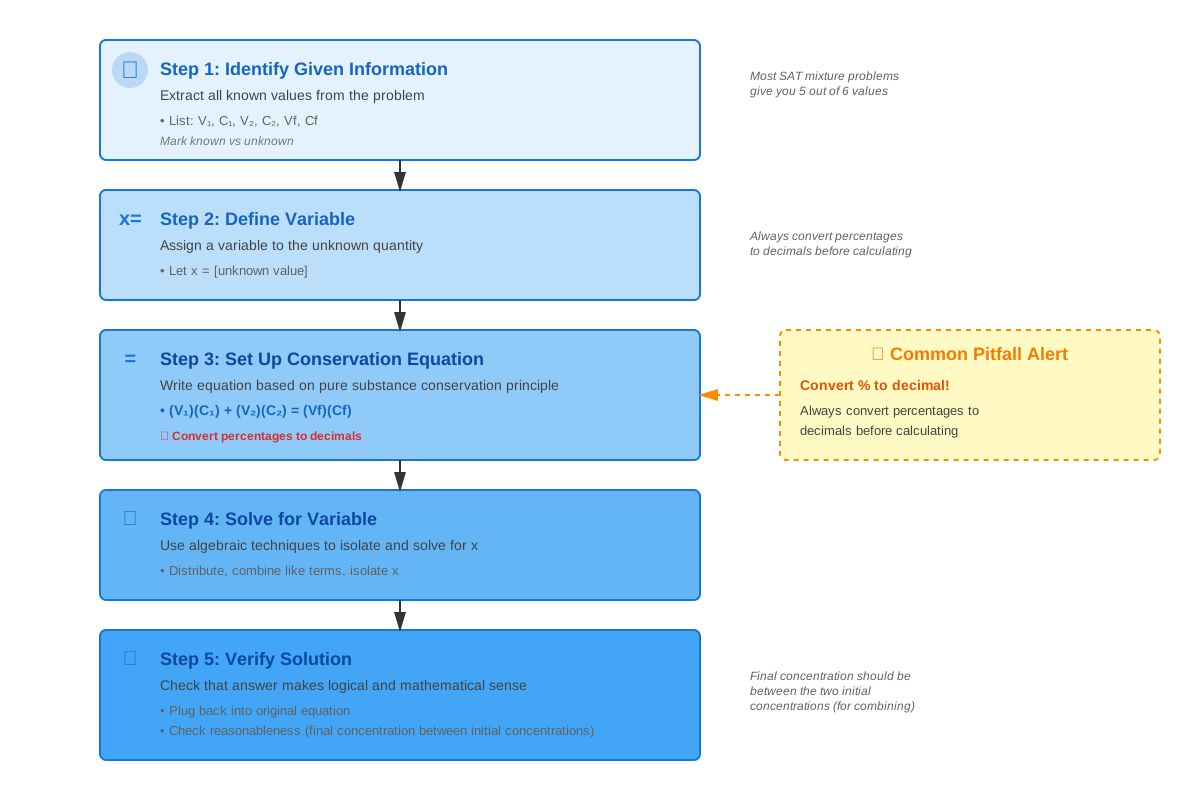
The systematic approach to mixture problems involves five critical steps:
- Identify the components: Determine what substances are being mixed and what characteristic (percentage) is being tracked
- Define variables: Assign variables to unknown quantities (typically amounts or concentrations)
- Express concentrations as decimals: Convert all percentages to decimal form for calculation
- Write the conservation equation: Apply the fundamental mixture equation
- Solve and verify: Solve algebraically and check that the answer makes logical sense
Consider this framework for a typical problem: "How many liters of 25% acid solution must be added to 40 liters of 10% acid solution to create a 15% acid solution?"
- Let x = liters of 25% solution to add
- Pure acid from 25% solution: 0.25x
- Pure acid from 10% solution: 40(0.10) = 4 liters
- Final amount: (x + 40) liters at 15% concentration
- Equation: 0.25x + 4 = 0.15(x + 40)
Weighted Average Interpretation
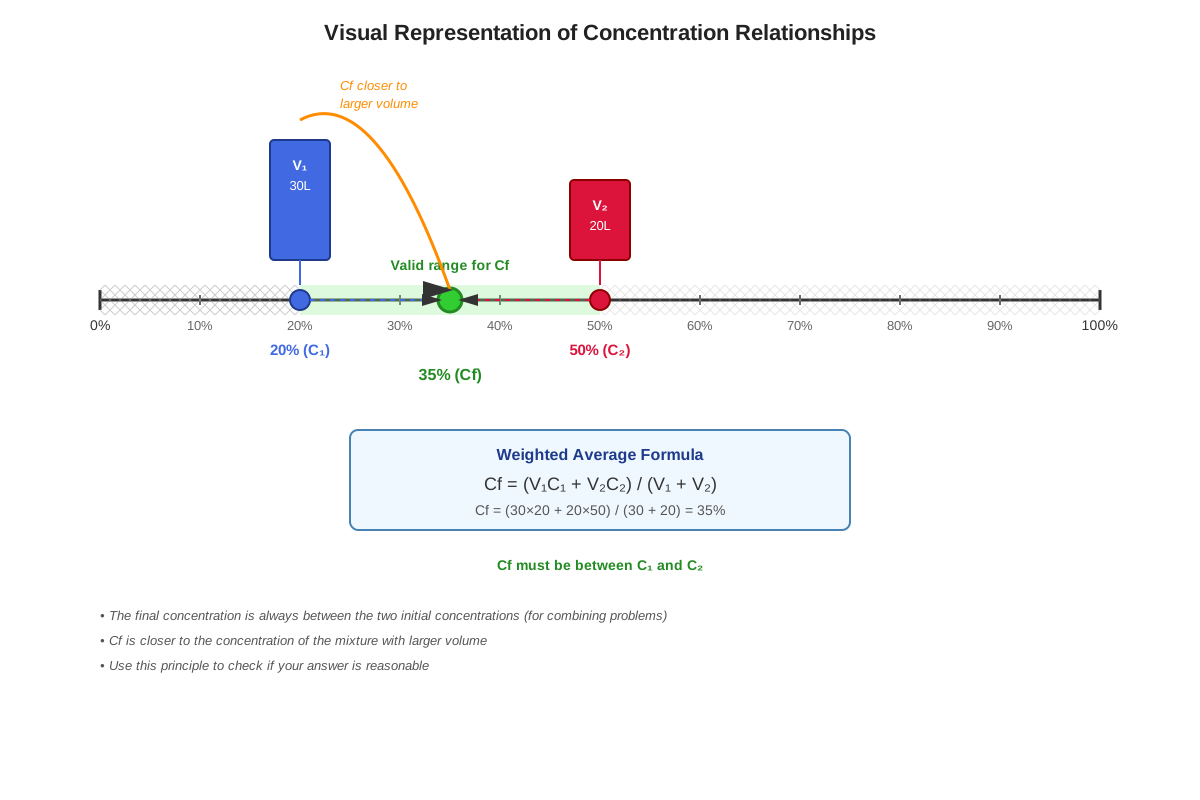
Mixture problems can also be understood through the lens of weighted averages. The final concentration is a weighted average of the initial concentrations, where the weights are the relative amounts:
Concentration_final = (Amount₁/(Amount₁ + Amount₂)) × Concentration₁ + (Amount₂/(Amount₁ + Amount₂)) × Concentration₂This perspective helps with estimation and answer elimination. The final concentration must fall between the two initial concentrations (unless adding pure substance or pure solvent). If mixing equal amounts, the final concentration is the simple average; if amounts differ, the final concentration is closer to the concentration of the larger amount.
Special Cases and Shortcuts
Adding pure substance (100% concentration): When adding pure substance to a mixture, the equation simplifies because the concentration term equals 1.00. For example, adding pure alcohol to a 40% alcohol solution.
Adding pure solvent (0% concentration): When diluting with pure solvent (like adding water to juice), the concentration term equals 0, simplifying calculations. The pure substance amount remains constant while total volume increases.
Equal amounts mixed: When combining equal volumes or masses of two mixtures, the final concentration is simply the arithmetic mean of the two initial concentrations.
Ratio method: Some problems are efficiently solved by setting up ratios. If mixing solutions A and B to get concentration C, the ratio of amounts is: (C - B):(A - C). This "alligation" method provides quick solutions when all concentrations are known.
Concept Relationships
The concepts within mixture percent problems form an interconnected system. The fundamental mixture equation serves as the foundation, from which all other approaches derive. This equation directly embodies the conservation principle—that pure substance quantities are preserved through mixing. The weighted average interpretation is mathematically equivalent to the fundamental equation but provides an alternative conceptual framework that aids in estimation and answer checking.
Different problem types (dilution, concentration, combining, replacement) are variations that modify the fundamental equation by setting specific terms to 0, 1, or requiring multi-step applications. The systematic setup process provides the procedural framework for translating any mixture problem into the fundamental equation, while special cases and shortcuts offer efficiency improvements for specific scenarios.
These mixture concepts connect to prerequisite knowledge in clear ways: percentage calculations → enable conversion between problem statements and decimal concentrations → which feed into the fundamental mixture equation. Linear equation solving → provides the algebraic tools to solve the mixture equation → yielding the answer. Proportional reasoning → underlies the weighted average interpretation → which validates answers through logical constraints.
Mixture problems also connect forward to more advanced SAT topics: they're essentially systems of equations problems (when two unknowns exist), they relate to weighted averages in statistics, and they parallel rate problems where distance = rate × time mirrors amount = concentration × volume.
Quick check — test yourself on Mixture percent problems so far.
Try Flashcards →High-Yield Facts
⭐ The amount of pure substance before mixing always equals the amount after mixing (conservation principle)
⭐ The final concentration must lie between the two initial concentrations when combining mixtures (unless adding pure substance or pure solvent)
⭐ Convert all percentages to decimals before setting up equations (20% becomes 0.20, not 20)
⭐ The fundamental mixture equation is: (Amount₁)(Concentration₁) + (Amount₂)(Concentration₂) = (Amount_final)(Concentration_final)
⭐ When mixing equal amounts of two solutions, the final concentration is the arithmetic mean of the two concentrations
- Adding pure solvent (0% concentration) decreases the overall concentration without changing the amount of pure substance
- Adding pure substance (100% concentration) increases both the amount of pure substance and the overall concentration
- In replacement problems, first calculate what's removed, then calculate what's added
- The ratio of amounts needed to achieve a target concentration can be found using: (Target - Lower):(Higher - Target)
- Total volume/mass of final mixture equals the sum of all components added (assuming volumes are additive)
- If the problem asks for a percentage answer, remember to convert the decimal result back to percentage form
- Mixture problems often involve two equations: one for the mixture relationship and one for the total amount
Common Misconceptions
Misconception: Adding the percentages directly to find the final concentration (e.g., mixing 20% and 40% solutions gives 60% solution)
Correction: Percentages cannot be added directly; the final concentration depends on the amounts mixed and must be calculated using the mixture equation or weighted average. Mixing equal amounts of 20% and 40% solutions yields 30%, not 60%.
Misconception: Using percentages directly in equations without converting to decimals (e.g., writing 20 instead of 0.20)
Correction: Percentages must be converted to decimal form for calculations. Using 20 instead of 0.20 produces answers that are off by a factor of 100.
Misconception: Believing the final concentration can exceed the higher initial concentration when mixing two solutions
Correction: When combining two mixtures (without adding pure substance), the final concentration must fall between the two initial concentrations. If you calculate a final concentration outside this range, an error has occurred.
Misconception: Forgetting to account for the volume/mass added when calculating final concentration
Correction: The denominator in the final concentration calculation must include all components. If adding x liters to 40 liters, the final volume is (40 + x), not just 40.
Misconception: Assuming that removing half the mixture and replacing it with another solution results in the average of the two concentrations
Correction: Replacement problems require careful tracking. Removing half of a 20% solution and replacing with 40% solution doesn't yield 30%; it yields 30% only if you remove all of the first solution. The calculation is: 0.5(20%) + 0.5(40%) = 30% only when completely replacing.
Misconception: Thinking that dilution problems require adding a specific percentage solution rather than pure solvent
Correction: Dilution specifically means adding pure solvent (0% concentration of the solute). If adding a solution with some concentration of the solute, it's a mixing problem, not pure dilution.
Worked Examples
Example 1: Combining Two Solutions
Problem: A chemist has 30 milliliters of a 25% acid solution and 50 milliliters of a 40% acid solution. If these solutions are mixed together, what is the percent concentration of acid in the resulting mixture?
Solution:
Step 1: Identify what we know
- Solution 1: 30 mL at 25% concentration
- Solution 2: 50 mL at 40% concentration
- Need to find: final concentration percentage
Step 2: Convert percentages to decimals
- 25% = 0.25
- 40% = 0.40
Step 3: Calculate pure acid in each solution
- Pure acid from Solution 1: 30 × 0.25 = 7.5 mL
- Pure acid from Solution 2: 50 × 0.40 = 20 mL
- Total pure acid: 7.5 + 20 = 27.5 mL
Step 4: Calculate total volume
- Total volume: 30 + 50 = 80 mL
Step 5: Calculate final concentration
- Final concentration = 27.5/80 = 0.34375 = 34.375%
Step 6: Verify using weighted average
- The answer should be between 25% and 40% ✓
- Since there's more of the 40% solution (50 mL vs 30 mL), the final concentration should be closer to 40% than to 25% ✓
- Weighted average: (30/80)(25%) + (50/80)(40%) = 9.375% + 25% = 34.375% ✓
Answer: The final concentration is approximately 34.4% (or exactly 34.375%)
This problem directly addresses the learning objective of applying mixture percent problems to SAT-style questions and demonstrates identifying key features (initial quantities and concentrations).
Example 2: Unknown Quantity Problem
Problem: How many liters of pure water must be added to 20 liters of a 60% saline solution to create a 40% saline solution?
Solution:
Step 1: Define the variable
- Let x = liters of pure water to add
Step 2: Identify concentrations
- Initial solution: 60% = 0.60 saline
- Pure water: 0% = 0.00 saline
- Target solution: 40% = 0.40 saline
Step 3: Set up the mixture equation
- Pure saline from initial solution: 20 × 0.60 = 12 liters
- Pure saline from water: x × 0.00 = 0 liters
- Final volume: (20 + x) liters
- Final concentration: 0.40
Step 4: Write the equation
12 + 0 = 0.40(20 + x)Step 5: Solve for x
- 12 = 0.40(20 + x)
- 12 = 8 + 0.40x
- 4 = 0.40x
- x = 10 liters
Step 6: Verify the answer
- Final volume: 20 + 10 = 30 liters
- Pure saline: 12 liters (unchanged by adding water)
- Final concentration: 12/30 = 0.40 = 40% ✓
- Logical check: Adding water should decrease concentration from 60% to 40% ✓
Answer: 10 liters of pure water must be added
This example demonstrates the systematic equation setup process and shows how dilution problems are a special case where one concentration equals zero.
Exam Strategy
When approaching SAT mixture percent problems, follow this strategic framework:
Initial Assessment (15-20 seconds):
- Quickly identify this as a mixture problem by spotting trigger words: "solution," "mixture," "concentration," "percent," "combined," "mixed," "diluted"
- Determine what the question asks for: an amount, a concentration, a ratio, or a total quantity
- Note whether you're combining mixtures, diluting, concentrating, or working with replacement
Setup Strategy (30-45 seconds):
- Draw a simple table or diagram with three columns: Mixture 1, Mixture 2, and Final Mixture
- List Amount, Concentration (as decimal), and Pure Substance for each
- Identify what's unknown and assign a variable
- Write the conservation equation before attempting to solve
Calculation Approach:
- Always convert percentages to decimals immediately to avoid errors
- Use the fundamental equation: (Amt₁)(Conc₁) + (Amt₂)(Conc₂) = (Amt_final)(Conc_final)
- For unknown quantity problems, set up an equation with one variable
- Simplify algebraically before plugging in numbers when possible
Answer Checking:
- Verify that the final concentration falls between the initial concentrations (for combining problems)
- Ensure your answer has the correct units (liters, grams, percent, etc.)
- Plug your answer back into the original equation to confirm
- Use estimation: if mixing mostly high-concentration solution with a little low-concentration, the result should be close to the high concentration
Process of Elimination Tips:
- Eliminate answers outside the range of initial concentrations (for combining problems)
- Eliminate answers that would require negative amounts
- If the problem involves dilution, eliminate answers showing increased concentration
- Check extreme cases: what if you added zero? What if you added a huge amount?
Time Management:
- Budget 1.5-2 minutes for mixture problems
- If stuck after 1 minute, use estimation and elimination rather than perfect calculation
- These problems reward careful setup more than computational speed
Memory Techniques
The "PACT" Framework for mixture problems:
- Pure substance amounts (calculate these first)
- Amounts of each mixture (identify or define as variables)
- Concentrations as decimals (convert percentages immediately)
- Total equals total (conservation equation)
Visualization Strategy: Picture two containers being poured into a third container. The "stuff" (pure substance) from both containers ends up in the final container. The total "stuff" is conserved, but the concentration changes because the total volume changes.
The "Between" Rule: When combining mixtures, the final concentration is BETWEEN the initial concentrations. Visualize a number line with the two initial concentrations marked; the answer must fall between them.
Decimal Conversion Reminder: "Percent means per hundred, so divide by 100." Create the habit of immediately writing 0.25 next to any 25% in the problem.
The "Water is Zero" Mnemonic: For dilution problems, remember "Water is Zero" (0% concentration of the solute), which simplifies one term in your equation.
Equation Template Acronym - "ACAFT":
- Amount₁ × Concentration₁ + Amount₂ × Concentration₂ = Final amount × Final concentration × Total
Summary
Mixture percent problems are essential SAT Math questions that test the ability to analyze situations involving combined substances with different percentage compositions. The fundamental principle underlying all mixture problems is conservation: the total amount of pure substance before mixing equals the total amount after mixing, expressed mathematically as (Amount₁)(Concentration₁) + (Amount₂)(Concentration₂) = (Amount_final)(Concentration_final). Success requires converting percentages to decimals, systematically setting up equations, and solving algebraically. The final concentration when combining mixtures must fall between the initial concentrations, providing a critical check on answers. Different problem types—combining mixtures, dilution, concentration, and replacement—are variations on this fundamental equation. These problems appear 1-2 times per SAT administration, typically at medium to medium-hard difficulty levels, and serve as important discriminators for high scorers. Mastery requires recognizing problem types quickly, setting up equations carefully, and verifying answers through logical constraints and back-substitution.
Key Takeaways
- The fundamental mixture equation—(Amount₁)(Concentration₁) + (Amount₂)(Concentration₂) = (Amount_final)(Concentration_final)—solves all mixture problems
- Always convert percentages to decimals before setting up equations to avoid calculation errors
- The final concentration must lie between the two initial concentrations when combining mixtures (unless adding pure substance or pure solvent)
- Pure substance amounts are conserved through mixing; only concentrations change due to volume changes
- Systematic setup (identify knowns, define variables, write conservation equation) is more important than computational speed
- Dilution problems involve adding 0% concentration solvent; concentration problems involve adding 100% pure substance
- Verify answers by checking logical constraints and substituting back into the original equation
Related Topics
Systems of Linear Equations: Many mixture problems with two unknowns require setting up and solving systems of equations, extending the single-equation mixture framework to more complex scenarios.
Weighted Averages: The mathematical structure of mixture problems is identical to weighted average problems, where different groups with different characteristics are combined.
Rate and Work Problems: These problems share the same fundamental structure as mixture problems (rate × time = work parallels concentration × amount = pure substance), making mixture problem skills transferable.
Ratio and Proportion: Advanced mixture problems often involve ratios between components, and the alligation method for mixture problems is fundamentally a ratio-based approach.
Percent Change and Growth: Understanding how percentages change when quantities are combined or modified connects directly to mixture problem concepts.
Practice CTA
Now that you've mastered the core concepts, equation setup strategies, and problem-solving approaches for mixture percent problems, it's time to solidify your understanding through practice. Work through the practice questions to apply these techniques to authentic SAT-style problems, and use the flashcards to reinforce the high-yield facts and formulas. Remember: mixture problems reward systematic setup and careful verification more than speed. Take your time to set up each equation correctly, and you'll find these problems become straightforward and even predictable. You've got the tools—now build the confidence through practice!
Sign up free to keep reading
Create a free AnvayaPrep account to finish this SAT guide on Mixture percent problems — plus flashcards and practice questions.