Overview
Percent basics form one of the most fundamental and frequently tested concepts in SAT math. Understanding percentages is not merely about memorizing formulas—it requires developing fluency in converting between fractions, decimals, and percents, as well as applying these conversions to solve real-world problems. On the SAT, percent questions appear across multiple contexts: calculating discounts, determining tax amounts, analyzing data sets, interpreting graphs, and solving word problems involving increases and decreases. Mastery of this topic directly impacts performance on approximately 10-15% of all SAT Math questions.
The beauty of sat percent basics lies in their versatility and practical application. Unlike some abstract mathematical concepts, percentages connect directly to everyday experiences—shopping discounts, tip calculations, grade point averages, and financial literacy. This real-world relevance makes percent problems both accessible and challenging, as the SAT frequently embeds them within complex word problems or multi-step scenarios that test not just computational ability but also reading comprehension and logical reasoning.
Within the broader SAT Math curriculum, percent basics serve as a gateway to more advanced topics including ratios, proportions, exponential growth and decay, probability, and data analysis. A solid foundation in percentages enables students to tackle questions involving compound interest, population growth models, and statistical interpretations. Furthermore, percent problems often integrate with algebra, requiring students to set up and solve equations where the unknown variable represents a percentage, an original amount, or a final value after a percent change.
Learning Objectives
- [ ] Identify key features of Percent basics
- [ ] Explain how Percent basics appears on the SAT
- [ ] Apply Percent basics to answer SAT-style questions
- [ ] Convert fluently between percentages, decimals, and fractions
- [ ] Calculate percent increase and percent decrease accurately
- [ ] Solve multi-step problems involving successive percent changes
- [ ] Interpret percent-based data representations in graphs and tables
Prerequisites
- Basic arithmetic operations: Addition, subtraction, multiplication, and division are essential for all percent calculations and conversions
- Fraction fundamentals: Understanding equivalent fractions and simplification enables smooth conversion between fractions and percentages
- Decimal operations: Multiplying and dividing decimals is necessary for converting percentages and performing calculations
- Basic algebraic manipulation: Setting up and solving simple equations helps when the unknown is a percentage or base amount
- Word problem comprehension: Translating verbal descriptions into mathematical expressions is crucial for SAT percent problems
Why This Topic Matters
Percentages represent one of the most practical mathematical concepts students will use throughout their lives. From calculating tips at restaurants to understanding credit card interest rates, from interpreting medical statistics to analyzing investment returns, percentages provide a universal language for expressing proportional relationships. This real-world applicability makes percent problems particularly valuable for the SAT, which aims to assess college and career readiness.
On the SAT Math section, percent-related questions appear with remarkable consistency. Approximately 3-5 questions per test directly involve percentage calculations, while many additional questions incorporate percentages within broader problem contexts. These questions span both the calculator and no-calculator portions, appearing as multiple-choice questions, grid-in responses, and within data interpretation scenarios. The College Board frequently tests percent basics through discount problems, tax calculations, survey data analysis, population changes, and financial scenarios.
Common SAT question formats include: calculating the percent one number is of another; finding a value after a percent increase or decrease; determining the original value before a percent change; solving problems with successive percent changes; and interpreting percentages from tables, graphs, or data sets. The test also favors questions that combine percentages with other concepts like ratios, proportions, or algebraic expressions, requiring students to demonstrate integrated mathematical reasoning rather than isolated computational skills.
Core Concepts
Understanding Percentages
A percent literally means "per hundred" or "out of 100," derived from the Latin "per centum." When expressing a value as a percentage, the relationship being described is always a part-to-whole comparison scaled to a denominator of 100. For example, 45% means 45 out of every 100, or 45/100. This fundamental definition underlies all percentage calculations and conversions.
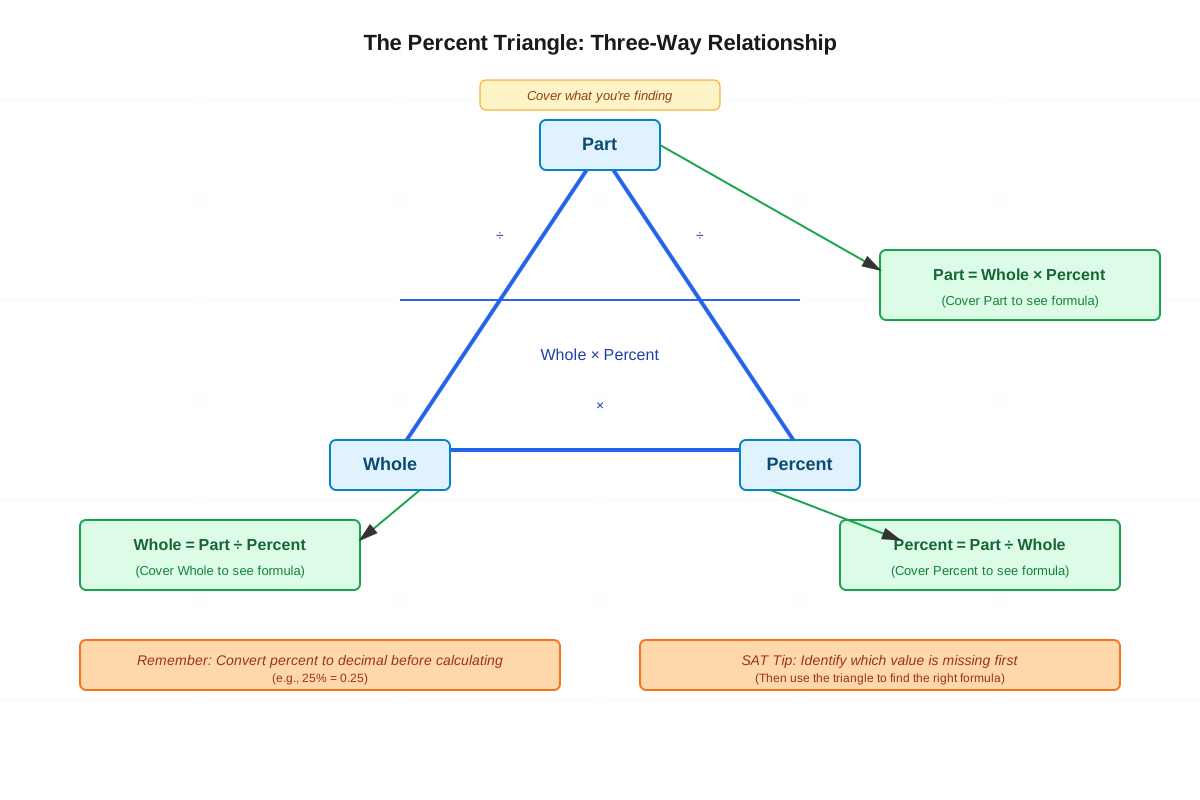
The three essential components of any percent problem are:
- The part: The portion being considered
- The whole (or base): The total amount or reference value
- The percent: The ratio of part to whole expressed per 100
These three quantities relate through the fundamental percent equation:
Part = Percent × WholeOr equivalently: Part = (Percent/100) × Whole
Converting Between Forms
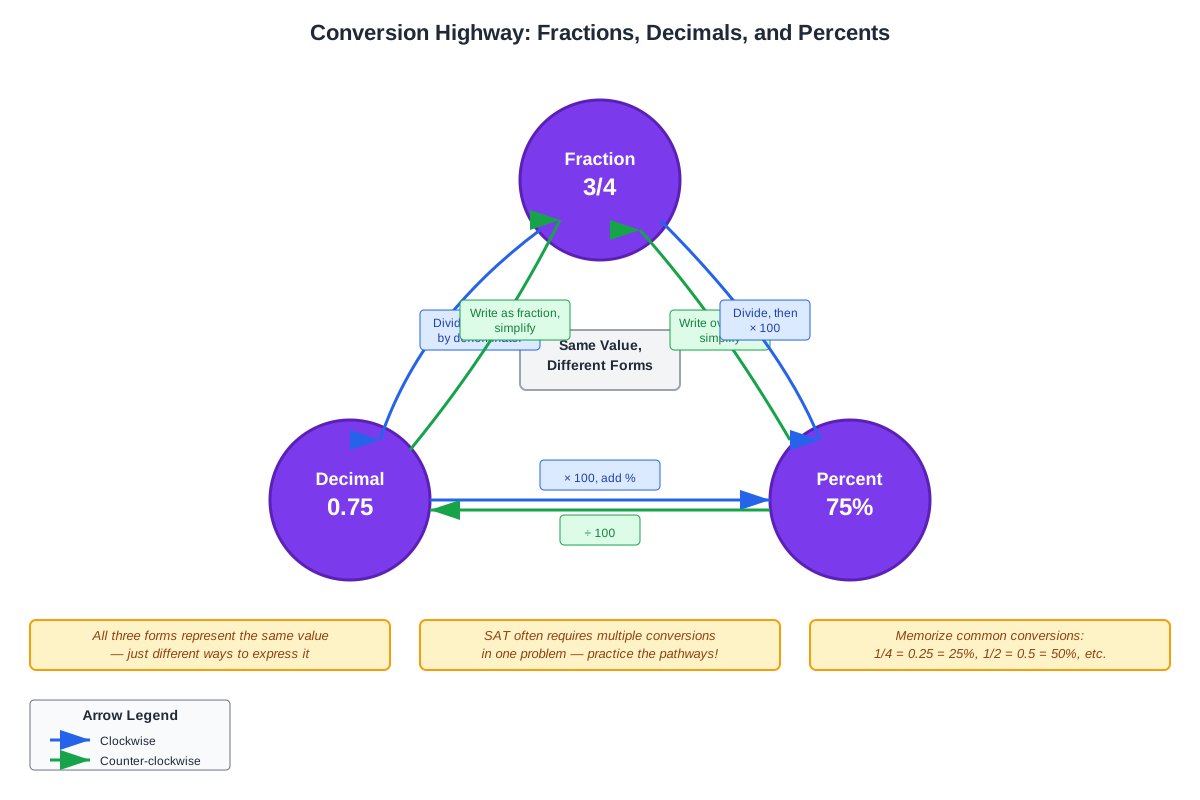
Fluency in converting between percentages, decimals, and fractions is non-negotiable for SAT success. These conversions enable students to choose the most efficient calculation method for each problem.
| From | To Decimal | To Percent | To Fraction |
|---|---|---|---|
| Percent | Divide by 100 (move decimal 2 left) | — | Write over 100, simplify |
| Decimal | — | Multiply by 100 (move decimal 2 right) | Write as fraction, simplify |
| Fraction | Divide numerator by denominator | Convert to decimal, then multiply by 100 | — |
Examples of conversions:
- 37% = 0.37 = 37/100
- 0.625 = 62.5% = 625/1000 = 5/8
- 3/4 = 0.75 = 75%
- 150% = 1.5 = 3/2
Calculating Basic Percentages
To find what percent one number is of another, use the formula:
Percent = (Part / Whole) × 100For example, if a student answered 42 questions correctly out of 50 total questions:
Percent correct = (42/50) × 100 = 0.84 × 100 = 84%
To find a percentage of a number, convert the percent to a decimal and multiply:
Result = (Percent as decimal) × NumberFor example, to find 35% of 80:
35% of 80 = 0.35 × 80 = 28
Percent Increase and Decrease
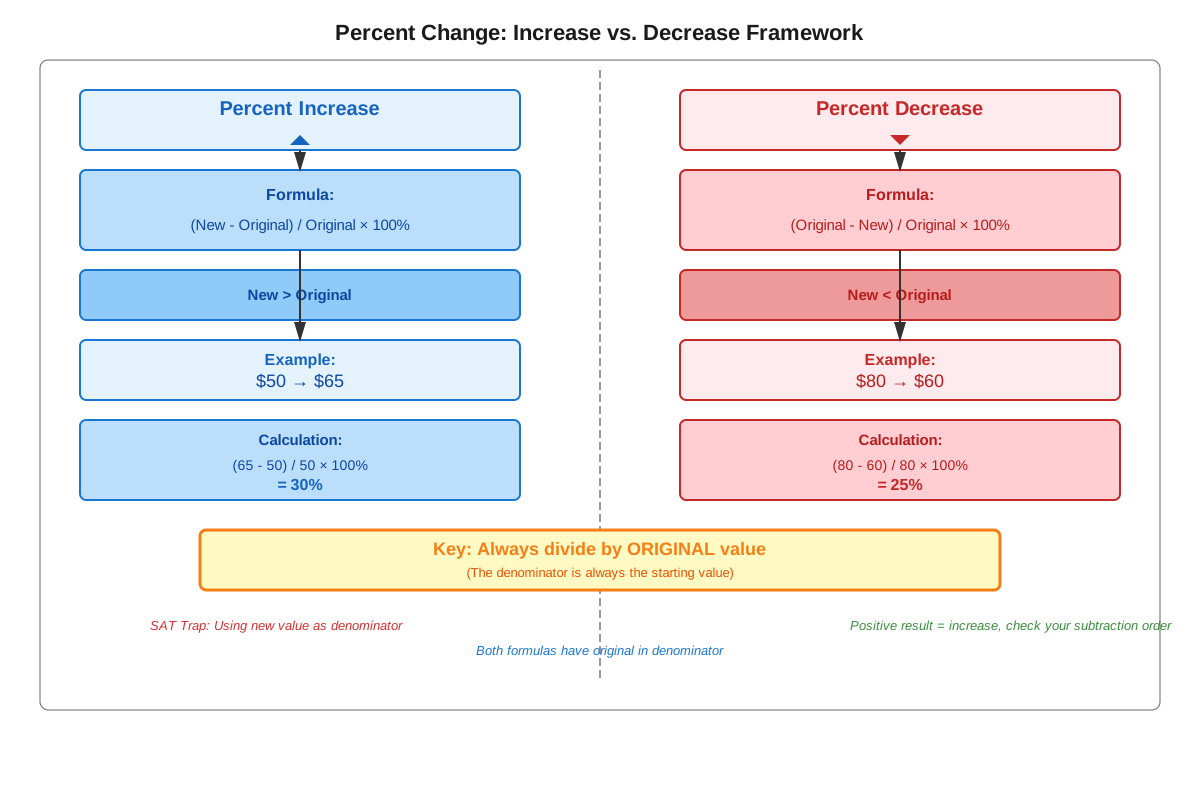
Percent change problems are among the most common on the SAT. The general formula for percent change is:
Percent Change = (New Value - Original Value) / Original Value × 100When the result is positive, it represents a percent increase; when negative, a percent decrease.
Key distinction: Always divide by the original (starting) value, not the new value. This is a frequent source of errors.
To calculate a new value after a percent increase:
New Value = Original Value × (1 + Percent Increase as decimal)To calculate a new value after a percent decrease:
New Value = Original Value × (1 - Percent Decrease as decimal)For example, if a $60 shirt is discounted by 25%:
New Price = 60 × (1 - 0.25) = 60 × 0.75 = $45
Alternatively: Discount = 60 × 0.25 = $15, so New Price = 60 - 15 = $45
Successive Percent Changes
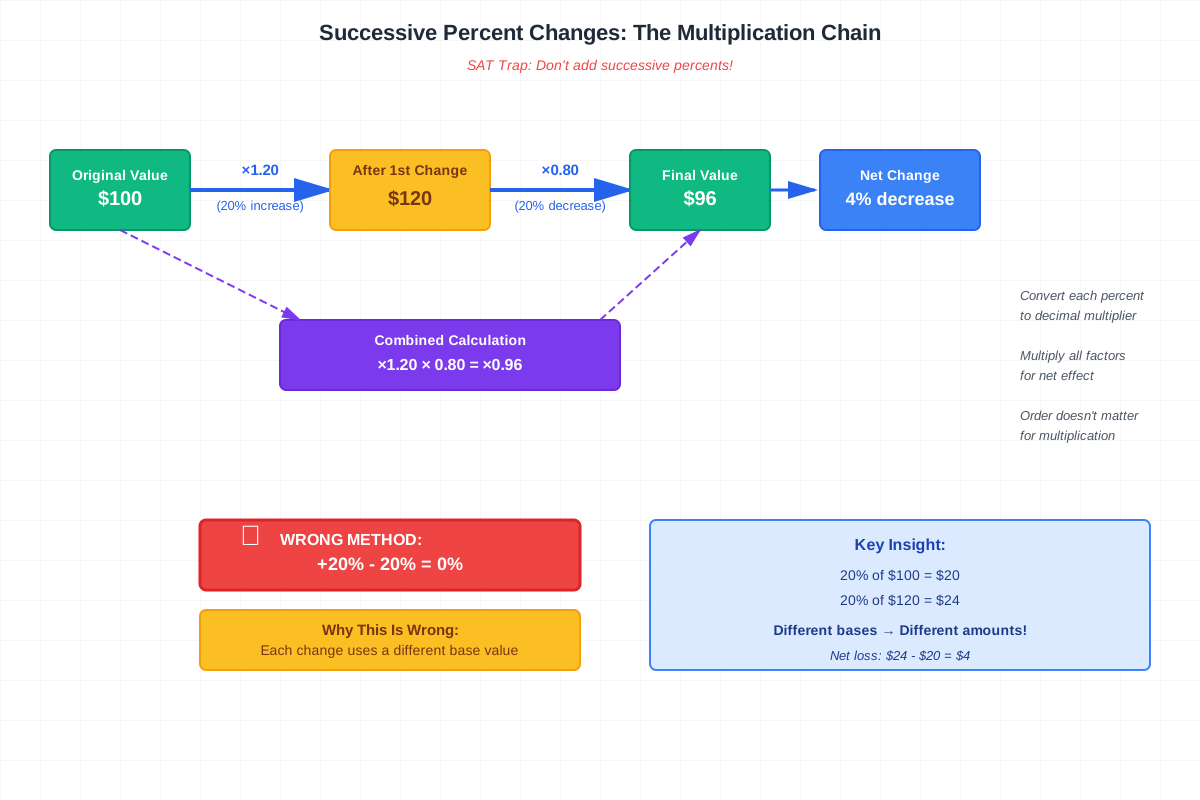
A particularly challenging SAT concept involves applying multiple percent changes sequentially. A critical principle: successive percent changes are not additive. A 20% increase followed by a 20% decrease does NOT return to the original value.
When applying successive percent changes, multiply the multipliers:
For a 10% increase followed by a 15% decrease:
Final Value = Original × 1.10 × 0.85 = Original × 0.935This represents an overall decrease of 6.5% (since 0.935 = 1 - 0.065).
Percent Greater Than and Percent Of
The SAT tests the distinction between "percent greater than" and "percent of." If A is 50% greater than B, then A = 1.5B. However, B is not 50% less than A. To find what percent less B is than A:
Percent less = (A - B) / A × 100 = (1.5B - B) / 1.5B × 100 = 0.5B / 1.5B × 100 = 33.33%This asymmetry frequently appears in SAT questions designed to test conceptual understanding.
Working with Percentages Greater Than 100%
Percentages can exceed 100%, representing values greater than the whole. For example, if a company's revenue is 250% of last year's revenue, the company has grown to 2.5 times its previous size, representing a 150% increase.
When a value is 180% of another, it means the value is 1.8 times as large, or 80% greater than the reference value.
Concept Relationships
The core concepts within percent basics form an interconnected web of mathematical relationships. Converting between forms (percentages, decimals, fractions) serves as the foundation that enables all other percent operations. This conversion skill directly feeds into calculating basic percentages, which requires expressing percents as decimals or fractions before multiplication.
Basic percentage calculations → lead to → Percent increase and decrease, which apply the fundamental percent formula to change scenarios. Understanding percent change then enables mastery of successive percent changes, which represent repeated applications of the percent change concept with the critical insight that changes multiply rather than add.
The distinction between percent greater than and percent of builds upon percent change understanding, requiring students to recognize that the reference point (denominator) shifts depending on which value serves as the base. This concept connects back to the fundamental definition of percentages as part-to-whole relationships.
Percentages greater than 100% extend basic percentage understanding beyond the intuitive "part of a whole" interpretation, connecting to concepts of ratios and proportional reasoning. This extension bridges percent basics to more advanced topics like exponential growth and compound interest.
All these concepts rely on the prerequisite knowledge of fractions, decimals, and basic algebra. They collectively enable progression to advanced topics including ratio and proportion problems, probability calculations, statistical analysis, and financial mathematics—all frequent SAT topics.
Quick check — test yourself on Percent basics so far.
Try Flashcards →High-Yield Facts
⭐ The fundamental percent equation is: Part = (Percent/100) × Whole, which can be rearranged to solve for any unknown component
⭐ To convert a percent to a decimal, divide by 100 (move the decimal point two places left)
⭐ Percent change always divides by the original value, not the new value: (New - Original)/Original × 100
⭐ A value after a percent increase is calculated as: Original × (1 + percent as decimal)
⭐ Successive percent changes multiply their multipliers; they do not add algebraically
- To find what percent one number is of another: (Part/Whole) × 100
- A percent decrease is calculated as: Original × (1 - percent as decimal)
- If A is x% greater than B, then B is NOT x% less than A (the percentages differ due to different bases)
- Percentages can exceed 100%, representing values greater than the reference whole
- Converting to decimal form before calculating often simplifies percent problems
- The phrase "what percent" signals that the answer should be expressed as a percentage
- "Of" in percent problems typically indicates multiplication
- When a question asks for a percent increase or decrease, the answer should not include the original 100%
- 50% of a number is equivalent to dividing that number by 2
- 25% of a number is equivalent to dividing that number by 4
Common Misconceptions
Misconception: Adding successive percent changes gives the total percent change (e.g., a 10% increase followed by a 10% decrease results in no change).
Correction: Successive percent changes multiply, not add. A 10% increase (×1.10) followed by a 10% decrease (×0.90) yields 1.10 × 0.90 = 0.99, representing a 1% overall decrease.
Misconception: Percent change can be calculated by dividing by either the original or new value.
Correction: Percent change MUST divide by the original (starting) value. Using the new value produces an incorrect result and is a common trap in SAT questions.
Misconception: If A is 50% more than B, then B is 50% less than A.
Correction: The percentages differ because the base values differ. If A = 1.5B, then B = A/1.5, making B approximately 33.3% less than A, not 50% less.
Misconception: To find 15% of a number, multiply by 15.
Correction: To find 15% of a number, multiply by 0.15 (or 15/100), not by 15. Multiplying by 15 would give 1500% of the number.
Misconception: A discount of 20% followed by an additional 30% discount equals a 50% total discount.
Correction: The discounts apply sequentially to different base amounts. The total multiplier is 0.80 × 0.70 = 0.56, representing a 44% total discount, not 50%.
Misconception: Percentages cannot exceed 100%.
Correction: Percentages can be any positive value. A 200% increase means the value tripled (original + 200% of original = 300% of original = 3 times original).
Misconception: "Percent of" and "percent greater than" mean the same thing.
Correction: "A is 120% of B" means A = 1.2B, while "A is 120% greater than B" means A = B + 1.2B = 2.2B. The latter includes the original 100% plus the additional 120%.
Worked Examples
Example 1: Multi-Step Percent Change Problem
Problem: A store marks up the wholesale price of a jacket by 60% to set its retail price. During a sale, the store offers a 25% discount off the retail price. If the wholesale price was $80, what is the sale price, and what is the overall percent markup from wholesale to sale price?
Solution:
Step 1: Calculate the retail price after the 60% markup.
- Retail price = Wholesale × (1 + markup as decimal)
- Retail price = 80 × (1 + 0.60) = 80 × 1.60 = $128
Step 2: Calculate the sale price after the 25% discount.
- Sale price = Retail × (1 - discount as decimal)
- Sale price = 128 × (1 - 0.25) = 128 × 0.75 = $96
Step 3: Calculate the overall percent markup from wholesale to sale price.
- Percent change = (New - Original)/Original × 100
- Percent markup = (96 - 80)/80 × 100
- Percent markup = 16/80 × 100 = 0.20 × 100 = 20%
Answer: The sale price is $96, representing a 20% markup over the wholesale price.
Key insights: This problem demonstrates that successive percent changes (60% increase, then 25% decrease) do not simply subtract (60% - 25% ≠ 35%). The actual result (20%) differs because the discount applies to the marked-up price, not the original wholesale price. This connects to Learning Objective 3 (applying percent basics to SAT questions) and illustrates the importance of understanding successive percent changes.
Example 2: Finding the Original Value
Problem: After a 15% decrease, a laptop costs $595. What was the original price before the decrease?
Solution:
Step 1: Set up the relationship between original and new price.
- New price = Original price × (1 - 0.15)
- 595 = Original price × 0.85
Step 2: Solve for the original price.
- Original price = 595 ÷ 0.85
- Original price = 700
Step 3: Verify the answer.
- 15% of 700 = 0.15 × 700 = 105
- 700 - 105 = 595 ✓
Answer: The original price was $700.
Key insights: This problem type frequently appears on the SAT and requires working backward from a final value. Many students incorrectly try to add 15% to $595, which would give $595 × 1.15 = $684.25—an incorrect answer because 15% of $700 is not the same as 15% of $595. The correct approach recognizes that $595 represents 85% of the original price (100% - 15% = 85%), so dividing by 0.85 recovers the original value. This demonstrates Learning Objective 3 and highlights the importance of identifying which value serves as the base (100%) in percent problems.
Exam Strategy
Trigger phrase recognition: When you see "percent of," prepare to multiply. When you see "what percent," prepare to divide and multiply by 100. When you see "percent increase/decrease," identify the original value first.
Systematic approach for SAT percent problems:
- Identify the three components: Determine which values represent the part, whole, and percent. Identify which one is unknown.
- Choose your form: Decide whether to work with the percent as a decimal, fraction, or percentage based on which form simplifies calculation. For mental math, fractions often work best (25% = 1/4, 50% = 1/2).
- Watch for successive changes: If multiple percent changes occur, resist the urge to add them. Instead, multiply the multipliers: (1 ± first change) × (1 ± second change).
- Verify the base: In percent change problems, always confirm you're dividing by the original value, not the new value. The SAT frequently includes trap answers that result from using the wrong base.
- Check reasonableness: After calculating, verify your answer makes sense. A 20% discount should reduce the price noticeably but not by half. A 150% increase should more than double the value.
Process of elimination tips:
- Eliminate answers that represent the wrong form (if the question asks for a percent, eliminate decimals or whole numbers)
- For percent increase problems, eliminate any answer less than the original value
- For percent decrease problems, eliminate any answer greater than the original value
- If calculating a percent change, eliminate any answer that seems to simply add or subtract the given percentages without accounting for the base
Time management: Simple percent calculations should take 30-45 seconds. Multi-step problems involving successive changes or working backward from a final value may require 90-120 seconds. If a problem requires more than 2 minutes, mark it and return after completing easier questions.
Memory Techniques
Mnemonic for the percent change formula: "New Minus Old Divided by Old" = NMOD-O (New - Old)/Old × 100
Visualization for successive percent changes: Picture a shrinking or growing rectangle. Each percent change scales the current size, not the original size. A 10% increase makes the rectangle 1.1 times as large; a subsequent 10% decrease shrinks that new rectangle to 0.9 of its current size, not the original size.
Acronym for conversion: Percent Divide Decimal Multiply = PDDM
- Percent to Decimal: Divide by 100
- Decimal to Percent: Multiply by 100
Common percent-fraction equivalents (memorize these for speed):
- 10% = 1/10
- 20% = 1/5
- 25% = 1/4
- 33.33% = 1/3
- 50% = 1/2
- 66.67% = 2/3
- 75% = 3/4
The "1 plus/minus" technique: For percent increases, think "1 plus the decimal" (20% increase = ×1.20). For percent decreases, think "1 minus the decimal" (20% decrease = ×0.80). This prevents the common error of forgetting to include the original 100%.
Summary
Percent basics represent a foundational SAT Math topic that combines computational fluency with conceptual understanding. Mastery requires three core competencies: converting seamlessly between percentages, decimals, and fractions; calculating percent changes using the correct base value; and handling successive percent changes through multiplication rather than addition. The fundamental percent equation—Part = (Percent/100) × Whole—underlies all percent problems, though it may appear in various forms depending on which quantity is unknown. Students must distinguish between "percent of" (multiplication) and "percent greater than" (multiplication plus the original value), recognize that percent change always divides by the original value, and understand that percentages can exceed 100% when representing values greater than the reference whole. Success on SAT percent problems demands not just mechanical calculation ability but also careful reading comprehension to identify which values represent the part, whole, and percent, and strategic thinking to choose the most efficient solution path. With consistent practice, percent problems transform from challenging obstacles into reliable point-scoring opportunities.
Key Takeaways
- The fundamental percent equation Part = (Percent/100) × Whole can be rearranged to solve for any unknown component
- Convert percentages to decimals by dividing by 100; convert decimals to percentages by multiplying by 100
- Percent change formula: (New Value - Original Value)/Original Value × 100, always dividing by the original
- Calculate values after percent changes using multipliers: Original × (1 ± percent as decimal)
- Successive percent changes multiply their multipliers; a 20% increase followed by a 20% decrease does NOT return to the original value
- "Percent of" means multiply; "percent greater than" means multiply and add to the original
- Memorize common percent-fraction equivalents (25% = 1/4, 50% = 1/2, etc.) for faster mental calculation
Related Topics
Ratios and Proportions: Percentages are a special type of ratio where the second term is always 100. Mastering percent basics provides the foundation for solving proportion problems and understanding part-to-whole relationships in various contexts.
Exponential Growth and Decay: Successive percent changes lead naturally to exponential functions. Understanding how repeated percent increases compound enables mastery of population growth, compound interest, and radioactive decay problems.
Data Analysis and Statistics: Interpreting percentages in tables, graphs, and data sets builds on percent basics. This includes calculating percentages from raw data, understanding percentage point differences, and analyzing percent distributions.
Financial Mathematics: Interest calculations, investment returns, tax computations, and discount problems all rely heavily on percent basics. These real-world applications frequently appear in SAT word problems.
Probability: Expressing probabilities as percentages requires converting fractions and decimals, directly applying percent conversion skills to statistical contexts.
Practice CTA
Now that you've mastered the core concepts of percent basics, it's time to solidify your understanding through active practice. The practice questions and flashcards have been specifically designed to mirror SAT question formats and difficulty levels, targeting the most frequently tested concepts. Each practice problem provides an opportunity to apply the strategies and techniques covered in this guide, building the speed and accuracy essential for test day success. Remember: understanding the concepts is only the first step—fluency comes through deliberate practice. Challenge yourself to work through the problems without a calculator first, then verify your answers and review any mistakes to identify gaps in understanding. Your investment in practice now will pay dividends in confidence and points on test day!
Sign up free to keep reading
Create a free AnvayaPrep account to finish this SAT guide on Percent basics — plus flashcards and practice questions.