Overview
Percent word problems are among the most frequently tested question types in the SAT math section, appearing in both the calculator and no-calculator portions of the exam. These problems require students to translate real-world scenarios involving percentages into mathematical expressions and solve for unknown quantities. Unlike straightforward percentage calculations, sat percent word problems embed the mathematical relationships within narrative contexts such as sales discounts, tax calculations, population changes, survey results, and financial scenarios. Mastering this topic is essential because it tests not only computational skills but also reading comprehension, logical reasoning, and the ability to identify relevant information within complex problem statements.
The importance of percent word problems on the SAT cannot be overstated. These questions typically account for 3-5 questions per test administration, representing approximately 5-8% of the total math score. More significantly, percent problems often appear as medium-to-hard difficulty questions, making them critical for students aiming to score above 650 on the math section. The College Board designs these problems to assess mathematical modeling—the ability to represent real-world situations using mathematical structures—which is a core competency emphasized in the current SAT framework.
Percent word problems connect to broader mathematical concepts including ratios, proportions, linear equations, and algebraic reasoning. They serve as a bridge between basic arithmetic operations and more complex problem-solving scenarios. Students who master this topic develop transferable skills in translating verbal information into mathematical notation, identifying relevant versus irrelevant information, and working systematically through multi-step problems. These competencies extend beyond percentages to virtually every other quantitative reasoning task on the SAT, making this topic foundational for overall math success.
Learning Objectives
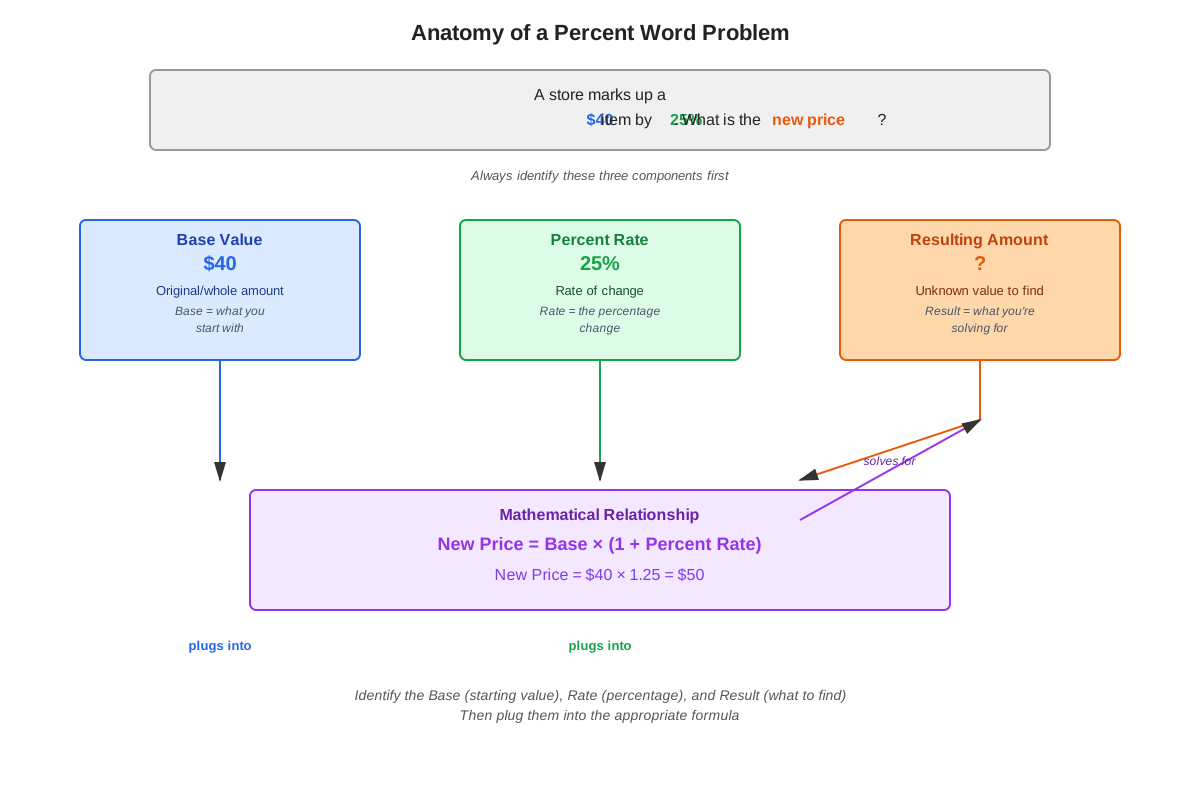
- [ ] Identify key features of percent word problems, including the base value, percent rate, and resulting amount
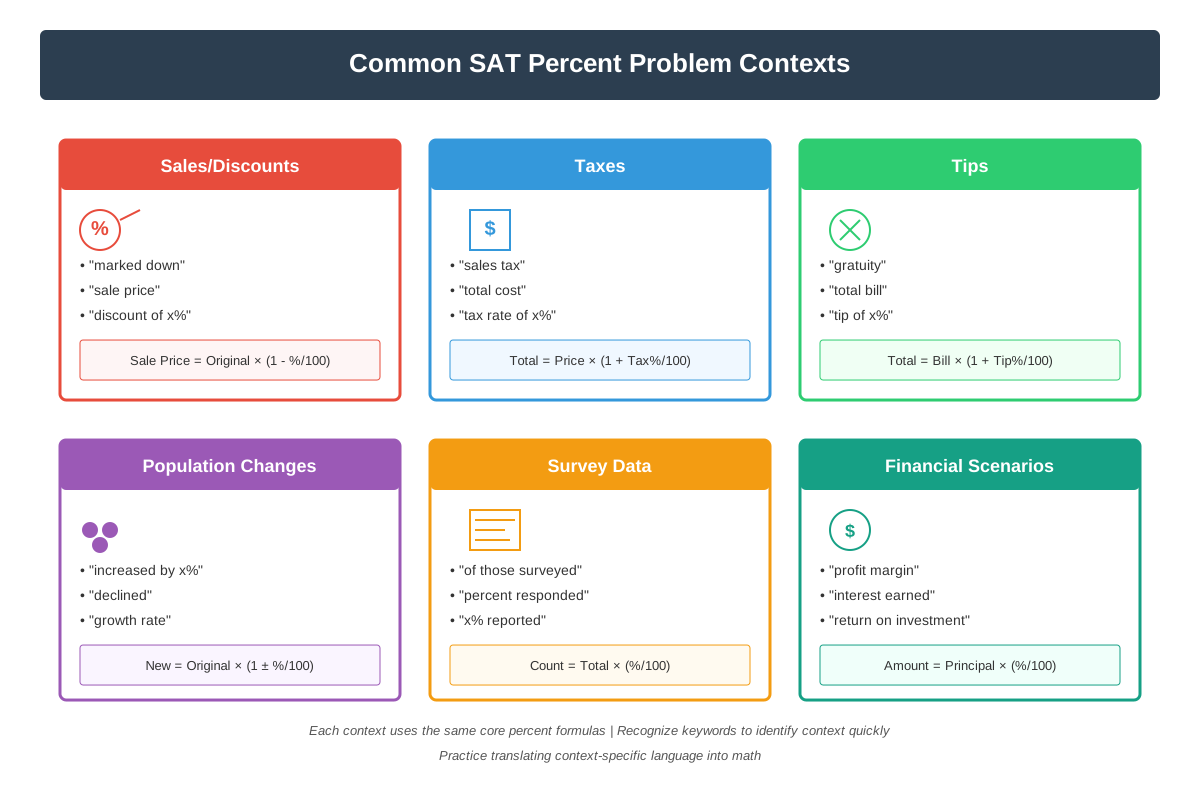
- [ ] Explain how percent word problems appears on the SAT, including common contexts and question formats
- [ ] Apply percent word problems to answer SAT-style questions with accuracy and efficiency
- [ ] Convert between percentage statements and algebraic equations representing real-world scenarios
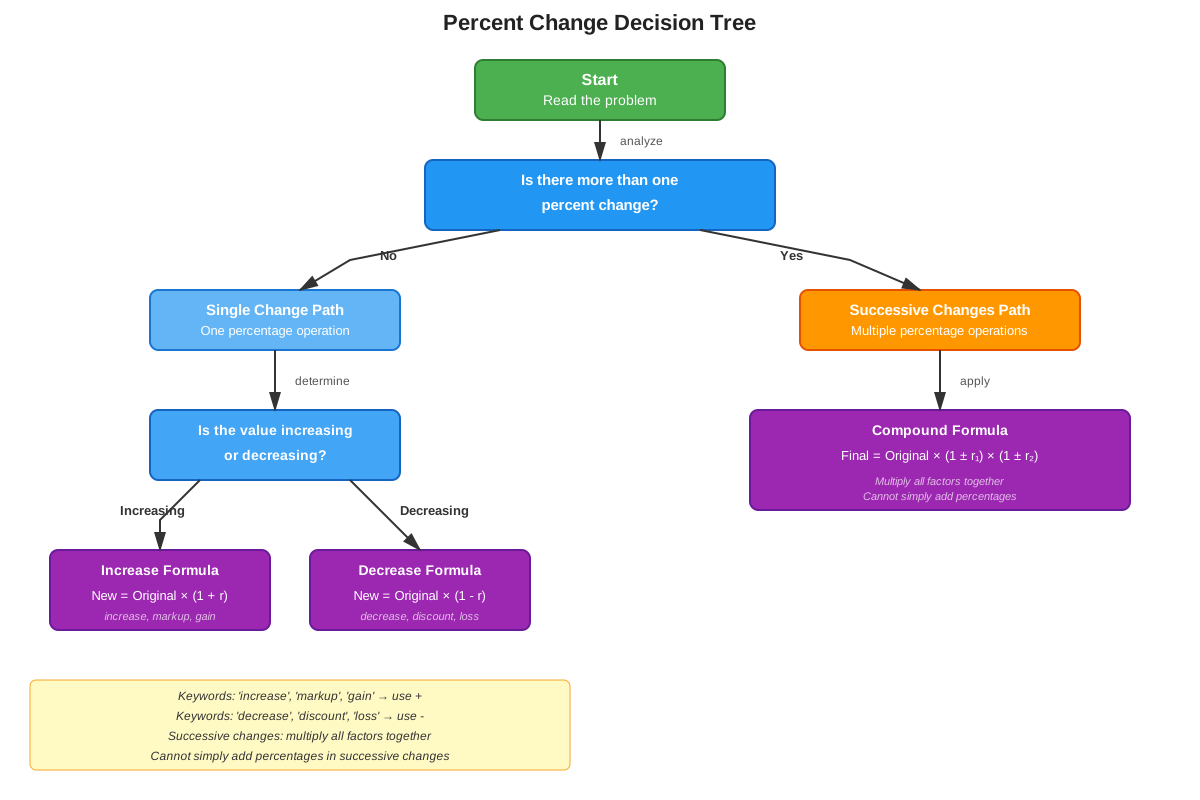
- [ ] Distinguish between percent increase, percent decrease, and successive percent changes
- [ ] Solve multi-step percent problems involving compound changes and reverse calculations
- [ ] Analyze word problems to determine whether to calculate a part, whole, or percentage rate
Prerequisites
- Basic percentage calculations: Understanding that percentages represent parts per hundred and can be converted to decimals or fractions (e.g., 25% = 0.25 = 1/4) is essential for setting up equations correctly
- Algebraic equation solving: The ability to solve linear equations for unknown variables is necessary since most percent word problems require isolating a variable
- Decimal and fraction operations: Proficiency with multiplying and dividing decimals ensures accurate calculations when working with percentage multipliers
- Ratio and proportion concepts: Understanding proportional relationships helps recognize when two quantities maintain a constant percentage relationship
- Order of operations: Knowing the correct sequence for evaluating mathematical expressions prevents errors in multi-step percent calculations
Why This Topic Matters
Percent word problems represent one of the most practical applications of mathematics that students encounter both on the SAT and in everyday life. From calculating tips at restaurants to understanding credit card interest rates, from interpreting election polling data to analyzing business profit margins, percentages provide a universal language for expressing relative quantities and changes. The SAT emphasizes this topic precisely because it assesses real-world quantitative literacy—the ability to make informed decisions based on numerical information presented in context.
On the SAT specifically, percent word problems appear with remarkable consistency. Statistical analysis of released SAT exams reveals that approximately 3-5 questions per test directly involve percentage calculations embedded in word problems, with additional questions incorporating percentages as secondary elements. These questions appear across both math modules and span difficulty levels from easy to hard. The College Board particularly favors scenarios involving: retail discounts and markups (appearing in roughly 30% of percent problems), population or quantity changes over time (25%), survey and statistical data interpretation (20%), financial calculations including interest and investments (15%), and mixture or concentration problems (10%).
The topic appears in several distinct question formats on the SAT. Most commonly, students encounter straightforward application problems where they must calculate a percentage of a quantity or find what percent one number is of another. More challenging versions involve successive percent changes (such as applying a discount followed by tax), reverse percent problems (finding an original amount before a percentage change), or problems requiring students to set up and solve equations involving unknown percentages. The most difficult questions often combine percentages with other algebraic concepts, such as systems of equations or function notation, testing whether students can integrate multiple mathematical skills simultaneously.
Core Concepts
The Fundamental Percentage Equation
The foundation of all percent word problems rests on understanding the relationship between three quantities: the part, the whole (or base), and the percent. This relationship can be expressed through the fundamental equation:
Part = Percent × WholeOr equivalently: Part = (Percent/100) × Whole
When working with decimals, this becomes: Part = Decimal × Whole, where the decimal is the percentage divided by 100. For example, finding 30% of 80 translates to: Part = 0.30 × 80 = 24.
Every percent word problem involves finding one of these three components when the other two are known. The SAT tests all three variations:
- Finding the part: "What is 15% of 240?" → Part = 0.15 × 240 = 36
- Finding the whole: "18 is 30% of what number?" → 18 = 0.30 × Whole → Whole = 18/0.30 = 60
- Finding the percent: "24 is what percent of 80?" → 24 = (Percent/100) × 80 → Percent = (24/80) × 100 = 30%
Percent Increase and Decrease
Percent change problems form a major category of SAT percent word problems. These involve calculating how much a quantity has increased or decreased relative to its original value. The percent change formula is:
Percent Change = (New Value - Original Value) / Original Value × 100%For percent increase, the new value is larger than the original, yielding a positive result. For percent decrease, the new value is smaller, yielding a negative result (though typically reported as a positive percentage decrease).
A critical concept is the multiplier method for applying percent changes. When a quantity increases by r%, the new amount equals the original multiplied by (1 + r/100). When it decreases by r%, multiply by (1 - r/100). For example:
- Increasing $50 by 20%: $50 × 1.20 = $60
- Decreasing $50 by 20%: $50 × 0.80 = $40
This multiplier approach is significantly faster than calculating the change amount separately and then adding or subtracting it from the original value.
Successive Percent Changes
One of the most commonly tested—and frequently misunderstood—concepts involves successive percent changes, where multiple percentage changes are applied sequentially. The key principle is that each change applies to the result of the previous change, not to the original amount.
Consider a price that increases by 20% and then decreases by 20%. Many students incorrectly assume these changes cancel out, but they do not. If the original price is P:
- After 20% increase: P × 1.20 = 1.20P
- After 20% decrease: 1.20P × 0.80 = 0.96P
The final price is 96% of the original, representing a net 4% decrease. The multipliers are applied sequentially: P × 1.20 × 0.80 = 0.96P.
For any successive percent changes, multiply all the individual multipliers together to find the overall effect. This approach works regardless of how many changes occur or whether they are increases or decreases.
Reverse Percent Problems
Reverse percent problems provide the final amount after a percentage change and ask for the original amount. These require working backwards through the percentage relationship. The key is recognizing that if a quantity increased by r%, the final amount represents (100 + r)% of the original, and if it decreased by r%, the final amount represents (100 - r)% of the original.
For example: "After a 25% discount, a jacket costs $60. What was the original price?"
The $60 represents 75% of the original price (since 100% - 25% = 75%). Therefore:
0.75 × Original = 60
Original = 60/0.75 = $80
The general approach is to identify what percentage the given amount represents, then divide by that percentage (in decimal form) to find the original value.
Percent Greater/Less Than Comparisons
SAT problems frequently ask students to compare two quantities using percentage language: "A is what percent greater than B?" or "A is what percent less than B?" These require careful attention to which quantity serves as the base for comparison.
The formula for "A is what percent greater than B" is:
Percent Greater = (A - B) / B × 100%For "A is what percent less than B":
Percent Less = (B - A) / B × 100%Note that the base (denominator) is always the quantity being compared to (B in both cases). A common error is using A as the base, which yields an incorrect result. For example, if A = 120 and B = 100:
- A is 20% greater than B: (120-100)/100 × 100% = 20%
- B is approximately 16.67% less than A: (120-100)/120 × 100% ≈ 16.67%
These are different percentages because they use different bases.
Percent Composition and Parts of a Whole
Many SAT problems involve quantities that are divided into parts, each representing a certain percentage of the whole. The fundamental principle is that all parts must sum to 100% of the whole. These problems often involve:
- Survey results where percentages of respondents chose different options
- Mixture problems where components make up certain percentages of the total
- Budget allocation where different categories receive percentage shares
- Population demographics divided by age, gender, or other characteristics
The key strategy is to recognize that if you know the total and the percentage for each part, you can find each part's actual value. Conversely, if you know actual values for parts and the total, you can calculate percentages. Setting up a table to organize the information often helps visualize these relationships.
Concept Relationships
The concepts within percent word problems form an interconnected hierarchy. At the foundation lies the fundamental percentage equation (Part = Percent × Whole), which serves as the basis for all other concepts. This equation directly enables solving for any of the three components when the other two are known.
Percent increase and decrease builds upon the fundamental equation by introducing the concept of change relative to an original value. This leads naturally to the multiplier method, which provides a more efficient calculation approach. The multiplier method, in turn, becomes essential for understanding successive percent changes, where multiple multipliers are applied sequentially.
Reverse percent problems represent an inverse application of percent increase/decrease concepts, requiring students to work backwards from a final value to an original value. This connects to algebraic equation-solving skills, as students must set up and solve equations where the unknown appears in the base position rather than the result position.
Percent greater/less than comparisons extend the percent change concept by emphasizing the importance of identifying the correct base for comparison. This concept reinforces the principle that percentages are always relative to a reference value, and changing that reference changes the percentage.
Percent composition problems integrate all previous concepts by requiring students to work with multiple percentages simultaneously, ensuring they sum to 100% and maintaining consistency between parts and wholes.
The relationship map flows as follows:
Fundamental Percentage Equation → Percent Change Calculations → Multiplier Method → Successive Changes → Reverse Problems → Comparative Percentages → Composition Problems
Each concept builds upon and reinforces the previous ones, creating a comprehensive framework for solving any percent word problem encountered on the SAT.
Quick check — test yourself on Percent word problems so far.
Try Flashcards →High-Yield Facts
⭐ The fundamental percentage equation is Part = Percent × Whole, and every percent problem involves finding one of these three components when given the other two
⭐ To apply a percent increase of r%, multiply by (1 + r/100); to apply a percent decrease of r%, multiply by (1 - r/100)
⭐ Successive percent changes do NOT add or subtract directly; instead, multiply the individual multipliers together to find the net effect
⭐ In reverse percent problems, identify what percentage the given amount represents, then divide by that percentage in decimal form to find the original value
⭐ When comparing "A is what percent greater/less than B," always use B (the comparison reference) as the base in the denominator
- Converting a percentage to a decimal requires dividing by 100 (e.g., 35% = 0.35), while converting a decimal to a percentage requires multiplying by 100
- A 50% increase followed by a 50% decrease does NOT return to the original value; it results in a 25% decrease overall (multipliers: 1.5 × 0.5 = 0.75)
- If quantity A is 20% greater than quantity B, then quantity B is approximately 16.67% less than quantity A (not 20% less)
- When a problem states "increased BY 20%," the new amount is 120% of the original; when it states "increased TO 20%," the new amount is 20% of the original (very different meanings)
- In problems involving percentages of percentages (e.g., "30% of the 40% who responded"), multiply the percentages: 0.30 × 0.40 = 0.12 or 12%
- The percent change from A to B and the percent change from B to A are different values unless the change is 0%
- If a quantity doubles, it has increased by 100%; if it triples, it has increased by 200% (not 300%)
Common Misconceptions
Misconception: Successive percent changes can be added or subtracted directly (e.g., a 20% increase followed by a 10% decrease results in a net 10% increase).
Correction: Each percent change applies to the result of the previous change, not the original amount. You must multiply the multipliers: 1.20 × 0.90 = 1.08, representing an 8% increase, not 10%.
Misconception: "Percent of" and "percent off" mean the same thing.
Correction: "Percent of" means to multiply by that percentage (e.g., 30% of $100 = $30), while "percent off" means to subtract that percentage from 100% (e.g., 30% off $100 means paying 70% of $100 = $70).
Misconception: When comparing two quantities, the percent difference is the same regardless of which quantity is used as the base.
Correction: The base matters significantly. If A = 120 and B = 100, A is 20% greater than B, but B is only 16.67% less than A because the bases (denominators) are different.
Misconception: In reverse percent problems, you can simply multiply the given amount by the percentage to find the original.
Correction: You must divide by the percentage (in decimal form) that the given amount represents. If $80 is the price after a 20% discount, it represents 80% of the original, so Original = 80/0.80 = $100, not 80 × 0.20.
Misconception: A 100% increase means the quantity doubles, so a 200% increase means it triples.
Correction: A 100% increase does mean doubling (multiplying by 2), but a 200% increase means multiplying by 3 (the original 100% plus an additional 200% equals 300% of the original).
Misconception: When a problem gives percentages that don't sum to 100%, there must be an error in the problem.
Correction: Some problems intentionally provide percentages that don't sum to 100% because they represent overlapping categories, percentages of different wholes, or incomplete data where the remaining percentage is implied or must be calculated.
Misconception: Percent change is calculated as (New - Old)/New × 100%.
Correction: The correct formula uses the original (old) value in the denominator: (New - Old)/Old × 100%. Using the new value as the base gives an incorrect result.
Worked Examples
Example 1: Multi-Step Discount and Tax Problem
Problem: A store advertises a 30% discount on all items. After applying the discount, a 6% sales tax is added to the discounted price. If a customer pays $74.20 for an item, what was the original price before the discount and tax?
Solution:
Step 1: Identify what the $74.20 represents. This is the final price after both the discount and the tax have been applied.
Step 2: Work backwards through the successive changes. Let P be the original price.
After the 30% discount, the price becomes: P × 0.70 (since 100% - 30% = 70%)
After the 6% tax is added to the discounted price: (P × 0.70) × 1.06
Step 3: Set up the equation with the final price:
(P × 0.70) × 1.06 = 74.20
Step 4: Simplify the left side:
P × 0.742 = 74.20
Step 5: Solve for P:
P = 74.20/0.742 = 100
Answer: The original price was $100.
Connection to Learning Objectives: This problem demonstrates successive percent changes (discount then tax), the multiplier method (0.70 and 1.06), and reverse calculation (working backwards from a final amount). It shows how SAT problems combine multiple percentage concepts in realistic scenarios.
Example 2: Percent Comparison Problem
Problem: In a survey of 500 students, 180 students prefer online learning while 220 students prefer in-person learning. The number of students who prefer online learning is what percent less than the number who prefer in-person learning?
Solution:
Step 1: Identify the two quantities being compared:
- Students preferring online learning: 180
- Students preferring in-person learning: 220
Step 2: Recognize the question asks "what percent less," meaning we're comparing the smaller to the larger, using the larger as the base.
Step 3: Calculate the difference:
220 - 180 = 40 students
Step 4: Apply the percent less formula, using the reference quantity (in-person, 220) as the base:
Percent Less = (Difference/Base) × 100%
Percent Less = (40/220) × 100%
Step 5: Simplify:
Percent Less = (2/11) × 100% ≈ 18.18%
Answer: The number of students who prefer online learning is approximately 18.2% less than the number who prefer in-person learning.
Alternative Approach: Some students might calculate what percent 180 is of 220:
180/220 = 0.8182 = 81.82%
This means online learners represent 81.82% of the in-person learners, so they are 100% - 81.82% = 18.18% less.
Connection to Learning Objectives: This problem illustrates percent comparison concepts, emphasizes the importance of identifying the correct base for comparison, and shows how the same answer can be reached through different valid approaches—a valuable problem-solving skill for the SAT.
Exam Strategy
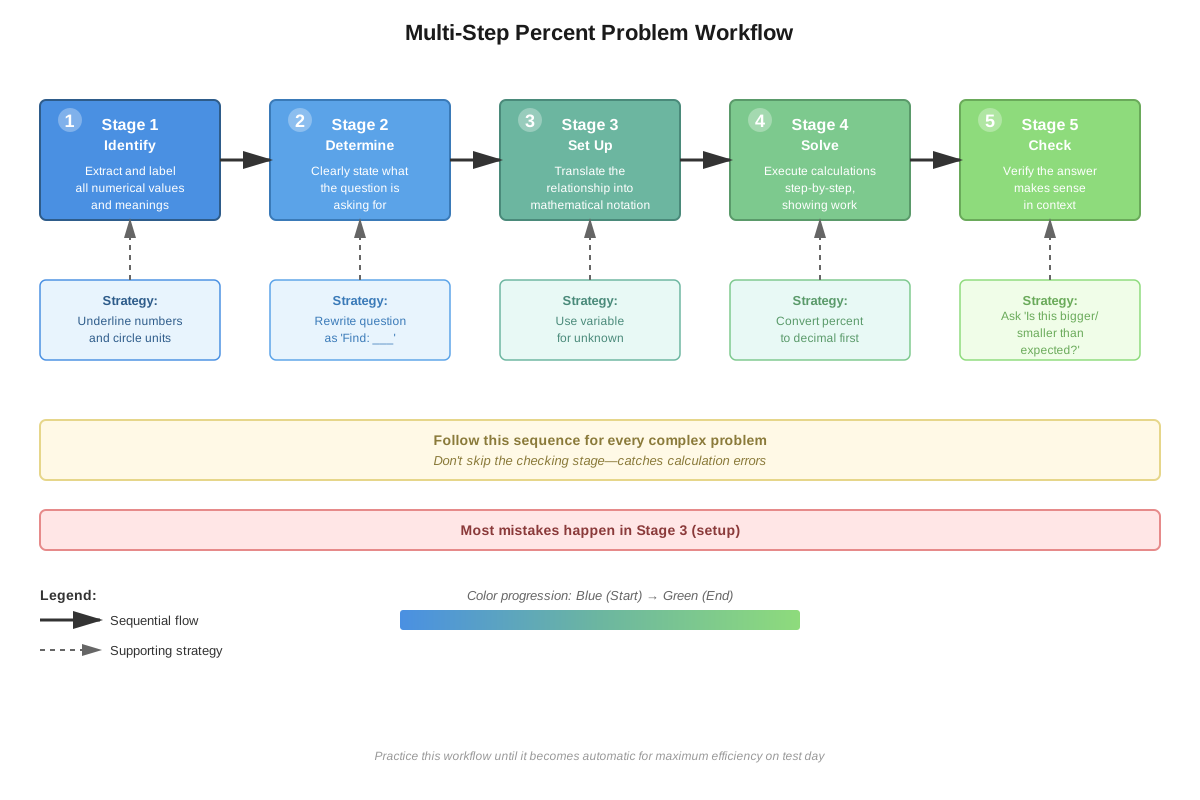
When approaching percent word problems on the SAT, begin by carefully reading the entire problem to identify three critical elements: what is being asked, what information is provided, and what the base (reference) quantity is. Many students rush into calculations before fully understanding the problem structure, leading to errors. Take 10-15 seconds to annotate the problem, circling key numbers and underlining what you need to find.
Trigger words and phrases signal specific problem types. Watch for "percent of" (multiplication), "percent off" or "discount" (subtraction from 100%), "percent more/greater than" or "percent less than" (comparison with specific base), "increased by" versus "increased to" (very different meanings), "after a percent increase/decrease" (reverse problem), and "successive" or "then" (multiple changes applied sequentially). Recognizing these triggers immediately tells you which formula or approach to use.
For process of elimination, leverage the reasonableness of answer choices. If a problem involves a discount, the final price must be less than the original—eliminate any choices that violate this logic. When dealing with successive changes, remember that a 20% increase followed by a 20% decrease does NOT return to the original value, so eliminate any choice suggesting it does. If calculating a percent increase, the answer must be positive; if calculating a percent decrease, it must be positive when expressed as a decrease. Use estimation: if you're finding 30% of 80, the answer should be close to one-third of 80 (about 27), so eliminate choices like 8 or 56.
Time allocation is crucial. Simple percent problems (finding 15% of a number) should take 30-45 seconds. Medium-difficulty problems involving one percent change or comparison should take 60-90 seconds. Complex problems with successive changes or reverse calculations may require 2-2.5 minutes. If you're exceeding these times, mark the question and return to it later. Don't let a single percent problem consume 4-5 minutes when you could answer two easier questions in that time.
Strategic calculation approaches can save valuable time. Use the multiplier method rather than calculating the change amount separately. For example, to find a price after a 35% discount, multiply by 0.65 directly rather than finding 35% of the price and then subtracting. When dealing with common percentages, know the fraction equivalents: 50% = 1/2, 25% = 1/4, 20% = 1/5, 10% = 1/10, etc. Sometimes fraction arithmetic is faster than decimal arithmetic.
Finally, always verify that your answer makes sense in context. If a problem asks for a percentage and your answer is 350%, double-check your work—while possible, such large percentages are uncommon and may indicate an error. If asked for a dollar amount and you get a negative number, you've made a mistake. This quick reasonableness check catches many careless errors.
Memory Techniques
The "POW" mnemonic helps remember the fundamental percentage equation components: Part = Of (percent) × Whole. When you see "of" in a percent problem, it signals multiplication.
The "MADS" acronym for percent change: Multiplier Approach Defeats Subtraction. This reminds you that using multipliers (1.20 for a 20% increase, 0.80 for a 20% decrease) is more efficient than calculating the change amount and adding/subtracting it.
Visualization strategy for successive changes: Picture a staircase where each step represents a percent change. You can't skip steps—you must land on each one sequentially. This mental image reinforces that each change applies to the previous result, not the original amount.
The "BASE-ic Rule": When comparing quantities, the BASE is always the quantity you're comparing TO (the reference point). If the problem says "A is what percent greater than B," B is the base. Visualize B as the foundation or base of a structure, with A built on top of it.
The "Reverse Gear" technique for reverse percent problems: When working backwards, remember you must shift into "reverse gear" by dividing instead of multiplying. If going forward is multiplying by 0.80 (20% discount), going backward is dividing by 0.80.
Finger counting for common percentages: Assign each finger a common percentage and its decimal equivalent. Thumb = 50% (0.5), Index = 25% (0.25), Middle = 20% (0.20), Ring = 10% (0.10), Pinky = 5% (0.05). This kinesthetic memory aid helps quickly recall conversions during the test.
The "100% Rule" for composition problems: Visualize a pie chart that must be completely filled. All the slices (percentages) must add up to 100%. If you know some slices, you can find the missing ones by subtracting from 100%.
Summary
Percent word problems constitute a high-yield SAT math topic that tests students' ability to translate real-world scenarios into mathematical relationships involving percentages. Mastery requires understanding the fundamental percentage equation (Part = Percent × Whole) and recognizing which component is unknown. The multiplier method provides an efficient approach for calculating percent increases (multiply by 1 + r/100) and decreases (multiply by 1 - r/100), and becomes essential when dealing with successive percent changes, where multipliers are applied sequentially rather than added. Reverse percent problems require working backwards by identifying what percentage a given amount represents and dividing by that percentage. Comparison problems demand careful attention to which quantity serves as the base, as "A is what percent greater than B" yields a different answer than "B is what percent less than A." Success on SAT percent word problems depends on careful reading to identify trigger words, systematic problem-solving approaches, and verification that answers make sense in context. These problems appear consistently on every SAT administration, making them essential for achieving competitive math scores.
Key Takeaways
- The fundamental percentage equation (Part = Percent × Whole) underlies all percent word problems; identify which component is unknown and solve accordingly
- Use the multiplier method for efficiency: multiply by (1 + r/100) for increases and (1 - r/100) for decreases rather than calculating changes separately
- Successive percent changes require multiplying individual multipliers together; they never simply add or subtract
- In reverse percent problems, divide the given amount by the percentage it represents (in decimal form) to find the original value
- When comparing quantities using percentages, always use the reference quantity (the one being compared TO) as the base in your calculation
- Careful reading and identification of trigger words ("of," "off," "more than," "less than," "after," "before") is essential for selecting the correct approach
- Always verify that your answer is reasonable in context—this catches most calculation errors
Related Topics
Ratios and Proportions: Percentages are a special type of ratio where the whole is always 100. Mastering percent word problems provides a foundation for solving more complex proportion problems, including direct and inverse variation, scale factors, and similar figures. Understanding that percentages express proportional relationships helps students recognize when to set up proportions versus when to use percentage calculations.
Linear Equations and Functions: Many percent word problems can be modeled as linear equations, particularly those involving successive changes or finding original values. Students who excel at percent problems develop equation-solving skills that transfer directly to more abstract algebraic contexts, including systems of equations and linear function applications.
Data Analysis and Statistics: Percentages appear extensively in data interpretation questions involving tables, graphs, and statistical measures. Mastering percent word problems enables students to analyze survey results, understand margin of error, interpret percentage point differences, and work with percentile rankings—all common SAT question types.
Exponential Growth and Decay: Successive percent changes introduce the concept of compound changes, which forms the foundation for understanding exponential functions. Students who understand why a 10% annual increase means multiplying by 1.10 each year are prepared to tackle exponential growth models in more advanced mathematics.
Practice CTA
Now that you've mastered the core concepts, strategies, and common pitfalls of percent word problems, it's time to put your knowledge into action. Challenge yourself with the practice questions designed specifically to mirror SAT-style problems at varying difficulty levels. Each question you attempt strengthens your pattern recognition and builds the confidence you need for test day. Don't just solve the problems—analyze why each answer is correct and why the distractors are wrong. Use the flashcards to reinforce key formulas and concepts until they become automatic. Remember, percent word problems are highly learnable skills, not innate talents. Every practice problem you complete brings you closer to mastering this high-yield topic and improving your SAT math score. You've got this!
Sign up free to keep reading
Create a free AnvayaPrep account to finish this SAT guide on Percent word problems — plus flashcards and practice questions.