Overview
Probability percent represents the likelihood of an event occurring expressed as a percentage rather than as a fraction or decimal. On the SAT, this concept bridges two fundamental mathematical domains: probability theory and percentage calculations. When students encounter sat probability percent questions, they must convert probability values (typically ranging from 0 to 1) into percentages (ranging from 0% to 100%) or work directly with percentage representations of likelihood.
Understanding probability percent is essential for SAT success because the College Board frequently tests students' ability to interpret real-world scenarios involving chance, risk, and statistical likelihood. These questions appear in both calculator and no-calculator sections, often embedded within word problems that require multi-step reasoning. The math skills involved extend beyond simple computation—students must demonstrate conceptual understanding of what percentages mean in probabilistic contexts, such as survey results, experimental outcomes, or predictive models.
This topic connects directly to fundamental percentage operations, ratio and proportion reasoning, and data interpretation skills. Mastery of probability percent enables students to tackle more complex SAT questions involving conditional probability, expected value, and statistical analysis. The ability to fluidly convert between fractions, decimals, and percentages while maintaining accurate probability interpretations distinguishes high-scoring students from those who struggle with quantitative reasoning sections.
Learning Objectives
- [ ] Identify key features of probability percent and distinguish it from other probability representations
- [ ] Explain how probability percent appears on the SAT across different question formats
- [ ] Apply probability percent to answer SAT-style questions with accuracy and efficiency
- [ ] Convert seamlessly between probability fractions, decimals, and percentages
- [ ] Calculate complementary probabilities using percentage representations
- [ ] Interpret probability percent in real-world contexts and data presentations
- [ ] Solve multi-step problems combining probability percent with other mathematical operations
Prerequisites
- Basic percentage calculations: Converting between fractions, decimals, and percentages is fundamental to expressing probability as a percent
- Fundamental probability concepts: Understanding sample spaces, favorable outcomes, and the basic probability formula P(event) = favorable outcomes / total outcomes
- Fraction operations: Simplifying fractions and performing arithmetic with fractions enables accurate probability calculations before conversion to percentages
- Ratio and proportion reasoning: Probability inherently involves comparing parts to wholes, which requires proportional thinking
Why This Topic Matters
Probability percent appears in everyday decision-making contexts, from weather forecasts (70% chance of rain) to medical test accuracy (95% sensitivity) to financial risk assessment (15% probability of default). Understanding these percentages enables informed choices in personal, academic, and professional settings. The ability to quantify uncertainty and communicate likelihood in accessible percentage terms represents a crucial life skill beyond test preparation.
On the SAT, probability percent questions appear with notable frequency—typically 2-4 questions per test across both the calculator and no-calculator sections. These questions account for approximately 5-8% of the total math score, making them high-yield content for focused study. The College Board particularly favors questions that combine probability percent with data interpretation, requiring students to extract information from tables, charts, or survey results and then calculate percentage-based probabilities.
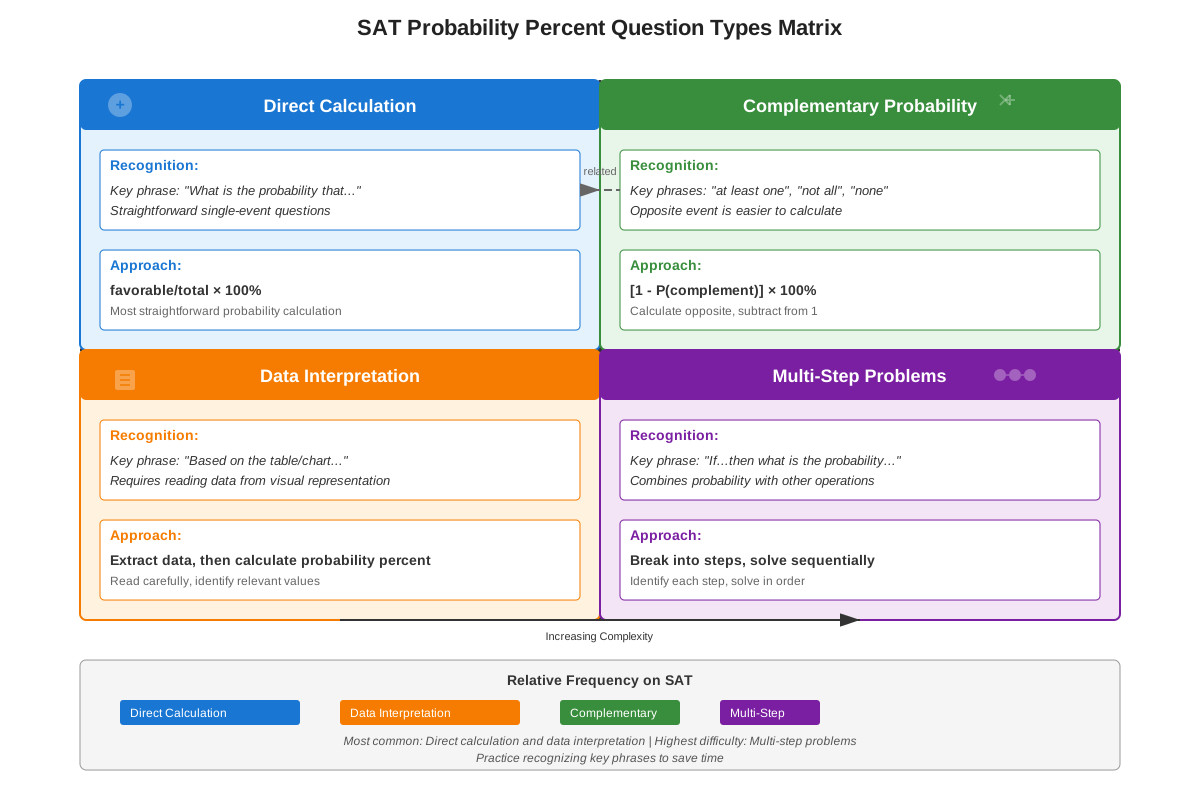
Common SAT question formats include: calculating the probability of selecting specific items from a group and expressing the answer as a percentage; interpreting survey or experimental data to determine the percent chance of particular outcomes; finding complementary probabilities (the percent chance something does NOT occur); and multi-step problems where probability percent serves as an intermediate calculation toward a final answer. Questions often embed probability percent within real-world scenarios involving quality control, demographic statistics, game outcomes, or scientific experiments, testing both mathematical computation and contextual interpretation skills.
Core Concepts
Understanding Probability as a Percentage
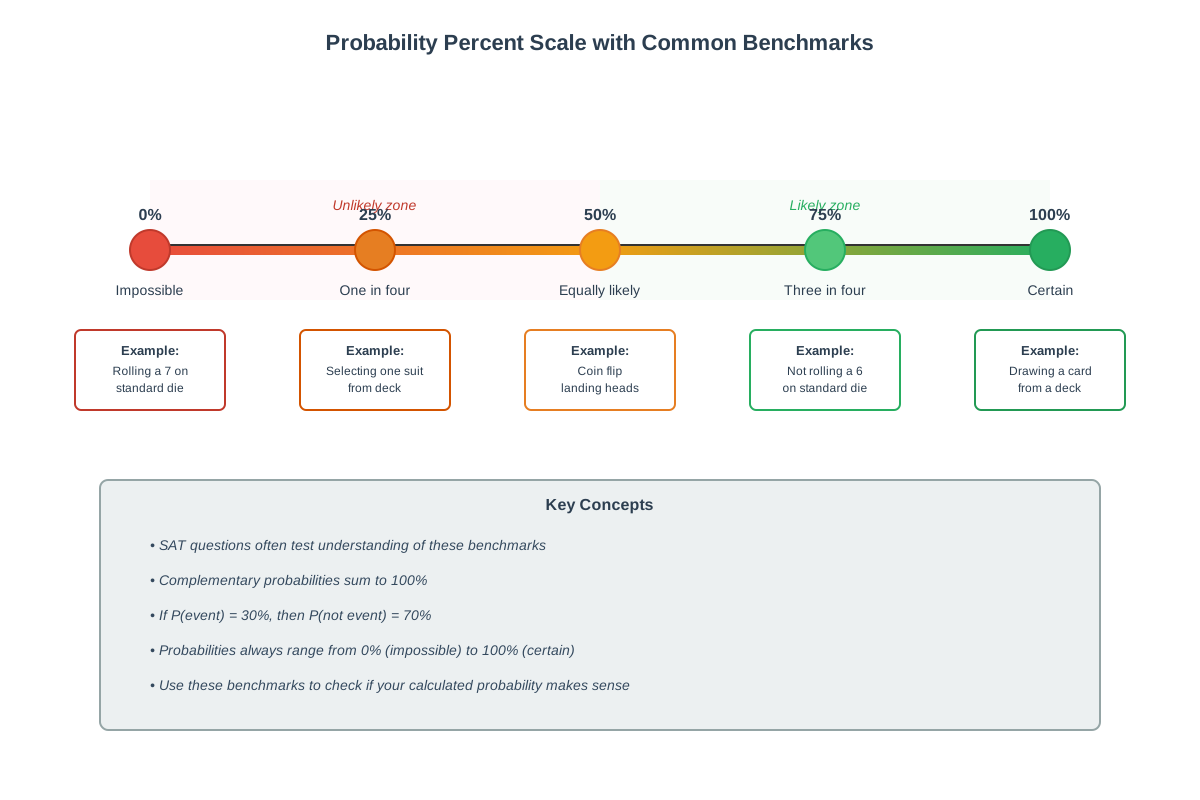
Probability percent expresses the likelihood of an event as a value between 0% and 100%, where 0% represents impossibility and 100% represents certainty. The fundamental conversion formula transforms any probability value into percentage form:
Probability Percent = P(event) × 100%For example, if the probability of drawing a red marble from a bag is 3/5, the probability percent equals (3/5) × 100% = 60%. This conversion maintains the proportional relationship while making the likelihood more intuitive for interpretation. The percentage representation communicates the same information as the fraction or decimal (0.6) but often proves more accessible for quick comprehension and comparison.
Converting Between Probability Representations
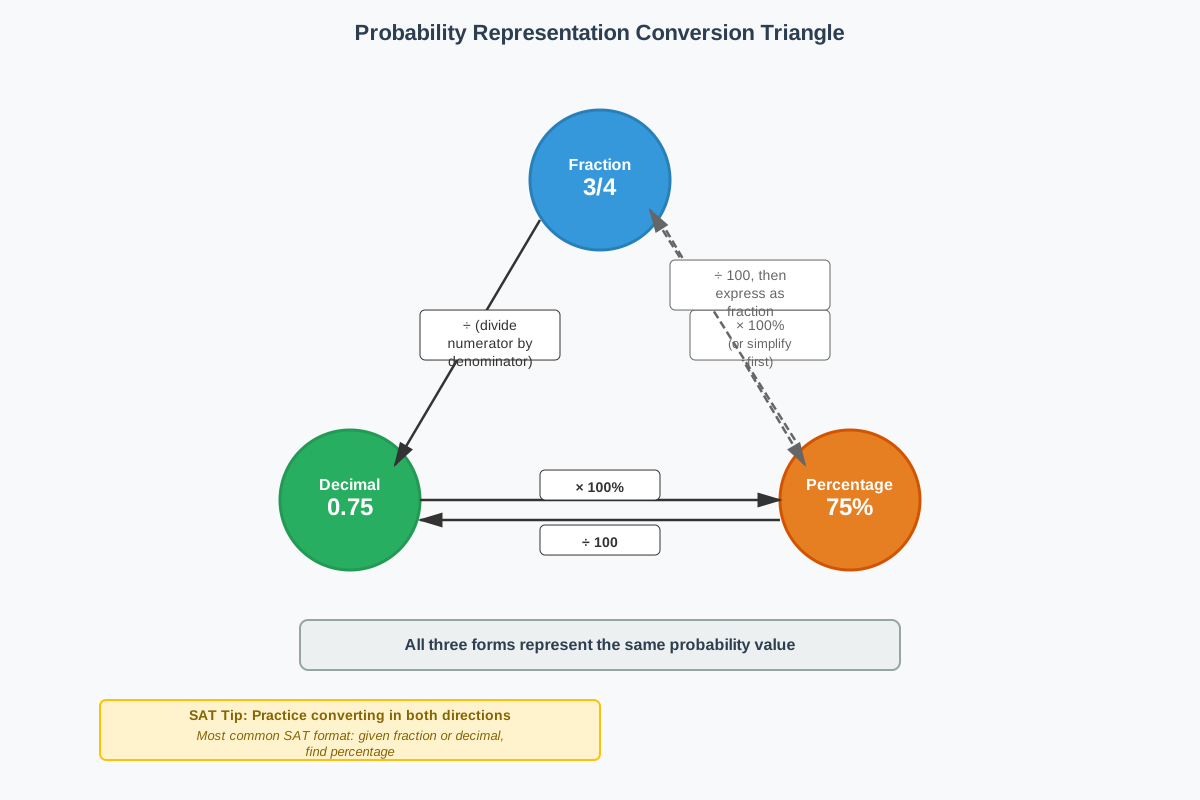
Fluency in converting between fractions, decimals, and percentages forms the foundation of probability percent mastery. The conversion pathway follows this sequence:
- Fraction to Decimal: Divide the numerator by the denominator
- Decimal to Percent: Multiply by 100 and add the % symbol
- Percent to Decimal: Divide by 100 (or move decimal point two places left)
- Decimal to Fraction: Express as a fraction with appropriate denominator and simplify
| Fraction | Decimal | Percent |
|---|---|---|
| 1/4 | 0.25 | 25% |
| 3/5 | 0.6 | 60% |
| 7/8 | 0.875 | 87.5% |
| 2/3 | 0.666... | 66.67% (rounded) |
| 1/2 | 0.5 | 50% |
SAT questions frequently require students to work backward from percentages to other forms. If a question states "there is a 35% probability," students must recognize this equals 0.35 as a decimal or 35/100 = 7/20 as a simplified fraction for subsequent calculations.
Calculating Basic Probability Percent
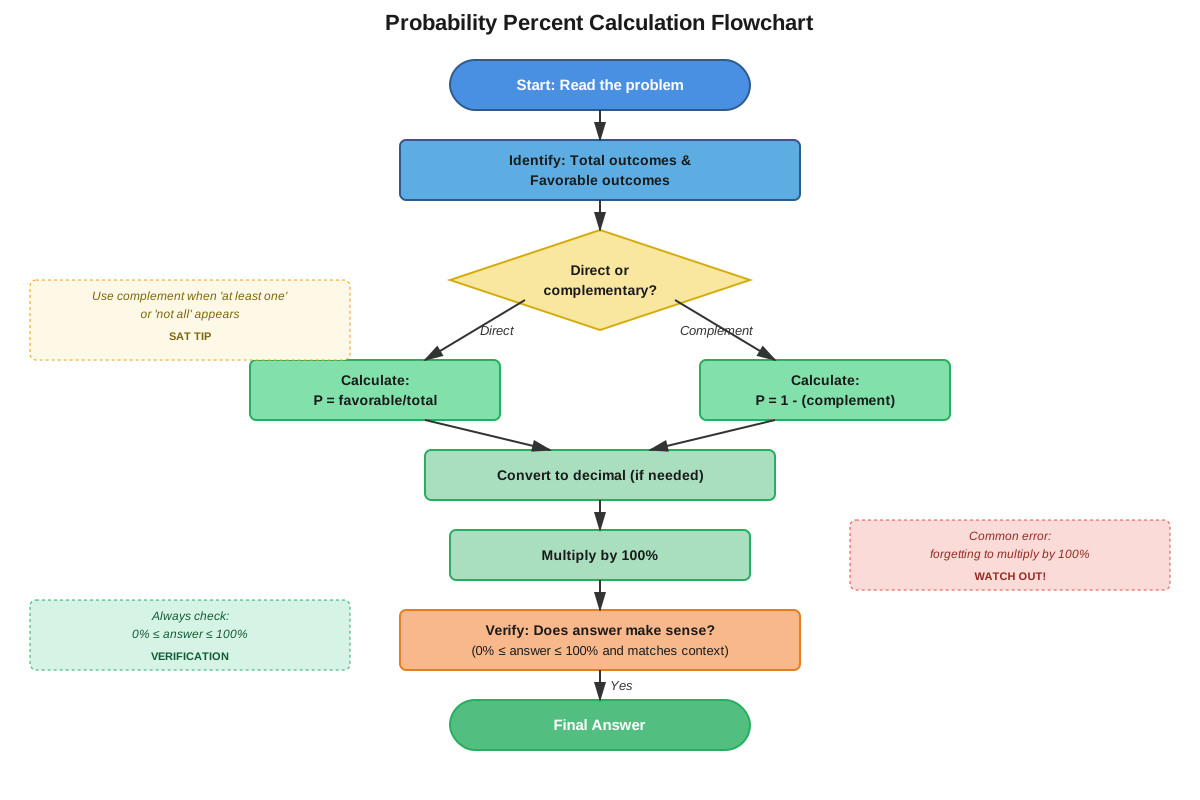
The standard approach to probability percent problems follows these steps:
- Identify the sample space: Determine all possible outcomes
- Count favorable outcomes: Identify outcomes matching the desired event
- Calculate the probability fraction: P(event) = favorable outcomes / total outcomes
- Convert to percentage: Multiply the fraction by 100%
Example: A jar contains 12 red marbles, 8 blue marbles, and 5 green marbles. What is the probability percent of randomly selecting a blue marble?
- Total outcomes: 12 + 8 + 5 = 25 marbles
- Favorable outcomes: 8 blue marbles
- Probability: 8/25
- Probability percent: (8/25) × 100% = 0.32 × 100% = 32%
Complementary Probability Percent
The complement of an event represents all outcomes where the event does NOT occur. Since all probabilities sum to 100%, complementary probability follows the rule:
P(not A) = 100% - P(A)This concept proves particularly valuable on the SAT when calculating the probability of "at least one" occurrence or when the complement is easier to calculate than the original event. For instance, finding the probability that at least one coin flip results in heads is simpler by calculating the complement: 100% minus the probability that all flips are tails.
Example: If the probability of rain tomorrow is 35%, what is the probability percent that it will NOT rain?
P(no rain) = 100% - 35% = 65%
Probability Percent from Data Tables
SAT questions frequently present data in tables or charts, requiring students to extract relevant information and calculate probability percentages. The key skill involves identifying the appropriate subset of data (favorable outcomes) and the total population (sample space).
Example Table:
| Grade Level | Plays Sports | Does Not Play Sports | Total |
|---|---|---|---|
| 9th Grade | 45 | 30 | 75 |
| 10th Grade | 52 | 28 | 80 |
| Total | 97 | 58 | 155 |
Question: If a student is randomly selected from 9th grade, what is the probability percent they play sports?
- Sample space: 75 (total 9th graders)
- Favorable outcomes: 45 (9th graders who play sports)
- Probability percent: (45/75) × 100% = 60%
Multi-Step Probability Percent Problems
Advanced SAT questions combine probability percent with other mathematical operations, requiring sequential reasoning. These problems might involve:
- Calculating probability percent, then using that percentage in a subsequent calculation
- Finding a probability percent, then determining the complementary probability
- Working with conditional probabilities expressed as percentages
- Combining multiple probability percentages through multiplication (independent events) or addition (mutually exclusive events)
The critical skill involves maintaining accuracy through each step while tracking whether to work with percentages, decimals, or fractions at each stage. Generally, converting to decimals for intermediate calculations and converting back to percentages for final answers minimizes errors.
Concept Relationships
Probability percent serves as the intersection point between probability theory and percentage operations. The foundational probability formula (favorable outcomes / total outcomes) → converts through multiplication by 100 → produces probability percent. This conversion process relies on percentage calculation skills, which themselves depend on fraction-to-decimal conversion mastery.
Within probability percent problems, the complement relationship creates an inverse connection: as P(A) increases, P(not A) decreases, with their sum always equaling 100%. This complementary relationship enables strategic problem-solving where calculating the opposite event proves simpler.
Probability percent connects to data interpretation through tables, charts, and graphs that present frequency information. The pathway flows: raw data → frequency counts → probability fractions → probability percentages. This connection explains why SAT questions often embed probability percent within data analysis contexts.
Looking outward to related topics, probability percent forms the foundation for conditional probability (where percentages represent likelihoods given specific conditions), expected value calculations (which multiply probability percentages by outcomes), and statistical inference (where confidence levels and p-values express uncertainty as percentages). Mastering probability percent enables progression to these more sophisticated statistical concepts that appear on advanced standardized tests.
High-Yield Facts
⭐ Probability percent always ranges from 0% to 100%, where 0% means impossible and 100% means certain
⭐ To convert any probability to a percentage, multiply by 100 and add the % symbol
⭐ Complementary probabilities sum to 100%: P(A) + P(not A) = 100%
⭐ When extracting probability from data tables, identify the correct subset (favorable) and total (sample space) carefully
⭐ Common SAT trap: confusing the part with the whole when calculating probability from tables
- Converting percentages back to decimals for calculations requires dividing by 100 (moving decimal two places left)
- Probability percent can be expressed with decimal precision (e.g., 33.33%) when fractions don't convert to whole percentages
- The probability of selecting items "with replacement" differs from "without replacement," affecting percentage calculations
- When multiple independent events occur, multiply their decimal probabilities, then convert to percentage
- Survey data questions often require calculating probability percent from two-way frequency tables
Quick check — test yourself on Probability percent so far.
Try Flashcards →Common Misconceptions
Misconception: Probability percent can exceed 100% if multiple events are considered together.
Correction: Individual probability percentages always range from 0% to 100%. When considering multiple events, students might add probabilities, but this represents the probability of "either/or" scenarios, not a single event exceeding 100%. The sum of all mutually exclusive and exhaustive events equals exactly 100%.
Misconception: Converting a fraction to a percentage means simply adding a % symbol to the fraction.
Correction: Converting a fraction to probability percent requires dividing the numerator by the denominator to get a decimal, then multiplying by 100. For example, 3/8 does not equal 3/8%, but rather (3÷8) × 100% = 37.5%.
Misconception: The complement of a 40% probability is -40%.
Correction: Complementary probability subtracts from 100%, not from zero. The complement of 40% is 100% - 40% = 60%. Probabilities cannot be negative.
Misconception: When a table shows 30 out of 100 people prefer option A, the probability percent is 30/100%.
Correction: The probability is 30/100, which equals 0.30 as a decimal, which converts to 30% (not 30/100%). The percentage already incorporates the "per hundred" concept, so the fraction must be converted, not restated.
Misconception: Probability percent and percentage change are the same concept.
Correction: Probability percent expresses likelihood of an event (0-100% scale), while percentage change measures relative increase or decrease in a quantity (can exceed 100% or be negative). A 150% increase in sales is valid; a 150% probability is impossible.
Misconception: Rounding probability percentages early in multi-step problems doesn't affect the final answer.
Correction: Premature rounding introduces cumulative error. Maintain full decimal precision through intermediate steps, rounding only the final answer to the requested precision (typically one or two decimal places on the SAT).
Worked Examples
Example 1: Basic Probability Percent from a Scenario
Problem: A high school cafeteria offers 5 vegetarian meals, 12 chicken meals, 8 beef meals, and 3 fish meals each day. If a student randomly selects a meal, what is the probability percent that the student selects a vegetarian or fish meal?
Solution:
Step 1: Identify the sample space (total possible outcomes)
- Total meals = 5 + 12 + 8 + 3 = 28 meals
Step 2: Identify favorable outcomes
- Vegetarian or fish meals = 5 + 3 = 8 meals
- (Note: "or" in probability means addition when events are mutually exclusive)
Step 3: Calculate the probability fraction
- P(vegetarian or fish) = 8/28 = 2/7 (simplified)
Step 4: Convert to probability percent
- (2/7) × 100% = 0.2857... × 100% = 28.57%
Answer: 28.57% or approximately 28.6%
Connection to Learning Objectives: This problem demonstrates identifying key features of probability percent (conversion from fraction to percentage) and applying the concept to answer an SAT-style question involving a real-world scenario.
Example 2: Complementary Probability Percent from a Table
Problem: The table below shows survey results from 200 students about their preferred study location.
| Location | Number of Students |
|---|---|
| Library | 75 |
| Home | 82 |
| Coffee Shop | 28 |
| Other | 15 |
If a student from this survey is selected at random, what is the probability percent that the student does NOT prefer studying at home?
Solution:
Step 1: Identify the total sample space
- Total students = 200 (given, or verify: 75 + 82 + 28 + 15 = 200)
Step 2: Recognize this is a complementary probability problem
- We need P(NOT home) = 100% - P(home)
Step 3: Calculate P(home)
- Students who prefer home = 82
- P(home) = 82/200 = 0.41
- P(home) as percent = 0.41 × 100% = 41%
Step 4: Calculate the complement
- P(NOT home) = 100% - 41% = 59%
Alternative approach (direct calculation):
- Students who do NOT prefer home = 75 + 28 + 15 = 118
- P(NOT home) = 118/200 = 0.59 = 59%
Answer: 59%
Connection to Learning Objectives: This problem demonstrates calculating complementary probabilities using percentage representations and interpreting probability percent from data tables—both high-yield SAT skills. The alternative approach shows that complementary probability can be calculated directly or through subtraction, with both methods yielding identical results.
Exam Strategy
When approaching sat probability percent questions, begin by carefully reading the problem to identify three critical elements: the total sample space, the favorable outcomes, and whether the question asks for a direct probability or a complement. Circle or underline these elements in the question text to maintain focus.
Trigger words and phrases that signal probability percent questions include:
- "What is the probability that..." or "What is the percent chance that..."
- "If randomly selected..." or "If chosen at random..."
- "What percent of..." when referring to likelihood rather than composition
- "How likely is it that..." or "What are the chances that..."
- "Does NOT," "at least one," or "none" (complement indicators)
For process-of-elimination strategies, recognize that probability percentages must fall between 0% and 100%. Immediately eliminate any answer choice outside this range. When answer choices are close together (e.g., 32%, 34%, 36%, 38%), the problem likely requires precise calculation rather than estimation—avoid rounding intermediate steps. If answer choices are widely spaced (e.g., 20%, 40%, 60%, 80%), estimation and benchmark fractions (1/4 = 25%, 1/3 ≈ 33%, 1/2 = 50%) can quickly identify the correct range.
Time allocation for probability percent questions should average 60-90 seconds for straightforward single-step problems and 2-3 minutes for complex multi-step problems involving tables or complementary probabilities. If a problem requires more than 3 minutes, mark it for review and move forward—these questions rarely carry more weight than simpler problems, so time management takes priority.
Exam Tip: When working with data tables, always verify that your identified sample space matches the question's context. A question asking about "9th graders" requires using the 9th grade total, not the entire school population. This represents the most common error on table-based probability percent questions.
Convert percentages to decimals for intermediate calculations to avoid errors with percentage arithmetic. For example, if you need to multiply probabilities, work with 0.40 × 0.30 = 0.12 = 12% rather than attempting 40% × 30% directly. The decimal form follows standard multiplication rules, while percentage multiplication requires additional conceptual steps.
Memory Techniques
Mnemonic for Probability Percent Conversion: "Fraction Divides, Times Hundred" (FDTH)
- Fraction: Start with the probability fraction
- Divides: Divide numerator by denominator
- Times: Multiply by 100
- Hundred: Add the percent symbol
Visualization Strategy: Picture a probability percent as a partially filled container where 0% is completely empty, 50% is half-full, and 100% is completely full. This mental image helps quickly assess whether calculated percentages make intuitive sense. A probability percent of 85% should feel "almost full" or "very likely," while 15% should feel "nearly empty" or "unlikely."
Complement Rule Acronym: "SWAN" - Subtract What you know Away from oNe hundred
- Reminds students that P(not A) = 100% - P(A)
- The "one hundred" reference anchors the complement calculation
Benchmark Fraction Memory Aid: Memorize these common conversions for quick estimation:
- 1/4 = 25% (quarter)
- 1/3 ≈ 33% (third)
- 1/2 = 50% (half)
- 2/3 ≈ 67% (two-thirds)
- 3/4 = 75% (three-quarters)
These benchmarks enable rapid answer elimination and reasonableness checking without calculator computation.
Summary
Probability percent represents the likelihood of events occurring expressed on a 0% to 100% scale, combining fundamental probability concepts with percentage operations. Mastery requires fluent conversion between fractions, decimals, and percentages while maintaining accurate interpretation of what these values represent. The SAT tests this concept through direct calculation problems, data table interpretation, complementary probability scenarios, and multi-step problems embedding probability percent within broader mathematical contexts. Success depends on identifying the correct sample space and favorable outcomes, applying the conversion formula P(event) × 100%, and recognizing when complementary probability (100% - P(event)) provides a more efficient solution path. Students must distinguish probability percent from related but distinct concepts like percentage change or percentage composition, avoid premature rounding in multi-step calculations, and verify that final answers fall within the valid 0-100% range. The ability to extract probability information from tables, charts, and word problems while maintaining computational accuracy separates proficient students from those who struggle with these high-yield SAT questions.
Key Takeaways
- Probability percent converts probability values to percentages by multiplying by 100, making likelihood more intuitive and comparable
- All probability percentages must fall between 0% (impossible) and 100% (certain), providing an immediate reasonableness check for answers
- Complementary probabilities sum to 100%, enabling efficient calculation when P(not A) is simpler to find than P(A)
- Data table problems require careful identification of the relevant sample space and favorable outcomes based on the specific question context
- Converting to decimals for intermediate calculations minimizes errors in multi-step probability percent problems
- Common SAT traps include confusing parts with wholes, adding percentages incorrectly, and premature rounding—systematic approaches prevent these errors
- Trigger words like "randomly selected," "does NOT," and "at least one" signal specific probability percent strategies and calculation approaches
Related Topics
Conditional Probability: Builds on probability percent by calculating likelihoods when additional information restricts the sample space. Mastering probability percent provides the foundation for understanding how percentages change when conditions are applied.
Expected Value: Combines probability percentages with outcome values to calculate weighted averages representing long-term expectations. Requires converting probability percents to decimals for multiplication with monetary or numerical outcomes.
Statistical Inference and Confidence Intervals: Uses probability percent to express certainty levels in statistical conclusions. Understanding probability percent as likelihood enables interpretation of statements like "95% confidence interval."
Compound Probability: Extends single-event probability percent to multiple events occurring in sequence or combination. Requires multiplying or adding probability percentages depending on whether events are independent or mutually exclusive.
Data Analysis and Two-Way Tables: Frequently presents probability percent scenarios through organized data displays. Strengthening probability percent skills enhances overall data interpretation abilities across the SAT math section.
Practice CTA
Now that you've mastered the core concepts of probability percent, reinforce your understanding through targeted practice. Complete the practice questions to apply these strategies to authentic SAT-style problems, testing your ability to convert between representations, calculate complementary probabilities, and extract information from data tables. Use the flashcards to drill the high-yield facts and common conversions until they become automatic, freeing your cognitive resources for complex problem-solving during the actual exam. Remember: probability percent questions represent high-yield content that appears consistently on every SAT—your investment in mastering this topic will directly translate to points on test day. Approach each practice problem systematically, verify your answers fall within the valid 0-100% range, and build the confidence that comes from repeated successful application of these concepts.
Sign up free to keep reading
Create a free AnvayaPrep account to finish this SAT guide on Probability percent — plus flashcards and practice questions.