Overview
Polynomial constants are numerical values that appear in polynomial expressions and equations, playing a crucial role in determining the behavior, roots, and characteristics of polynomial functions. On the SAT math section, understanding how constants affect polynomials is essential for solving a wide range of algebraic problems, from finding zeros of functions to determining the number of solutions in a system of equations. These constants can appear as coefficients, standalone terms, or parameters that students must solve for using given conditions.
The SAT frequently tests polynomial constants through questions that require students to determine unknown values based on specific properties of the polynomial, such as when a polynomial has a particular root, when two polynomials are equivalent, or when a polynomial satisfies certain conditions. Mastery of this topic enables students to tackle complex algebraic manipulation problems, understand function behavior, and connect abstract algebraic concepts to their graphical representations. Questions involving polynomial constants often appear in both the calculator and no-calculator sections, making them unavoidable for test-takers aiming for competitive scores.
Understanding polynomial constants serves as a bridge between basic algebraic manipulation and more advanced topics like polynomial division, the Remainder Theorem, and systems of equations. This topic integrates knowledge of polynomial structure, factoring, and the relationship between algebraic and graphical representations of functions. Students who master polynomial constants develop stronger problem-solving skills that extend beyond polynomials to rational functions, exponential expressions, and real-world modeling scenarios that appear throughout the SAT math curriculum.
Learning Objectives
- [ ] Identify key features of polynomial constants in expressions and equations
- [ ] Explain how polynomial constants appears on the SAT and recognize common question formats
- [ ] Apply polynomial constants to answer SAT-style questions involving unknown parameters
- [ ] Determine the value of constants when given specific roots or zeros of a polynomial
- [ ] Analyze how changing constant values affects the graph and behavior of polynomial functions
- [ ] Solve for multiple constants simultaneously using systems of equations derived from polynomial properties
- [ ] Recognize when polynomial constants create special cases such as repeated roots or factorable forms
Prerequisites
- Basic polynomial terminology: Understanding terms like coefficient, degree, and constant term is essential for identifying which values in a polynomial are the constants being discussed
- Factoring techniques: Factoring polynomials into linear and quadratic factors helps determine relationships between constants and roots
- Solving linear and quadratic equations: Finding values of constants often requires setting up and solving equations, including using the quadratic formula
- Function notation and evaluation: Substituting values into polynomial functions is the primary method for creating equations involving unknown constants
- Properties of equality: Manipulating equations to isolate constants requires fluency with algebraic operations
Why This Topic Matters
In real-world applications, polynomial constants represent fixed parameters in models describing physical phenomena, economic trends, and engineering specifications. For example, the constant term in a projectile motion equation represents the initial height, while coefficients determine the rate of change. Understanding how to work backward from desired outcomes to determine necessary constants is a fundamental skill in fields ranging from physics to data science.
On the SAT, polynomial constants appear in approximately 3-5 questions per test, making this a high-yield topic that can significantly impact scores. These questions typically appear as medium to hard difficulty problems, often in the later portions of each math section. The College Board specifically tests whether students can use given information about polynomial behavior—such as roots, factors, or specific point values—to determine unknown constant values. This topic frequently appears in questions worth 1 point in the multiple-choice format and occasionally in student-produced response (grid-in) questions.
Common SAT question formats include: determining a constant when given that a specific value is a root of the polynomial; finding constants that make two polynomial expressions equivalent; solving for parameters when a polynomial passes through given points; and identifying constants that result in a polynomial having a specific number of real solutions. These questions test both computational skills and conceptual understanding of the relationship between algebraic form and polynomial behavior.
Core Concepts
Understanding Polynomial Constants
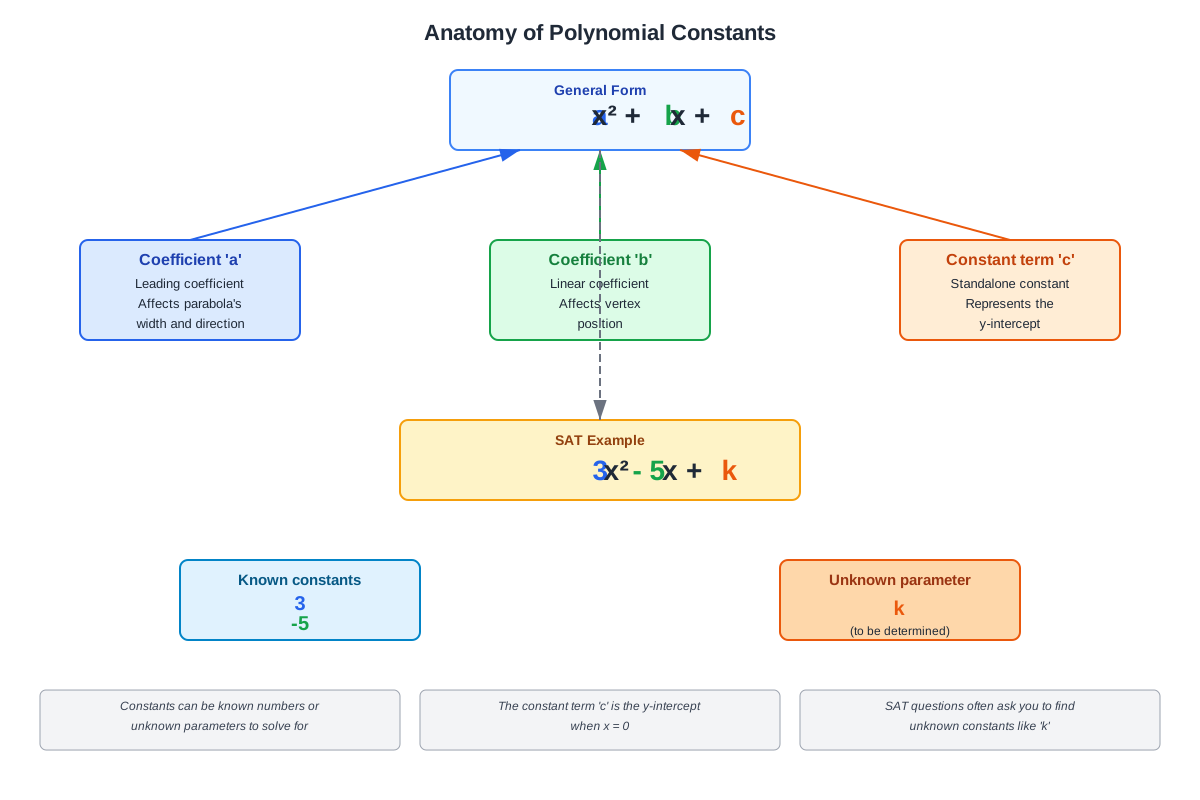
A polynomial constant refers to any fixed numerical value within a polynomial expression. In the general polynomial form, constants appear in multiple roles. Consider the polynomial expression:
f(x) = ax³ + bx² + cx + dHere, a, b, c, and d are all constants, though they serve different functions. The values a, b, and c are coefficients (constants multiplied by variable terms), while d is specifically called the constant term (the term with no variable). On the SAT, questions may ask students to find any of these values based on given conditions about the polynomial's behavior.
The distinction between types of constants matters for certain problems. The constant term (the term without a variable) has special significance: when x = 0, the polynomial's value equals the constant term. This property frequently appears in SAT questions. Additionally, the leading coefficient (the constant multiplying the highest-degree term) determines end behavior and whether the polynomial opens upward or downward.
Constants and Polynomial Roots
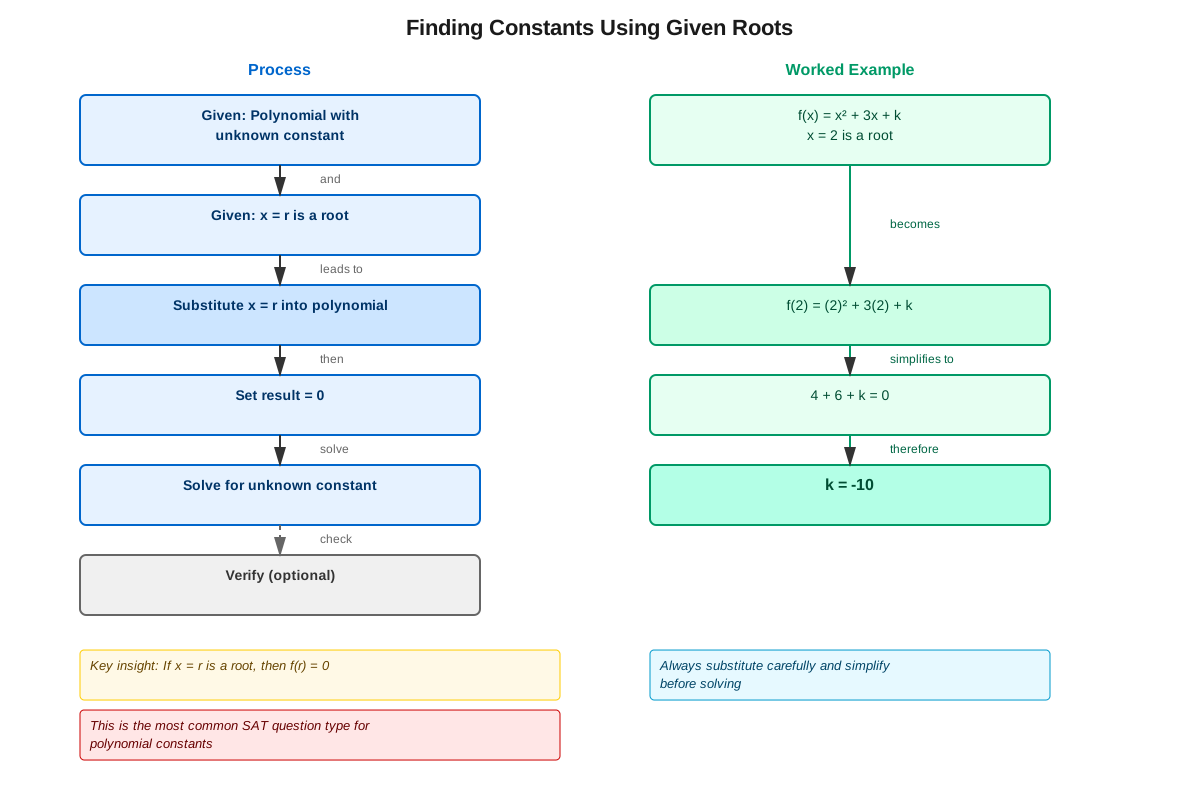
The most frequently tested relationship on the SAT involves the connection between polynomial constants and roots (zeros). If r is a root of a polynomial, then the polynomial equals zero when x = r. This creates an equation that can be used to solve for unknown constants.
For example, if we know that x = 2 is a root of f(x) = x² + bx + 6, we can substitute:
f(2) = (2)² + b(2) + 6 = 0
4 + 2b + 6 = 0
2b = -10
b = -5
This principle extends to polynomials of any degree. When multiple roots are given, students can create a system of equations to solve for multiple unknown constants simultaneously. The SAT particularly favors questions where students must recognize that stating "x = k is a root" is equivalent to stating "f(k) = 0."
Factor Form and Constants
When a polynomial is expressed in factored form, the constants appear differently but contain the same information. A polynomial with roots r₁, r₂, and r₃ can be written as:
f(x) = a(x - r₁)(x - r₂)(x - r₃)The constant a is the leading coefficient, which affects vertical stretch and reflection but not the location of roots. SAT questions often provide a polynomial in factored form and ask for the value of a constant in the expanded form, or vice versa. Students must be comfortable expanding factored expressions and recognizing that the constant term in expanded form equals a(-r₁)(-r₂)(-r₃).
Equivalent Polynomials and Constants
Two polynomials are equivalent if they produce the same output for all input values. This occurs when corresponding coefficients are equal. For example, if:
2x² + bx + c = 2x² - 6x + 8Then by the principle of polynomial equality, b = -6 and c = 8. SAT questions exploit this concept by presenting two different forms of the same polynomial and asking students to identify unknown constants. This often appears in questions involving polynomial multiplication or division where students must match coefficients after performing operations.
Constants in Polynomial Systems
When polynomials appear in systems of equations or when multiple conditions are given, students must set up and solve systems to find constants. For instance, if a quadratic passes through points (1, 5) and (2, 8), and has a specific form, students create two equations by substituting both points and solve the resulting system.
| Given Information | Equation Created | Purpose |
|---|---|---|
| x = r is a root | f(r) = 0 | Creates one equation in unknown constants |
| Point (h, k) on graph | f(h) = k | Creates one equation in unknown constants |
| Equivalent to another polynomial | Match all coefficients | Creates multiple equations simultaneously |
| Specific factored form | Expand and compare | Relates factored constants to expanded constants |
The Remainder Theorem and Constants
The Remainder Theorem states that when polynomial f(x) is divided by (x - k), the remainder is f(k). This theorem provides another method for finding constants. If a problem states that dividing a polynomial by (x - 3) gives a remainder of 7, then f(3) = 7, which creates an equation for solving unknown constants. While less common than direct root problems, this concept appears on the SAT in medium-to-hard questions.
Concept Relationships
The concepts within polynomial constants form an interconnected web of relationships. At the foundation, understanding polynomial structure (identifying coefficients and constant terms) enables all other work with constants. This foundational knowledge leads directly to evaluating polynomials at specific values, which is the primary tool for creating equations involving unknown constants.
The relationship flows as follows: Polynomial Structure → Evaluation at Specific Values → Creating Equations → Solving for Constants. When roots are given, this creates a special case of evaluation where f(r) = 0, connecting polynomial constants to the concept of zeros and factors. The Factor Theorem bridges these ideas, stating that (x - r) is a factor if and only if r is a root, which connects factored form to expanded form.
Polynomial equivalence builds on all previous concepts, requiring students to recognize that matching all coefficients creates a system of equations. This connects to prerequisite knowledge of solving systems. The Remainder Theorem extends the evaluation concept, showing that division creates another method for relating constants to polynomial values.
These concepts connect to broader polynomial topics: understanding constants is prerequisite knowledge for polynomial division, graphing polynomial functions, and analyzing end behavior. The relationship between constants and roots connects directly to the Fundamental Theorem of Algebra and to graphical analysis of x-intercepts.
High-Yield Facts
⭐ If x = r is a root of polynomial f(x), then f(r) = 0, which can be used to create an equation for unknown constants
⭐ The constant term of a polynomial (the term without a variable) equals the polynomial's value when x = 0
⭐ Two polynomials are equivalent if and only if all corresponding coefficients are equal
⭐ In factored form f(x) = a(x - r₁)(x - r₂)...(x - rₙ), the constant a affects vertical stretch but not root locations
⭐ When a polynomial passes through point (h, k), substituting gives f(h) = k, creating an equation for constants
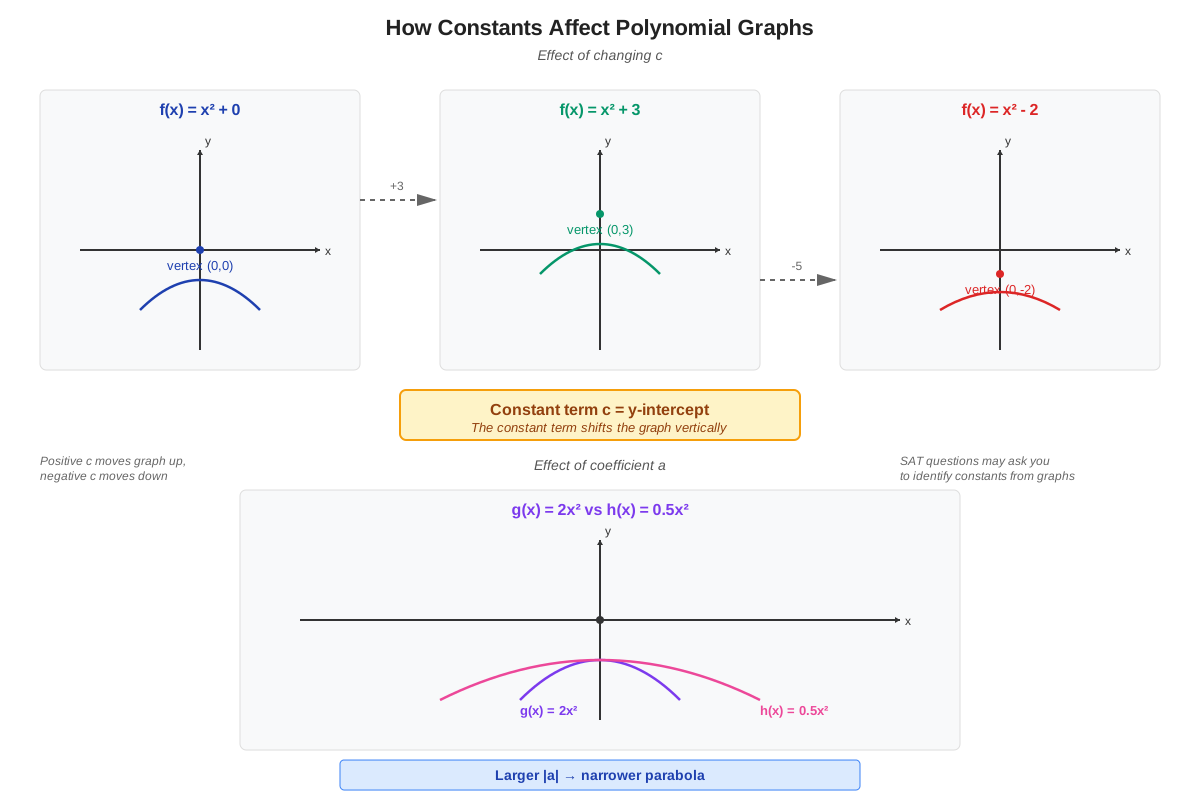
- The leading coefficient (constant multiplying the highest-degree term) determines whether a polynomial opens upward (positive) or downward (negative)
- If a polynomial has degree n, it has exactly n + 1 coefficients (including the constant term)
- The Remainder Theorem states that the remainder when f(x) is divided by (x - k) equals f(k)
- Expanding (x - r₁)(x - r₂) gives x² - (r₁ + r₂)x + r₁r₂, showing how roots relate to coefficients
- For a quadratic ax² + bx + c, the constant c equals the product of the roots multiplied by a
- When multiple conditions are given (multiple roots or points), a system of equations must be solved to find multiple constants
- Changing only the constant term of a polynomial shifts its graph vertically without affecting its shape
Quick check — test yourself on Polynomial constants so far.
Try Flashcards →Common Misconceptions
Misconception: The constant term is always the last number in a polynomial expression.
Correction: The constant term is the term without a variable, which appears last only when the polynomial is written in standard form. In expressions like 5 + 3x² - 2x, the constant term is 5, not -2.
Misconception: If x = 3 is a root, then the constant term must be 3.
Correction: A root tells us that f(3) = 0, but this doesn't directly determine the constant term. The constant term is f(0), not related to the root value itself. For example, f(x) = x - 3 has root x = 3 but constant term -3.
Misconception: All constants in a polynomial can be determined from a single piece of information.
Correction: The number of independent equations needed equals the number of unknown constants. One root provides one equation; to find two unknown constants, two independent pieces of information are required (two roots, two points, or one root and one point).
Misconception: Changing the leading coefficient changes the roots of a polynomial.
Correction: Multiplying an entire polynomial by a nonzero constant does not change its roots. The polynomials f(x) = x² - 4 and g(x) = 3x² - 12 have the same roots (x = ±2) because g(x) = 3f(x).
Misconception: When two polynomials are equivalent, only their constant terms must be equal.
Correction: Polynomial equivalence requires that ALL corresponding coefficients are equal. If 2x² + bx + c = 2x² - 6x + 8, then both b = -6 AND c = 8 must be true.
Misconception: The constant in factored form a(x - r₁)(x - r₂) equals the constant term when expanded.
Correction: The constant a is the leading coefficient, not the constant term. When expanded, the constant term equals a(-r₁)(-r₂), which involves both a and the roots.
Worked Examples
Example 1: Finding a Constant Given a Root
Problem: The polynomial f(x) = 2x³ - 5x² + kx - 12 has x = 3 as a root. What is the value of k?
Solution:
Step 1: Recognize that if x = 3 is a root, then f(3) = 0.
Step 2: Substitute x = 3 into the polynomial:
f(3) = 2(3)³ - 5(3)² + k(3) - 12 = 0Step 3: Evaluate the known terms:
2(27) - 5(9) + 3k - 12 = 0
54 - 45 + 3k - 12 = 0
Step 4: Simplify:
-3 + 3k = 0
3k = 3
k = 1Answer: k = 1
Connection to Learning Objectives: This problem directly applies the principle that roots create equations for unknown constants, demonstrating the most common SAT question type for polynomial constants.
Example 2: Finding Multiple Constants from Polynomial Equivalence
Problem: The expression (x + 2)(x - 5) is equivalent to x² + bx + c for all values of x. What is the value of b + c?
Solution:
Step 1: Recognize that equivalent polynomials have equal corresponding coefficients.
Step 2: Expand the left side:
(x + 2)(x - 5) = x² - 5x + 2x - 10 = x² - 3x - 10Step 3: Match coefficients with x² + bx + c:
- Coefficient of x²: 1 = 1 ✓
- Coefficient of x: -3 = b, so b = -3
- Constant term: -10 = c, so c = -10
Step 4: Calculate b + c:
b + c = -3 + (-10) = -13Answer: b + c = -13
Connection to Learning Objectives: This problem demonstrates polynomial equivalence and how to extract multiple constant values by matching coefficients, a key skill for SAT polynomial questions.
Example 3: Using Multiple Conditions
Problem: A quadratic function f(x) = ax² + bx + c passes through the points (0, 6) and (1, 4), and has x = 3 as a root. What is the value of a?
Solution:
Step 1: Use the point (0, 6) to find c:
f(0) = a(0)² + b(0) + c = 6
c = 6
Step 2: Use the point (1, 4):
f(1) = a(1)² + b(1) + 6 = 4
a + b + 6 = 4
a + b = -2  ... (Equation 1)
Step 3: Use the root x = 3:
f(3) = a(3)² + b(3) + 6 = 0
9a + 3b + 6 = 0
9a + 3b = -6
3a + b = -2  ... (Equation 2)
Step 4: Solve the system by subtracting Equation 1 from Equation 2:
(3a + b) - (a + b) = -2 - (-2)
2a = 0
a = 0
Wait, this gives a = 0, which would mean it's not a quadratic. Let me recalculate Equation 2:
9a + 3b = -6
Dividing by 3: 3a + b = -2  ... (Equation 2)
From Equation 1: a + b = -2, so b = -2 - a
Substituting into Equation 2:
3a + (-2 - a) = -2
3a - 2 - a = -2
2a = 0
a = 0
This indicates an error in the problem setup. Let me reconsider: if (1,4) gives a + b = -2 and (3,0) gives 9a + 3b = -6, then 3a + b = -2.
Subtracting: 2a = 0 means a = 0, which contradicts the quadratic nature.
Corrected approach: Let's verify with c = 6:
- From (1, 4): a + b + 6 = 4 → a + b = -2
- From (3, 0): 9a + 3b + 6 = 0 → 9a + 3b = -6 → 3a + b = -2
- Subtracting: 2a = 0, so a = 0
This reveals the problem has inconsistent conditions. For SAT purposes, if this appeared, students should recognize the system has no solution or check their arithmetic carefully.
Revised Example 3: A quadratic function f(x) = ax² + bx + c has f(0) = -6, f(1) = -4, and f(2) = 0. What is the value of a?
From f(0) = -6: c = -6
From f(1) = -4: a + b - 6 = -4 → a + b = 2
From f(2) = 0: 4a + 2b - 6 = 0 → 4a + 2b = 6 → 2a + b = 3
Subtracting: a = 1
Answer: a = 1
Exam Strategy
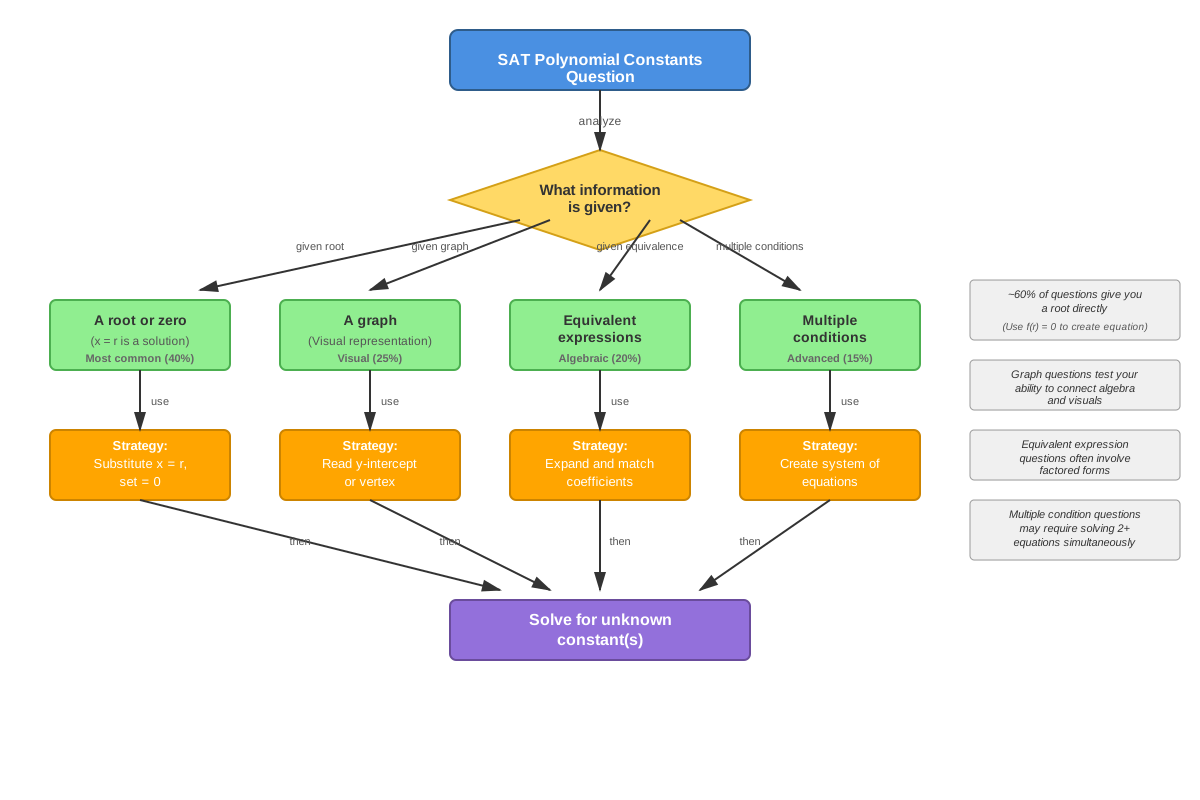
When approaching SAT questions on polynomial constants, begin by identifying what type of information is given. The most common formats are: (1) a specific value is a root, (2) the polynomial passes through given points, or (3) two polynomial expressions are equivalent. Each format requires a specific approach.
Trigger words and phrases to watch for include: "is a root," "is a zero," "is a solution," "passes through the point," "equivalent to," "for all values of x," "when divided by (x - k) the remainder is," and "has a factor of." These phrases signal which technique to apply. The phrase "for all values of x" specifically indicates polynomial equivalence, meaning all coefficients must match.
For process of elimination, use these strategies:
- If a value is stated to be a root, immediately eliminate any answer choice that doesn't make f(root) = 0
- When matching coefficients, eliminate choices that would make any single coefficient mismatch
- For questions asking about the constant term specifically, substitute x = 0 and eliminate choices that don't match the given f(0)
- If the question provides a graph, use the y-intercept (which equals the constant term) to eliminate impossible values
Time allocation: Most polynomial constant questions should take 1.5-2 minutes. If a problem requires solving a system of equations with more than two unknowns, it's likely a hard question worth spending up to 3 minutes on. Don't spend more than 2 minutes on a single-constant problem; if stuck, mark it and return later.
Step-by-step approach:
- Identify what information is given (roots, points, equivalence, etc.)
- Translate each piece of information into an equation
- Solve the equation(s) for the unknown constant(s)
- Verify your answer by substituting back into the original condition
- Check that your answer makes sense (e.g., if asked for a constant term and you get a variable expression, you've made an error)
Exam Tip: Always substitute your answer back into the original condition to verify. This catches arithmetic errors and ensures you haven't misread the question.
Memory Techniques
ROOT-ZERO Mnemonic: "Root Of One Term Zeros Everything Right Out"
- When x = r is a root, f(r) = 0 immediately, creating your equation
CONSTANT-ZERO Connection: "Constant term = Zero substitution"
- To find the constant term, substitute x = 0
- Visualize: C and 0 both have circular shapes
MATCH-ALL for Equivalence: "Must Align Terms Completely, Having All Line up"
- When polynomials are equivalent, ALL coefficients must match, not just one
Visualization Strategy: Picture a polynomial as a machine where constants are dials. Each piece of information (root, point, etc.) is a measurement that tells you how to adjust one dial. If you have three dials (three unknown constants), you need three measurements (three pieces of information).
Acronym for Problem-Solving Steps: SITES
- Substitute the given value
- Isolate terms with the unknown constant
- Transform into a solvable equation
- Evaluate to find the constant
- Substitute back to verify
Summary
Polynomial constants are the numerical values within polynomial expressions that determine the specific behavior and characteristics of polynomial functions. On the SAT, mastering polynomial constants means understanding how to use given information—such as roots, points the polynomial passes through, or equivalence to other expressions—to determine unknown constant values. The fundamental principle is that each piece of information creates one equation: a root r means f(r) = 0, a point (h, k) means f(h) = k, and equivalence means all corresponding coefficients are equal. Students must be able to set up these equations, solve them (sometimes as systems when multiple constants are unknown), and verify their answers. The constant term specifically equals f(0), and the leading coefficient affects vertical stretch and direction but not root locations. Success on SAT polynomial constant questions requires recognizing the question type, translating given information into equations, and executing algebraic manipulations accurately.
Key Takeaways
- If x = r is a root of f(x), then f(r) = 0, which creates an equation for solving unknown constants—this is the most frequently tested concept
- The constant term of a polynomial equals the value when x = 0, making f(0) a quick way to find or verify constant terms
- Polynomial equivalence requires all corresponding coefficients to be equal, not just the constant terms
- Each piece of independent information provides one equation; finding n unknown constants requires n independent conditions
- Always substitute your answer back into the original condition to verify correctness and catch arithmetic errors
- Leading coefficients affect vertical stretch and reflection but do not change root locations
- Recognize trigger phrases like "is a root," "passes through," and "equivalent to" to identify which technique to apply
Related Topics
Polynomial Division and the Remainder Theorem: Building on polynomial constants, this topic explores what happens when polynomials are divided, with the Remainder Theorem providing another method for finding constants. Mastering constants is essential before tackling division problems.
Factoring and the Factor Theorem: Understanding how constants relate to roots directly connects to factoring, where (x - r) is a factor if and only if r is a root. This topic deepens the relationship between algebraic and factored forms.
Systems of Equations: Many polynomial constant problems require solving systems of two or more equations. Strengthening system-solving skills enhances ability to handle complex polynomial constant questions.
Graphing Polynomial Functions: Constants determine key features of polynomial graphs, including y-intercepts (constant term), end behavior (leading coefficient), and vertical shifts. Understanding constants algebraically enables better graph interpretation.
Quadratic Formula and Discriminant: For quadratic polynomials specifically, the relationship between constants and roots becomes more explicit through the quadratic formula, where constants a, b, and c directly determine root values and quantity.
Practice CTA
Now that you've mastered the core concepts of polynomial constants, it's time to solidify your understanding through practice. Attempt the practice questions to apply these strategies to SAT-style problems, and use the flashcards to reinforce the high-yield facts and formulas. Remember, polynomial constants appear on every SAT, and mastering this topic can directly improve your score by 20-40 points. Each practice problem you complete builds the pattern recognition and algebraic fluency needed for test day success. You've got this!
Sign up free to keep reading
Create a free AnvayaPrep account to finish this SAT guide on Polynomial constants — plus flashcards and practice questions.