Overview
The quadratic formula is one of the most powerful and frequently tested tools in SAT Math. This algebraic method provides a systematic way to find the solutions (roots) of any quadratic equation, regardless of whether the equation can be factored easily or at all. While factoring and completing the square offer alternative approaches to solving quadratic equations, the quadratic formula stands out as the universal solution method that works in every situation. On the SAT, students encounter quadratic equations in multiple contexts: solving for unknown variables, finding x-intercepts of parabolas, determining the number of solutions a system has, and analyzing real-world scenarios modeled by quadratic relationships.
Understanding the sat quadratic formula is essential because it appears in approximately 10-15% of all math questions on the exam, making it one of the highest-yield topics for score improvement. The formula itself—x = [-b ± √(b² - 4ac)] / 2a—may seem intimidating at first, but with proper understanding and practice, it becomes a reliable tool that can be applied quickly and accurately under test conditions. Beyond simply memorizing the formula, successful SAT test-takers understand when to use it, how to interpret its components, and what the discriminant (b² - 4ac) reveals about the nature of solutions.
The quadratic formula connects to numerous other mathematical concepts tested on the SAT. It relates directly to the structure of parabolas, the concept of roots and zeros, the discriminant's role in determining solution types, and the relationship between algebraic and graphical representations of functions. Mastering this topic provides a foundation for understanding polynomial behavior, systems of equations, and optimization problems—all of which appear regularly on the exam.
Learning Objectives
- [ ] Identify key features of the quadratic formula, including each component and its role
- [ ] Explain how the quadratic formula appears on the SAT in various question formats
- [ ] Apply the quadratic formula to answer SAT-style questions accurately and efficiently
- [ ] Determine the number and type of solutions using the discriminant before solving
- [ ] Recognize when the quadratic formula is the most efficient solution method compared to factoring or graphing
- [ ] Interpret solutions in context for word problems involving quadratic relationships
- [ ] Connect the quadratic formula to graphical representations of parabolas
Prerequisites
- Standard form of quadratic equations (ax² + bx + c = 0): Essential for identifying the coefficients a, b, and c that are substituted into the formula
- Order of operations (PEMDAS): Required to correctly evaluate the formula, particularly the discriminant and fraction components
- Simplifying radicals: Necessary for expressing solutions in simplest form when the discriminant is not a perfect square
- Basic algebraic manipulation: Needed to rearrange equations into standard form before applying the formula
- Understanding of real vs. complex numbers: Helps interpret when solutions exist on the real number line versus when they involve imaginary components
Why This Topic Matters
The quadratic formula represents a critical intersection of algebraic reasoning and practical problem-solving that extends far beyond the SAT. In real-world applications, quadratic equations model projectile motion, optimize business profits, calculate areas and dimensions, determine optimal pricing strategies, and analyze physical phenomena like acceleration and trajectory. Engineers use quadratic relationships to design bridges and structures, while economists employ them to model supply and demand equilibrium points. The ability to solve these equations efficiently is fundamental to STEM fields and quantitative reasoning in general.
On the SAT, the quadratic formula appears with remarkable frequency and in diverse formats. Approximately 3-5 questions per test directly or indirectly require knowledge of quadratic equations, with the formula being the most reliable solution method for at least 2-3 of these. Questions may ask students to find actual solution values, determine the number of solutions without solving completely, identify relationships between coefficients and solutions, or apply the formula in context-based word problems. The College Board particularly favors questions that test conceptual understanding of the discriminant and its relationship to the number of real solutions.
Common SAT question formats include: direct "solve for x" problems where factoring is difficult or impossible; questions asking "how many solutions does this equation have?"; problems requiring students to find a value of a parameter that produces a specific number of solutions; word problems involving area, projectile motion, or optimization; and questions connecting algebraic solutions to graphical representations. The formula also appears in calculator and no-calculator sections, making it essential to understand both computational accuracy and conceptual reasoning.
Core Concepts
The Quadratic Formula Structure
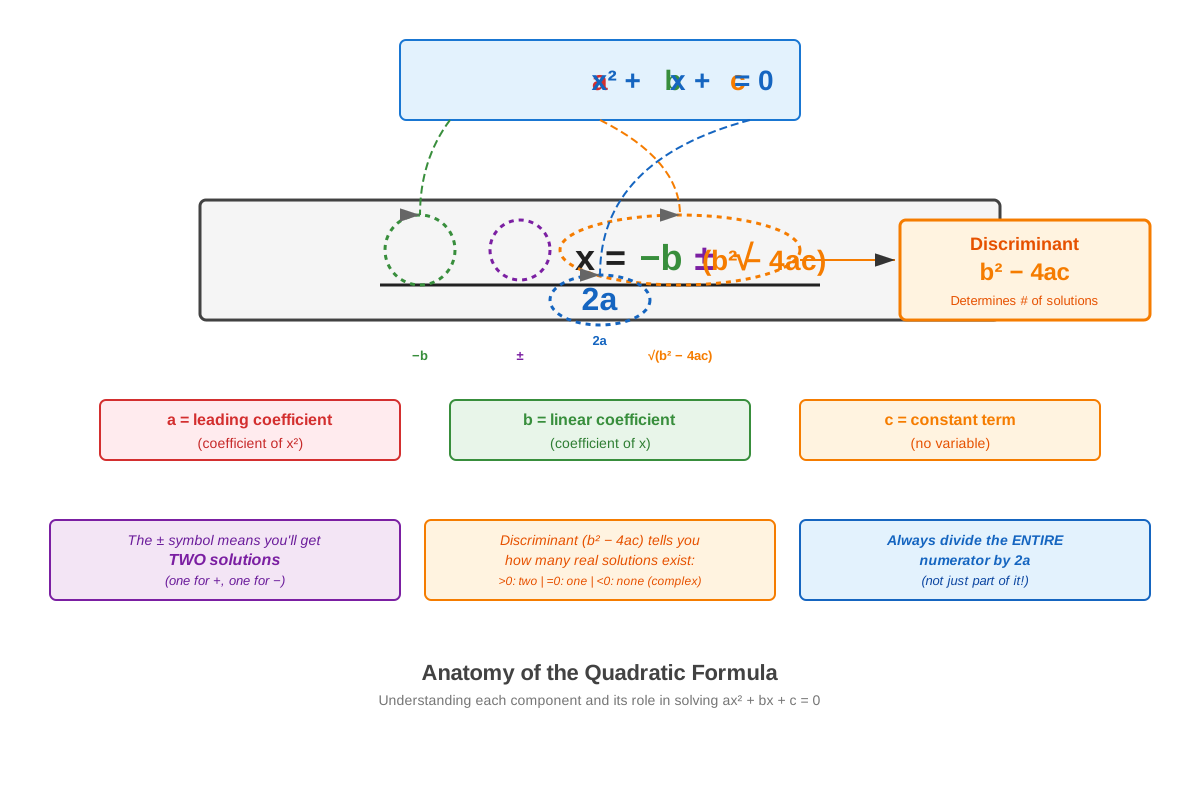
The quadratic formula is expressed as:
x = [-b ± √(b² - 4ac)] / 2aThis formula solves any quadratic equation written in standard form: ax² + bx + c = 0, where a ≠ 0. Each component serves a specific purpose:
- a: The coefficient of the x² term (the leading coefficient)
- b: The coefficient of the x term (the linear coefficient)
- c: The constant term (the y-intercept when graphed)
- ±: Indicates two solutions exist (one using addition, one using subtraction)
- √(b² - 4ac): The discriminant under the radical, which determines solution characteristics
The formula works by completing the square on the general quadratic equation, providing a universal solution method that bypasses the need for factoring. Understanding that this formula is derived from completing the square helps students appreciate why it always works and why the components appear as they do.
Identifying Coefficients Correctly
Before applying the quadratic formula, equations must be in standard form with all terms on one side equal to zero. This step is crucial because coefficient identification errors are among the most common mistakes on the SAT.
Key identification rules:
- Ensure the equation equals zero (move all terms to one side if necessary)
- Arrange terms in descending order of exponents: ax² + bx + c = 0
- Include negative signs with coefficients (if the equation is 2x² - 5x + 3 = 0, then b = -5, not 5)
- Recognize missing terms as having coefficient zero (x² + 7 = 0 means a = 1, b = 0, c = 7)
- Account for coefficients of 1 or -1 that aren't explicitly written (x² means a = 1, not a = 0)
| Original Equation | Standard Form | a | b | c |
|---|---|---|---|---|
| x² + 6x + 8 = 0 | x² + 6x + 8 = 0 | 1 | 6 | 8 |
| 2x² = 5x - 3 | 2x² - 5x + 3 = 0 | 2 | -5 | 3 |
| -x² + 4 = 0 | -x² + 0x + 4 = 0 | -1 | 0 | 4 |
| 3x² - 12x = 0 | 3x² - 12x + 0 = 0 | 3 | -12 | 0 |
The Discriminant and Solution Types
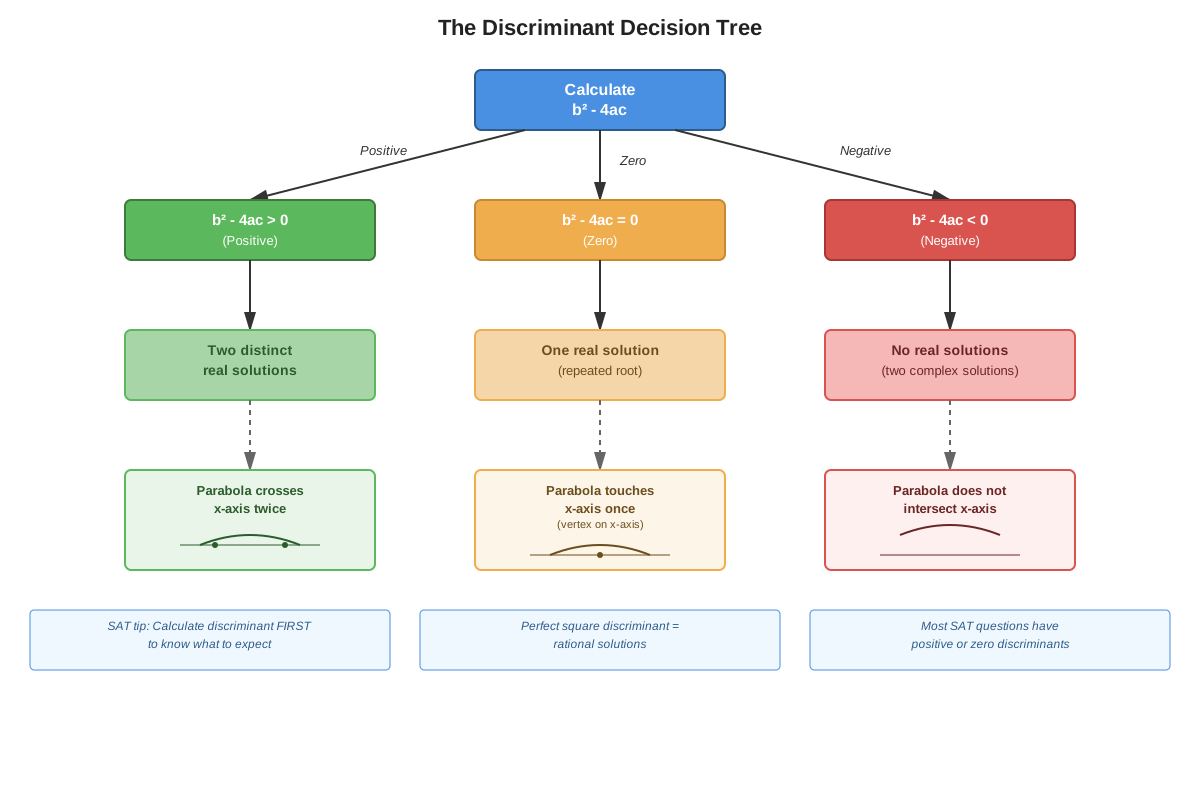
The discriminant is the expression b² - 4ac found under the radical sign in the quadratic formula. This single value determines the number and type of solutions before any calculation is performed, making it an extremely high-yield concept for the SAT.
Discriminant analysis:
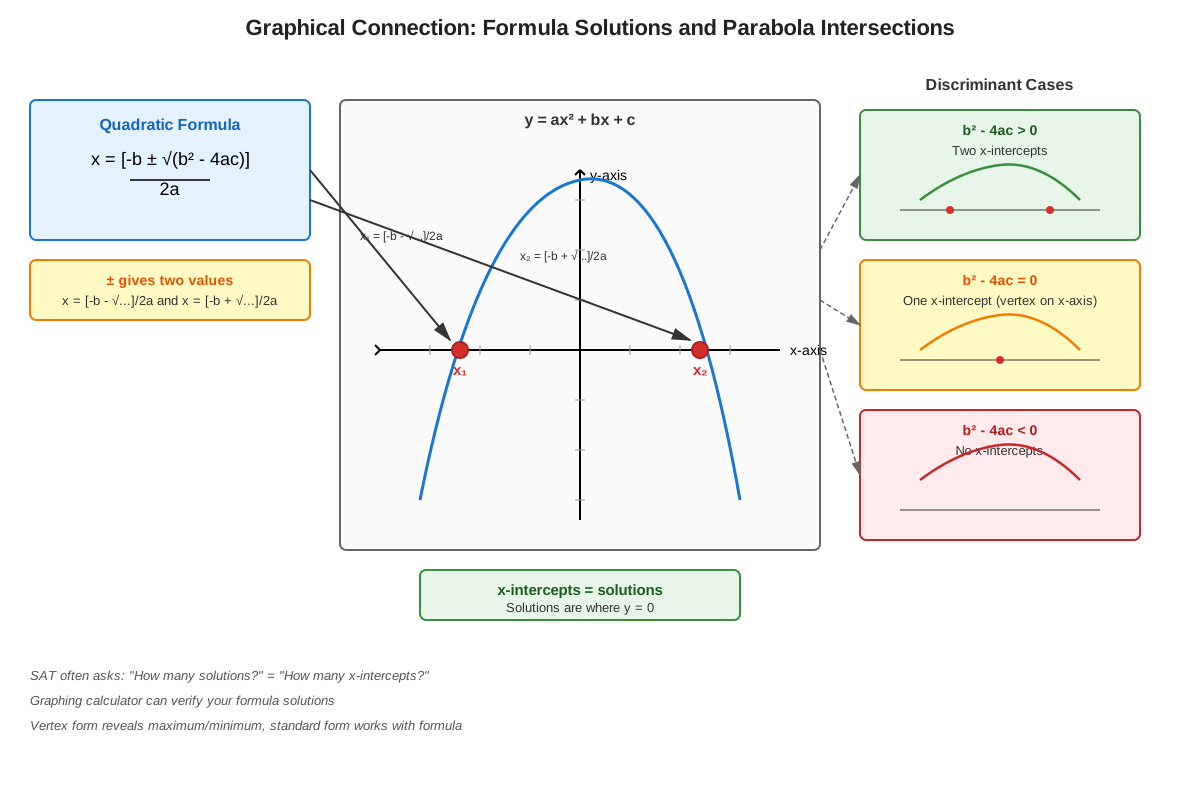
- b² - 4ac > 0: Two distinct real solutions (the parabola crosses the x-axis twice)
- b² - 4ac = 0: Exactly one real solution, called a repeated or double root (the parabola touches the x-axis at its vertex)
- b² - 4ac < 0: No real solutions, two complex solutions (the parabola doesn't intersect the x-axis)
The SAT frequently tests discriminant understanding through questions like "For what value of k does the equation x² + 6x + k = 0 have exactly one solution?" Students must recognize that one solution requires b² - 4ac = 0, then solve: 36 - 4(1)(k) = 0, yielding k = 9.
Step-by-Step Application Process
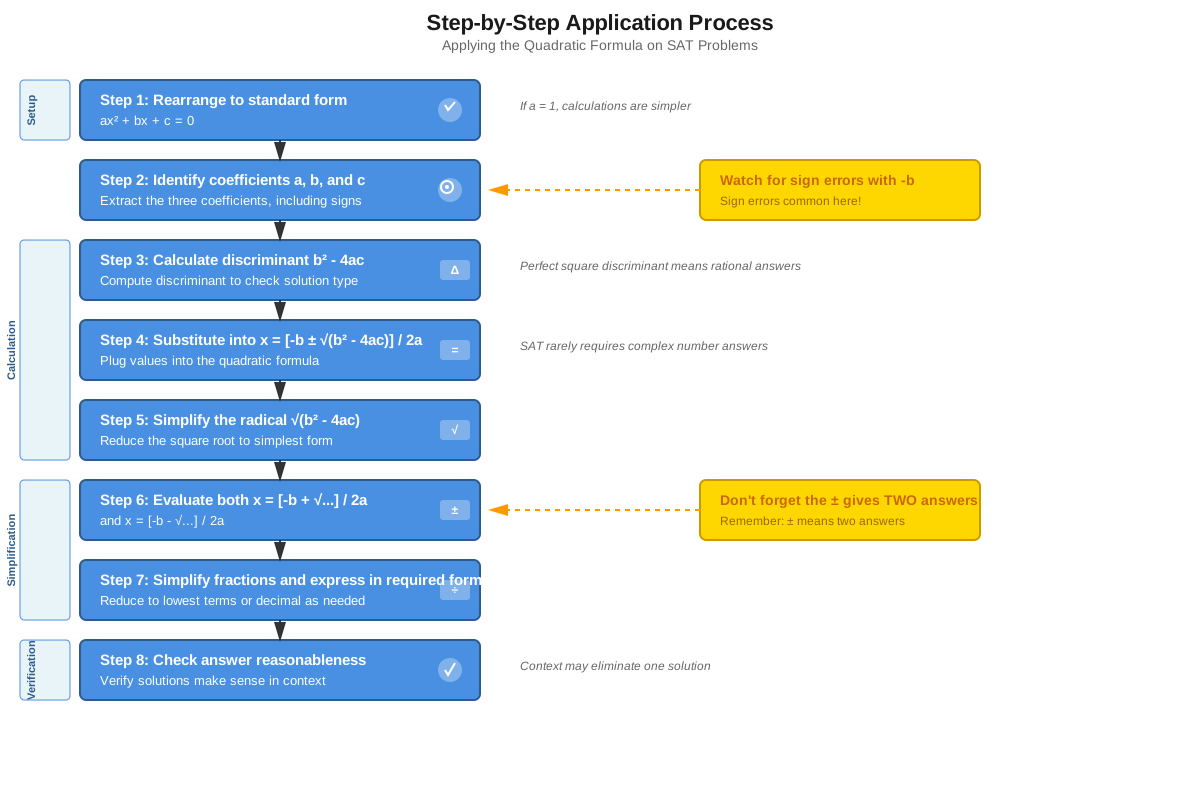
Applying the quadratic formula systematically reduces errors and increases speed:
- Rearrange the equation to standard form (ax² + bx + c = 0)
- Identify coefficients a, b, and c (watch for signs and missing terms)
- Calculate the discriminant b² - 4ac first (determines if solutions are real)
- Substitute values into the formula: x = [-b ± √(b² - 4ac)] / 2a
- Simplify the radical if possible (factor out perfect squares)
- Evaluate both solutions using + and - separately
- Simplify final answers (reduce fractions, rationalize if needed)
- Check reasonableness (do solutions make sense in context?)
Simplifying Solutions
SAT questions often require solutions in simplified form. Common simplification tasks include:
Simplifying radicals: √50 = √(25 × 2) = 5√2
Reducing fractions: Factor common terms from numerator and denominator. For example, if x = [-6 ± √12] / 4, first simplify √12 = 2√3, giving x = [-6 ± 2√3] / 4, then factor out 2 from the numerator: x = 2[-3 ± √3] / 4 = [-3 ± √3] / 2
Separating solutions: Write as two distinct values when the question asks for specific solutions rather than a general form.
Graphical Interpretation
The solutions found using the quadratic formula represent the x-intercepts (or zeros) of the parabola y = ax² + bx + c. This connection between algebraic and graphical representations is frequently tested:
- Two real solutions → parabola crosses x-axis at two points
- One real solution → parabola touches x-axis at exactly one point (the vertex)
- No real solutions → parabola doesn't intersect the x-axis
Understanding this relationship helps students verify answers and approach questions that present graphs alongside equations.
Concept Relationships
The quadratic formula serves as a central hub connecting multiple mathematical concepts. Standard form equations → provide the structure → from which coefficients a, b, and c are identified → and substituted into the quadratic formula → which contains the discriminant → that determines solution types → which correspond to graphical x-intercepts → that reveal parabola behavior.
The formula relates to prerequisite knowledge of algebraic manipulation (needed to achieve standard form) and radical simplification (required for final answers). It connects forward to systems of equations (where quadratic-linear systems require solving quadratics), polynomial functions (as the simplest case of polynomial root-finding), and optimization problems (where finding maximum or minimum values often involves quadratic relationships).
The discriminant specifically bridges algebra and geometry, translating numerical calculations into visual understanding of parabola-axis intersections. This concept also connects to complex numbers (when discriminant is negative) and perfect square trinomials (when discriminant equals zero).
Quick check — test yourself on Quadratic formula so far.
Try Flashcards →High-Yield Facts
⭐ The quadratic formula is x = [-b ± √(b² - 4ac)] / 2a and solves any equation in the form ax² + bx + c = 0
⭐ The discriminant b² - 4ac determines the number of real solutions: positive gives 2, zero gives 1, negative gives 0
⭐ Coefficients must include their signs: in 3x² - 7x + 2 = 0, b = -7, not 7
⭐ Missing terms have coefficient zero: x² + 5 = 0 means a = 1, b = 0, c = 5
⭐ The ± symbol means calculate two separate solutions: one with addition, one with subtraction
- The denominator 2a applies to the entire numerator, not just the radical portion
- Solutions represent x-intercepts of the parabola y = ax² + bx + c
- When the discriminant is a perfect square, the quadratic can be factored
- The quadratic formula works even when factoring is possible, though factoring may be faster
- Equations must equal zero before identifying coefficients; 2x² + 5x = 3 must become 2x² + 5x - 3 = 0
- A coefficient of 1 or -1 must still be used in calculations (x² means a = 1)
- Complex solutions come in conjugate pairs: if 3 + 2i is a solution, so is 3 - 2i
- The sum of solutions equals -b/a and the product equals c/a (Vieta's formulas)
- Simplifying radicals before dividing by 2a often reveals common factors to reduce
Common Misconceptions
Misconception: The formula is x = [-b ± √(b² - 4ac)] / 2a, so only the -b is divided by 2a, not the radical part.
Correction: The entire numerator [-b ± √(b² - 4ac)] is divided by 2a. The division bar extends across both terms in the numerator. Write it as a fraction with a horizontal line to avoid this error.
Misconception: If b is negative in the original equation, use its value without the negative sign in the formula since there's already a negative sign in -b.
Correction: Always use the actual coefficient value including its sign. If the equation is x² - 5x + 6 = 0, then b = -5, and -b = -(-5) = +5. The negative sign in the formula is part of the formula structure, not a signal to ignore negative coefficients.
Misconception: A negative discriminant means the equation has no solutions at all.
Correction: A negative discriminant means no real solutions, but two complex (imaginary) solutions exist. On the SAT, questions typically focus on real solutions, so "no real solutions" is the correct interpretation, but mathematically, solutions do exist in the complex number system.
Misconception: The ± symbol means you can choose to use either addition or subtraction based on which gives a nicer answer.
Correction: The ± symbol indicates that both operations must be performed to find both solutions. A quadratic equation has two solutions (unless the discriminant is zero), and you find them by calculating once with + and once with -.
Misconception: When simplifying √(b² - 4ac), you can split it as √(b²) - √(4ac).
Correction: The radical applies to the entire expression b² - 4ac as a single quantity. You cannot separate radicals across subtraction. √(a - b) ≠ √a - √b. Calculate b² - 4ac first, then take the square root of that result.
Misconception: If a = 1, you can ignore it in the formula since multiplying by 1 doesn't change anything.
Correction: While a = 1 simplifies calculations, you must still divide by 2a = 2(1) = 2. The denominator becomes 2, not 1. Forgetting this division is a common source of errors.
Misconception: The quadratic formula only works for equations that can't be factored.
Correction: The quadratic formula works for all quadratic equations, whether factorable or not. It's a universal method. However, when an equation factors easily, factoring may be faster. The formula is particularly valuable when factoring is difficult or impossible.
Worked Examples
Example 1: Standard Application with Two Real Solutions
Problem: Solve 2x² + 7x - 4 = 0
Solution:
Step 1: Identify that the equation is already in standard form.
- a = 2, b = 7, c = -4
Step 2: Calculate the discriminant to determine solution type.
- b² - 4ac = (7)² - 4(2)(-4)
- = 49 - (-32)
- = 49 + 32 = 81
Since the discriminant is positive (81 > 0), we expect two distinct real solutions.
Step 3: Substitute into the quadratic formula.
- x = [-b ± √(b² - 4ac)] / 2a
- x = [-7 ± √81] / 2(2)
- x = [-7 ± 9] / 4
Step 4: Calculate both solutions separately.
- x = [-7 + 9] / 4 = 2/4 = 1/2
- x = [-7 - 9] / 4 = -16/4 = -4
Step 5: Verify reasonableness.
Both solutions are real numbers, matching our discriminant prediction.
Answer: x = 1/2 or x = -4
Connection to learning objectives: This example demonstrates identifying coefficients correctly (including the negative sign for c), applying the formula systematically, and interpreting the discriminant to predict solution types.
Example 2: Discriminant Analysis Without Full Solution
Problem: For what value of k does the equation x² - 6x + k = 0 have exactly one real solution?
Solution:
Step 1: Recognize that "exactly one real solution" means the discriminant equals zero.
- For one solution: b² - 4ac = 0
Step 2: Identify coefficients in terms of k.
- a = 1, b = -6, c = k
Step 3: Set up the discriminant equation.
- (-6)² - 4(1)(k) = 0
- 36 - 4k = 0
Step 4: Solve for k.
- 36 = 4k
- k = 9
Step 5: Verify by checking what happens with k = 9.
- The equation becomes x² - 6x + 9 = 0
- This factors as (x - 3)² = 0, giving x = 3 as a double root
- Alternatively, discriminant = 36 - 4(1)(9) = 36 - 36 = 0 ✓
Answer: k = 9
Connection to learning objectives: This example shows how the discriminant appears in SAT questions, demonstrates conceptual understanding beyond mechanical calculation, and illustrates the relationship between discriminant values and solution types. This question format is extremely common on the SAT.
Exam Strategy
Trigger phrase alert: When you see "solve," "find the roots," "find the zeros," "find the x-intercepts," or "where does the graph cross the x-axis," consider whether the quadratic formula is needed.
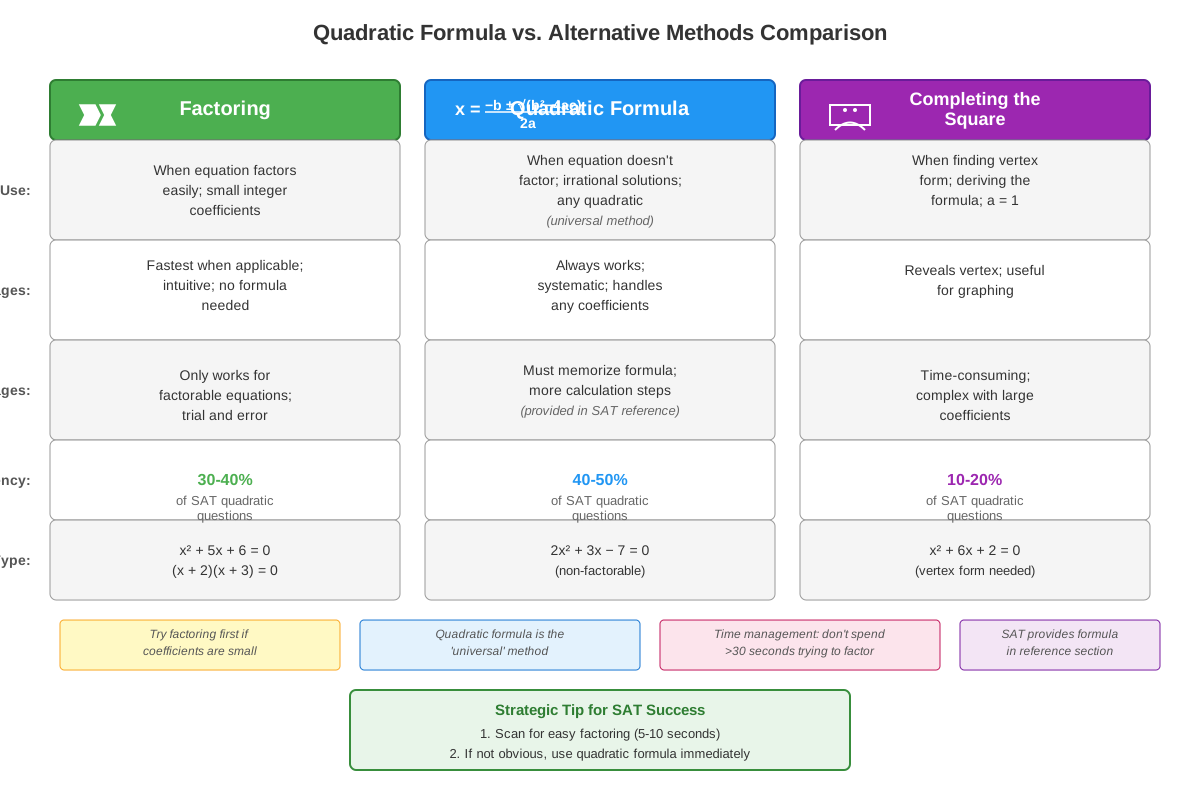
Decision tree for solving quadratics on the SAT:
- First, check if factoring is obvious (takes 5-10 seconds): Can you quickly see factors? If yes and it's faster, factor. If not immediately obvious, move to the formula.
- Rearrange to standard form immediately: Don't try to work with equations that aren't set equal to zero. This prevents coefficient identification errors.
- Calculate the discriminant first when appropriate: If the question asks about the number of solutions or whether real solutions exist, you may not need to complete the full calculation. Save time by stopping after the discriminant.
- Watch for coefficient sign errors: Circle or underline negative coefficients before substituting. The most common error is treating b = -5 as b = 5.
- Use your calculator strategically: On calculator-permitted sections, calculate the discriminant value first, then evaluate the entire formula. Store intermediate values to avoid rounding errors.
Process of elimination tips:
- If answer choices are all real numbers and your discriminant is negative, you've made an error—recheck coefficients
- If the discriminant is a perfect square, answers should be rational numbers (no radicals in final form)
- If a = 1 and c is positive while b is negative, both solutions are positive
- Eliminate answers that don't satisfy the original equation when substituted back
Time allocation: Budget 60-90 seconds for straightforward quadratic formula problems. If you're spending more than 2 minutes, you may have made an early error—consider starting over with fresh coefficient identification.
Calculator section advantage: Program the quadratic formula into your calculator if permitted, or use it to verify discriminant calculations and final simplifications.
Memory Techniques
Quadratic Formula Mnemonic: "X equals negative B, plus or minus the square root of B squared minus four A C, all over two A"
Sing this to a rhythm or melody to memorize the formula structure. Many students use the tune of "Pop Goes the Weasel" or "Row, Row, Row Your Boat."
Discriminant Decision Mnemonic: "P-Z-N" (Positive-Zero-Negative)
- Positive discriminant → Pair of solutions (2 real solutions)
- Zero discriminant → Zero extra solutions (1 solution)
- Negative discriminant → No real solutions (0 real solutions)
Coefficient Identification Acronym: "ABC-STD"
- Always
- Bring
- Coefficients to
- Standard
- Term
- Descending order
Visual Memory Aid: Picture the formula as a fraction with a "house" structure:
- The "roof" is the numerator: -b ± √(b² - 4ac)
- The "foundation" is the denominator: 2a
- Everything in the house (numerator) sits on the foundation (denominator)
Sign Error Prevention: "SIGN CHECK" before substituting
- See the equation in standard form
- Identify each coefficient
- Get the signs right
- Note any zeros for missing terms
Summary
The quadratic formula, x = [-b ± √(b² - 4ac)] / 2a, is an essential SAT Math tool that provides a universal method for solving any quadratic equation in standard form ax² + bx + c = 0. Success with this formula requires accurate coefficient identification (including proper signs and recognition of missing terms), systematic application of the formula structure, and understanding of the discriminant's role in determining solution types. The discriminant b² - 4ac reveals whether an equation has two real solutions (positive), one real solution (zero), or no real solutions (negative), making it a powerful analytical tool that often allows students to answer questions without complete calculation. Mastery involves not just mechanical computation but also conceptual understanding of how algebraic solutions connect to graphical representations, when the formula is the most efficient approach, and how to interpret solutions in context. The formula appears in 10-15% of SAT Math questions across various formats, making it one of the highest-yield topics for focused study and practice.
Key Takeaways
- The quadratic formula x = [-b ± √(b² - 4ac)] / 2a solves any quadratic equation and is one of the most frequently tested concepts on SAT Math
- Always rearrange equations to standard form (ax² + bx + c = 0) before identifying coefficients, and include negative signs with the coefficients themselves
- The discriminant b² - 4ac determines solution types: positive = 2 real solutions, zero = 1 real solution, negative = 0 real solutions
- The ± symbol requires calculating two separate solutions by performing the formula once with addition and once with subtraction
- Common errors include sign mistakes with coefficient b, forgetting to divide the entire numerator by 2a, and incorrectly splitting radicals across subtraction
- Solutions represent x-intercepts of the parabola, connecting algebraic and graphical representations
- Calculate the discriminant first when questions ask only about the number or type of solutions to save time
Related Topics
Factoring Quadratic Expressions: Understanding when quadratics can be factored provides an alternative, often faster solution method for equations with integer roots. Mastering the quadratic formula helps students recognize when factoring isn't feasible.
Completing the Square: This technique is the foundation from which the quadratic formula is derived. Understanding completing the square deepens comprehension of why the formula works and provides another solution method.
Parabola Graphing and Transformations: The solutions found using the quadratic formula correspond to x-intercepts on parabola graphs. This connection is essential for questions linking algebraic and graphical representations.
Systems of Equations (Quadratic-Linear): Solving systems where one equation is quadratic often requires the quadratic formula after substitution, making this topic a direct application of formula mastery.
Complex Numbers: When the discriminant is negative, solutions involve imaginary numbers. While less common on the SAT, understanding this extension demonstrates complete mastery of quadratic behavior.
Polynomial Functions: The quadratic formula represents the simplest case of finding polynomial roots, providing foundation for understanding higher-degree polynomial behavior.
Practice CTA
Now that you've mastered the core concepts of the quadratic formula, it's time to solidify your understanding through active practice. Work through the practice questions to apply these concepts in SAT-style formats, testing both your computational accuracy and conceptual reasoning. Use the flashcards to reinforce the formula structure, discriminant interpretation, and common error prevention strategies. Remember: the quadratic formula appears on virtually every SAT, making your practice time here a direct investment in score improvement. Approach each practice problem systematically, checking coefficient signs and discriminant values before diving into calculations. You've got this!
Sign up free to keep reading
Create a free AnvayaPrep account to finish this SAT guide on Quadratic formula — plus flashcards and practice questions.