Overview
The polynomial degree is one of the most fundamental characteristics of polynomial expressions and functions, representing the highest power of the variable in the polynomial. Understanding polynomial degree is crucial for SAT math success because it appears across multiple question types, from simplifying algebraic expressions to analyzing function behavior and solving complex equations. The degree of a polynomial determines critical properties such as the maximum number of solutions an equation can have, the end behavior of polynomial graphs, and how polynomials behave under various operations.
On the SAT, sat polynomial degree questions test both computational skills and conceptual understanding. Students must identify degrees in standard and non-standard forms, determine degrees after polynomial operations (addition, subtraction, multiplication), and use degree information to make predictions about graphs and solutions. These questions often appear in both the calculator and no-calculator sections, typically worth 1-2 questions per test, making them high-yield content that directly impacts scores.
Mastery of polynomial degree connects to broader mathematical concepts including function analysis, graphing, factoring, and the Fundamental Theorem of Algebra. This topic serves as a bridge between basic algebraic manipulation and advanced function analysis, making it essential not only for SAT success but also for college-level mathematics. Students who thoroughly understand polynomial degree gain powerful tools for quickly eliminating incorrect answer choices and verifying their solutions on test day.
Learning Objectives
- [ ] Identify key features of Polynomial degree
- [ ] Explain how Polynomial degree appears on the SAT
- [ ] Apply Polynomial degree to answer SAT-style questions
- [ ] Determine the degree of polynomials in both standard and non-standard form
- [ ] Calculate the degree of polynomials resulting from addition, subtraction, and multiplication operations
- [ ] Use polynomial degree to predict the maximum number of real zeros and turning points on a graph
- [ ] Recognize how coefficient values affect degree identification
Prerequisites
- Basic exponent rules: Understanding how to work with powers and exponents is essential because polynomial degree is defined by the highest exponent present in the expression.
- Combining like terms: Students must be able to simplify polynomial expressions to identify the term with the highest degree accurately.
- Variable identification: Recognizing variables versus constants is necessary to determine which terms contribute to the polynomial's degree.
- Order of operations: Proper application of PEMDAS ensures correct simplification before determining degree.
Why This Topic Matters
Polynomial degree appears in real-world applications across engineering, physics, economics, and computer science. Engineers use polynomial functions to model trajectories and structural loads, where the degree determines the complexity and accuracy of the model. Economists employ polynomial regression with varying degrees to forecast trends and analyze market behavior. In computer graphics, polynomial curves of different degrees create smooth animations and realistic renderings.
On the SAT, polynomial degree questions appear with notable frequency—typically 1-2 questions per test, representing approximately 2-4% of the math section. These questions appear in multiple formats: direct identification problems, operation-based questions requiring degree calculation after combining polynomials, and graph analysis questions where students must match polynomial degrees to visual representations. The College Board consistently includes polynomial degree in both multiple-choice and student-produced response formats.
Common SAT question patterns include: identifying the degree of a given polynomial expression, determining what degree results from multiplying two polynomials, selecting which polynomial has a specific degree from a list, and using degree information to eliminate impossible graph shapes. Questions often embed polynomial degree within larger problems about function behavior, making it a gateway skill that unlocks multiple points per test.
Core Concepts
Definition of Polynomial Degree
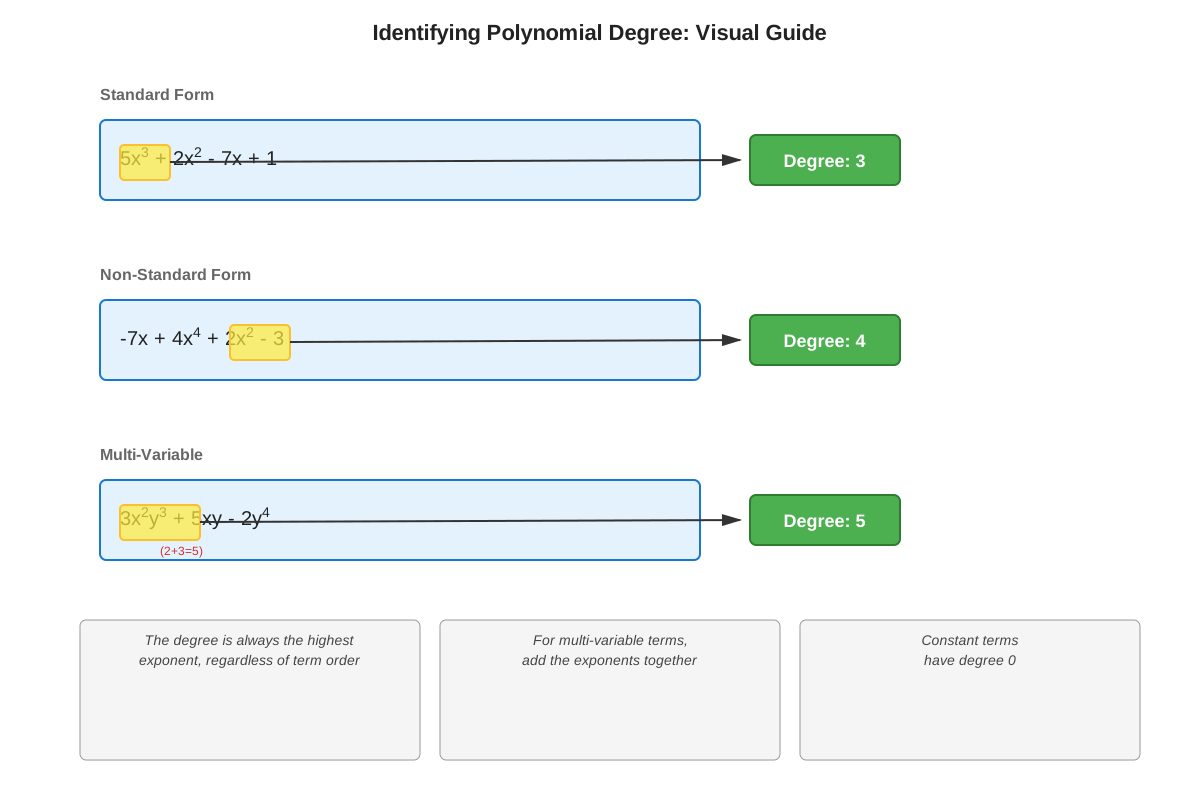
The polynomial degree is the highest power (exponent) of the variable in a polynomial expression when written in standard form. For a single-variable polynomial, this is straightforward: in the polynomial 5x⁴ + 3x² - 7x + 2, the degree is 4 because the highest exponent on x is 4. The degree provides immediate information about the polynomial's complexity and behavior.
For multi-variable polynomials, the degree of each term is the sum of all exponents in that term, and the polynomial's degree is the highest of these sums. For example, in 3x²y³ + 5xy² - 2x⁴, the first term has degree 2+3=5, the second term has degree 1+2=3, and the third term has degree 4, making the overall polynomial degree 5.
Standard Form and Degree Identification
Polynomials in standard form are written with terms arranged in descending order of degree. This arrangement makes degree identification immediate—simply look at the first term's exponent. For example, 7x⁵ - 3x⁴ + 2x² - 8 is in standard form with degree 5.
However, SAT questions frequently present polynomials in non-standard form to test deeper understanding. The polynomial -8 + 2x² - 3x⁴ + 7x⁵ has the same degree (5) but requires students to scan all terms rather than simply reading the first one. Students must develop the habit of identifying the highest-degree term regardless of position.
Special Cases and Edge Cases
Several special cases require careful attention:
Constant polynomials (like 7 or -3) have degree 0 because they can be written as 7x⁰. The zero polynomial (0) is a unique case—mathematically, it either has no degree or is assigned degree -∞, though SAT questions typically avoid this edge case.
Linear polynomials (degree 1) take the form ax + b where a ≠ 0. These represent straight lines and are the simplest non-constant polynomials.
Quadratic polynomials (degree 2) follow the form ax² + bx + c where a ≠ 0. The leading coefficient a must be non-zero; otherwise, the polynomial reduces to a lower degree.
Degree Under Polynomial Operations
Understanding how operations affect degree is crucial for SAT success:
| Operation | Degree Result | Example |
|---|---|---|
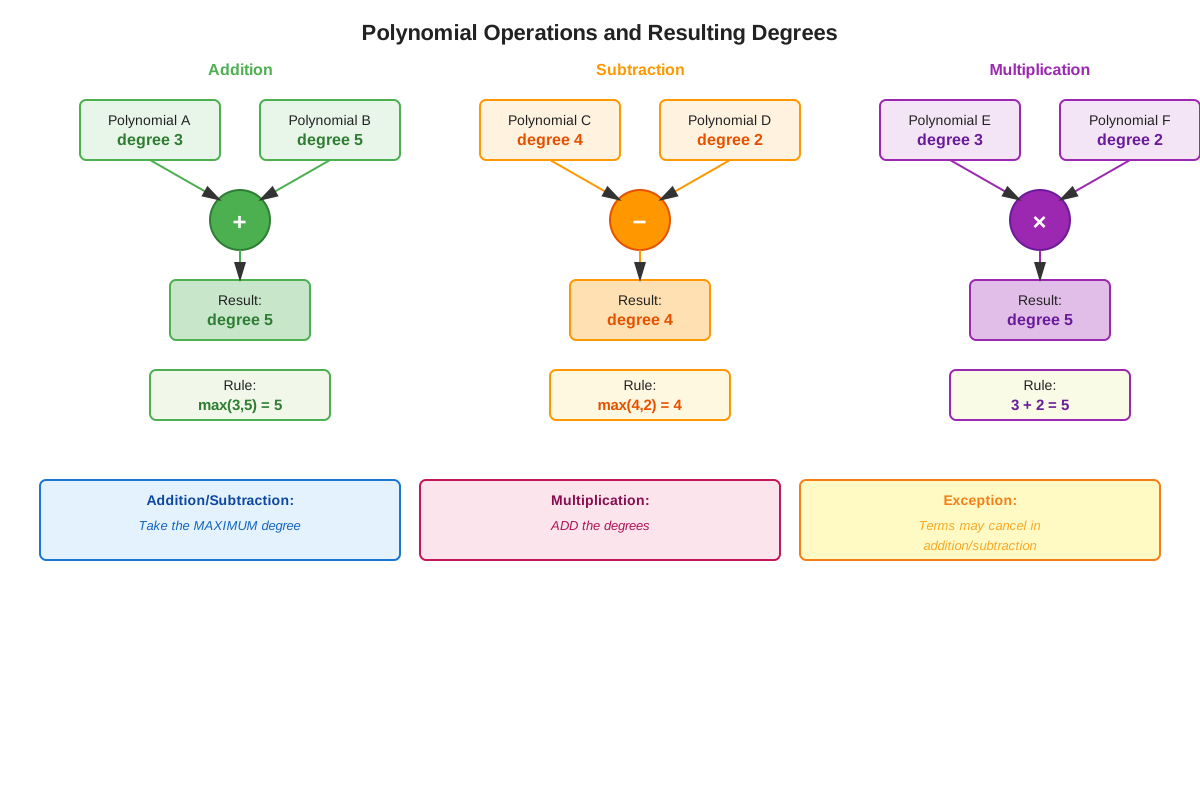
| Addition/Subtraction | Maximum degree of inputs (or less if leading terms cancel) | (x³ + 2x) + (x² - 5) = x³ + x² + 2x - 5, degree 3 |
| Multiplication | Sum of input degrees | (x² + 1)(x³ - 2) has degree 2 + 3 = 5 |
| Scalar multiplication | Unchanged (if scalar ≠ 0) | 5(x⁴ + 3x) = 5x⁴ + 15x, degree 4 |
Addition and subtraction typically preserve the highest degree present, but cancellation can reduce degree. If adding 3x⁴ + 2x and -3x⁴ + 5, the x⁴ terms cancel, leaving 2x + 5 with degree 1 instead of 4.
Multiplication always produces a degree equal to the sum of the input degrees (assuming non-zero polynomials). When multiplying (2x³ + 5)(4x² - 3), the highest-degree term comes from multiplying the highest-degree terms: (2x³)(4x²) = 8x⁵, giving degree 5.
Leading Coefficient and Degree
The leading coefficient is the coefficient of the highest-degree term. In 5x⁴ - 3x² + 7, the leading coefficient is 5. This coefficient must be non-zero for the polynomial to have that degree. If the leading coefficient becomes zero through simplification, the polynomial's degree decreases.
This principle is tested when SAT questions ask about polynomial operations. For instance, if asked to find the degree of (ax³ + 2x) - (ax³ - 5), students must recognize that when a is the same in both expressions, the x³ terms cancel, reducing the degree to 1.
Degree and Graph Behavior
Polynomial degree determines several graphical properties:
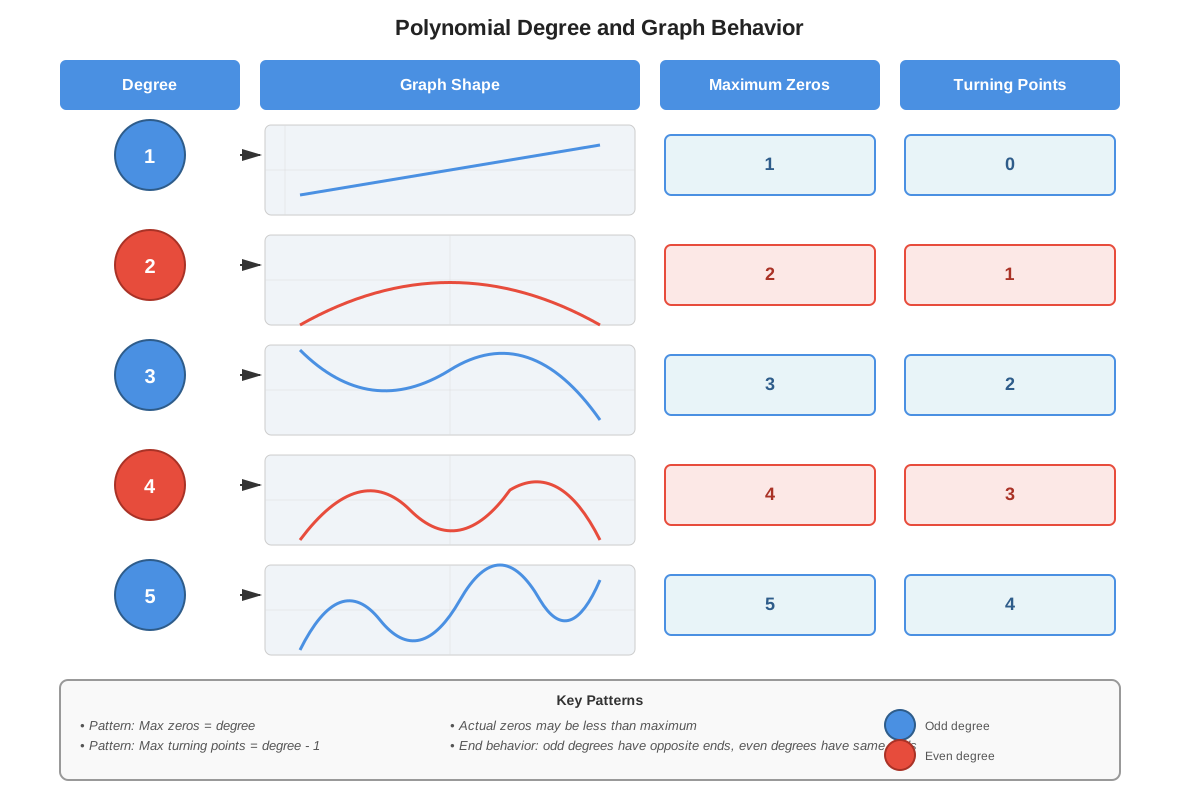
- Maximum number of x-intercepts (zeros): A polynomial of degree n has at most n real zeros
- Maximum number of turning points: A polynomial of degree n has at most n-1 turning points
- End behavior: Odd-degree polynomials have opposite end behaviors (one end up, one down), while even-degree polynomials have matching end behaviors (both up or both down)
These relationships allow students to eliminate incorrect graphs on SAT questions. A degree-3 polynomial cannot have 4 x-intercepts, and a degree-4 polynomial cannot have ends pointing in opposite directions.
Concept Relationships
Polynomial degree serves as the foundation for understanding polynomial behavior and connects to multiple mathematical concepts. The relationship flows as follows:
Exponent Rules → Polynomial Degree → Polynomial Classification → Function Behavior
Understanding exponents enables degree identification, which allows classification (constant, linear, quadratic, cubic, etc.), which predicts function behavior including zeros, turning points, and end behavior.
Within polynomial operations, degree relationships follow specific patterns:
Individual Polynomial Degrees → Operation Type → Resulting Polynomial Degree
Addition/subtraction preserves or reduces degree, while multiplication increases degree predictably. This connects to factoring, where the degree of a factored polynomial equals the sum of the degrees of its factors.
Polynomial degree also connects to the Fundamental Theorem of Algebra, which states that a polynomial of degree n has exactly n complex zeros (counting multiplicity). This theoretical foundation explains why degree limits the number of x-intercepts visible on graphs.
The concept extends to polynomial division, where the degree of the quotient equals the degree of the dividend minus the degree of the divisor (when division is exact). This relationship appears in rational function analysis and partial fraction decomposition.
Quick check — test yourself on Polynomial degree so far.
Try Flashcards →High-Yield Facts
⭐ The degree of a polynomial is the highest exponent when the polynomial is written in standard form
⭐ When multiplying polynomials, add the degrees: degree(f·g) = degree(f) + degree(g)
⭐ A polynomial of degree n has at most n real zeros (x-intercepts)
⭐ A polynomial of degree n has at most n-1 turning points on its graph
⭐ The leading coefficient must be non-zero; if it becomes zero, the degree decreases
- Constant polynomials (like 5 or -3) have degree 0
- Linear polynomials have degree 1 and graph as straight lines
- Quadratic polynomials have degree 2 and graph as parabolas
- When adding or subtracting polynomials, the result has degree equal to the maximum input degree (unless leading terms cancel)
- In multi-variable polynomials, add all exponents in each term, then take the maximum
- Odd-degree polynomials have opposite end behaviors; even-degree polynomials have matching end behaviors
- The zero polynomial is a special case with undefined or negative infinity degree
- Degree determines the maximum complexity of polynomial behavior but not the minimum (a degree-5 polynomial might have only 1 zero)
Common Misconceptions
Misconception: The degree is always the first exponent you see in the expression.
Correction: The degree is the highest exponent regardless of term order. In -3 + 5x² + 2x⁴ - x, the degree is 4, not 0. Always scan all terms or rewrite in standard form.
Misconception: When adding polynomials, you add their degrees.
Correction: When adding or subtracting polynomials, the result has degree equal to the maximum of the input degrees (or less if cancellation occurs). Only multiplication requires adding degrees.
Misconception: A polynomial of degree 4 must have exactly 4 zeros.
Correction: A degree-4 polynomial has at most 4 real zeros but could have fewer (some zeros might be complex, or real zeros might have multiplicity greater than 1). For example, x⁴ + 1 has no real zeros.
Misconception: The coefficient affects the degree.
Correction: Degree depends only on exponents, not coefficients. Both 5x³ and 0.001x³ have degree 3. However, if the leading coefficient is zero, that term doesn't exist, changing the degree.
Misconception: Multi-variable terms like x²y² have degree 2.
Correction: For multi-variable terms, add all exponents. The term x²y² has degree 2+2=4. Each variable's exponent contributes to the total degree of that term.
Misconception: Negative exponents contribute to polynomial degree.
Correction: Polynomials cannot have negative exponents. An expression like 3x² + 5x⁻¹ is not a polynomial. Only non-negative integer exponents are allowed in polynomial expressions.
Misconception: The degree of (x² + 1)(x³ - 2) is 6 because 2×3=6.
Correction: While the result is correct, the reasoning should be that degrees add under multiplication: 2+3=5. The highest-degree term comes from multiplying x²·x³=x⁵, giving degree 5, not 6.
Worked Examples
Example 1: Identifying Degree After Operations
Problem: If f(x) = 3x⁴ - 2x² + 5 and g(x) = -3x⁴ + x³ - 7, what is the degree of f(x) + g(x)?
Solution:
Step 1: Write out the addition
f(x) + g(x) = (3x⁴ - 2x² + 5) + (-3x⁴ + x³ - 7)
Step 2: Combine like terms
= 3x⁴ - 3x⁴ + x³ - 2x² + 5 - 7
= 0x⁴ + x³ - 2x² - 2
= x³ - 2x² - 2
Step 3: Identify the highest degree term
The x⁴ terms canceled, leaving x³ as the highest-degree term.
Answer: The degree is 3.
Key Insight: This problem tests the understanding that addition can reduce degree through cancellation. Students who assume the degree must be 4 (the maximum of the input degrees) without performing the addition will answer incorrectly. This connects to Learning Objective 5 about calculating degrees after operations.
Example 2: Degree and Graph Analysis
Problem: A polynomial function p(x) has degree 5 with a positive leading coefficient. Which of the following must be true?
A) The graph has exactly 5 x-intercepts
B) The graph has at most 4 turning points
C) As x approaches positive infinity, p(x) approaches negative infinity
D) The graph is symmetric about the y-axis
Solution:
Step 1: Analyze each option using degree properties
Option A: A degree-5 polynomial has at most 5 real zeros, not necessarily exactly 5. Some zeros could be complex. This is not necessarily true.
Option B: A polynomial of degree n has at most n-1 turning points. For degree 5: at most 5-1=4 turning points. This must be true.
Option C: For odd-degree polynomials with positive leading coefficients, as x→+∞, p(x)→+∞ (not -∞). This is false.
Option D: Symmetry about the y-axis requires all even-degree terms (even function). A degree-5 polynomial is odd-degree and cannot be even symmetric. This is false.
Answer: B
Key Insight: This problem integrates multiple concepts: the relationship between degree and turning points, end behavior based on degree and leading coefficient, and the distinction between "at most" and "exactly." It demonstrates how polynomial degree appears in graph analysis questions, connecting to Learning Objectives 1 and 6.
Exam Strategy
When approaching sat polynomial degree questions, follow this systematic process:
Step 1: Identify the question type
- Direct identification: "What is the degree of..."
- Operation-based: "What is the degree of f(x)·g(x)..."
- Graph analysis: "Which graph could represent a degree-4 polynomial..."
Step 2: Simplify if necessary
Before determining degree, combine like terms and write in clearer form. Don't assume the expression is already simplified.
Step 3: Apply the appropriate rule
- For single polynomials: find the highest exponent
- For multiplication: add degrees
- For addition/subtraction: take maximum (watch for cancellation)
Exam Tip: When multiplying polynomials, you don't need to fully expand. Just multiply the highest-degree terms to find the resulting degree quickly.
Trigger words and phrases to watch for:
- "Leading term" or "leading coefficient" → focus on highest-degree term
- "Standard form" → terms arranged by descending degree
- "At most" vs. "exactly" → critical distinction for zeros and turning points
- "As x approaches infinity" → end behavior determined by degree and leading coefficient
Process-of-elimination strategies:
- Eliminate graphs with too many x-intercepts (more than the degree)
- Eliminate graphs with wrong end behavior (odd vs. even degree)
- For operation questions, eliminate answers that violate degree rules (e.g., multiplication cannot decrease degree)
Time allocation:
Direct degree identification questions should take 30-45 seconds. Operation-based questions requiring calculation may take 60-90 seconds. Graph analysis questions typically require 45-75 seconds. If a question takes longer, mark it and return after completing easier questions.
Memory Techniques
Degree Operation Mnemonic: "MAS"
- Multiply → Add degrees
- Add/Subtract → Same (maximum) degree
End Behavior Visualization: "ODD-OPPOSITE, EVEN-EQUAL"
- ODD degree polynomials have OPPOSITE end behaviors (one up, one down)
- EVEN degree polynomials have EQUAL end behaviors (both up or both down)
Maximum Features Formula: "Degree Minus One"
For a polynomial of degree n:
- Maximum turning points = n - 1
- Maximum zeros = n (not minus one!)
Remember: "Turns are one less, zeros are the same as degree"
Multi-variable Degree: "ADD-ALL"
For terms with multiple variables, ADD ALL exponents together. In x³y²z, add 3+2+1=6.
Leading Coefficient Check: "No Zero Hero"
The leading coefficient cannot be zero, or it's "no hero" (not actually the leading term). If it's zero, the degree drops.
Summary
Polynomial degree represents the highest exponent in a polynomial expression and serves as a fundamental characteristic that determines polynomial behavior, complexity, and graphical properties. On the SAT, students must identify degrees in various forms, calculate degrees resulting from polynomial operations, and use degree information to analyze graphs and predict function behavior. The degree of a polynomial determines the maximum number of real zeros (at most n for degree n), the maximum number of turning points (at most n-1), and the end behavior pattern (opposite for odd degrees, matching for even degrees). When performing operations, multiplication requires adding degrees, while addition and subtraction preserve the maximum degree unless cancellation occurs. Mastery of polynomial degree enables quick elimination of incorrect answer choices and provides a framework for understanding more complex polynomial concepts, making it essential high-yield content for SAT math success.
Key Takeaways
- Polynomial degree is the highest exponent in the expression; always check all terms, not just the first one
- Multiplying polynomials adds their degrees; adding/subtracting preserves the maximum degree (unless terms cancel)
- A degree-n polynomial has at most n real zeros and at most n-1 turning points
- The leading coefficient must be non-zero; if it's zero, the polynomial has a lower degree
- Odd-degree polynomials have opposite end behaviors; even-degree polynomials have matching end behaviors
- For multi-variable terms, add all exponents to find that term's degree
- Degree determines maximum complexity but not minimum—a high-degree polynomial might have simple behavior
Related Topics
Polynomial Operations and Simplification: Building on degree identification, this topic covers adding, subtracting, multiplying, and dividing polynomials while tracking how operations affect structure and degree.
Factoring Polynomials: Understanding degree helps determine factoring strategies and verify that factored forms are equivalent to original expressions (degrees must match).
Polynomial Graphs and End Behavior: Degree directly determines end behavior patterns and the maximum number of turning points, making it essential for graph analysis.
The Fundamental Theorem of Algebra: This theorem states that a degree-n polynomial has exactly n complex zeros (counting multiplicity), providing theoretical foundation for degree's importance.
Rational Functions: These functions are ratios of polynomials, and understanding the degrees of numerator and denominator determines asymptotic behavior and domain restrictions.
Practice CTA
Now that you've mastered the core concepts of polynomial degree, it's time to solidify your understanding through active practice. Work through the practice questions to test your ability to identify degrees in various forms, calculate degrees after operations, and apply degree concepts to graph analysis. Use the flashcards to reinforce high-yield facts and ensure instant recall on test day. Remember: polynomial degree appears on virtually every SAT, and mastering this topic provides a foundation for multiple questions across the math section. Your investment in practice now will pay dividends in points on test day!
Sign up free to keep reading
Create a free AnvayaPrep account to finish this SAT guide on Polynomial degree — plus flashcards and practice questions.