Overview
Polynomial division basics is a fundamental algebraic skill that appears consistently on the SAT math section, particularly in questions involving factoring, finding zeros of polynomial functions, and simplifying rational expressions. This topic requires students to divide one polynomial by another using either long division or synthetic division methods, producing a quotient and potentially a remainder. Mastery of polynomial division enables students to break down complex polynomial expressions into simpler components, identify factors, and solve higher-degree equations that would otherwise be intractable.
On the SAT, polynomial division questions typically appear in the Heart of Algebra and Passport to Advanced Math domains, accounting for approximately 3-5 questions per test. These questions may directly ask students to perform division, or they may embed division within multi-step problems involving function composition, remainder theorems, or factor identification. Understanding sat polynomial division basics is crucial because it serves as a gateway skill to more advanced topics like the Remainder Theorem, Factor Theorem, and rational function analysis—all of which appear regularly on the exam.
The relationship between polynomial division and other mathematical concepts is extensive. Division connects directly to multiplication (as its inverse operation), factoring (as a method to verify factors), and the fundamental structure of polynomial functions. When students master polynomial division, they gain powerful tools for analyzing polynomial behavior, finding roots, and manipulating algebraic expressions with confidence. This topic also reinforces understanding of place value, coefficient relationships, and the distributive property at a more sophisticated level than basic arithmetic.
Learning Objectives
- [ ] Identify key features of polynomial division basics, including dividend, divisor, quotient, and remainder
- [ ] Explain how polynomial division basics appears on the SAT in various question formats
- [ ] Apply polynomial division basics to answer SAT-style questions using both long division and synthetic division
- [ ] Execute polynomial long division accurately with polynomials of varying degrees
- [ ] Determine when synthetic division is applicable and perform it correctly
- [ ] Interpret the remainder in polynomial division and apply the Remainder Theorem
- [ ] Verify division results by multiplying quotient by divisor and adding remainder
Prerequisites
- Basic polynomial operations: Students must understand how to add, subtract, and multiply polynomials, as division reverses multiplication and requires coefficient manipulation
- Polynomial terminology: Familiarity with terms like degree, coefficient, leading term, and constant term is essential for organizing division problems correctly
- Long division with integers: The polynomial long division algorithm mirrors numerical long division, so comfort with the numerical process facilitates understanding
- Factoring fundamentals: Recognizing common factors and understanding the relationship between factors and division helps students verify their work and understand why division works
Why This Topic Matters
Polynomial division has practical applications beyond the SAT, appearing in engineering, physics, computer science, and economics. Engineers use polynomial division when analyzing signal processing and control systems. Economists apply it when modeling cost functions and marginal analysis. Computer scientists employ polynomial division in error-correction algorithms and cryptography. Understanding how to decompose complex polynomial relationships into simpler components is a fundamental analytical skill across STEM fields.
On the SAT specifically, polynomial division appears in approximately 2-4 questions per test administration, representing roughly 3-6% of the math section. Questions may appear as direct computational problems ("What is the quotient when..."), but more commonly they're embedded in multi-step problems. Students might need to divide polynomials to find factors, verify that a given expression is a factor of another, determine remainders, or simplify rational expressions before solving equations. The College Board frequently tests this concept in calculator and no-calculator sections alike, emphasizing conceptual understanding over mere computation.
Common SAT question formats include: asking for the remainder when one polynomial divides another; providing a polynomial and asking which binomial is a factor; presenting a rational expression that requires division to simplify; and word problems where polynomial division models a real-world scenario. Questions often combine polynomial division with other concepts like the Remainder Theorem, making this a high-yield topic that connects multiple mathematical ideas.
Core Concepts
The Division Algorithm for Polynomials
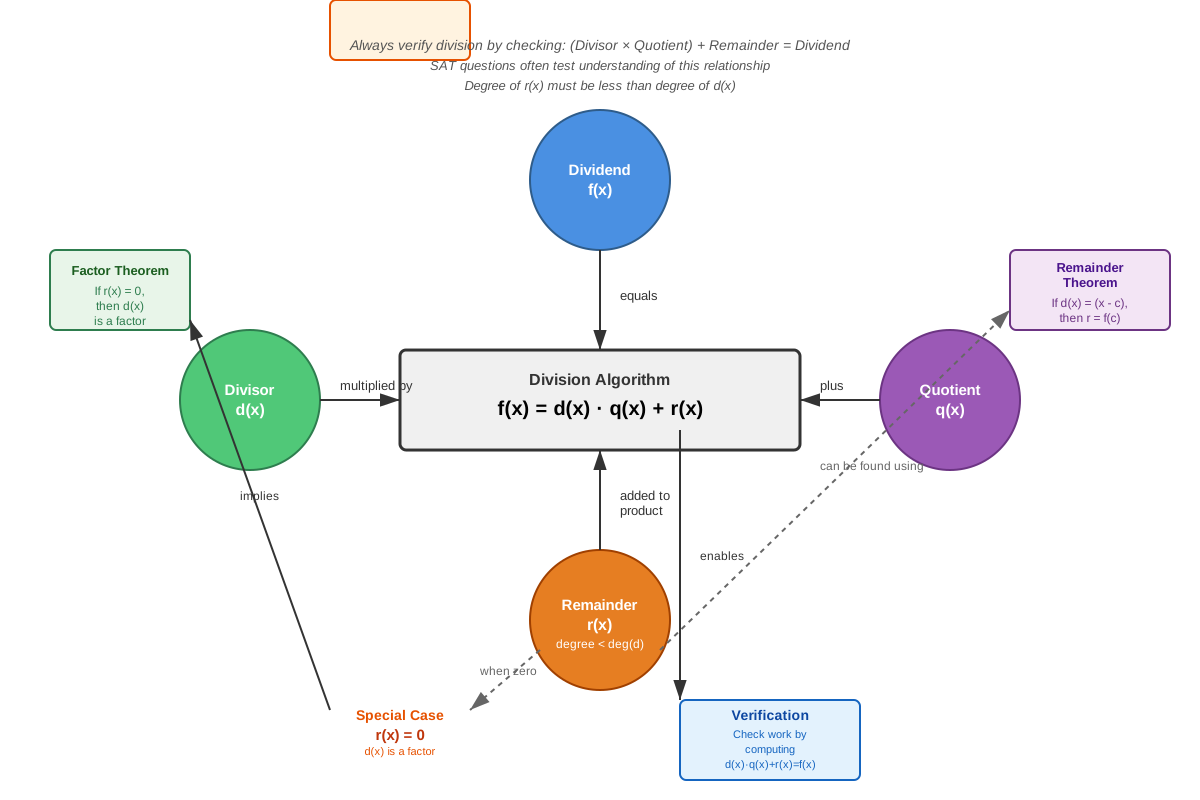
The polynomial division algorithm states that for any polynomial f(x) (the dividend) and non-zero polynomial d(x) (the divisor), there exist unique polynomials q(x) (the quotient) and r(x) (the remainder) such that:
f(x) = d(x) · q(x) + r(x)where the degree of r(x) is less than the degree of d(x), or r(x) = 0. This fundamental relationship mirrors integer division: just as 17 ÷ 5 = 3 remainder 2 (meaning 17 = 5 × 3 + 2), polynomial division produces a quotient and remainder that satisfy the same structural relationship.
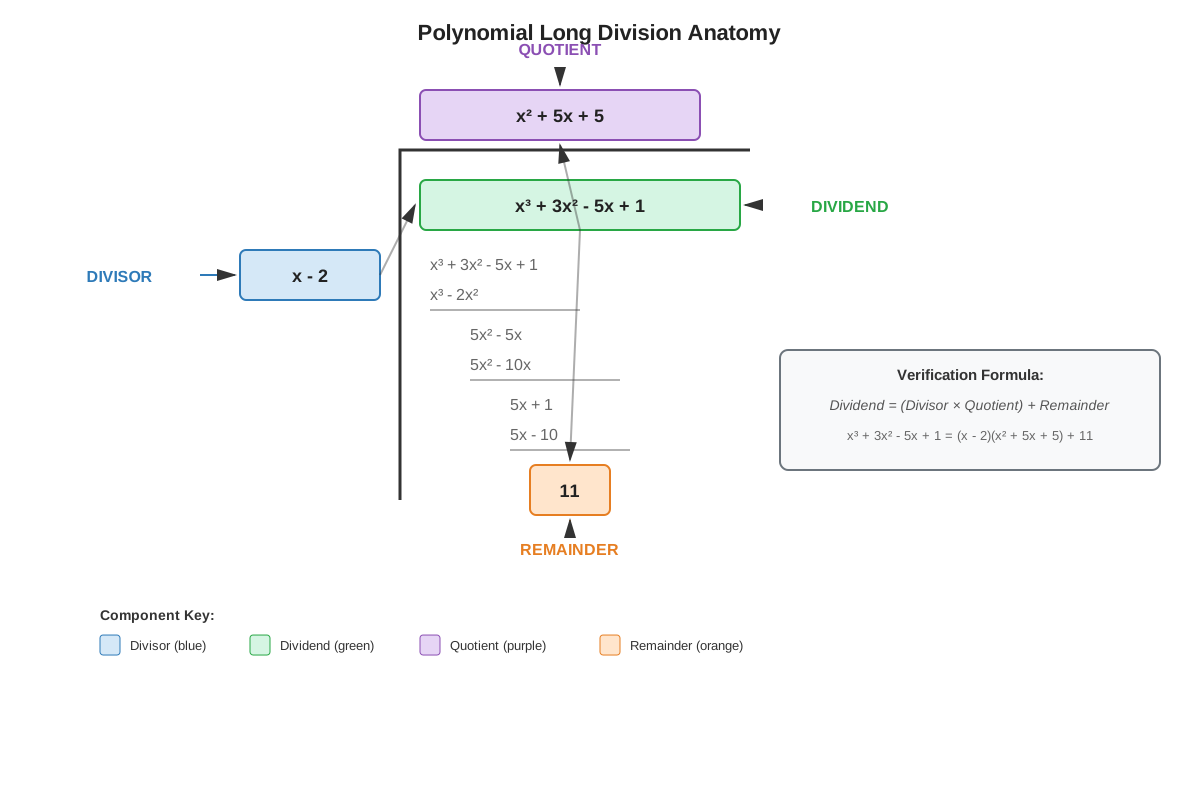
The dividend is the polynomial being divided, the divisor is the polynomial dividing into the dividend, the quotient is the result of the division, and the remainder is what's left over when the division doesn't result in an even quotient. Understanding these four components is essential for setting up and interpreting division problems correctly.
Polynomial Long Division
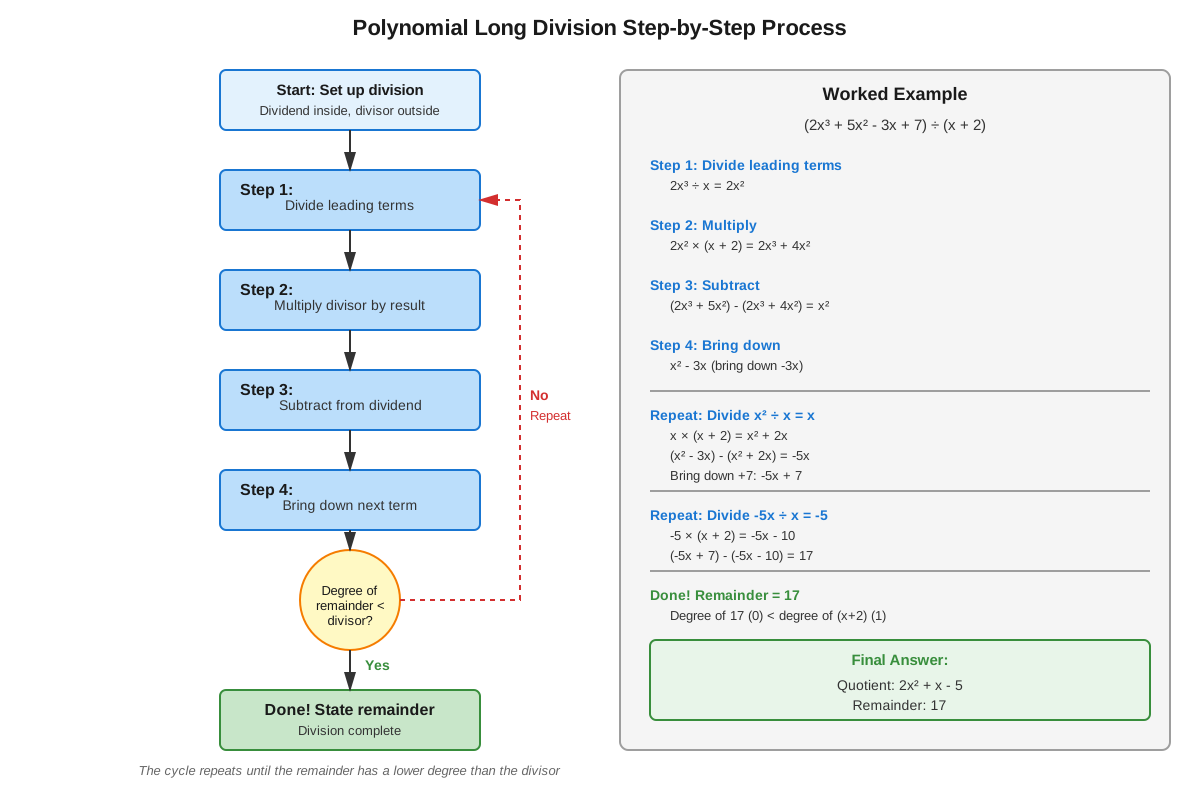
Polynomial long division extends the familiar long division algorithm from arithmetic to algebraic expressions. The process involves these systematic steps:
- Arrange both polynomials in descending order of degree, inserting zero coefficients for any missing degree terms
- Divide the leading term of the dividend by the leading term of the divisor to get the first term of the quotient
- Multiply the entire divisor by this quotient term and write the result below the dividend
- Subtract this product from the dividend to create a new, lower-degree polynomial
- Repeat the process with the new polynomial until the remainder has a degree less than the divisor's degree
For example, dividing (2x³ + 5x² - 3x + 7) by (x + 2):
         2x² + x - 5
       ________________
x + 2 | 2x³ + 5x² - 3x + 7
        2x³ + 4x²
        ___________
              x² - 3x
              x² + 2x
              _______
                 -5x + 7
                 -5x - 10
                 ________
                      17
The quotient is 2x² + x - 5 with remainder 17, meaning: 2x³ + 5x² - 3x + 7 = (x + 2)(2x² + x - 5) + 17
Synthetic Division
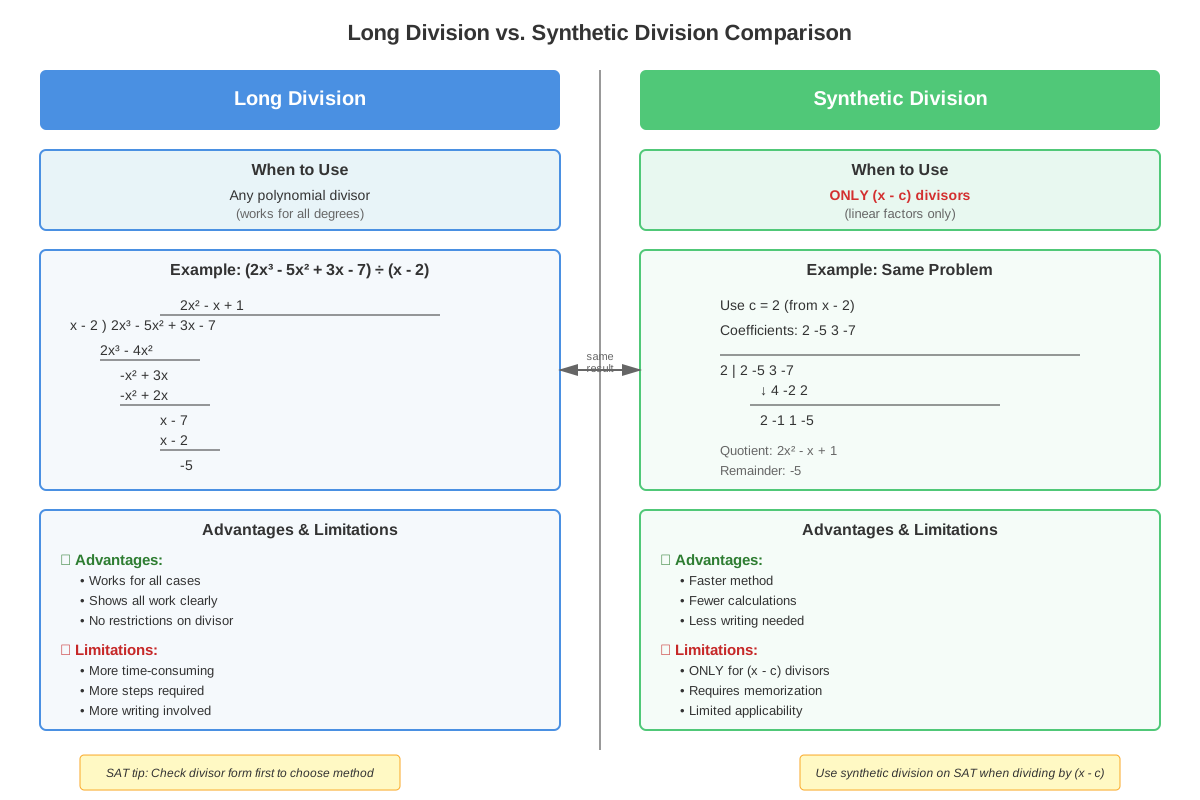
Synthetic division is a streamlined method for dividing a polynomial by a linear binomial of the form (x - c). This technique is significantly faster than long division but only works when the divisor is linear with a leading coefficient of 1. The process uses only the coefficients of the polynomials, arranged in a compact format.
Steps for synthetic division when dividing f(x) by (x - c):
- Write the value c (the zero of the divisor) to the left
- Write all coefficients of f(x) in descending order, including zeros for missing terms
- Bring down the leading coefficient unchanged
- Multiply c by this coefficient and write the result under the next coefficient
- Add the column and write the sum below
- Repeat steps 4-5 until all coefficients are processed
- The final number is the remainder; all other numbers form the quotient's coefficients
For example, dividing (3x³ - 7x² + 2x - 5) by (x - 2):
2 |  3  -7   2  -5
  |     6  -2   0
  |________________
     3  -1   0  -5
The quotient is 3x² - x + 0 = 3x² - x, with remainder -5.
Remainder Theorem Connection
The Remainder Theorem states that when a polynomial f(x) is divided by (x - c), the remainder is f(c). This powerful connection means students can find remainders without performing complete division—simply evaluate the polynomial at x = c. Conversely, if the remainder is zero, then (x - c) is a factor of f(x), which is the Factor Theorem.
This relationship makes synthetic division particularly valuable: the final number in synthetic division gives both the remainder and the value of f(c) simultaneously, providing a quick way to evaluate polynomials and test potential factors.
Handling Missing Terms and Coefficients
A critical aspect of polynomial division is properly accounting for missing degree terms. When a polynomial lacks a term of a particular degree (for example, x³ + 5x + 2 has no x² term), students must insert a zero coefficient (0x²) as a placeholder. This maintains proper alignment during the division process and prevents errors in coefficient subtraction.
| Polynomial | Standard Form with Placeholders |
|---|---|
| x³ + 5x + 2 | x³ + 0x² + 5x + 2 |
| 2x⁴ - 3x + 1 | 2x⁴ + 0x³ + 0x² - 3x + 1 |
| x² - 9 | x² + 0x - 9 |
Concept Relationships
Polynomial division basics connects intimately with multiple algebraic concepts, forming a web of mathematical relationships. Polynomial multiplication serves as the inverse operation to division; students can verify division results by multiplying the quotient by the divisor and adding the remainder to check if they obtain the original dividend. This verification process reinforces understanding of both operations.
The connection flows as: Basic polynomial operations → Polynomial division → Factoring and zeros → Rational expressions → Function analysis. Mastering division enables students to factor higher-degree polynomials that resist simple factoring techniques, which in turn allows finding zeros of polynomial functions. These zeros represent x-intercepts on graphs and solutions to polynomial equations.
Synthetic division relates specifically to linear divisors and connects directly to the Remainder Theorem and Factor Theorem. When synthetic division yields a remainder of zero, students have identified a factor and a zero simultaneously. This relationship makes synthetic division a powerful tool for testing potential rational zeros when solving polynomial equations.
Long division handles all division scenarios and connects to rational expression simplification. When simplifying complex fractions involving polynomials, division reduces the expression to lowest terms. This skill extends to partial fraction decomposition in advanced mathematics and calculus.
The concept map: Polynomial structure → Division algorithm → Long division (general method) → Synthetic division (special case) → Remainder/Factor Theorems → Factoring → Finding zeros → Graphing polynomial functions.
Quick check — test yourself on Polynomial division basics so far.
Try Flashcards →High-Yield Facts
⭐ The division algorithm states: f(x) = d(x) · q(x) + r(x), where the degree of r(x) is less than the degree of d(x)
⭐ Synthetic division only works when dividing by linear binomials of the form (x - c) with leading coefficient 1
⭐ The Remainder Theorem: When f(x) is divided by (x - c), the remainder equals f(c)
⭐ Missing degree terms must be represented with zero coefficients as placeholders during division
⭐ The degree of the quotient equals the degree of the dividend minus the degree of the divisor
- The first term of the quotient always comes from dividing the leading terms of dividend and divisor
- If the remainder is zero, the divisor is a factor of the dividend (Factor Theorem)
- Polynomial division can be verified by computing d(x) · q(x) + r(x) and checking if it equals f(x)
- In synthetic division, use the value c from (x - c), not -c; for (x + 3), use c = -3
- The number of terms in the quotient is typically one less than the number of terms in the dividend when dividing by a linear binomial
- Coefficients must be aligned by degree during long division, similar to aligning place values in numerical division
- When the dividend's degree is less than the divisor's degree, the quotient is 0 and the remainder is the dividend itself
Common Misconceptions
Misconception: When dividing by (x + 3), use 3 in synthetic division → Correction: Use -3 in synthetic division because the divisor is (x - (-3)); always use the value that makes the divisor equal to zero
Misconception: Synthetic division works for any divisor → Correction: Synthetic division only works for linear divisors of the form (x - c) with leading coefficient 1; for (2x - 4) or (x² + 1), use long division instead
Misconception: Missing terms don't matter in polynomial division → Correction: Missing terms must be represented with zero coefficients to maintain proper alignment; omitting them causes incorrect subtraction and wrong answers
Misconception: The remainder must be a constant → Correction: The remainder can be any polynomial with degree less than the divisor's degree; when dividing by a quadratic, the remainder could be linear (ax + b)
Misconception: Division always produces a simpler expression → Correction: Division produces a quotient and possibly a remainder; the result may not be "simpler" but represents the dividend in factored form according to the division algorithm
Misconception: The quotient's degree is always one less than the dividend's degree → Correction: The quotient's degree equals the dividend's degree minus the divisor's degree; dividing a cubic by a quadratic yields a linear quotient, not a quadratic
Misconception: You can skip steps in long division if terms "look like" they'll cancel → Correction: Every step must be completed systematically; skipping steps leads to sign errors and incorrect coefficient calculations
Worked Examples
Example 1: Long Division with Remainder
Problem: Divide 3x³ - 5x² + 7x - 2 by x - 3 using long division.
Solution:
Step 1: Set up the division with both polynomials in descending order (already done).
Step 2: Divide the leading term of the dividend (3x³) by the leading term of the divisor (x):
3x³ ÷ x = 3x²
Step 3: Multiply the entire divisor by 3x²:
(x - 3)(3x²) = 3x³ - 9x²
Step 4: Subtract from the dividend:
(3x³ - 5x² + 7x - 2) - (3x³ - 9x²) = 4x² + 7x - 2
Step 5: Repeat with the new polynomial. Divide 4x² by x:
4x² ÷ x = 4x
Step 6: Multiply and subtract:
(x - 3)(4x) = 4x² - 12x
(4x² + 7x - 2) - (4x² - 12x) = 19x - 2
Step 7: Repeat again. Divide 19x by x:
19x ÷ x = 19
Step 8: Multiply and subtract:
(x - 3)(19) = 19x - 57
(19x - 2) - (19x - 57) = 55
Step 9: The remainder (55) has degree 0, which is less than the divisor's degree (1), so we stop.
Answer: The quotient is 3x² + 4x + 19 with remainder 55.
We can write: 3x³ - 5x² + 7x - 2 = (x - 3)(3x² + 4x + 19) + 55
Connection to learning objectives: This example demonstrates the systematic application of polynomial long division and shows how to identify all four components (dividend, divisor, quotient, remainder).
Example 2: Synthetic Division and Remainder Theorem
Problem: Use synthetic division to divide 2x⁴ - 3x³ + x - 5 by x + 2, then verify using the Remainder Theorem.
Solution:
Step 1: Identify c from the divisor (x + 2) = (x - (-2)), so c = -2
Step 2: Write coefficients in order, including 0 for the missing x² term:
2, -3, 0, 1, -5
Step 3: Set up synthetic division:
-2 |  2  -3   0   1  -5
   |    -4  14 -28  54
   |_____________________
      2  -7  14 -27  49
Step 4: Process:
- Bring down 2
- Multiply: -2 × 2 = -4; add: -3 + (-4) = -7
- Multiply: -2 × (-7) = 14; add: 0 + 14 = 14
- Multiply: -2 × 14 = -28; add: 1 + (-28) = -27
- Multiply: -2 × (-27) = 54; add: -5 + 54 = 49
Step 5: Read the result:
Quotient: 2x³ - 7x² + 14x - 27
Remainder: 49
Step 6: Verify using Remainder Theorem by evaluating f(-2):
f(x) = 2x⁴ - 3x³ + x - 5
f(-2) = 2(-2)⁴ - 3(-2)³ + (-2) - 5
f(-2) = 2(16) - 3(-8) - 2 - 5
f(-2) = 32 + 24 - 2 - 5 = 49 ✓
Answer: The quotient is 2x³ - 7x² + 14x - 27 with remainder 49, verified by the Remainder Theorem.
Connection to learning objectives: This example shows when and how to apply synthetic division, demonstrates proper handling of missing terms, and illustrates the powerful connection between division and the Remainder Theorem.
Exam Strategy
When approaching SAT polynomial division questions, first identify the divisor type: if it's linear with leading coefficient 1, synthetic division saves time; otherwise, use long division. Look for trigger phrases like "when divided by," "quotient," "remainder," "factor of," or "f(c) equals" that signal division or the Remainder Theorem.
Time allocation strategy: Allocate 1.5-2 minutes for straightforward division problems, but up to 3 minutes for multi-step questions combining division with other concepts. If a problem seems to require extensive calculation, check whether the Remainder Theorem provides a shortcut—many SAT questions test conceptual understanding rather than computational endurance.
Process of elimination tips:
- If answer choices for a quotient have different degrees, check the degree first (dividend degree minus divisor degree) to eliminate impossible options
- When asked about remainders, use the Remainder Theorem to evaluate f(c) and eliminate answers that don't match
- If a question asks which binomial is a factor, test each option using synthetic division or the Factor Theorem (remainder must be zero)
- For verification questions, multiply the given quotient by the divisor and check if adding the remainder yields the original polynomial
Common SAT tricks to watch for:
- Questions may give you (x + c) but expect you to use -c in synthetic division
- Problems might omit terms to test whether you insert zero coefficients
- Multi-step questions may require division as an intermediate step toward finding zeros or simplifying expressions
- The SAT often provides the quotient and asks for the remainder, or vice versa, testing the division algorithm relationship
Strategic approach: Read the question carefully to determine what's being asked (quotient, remainder, or verification), set up the problem with all terms properly ordered and placeholders inserted, choose the most efficient method, and always verify your answer makes sense by checking degrees and potentially multiplying back.
Memory Techniques
DQDR - Remember the four components of polynomial division: Dividend, Quotient, Divisor, Remainder. The relationship is: Dividend = Divisor × Quotient + Remainder.
"Divide, Multiply, Subtract, Bring down" - The long division mantra that applies to both numerical and polynomial division. Repeat this sequence until the remainder's degree is less than the divisor's degree.
"Synthetic is Specific" - Synthetic division works only for Specific divisors: linear binomials (x - c) with leading coefficient 1. This alliteration helps remember the limitation.
Remainder Theorem visualization: Picture the divisor (x - c) as a "zero-maker." When you plug in c, you're finding where the divisor would equal zero, and the Remainder Theorem tells you what's "left over" at that point.
Missing term mnemonic: "Zero in on missing terms" - Always insert zero coefficients for missing degree terms to maintain alignment.
Sign flip reminder for synthetic division: "Opposite day for c" - When the divisor is (x + 3), use the opposite sign: -3. When it's (x - 5), use +5.
Degree relationship: "Big minus small equals quotient's call" - The quotient's degree equals the big (dividend) degree minus the small (divisor) degree.
Summary
Polynomial division basics encompasses two primary methods—long division and synthetic division—for dividing one polynomial by another, producing a quotient and remainder that satisfy the division algorithm: f(x) = d(x) · q(x) + r(x). Long division works for all polynomial division scenarios and mirrors the familiar numerical long division process, requiring careful alignment of terms by degree and systematic repetition of divide-multiply-subtract-bring down steps. Synthetic division provides a streamlined alternative specifically for linear divisors of the form (x - c), using only coefficients in a compact format that simultaneously computes the quotient and remainder. The Remainder Theorem connects division to function evaluation, stating that the remainder when dividing f(x) by (x - c) equals f(c), providing a powerful shortcut for many SAT problems. Success with polynomial division requires attention to missing terms (which must be represented with zero coefficients), proper sign handling (especially in synthetic division where the value c comes from x - c), and understanding that the remainder's degree must be less than the divisor's degree. This topic appears regularly on the SAT in direct computational questions and embedded within problems involving factoring, finding zeros, and simplifying rational expressions, making it a high-yield area for focused study.
Key Takeaways
- The division algorithm f(x) = d(x) · q(x) + r(x) is the fundamental relationship governing all polynomial division, where r(x) has degree less than d(x)
- Long division works for all cases; synthetic division is faster but only applies to linear divisors (x - c) with leading coefficient 1
- Always insert zero coefficients for missing degree terms to maintain proper alignment during division
- The Remainder Theorem provides a shortcut: when dividing f(x) by (x - c), the remainder equals f(c), eliminating the need for complete division
- The quotient's degree equals the dividend's degree minus the divisor's degree, a fact useful for eliminating wrong answer choices
- Verify division results by computing d(x) · q(x) + r(x) and confirming it equals the original dividend f(x)
- In synthetic division with divisor (x + a), use -a; the sign is opposite to what appears in the binomial
Related Topics
Factor Theorem and Polynomial Zeros: Building directly on polynomial division, the Factor Theorem states that (x - c) is a factor of f(x) if and only if f(c) = 0, connecting division to finding zeros of polynomial functions and graphing.
Rational Root Theorem: This theorem helps identify potential rational zeros to test using synthetic division, creating an efficient system for completely factoring polynomials and solving polynomial equations.
Rational Expressions and Simplification: Polynomial division is essential for simplifying complex rational expressions, reducing fractions to lowest terms, and performing operations with algebraic fractions.
Polynomial Remainder Theorem Applications: Advanced applications include using division to rewrite polynomials in nested form for efficient evaluation and analyzing polynomial behavior near specific values.
Partial Fraction Decomposition: In precalculus and calculus, polynomial division is the first step in decomposing rational functions into simpler fractions for integration and analysis.
Mastering polynomial division basics opens pathways to these more advanced topics and strengthens overall algebraic manipulation skills essential for SAT success and future mathematics courses.
Practice CTA
Now that you've thoroughly studied polynomial division basics, it's time to cement your understanding through active practice. Attempt the practice questions to apply these concepts in SAT-style scenarios, testing both computational skills and conceptual understanding. Use the flashcards to reinforce key definitions, formulas, and procedures until they become automatic. Remember: polynomial division appears on virtually every SAT, and mastering it now will boost your confidence and score. The investment you make in practice today translates directly into points on test day. You've got this!
Sign up free to keep reading
Create a free AnvayaPrep account to finish this SAT guide on Polynomial division basics — plus flashcards and practice questions.