Overview
Polynomial expressions form one of the most fundamental and frequently tested topics in SAT math. These algebraic expressions consist of variables and coefficients combined using addition, subtraction, and multiplication, with variables raised to non-negative integer exponents. On the SAT, polynomial expressions appear in approximately 15-20% of all math questions, making them a high-yield area that directly impacts your score. Understanding how to manipulate, simplify, and interpret these expressions is essential not only for answering direct polynomial questions but also for solving problems involving functions, graphs, and real-world modeling scenarios.
The importance of mastering polynomial expressions extends beyond isolated algebra questions. They serve as the foundation for understanding quadratic functions, rational expressions, and even calculus concepts that appear in advanced SAT problems. When you encounter word problems involving area, volume, revenue, or projectile motion, you're often working with polynomial expressions in disguise. The SAT tests your ability to recognize polynomial structure, perform operations correctly, and apply these skills under time pressure.
Sat polynomial expressions questions range from straightforward simplification problems to complex multi-step applications requiring conceptual understanding. The College Board designs these questions to assess both procedural fluency and conceptual reasoning, meaning you must understand not just how to manipulate polynomials but why certain operations work. This guide provides comprehensive coverage of all polynomial concepts tested on the SAT, equipping you with the knowledge and strategies needed to approach these questions with confidence and accuracy.
Learning Objectives
- [ ] Identify key features of polynomial expressions including degree, terms, coefficients, and standard form
- [ ] Explain how polynomial expressions appears on the SAT across different question types and contexts
- [ ] Apply polynomial expressions to answer SAT-style questions involving operations, factoring, and simplification
- [ ] Perform addition, subtraction, and multiplication operations on polynomial expressions accurately
- [ ] Recognize equivalent polynomial forms and determine when expressions are identical
- [ ] Evaluate polynomial expressions for given variable values and interpret results in context
Prerequisites
- Basic algebraic operations: Understanding how to combine like terms and apply the distributive property is essential for polynomial manipulation
- Exponent rules: Knowledge of how to multiply and divide terms with exponents enables correct polynomial operations
- Order of operations: Following PEMDAS ensures accurate evaluation and simplification of polynomial expressions
- Variable manipulation: Comfort working with variables and coefficients forms the foundation for all polynomial work
- Integer arithmetic: Proficiency with positive and negative numbers is necessary for combining polynomial terms
Why This Topic Matters
Polynomial expressions represent one of the most practical mathematical tools used across science, engineering, economics, and everyday problem-solving. In real-world applications, polynomials model countless phenomena: the trajectory of a basketball follows a quadratic polynomial, business revenue often depends on polynomial pricing functions, and engineering stress calculations rely on polynomial relationships. Understanding these expressions enables you to translate complex situations into mathematical language and extract meaningful solutions.
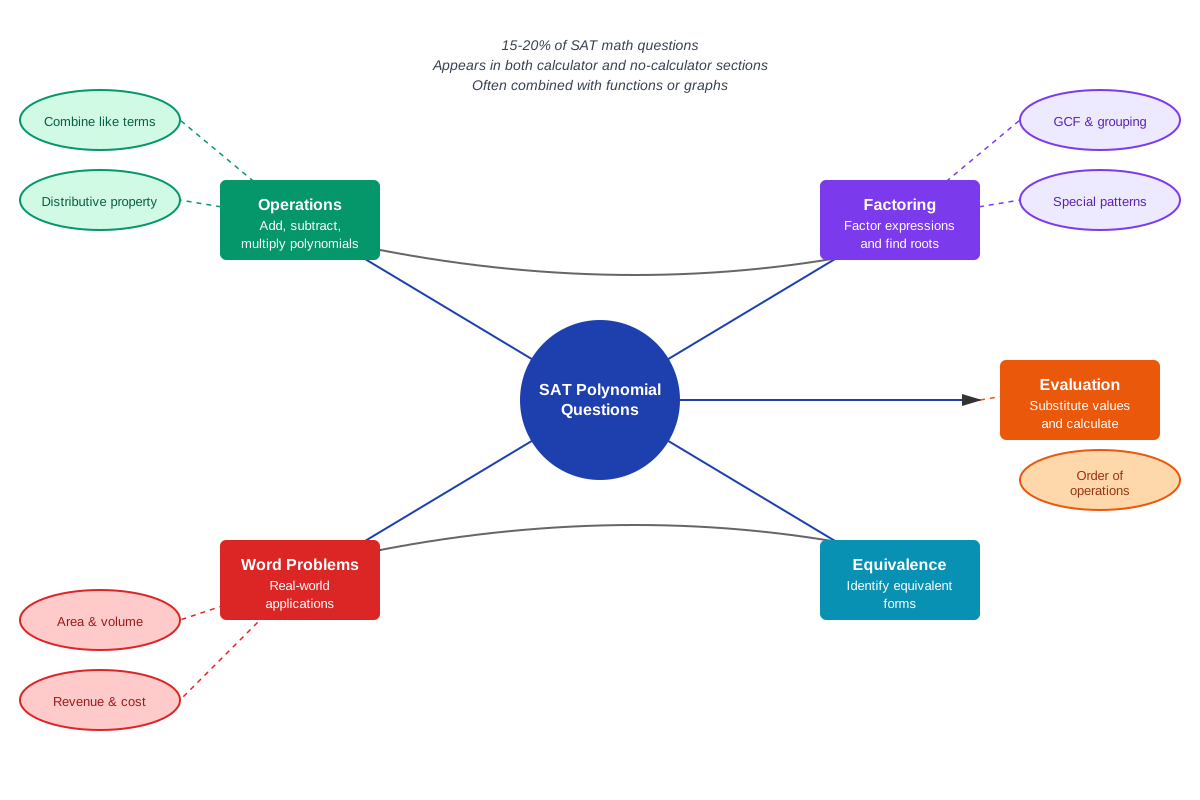
On the SAT, polynomial expressions appear in approximately 6-8 questions per test, distributed across both the calculator and no-calculator sections. These questions account for roughly 15-20% of the total math score, making them one of the highest-yield topics for focused study. The College Board tests polynomials through direct algebraic manipulation questions, word problems requiring polynomial setup, and questions involving polynomial graphs and functions. Questions typically appear at easy to medium difficulty levels, meaning they're highly accessible points if you've mastered the fundamentals.
Common SAT question formats include: simplifying polynomial expressions by combining like terms; adding, subtracting, or multiplying polynomials; identifying equivalent expressions; evaluating polynomials for specific values; and applying polynomial operations to solve real-world problems. The test also frequently embeds polynomial concepts within function notation, requiring you to recognize that f(x) = 3x² + 2x - 5 is simply a polynomial expression. Understanding these various presentations ensures you can recognize and solve polynomial questions regardless of how they're disguised.
Core Concepts
Definition and Structure of Polynomial Expressions
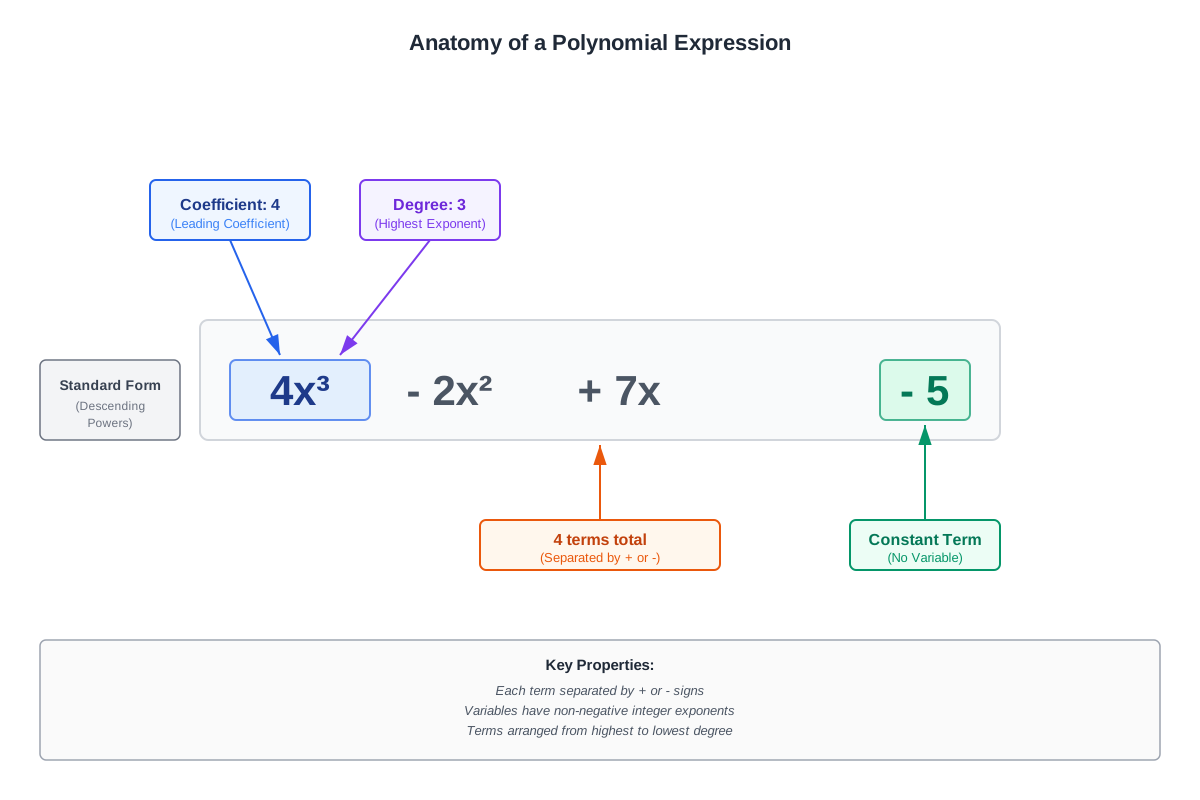
A polynomial expression is an algebraic expression consisting of one or more terms, where each term is the product of a coefficient (a number) and one or more variables raised to non-negative integer exponents. The general form of a polynomial in one variable x is: aₙxⁿ + aₙ₋₁xⁿ⁻¹ + ... + a₂x² + a₁x + a₀, where the coefficients (a values) are real numbers and the exponents are non-negative integers.
Each component of a polynomial has specific terminology. A term is a single part of the polynomial separated by addition or subtraction signs. The coefficient is the numerical factor of each term. The degree of a term is the sum of all exponents on variables in that term, and the degree of the polynomial is the highest degree among all its terms. The leading coefficient is the coefficient of the term with the highest degree, and the constant term is the term without any variables.
For example, in the polynomial 5x³ - 2x² + 7x - 3:
- There are four terms: 5x³, -2x², 7x, and -3
- The coefficients are 5, -2, 7, and -3
- The degree is 3 (from the term 5x³)
- The leading coefficient is 5
- The constant term is -3
Types of Polynomials
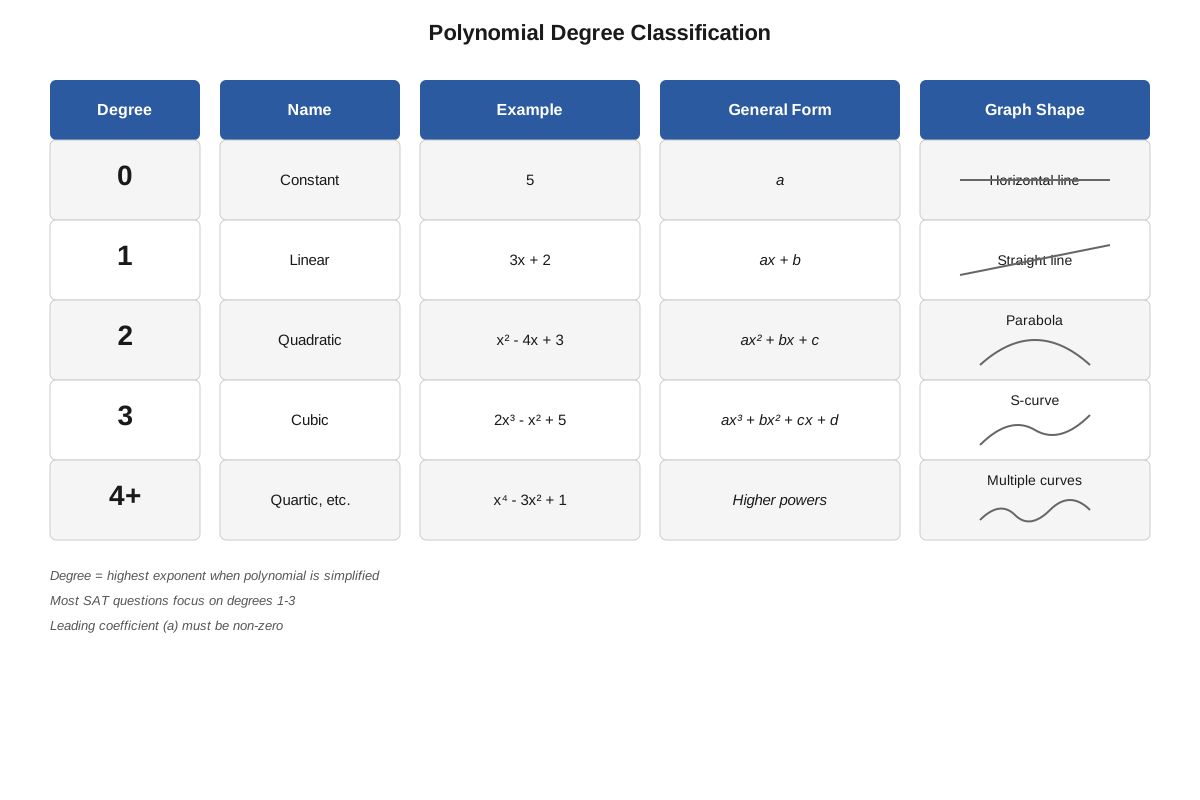
Polynomials are classified by both their degree and the number of terms they contain. Understanding these classifications helps you quickly identify polynomial structure and choose appropriate solution strategies.
| Classification by Degree | Name | Example |
|---|---|---|
| Degree 0 | Constant | 7 |
| Degree 1 | Linear | 3x + 2 |
| Degree 2 | Quadratic | x² - 5x + 6 |
| Degree 3 | Cubic | 2x³ + x² - 4 |
| Degree 4 | Quartic | x⁴ - 3x² + 1 |
| Classification by Terms | Name | Example |
|---|---|---|
| One term | Monomial | 5x² |
| Two terms | Binomial | 3x + 7 |
| Three terms | Trinomial | x² - 4x + 4 |
| Four or more terms | Polynomial | 2x³ + x² - 5x + 3 |
Standard Form and Like Terms
A polynomial is written in standard form when its terms are arranged in descending order of degree, from highest to lowest. Writing polynomials in standard form makes them easier to compare, add, subtract, and analyze. For example, the polynomial 3 + 5x² - 2x should be rewritten as 5x² - 2x + 3.
Like terms are terms that have identical variable parts with the same exponents. Only like terms can be combined through addition or subtraction. The terms 3x² and 5x² are like terms, but 3x² and 5x are not. When simplifying polynomial expressions, the fundamental process involves identifying and combining all like terms by adding or subtracting their coefficients while keeping the variable part unchanged.
For example, to simplify 4x² + 3x - 2x² + 5x - 7:
- Identify like terms: (4x² and -2x²), (3x and 5x), (-7 stands alone)
- Combine coefficients: (4 - 2)x² + (3 + 5)x - 7
- Simplify: 2x² + 8x - 7
Adding and Subtracting Polynomials
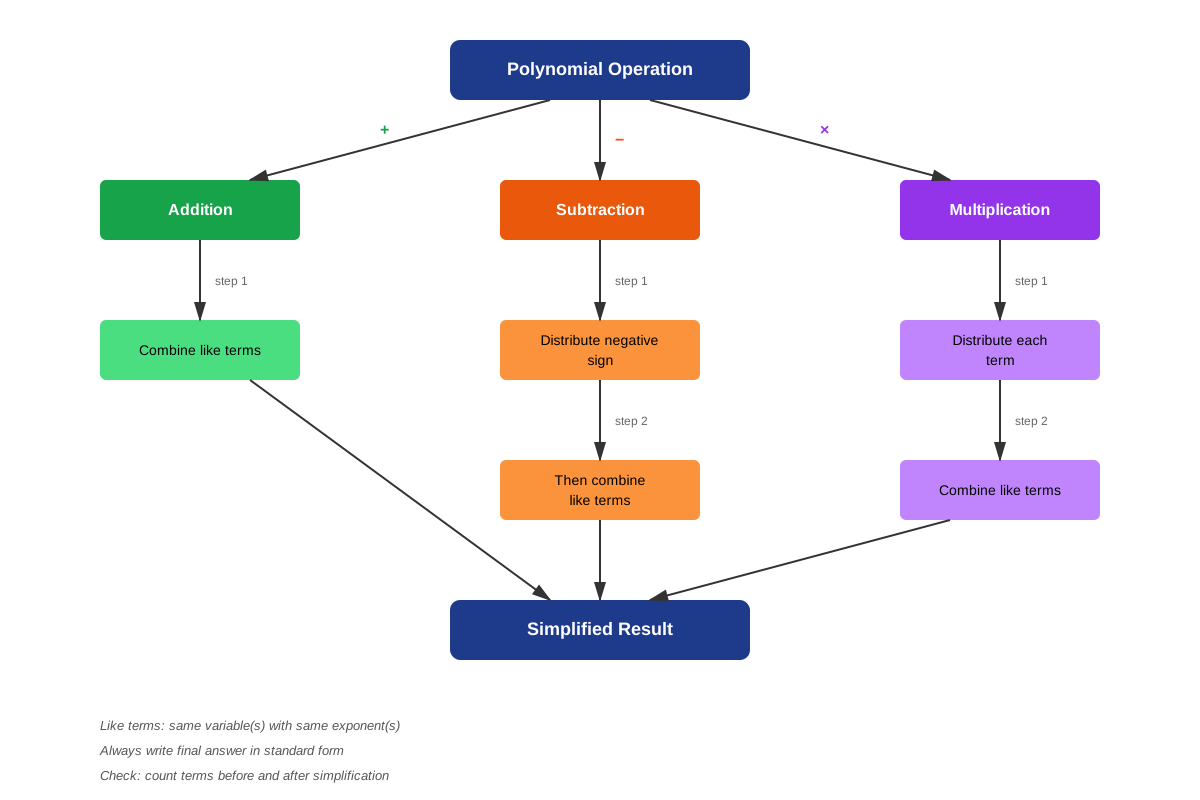
Adding polynomials involves combining all like terms from both expressions. The process requires careful attention to signs and systematic organization. When adding (3x² + 2x - 5) + (x² - 4x + 3):
- Remove parentheses (no sign change needed for addition): 3x² + 2x - 5 + x² - 4x + 3
- Rearrange to group like terms: 3x² + x² + 2x - 4x - 5 + 3
- Combine like terms: 4x² - 2x - 2
Subtracting polynomials requires distributing the negative sign to every term in the second polynomial before combining like terms. This is where many students make errors. When subtracting (3x² + 2x - 5) - (x² - 4x + 3):
- Distribute the negative sign: 3x² + 2x - 5 - x² + 4x - 3
- Rearrange to group like terms: 3x² - x² + 2x + 4x - 5 - 3
- Combine like terms: 2x² + 6x - 8
SAT Tip: When subtracting polynomials, always distribute the negative sign to EVERY term in the second polynomial. This is the most common error on SAT polynomial questions.
Multiplying Polynomials
Multiplying polynomials requires applying the distributive property systematically to ensure every term in the first polynomial multiplies every term in the second polynomial. For multiplying a monomial by a polynomial, distribute the monomial to each term: 3x(2x² - 5x + 4) = 6x³ - 15x² + 12x.
For multiplying two binomials, use the FOIL method (First, Outer, Inner, Last):
(2x + 3)(x - 4) = 2x·x + 2x·(-4) + 3·x + 3·(-4) = 2x² - 8x + 3x - 12 = 2x² - 5x - 12
For multiplying larger polynomials, systematically distribute each term in the first polynomial to every term in the second:
(x² + 2x - 3)(x + 4)
= x²(x + 4) + 2x(x + 4) - 3(x + 4)
= x³ + 4x² + 2x² + 8x - 3x - 12
= x³ + 6x² + 5x - 12
When multiplying, remember to:
- Multiply coefficients together
- Add exponents when multiplying variables with the same base
- Combine all like terms in the final answer
- Write the result in standard form
Evaluating Polynomial Expressions
Evaluating a polynomial means finding its value when the variable(s) are replaced with specific numbers. This skill appears frequently on the SAT, both in direct evaluation questions and within function notation problems. To evaluate 2x² - 3x + 5 when x = -2:
- Substitute -2 for every x: 2(-2)² - 3(-2) + 5
- Evaluate exponents first: 2(4) - 3(-2) + 5
- Multiply: 8 + 6 + 5
- Add: 19
Critical evaluation tips:
- Always use parentheses when substituting negative numbers
- Follow order of operations strictly (exponents before multiplication)
- Be careful with signs, especially when squaring negative numbers
- Double-check that you've substituted the value for every instance of the variable
Special Polynomial Products
Certain polynomial multiplication patterns appear so frequently on the SAT that recognizing them saves significant time. These special products include:
Square of a binomial:
- (a + b)² = a² + 2ab + b²
- (a - b)² = a² - 2ab + b²
Difference of squares:
- (a + b)(a - b) = a² - b²
Cube patterns (less common but occasionally tested):
- (a + b)³ = a³ + 3a²b + 3ab² + b³
- (a - b)³ = a³ - 3a²b + 3ab² - b³
Recognizing these patterns allows you to multiply quickly or factor efficiently. For example, if you see (3x + 5)², you can immediately write 9x² + 30x + 25 without using FOIL.
Concept Relationships
Polynomial expressions serve as the foundation for a vast network of algebraic concepts tested on the SAT. Understanding these relationships helps you see the bigger picture and transfer knowledge across question types.
Within polynomial expressions: The concept of terms and coefficients → enables → combining like terms → which allows → addition and subtraction of polynomials. Similarly, understanding the distributive property → enables → multiplication of polynomials → which leads to → recognition of special products and factoring patterns.
Connection to prerequisite knowledge: Basic exponent rules → directly support → polynomial multiplication and simplification. The order of operations → ensures correct → evaluation of polynomial expressions. Integer arithmetic skills → enable accurate → coefficient manipulation during all polynomial operations.
Connection to advanced topics: Mastery of polynomial expressions → provides the foundation for → factoring polynomials (the reverse of multiplication) → which enables → solving polynomial equations. Polynomial operations → directly apply to → rational expressions (fractions with polynomial numerators and denominators). Understanding polynomial structure → supports → graphing polynomial functions and analyzing their behavior.
Cross-topic applications: Polynomial expressions appear within function notation (f(x) = polynomial), systems of equations (where polynomials equal each other), word problems (where polynomials model real situations), and coordinate geometry (where polynomials describe curves). This interconnectedness means that improving polynomial skills enhances performance across multiple SAT math domains.
Quick check — test yourself on Polynomial expressions so far.
Try Flashcards →High-Yield Facts
⭐ A polynomial expression contains only non-negative integer exponents; expressions with negative or fractional exponents are not polynomials
⭐ The degree of a polynomial is determined by the term with the highest exponent sum, not by the number of terms
⭐ When subtracting polynomials, the negative sign must be distributed to every term in the second polynomial
⭐ Like terms must have identical variable parts with the same exponents; only coefficients can differ
⭐ When multiplying polynomials, multiply every term in the first polynomial by every term in the second polynomial
- The leading coefficient is the coefficient of the term with the highest degree when written in standard form
- A polynomial in standard form has terms arranged in descending order of degree
- When evaluating polynomials, always use parentheses when substituting negative values
- The constant term in a polynomial is the term without any variables (degree 0)
- Combining like terms involves adding or subtracting coefficients while keeping the variable part unchanged
- The product of two binomials always produces at most four terms before combining like terms
- Special products like (a + b)² and (a + b)(a - b) follow predictable patterns that save calculation time
Common Misconceptions
Misconception: When subtracting polynomials, only the first term of the second polynomial becomes negative.
Correction: The negative sign must be distributed to every single term in the second polynomial. For (3x² + 2x) - (x² + 5x), the result is 3x² + 2x - x² - 5x, not 3x² + 2x - x² + 5x.
Misconception: Terms with different exponents can be combined if they have the same variable.
Correction: Only like terms (identical variable parts with the same exponents) can be combined. The expression 3x² + 5x cannot be simplified further because x² and x are not like terms.
Misconception: When squaring a binomial, simply square each term: (x + 3)² = x² + 9.
Correction: Squaring a binomial produces three terms: (x + 3)² = x² + 6x + 9. The middle term (2ab) is often forgotten. Use the pattern (a + b)² = a² + 2ab + b².
Misconception: The degree of a polynomial equals the number of terms it contains.
Correction: The degree is the highest exponent in the polynomial, not the term count. The polynomial 5x⁴ + 2x - 7 has three terms but degree 4.
Misconception: When multiplying polynomials, only multiply terms in the same position.
Correction: Every term in the first polynomial must multiply every term in the second polynomial. For (x + 2)(x + 3), you must calculate x·x, x·3, 2·x, and 2·3, giving x² + 3x + 2x + 6 = x² + 5x + 6.
Misconception: Expressions with variables in denominators or under radicals are polynomials.
Correction: Polynomials can only have non-negative integer exponents. The expression 3/x (which equals 3x⁻¹) and √x (which equals x^(1/2)) are not polynomials.
Misconception: When evaluating a polynomial for a negative number, the negative sign only affects the first occurrence of the variable.
Correction: The given value must be substituted for every instance of the variable. When evaluating x² - 3x + 2 for x = -1, you must replace both x's: (-1)² - 3(-1) + 2 = 1 + 3 + 2 = 6.
Worked Examples
Example 1: Polynomial Operations and Simplification
Problem: If p(x) = 3x² - 5x + 2 and q(x) = x² + 4x - 7, what is 2p(x) - q(x)?
Solution:
Step 1: Multiply p(x) by 2
2p(x) = 2(3x² - 5x + 2)
2p(x) = 6x² - 10x + 4
Step 2: Set up the subtraction
2p(x) - q(x) = (6x² - 10x + 4) - (x² + 4x - 7)
Step 3: Distribute the negative sign to every term in q(x)
= 6x² - 10x + 4 - x² - 4x + 7
Step 4: Group like terms
= (6x² - x²) + (-10x - 4x) + (4 + 7)
Step 5: Combine like terms
= 5x² - 14x + 11
Answer: 5x² - 14x + 11
Connection to learning objectives: This problem demonstrates applying polynomial operations (multiplication by a scalar and subtraction) and identifying key features (terms, coefficients, degree). The final answer is a quadratic polynomial in standard form with degree 2, leading coefficient 5, and constant term 11.
Example 2: Polynomial Multiplication and Evaluation
Problem: The expression (2x - 3)(x + 5) - x² can be written as ax² + bx + c, where a, b, and c are constants. What is the value of a + b + c?
Solution:
Step 1: Multiply the binomials using FOIL
(2x - 3)(x + 5) = 2x·x + 2x·5 + (-3)·x + (-3)·5
= 2x² + 10x - 3x - 15
= 2x² + 7x - 15
Step 2: Subtract x² from the result
(2x² + 7x - 15) - x² = 2x² - x² + 7x - 15
= x² + 7x - 15
Step 3: Identify the coefficients
The expression x² + 7x - 15 is in the form ax² + bx + c
Therefore: a = 1, b = 7, c = -15
Step 4: Calculate a + b + c
a + b + c = 1 + 7 + (-15) = -7
Answer: -7
Alternative approach: Notice that a + b + c equals the value of the polynomial when x = 1. We could evaluate the original expression at x = 1:
(2(1) - 3)(1 + 5) - 1² = (2 - 3)(6) - 1 = (-1)(6) - 1 = -6 - 1 = -7
Connection to learning objectives: This problem combines polynomial multiplication, subtraction, and evaluation concepts. It demonstrates how recognizing that a + b + c = f(1) provides an efficient alternative solution method, a valuable SAT strategy.
Exam Strategy
When approaching SAT polynomial questions, implement these strategic approaches to maximize accuracy and efficiency:
Recognition and classification: Immediately identify the polynomial structure and degree. This helps you anticipate the complexity of operations and choose appropriate methods. If you see a quadratic (degree 2), consider whether special products might apply. For higher-degree polynomials, prepare for more systematic distribution.
Trigger words and phrases that signal polynomial questions include:
- "Simplify the expression"
- "Which expression is equivalent to"
- "If f(x) = [polynomial], find f(a)"
- "The expression can be written as"
- "Combine like terms"
- "Expand and simplify"
Process-of-elimination strategies:
- Check the degree: If the question involves multiplying a linear and quadratic polynomial, the answer must be cubic (degree 3). Eliminate any answer choices with incorrect degrees.
- Test with x = 0: Substituting zero often reveals the constant term quickly, allowing you to eliminate wrong answers.
- Test with x = 1: This simple substitution often distinguishes between similar-looking expressions.
- Check leading coefficients: Multiply the leading coefficients of the original polynomials to verify the leading coefficient of the product.
Time allocation: Polynomial questions typically require 45-90 seconds depending on complexity. Simple addition/subtraction problems should take 30-45 seconds, while multiplication problems may require 60-90 seconds. If a problem is taking longer, mark it and return after completing easier questions.
Common traps to avoid:
- Forgetting to distribute negative signs when subtracting
- Combining terms that aren't actually like terms
- Dropping terms during multiplication
- Sign errors when substituting negative values
- Forgetting to write answers in standard form when required
Calculator usage: Most polynomial operations don't require a calculator. However, when evaluating polynomials for specific values (especially with large numbers or multiple operations), a calculator can prevent arithmetic errors. Use your calculator to verify final numerical answers but perform algebraic manipulation by hand.
Memory Techniques
FOIL mnemonic for multiplying binomials:
- First terms
- Outer terms
- Inner terms
- Last terms
"DADD" for polynomial operations:
- Distribute (when multiplying)
- Arrange (group like terms)
- Do the math (combine coefficients)
- Descending order (write in standard form)
"PEMDAS applies to polynomials": When evaluating, remember Parentheses, Exponents, Multiplication, Division, Addition, Subtraction. This prevents order-of-operations errors.
Visualization for special products:
Picture (a + b)² as a square with side length (a + b). The area consists of four regions: a², ab, ab, and b², which combine to give a² + 2ab + b². This visual reinforces why the middle term has coefficient 2.
"Every term to every term" for polynomial multiplication: Visualize drawing arrows from each term in the first polynomial to each term in the second polynomial, ensuring you don't miss any products.
Sign change chant: When subtracting polynomials, mentally say "change all the signs" as you distribute the negative to every term in the second polynomial.
Degree addition rule: "When multiplying, degrees add; when adding, degrees stay." This helps you predict the degree of results: multiplying x² by x³ gives x⁵ (degrees 2 + 3 = 5), but adding them gives x³ + x² (degree stays at 3).
Summary
Polynomial expressions represent algebraic combinations of variables and coefficients with non-negative integer exponents, forming the foundation for a significant portion of SAT math content. Mastery requires understanding polynomial structure (terms, coefficients, degree, standard form), performing operations accurately (addition, subtraction, multiplication), and applying these skills to various question formats. The key to success lies in systematic approaches: distributing negative signs carefully when subtracting, multiplying every term to every term when multiplying, and combining only like terms when simplifying. Recognition of special products like (a + b)² and (a - b)(a + b) accelerates problem-solving. Evaluation skills require careful substitution and strict adherence to order of operations. Since polynomial questions appear in 15-20% of SAT math problems, investing time to master these concepts yields substantial score improvements. The most common errors—forgetting to distribute negative signs, combining unlike terms, and sign mistakes during evaluation—are entirely preventable through careful, methodical work and consistent practice.
Key Takeaways
- Polynomial expressions consist of terms with variables raised to non-negative integer exponents, and the degree is determined by the highest exponent
- Only like terms (identical variable parts with same exponents) can be combined; combine by adding or subtracting coefficients while keeping variables unchanged
- When subtracting polynomials, distribute the negative sign to every term in the second polynomial—this is the most common source of errors
- Multiplying polynomials requires distributing every term in the first polynomial to every term in the second polynomial, then combining like terms
- Special products like (a + b)² = a² + 2ab + b² and (a + b)(a - b) = a² - b² save time and reduce errors
- When evaluating polynomials, use parentheses for substituted values and follow order of operations strictly
- Polynomial questions appear in approximately 15-20% of SAT math problems, making them a high-yield study topic
Related Topics
Factoring polynomials: The reverse process of polynomial multiplication, where you break down a polynomial into a product of simpler expressions. Mastering polynomial operations makes factoring more intuitive since you recognize the patterns in reverse.
Polynomial equations: Setting polynomials equal to values or other polynomials and solving for variables. Your ability to manipulate polynomial expressions directly enables solving these equations.
Polynomial functions and graphs: Understanding how polynomial expressions behave when graphed, including end behavior, zeros, and turning points. The degree and leading coefficient of polynomial expressions determine graph characteristics.
Rational expressions: Fractions with polynomial expressions in numerators and denominators. All operations on rational expressions require polynomial manipulation skills as a foundation.
Systems of polynomial equations: Solving multiple polynomial equations simultaneously. Strong polynomial operation skills make these systems more manageable.
Practice CTA
Now that you've mastered the core concepts of polynomial expressions, it's time to solidify your understanding through active practice. Attempt the practice questions designed specifically for this topic—they mirror actual SAT question formats and difficulty levels. Use the flashcards to reinforce key definitions, formulas, and common patterns until they become automatic. Remember, the difference between knowing polynomial concepts and scoring points on test day lies in repeated, focused practice. Each problem you work through builds the pattern recognition and procedural fluency that leads to faster, more accurate performance under time pressure. You've built the foundation—now strengthen it through deliberate practice!
Sign up free to keep reading
Create a free AnvayaPrep account to finish this SAT guide on Polynomial expressions — plus flashcards and practice questions.