Overview
The sum of cubes is a powerful algebraic factoring pattern that appears regularly on the SAT math section, particularly in questions involving polynomial manipulation, simplification, and equation solving. This formula allows students to factor expressions of the form a³ + b³ into a product of a binomial and a trinomial, transforming seemingly complex cubic expressions into manageable factors. Understanding this pattern is essential because the SAT frequently tests students' ability to recognize special factoring forms and apply them efficiently under time pressure.
Mastering the sum of cubes formula provides a significant strategic advantage on the SAT. Questions involving this concept often appear in the calculator and no-calculator sections, typically worth 1-2 questions per test administration. These problems may be presented directly as factoring exercises or embedded within more complex scenarios involving rational expressions, equation solving, or function analysis. The ability to quickly identify and factor sum of cubes expressions can save valuable time and unlock solutions to problems that would otherwise require lengthy polynomial division or trial-and-error approaches.
Within the broader context of polynomial algebra, the sum of cubes connects directly to fundamental factoring techniques, polynomial operations, and the structure of algebraic expressions. It serves as a bridge between basic factoring (such as difference of squares) and more advanced polynomial manipulation. Students who master this topic develop stronger pattern recognition skills and gain confidence in approaching unfamiliar algebraic expressions—both critical competencies for achieving high scores on the SAT math section.
Learning Objectives
- [ ] Identify key features of sum of cubes expressions and distinguish them from other polynomial forms
- [ ] Explain how sum of cubes appears on the SAT in various question formats and contexts
- [ ] Apply sum of cubes factoring formula to answer SAT-style questions efficiently
- [ ] Derive the sum of cubes formula through polynomial multiplication to deepen conceptual understanding
- [ ] Recognize when NOT to apply the sum of cubes formula and identify alternative approaches
- [ ] Combine sum of cubes factoring with other algebraic techniques to solve multi-step problems
Prerequisites
- Basic polynomial operations (addition, subtraction, multiplication): Essential for understanding how the factored form expands back to the original expression and for verifying solutions
- Exponent rules and properties: Necessary to recognize cubic terms (a³, b³) and manipulate expressions involving powers
- Factoring fundamentals (GCF, grouping, difference of squares): Provides the foundational framework for understanding special factoring patterns like sum of cubes
- Binomial multiplication (FOIL and extended methods): Required to verify factorizations and understand the derivation of the sum of cubes formula
- Algebraic substitution: Helps in recognizing sum of cubes patterns when variables or expressions are substituted for a and b
Why This Topic Matters
The sat sum of cubes formula represents a high-efficiency tool that transforms complex cubic expressions into factored forms, enabling solutions to problems that would otherwise be computationally intensive or time-prohibitive. In real-world applications, cubic relationships appear in volume calculations, physics equations involving acceleration and force, economics models for cost functions, and engineering problems involving three-dimensional structures. Understanding how to manipulate cubic expressions provides practical problem-solving skills beyond standardized testing.
On the SAT, sum of cubes questions typically appear 1-2 times per test administration, most commonly in the Heart of Algebra and Passport to Advanced Math content domains. These questions carry the same point value as any other question, but they often serve as "gatekeeper" problems that separate high scorers from average performers. Students who recognize the pattern can solve these problems in 30-60 seconds, while those who don't may spend 3-4 minutes attempting polynomial long division or never reach a solution at all.
The SAT presents sum of cubes in several distinct formats: direct factoring problems where students must factor a given expression, equation-solving scenarios where factoring reveals solutions, simplification problems involving rational expressions with sum of cubes in numerators or denominators, and word problems where cubic relationships must be identified and manipulated. Additionally, the College Board occasionally embeds sum of cubes within more complex expressions, testing whether students can identify the pattern amid algebraic "noise." Recognizing these various presentations is crucial for consistent performance.
Core Concepts
The Sum of Cubes Formula
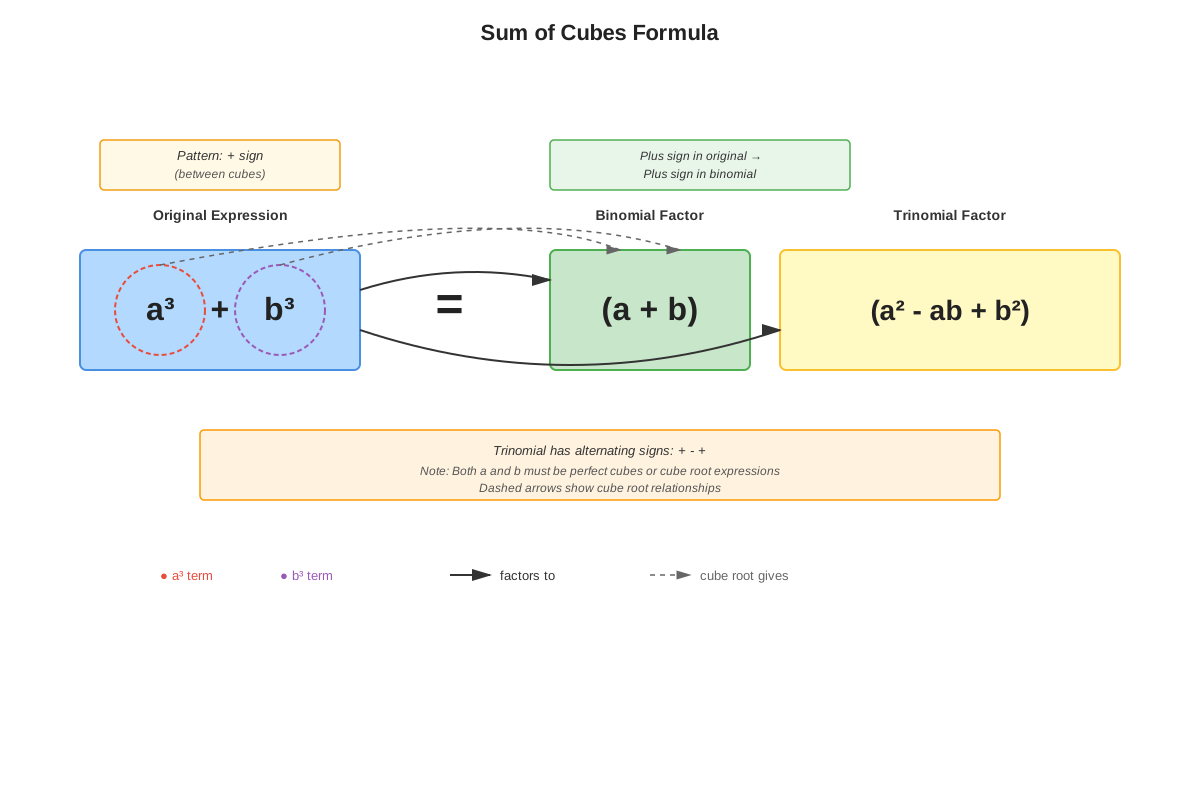
The sum of cubes formula is an algebraic identity that factors any expression of the form a³ + b³. The complete formula states:
a³ + b³ = (a + b)(a² - ab + b²)This formula reveals that the sum of two perfect cubes can always be factored into the product of a binomial (a + b) and a trinomial (a² - ab + b²). The binomial factor consists of the cube roots of the original terms added together, while the trinomial factor follows a specific pattern: the square of the first term, minus the product of both terms, plus the square of the second term.
Understanding why this formula works deepens mastery and aids memorization. When the right side is expanded using polynomial multiplication, every term cancels or combines to produce exactly a³ + b³. Specifically, multiplying (a + b) by (a² - ab + b²) yields: a³ - a²b + ab² + a²b - ab² + b³, where the middle terms (-a²b and +a²b, +ab² and -ab²) cancel completely, leaving only a³ + b³.
Identifying Sum of Cubes Expressions
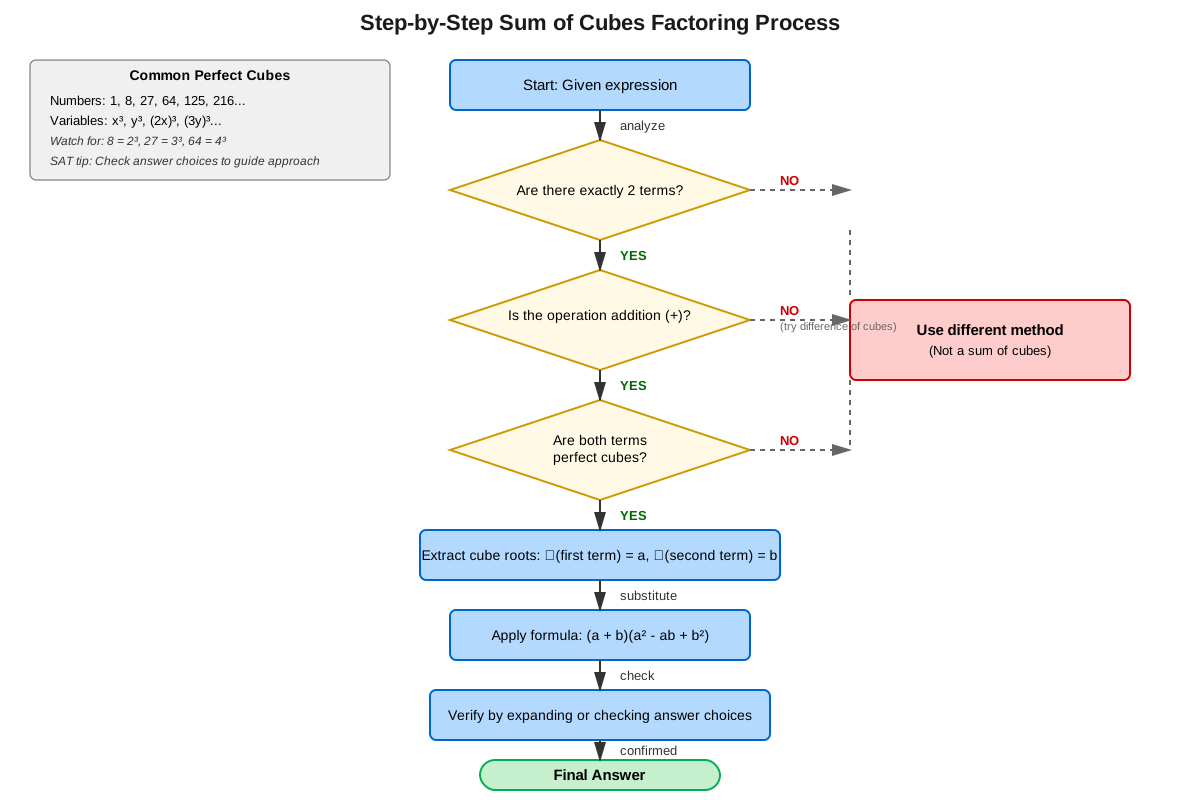
Recognition is the critical first step in applying the sum of cubes formula. An expression qualifies as a sum of cubes when it meets three specific criteria:
- Two terms only: The expression must contain exactly two terms separated by addition
- Perfect cubes: Each term must be a perfect cube (can be written as something³)
- Addition operation: The terms must be added, not subtracted
Common perfect cubes that appear on the SAT include: 1 (1³), 8 (2³), 27 (3³), 64 (4³), 125 (5³), x³, y³, and expressions like (2x)³ = 8x³ or (3y)³ = 27y³. Students must recognize that 8x³ = (2x)³ and 27y³ = (3y)³ to properly identify a and b values.
The Trinomial Factor Pattern
The trinomial factor (a² - ab + b²) follows a memorable pattern that distinguishes it from other trinomials. This factor is NOT factorable over the real numbers—a crucial fact that prevents students from attempting further factorization. The pattern consists of:
- First term: Square of the first cube root (a²)
- Middle term: Negative product of both cube roots (-ab)
- Last term: Square of the second cube root (b²)
The signs in this trinomial follow the pattern: positive, negative, positive. This contrasts with the difference of cubes formula (covered separately), where the signs differ. A helpful memory device: for sum of cubes, the binomial has a plus sign, and the trinomial starts with the "opposite" sign pattern (positive, then negative).
Applying the Formula Step-by-Step
Factoring a sum of cubes expression requires a systematic approach:
- Verify the pattern: Confirm the expression has exactly two terms, both perfect cubes, connected by addition
- Identify a and b: Determine what values, when cubed, produce each term
- Write the binomial factor: Form (a + b) using the cube roots
- Construct the trinomial factor: Apply the pattern (a² - ab + b²)
- Verify by expansion: Multiply the factors to confirm they produce the original expression
For example, to factor x³ + 8:
- Recognize x³ + 8 as x³ + 2³
- Identify a = x and b = 2
- Binomial factor: (x + 2)
- Trinomial factor: (x² - 2x + 4)
- Result: x³ + 8 = (x + 2)(x² - 2x + 4)
Sum of Cubes vs. Related Patterns
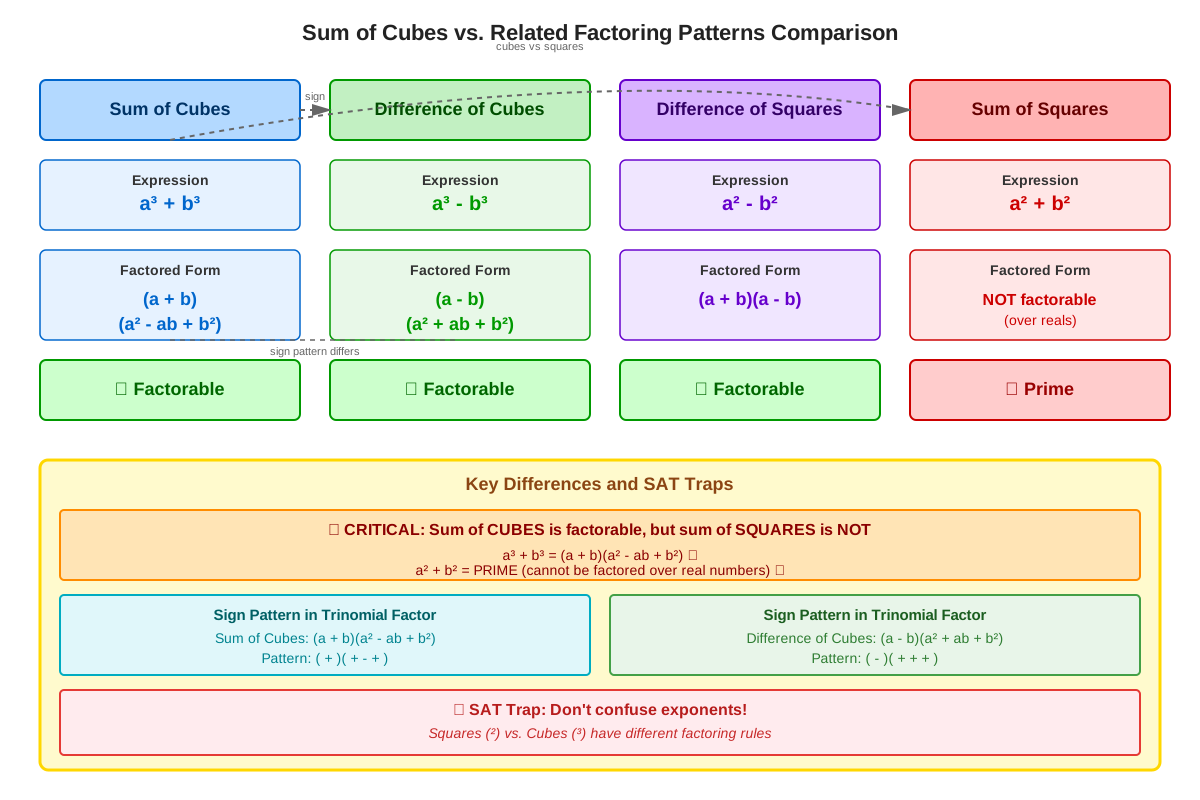
Understanding what sum of cubes is NOT helps prevent common errors:
| Pattern | Form | Factorization | Key Difference |
|---|---|---|---|
| Sum of Cubes | a³ + b³ | (a + b)(a² - ab + b²) | Two cubic terms, addition |
| Difference of Cubes | a³ - b³ | (a - b)(a² + ab + b²) | Two cubic terms, subtraction |
| Difference of Squares | a² - b² | (a + b)(a - b) | Two squared terms, subtraction |
| Sum of Squares | a² + b² | Not factorable (over reals) | Two squared terms, addition |
Notably, while sum of cubes IS factorable, sum of squares (a² + b²) is NOT factorable over real numbers. This distinction frequently appears on the SAT to test conceptual understanding.
Complex Sum of Cubes Expressions
The SAT often presents sum of cubes with coefficients or more complex terms. For instance, 64x³ + 125y³ requires recognizing that 64x³ = (4x)³ and 125y³ = (5y)³. The factorization becomes:
64x³ + 125y³ = (4x)³ + (5y)³ = (4x + 5y)(16x² - 20xy + 25y²)When dealing with coefficients, extract the cube root of the numerical coefficient and keep the variable with its exponent divided by 3. For 27a³, recognize this as (3a)³, so a = 3a in the formula.
Concept Relationships
The sum of cubes formula exists within a hierarchy of factoring techniques. At the foundation lie basic factoring methods: extracting the greatest common factor (GCF) and factoring by grouping. These fundamental techniques should always be attempted first, as they may simplify expressions before applying special patterns. The sum of cubes builds directly on these foundations while representing a more specialized tool.
Within the family of special factoring patterns, sum of cubes relates most closely to the difference of cubes (a³ - b³) and the difference of squares (a² - b²). All three represent memorizable formulas that factor specific polynomial forms. The relationship flows: basic factoring → special two-term patterns (difference of squares) → special cubic patterns (sum and difference of cubes). Mastering sum of cubes enables students to tackle the full range of special factoring patterns.
The connection to polynomial division is particularly important. When students don't recognize a sum of cubes pattern, they might resort to polynomial long division or synthetic division—processes that are time-consuming and error-prone under test conditions. Recognizing the sum of cubes pattern eliminates the need for division, demonstrating how pattern recognition → efficient factoring → time savings.
Sum of cubes factoring also connects forward to rational expressions and equation solving. Once a sum of cubes is factored, the binomial factor may cancel with denominators in rational expressions, or the factors may be set equal to zero to solve equations. The relationship map: sum of cubes recognition → factoring → simplified rational expressions OR solution sets for equations.
Finally, sum of cubes relates to function analysis and graphing. The factored form reveals zeros of cubic functions and helps identify key features of graphs. This connection: cubic function → factor using sum of cubes → identify x-intercepts and behavior.
High-Yield Facts
⭐ The sum of cubes formula is: a³ + b³ = (a + b)(a² - ab + b²)
⭐ The trinomial factor (a² - ab + b²) in a sum of cubes factorization is NOT factorable over real numbers
⭐ Sum of cubes requires exactly two terms that are perfect cubes connected by addition
⭐ Common perfect cubes on the SAT: 1, 8, 27, 64, 125, 216, 1000, and any variable cubed (x³, y³)
⭐ The binomial factor in sum of cubes always uses addition: (a + b), never subtraction
- The middle term of the trinomial factor is always negative: -ab
- To find a and b, take the cube root of each term in the original expression
- Sum of squares (a² + b²) is NOT factorable, but sum of cubes (a³ + b³) IS factorable
- When coefficients are present, factor them as part of the cube: 8x³ = (2x)³
- The sum of cubes formula can be verified by expanding the factored form using polynomial multiplication
- On the SAT, sum of cubes often appears in rational expressions requiring simplification
- Recognizing 64 = 4³, 125 = 5³, and 216 = 6³ speeds up problem-solving significantly
Quick check — test yourself on Sum of cubes so far.
Try Flashcards →Common Misconceptions
Misconception: The sum of cubes formula is the same as the difference of cubes formula.
Correction: While similar, these formulas differ in critical ways. Sum of cubes: (a + b)(a² - ab + b²). Difference of cubes: (a - b)(a² + ab + b²). The binomial factor's sign matches the original operation, while the trinomial's middle term has the opposite sign.
Misconception: The trinomial factor (a² - ab + b²) can be factored further.
Correction: The trinomial factor in a sum of cubes factorization is prime over the real numbers and cannot be factored further. Attempting to factor it wastes time and leads to errors. This is a key difference from factorable trinomials like x² - 5x + 6.
Misconception: Sum of cubes and sum of squares both factor using similar patterns.
Correction: Sum of squares (a² + b²) is NOT factorable over real numbers, while sum of cubes (a³ + b³) IS factorable. This is a fundamental distinction that the SAT frequently tests. Only difference of squares and both sum and difference of cubes have factoring formulas.
Misconception: The coefficient doesn't matter when identifying sum of cubes; only the variable exponent matters.
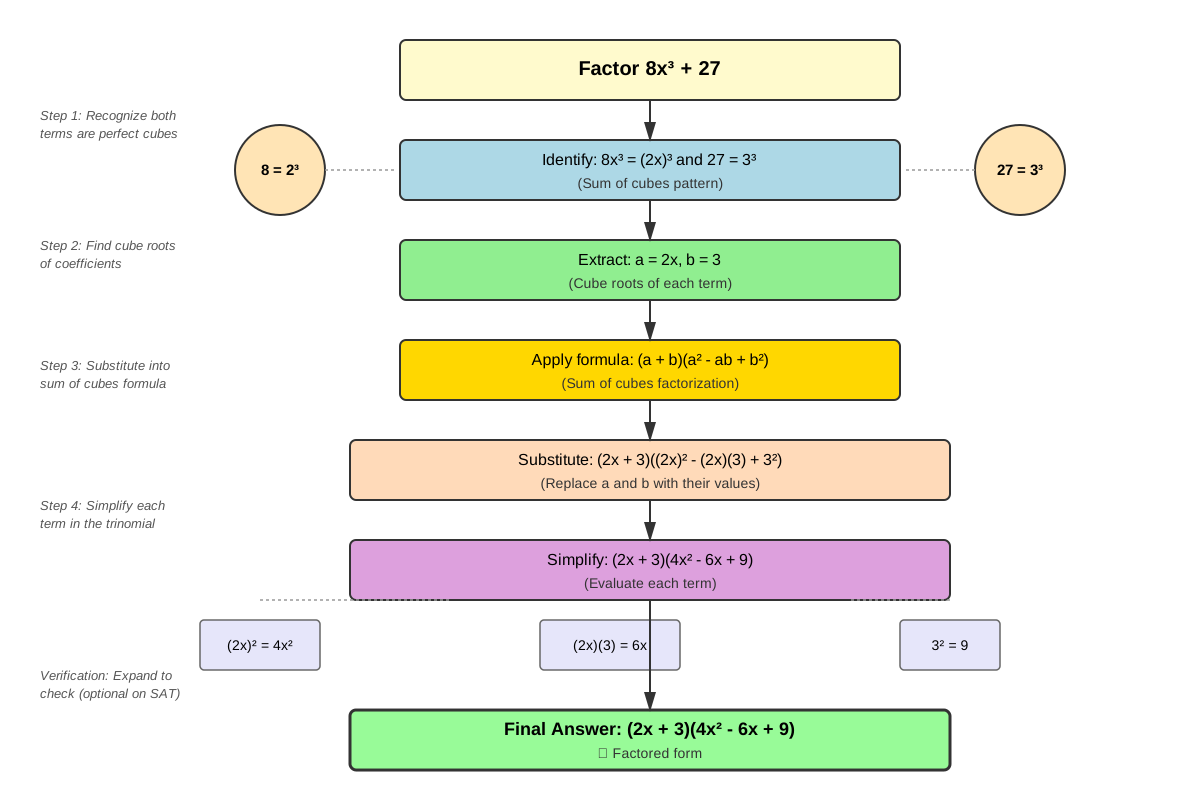
Correction: The coefficient must also be a perfect cube. For 8x³ + 27, recognize that 8 = 2³ and 27 = 3³, so this factors as (2x)³ + 3³ = (2x + 3)(4x² - 6x + 9). Ignoring the coefficient leads to incorrect factorizations.
Misconception: When solving equations using sum of cubes, both factors always yield real solutions.
Correction: While the binomial factor (a + b) = 0 yields a real solution, the trinomial factor (a² - ab + b²) = 0 often yields complex (non-real) solutions. On the SAT, which focuses on real numbers, typically only the binomial factor provides the answer.
Misconception: The sum of cubes formula works for expressions with more than two terms.
Correction: The sum of cubes formula applies exclusively to expressions with exactly two terms. If an expression has three or more terms, different factoring methods (grouping, trinomial factoring) must be used. Always verify the two-term requirement before applying the formula.
Worked Examples
Example 1: Direct Factoring
Problem: Factor completely: x³ + 64
Solution:
Step 1: Verify this is a sum of cubes pattern.
- Two terms: x³ and 64 ✓
- Both perfect cubes: x³ = (x)³ and 64 = 4³ ✓
- Connected by addition ✓
Step 2: Identify a and b.
- a = x (since x³ = (x)³)
- b = 4 (since 64 = 4³)
Step 3: Apply the sum of cubes formula: a³ + b³ = (a + b)(a² - ab + b²)
Step 4: Write the binomial factor.
- (a + b) = (x + 4)
Step 5: Write the trinomial factor.
- a² = x²
- -ab = -x(4) = -4x
- b² = 4² = 16
- Trinomial: (x² - 4x + 16)
Step 6: Combine the factors.
- x³ + 64 = (x + 4)(x² - 4x + 16)
Step 7: Verify by expanding (optional but recommended).
- (x + 4)(x² - 4x + 16)
- = x(x² - 4x + 16) + 4(x² - 4x + 16)
- = x³ - 4x² + 16x + 4x² - 16x + 64
- = x³ + 64 ✓
Connection to Learning Objectives: This example demonstrates identification of sum of cubes features and direct application of the factoring formula, addressing the first and third learning objectives.
Example 2: Complex Coefficients with Equation Solving
Problem: Solve for x: 27x³ + 8 = 0
Solution:
Step 1: Recognize this as a sum of cubes that needs factoring.
- Rewrite: 27x³ + 8 = 0
- Identify: 27x³ = (3x)³ and 8 = 2³
Step 2: Identify a and b.
- a = 3x (since 27x³ = (3x)³)
- b = 2 (since 8 = 2³)
Step 3: Apply the sum of cubes formula.
- (3x)³ + 2³ = (3x + 2)[(3x)² - (3x)(2) + 2²]
- = (3x + 2)(9x² - 6x + 4)
Step 4: Set the equation equal to zero.
- (3x + 2)(9x² - 6x + 4) = 0
Step 5: Apply the zero product property.
- Either (3x + 2) = 0 OR (9x² - 6x + 4) = 0
Step 6: Solve the binomial factor.
- 3x + 2 = 0
- 3x = -2
- x = -2/3
Step 7: Consider the trinomial factor.
- For 9x² - 6x + 4 = 0, use the discriminant to check for real solutions
- Discriminant: b² - 4ac = (-6)² - 4(9)(4) = 36 - 144 = -108
- Since the discriminant is negative, this factor yields no real solutions
Step 8: State the final answer.
- x = -2/3 (only real solution)
Connection to Learning Objectives: This example shows how sum of cubes appears in equation-solving contexts on the SAT, demonstrates recognition of complex coefficients, and illustrates why the trinomial factor typically doesn't contribute real solutions—all critical for exam success.
Exam Strategy
When approaching sat sum of cubes questions, employ a systematic recognition-and-execution strategy. First, scan the expression for the two-term structure—if more than two terms exist, sum of cubes doesn't apply directly. Next, verify that both terms are perfect cubes by mentally checking if their coefficients and variable exponents are divisible by 3. This initial screening takes 5-10 seconds but prevents misapplication of the formula.
Trigger words and phrases that signal sum of cubes problems include: "factor completely," "simplify the expression," "solve the equation," "find all real solutions," and "which of the following is equivalent to." When you see these phrases paired with cubic expressions, immediately check for sum or difference of cubes patterns. Additionally, rational expressions with cubic terms in numerators or denominators often require sum of cubes factoring for simplification.
For process of elimination on multiple-choice questions, use these strategies:
- Check the binomial factor first: The binomial must be (a + b) for sum of cubes. Eliminate any answer choice with (a - b) as the first factor.
- Verify the trinomial's middle term sign: For sum of cubes, the middle term must be negative (-ab). Eliminate choices with +ab.
- Test with simple values: If unsure, substitute x = 0 or x = 1 into both the original expression and answer choices. Incorrect factorizations will produce different values.
- Expand suspicious answers: If time permits and you're uncertain, quickly expand the factored form to verify it matches the original.
Time allocation is crucial. A straightforward sum of cubes factoring problem should take 30-60 seconds once you recognize the pattern. If you're spending more than 90 seconds, you may be missing the pattern or attempting an inefficient method. In such cases, mark the question, move on, and return if time permits. Don't let a single sum of cubes question consume 3-4 minutes that could be used on multiple other problems.
Exam Tip: Always check if a GCF can be factored out BEFORE applying sum of cubes. For example, 2x³ + 16 should first be factored as 2(x³ + 8), then apply sum of cubes to the parenthetical expression.
Memory Techniques
The "SOAP" Mnemonic for the trinomial factor pattern:
- Square the first term (a²)
- Opposite sign for the middle term (-ab)
- And
- Plus the square of the second term (+b²)
This creates the pattern: a² - ab + b², where "opposite" reminds you that for sum of cubes (which has +), the middle term has -.
The "Same-Opposite-Always Positive" Rule:
- The binomial factor's sign is the SAME as the original operation (+ for sum)
- The trinomial's middle term is the OPPOSITE sign (- for sum)
- The trinomial's last term is ALWAYS POSITIVE (+b²)
Visualization Strategy: Picture a cube (like a die) splitting into two pieces—a thin slice (the binomial) and a thicker piece (the trinomial). The thin slice is simple (a + b), while the thicker piece is more complex (a² - ab + b²). This mental image reinforces that sum of cubes factors into one simple and one complex part.
The "Perfect Cube Checklist": Memorize this quick reference for common perfect cubes:
- 1, 8, 27, 64, 125 (1³ through 5³)
- Any variable with exponent divisible by 3 (x³, x⁶, x⁹)
- Products: (2x)³ = 8x³, (3x)³ = 27x³, (4x)³ = 64x³
Acronym for Application Steps: VIBVC
- Verify the pattern (two terms, cubes, addition)
- Identify a and b
- Binomial factor (a + b)
- Vary the trinomial (a² - ab + b²)
- Check by expanding
Summary
The sum of cubes formula, a³ + b³ = (a + b)(a² - ab + b²), is an essential factoring pattern for SAT success that transforms cubic expressions into products of a binomial and a trinomial. Recognition requires identifying exactly two terms that are perfect cubes connected by addition. The factored form consists of a simple binomial (a + b) and a more complex trinomial (a² - ab + b²) that cannot be factored further over real numbers. This pattern appears regularly on the SAT in direct factoring problems, equation-solving scenarios, and rational expression simplification. Mastery requires memorizing the formula, recognizing perfect cubes (especially 1, 8, 27, 64, 125 and their variable equivalents), and understanding that the trinomial's middle term is always negative for sum of cubes. Students who efficiently identify and apply this pattern gain significant time advantages and unlock solutions to problems that would otherwise require lengthy polynomial division. The key distinction from related patterns—particularly that sum of squares is NOT factorable while sum of cubes IS—frequently appears as a conceptual test on the SAT.
Key Takeaways
- The sum of cubes formula a³ + b³ = (a + b)(a² - ab + b²) must be memorized and applied quickly on the SAT
- Sum of cubes requires exactly two perfect cube terms connected by addition; any other configuration requires different methods
- The trinomial factor (a² - ab + b²) is NOT factorable over real numbers—never attempt to factor it further
- Common perfect cubes (1, 8, 27, 64, 125) and their recognition with coefficients (8x³ = (2x)³) are high-yield for quick problem-solving
- The binomial factor's sign matches the original operation (+ for sum), while the trinomial's middle term has the opposite sign (-)
- Sum of cubes differs fundamentally from sum of squares: sum of cubes IS factorable, sum of squares is NOT
- On equation-solving problems, the binomial factor typically provides the real solution, while the trinomial factor often yields complex solutions
Related Topics
Difference of Cubes: The complementary formula a³ - b³ = (a - b)(a² + ab + b²) follows similar logic but with different signs. Mastering sum of cubes makes learning difference of cubes straightforward, as the patterns are closely related. Together, these formulas provide complete coverage of two-term cubic factoring.
Polynomial Long Division: When sum of cubes patterns aren't recognized, students may resort to polynomial division. Understanding sum of cubes eliminates the need for this time-consuming process in specific cases, demonstrating the value of pattern recognition over algorithmic approaches.
Rational Expressions with Cubic Terms: Many SAT problems present sum of cubes within rational expressions requiring simplification. Factoring the sum of cubes in the numerator or denominator often reveals common factors that cancel, dramatically simplifying complex fractions.
Cubic Functions and Graphing: The factored form of cubic expressions reveals zeros and helps analyze function behavior. Sum of cubes factoring connects algebraic manipulation to graphical interpretation, a connection the SAT frequently tests.
Complex Numbers: While the SAT focuses on real numbers, the trinomial factor in sum of cubes factorizations can be solved using complex numbers. Understanding why this factor doesn't yield real solutions deepens conceptual mastery and prepares students for advanced mathematics.
Practice CTA
Now that you've mastered the sum of cubes formula and its applications, it's time to solidify your understanding through practice. Attempt the practice questions designed specifically for this topic—they mirror actual SAT question formats and difficulty levels. Use the flashcards to reinforce the formula, perfect cube recognition, and key distinctions between sum of cubes and related patterns. Remember, pattern recognition improves with repetition, and each practice problem you solve builds the automaticity needed for test-day success. The difference between knowing the formula and applying it flawlessly under pressure comes from deliberate practice. You've invested the time to learn this high-yield topic—now convert that knowledge into points by practicing until sum of cubes recognition becomes second nature!
Sign up free to keep reading
Create a free AnvayaPrep account to finish this SAT guide on Sum of cubes — plus flashcards and practice questions.