Overview
The difference of cubes is a powerful algebraic factoring pattern that appears regularly on the SAT math section. This formula allows students to factor expressions of the form a³ - b³ into a product of a binomial and a trinomial: a³ - b³ = (a - b)(a² + ab + b²). Understanding this pattern is essential for solving polynomial equations, simplifying complex algebraic expressions, and tackling higher-level algebra problems that frequently appear in the calculator and no-calculator portions of the SAT.
Mastering the difference of cubes formula provides students with a critical tool for recognizing and manipulating cubic expressions efficiently. On the SAT, this topic often appears in questions involving factoring, solving equations, simplifying rational expressions, and identifying equivalent forms of algebraic expressions. The ability to quickly recognize when an expression represents a difference of cubes can save valuable time during the exam and unlock solutions to problems that might otherwise seem intractable.
The SAT difference of cubes concept connects directly to broader polynomial manipulation skills, including factoring techniques, polynomial division, and understanding the structure of algebraic expressions. This topic builds upon foundational knowledge of exponents, binomial multiplication, and basic factoring patterns while serving as a gateway to more advanced algebraic reasoning. Students who master this concept gain confidence in handling complex polynomial problems and develop pattern-recognition skills that transfer to multiple areas of SAT mathematics.
Learning Objectives
- [ ] Identify key features of difference of cubes expressions in various algebraic forms
- [ ] Explain how difference of cubes appears on the SAT in different question types
- [ ] Apply difference of cubes to answer SAT-style questions efficiently and accurately
- [ ] Factor expressions using the difference of cubes formula without errors
- [ ] Recognize when NOT to apply the difference of cubes formula
- [ ] Combine difference of cubes with other factoring techniques to solve complex problems
- [ ] Verify factorization results by expanding and checking equivalence
Prerequisites
- Exponent rules and properties: Understanding how to work with powers, particularly cubes (x³), is fundamental to recognizing difference of cubes patterns
- Basic factoring techniques: Knowledge of factoring out common factors and recognizing patterns like difference of squares provides the foundation for more complex factoring
- Binomial multiplication: The ability to multiply binomials using FOIL or the distributive property is necessary to verify difference of cubes factorizations
- Perfect cubes recognition: Familiarity with common perfect cubes (1, 8, 27, 64, 125, etc.) enables quick pattern identification
- Polynomial operations: Understanding how to add, subtract, and multiply polynomials is essential for manipulating cubic expressions
Why This Topic Matters
The difference of cubes appears in real-world applications involving volume calculations, engineering problems, and financial modeling where cubic relationships exist. In physics, cubic functions model phenomena like the relationship between the radius and volume of spheres. In economics, certain cost and revenue functions involve cubic terms that require factoring for optimization problems.
On the SAT, difference of cubes questions appear approximately 2-3 times per exam, typically in the Heart of Algebra and Passport to Advanced Math domains. These questions usually appear as medium to hard difficulty problems worth 1 point each, making them high-yield targets for score improvement. The College Board frequently tests this concept because it assesses both pattern recognition and algebraic manipulation skills—two core competencies for college-level mathematics.
Common SAT question formats include: asking students to factor a cubic expression completely, identifying equivalent forms of expressions, solving cubic equations by factoring, simplifying rational expressions with cubic terms in numerators or denominators, and determining the number of real solutions to cubic equations. The difference of cubes often appears disguised within more complex problems, requiring students to recognize the pattern amid other algebraic operations. Questions may present the cubic terms with coefficients or variables that need to be identified as perfect cubes before applying the formula.
Core Concepts
The Difference of Cubes Formula
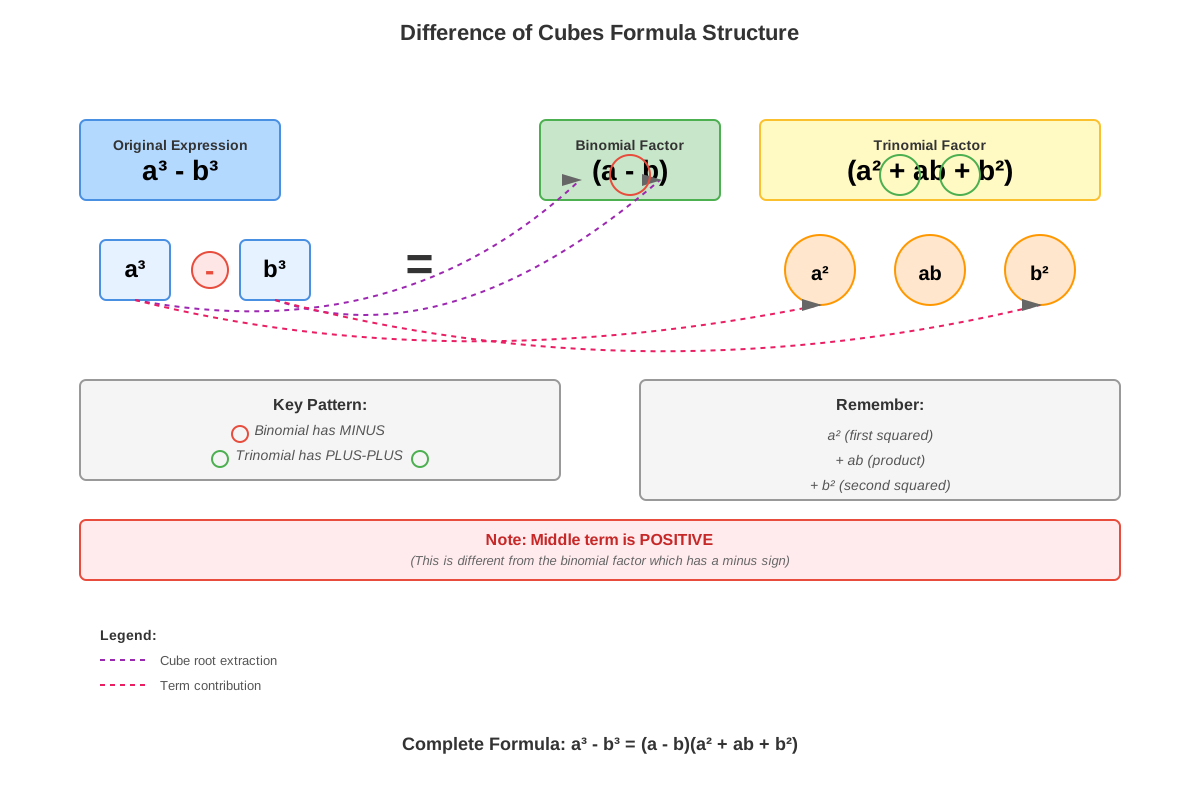
The difference of cubes formula is an algebraic identity that factors expressions in the form a³ - b³. The complete factorization is:
a³ - b³ = (a - b)(a² + ab + b²)This formula consists of two factors: a binomial factor (a - b) and a trinomial factor (a² + ab + b²). The binomial factor is straightforward—it's simply the difference of the cube roots. The trinomial factor follows a specific pattern: the first term is the square of the first cube root, the middle term is the product of both cube roots, and the last term is the square of the second cube root. Notably, the signs in the trinomial are positive-positive, which distinguishes this from other factoring patterns.
Identifying Perfect Cubes
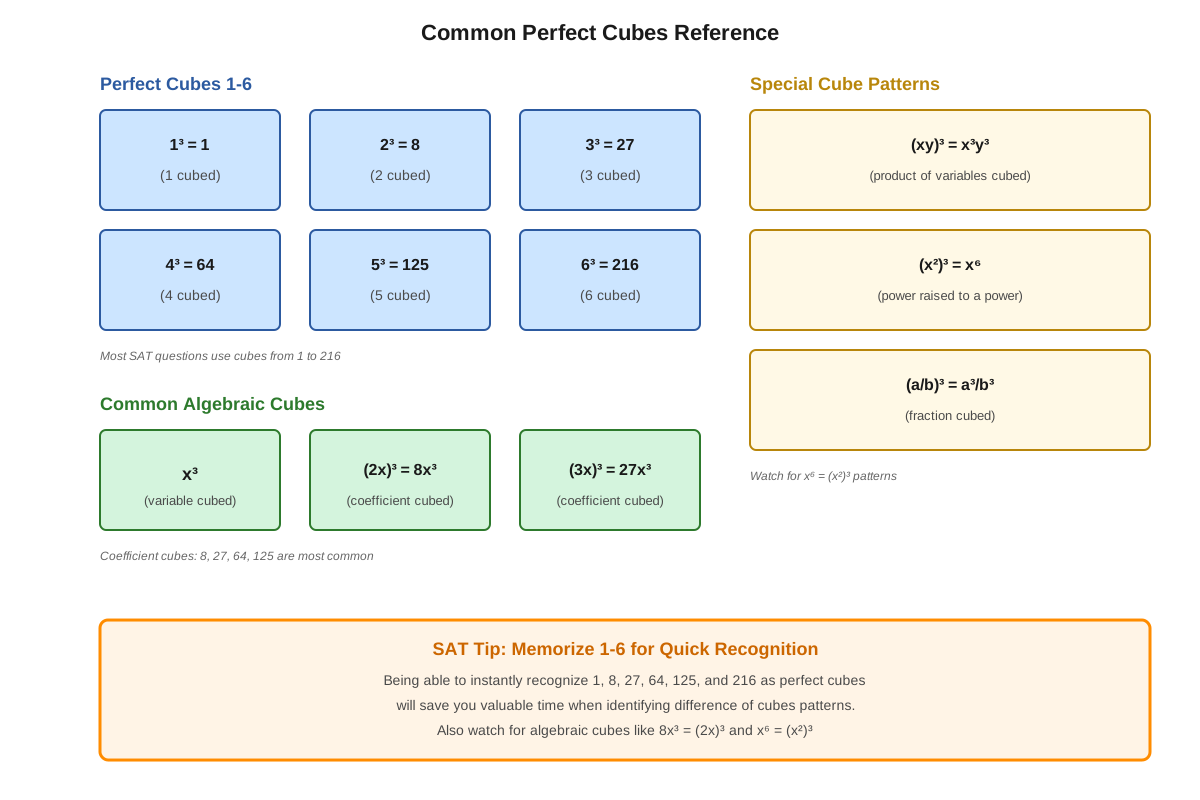
Before applying the difference of cubes formula, students must recognize when terms are perfect cubes. A perfect cube is any number or expression that can be written as something raised to the third power. Common numerical perfect cubes include:
| Number | Cube Root | Number | Cube Root |
|---|---|---|---|
| 1 | 1 | 64 | 4 |
| 8 | 2 | 125 | 5 |
| 27 | 3 | 216 | 6 |
For algebraic expressions, any variable raised to a power divisible by 3 is a perfect cube: x³, x⁶, x⁹, y³, etc. The cube root of x⁶ is x², and the cube root of 8x³ is 2x. Recognizing these patterns quickly is essential for SAT success.
Step-by-Step Factoring Process
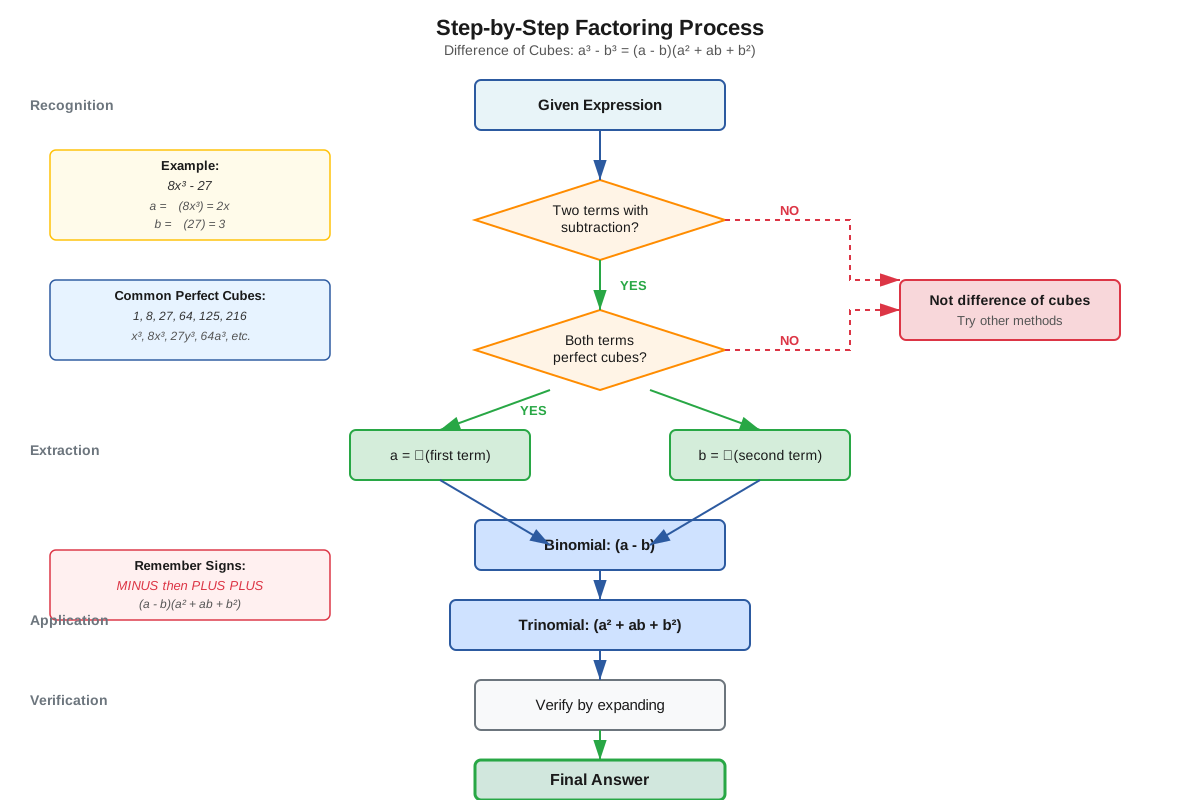
To factor a difference of cubes expression:
- Verify the pattern: Confirm that you have two terms separated by subtraction, and both terms are perfect cubes
- Identify a and b: Determine what values, when cubed, give you each term (a³ and b³)
- Write the binomial factor: Use (a - b) as the first factor
- Construct the trinomial factor: Write (a² + ab + b²) as the second factor
- Verify your answer: Multiply the factors to confirm they equal the original expression
For example, to factor x³ - 27:
- Both x³ and 27 are perfect cubes (27 = 3³)
- Here a = x and b = 3
- Binomial factor: (x - 3)
- Trinomial factor: (x² + 3x + 9)
- Final answer: x³ - 27 = (x - 3)(x² + 3x + 9)
Difference of Cubes vs. Sum of Cubes
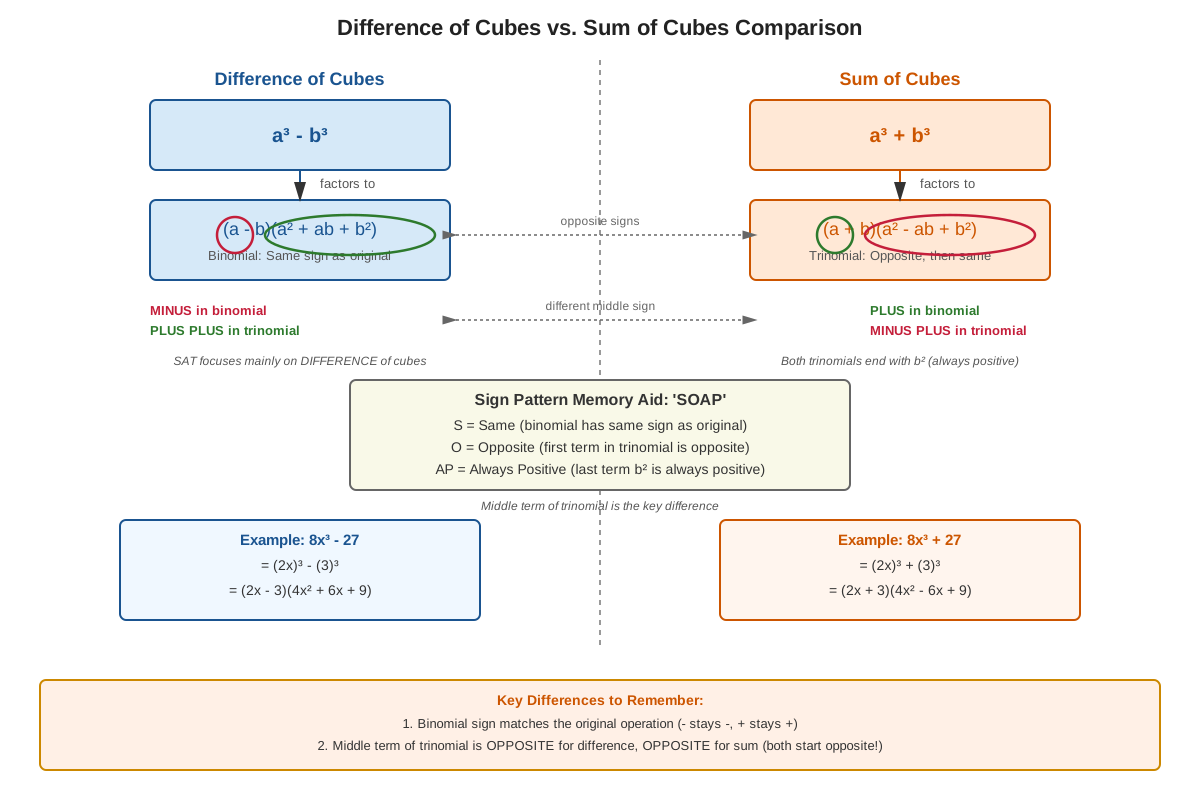
While this guide focuses on the difference of cubes, understanding its relationship to the sum of cubes formula enhances comprehension. The sum of cubes formula is:
a³ + b³ = (a + b)(a² - ab + b²)| Feature | Difference of Cubes | Sum of Cubes |
|---|---|---|
| Operation | Subtraction (a³ - b³) | Addition (a³ + b³) |
| Binomial sign | Minus (a - b) | Plus (a + b) |
| Trinomial signs | Plus, Plus (a² + ab + b²) | Plus, Minus (a² - ab + b²) |
Notice that the binomial factor matches the operation between the cubes, while the trinomial factor has a different sign pattern for each formula.
Complex Difference of Cubes Problems
SAT questions often present difference of cubes in less obvious forms. Consider 64x⁶ - 125y³:
- 64x⁶ = (4x²)³ because 4³ = 64 and (x²)³ = x⁶
- 125y³ = (5y)³ because 5³ = 125
- Therefore: a = 4x² and b = 5y
- Factored form: (4x² - 5y)(16x⁴ + 20x²y + 25y²)
The trinomial factor requires careful calculation: a² = (4x²)² = 16x⁴, ab = (4x²)(5y) = 20x²y, and b² = (5y)² = 25y².
Combining with Other Factoring Techniques
Many SAT problems require factoring out a greatest common factor (GCF) before applying the difference of cubes formula. For example, with 2x³ - 54:
- Factor out the GCF of 2: 2(x³ - 27)
- Recognize x³ - 27 as a difference of cubes
- Apply the formula: 2(x - 3)(x² + 3x + 9)
Always check for common factors first, as this simplifies the expression and makes pattern recognition easier.
Concept Relationships
The difference of cubes formula connects directly to fundamental polynomial operations. Exponent rules enable recognition of perfect cubes → Pattern recognition identifies the difference of cubes structure → Factoring formula application breaks the expression into simpler factors → Verification through multiplication confirms the factorization.
Within polynomial factoring, the difference of cubes relates to other special patterns. The difference of squares (a² - b²) is a simpler pattern that students learn first, and understanding this foundation makes the difference of cubes more accessible. Both formulas involve recognizing subtraction between perfect powers and applying memorized factoring patterns.
The difference of cubes also connects to solving polynomial equations. Once factored, cubic equations can be solved by setting each factor equal to zero. The binomial factor yields one real solution, while the trinomial factor may yield additional real or complex solutions depending on its discriminant.
Furthermore, difference of cubes factorization is essential for simplifying rational expressions. When cubic terms appear in numerators or denominators, factoring allows for cancellation of common factors, a frequent SAT question type. This connects to the broader concept of equivalent expressions, where different algebraic forms represent the same mathematical relationship.
High-Yield Facts
⭐ The difference of cubes formula is: a³ - b³ = (a - b)(a² + ab + b²)
⭐ The trinomial factor in difference of cubes CANNOT be factored further using real numbers
⭐ Both terms must be perfect cubes AND separated by subtraction to apply this formula
⭐ Common perfect cubes to memorize: 1, 8, 27, 64, 125, 216, 343, 512, 729, 1000
⭐ The signs in the trinomial factor are always positive (+) for difference of cubes
- The cube root of x⁶ is x², and the cube root of x⁹ is x³
- Always factor out the greatest common factor before applying the difference of cubes formula
- The binomial factor (a - b) will equal zero when a = b, giving one solution to the equation
- Coefficients can be perfect cubes: 8x³ = (2x)³ and 27y³ = (3y)³
- The difference of cubes formula works for any algebraic expressions, not just simple variables
- Multiplying the factored form should always return the original expression (verification method)
- The trinomial factor a² + ab + b² is always positive for real values of a and b
- On the SAT, difference of cubes often appears combined with other algebraic operations
Quick check — test yourself on Difference of cubes so far.
Try Flashcards →Common Misconceptions
Misconception: The trinomial factor can be factored further into two binomials.
Correction: The trinomial a² + ab + b² from the difference of cubes formula is prime over the real numbers and cannot be factored further. Unlike x² + 5x + 6 which factors to (x + 2)(x + 3), the trinomial from difference of cubes has no real factors.
Misconception: The difference of cubes formula is a³ - b³ = (a - b)(a² - ab + b²).
Correction: The correct formula has PLUS signs in the trinomial: a³ - b³ = (a - b)(a² + ab + b²). The middle term is +ab, not -ab. Students often confuse this with the sum of cubes formula, which does have a minus sign in the middle term.
Misconception: Any expression with cubes can be factored using the difference of cubes formula.
Correction: The formula only applies when you have exactly two perfect cube terms separated by subtraction. An expression like x³ + 2x² - 8 contains a cubic term but is not a difference of cubes and requires different factoring methods.
Misconception: The binomial factor should be (a + b) when factoring a³ - b³.
Correction: The binomial factor must match the operation between the cubes. For a³ - b³ (difference), the binomial is (a - b) with subtraction. Only for a³ + b³ (sum) would the binomial be (a + b).
Misconception: x⁶ - 64 should be factored only as a difference of cubes.
Correction: While x⁶ - 64 can be viewed as (x²)³ - 4³, it's more efficient to recognize it first as a difference of squares: (x³)² - 8² = (x³ - 8)(x³ + 8). Then each factor can be further factored as difference and sum of cubes respectively, yielding a more complete factorization.
Misconception: The coefficient must be 1 to apply the difference of cubes formula.
Correction: Coefficients that are perfect cubes can be incorporated into the formula. For example, 8x³ - 27 = (2x)³ - 3³ = (2x - 3)(4x² + 6x + 9). The coefficient becomes part of the 'a' or 'b' term.
Worked Examples
Example 1: Basic Difference of Cubes Factorization
Problem: Factor completely: x³ - 64
Solution:
Step 1: Verify this is a difference of cubes pattern.
- First term: x³ is clearly a perfect cube (x³ = x³)
- Second term: 64 = 4³ (since 4 × 4 × 4 = 64)
- Operation: subtraction (difference)
- Conclusion: This is a difference of cubes with a = x and b = 4
Step 2: Apply the formula a³ - b³ = (a - b)(a² + ab + b²)
- Binomial factor: (a - b) = (x - 4)
- Trinomial factor: (a² + ab + b²)
- a² = x² = x²
- ab = (x)(4) = 4x
- b² = 4² = 16
- Trinomial: (x² + 4x + 16)
Step 3: Write the complete factorization.
x³ - 64 = (x - 4)(x² + 4x + 16)
Step 4: Verify by expanding (optional but recommended).
(x - 4)(x² + 4x + 16)
= x(x² + 4x + 16) - 4(x² + 4x + 16)
= x³ + 4x² + 16x - 4x² - 16x - 64
= x³ - 64 ✓
Connection to Learning Objectives: This example demonstrates identifying the key features of a difference of cubes (perfect cubes separated by subtraction) and applying the formula correctly—core skills tested on the SAT.
Example 2: Complex Difference of Cubes with Coefficients
Problem: Factor completely: 27x³ - 8y⁶
Solution:
Step 1: Identify the perfect cubes.
- First term: 27x³ = (3x)³ because 27 = 3³ and x³ = (x)³
- Second term: 8y⁶ = (2y²)³ because 8 = 2³ and y⁶ = (y²)³
- Therefore: a = 3x and b = 2y²
Step 2: Apply the difference of cubes formula.
- Binomial factor: (a - b) = (3x - 2y²)
- Trinomial factor: (a² + ab + b²)
- a² = (3x)² = 9x²
- ab = (3x)(2y²) = 6xy²
- b² = (2y²)² = 4y⁴
- Trinomial: (9x² + 6xy² + 4y⁴)
Step 3: Write the final answer.
27x³ - 8y⁶ = (3x - 2y²)(9x² + 6xy² + 4y⁴)
Step 4: Check for further factoring.
- The binomial (3x - 2y²) cannot be factored further
- The trinomial (9x² + 6xy² + 4y⁴) is prime (cannot be factored over real numbers)
- The factorization is complete
Connection to Learning Objectives: This example shows how difference of cubes appears in more complex SAT problems with coefficients and higher powers. Recognizing that 27 = 3³ and y⁶ = (y²)³ requires strong pattern recognition skills essential for SAT success.
Exam Strategy
When approaching SAT difference of cubes questions, begin by scanning for the telltale signs: two terms, subtraction operation, and exponents of 3 (or multiples of 3). The SAT often disguises these problems by using coefficients or higher powers, so train your eye to recognize perfect cubes quickly.
Trigger words and phrases to watch for include: "factor completely," "which expression is equivalent to," "what are the solutions to," and "simplify the expression." When you see cubic terms (x³, y³, or numbers like 8, 27, 64, 125), immediately consider whether a difference or sum of cubes formula applies.
For process of elimination, remember these strategies:
- Eliminate any answer choice where the trinomial factor has a negative middle term (for difference of cubes, it must be positive)
- Eliminate choices where the binomial factor has addition instead of subtraction
- If given numerical answer choices, substitute a simple value (like x = 1) into both the original expression and answer choices to eliminate incorrect options
- Check the degrees of terms: the trinomial factor should have terms with degrees 2, 1, and 0 in the variable
Time allocation is critical on the SAT. If you immediately recognize a difference of cubes pattern, the problem should take 30-45 seconds. If you don't recognize the pattern within 15 seconds, mark the question and return to it later—don't waste time trying to factor by trial and error. Practice recognition until it becomes automatic.
Exam Tip: Always verify your factorization by checking the first and last terms when multiplied out. The first term of (a - b)(a² + ab + b²) must be a³, and the last term must be -b³. This quick check catches most errors without full expansion.
Memory Techniques
SOAP Mnemonic for the trinomial factor signs:
- Same sign as the binomial (for difference of cubes, it's minus)
- Opposite sign for the middle term (becomes plus)
- Always Positive for the last term
This helps remember that difference of cubes gives (a - b)(a² + ab + b²) with the pattern: minus, plus, plus.
"Cube Root First" visualization: Picture extracting the cube root from each term first, then building the factors. Visualize pulling out the "a" from a³ and "b" from b³, then constructing (a - b) and (a² + ab + b²) like building blocks.
Perfect Cubes Finger Counting: Memorize cubes 1-10 using your fingers:
- Thumb = 1³ = 1
- Index = 2³ = 8
- Middle = 3³ = 27
- Ring = 4³ = 64
- Pinky = 5³ = 125
- Continue with other hand for 6³ = 216, 7³ = 343, 8³ = 512, 9³ = 729, 10³ = 1000
"Square, Product, Square" (SPS) for the trinomial: The three terms are Square of first, Product of both, Square of second. This helps construct a² + ab + b² correctly every time.
Summary
The difference of cubes is a high-yield SAT math topic that requires recognizing the pattern a³ - b³ and applying the factoring formula (a - b)(a² + ab + b²). Success depends on quickly identifying perfect cubes, including those with coefficients and higher powers, and accurately constructing both the binomial and trinomial factors. The trinomial factor always has positive signs for difference of cubes, distinguishing it from the sum of cubes formula. SAT questions test this concept through direct factoring problems, equation solving, and expression simplification, often combining difference of cubes with other algebraic techniques like factoring out common factors. Students must memorize common perfect cubes, understand the formula structure, and practice recognizing the pattern in various disguised forms. Verification through multiplication or substitution helps catch errors and build confidence. Mastering this topic provides a significant advantage on medium to hard SAT math questions and demonstrates the algebraic reasoning skills essential for college-level mathematics.
Key Takeaways
- The difference of cubes formula a³ - b³ = (a - b)(a² + ab + b²) must be memorized exactly, with positive signs in the trinomial
- Both terms must be perfect cubes separated by subtraction; memorize cubes 1-10 and recognize algebraic perfect cubes like x⁶ = (x²)³
- Always factor out the greatest common factor first before applying the difference of cubes formula
- The trinomial factor cannot be factored further over real numbers—don't waste time trying
- Verify factorizations by checking that the first term equals a³ and the last term equals -b³ when multiplied out
- Difference of cubes appears 2-3 times per SAT, typically as medium-to-hard questions worth significant points
- Practice recognizing disguised forms with coefficients (like 27x³ = (3x)³) and higher powers (like x⁶ = (x²)³)
Related Topics
Sum of Cubes: The complementary formula a³ + b³ = (a + b)(a² - ab + b²) follows similar logic but with different signs. Mastering difference of cubes makes learning sum of cubes straightforward, and both appear on the SAT with similar frequency.
Difference of Squares: The simpler pattern a² - b² = (a + b)(a - b) is foundational to understanding difference of cubes. Some expressions can be factored using both patterns sequentially for complete factorization.
Polynomial Division: Understanding how the trinomial factor relates to dividing a³ - b³ by (a - b) deepens comprehension and provides an alternative verification method.
Solving Cubic Equations: Once a cubic expression is factored using difference of cubes, solving the equation involves setting each factor equal to zero, connecting factoring skills to equation-solving skills.
Rational Expressions: Difference of cubes frequently appears in numerators or denominators of fractions on the SAT, requiring factorization before simplification through cancellation.
Practice CTA
Now that you've mastered the difference of cubes formula and strategies, it's time to solidify your understanding through practice! Attempt the practice questions to test your ability to recognize patterns, apply the formula accurately, and solve SAT-style problems under timed conditions. Use the flashcards to drill perfect cube recognition and formula recall until both become automatic. Remember, the difference between knowing the formula and scoring points is consistent practice—every problem you solve builds the pattern recognition and confidence you need for test day success. You've got this!
Sign up free to keep reading
Create a free AnvayaPrep account to finish this SAT guide on Difference of cubes — plus flashcards and practice questions.