Overview
Turning points are critical features of polynomial functions that represent locations where a graph changes direction from increasing to decreasing, or vice versa. On the SAT math section, understanding turning points is essential for analyzing polynomial behavior, interpreting graphs, and solving complex function problems. These points reveal fundamental information about a polynomial's structure and help students visualize how functions behave across their domains.
The concept of turning points bridges multiple mathematical domains tested on the SAT. Students must understand how the degree of a polynomial limits the maximum number of turning points, how to identify these points visually on coordinate planes, and how turning points relate to the roots and end behavior of polynomial functions. This topic frequently appears in both multiple-choice and grid-in questions, often integrated with questions about function transformations, zeros, and graphical analysis.
Mastering sat turning points provides students with powerful analytical tools for the exam. Questions may ask students to determine the possible number of turning points for a given polynomial degree, identify turning points from a graph, or use turning point information to eliminate incorrect answer choices about polynomial equations. This topic connects directly to concepts like polynomial degree, leading coefficients, and the fundamental theorem of algebra, making it a cornerstone of polynomial understanding that appears across multiple question types throughout the SAT math sections.
Learning Objectives
- [ ] Identify key features of turning points on polynomial graphs
- [ ] Explain how turning points appears on the SAT in various question formats
- [ ] Apply turning points to answer SAT-style questions accurately and efficiently
- [ ] Determine the maximum number of turning points for any polynomial given its degree
- [ ] Distinguish between turning points and other critical features like zeros and extrema
- [ ] Use turning point information to eliminate incorrect answer choices on multiple-choice questions
- [ ] Analyze graphs to count and locate turning points precisely
Prerequisites
- Polynomial functions and their general form: Understanding polynomial structure is necessary to connect degree with turning point behavior
- Graphing on the coordinate plane: Students must be able to read and interpret function graphs to identify where direction changes occur
- Basic function behavior (increasing/decreasing): Recognizing when a function changes from rising to falling is fundamental to identifying turning points
- Degree and leading coefficient: These properties determine the maximum number of turning points and end behavior of polynomials
Why This Topic Matters
Turning points represent one of the most visually intuitive yet mathematically significant features of polynomial functions. In real-world applications, turning points identify maximum and minimum values in optimization problems, such as determining the peak height of a projectile, the optimal production level for maximum profit, or the point where population growth shifts to decline. Engineers, economists, and scientists regularly use turning point analysis to make critical decisions based on polynomial models.
On the SAT, turning points appear in approximately 3-5% of math questions, making them a high-yield topic for focused study. Questions involving turning points typically appear in the calculator and no-calculator sections, often worth 1 point each but sometimes integrated into more complex multi-step problems. The College Board frequently tests this concept through graph interpretation questions, where students must analyze a polynomial's visual representation, or through conceptual questions asking about the relationship between polynomial degree and possible turning points.
Common SAT question formats include: identifying the number of turning points visible on a graph; determining whether a polynomial of a given degree could have a specific number of turning points; using turning point information to match equations with their graphs; and eliminating answer choices based on turning point constraints. The topic also appears in questions combining multiple concepts, such as asking students to identify a polynomial's degree based on both its zeros and turning points, making it essential for comprehensive polynomial mastery.
Core Concepts
Definition of Turning Points
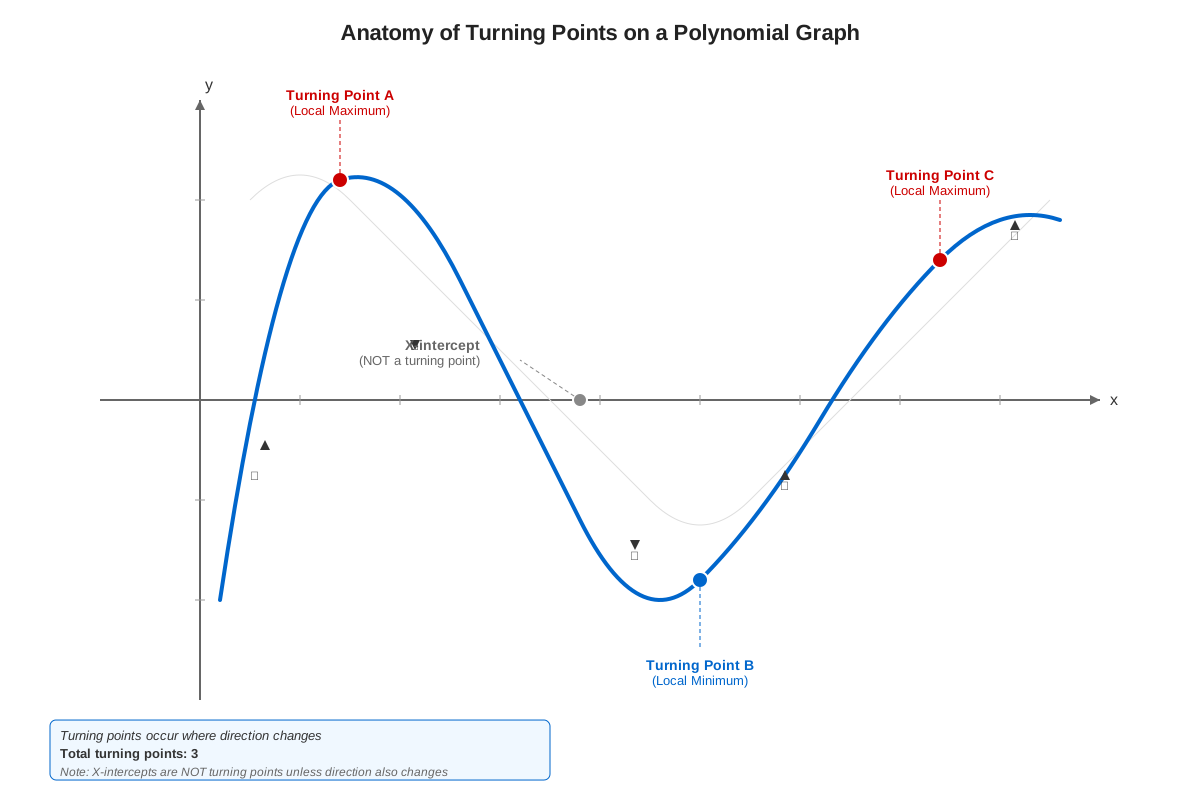
A turning point is a point on the graph of a function where the function changes from increasing to decreasing, or from decreasing to increasing. More formally, a turning point occurs at a location where the function reaches a local maximum or local minimum. At these points, the graph "turns around" and heads in the opposite vertical direction. For polynomial functions specifically, turning points are smooth curves rather than sharp corners or cusps, which distinguishes them from turning points in piecewise or absolute value functions.
Visually, imagine tracing a polynomial curve from left to right with your finger. Every time your finger changes from moving upward to moving downward (or vice versa), you've passed through a turning point. These points are interior features of the graph—they occur between the endpoints and represent changes in the function's rate of change.
The Degree-Turning Point Relationship
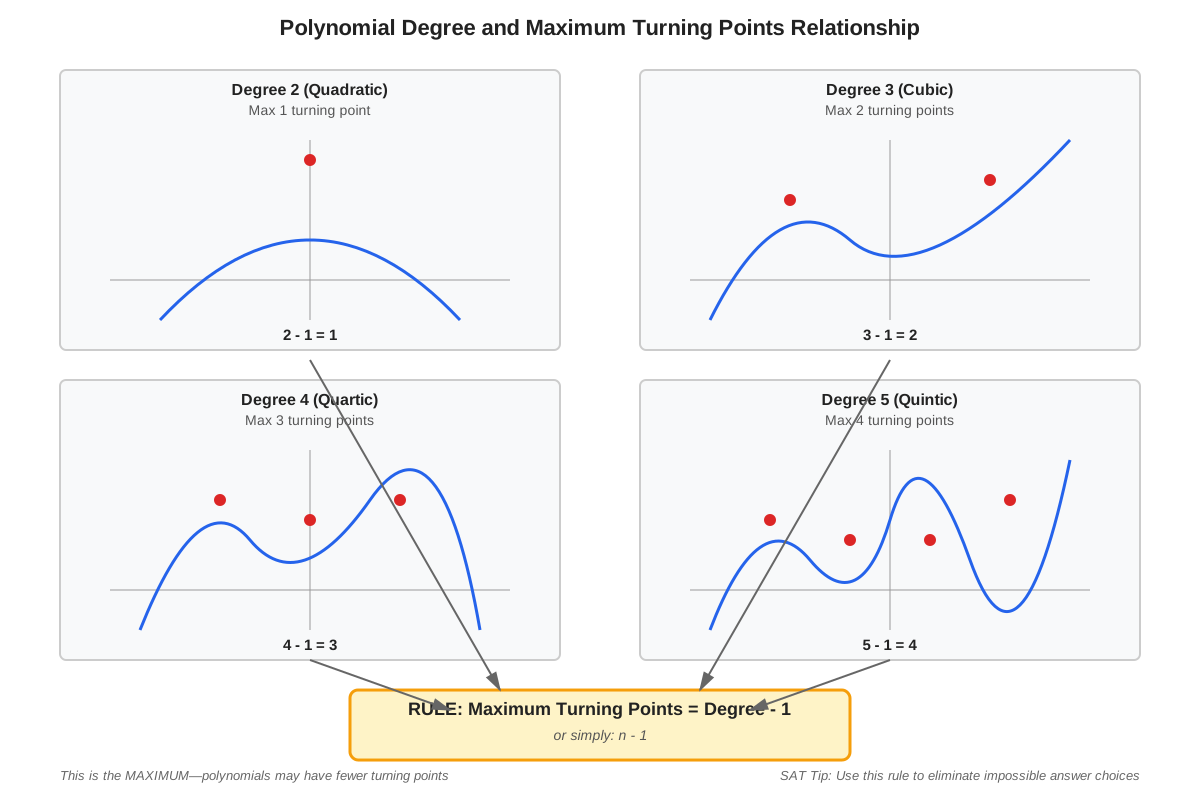
The most important rule for SAT questions about turning points is the relationship between a polynomial's degree and its maximum number of turning points:
A polynomial of degree n can have at most (n - 1) turning points.
This fundamental relationship appears frequently on the SAT. For example:
- A linear function (degree 1) has at most 0 turning points—it's a straight line
- A quadratic function (degree 2) has at most 1 turning point—the vertex of the parabola
- A cubic function (degree 3) has at most 2 turning points
- A quartic function (degree 4) has at most 3 turning points
- A quintic function (degree 5) has at most 4 turning points
The key word here is "at most." A polynomial may have fewer turning points than the maximum allowed by its degree. For instance, a cubic function might have 2, 1, or even 0 turning points, but it cannot have 3 or more. The function f(x) = x³ is a cubic with zero turning points—it increases continuously across its entire domain.
Counting Turning Points on Graphs
When analyzing a polynomial graph on the SAT, count turning points systematically by scanning from left to right and marking each location where the graph changes direction. Consider this step-by-step process:
- Start at the left side of the graph
- Determine whether the function is initially increasing or decreasing
- Move rightward and mark each point where the direction changes
- Count the total number of direction changes
- Verify that this count doesn't exceed (degree - 1)
| Polynomial Degree | Maximum Turning Points | Example Function |
|---|---|---|
| 1 (Linear) | 0 | f(x) = 2x + 3 |
| 2 (Quadratic) | 1 | f(x) = x² - 4x + 1 |
| 3 (Cubic) | 2 | f(x) = x³ - 3x² + 2 |
| 4 (Quartic) | 3 | f(x) = x⁴ - 4x² + 1 |
| 5 (Quintic) | 4 | f(x) = x⁵ - 5x³ + 4x |
Turning Points vs. Zeros
Students must distinguish between turning points and zeros (x-intercepts or roots). These are fundamentally different features:
- Zeros: Points where the function crosses or touches the x-axis (where y = 0)
- Turning points: Points where the function changes direction (may occur above, below, or on the x-axis)
A polynomial can have a turning point that is also a zero (when the graph touches but doesn't cross the x-axis), but most turning points occur at non-zero y-values. Similarly, most zeros are not turning points—the graph typically crosses through the x-axis without changing direction. Understanding this distinction prevents common errors on SAT questions that ask about one feature while providing information about the other.
Local Maxima and Local Minima
Every turning point is either a local maximum (the function reaches a peak) or a local minimum (the function reaches a valley). At a local maximum, the function value is greater than all nearby points; at a local minimum, the function value is less than all nearby points. The terms "local" emphasize that these are relative to the surrounding region, not necessarily the absolute highest or lowest points on the entire graph.
For SAT purposes, students don't need to calculate exact turning point coordinates using calculus, but they should recognize these features visually and understand their significance. A polynomial with an even degree has either a global maximum or global minimum (depending on the leading coefficient's sign), while odd-degree polynomials have neither global maximum nor minimum—they extend to infinity in both directions.
Using Turning Points to Determine Polynomial Degree
SAT questions sometimes provide a graph and ask students to determine the minimum possible degree of the polynomial. The strategy is:
Minimum degree = (number of turning points) + 1
If a graph shows 3 turning points, the polynomial must be at least degree 4. It could be degree 5, 6, or higher (since higher-degree polynomials can have fewer than their maximum turning points), but it cannot be degree 3 or lower. This reasoning helps eliminate incorrect answer choices efficiently.
Concept Relationships
The concept of turning points sits at the intersection of multiple polynomial properties. The degree of a polynomial directly determines the maximum number of turning points through the (n - 1) rule, creating a foundational relationship that students must internalize. This connection flows from the polynomial's structure: each degree increase adds potential for one additional direction change in the graph's behavior.
Turning points relate closely to zeros and x-intercepts but remain distinct. While both are critical features for understanding polynomial behavior, zeros indicate where the function equals zero, whereas turning points indicate where the rate of change switches sign. A graph might show three zeros but only two turning points, or vice versa. However, when a polynomial has a repeated root (multiplicity greater than 1), the graph may touch the x-axis at that zero without crossing, creating a turning point at that location.
The relationship map flows as follows:
Polynomial Degree → Maximum Turning Points → Graph Shape → End Behavior
Additionally: Leading Coefficient Sign → Direction of End Behavior → Type of Extreme Turning Points
The leading coefficient and degree together determine end behavior, which influences whether the outermost turning points are maxima or minima. For even-degree polynomials with positive leading coefficients, the graph opens upward, making the turning point(s) local minima or creating a global minimum. For odd-degree polynomials, the end behavior extends in opposite directions, and turning points alternate between local maxima and minima.
Understanding turning points also connects to function transformations. Vertical shifts move turning points up or down without changing their x-coordinates, while horizontal shifts move them left or right. Vertical stretches and compressions change the y-coordinates of turning points but not their x-coordinates, and reflections across the x-axis convert maxima to minima and vice versa.
Quick check — test yourself on Turning points so far.
Try Flashcards →High-Yield Facts
⭐ A polynomial of degree n has at most (n - 1) turning points
⭐ The minimum degree of a polynomial equals (number of turning points + 1)
⭐ Turning points represent locations where the graph changes from increasing to decreasing or vice versa
⭐ A quadratic function (degree 2) has exactly one turning point at its vertex
⭐ Turning points and zeros are different features—a graph can have turning points that are not zeros
- A polynomial may have fewer turning points than its maximum but never more
- At a turning point, the function reaches either a local maximum or local minimum
- Linear functions (degree 1) have no turning points because they never change direction
- A cubic function can have 0, 1, or 2 turning points but never 3 or more
- Even-degree polynomials with positive leading coefficients have their leftmost and rightmost sections pointing upward
- Odd-degree polynomials extend to infinity in opposite directions and have no global maximum or minimum
- The number of turning points helps distinguish between possible polynomial equations when matching graphs to functions
- Turning points occur at smooth curves on polynomial graphs, never at sharp corners
- A polynomial with 4 turning points must be at least degree 5
- Counting turning points accurately requires scanning the entire visible portion of the graph from left to right
Common Misconceptions
Misconception: Turning points and zeros are the same thing.
Correction: Turning points indicate where a function changes direction (from increasing to decreasing or vice versa), while zeros indicate where the function crosses or touches the x-axis (where y = 0). These are distinct features. A turning point might occur at y = 5, far above the x-axis, and a zero might occur where the graph crosses the x-axis without changing direction.
Misconception: A polynomial of degree n has exactly (n - 1) turning points.
Correction: A polynomial of degree n has at most (n - 1) turning points, but it may have fewer. For example, f(x) = x³ is a cubic function (degree 3) but has zero turning points because it increases continuously. The (n - 1) rule gives the maximum, not a guaranteed count.
Misconception: Every x-intercept is a turning point.
Correction: Most x-intercepts are not turning points. When a polynomial crosses through the x-axis at a simple root, the graph continues in the same general direction (increasing or decreasing) without turning around. Only when a polynomial touches the x-axis without crossing (at a repeated root with even multiplicity) does the x-intercept coincide with a turning point.
Misconception: If a graph shows 3 turning points, the polynomial is degree 3.
Correction: If a graph shows 3 turning points, the polynomial must be at least degree 4 (since maximum turning points = degree - 1). The polynomial could be degree 4, 5, 6, or higher. The number of turning points establishes a minimum degree, not an exact degree.
Misconception: Turning points only occur at the vertex of parabolas.
Correction: While quadratic functions (parabolas) have exactly one turning point at the vertex, higher-degree polynomials have multiple turning points distributed across the graph. A quartic function might have three distinct turning points at different locations, none of which would be called a "vertex" in the traditional sense.
Misconception: The endpoints of a graphed polynomial are turning points.
Correction: Turning points are interior features where the function changes direction. The endpoints of a viewing window or domain are not turning points unless the function actually changes direction at those specific locations. When analyzing graphs, focus on direction changes within the visible portion, not at the edges.
Worked Examples
Example 1: Determining Possible Turning Points
Question: A polynomial function f has degree 5. Which of the following could be the number of turning points of the graph of f?
A) 5
B) 4
C) 3
D) All of the above
Solution:
Step 1: Apply the fundamental rule for maximum turning points.
- A polynomial of degree n has at most (n - 1) turning points
- For degree 5: maximum turning points = 5 - 1 = 4
Step 2: Determine the possible range.
- The polynomial can have at most 4 turning points
- It could have fewer: 3, 2, 1, or even 0 turning points
- It cannot have 5 or more turning points
Step 3: Evaluate each answer choice.
- Choice A: 5 turning points → IMPOSSIBLE (exceeds the maximum of 4)
- Choice B: 4 turning points → POSSIBLE (equals the maximum)
- Choice C: 3 turning points → POSSIBLE (less than the maximum)
- Choice D: Cannot be correct since A is impossible
Step 4: Select the correct answer.
Since both B and C are possible but A is not, and the question asks which "could be" the number, we need to identify that both 3 and 4 are valid. However, if forced to choose one answer, C (3 turning points) is possible. If this were a "select all that apply" question, both B and C would be correct.
Answer: C is possible, as is B. The key insight is that 5 turning points is impossible for a degree-5 polynomial.
Example 2: Analyzing a Graph
Question: The graph of a polynomial function f is shown below. The graph has turning points at x = -2, x = 1, and x = 4. What is the minimum possible degree of f?
[Description: The graph shows a smooth curve that starts from the bottom left, rises to a peak at x = -2, falls to a valley at x = 1, rises again to a peak at x = 4, then falls toward the bottom right]
Solution:
Step 1: Count the turning points.
- The graph changes direction at x = -2 (peak/local maximum)
- The graph changes direction at x = 1 (valley/local minimum)
- The graph changes direction at x = 4 (peak/local maximum)
- Total turning points: 3
Step 2: Apply the minimum degree formula.
- Minimum degree = (number of turning points) + 1
- Minimum degree = 3 + 1 = 4
Step 3: Verify the logic.
- A degree-4 polynomial can have at most 3 turning points ✓
- A degree-3 polynomial can have at most 2 turning points (insufficient)
- The polynomial must be at least degree 4
Step 4: Consider whether it could be higher.
- The polynomial could be degree 5, 6, 7, or higher (since higher-degree polynomials can have fewer than their maximum turning points)
- However, the question asks for the minimum possible degree
Answer: The minimum possible degree is 4.
Connection to Learning Objectives: This example demonstrates how to identify turning points from a graph (Objective 1), apply the degree-turning point relationship (Objective 4), and use this information to answer SAT-style questions (Objective 3).
Exam Strategy
When approaching SAT questions about turning points, begin by identifying what the question provides and what it asks. Questions typically fall into three categories: (1) given a degree, determine possible turning points; (2) given a graph, count turning points and determine minimum degree; (3) use turning point information to eliminate answer choices about polynomial properties.
Trigger words and phrases to watch for include:
- "at most" (signals maximum turning points)
- "could be" or "possible" (indicates multiple valid answers may exist)
- "minimum degree" (use the formula: turning points + 1)
- "changes direction" (definition of turning point)
- "local maximum" or "local minimum" (types of turning points)
- "how many times does the graph turn around" (asking for turning point count)
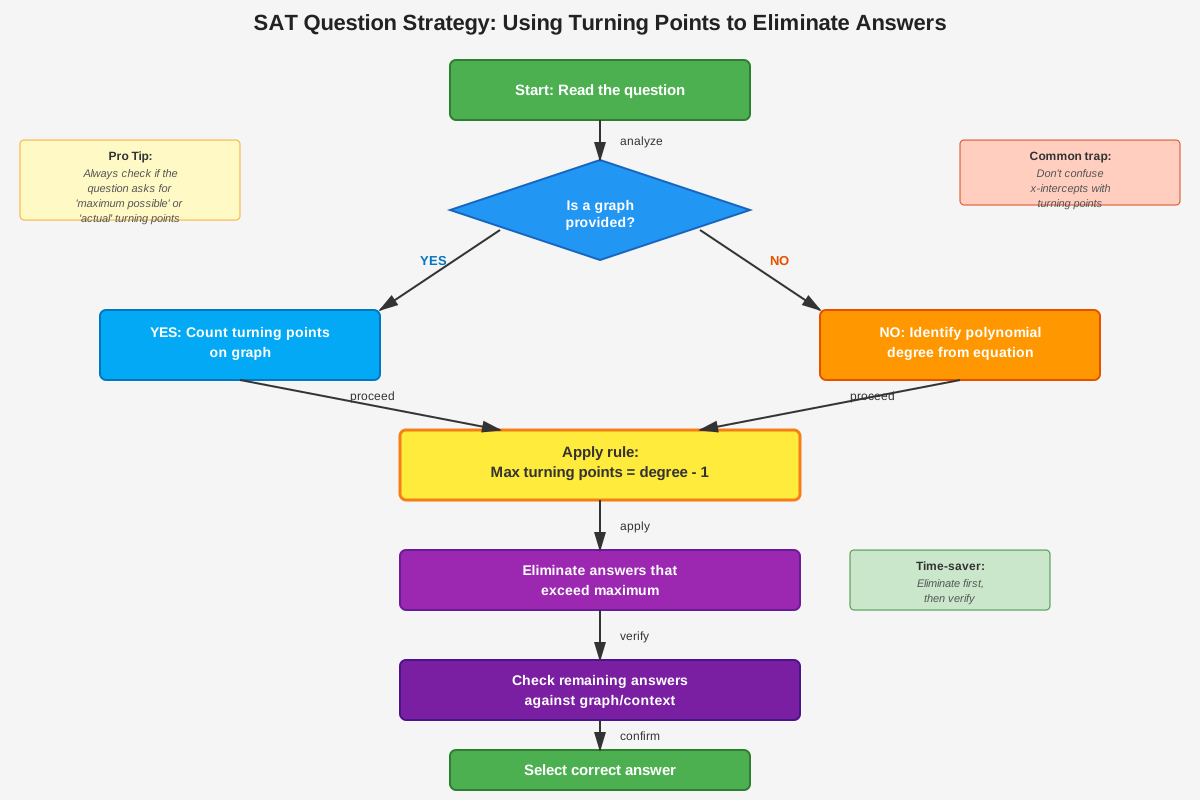
For process of elimination, use these strategies:
- Eliminate answers that exceed (degree - 1): If a question asks about possible turning points for a degree-4 polynomial, immediately eliminate any answer choice showing 4 or more turning points.
- Eliminate answers below (turning points + 1): If a graph clearly shows 3 turning points, eliminate any answer suggesting the polynomial could be degree 3 or lower.
- Check end behavior consistency: If a question provides both degree and leading coefficient information, verify that answer choices match the expected end behavior. This helps eliminate graphs that show incorrect turning point patterns.
- Verify zero-turning point distinction: If an answer choice confuses zeros with turning points (e.g., claiming a polynomial with 4 zeros must have 4 turning points), eliminate it immediately.
Time allocation: Turning point questions typically require 30-60 seconds. Spend 10-15 seconds identifying what's given and what's asked, 20-30 seconds applying the relevant formula or counting features on a graph, and 10-15 seconds verifying your answer and eliminating alternatives. Don't spend excessive time on these questions—they test straightforward concepts that yield quickly to systematic approaches.
Exam Tip: When counting turning points on a graph, use your pencil to physically trace the curve from left to right, marking each direction change. This kinesthetic approach reduces counting errors.
Memory Techniques
Mnemonic for the maximum turning points formula: "Degree Minus One" → DMO → "Don't Miss One" (Don't miss subtracting one from the degree)
Visualization strategy: Picture a polynomial graph as a roller coaster track. Each turning point is where the coaster changes from going up to going down, or vice versa. A degree-4 polynomial is like a roller coaster with at most 3 "humps" or direction changes. This concrete image helps students remember that higher degrees allow more turns.
Acronym for checking graphs: TIDE
- Turning points: Count them
- Intercepts: Note the zeros (but don't confuse with turning points)
- Degree: Determine minimum from turning points
- End behavior: Verify consistency with degree and leading coefficient
Memory phrase: "Turning Points Plus One" → TPPO → "The Polynomial's Power Obviously" (The turning points plus one gives the minimum degree/power)
Finger counting technique: Hold up fingers equal to the polynomial's degree, then fold down one finger. The remaining fingers show the maximum turning points. For degree 5, hold up five fingers, fold one down, and see four remaining—representing the maximum of 4 turning points.
Summary
Turning points are essential features of polynomial functions that indicate where graphs change direction from increasing to decreasing or vice versa. The fundamental relationship governing turning points states that a polynomial of degree n can have at most (n - 1) turning points, though it may have fewer. This rule enables students to determine the minimum possible degree of a polynomial by adding one to the number of observed turning points. On the SAT, turning point questions test students' ability to analyze graphs, apply the degree-turning point relationship, and distinguish between turning points and other features like zeros. Mastery requires understanding that turning points represent local maxima and minima, recognizing them visually on coordinate planes, and using them strategically to eliminate incorrect answer choices. Success on these questions depends on systematic counting, applying the (n - 1) formula correctly, and avoiding common misconceptions such as confusing turning points with x-intercepts or assuming polynomials always have their maximum number of turning points.
Key Takeaways
- A polynomial of degree n has at most (n - 1) turning points—this is the single most important rule for SAT questions
- Turning points indicate where a graph changes from increasing to decreasing (or vice versa), representing local maxima or minima
- The minimum degree of a polynomial equals (number of turning points + 1)
- Turning points and zeros are distinct features—don't confuse x-intercepts with direction changes
- Quadratic functions have exactly one turning point (the vertex), while higher-degree polynomials can have multiple turning points
- Count turning points systematically by scanning graphs from left to right and marking each direction change
- A polynomial may have fewer turning points than its maximum but can never exceed the (n - 1) limit
Related Topics
Polynomial End Behavior: Understanding how polynomials behave as x approaches positive and negative infinity connects directly to turning points, as end behavior determines whether the outermost turning points are maxima or minima. Mastering turning points provides the foundation for predicting complete polynomial graph shapes.
Zeros and Multiplicity: The relationship between repeated roots and turning points deepens polynomial understanding. When a polynomial has a zero with even multiplicity, the graph touches the x-axis at a turning point, creating an important connection between these concepts.
Function Transformations: Studying how shifts, stretches, and reflections affect turning points extends the practical application of this knowledge. Transformations move or modify turning points in predictable ways, building on the foundational understanding developed here.
Polynomial Division and Factoring: These algebraic techniques help determine polynomial structure, which in turn reveals information about possible turning points. The connection flows from algebraic form to graphical features.
Practice CTA
Now that you've mastered the core concepts of turning points, it's time to solidify your understanding through active practice. Attempt the practice questions to test your ability to identify turning points, apply the degree-turning point relationship, and analyze polynomial graphs under timed conditions. Use the flashcards to reinforce the key formulas and definitions until they become automatic. Remember: understanding turning points gives you a powerful analytical tool for multiple question types on the SAT math section. Every practice problem you complete builds the pattern recognition and strategic thinking that leads to confident, accurate performance on test day. You've got this!
Sign up free to keep reading
Create a free AnvayaPrep account to finish this SAT guide on Turning points — plus flashcards and practice questions.