Overview
Zeros of polynomials represent one of the most fundamental and frequently tested concepts in SAT math. A zero of a polynomial is any value that, when substituted for the variable, makes the polynomial equal to zero. These values are also called roots, solutions, or x-intercepts when graphed on a coordinate plane. Understanding zeros is essential because they reveal critical information about polynomial behavior, factorization, and graphical representation—all of which appear regularly on the SAT.
The SAT tests zeros of polynomials in multiple contexts: finding zeros algebraically through factoring or the quadratic formula, interpreting zeros graphically, understanding the relationship between factors and zeros, and applying the Fundamental Theorem of Algebra. Questions may ask students to determine the number of real zeros, find specific zero values, or use zeros to construct polynomial equations. This topic bridges algebraic manipulation with graphical interpretation, making it a cornerstone of polynomial understanding.
Mastering sat zeros of polynomials connects directly to broader mathematical concepts including quadratic equations, factoring techniques, graphing functions, and systems of equations. The ability to find and interpret zeros underpins success with rational functions, polynomial division, and even calculus concepts that appear in advanced mathematics. For the SAT specifically, this topic appears in both calculator and no-calculator sections, often integrated with word problems, data interpretation, and multi-step reasoning questions.
Learning Objectives
- [ ] Identify key features of zeros of polynomials
- [ ] Explain how zeros of polynomials appears on the SAT
- [ ] Apply zeros of polynomials to answer SAT-style questions
- [ ] Determine the number and nature of zeros using the discriminant and degree
- [ ] Convert between factored form and standard form using zeros
- [ ] Interpret the graphical meaning of real and complex zeros
- [ ] Apply the Factor Theorem and Remainder Theorem to polynomial problems
Prerequisites
- Factoring techniques: Essential for converting polynomials to factored form where zeros become immediately visible
- Solving linear and quadratic equations: The foundation for finding zeros algebraically through various solution methods
- Basic function notation: Necessary to understand f(x) = 0 and evaluate polynomials at specific values
- Coordinate plane graphing: Required to visualize zeros as x-intercepts and understand graphical representations
- Order of operations and algebraic manipulation: Fundamental for substituting values and simplifying polynomial expressions
Why This Topic Matters
Zeros of polynomials appear in approximately 8-12% of SAT math questions, making them a high-yield topic for test preparation. The College Board consistently includes 2-4 direct questions about zeros per test, plus additional questions where understanding zeros provides the key to solving more complex problems. Questions range from straightforward "find the zeros" problems to sophisticated applications involving systems of equations, optimization, and real-world modeling.
In real-world applications, zeros represent critical transition points: break-even points in business (where profit equals zero), equilibrium states in physics, optimal solutions in engineering, and threshold values in biology and chemistry. For example, a projectile's zeros indicate when it hits the ground, while a profit function's zeros show break-even sales volumes. Understanding zeros enables students to model and solve practical problems across STEM fields.
On the SAT, zeros appear in multiple question formats: multiple-choice questions asking for specific zero values, grid-in questions requiring numerical answers, and word problems where zeros represent meaningful real-world values. The topic integrates with graphing calculator skills, as students may need to verify zeros visually or use calculator functions to approximate irrational zeros. Questions often combine zeros with other concepts like vertex form, symmetry, and function transformations.
Core Concepts
Definition and Fundamental Properties
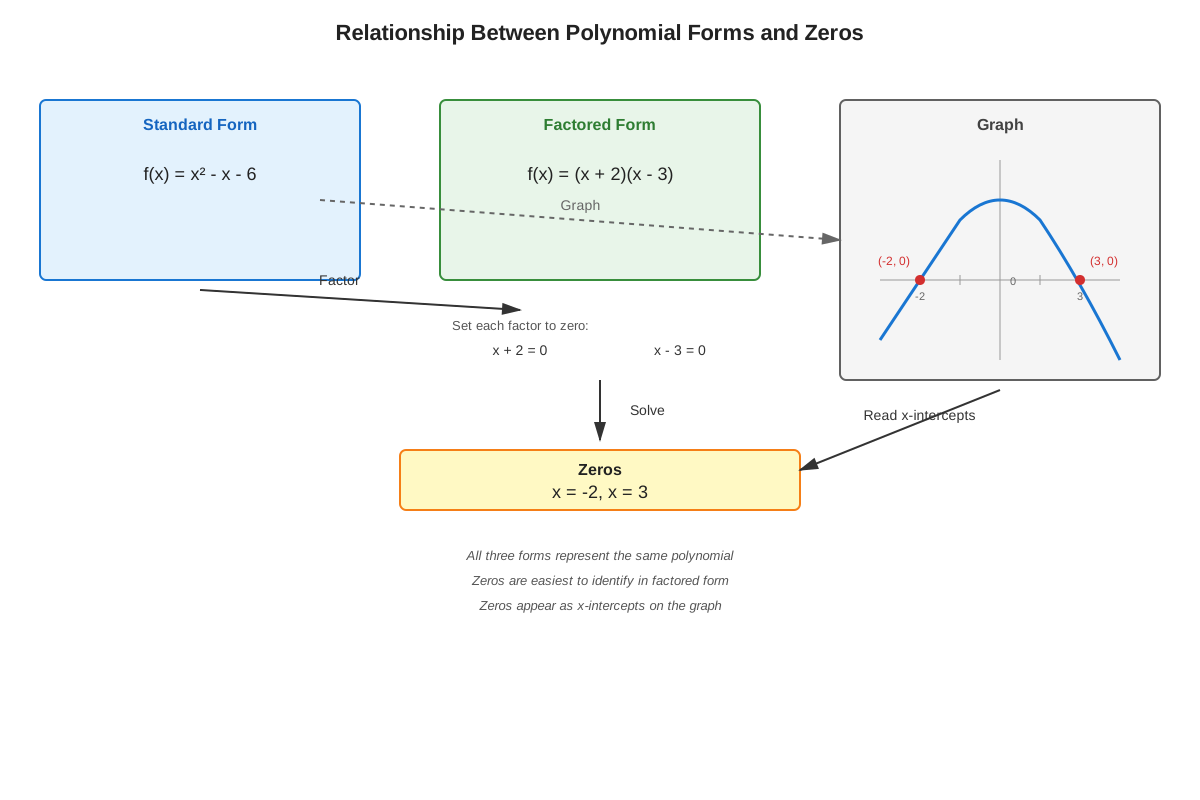
A zero of a polynomial function f(x) is any value r such that f(r) = 0. When x = r is substituted into the polynomial, the result equals zero. These zeros are also called roots or solutions of the polynomial equation. Graphically, real zeros correspond to x-intercepts—points where the graph crosses or touches the x-axis.
The Fundamental Theorem of Algebra states that a polynomial of degree n has exactly n zeros (counting multiplicities) in the complex number system. For SAT purposes, this means a quadratic (degree 2) has two zeros, a cubic (degree 3) has three zeros, and so forth. However, not all zeros must be real numbers; some may be complex.
The Factor Theorem
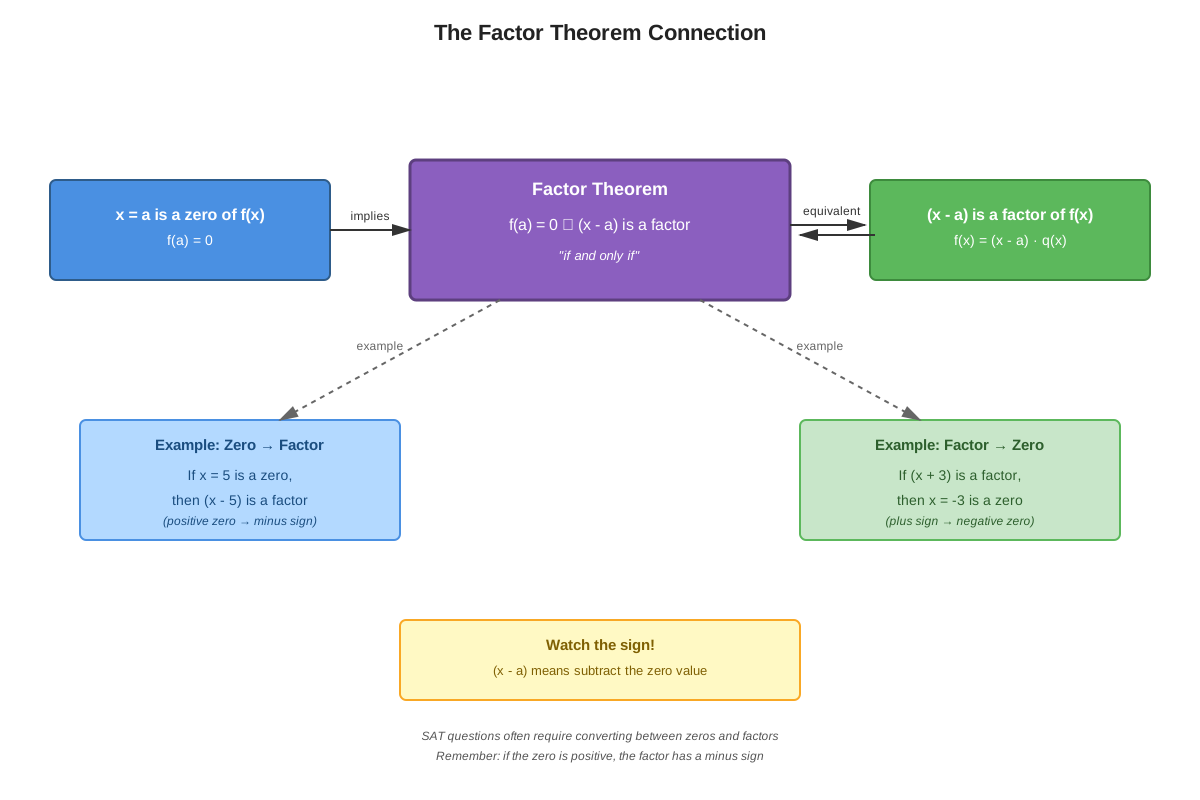
The Factor Theorem establishes the crucial connection between zeros and factors: (x - r) is a factor of polynomial f(x) if and only if r is a zero of f(x). This bidirectional relationship allows students to:
- Find zeros by factoring the polynomial and setting each factor equal to zero
- Construct polynomials from given zeros by writing factors and multiplying them
For example, if a polynomial has zeros at x = 2 and x = -3, it must contain factors (x - 2) and (x + 3), making the polynomial f(x) = a(x - 2)(x + 3) for some constant a.
Finding Zeros Algebraically
Factoring Method: For polynomials that factor easily, express the polynomial in factored form and apply the Zero Product Property (if ab = 0, then a = 0 or b = 0).
Example: For f(x) = x² - 5x + 6
- Factor: f(x) = (x - 2)(x - 3)
- Set each factor to zero: x - 2 = 0 or x - 3 = 0
- Zeros are x = 2 and x = 3
Quadratic Formula: For quadratic polynomials ax² + bx + c, use:
x = (-b ± √(b² - 4ac)) / (2a)The discriminant (b² - 4ac) determines the nature of zeros:
- Positive discriminant: two distinct real zeros
- Zero discriminant: one repeated real zero (multiplicity 2)
- Negative discriminant: two complex conjugate zeros (no real zeros)
Multiplicity of Zeros
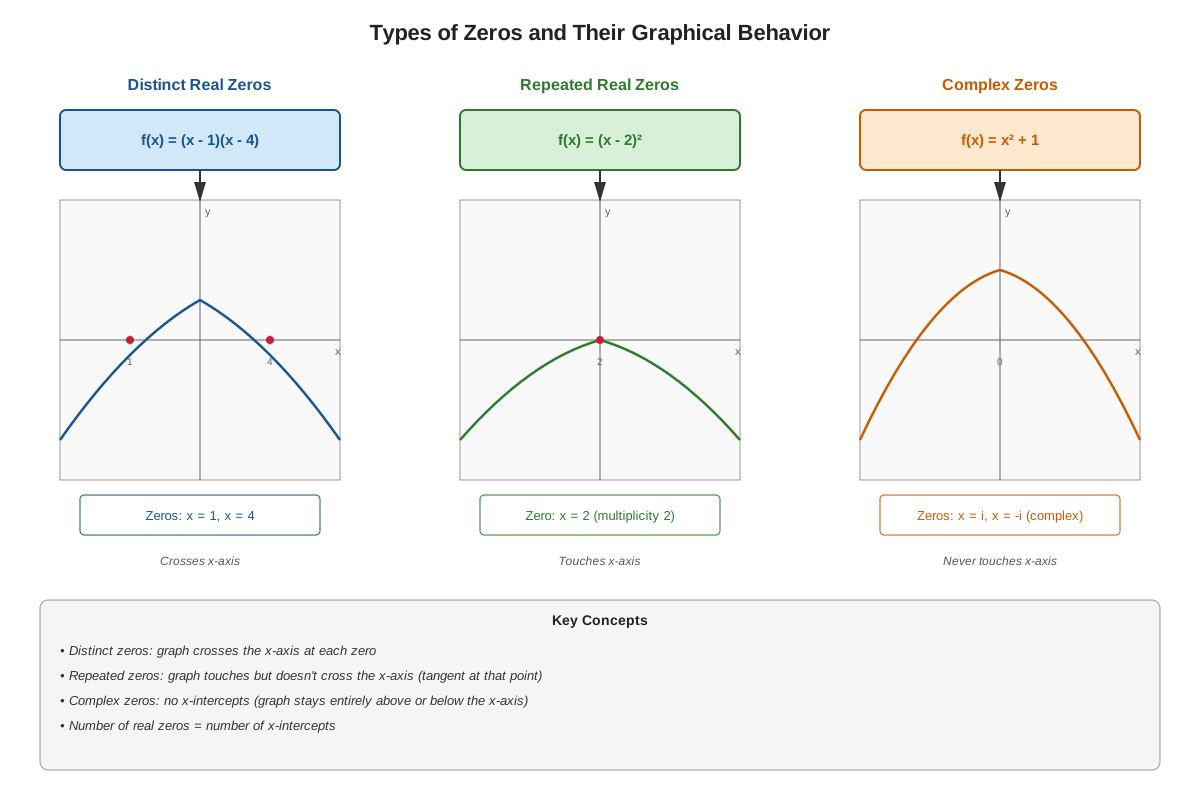
The multiplicity of a zero indicates how many times that zero appears. If (x - r)^m is a factor of f(x), then r is a zero with multiplicity m.
| Multiplicity | Graphical Behavior | Example |
|---|---|---|
| Odd (1, 3, 5...) | Graph crosses x-axis | f(x) = (x - 2) crosses at x = 2 |
| Even (2, 4, 6...) | Graph touches x-axis but doesn't cross | f(x) = (x - 2)² touches at x = 2 |
Relationship Between Zeros and Coefficients
For a quadratic ax² + bx + c with zeros r and s:
- Sum of zeros: r + s = -b/a
- Product of zeros: rs = c/a
These relationships, derived from Vieta's formulas, allow students to find zeros without complete factorization or to verify answers quickly.
Graphical Interpretation
Real zeros appear as x-intercepts on the coordinate plane. The number of times a graph crosses or touches the x-axis equals the number of real zeros (counting multiplicities). Complex zeros do not appear as x-intercepts but still affect the polynomial's overall shape and behavior.
Key graphical observations:
- A polynomial of degree n can have at most n real zeros
- A polynomial of odd degree must have at least one real zero
- A polynomial of even degree may have no real zeros
- The graph's end behavior depends on the leading coefficient and degree
Constructing Polynomials from Zeros
Given zeros, construct a polynomial by:
- Write a factor (x - r) for each zero r
- Multiply all factors together
- Multiply by any constant a (affects vertical stretch but not zeros)
Example: Construct a polynomial with zeros at x = -1, x = 2, and x = 4:
- Factors: (x + 1)(x - 2)(x - 4)
- Expanded: f(x) = (x + 1)(x² - 6x + 8) = x³ - 5x² + 2x + 8
Concept Relationships
The core concepts within zeros of polynomials form an interconnected web. The Factor Theorem serves as the central hub, connecting algebraic factors to numerical zeros. This theorem leads directly to the factoring method for finding zeros, which relies on the Zero Product Property. When factoring proves difficult, the quadratic formula provides an alternative path, with the discriminant revealing information about zero types before calculation.
Multiplicity connects zeros to graphical behavior, determining whether the graph crosses or touches the x-axis. This graphical interpretation links back to the Fundamental Theorem of Algebra, which guarantees the total number of zeros. The sum and product relationships (Vieta's formulas) provide shortcuts connecting zeros directly to polynomial coefficients, bypassing complete factorization.
Relationship map:
- Polynomial equation → Factor Theorem → Factors ↔ Zeros
- Zeros → Multiplicity → Graphical behavior
- Coefficients → Vieta's formulas → Sum/Product of zeros
- Quadratic form → Discriminant → Nature of zeros (real vs. complex)
- Given zeros → Factor construction → Polynomial equation
Prerequisites connect through: factoring skills enable the factoring method; equation-solving skills apply to finding zeros; graphing knowledge supports visual interpretation; and function notation allows proper expression of polynomial evaluation.
High-Yield Facts
⭐ A zero of polynomial f(x) is any value r where f(r) = 0; these are also called roots, solutions, or x-intercepts
⭐ The Factor Theorem states (x - r) is a factor of f(x) if and only if r is a zero of f(x)
⭐ For quadratic ax² + bx + c, the discriminant b² - 4ac determines zero types: positive = two real, zero = one real, negative = two complex
⭐ A polynomial of degree n has exactly n zeros counting multiplicities (Fundamental Theorem of Algebra)
⭐ The Zero Product Property states if ab = 0, then a = 0 or b = 0, enabling factoring methods
- For quadratic with zeros r and s: sum = -b/a and product = c/a (Vieta's formulas)
- A zero with odd multiplicity causes the graph to cross the x-axis; even multiplicity causes touching without crossing
- Complex zeros always occur in conjugate pairs for polynomials with real coefficients
- A polynomial of odd degree must have at least one real zero
- To construct a polynomial from zeros r₁, r₂, ..., rₙ, multiply factors (x - r₁)(x - r₂)...(x - rₙ)
- The Remainder Theorem states f(r) equals the remainder when f(x) is divided by (x - r)
- Rational zeros (if they exist) must be factors of the constant term divided by factors of the leading coefficient
Quick check — test yourself on Zeros of polynomials so far.
Try Flashcards →Common Misconceptions
Misconception: Zeros and y-intercepts are the same thing → Correction: Zeros are x-values where f(x) = 0 (x-intercepts), while the y-intercept is the value f(0) where the graph crosses the y-axis. They represent completely different features.
Misconception: A polynomial of degree n always has n real zeros → Correction: A polynomial of degree n has exactly n zeros total, but some may be complex (non-real). Only real zeros appear as x-intercepts on a graph.
Misconception: If a graph touches the x-axis at x = 2, then x = 2 is a zero with multiplicity 1 → Correction: When a graph touches but doesn't cross the x-axis, the zero has even multiplicity (2, 4, 6, etc.). Multiplicity 1 would cause the graph to cross.
Misconception: The factor for zero x = 3 is (x + 3) → Correction: The factor for zero x = 3 is (x - 3). The sign in the factor is opposite to the sign of the zero. If x - 3 = 0, then x = 3.
Misconception: A negative discriminant means the polynomial has no zeros → Correction: A negative discriminant means the quadratic has no real zeros, but it still has two complex zeros. All polynomials have zeros in the complex number system.
Misconception: Finding zeros and solving equations are different processes → Correction: Finding zeros of f(x) is identical to solving f(x) = 0. These are two ways of describing the same mathematical task.
Misconception: The constant a in f(x) = a(x - r)(x - s) affects the zeros → Correction: The constant a affects vertical stretch/compression and reflection but does not change the zero locations. Zeros depend only on the factors (x - r) and (x - s).
Worked Examples
Example 1: Finding and Interpreting Zeros
Problem: The function f(x) = 2x² - 8x - 10 models the profit (in thousands of dollars) for a company, where x represents months after January. Find the zeros and explain what they mean in context.
Solution:
Step 1: Factor out the common factor
f(x) = 2(x² - 4x - 5)
Step 2: Factor the quadratic expression
f(x) = 2(x - 5)(x + 1)
Step 3: Apply the Zero Product Property
Set each factor equal to zero:
- x - 5 = 0 → x = 5
- x + 1 = 0 → x = -1
Step 4: Interpret the zeros
The zeros are x = -1 and x = 5. In context:
- x = -1 represents one month before January (December of the previous year)
- x = 5 represents May (five months after January)
These are the break-even points where profit equals zero. The company breaks even in December and May.
Step 5: Verify by substitution
f(5) = 2(5)² - 8(5) - 10 = 50 - 40 - 10 = 0 ✓
f(-1) = 2(-1)² - 8(-1) - 10 = 2 + 8 - 10 = 0 ✓
Connection to learning objectives: This example demonstrates identifying zeros algebraically (factoring method), applying zeros to real-world contexts, and verifying solutions—all key SAT skills.
Example 2: Constructing Polynomials and Using the Discriminant
Problem: A quadratic function has zeros at x = 3 and x = -2, and passes through the point (1, -8).
(a) Write the equation of the function
(b) Verify the zeros using the quadratic formula
(c) Determine if the parabola opens upward or downward
Solution:
Part (a): Construct the equation
Step 1: Write factors from zeros
Since zeros are 3 and -2, factors are (x - 3) and (x + 2)
f(x) = a(x - 3)(x + 2)
Step 2: Use the given point to find a
Substitute (1, -8):
-8 = a(1 - 3)(1 + 2)
-8 = a(-2)(3)
-8 = -6a
a = 4/3
Step 3: Write the complete equation
f(x) = (4/3)(x - 3)(x + 2)
Step 4: Expand to standard form
f(x) = (4/3)(x² - x - 6)
f(x) = (4/3)x² - (4/3)x - 8
Part (b): Verify using quadratic formula
For (4/3)x² - (4/3)x - 8 = 0, multiply by 3:
4x² - 4x - 24 = 0
Divide by 4: x² - x - 6 = 0
Using the quadratic formula with a = 1, b = -1, c = -6:
x = (1 ± √(1 + 24))/2 = (1 ± √25)/2 = (1 ± 5)/2
x = 6/2 = 3 or x = -4/2 = -2 ✓
Part (c): Determine direction
Since a = 4/3 > 0, the parabola opens upward.
Connection to learning objectives: This example integrates constructing polynomials from zeros, converting between forms, applying the quadratic formula, and interpreting the leading coefficient—comprehensive SAT skills.
Exam Strategy
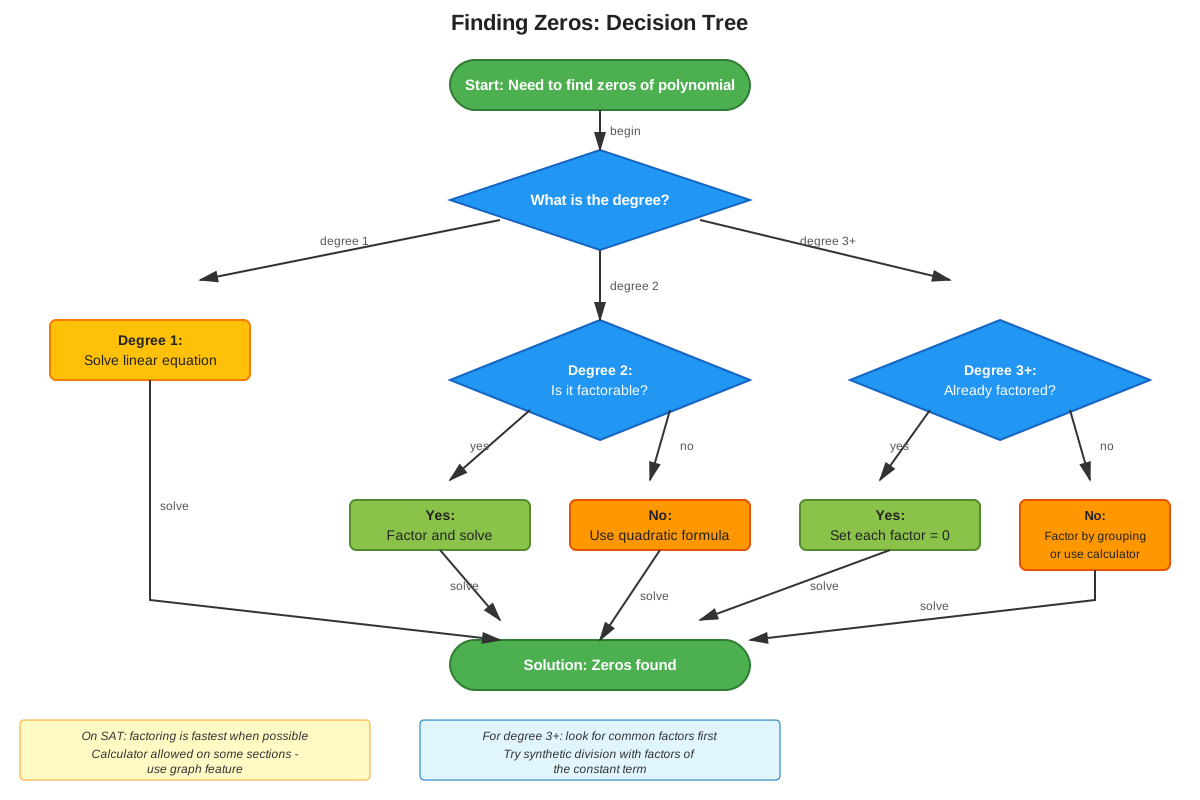
When approaching SAT questions on zeros of polynomials, begin by identifying what form the polynomial is presented in. Factored form makes zeros immediately visible, while standard form requires factoring or the quadratic formula. Look for trigger phrases like "x-intercepts," "solutions," "roots," or "where the graph crosses the x-axis"—all indicate zeros.
Time-saving approach: For multiple-choice questions, consider substituting answer choices into the polynomial rather than solving algebraically. If the question asks "which is a zero of f(x) = x² - 7x + 12," test each answer choice by substitution. This often proves faster than factoring, especially under time pressure.
Process of elimination tips specific to zeros:
- Eliminate answers that would produce the wrong number of zeros (a quadratic must have two zeros counting multiplicity)
- If the polynomial has integer coefficients and the constant term is positive, eliminate negative answer choices for product of zeros
- For graphical questions, eliminate zeros that don't match the number of x-intercepts shown
- Use the discriminant quickly: if b² - 4ac < 0, eliminate all real number answer choices
Strategic factoring decisions: Attempt factoring first for quadratics with small integer coefficients. If factoring isn't immediately apparent within 15-20 seconds, switch to the quadratic formula rather than wasting time. The SAT rewards efficiency.
Calculator usage: For calculator-permitted sections, verify zeros by graphing the function and using the "zero" or "root" function. This provides a quick check and helps visualize the problem. However, don't rely solely on calculator approximations for exact answers—algebraic methods yield precise values.
Time allocation: Straightforward zero-finding questions should take 30-60 seconds. Multi-step problems involving constructing polynomials or real-world applications may require 90-120 seconds. If a question exceeds these times, mark it and return later.
Memory Techniques
ZERO mnemonic for the complete process:
- Zero Product Property applies after factoring
- Equate each factor to zero
- Remember to check both solutions
- Opposite signs in factors (x - r means zero at +r)
Factor-Zero Sign Rule: "Minus in the factor, plus in the zero"
- (x - 5) gives zero x = 5
- (x + 3) gives zero x = -3
Discriminant Decision Tree visualization:
b² - 4ac
    |
    ├─ Positive → Two real zeros (graph crosses twice)
    ├─ Zero → One real zero (graph touches once)
    └─ Negative → No real zeros (graph doesn't touch x-axis)
Vieta's Vowels: "Sum and Product"
- Sum = -b/a (S comes before P alphabetically, sum uses b)
- Product = c/a (P comes after, product uses c)
Multiplicity Memory: "Even touches, Odd crosses"
- Even multiplicity: graph touches x-axis like a gentle bounce
- Odd multiplicity: graph crosses x-axis like cutting through
FACTOR acronym for constructing polynomials:
- Find all given zeros
- Arrange as factors (x - r)
- Combine by multiplication
- Test with given point if needed
- Open to standard form if required
- Review and verify
Summary
Zeros of polynomials represent the x-values where a polynomial function equals zero, appearing as x-intercepts on graphs and serving as fundamental features for understanding polynomial behavior. The Factor Theorem establishes that (x - r) is a factor if and only if r is a zero, creating a bidirectional relationship between algebraic and numerical representations. Students can find zeros through factoring combined with the Zero Product Property, or through the quadratic formula when factoring proves difficult. The discriminant reveals whether zeros are real or complex before calculation, while multiplicity determines graphical behavior at each zero. For SAT success, students must fluently convert between factored and standard forms, construct polynomials from given zeros, interpret zeros in real-world contexts, and apply Vieta's formulas for sum and product relationships. Understanding that a polynomial of degree n has exactly n zeros (counting multiplicities and including complex zeros) provides the foundation for all polynomial analysis.
Key Takeaways
- Zeros, roots, solutions, and x-intercepts all refer to values where f(x) = 0
- The Factor Theorem connects factors and zeros: (x - r) is a factor ↔ r is a zero
- Use factoring for simple polynomials, the quadratic formula for complex quadratics, and the discriminant to predict zero types
- Multiplicity determines graphical behavior: odd multiplicity crosses the x-axis, even multiplicity touches without crossing
- A polynomial of degree n has exactly n zeros total (real and complex combined), but may have fewer real zeros
- Vieta's formulas provide shortcuts: for ax² + bx + c with zeros r and s, sum = -b/a and product = c/a
- On the SAT, zeros appear in multiple contexts including word problems, graphical interpretation, and polynomial construction
Related Topics
Quadratic Functions and Parabolas: Mastering zeros enables deeper understanding of vertex form, axis of symmetry, and optimization problems. The vertex lies exactly halfway between zeros when they exist.
Polynomial Division and the Remainder Theorem: The Remainder Theorem extends zero concepts—if f(r) = 0, then (x - r) divides f(x) evenly with no remainder. This connects to synthetic division and factoring higher-degree polynomials.
Rational Functions and Asymptotes: Zeros of the numerator become zeros of rational functions, while zeros of the denominator create vertical asymptotes. Understanding polynomial zeros is prerequisite for rational function analysis.
Systems of Equations: Finding where two functions intersect involves setting them equal and solving for zeros of their difference. This application appears frequently in SAT word problems.
Complex Numbers: When discriminants are negative, zeros become complex conjugates. While less emphasized on the SAT, understanding that all polynomials have zeros in the complex system completes the theoretical picture.
Practice CTA
Now that you've mastered the core concepts of zeros of polynomials, it's time to solidify your understanding through active practice. Attempt the practice questions to apply these strategies under test-like conditions, and use the flashcards to reinforce high-yield facts and formulas. Remember: understanding the theory is just the first step—consistent practice transforms knowledge into the automatic recall and problem-solving speed that leads to SAT success. Each practice problem you solve strengthens your neural pathways and builds the confidence you need on test day. You've got this!
Sign up free to keep reading
Create a free AnvayaPrep account to finish this SAT guide on Zeros of polynomials — plus flashcards and practice questions.