Overview
The complement rule is one of the most powerful and frequently tested concepts in probability on the SAT math section. This elegant principle allows students to calculate the probability of an event occurring by instead finding the probability that it does not occur, then subtracting from 1. While this may seem like a simple mathematical trick, the complement rule often transforms complex, multi-step probability problems into straightforward calculations that can be solved in seconds rather than minutes.
Understanding the sat complement rule is essential because many probability questions on the exam are deliberately designed to be tedious when approached directly but become remarkably simple when solved using the complement. For instance, finding the probability that "at least one" event occurs among multiple trials can require calculating numerous individual scenarios and adding them together—unless you recognize that the complement (none of the events occurring) is far easier to compute. This strategic insight can save precious time during the exam and significantly reduce calculation errors.
The complement rule connects fundamentally to basic probability principles, set theory, and logical reasoning. It reinforces the concept that all possible outcomes in a sample space must sum to a probability of 1, and it provides a bridge between theoretical probability and practical problem-solving. Mastering this topic strengthens overall mathematical reasoning and prepares students for more advanced statistical concepts they'll encounter in college-level coursework.
Learning Objectives
- [ ] Identify key features of Complement rule
- [ ] Explain how Complement rule appears on the SAT
- [ ] Apply Complement rule to answer SAT-style questions
- [ ] Recognize when using the complement rule provides a more efficient solution path than direct calculation
- [ ] Convert between complement and direct probability statements accurately
- [ ] Solve multi-step probability problems involving "at least one" scenarios using the complement rule
- [ ] Evaluate probability expressions involving complements in both fraction and decimal form
Prerequisites
- Basic probability concepts: Understanding that probability represents the ratio of favorable outcomes to total possible outcomes is fundamental to applying the complement rule
- Fractions and decimals: The complement rule requires subtracting probabilities from 1, necessitating comfort with fraction subtraction and decimal operations
- Sample space understanding: Recognizing that all possible outcomes in a probability scenario must account for 100% of possibilities is essential to grasping why complements sum to 1
- Basic set notation: Familiarity with the concept of "not A" or "A complement" helps in translating word problems into mathematical expressions
Why This Topic Matters
The complement rule appears in real-world applications across numerous fields. Insurance companies use complement probabilities to calculate risk (the probability a claim will NOT be filed). Quality control engineers determine defect rates by examining the complement of acceptable products. Medical researchers assess treatment effectiveness by analyzing the probability that symptoms do NOT improve. Weather forecasters communicate the complement when they state there's a 30% chance of rain (implicitly, a 70% chance of no rain).
On the SAT, probability questions appear in approximately 5-8% of all math questions, and the complement rule is relevant to roughly half of these probability problems. This translates to 1-2 questions per exam where recognizing the complement approach can provide a significant advantage. The College Board frequently tests this concept because it assesses both mathematical knowledge and strategic problem-solving—two core competencies the SAT aims to measure.
The complement rule most commonly appears in SAT questions involving:
- "At least one" scenarios (at least one success, at least one defect, at least one occurrence)
- "None" or "no" scenarios that can be flipped to their complements
- Multiple independent events where calculating all favorable outcomes directly would be time-consuming
- Probability questions embedded in data analysis contexts with tables or charts
- Word problems requiring translation from English to mathematical probability statements
Core Concepts
The Fundamental Complement Rule
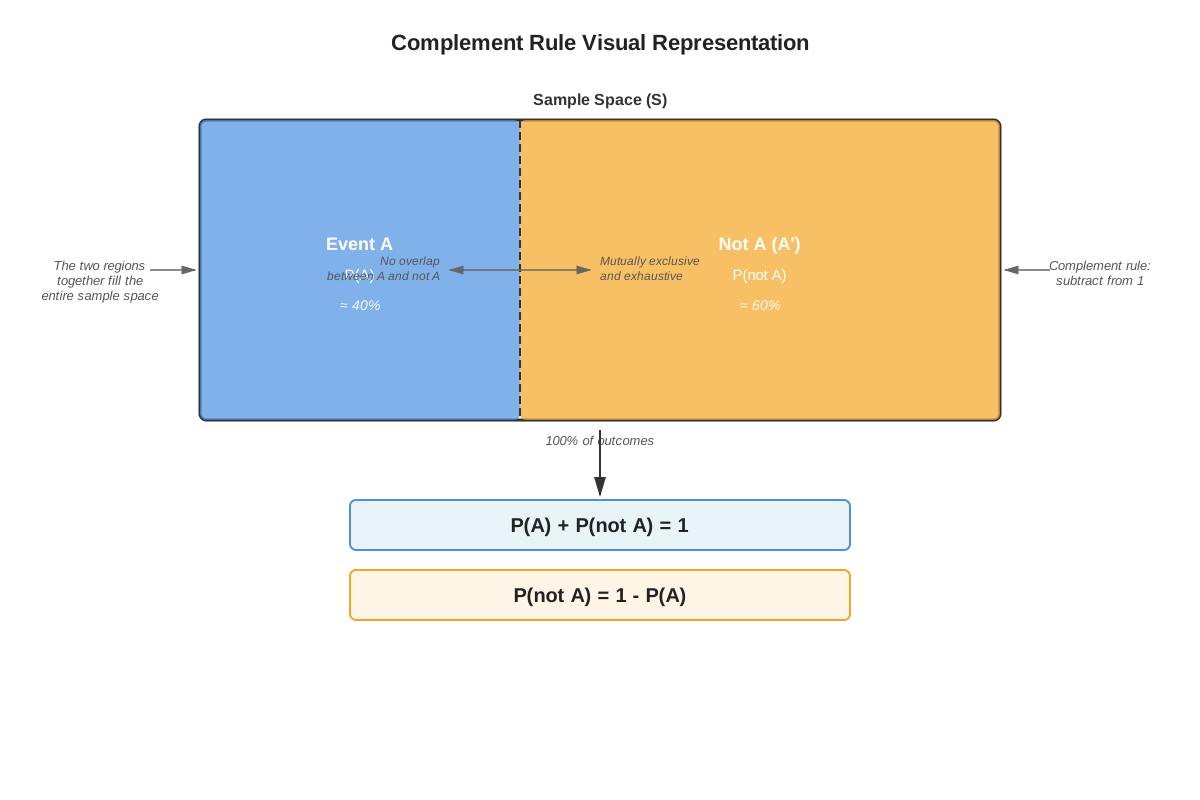
The complement rule states that the probability of an event occurring plus the probability of that event NOT occurring must equal 1. Mathematically, this is expressed as:
P(A) + P(not A) = 1Or equivalently:
P(A) = 1 - P(not A)Where P(A) represents the probability of event A occurring, and P(not A) represents the probability of event A not occurring. The complement of event A is often denoted as A', Ā, or A^c in formal notation, though SAT questions typically use plain English descriptions.
This rule emerges from the fundamental principle that in any probability scenario, something must happen. The sample space—the set of all possible outcomes—has a total probability of 1 (or 100%). Since every outcome either belongs to event A or does not belong to event A, these two mutually exclusive categories must account for the entire sample space.
When to Use the Complement Rule
The complement rule becomes particularly valuable in specific problem types:
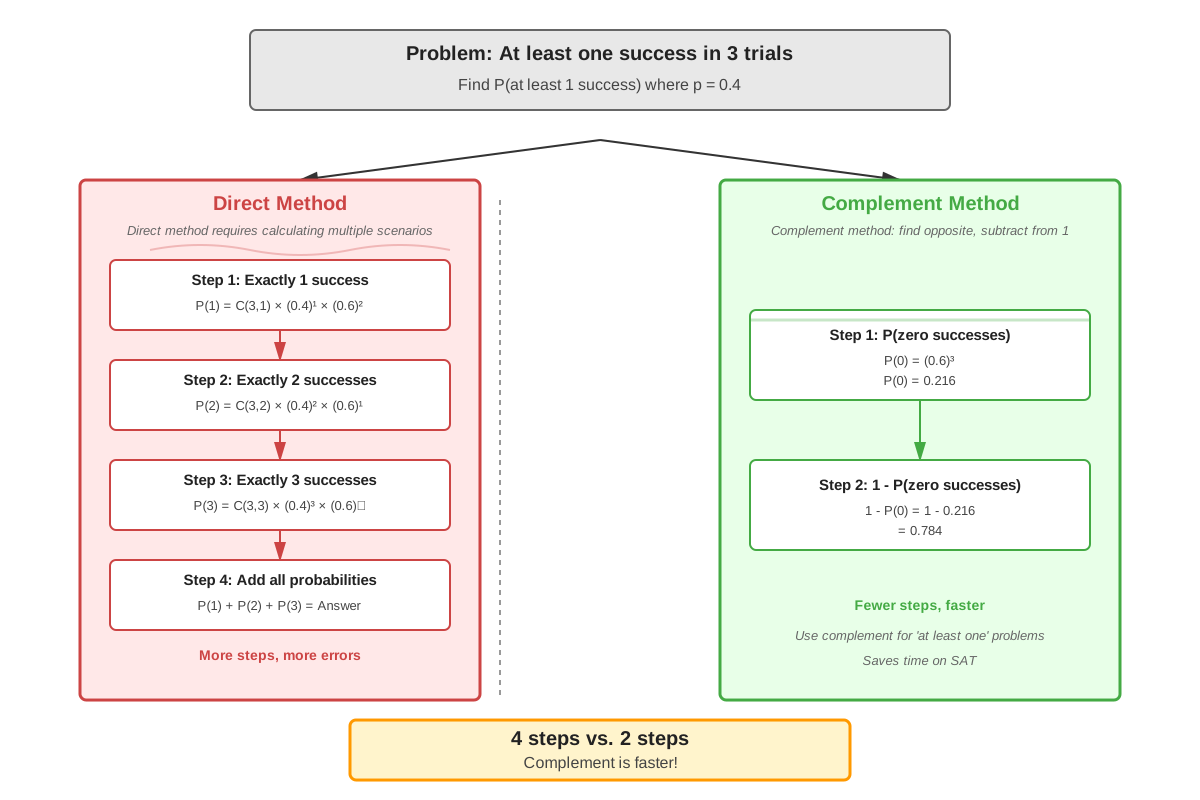
"At Least One" Problems: When a question asks for the probability that at least one event occurs (at least one success, at least one person, at least one day), calculating directly requires finding P(exactly 1) + P(exactly 2) + P(exactly 3) + ... for all possible numbers. Instead, recognize that "at least one" is the complement of "none," which is typically a single, simple calculation.
Multiple Independent Events: When dealing with several independent trials where you need the probability that something happens in at least one trial, the complement (it happens in zero trials) involves multiplying probabilities of failure, which is straightforward.
Complex Favorable Outcomes: When the favorable outcomes are numerous or complicated to enumerate, but the unfavorable outcomes are simple and few, the complement provides an efficient alternative path.
Calculating with Complements
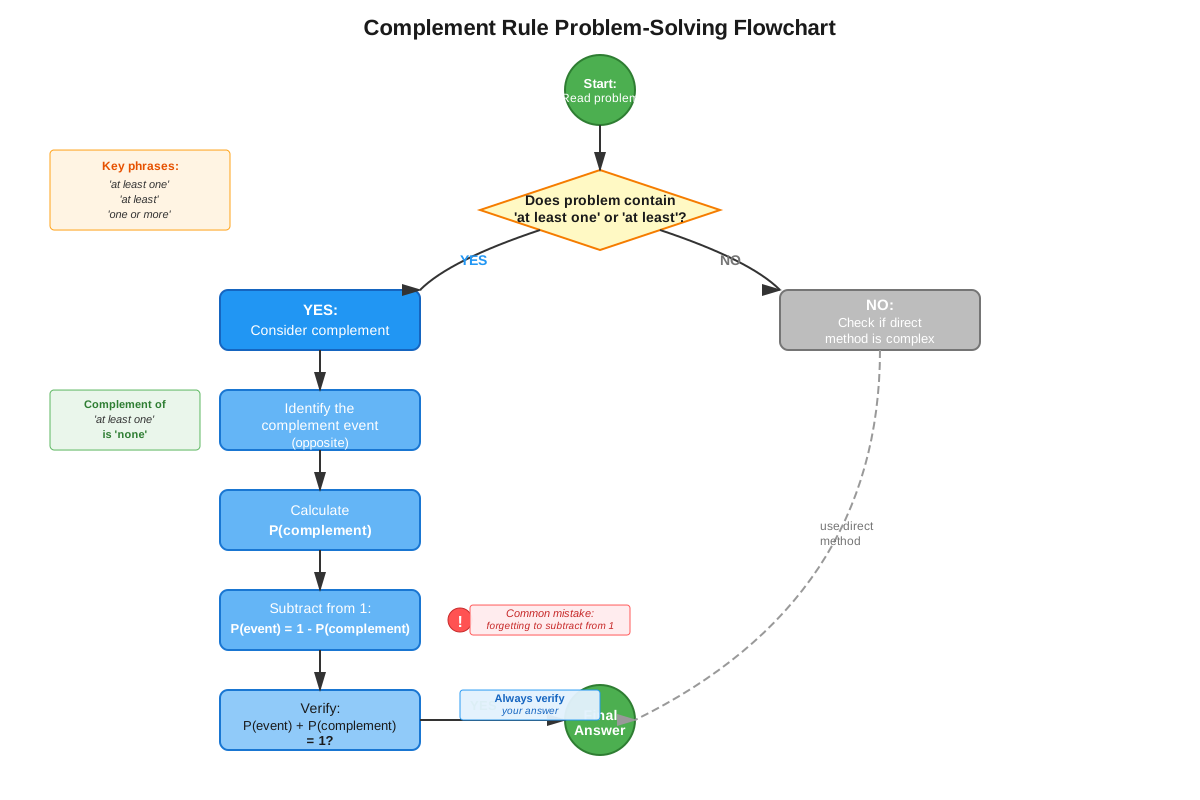
The process for applying the complement rule follows these steps:
- Identify the event: Clearly define what event A represents in the problem
- Determine the complement: Identify what "not A" means in context
- Assess efficiency: Decide whether calculating P(A) directly or P(not A) is simpler
- Calculate the simpler probability: Find either P(A) or P(not A), whichever is easier
- Apply the complement rule: Use P(A) = 1 - P(not A) to find the desired probability
Complement Rule with Independent Events
When dealing with multiple independent events, the complement rule combines with the multiplication rule for independent events. If you want the probability that event A occurs at least once in n independent trials:
P(at least one A) = 1 - P(no A in any trial)
P(at least one A) = 1 - [P(not A)]^n
This formula is extraordinarily powerful on the SAT because it reduces what could be a lengthy calculation into a simple two-step process: find the probability of failure in one trial, raise it to the power of the number of trials, and subtract from 1.
Complement Rule in Context
| Scenario Type | Direct Calculation | Complement Calculation | Better Approach |
|---|---|---|---|
| At least one success in 5 trials | P(1) + P(2) + P(3) + P(4) + P(5) | 1 - P(0 successes) | Complement |
| Exactly 3 successes in 5 trials | Calculate directly using combinations | Not applicable | Direct |
| No failures in 10 trials | Calculate directly | 1 - P(at least 1 failure) | Direct |
| At least one defect in batch | Sum all scenarios with defects | 1 - P(no defects) | Complement |
Concept Relationships
The complement rule builds directly upon fundamental probability axioms, particularly the principle that all probabilities in a sample space sum to 1. This connection to basic probability is essential—without understanding that the total probability space equals 1, the complement rule appears arbitrary rather than logical.
The complement rule connects strongly to set theory concepts, where the complement of set A within universal set U contains all elements not in A. This mathematical foundation helps students visualize why P(A) + P(not A) = 1: every outcome in the sample space belongs either to A or to its complement, with no overlap and no gaps.
When combined with the multiplication rule for independent events, the complement rule becomes especially powerful. This relationship enables efficient solutions to complex multi-trial problems: Independent Events → Multiplication Rule → Combined with Complement Rule → Efficient "At Least One" Solutions.
The complement rule also relates to conditional probability in more advanced problems. Understanding that P(A|B) and P(not A|B) are complements within the conditional sample space extends the basic complement principle to more sophisticated scenarios.
Finally, the complement rule connects to logical reasoning and problem-solving strategy. Recognizing when to use the complement approach rather than direct calculation represents metacognitive skill development: Problem Analysis → Strategy Selection → Efficient Solution Path. This strategic thinking applies beyond probability to many SAT math topics.
High-Yield Facts
- ⭐ The complement rule states that P(A) + P(not A) = 1 for any event A
- ⭐ "At least one" problems are almost always easier to solve using the complement rule by calculating "none" instead
- ⭐ The complement of "at least one" is "none" or "zero"
- ⭐ For independent events, P(at least one success) = 1 - P(no successes) = 1 - [P(failure)]^n
- ⭐ The probability of a complement can never be negative; if your calculation yields a negative probability, you've made an error
- The sum of an event's probability and its complement's probability always equals exactly 1 (or 100%)
- Complement probabilities work with any probability representation: fractions, decimals, or percentages
- The complement of "all" is "not all" (which means at least one failure)
- When multiple outcomes satisfy an event, the complement rule still applies to the entire event as a whole
- The complement rule applies to both theoretical probability (calculated from known outcomes) and experimental probability (based on data)
- If P(A) = 0.3, then P(not A) must equal 0.7, regardless of what event A represents
- The complement rule can be applied repeatedly: the complement of a complement returns to the original event
- In SAT problems, phrases like "at least," "at most," and "no" often signal complement rule opportunities
Quick check — test yourself on Complement rule so far.
Try Flashcards →Common Misconceptions
Misconception: The complement rule only works with simple, single events and cannot be applied to complex scenarios involving multiple conditions.
Correction: The complement rule applies to any event, regardless of complexity. Whether the event is "rolling a 6 on a die" or "at least one of five students scoring above 90% on a test," the event and its complement must sum to probability 1. The key is properly defining what constitutes the complement in context.
Misconception: When using the complement rule with multiple trials, you should subtract the complement probability from the number of trials rather than from 1.
Correction: Always subtract from 1, never from the number of trials. The complement rule is P(A) = 1 - P(not A), where both probabilities are values between 0 and 1. The number of trials affects how you calculate P(not A) but doesn't change the fundamental formula.
Misconception: "At least one" and "exactly one" mean the same thing and can be solved the same way.
Correction: These phrases have completely different meanings. "At least one" means one or more (1, 2, 3, ..., all), while "exactly one" means precisely one, no more and no fewer. "At least one" problems are ideal for the complement rule; "exactly one" problems typically require direct calculation using combinations.
Misconception: If P(A) = 0.4, then P(not A) = -0.4 because you subtract from zero.
Correction: You always subtract from 1, not from zero. If P(A) = 0.4, then P(not A) = 1 - 0.4 = 0.6. Probabilities cannot be negative; any negative result indicates a calculation error.
Misconception: The complement rule doesn't apply when probabilities are given as fractions rather than decimals.
Correction: The complement rule works identically with fractions, decimals, or percentages. If P(A) = 2/5, then P(not A) = 1 - 2/5 = 3/5. If P(A) = 40%, then P(not A) = 100% - 40% = 60%. The mathematical relationship remains constant regardless of representation.
Misconception: When calculating P(at least one) using complements with independent events, you should add the individual failure probabilities rather than multiply them.
Correction: For independent events, probabilities multiply, not add. If the probability of failure in each of three independent trials is 0.2, the probability of failure in all three trials is 0.2 × 0.2 × 0.2 = 0.008, not 0.2 + 0.2 + 0.2 = 0.6. Then P(at least one success) = 1 - 0.008 = 0.992.
Worked Examples
Example 1: At Least One Success Scenario
Problem: A basketball player has a 70% free throw success rate. If she attempts 3 free throws, what is the probability that she makes at least one of them?
Solution:
Step 1 - Identify the event and its complement:
- Event A: Makes at least one free throw (could be 1, 2, or 3 makes)
- Complement (not A): Makes zero free throws (misses all 3)
Step 2 - Assess which is easier to calculate:
Calculating "at least one" directly would require:
P(exactly 1 make) + P(exactly 2 makes) + P(exactly 3 makes)
This involves multiple combinations and calculations. The complement (missing all 3) is much simpler.
Step 3 - Calculate P(not A):
- Probability of missing one free throw = 1 - 0.70 = 0.30
- Since the attempts are independent, probability of missing all 3:
- P(miss all 3) = 0.30 × 0.30 × 0.30 = 0.027
Step 4 - Apply the complement rule:
P(at least one make) = 1 - P(no makes)
P(at least one make) = 1 - 0.027 = 0.973
Answer: The probability is 0.973 or 97.3%
Connection to learning objectives: This example demonstrates applying the complement rule to SAT-style questions and recognizing when the complement provides a more efficient solution path than direct calculation.
Example 2: Data Table with Complement
Problem: A survey of 200 students found their preferred study locations:
| Location | Number of Students |
|---|---|
| Library | 85 |
| Coffee Shop | 45 |
| Home | 60 |
| Other | 10 |
If one student is randomly selected from this survey, what is the probability that the student does NOT prefer studying at the library?
Solution:
Step 1 - Identify the event and complement:
- Event A: Student prefers the library
- Complement (not A): Student prefers any location other than the library
Step 2 - Determine the calculation approach:
We could add the probabilities for Coffee Shop, Home, and Other, or we could use the complement rule. Let's compare both methods.
Method 1 - Direct calculation:
P(not library) = P(Coffee Shop) + P(Home) + P(Other)
P(not library) = 45/200 + 60/200 + 10/200 = 115/200 = 23/40
Method 2 - Complement rule:
P(library) = 85/200 = 17/40
P(not library) = 1 - P(library) = 1 - 17/40 = 40/40 - 17/40 = 23/40
Step 3 - Verify and simplify:
Both methods yield 23/40, which equals 0.575 or 57.5%
Answer: The probability is 23/40 or 0.575
Connection to learning objectives: This example shows how the complement rule appears in SAT data analysis contexts and demonstrates that the complement approach can be equally efficient (or sometimes more efficient) even when direct calculation is possible. It also reinforces converting between fraction and decimal probability representations.
Exam Strategy
When approaching SAT probability questions, develop a systematic process for identifying complement rule opportunities:
Trigger Words and Phrases:
- "At least one" → Complement is "none" or "zero"
- "At least" (any number) → Consider whether the complement is simpler
- "No" or "none" → This might BE the complement; consider if you should find its complement
- "All" → Complement is "not all" or "at least one failure"
- "Some" → Complement is "none"
Decision Framework:
- Read the question and identify what probability you need to find
- Ask: "What is the complement of this event?"
- Compare: "Which is easier to calculate—the event or its complement?"
- If the complement is simpler, calculate it and subtract from 1
- If direct calculation is simpler, proceed directly
Process of Elimination Tips:
- Eliminate any answer choice greater than 1 or less than 0 (impossible probabilities)
- If you calculated a complement probability, eliminate answer choices that equal your intermediate result rather than 1 minus that result
- For "at least one" problems, the answer should be relatively high (usually > 0.5) unless the individual probability is very low
- Check if answer choices are given as complements of each other (e.g., 0.3 and 0.7); this often indicates a complement rule problem
Time Allocation:
Complement rule problems should take 60-90 seconds once you recognize the pattern. If you find yourself writing out more than 3-4 calculation steps, pause and reconsider whether the complement approach would be more efficient. The SAT rewards strategic thinking, not lengthy calculations.
Exam Tip: If a probability problem involves more than two steps of direct calculation, always check if the complement rule offers a shortcut. The SAT frequently designs problems where the "obvious" approach is tedious but the complement approach is elegant.
Memory Techniques
Mnemonic for Complement Rule Formula: "Probability Always Needs One" → P(A) + P(not A) = 1
Visualization Strategy: Picture a complete circle representing probability = 1. When you shade in the region representing event A, the unshaded region is "not A." Together, they fill the entire circle. This visual reinforces that complements must sum to the whole.
"At Least One" Acronym: ALONE = At Least One? None is Easier!
This reminds you that "at least one" problems are typically solved by calculating "none" (the complement) first.
Complement Phrase Flip: Create a mental table of complement pairs:
- "At least one" ↔ "None"
- "All" ↔ "Not all" (at least one failure)
- "Some" ↔ "None"
- "At most k" ↔ "More than k"
The "1 Minus" Gesture: When you see an "at least one" problem, physically write "1 -" on your scratch paper immediately. This primes your brain to use the complement approach and prevents you from starting down the lengthy direct calculation path.
Summary
The complement rule is a fundamental probability principle stating that the probability of an event occurring plus the probability of it not occurring must equal 1, expressed as P(A) + P(not A) = 1. This elegant relationship transforms complex probability problems—especially those involving "at least one" scenarios—into simple calculations by finding the probability of the complement event and subtracting from 1. On the SAT, recognizing when to apply the complement rule can reduce multi-step problems to two-step solutions, saving valuable time and reducing calculation errors. The rule applies universally to all probability scenarios regardless of whether probabilities are expressed as fractions, decimals, or percentages, and it combines powerfully with the multiplication rule for independent events to solve problems involving multiple trials. Mastering the complement rule requires both understanding the mathematical principle and developing the strategic insight to recognize when the complement approach offers a more efficient solution path than direct calculation.
Key Takeaways
- The complement rule formula P(A) = 1 - P(not A) is essential for efficient SAT probability problem-solving
- "At least one" problems are almost always solved most efficiently using the complement rule by calculating "none" first
- The complement of an event and the event itself must always sum to exactly 1 (or 100%)
- For independent events, P(at least one success) = 1 - [P(failure)]^n provides a powerful shortcut
- Recognizing complement rule opportunities through trigger words like "at least," "none," and "all" is a critical test-taking skill
- The complement rule works identically with fractions, decimals, and percentages
- Strategic problem analysis—determining whether direct calculation or the complement approach is more efficient—often matters more than computational skill on SAT probability questions
Related Topics
Multiplication Rule for Independent Events: Understanding how to calculate the probability of multiple independent events occurring together is essential for advanced complement rule applications, particularly in "at least one" scenarios involving multiple trials.
Conditional Probability: The complement rule extends to conditional probability situations where P(A|B) + P(not A|B) = 1, enabling more sophisticated problem-solving in scenarios where the sample space is restricted.
Combinations and Permutations: Many probability problems combine counting principles with the complement rule, requiring students to calculate the number of favorable outcomes using combinations before applying probability formulas.
Set Theory and Venn Diagrams: Visual representations of probability using sets reinforce why complements work and help solve problems involving unions, intersections, and complements of multiple events.
Expected Value: After mastering basic probability including the complement rule, students can progress to calculating expected values, which weight probabilities by their outcomes to determine long-term averages.
Practice CTA
Now that you've mastered the complement rule, it's time to solidify your understanding through practice! The concepts you've learned—identifying complement opportunities, applying the 1 - P(not A) formula, and recognizing "at least one" scenarios—will become automatic only through repeated application. Challenge yourself with the practice questions to test your ability to recognize when the complement rule provides the most efficient solution path. Use the flashcards to reinforce key formulas and trigger words until they become second nature. Remember: on the SAT, strategic problem-solving often matters more than computational complexity. The complement rule is your shortcut to faster, more accurate probability solutions. You've got this!
Sign up free to keep reading
Create a free AnvayaPrep account to finish this SAT guide on Complement rule — plus flashcards and practice questions.