Overview
Dependent events are a fundamental concept in probability that appears regularly on the SAT math section. Understanding dependent events means recognizing situations where the outcome of one event directly affects the probability of another event occurring. Unlike independent events where outcomes don't influence each other, dependent events create a chain reaction where each occurrence changes the conditions for what follows.
On the SAT, dependent events questions typically involve scenarios like drawing cards from a deck without replacement, selecting items from a bag sequentially, or choosing people from a group for different positions. These problems test whether students can recognize when probabilities change after each selection and correctly calculate compound probabilities using multiplication. Mastering this topic is essential because it appears in approximately 10-15% of SAT probability questions and often combines with other mathematical concepts like fractions, ratios, and combinatorics.
The concept of dependent events bridges fundamental probability principles with more advanced statistical reasoning. It builds directly on basic probability calculations while serving as a foundation for understanding conditional probability, combinations, and real-world statistical analysis. Students who master dependent events develop critical thinking skills about how sequential actions affect outcomes—a reasoning pattern that extends far beyond mathematics into logical decision-making and data interpretation across all SAT sections.
Learning Objectives
- [ ] Identify key features of dependent events
- [ ] Explain how dependent events appears on the SAT
- [ ] Apply dependent events to answer SAT-style questions
- [ ] Calculate compound probabilities for multiple dependent events in sequence
- [ ] Distinguish between dependent and independent events in word problems
- [ ] Solve multi-step probability problems involving selection without replacement
- [ ] Interpret real-world scenarios to determine whether events are dependent or independent
Prerequisites
- Basic probability concepts: Understanding that probability equals favorable outcomes divided by total possible outcomes is essential for calculating individual event probabilities
- Fraction operations: Multiplying and simplifying fractions is necessary since dependent event probabilities are calculated by multiplying sequential probabilities
- Ratio and proportion: Recognizing how quantities change relative to each other helps understand how removing items affects remaining probabilities
- Basic counting principles: Knowing how to count possible outcomes systematically is required to determine denominators and numerators in probability calculations
Why This Topic Matters
Dependent events form the mathematical foundation for understanding real-world scenarios involving sequential selection, sampling, and decision-making processes. In everyday life, dependent events appear in situations like drawing lottery numbers, dealing cards in games, quality control sampling in manufacturing, and even understanding genetic inheritance patterns. The ability to recognize and calculate dependent probabilities enables informed decision-making in fields ranging from finance and insurance to medicine and engineering.
On the SAT, dependent events questions appear with moderate to high frequency, typically showing up 1-2 times per test administration. These questions usually appear in both the calculator and no-calculator sections, often as medium to hard difficulty problems worth the same points as easier questions. The College Board particularly favors dependent events problems because they test multiple skills simultaneously: reading comprehension, logical reasoning, fraction manipulation, and probability calculation.
Common SAT presentations of this topic include: selecting colored marbles or balls from a bag without replacement, drawing cards from a standard deck sequentially, choosing students or committee members for different roles, and quality control scenarios where defective items are removed from a batch. Questions may ask for the probability of a specific sequence of outcomes, the probability that at least one event occurs, or require students to set up equations involving dependent probabilities. The SAT often disguises dependent events within word problems, requiring students to recognize the dependency relationship before applying the appropriate calculation method.
Core Concepts
Definition of Dependent Events
Dependent events are two or more events where the outcome of one event affects the probability of the other event(s) occurring. The key characteristic that defines dependency is that the sample space—the set of all possible outcomes—changes after the first event occurs. When events are dependent, the probability of the second event is conditional upon what happened in the first event.
Mathematically, events A and B are dependent if:
P(B after A) ≠ P(B)This means the probability of B occurring after A has occurred is different from the probability of B occurring independently. The classic example involves drawing cards from a deck without replacement: after drawing one card, there are only 51 cards remaining, fundamentally changing the probability of drawing any specific card next.
The Multiplication Rule for Dependent Events
To calculate the probability of multiple dependent events occurring in sequence, multiply the probability of each event, adjusting for the changed conditions after each occurrence. The formula for two dependent events A and B is:
P(A and B) = P(A) × P(B|A)Where P(B|A) represents the "conditional probability" of B given that A has already occurred. For three or more dependent events, continue the pattern:
P(A and B and C) = P(A) × P(B|A) × P(C|A and B)Example: Finding the probability of drawing two red cards consecutively from a standard deck without replacement:
- P(first card is red) = 26/52 = 1/2
- P(second card is red | first was red) = 25/51
- P(both red) = (26/52) × (25/51) = 650/2652 = 25/102
Selection Without Replacement
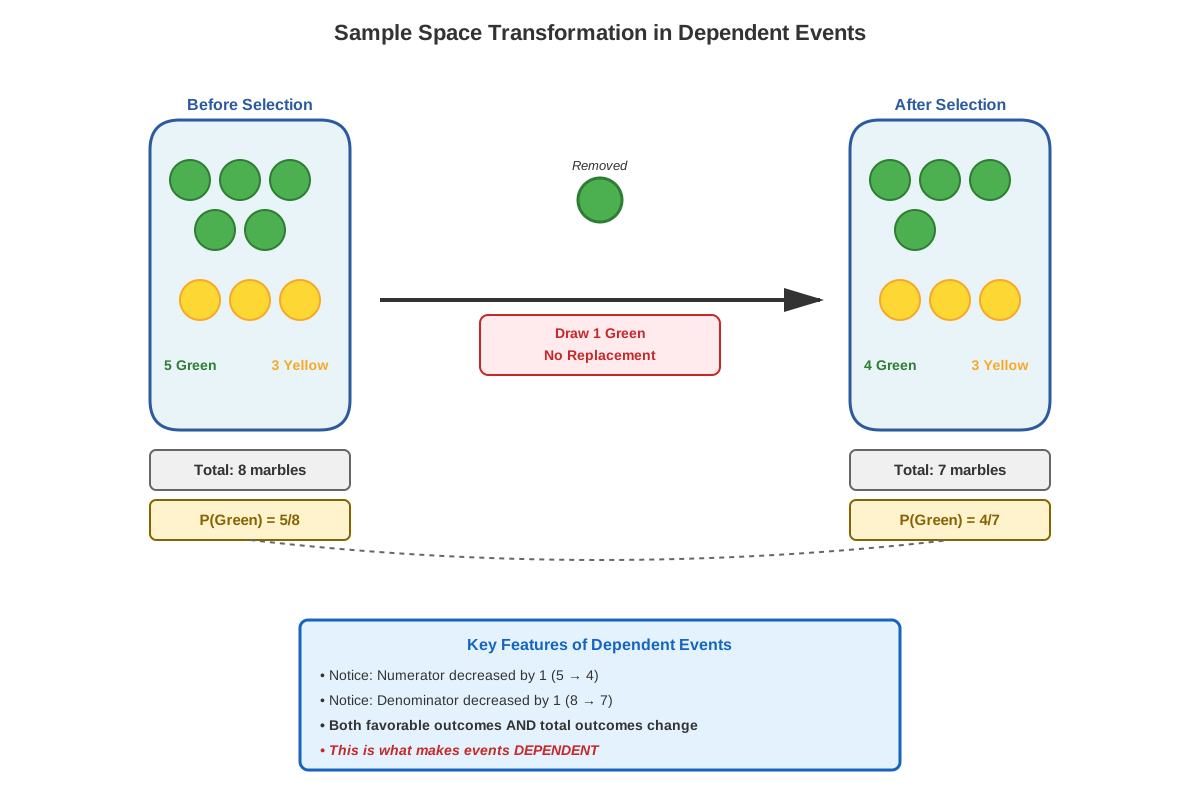
Selection without replacement is the most common scenario creating dependent events on the SAT. When an item is selected and not returned to the original group, both the number of favorable outcomes and the total number of possible outcomes decrease for subsequent selections.
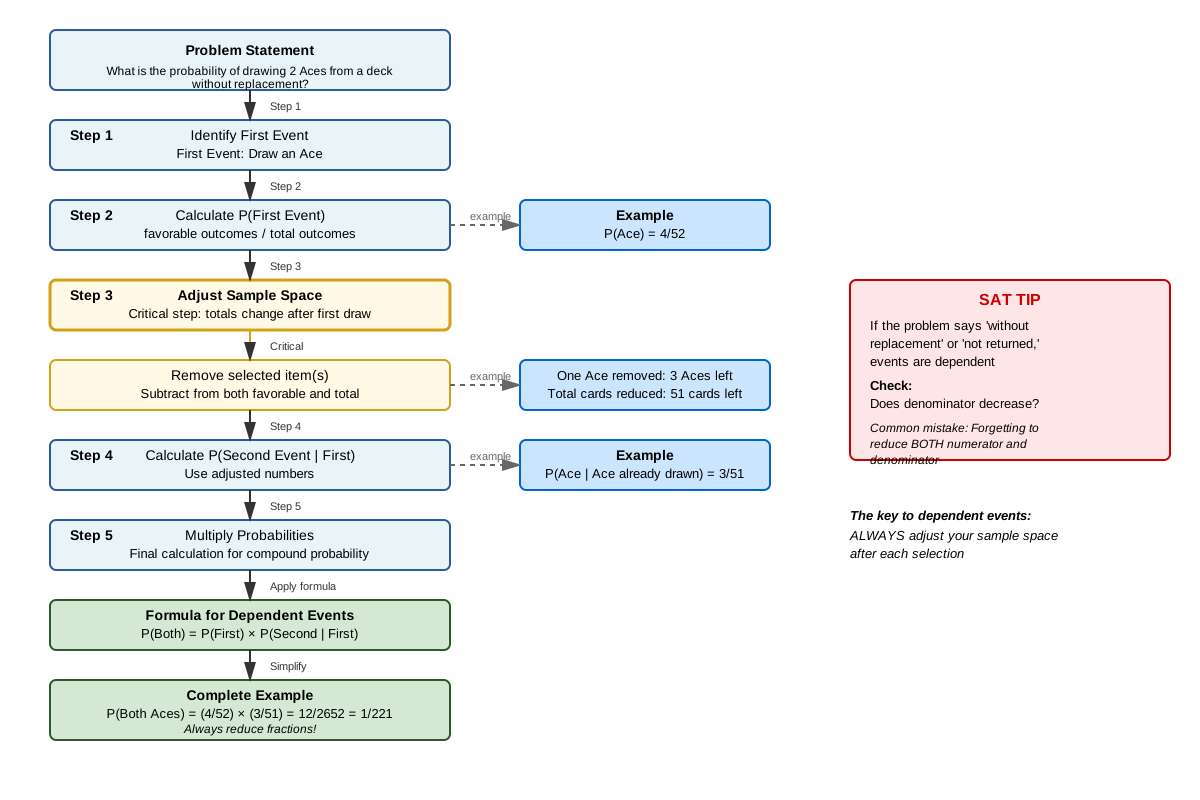
The systematic approach involves:
- Calculate the probability of the first event using the original total
- Reduce both the favorable outcomes and total outcomes by 1 (or appropriate amount)
- Calculate the probability of the second event using the new numbers
- Multiply the probabilities together
- Simplify the resulting fraction
| Selection | Favorable Outcomes | Total Outcomes | Probability |
|---|---|---|---|
| First | Original count | Original total | Favorable/Total |
| Second | Reduced by 1 | Reduced by 1 | New Favorable/New Total |
| Third | Reduced by 2 | Reduced by 2 | New Favorable/New Total |
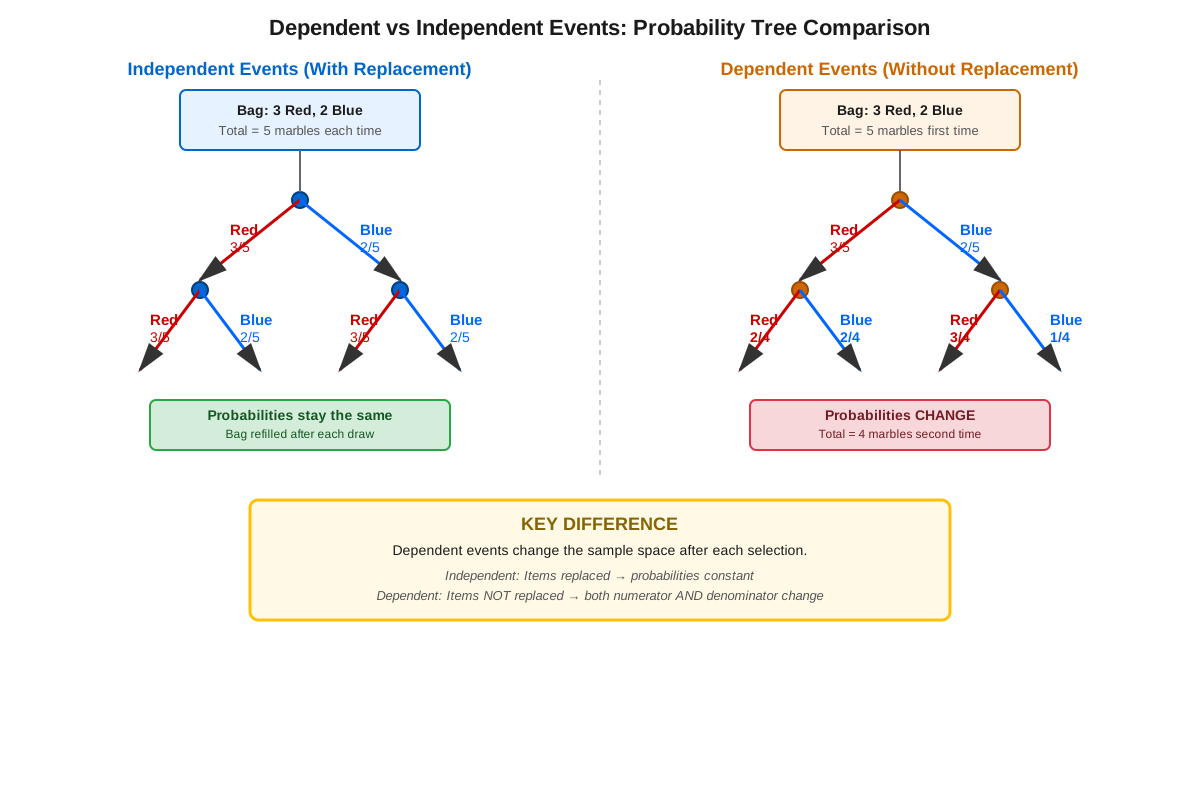
Dependent vs. Independent Events
Understanding the distinction between dependent and independent events is crucial for SAT dependent events problems. The key difference lies in whether the sample space changes:
Independent Events:
- The outcome of one event does not affect the other
- Sample space remains constant
- Examples: flipping a coin multiple times, rolling dice, spinning a wheel with replacement
- Formula: P(A and B) = P(A) × P(B)
Dependent Events:
- The outcome of one event changes the probability of the other
- Sample space changes after each event
- Examples: drawing cards without replacement, selecting people for different positions, removing items from a container
- Formula: P(A and B) = P(A) × P(B|A)
Recognizing Dependency in Word Problems
SAT questions rarely explicitly state "these are dependent events." Instead, students must identify dependency through contextual clues:
Key phrases indicating dependent events:
- "without replacement"
- "not returned"
- "different people/items"
- "one after another" (when items are removed)
- "first...then..." (in selection contexts)
- "remaining" or "left"
Key phrases indicating independent events:
- "with replacement"
- "returned to"
- "each time" (when conditions reset)
- "independently"
- "separate trials"
Complex Dependent Event Scenarios
Advanced SAT dependent events problems may involve:
Multiple favorable outcomes: When more than one outcome satisfies the condition at each stage, count all favorable possibilities while tracking how the sample space changes.
"At least one" problems: These often require calculating the complement (probability of none) and subtracting from 1, which can be more efficient than calculating all possible success scenarios.
Conditional restrictions: Some problems specify that certain outcomes must occur in specific positions or that different types of items must be selected, requiring careful tracking of changing probabilities at each step.
Concept Relationships
The concept of dependent events builds directly upon fundamental probability principles, specifically the basic probability formula (favorable outcomes ÷ total outcomes). This foundation → extends to → dependent events by introducing the dynamic element where both numerator and denominator change after each selection.
Within the topic itself, the relationship flows as follows:
Recognition of dependency → Application of multiplication rule → Systematic calculation with changing sample space → Simplification of compound fractions
Dependent events connect intimately with independent events through contrast—understanding one clarifies the other. Both concepts → feed into → conditional probability, which formalizes the notation P(B|A) used in dependent event calculations.
The topic also relates to combinations and permutations: when order matters in dependent selections, permutation principles apply; when order doesn't matter, combination principles help count favorable outcomes. Additionally, dependent events → connect to → complementary probability (calculating "at least one" scenarios) and → extend to → tree diagrams as a visual tool for mapping multiple dependent outcomes.
Understanding dependent events → enables mastery of → more advanced statistical concepts like Bayes' theorem, sampling distributions, and hypothesis testing, though these typically exceed SAT scope.
High-Yield Facts
⭐ Dependent events occur when the outcome of one event changes the probability of subsequent events
⭐ The multiplication rule for dependent events is P(A and B) = P(A) × P(B|A), where probabilities are calculated with adjusted sample spaces
⭐ Selection without replacement always creates dependent events because the total number of items decreases
⭐ After removing one item from a group, both the numerator (favorable outcomes) and denominator (total outcomes) typically decrease by 1
⭐ The phrase "without replacement" is the most common indicator of dependent events on the SAT
- When calculating probabilities for three or more dependent events, continue multiplying, adjusting the sample space after each selection
- Drawing cards from a standard deck without replacement is the most frequently tested dependent events scenario on the SAT
- The probability of dependent events occurring in sequence is always less than or equal to the probability of the first event alone
- If events are dependent, you cannot simply multiply the original probabilities—you must account for the changing conditions
- Dependent events problems often involve fractions that require simplification as a final step
Quick check — test yourself on Dependent events so far.
Try Flashcards →Common Misconceptions
Misconception: All sequential events are dependent events.
Correction: Events are only dependent if the outcome of one affects the probability of the other. Rolling a die twice involves sequential events, but they're independent because the first roll doesn't change the die or affect the second roll. Dependency requires a change in the sample space or conditions.
Misconception: In dependent events, only the numerator (favorable outcomes) changes while the denominator stays the same.
Correction: Both the numerator and denominator typically change in dependent events. When you draw a red card from a deck, the next draw has both fewer red cards (numerator decreases) and fewer total cards (denominator decreases). Both values must be adjusted to reflect the new sample space.
Misconception: The multiplication rule P(A) × P(B) works for all probability problems involving "and."
Correction: The simple multiplication rule P(A) × P(B) only works for independent events. For dependent events, you must use P(A) × P(B|A), where the second probability reflects the changed conditions after the first event. Using the wrong formula leads to incorrect answers.
Misconception: If you're selecting different types of items (like a red ball then a blue ball), the events are automatically independent.
Correction: Selecting different types of items doesn't make events independent. If you draw a red ball from a bag of 5 red and 5 blue balls without replacement, then draw a blue ball, these are still dependent events because the total number of balls decreased from 10 to 9, changing the probability of drawing blue from 5/10 to 5/9.
Misconception: Dependent events always make the second probability smaller.
Correction: While the denominator always decreases in selection without replacement, whether the probability increases or decreases depends on what was removed. If you remove a non-favorable outcome, the probability of a favorable outcome actually increases. For example, if a bag has 2 red and 8 blue balls, and you remove a blue ball, the probability of drawing red increases from 2/10 to 2/9.
Worked Examples
Example 1: Classic Card Problem
Problem: A standard deck of 52 cards contains 4 aces. If two cards are drawn from the deck without replacement, what is the probability that both cards are aces?
Solution:
Step 1: Identify that this involves dependent events because cards are drawn "without replacement."
Step 2: Calculate the probability of drawing an ace on the first draw.
- Favorable outcomes: 4 aces
- Total outcomes: 52 cards
- P(first ace) = 4/52 = 1/13
Step 3: Calculate the probability of drawing an ace on the second draw, given that the first card was an ace.
- After removing one ace, favorable outcomes: 3 aces remain
- After removing one card, total outcomes: 51 cards remain
- P(second ace | first ace) = 3/51 = 1/17
Step 4: Apply the multiplication rule for dependent events.
- P(both aces) = P(first ace) × P(second ace | first ace)
- P(both aces) = (1/13) × (1/17)
- P(both aces) = 1/221
Answer: The probability that both cards are aces is 1/221 or approximately 0.0045.
Connection to learning objectives: This example demonstrates identifying dependent events (cards without replacement), applying the multiplication rule with adjusted probabilities, and solving a typical SAT-style problem.
Example 2: Selection from a Group
Problem: A committee of 3 people will be selected from a group of 5 women and 4 men. If the selection is random and people are chosen one at a time without replacement, what is the probability that the first person chosen is a woman, the second person chosen is a man, and the third person chosen is a woman?
Solution:
Step 1: Recognize this as a dependent events problem because people are selected "without replacement" and the question asks for a specific sequence.
Step 2: Calculate the probability that the first person is a woman.
- Favorable outcomes: 5 women
- Total outcomes: 9 people (5 women + 4 men)
- P(first is woman) = 5/9
Step 3: Calculate the probability that the second person is a man, given that a woman was selected first.
- After removing one woman: 4 women and 4 men remain
- Favorable outcomes: 4 men
- Total outcomes: 8 people remain
- P(second is man | first is woman) = 4/8 = 1/2
Step 4: Calculate the probability that the third person is a woman, given the previous selections.
- After removing one woman and one man: 4 women and 3 men remain
- Favorable outcomes: 4 women
- Total outcomes: 7 people remain
- P(third is woman | first is woman and second is man) = 4/7
Step 5: Multiply all three probabilities together.
- P(woman, then man, then woman) = (5/9) × (1/2) × (4/7)
- P(woman, then man, then woman) = (5 × 1 × 4)/(9 × 2 × 7)
- P(woman, then man, then woman) = 20/126 = 10/63
Answer: The probability of selecting a woman, then a man, then a woman is 10/63 or approximately 0.159.
Connection to learning objectives: This example shows how to handle multi-step dependent events, track changing sample spaces through three selections, and apply the multiplication rule for complex sequences—all common SAT question types.
Exam Strategy
When approaching SAT dependent events questions, follow this systematic process:
Step 1: Identify dependency indicators
Scan the problem for key phrases like "without replacement," "not returned," "different people," or "remaining." These signal that you're dealing with dependent events and must adjust probabilities after each selection.
Step 2: Determine what's being asked
SAT questions may ask for:
- Probability of a specific sequence (multiply probabilities in order)
- Probability of any arrangement (calculate one sequence, then multiply by number of arrangements)
- Probability of "at least one" (consider using complement: 1 - P(none))
Step 3: Set up the calculation systematically
Write out each probability fraction separately before multiplying:
- First event: favorable/total (original numbers)
- Second event: new favorable/new total (adjusted numbers)
- Continue for all events
Step 4: Track changes carefully
Create a quick table or list showing how numerators and denominators change after each selection. This prevents the common error of forgetting to adjust both values.
Exam Tip: If a problem seems to require calculating many different sequences, look for a pattern or consider whether the complement approach (1 - P(opposite)) would be faster.
Trigger words and phrases to watch for:
- "Without replacement" → dependent events, adjust sample space
- "Different" (people/items) → dependent events, can't select same item twice
- "In order" or "sequence" → multiply probabilities in the specified order
- "Any order" → calculate one sequence, then multiply by arrangements
- "At least one" → consider complement approach
Process of elimination tips:
- Eliminate answers that use the same denominator for all events (this suggests independent events)
- Eliminate answers greater than the probability of just the first event (compound probabilities of dependent events can't exceed individual probabilities)
- Eliminate answers that don't account for reduced sample space
Time allocation advice:
Dependent events problems typically require 1.5-2 minutes. If you find yourself spending more than 2.5 minutes, you may be overcomplicating the problem. Check whether you've correctly identified the type of problem and whether a simpler approach exists. Don't get stuck on complex simplification—SAT answers are usually in simplified form, but partial credit isn't given, so accuracy matters more than perfect simplification.
Memory Techniques
DRAW mnemonic for dependent events:
- Does the first event change the situation?
- Reduce both numerator and denominator
- Adjust probabilities for each new selection
- Without replacement = dependent
Visualization strategy:
Picture a bag of colored marbles. Each time you remove one, visualize the bag getting lighter and having fewer marbles. This physical image helps remember that both the total and the favorable outcomes change. Mentally "see" your hand reaching in with fewer choices each time.
The "Shrinking Pool" metaphor:
Think of dependent events as swimming in a pool that gets smaller after each lap. The pool (sample space) shrinks, making it easier or harder to find what you're looking for depending on what was removed. This metaphor reinforces that the denominator always decreases.
Fraction tracking acronym - FANS:
- Favorable outcomes (numerator)
- Adjust after each selection
- New total (denominator)
- Subtract what was removed
The "Musical Chairs" analogy:
Dependent events are like musical chairs—after each round, there's one fewer chair (total outcomes) and one fewer person (if selecting people). This helps remember that both numbers decrease together.
Summary
Dependent events represent probability scenarios where the outcome of one event directly affects the probability of subsequent events, primarily through changes in the sample space. The fundamental principle is that after each selection without replacement, both the number of favorable outcomes and the total number of possible outcomes change, requiring adjusted probability calculations at each step. The multiplication rule for dependent events, P(A and B) = P(A) × P(B|A), forms the mathematical foundation for solving these problems. On the SAT, dependent events appear most commonly in contexts involving drawing cards without replacement, selecting items from containers, or choosing people for different positions. Success requires recognizing dependency indicators in word problems, systematically tracking how numerators and denominators change after each selection, and accurately multiplying the sequence of adjusted probabilities. The key distinction from independent events is that dependent events cannot be calculated using original probabilities alone—each subsequent probability must reflect the new conditions created by previous selections.
Key Takeaways
- Dependent events occur when one outcome changes the probability of another, most commonly through selection without replacement that reduces the sample space
- The multiplication rule P(A) × P(B|A) requires adjusting the second probability to reflect changed conditions after the first event occurs
- Both numerator and denominator typically decrease in dependent events problems—track changes to both favorable outcomes and total outcomes
- "Without replacement" is the primary SAT indicator that events are dependent and probabilities must be adjusted for each selection
- Systematic calculation prevents errors: write out each probability fraction separately with adjusted values before multiplying
- Distinguish dependent from independent events by asking whether the sample space changes—if it does, events are dependent
- SAT dependent events problems typically involve cards, colored objects, or people selected sequentially without replacement
Related Topics
Independent Events: Understanding events where outcomes don't affect each other provides essential contrast to dependent events and helps students recognize which multiplication rule to apply. Mastering dependent events makes independent events clearer by comparison.
Conditional Probability: The formal notation P(B|A) used in dependent events is the foundation of conditional probability, which explores how probabilities change given specific conditions or information.
Combinations and Permutations: These counting principles help determine the number of ways to select or arrange items, often appearing alongside dependent events in complex SAT problems involving multiple selections.
Complementary Probability: The technique of calculating 1 - P(opposite) frequently combines with dependent events in "at least one" problems, providing an efficient alternative to calculating multiple scenarios.
Tree Diagrams: Visual representations of sequential events help organize dependent probability calculations, especially useful for problems involving three or more dependent selections.
Practice CTA
Now that you've mastered the core concepts of dependent events, it's time to solidify your understanding through practice! Attempt the practice questions to apply these principles to SAT-style problems, and use the flashcards to reinforce key definitions and formulas. Remember, dependent events questions appear regularly on the SAT, and with systematic practice, you'll recognize patterns and solve these problems with confidence. Each practice problem you complete strengthens your ability to identify dependency, track changing probabilities, and calculate accurate answers under test conditions. You've got this!
Sign up free to keep reading
Create a free AnvayaPrep account to finish this SAT guide on Dependent events — plus flashcards and practice questions.