Overview
Mutually exclusive events represent a fundamental concept in probability theory that appears regularly on the SAT math section. These events are defined by a simple but powerful characteristic: they cannot occur simultaneously. When two events are mutually exclusive, the occurrence of one event completely prevents the other from happening at the same time. For example, when flipping a coin, getting heads and getting tails are mutually exclusive events—the coin cannot land on both sides simultaneously. Understanding this concept is crucial for calculating probabilities correctly and avoiding common errors that can cost valuable points on test day.
The SAT frequently tests students' ability to recognize sat mutually exclusive events and apply the appropriate probability rules. Questions may present scenarios involving dice rolls, card draws, spinner outcomes, or real-world situations where students must determine whether events can happen together. The ability to identify mutually exclusive events directly impacts how probabilities are calculated, particularly when finding the probability that at least one of several events occurs. Mastering this topic typically requires understanding both the conceptual definition and the mathematical formula: P(A or B) = P(A) + P(B) for mutually exclusive events.
This topic serves as a cornerstone for broader probability concepts tested on the SAT. It connects directly to the addition rule of probability, complementary events, and compound probability scenarios. Students who thoroughly understand mutually exclusive events gain a significant advantage in tackling more complex probability questions, including those involving conditional probability and independent events. The concept also reinforces logical reasoning skills that extend beyond probability into other mathematical domains, making it a high-yield topic worthy of focused study time.
Learning Objectives
- [ ] Identify key features of mutually exclusive events
- [ ] Explain how mutually exclusive events appears on the SAT
- [ ] Apply mutually exclusive events to answer SAT-style questions
- [ ] Distinguish between mutually exclusive and non-mutually exclusive events in various contexts
- [ ] Calculate probabilities using the addition rule for mutually exclusive events
- [ ] Recognize when events are NOT mutually exclusive and adjust probability calculations accordingly
- [ ] Solve multi-step probability problems involving mutually exclusive events
Prerequisites
- Basic probability concepts: Understanding that probability represents the likelihood of an event occurring, expressed as a fraction, decimal, or percentage between 0 and 1
- Fraction operations: Ability to add, subtract, and simplify fractions, which is essential for combining probabilities
- Set theory basics: Familiarity with the concept of outcomes and sample spaces helps visualize when events can or cannot overlap
- Logical reasoning: Capacity to analyze whether two situations can occur simultaneously, which forms the foundation for identifying mutually exclusive events
Why This Topic Matters
Understanding mutually exclusive events has practical applications far beyond the SAT. In everyday life, this concept helps with decision-making when evaluating options that cannot coexist. Medical professionals use mutually exclusive event analysis when considering diagnoses that cannot occur together. Business analysts apply these principles when calculating the probability of different market outcomes. Insurance companies rely on mutually exclusive event calculations to assess risk and set premiums appropriately.
On the SAT, mutually exclusive events appear in approximately 2-4 questions per test administration, making it a high-frequency topic. These questions typically appear in both the calculator and no-calculator sections of the math test. The College Board consistently includes at least one direct question about mutually exclusive events, and the concept often appears embedded within more complex probability scenarios. Questions may be presented as multiple-choice or grid-in formats, with point values ranging from 1 to 2 points each.
Common SAT question formats include: identifying whether described events are mutually exclusive, calculating the probability that one of several mutually exclusive events occurs, determining missing probabilities when given partial information about mutually exclusive events, and analyzing real-world scenarios (such as survey results or game outcomes) where students must recognize the mutually exclusive nature of categories. The SAT particularly favors questions that combine mutually exclusive events with data interpretation from tables or graphs, requiring students to extract relevant information before applying probability rules.
Core Concepts
Definition of Mutually Exclusive Events
Two or more events are mutually exclusive (also called disjoint events) when they cannot occur at the same time. In mathematical terms, events A and B are mutually exclusive if their intersection is empty—meaning there are no outcomes that belong to both events simultaneously. The probability that both events occur together is zero: P(A and B) = 0.
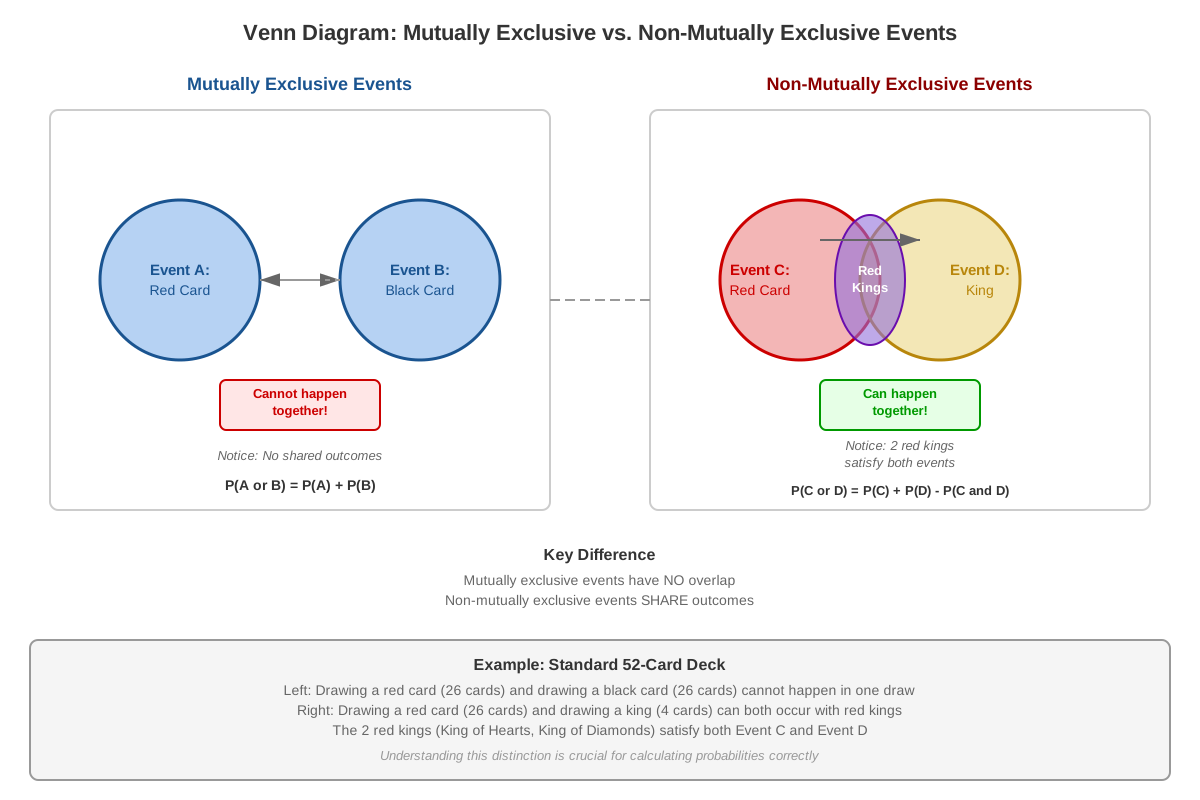
Consider rolling a standard six-sided die. The event "rolling a 2" and the event "rolling a 5" are mutually exclusive because a single die roll cannot produce both numbers simultaneously. However, the event "rolling an even number" and the event "rolling a number less than 4" are NOT mutually exclusive because the outcome "2" satisfies both conditions.
Visual Representation
When representing mutually exclusive events using Venn diagrams, the circles representing each event do not overlap. This visual separation clearly shows that no outcomes exist in both events. In contrast, non-mutually exclusive events have overlapping circles, with the overlap region representing outcomes that satisfy both conditions.
The Addition Rule for Mutually Exclusive Events
The fundamental formula for calculating the probability that at least one of two mutually exclusive events occurs is:
P(A or B) = P(A) + P(B)This simplified addition rule applies ONLY when events are mutually exclusive. The formula states that to find the probability that event A or event B occurs, simply add their individual probabilities. This works because there's no risk of double-counting outcomes—since the events cannot happen together, every outcome belongs to at most one event.
For example, when drawing one card from a standard 52-card deck:
- P(drawing a King) = 4/52
- P(drawing a Queen) = 4/52
- P(drawing a King or Queen) = 4/52 + 4/52 = 8/52 = 2/13
These events are mutually exclusive because a single card cannot be both a King and a Queen.
The General Addition Rule (Non-Mutually Exclusive Events)
When events are NOT mutually exclusive, the addition rule must account for overlap:
P(A or B) = P(A) + P(B) - P(A and B)The subtraction of P(A and B) prevents double-counting outcomes that satisfy both conditions. Understanding this distinction is crucial for SAT success, as the test frequently presents scenarios where students must determine which formula applies.
Identifying Mutually Exclusive Events
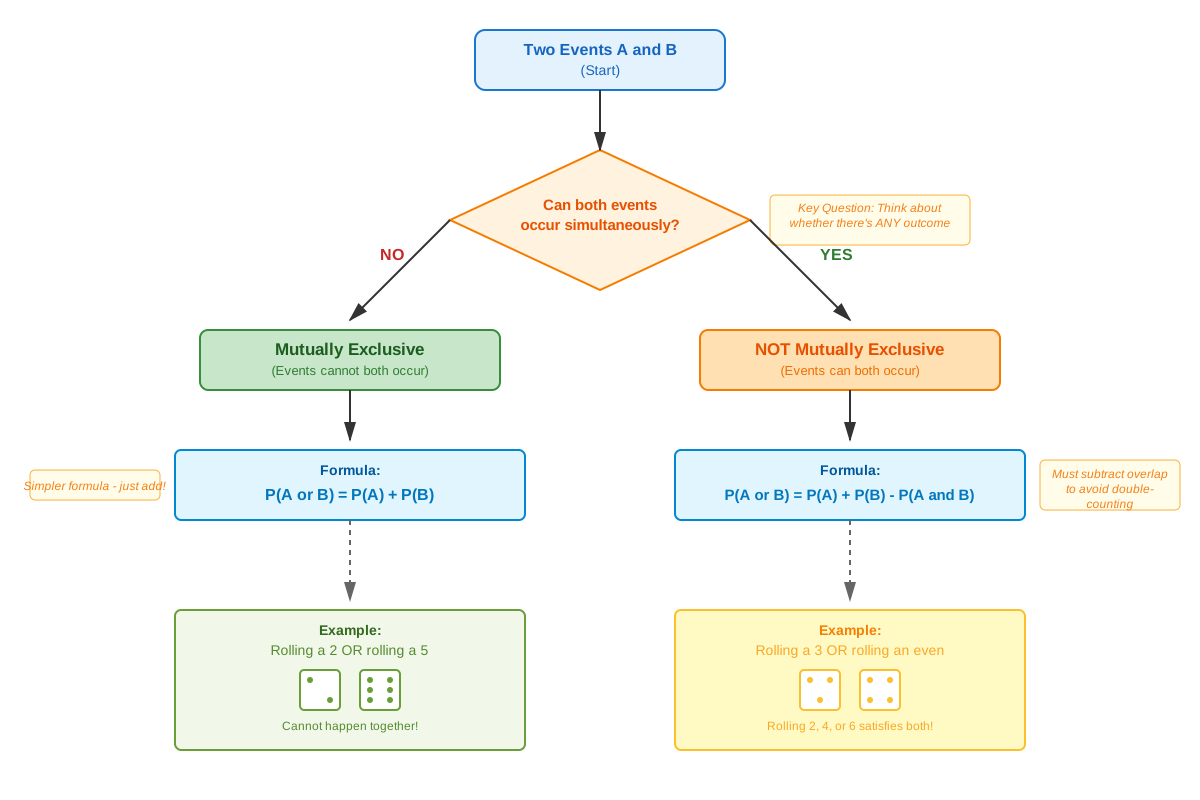
To determine whether events are mutually exclusive, ask: "Can these events happen at the same time?" If the answer is no, they are mutually exclusive. Consider these examples:
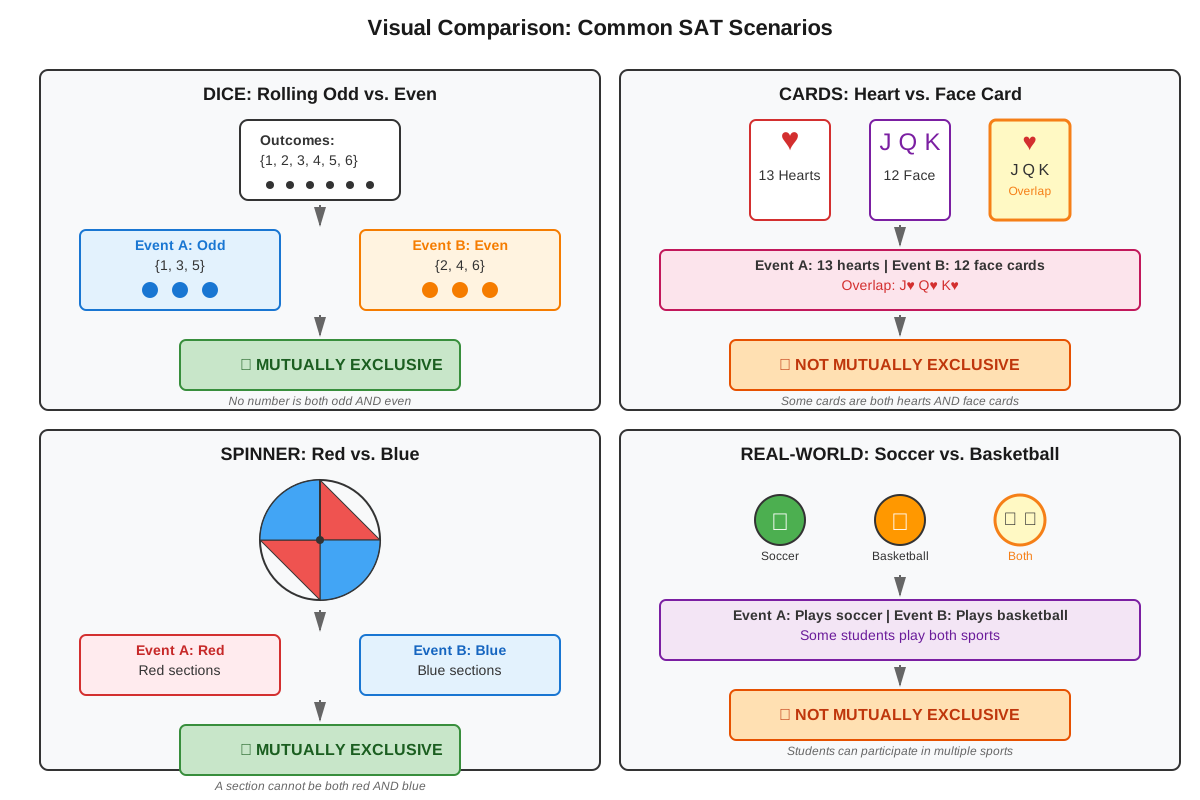
| Event Pair | Mutually Exclusive? | Explanation |
|---|---|---|
| Rolling a 3; Rolling an odd number | No | 3 is odd, so both occur together |
| Drawing a heart; Drawing a spade | Yes | A card cannot be both suits |
| Student is a sophomore; Student is a junior | Yes | A student has only one grade level |
| Student plays soccer; Student plays basketball | No | Students can play multiple sports |
| Temperature above 80°F; Temperature below 70°F | Yes | Temperature cannot satisfy both conditions |
Multiple Mutually Exclusive Events
The addition rule extends to more than two events. If events A, B, and C are all mutually exclusive (meaning no two can occur together), then:
P(A or B or C) = P(A) + P(B) + P(C)This principle applies to any number of mutually exclusive events. For instance, when rolling a die, the six possible outcomes (1, 2, 3, 4, 5, 6) are all mutually exclusive, and their probabilities sum to 1:
P(1) + P(2) + P(3) + P(4) + P(5) + P(6) = 1/6 + 1/6 + 1/6 + 1/6 + 1/6 + 1/6 = 1Complementary Events as Mutually Exclusive
Complementary events represent a special case of mutually exclusive events. An event and its complement are always mutually exclusive because they represent opposite outcomes. If A is an event, then "not A" (written as A' or Ā) is its complement. These events satisfy:
- P(A) + P(A') = 1
- P(A and A') = 0
For example, when flipping a coin, "heads" and "not heads" are complementary and mutually exclusive. This relationship proves useful for solving problems where calculating the complement is easier than calculating the event directly.
Concept Relationships
The concept of mutually exclusive events forms the foundation for understanding the addition rule of probability. When events are mutually exclusive → the simplified addition rule applies → probabilities can be added directly without adjustment. Conversely, when events are NOT mutually exclusive → the general addition rule must be used → the overlap probability must be subtracted to avoid double-counting.
Mutually exclusive events connect to prerequisite knowledge of basic probability through the fundamental principle that all probabilities in a sample space must sum to 1. This relationship becomes particularly clear when considering a complete set of mutually exclusive events that covers all possible outcomes (called a partition of the sample space). For example, the events "rolling 1," "rolling 2," "rolling 3," "rolling 4," "rolling 5," and "rolling 6" form a complete set of mutually exclusive events whose probabilities sum to 1.
The concept also relates to independent events, though these are distinct ideas that students often confuse. Two events can be independent (the occurrence of one doesn't affect the probability of the other) without being mutually exclusive. In fact, if two events are mutually exclusive and both have non-zero probability, they cannot be independent—knowing one occurred tells you the other definitely did not occur.
Understanding mutually exclusive events enables progression to more advanced topics including conditional probability, where students calculate probabilities given that certain events have or have not occurred. It also supports understanding of probability distributions, where mutually exclusive outcomes form the basis for discrete probability models.
Quick check — test yourself on Mutually exclusive events so far.
Try Flashcards →High-Yield Facts
⭐ Two events are mutually exclusive if and only if they cannot occur simultaneously; mathematically, P(A and B) = 0
⭐ For mutually exclusive events, P(A or B) = P(A) + P(B)—simply add the individual probabilities
⭐ When events are NOT mutually exclusive, you must subtract the overlap: P(A or B) = P(A) + P(B) - P(A and B)
⭐ Complementary events are always mutually exclusive, and their probabilities always sum to 1
⭐ A complete set of mutually exclusive events covering all possible outcomes has probabilities that sum to 1
- Visual test: In a Venn diagram, mutually exclusive events have no overlapping region between circles
- Multiple mutually exclusive events follow the same addition principle: just add all individual probabilities
- If two events with non-zero probability are mutually exclusive, they cannot be independent events
- The phrase "or" in probability typically signals addition, but the method depends on whether events are mutually exclusive
- Common SAT scenarios involving mutually exclusive events include: drawing cards, rolling dice, selecting from distinct categories, and analyzing survey data with non-overlapping groups
Common Misconceptions
Misconception: All "or" probability questions use simple addition of probabilities → Correction: Simple addition (P(A) + P(B)) only applies when events are mutually exclusive. When events can occur together, you must subtract the overlap probability to avoid double-counting: P(A or B) = P(A) + P(B) - P(A and B).
Misconception: If two events are independent, they must be mutually exclusive → Correction: Independence and mutual exclusivity are different concepts. Independent events can occur together (their occurrence doesn't affect each other's probability), while mutually exclusive events cannot occur together. In fact, mutually exclusive events with non-zero probabilities cannot be independent.
Misconception: Mutually exclusive events must have equal probabilities → Correction: Mutually exclusive events can have any probabilities as long as they cannot occur simultaneously. For example, when rolling a die, "rolling a 1" (probability 1/6) and "rolling an even number" (probability 3/6) are mutually exclusive despite having different probabilities.
Misconception: If events are described separately, they are automatically mutually exclusive → Correction: Events must be analyzed for logical compatibility. Just because two events are listed separately doesn't mean they cannot occur together. For example, "student takes math" and "student takes science" are separate events but not mutually exclusive since students can take both subjects.
Misconception: The probability of mutually exclusive events occurring together is undefined → Correction: The probability of mutually exclusive events occurring together is exactly zero, not undefined. This is the defining characteristic: P(A and B) = 0 for mutually exclusive events A and B.
Misconception: Complementary events and mutually exclusive events are the same thing → Correction: While all complementary events are mutually exclusive, not all mutually exclusive events are complementary. Complementary events must also cover all possible outcomes (sum to probability 1), whereas mutually exclusive events simply cannot occur together but may not cover the entire sample space.
Worked Examples
Example 1: Card Drawing Scenario
Problem: A standard 52-card deck contains 4 suits (hearts, diamonds, clubs, spades) with 13 cards each. If one card is drawn randomly, what is the probability that the card is either a heart or a club?
Solution:
Step 1: Identify the events
- Event A: Drawing a heart
- Event B: Drawing a club
Step 2: Determine if events are mutually exclusive
Ask: Can a single card be both a heart AND a club? No—each card belongs to exactly one suit. Therefore, these events are mutually exclusive.
Step 3: Calculate individual probabilities
- P(heart) = 13/52 (13 hearts in the deck)
- P(club) = 13/52 (13 clubs in the deck)
Step 4: Apply the addition rule for mutually exclusive events
Since the events are mutually exclusive:
P(heart or club) = P(heart) + P(club)
P(heart or club) = 13/52 + 13/52 = 26/52 = 1/2
Answer: The probability is 1/2 or 0.5 or 50%
Connection to Learning Objectives: This example demonstrates identifying mutually exclusive events (different suits cannot overlap) and applying the simplified addition rule, which are core SAT skills.
Example 2: Survey Data Analysis
Problem: A school survey of 200 students found that 80 students play only basketball, 60 students play only soccer, 40 students play both sports, and 20 students play neither sport. If one student is selected randomly, what is the probability that the student plays basketball or soccer?
Solution:
Step 1: Identify the events
- Event A: Student plays basketball
- Event B: Student plays soccer
Step 2: Determine if events are mutually exclusive
Ask: Can a student play both basketball AND soccer? Yes—the problem states 40 students play both sports. Therefore, these events are NOT mutually exclusive.
Step 3: Calculate individual probabilities
- Students who play basketball = 80 (only basketball) + 40 (both) = 120
- P(basketball) = 120/200
- Students who play soccer = 60 (only soccer) + 40 (both) = 100
- P(soccer) = 100/200
- Students who play both = 40
- P(both) = 40/200
Step 4: Apply the general addition rule (for non-mutually exclusive events)
P(basketball or soccer) = P(basketball) + P(soccer) - P(both)
P(basketball or soccer) = 120/200 + 100/200 - 40/200
P(basketball or soccer) = 180/200 = 9/10
Alternative approach: Count directly
Students who play at least one sport = 80 + 60 + 40 = 180
P(basketball or soccer) = 180/200 = 9/10
Answer: The probability is 9/10 or 0.9 or 90%
Connection to Learning Objectives: This example shows the critical skill of recognizing when events are NOT mutually exclusive and adjusting the calculation method accordingly—a common SAT trap.
Exam Strategy
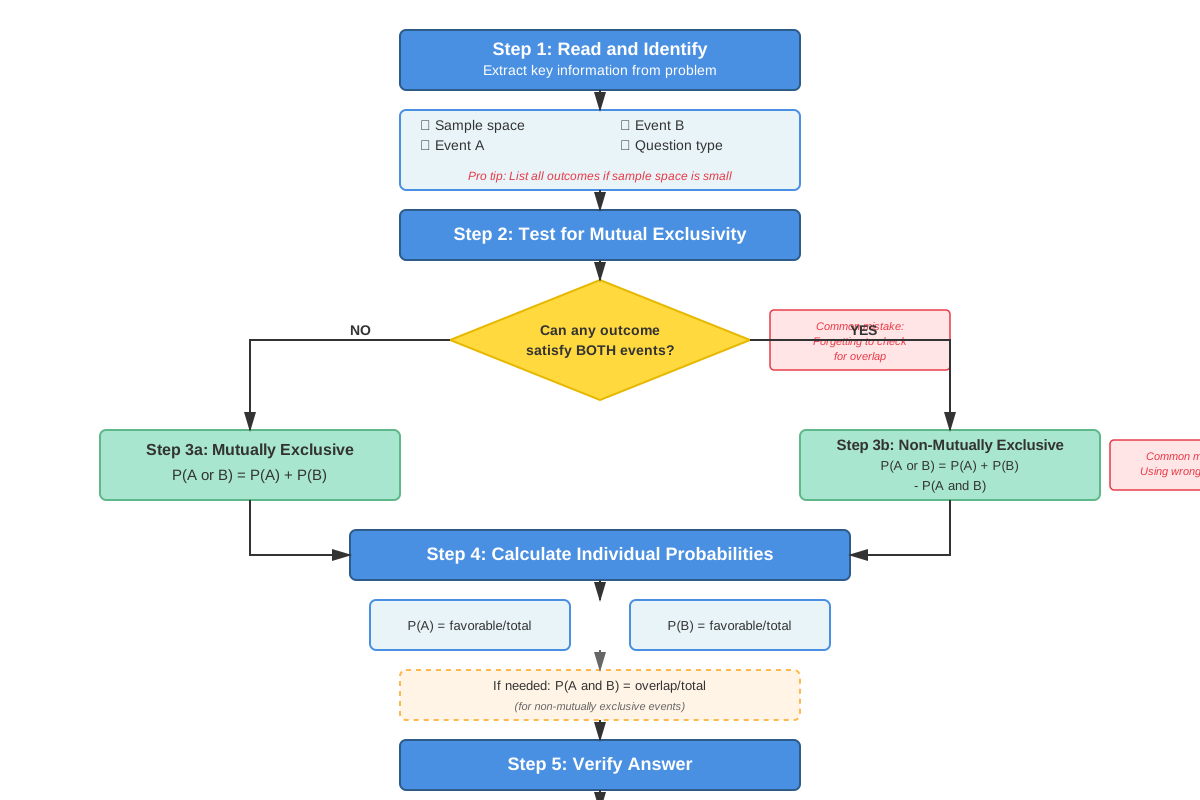
When approaching SAT questions on mutually exclusive events, follow this systematic process:
Step 1: Read carefully and identify the events
Underline or circle the specific events described in the question. SAT questions often embed multiple events within a scenario, so clear identification prevents confusion.
Step 2: Apply the mutual exclusivity test
Ask yourself: "Can these events happen at the same time?" or "Is there any outcome that satisfies both conditions?" If the answer is no, the events are mutually exclusive. If yes, they are not.
Step 3: Choose the appropriate formula
- Mutually exclusive: P(A or B) = P(A) + P(B)
- NOT mutually exclusive: P(A or B) = P(A) + P(B) - P(A and B)
Trigger words and phrases to watch for:
- "Either...or" often (but not always) suggests mutually exclusive events
- "At least one" typically signals an "or" probability calculation
- "Both" or "and" indicates intersection, which is zero for mutually exclusive events
- "Cannot occur together" explicitly states mutual exclusivity
- "Distinct categories" or "separate groups" usually indicates mutually exclusive events
- "Overlapping" or "in common" suggests events are NOT mutually exclusive
Process-of-elimination tips:
- If a question asks for P(A or B) and provides P(A) and P(B), check whether their sum exceeds 1. If it does, the events cannot be mutually exclusive (since probabilities cannot exceed 1), and you must subtract overlap.
- Answer choices that equal exactly P(A) + P(B) suggest the events are mutually exclusive
- If the problem mentions outcomes that satisfy both conditions, immediately recognize the events are NOT mutually exclusive
Time allocation advice:
Spend 15-20 seconds determining whether events are mutually exclusive before calculating. This upfront investment prevents the costly error of using the wrong formula. Most mutually exclusive event questions should take 45-90 seconds total once you've mastered the concept.
Exam Tip: When in doubt, draw a quick Venn diagram. If you can identify any outcome that belongs in both circles, the events are NOT mutually exclusive.
Memory Techniques
Mnemonic for Mutually Exclusive: "ME = Must Exclude"
The letters "ME" in Mutually Exclusive remind you that these events Must Exclude each other—they cannot happen together.
Visual Memory Aid: Picture two people who are mutually exclusive—they refuse to be in the same room together. When one enters, the other must leave. This image reinforces that mutually exclusive events cannot occur simultaneously.
Formula Memory Device: "Mutually Exclusive = Just Add"
When events are mutually exclusive, the formula is simple—just add the probabilities. No subtraction needed. If you need to subtract something, the events are NOT mutually exclusive.
The "AND Test" Acronym: ZERO
- Zero probability of both occurring
- Events cannot happen together
- Remember: no overlap
- One or the other, never both
Complementary Events Reminder: "Complements Complete"
Complementary events are mutually exclusive AND their probabilities complete the picture by summing to 1. Think of them as two puzzle pieces that fit together perfectly to form the whole (probability = 1) but never overlap.
Summary
Mutually exclusive events represent a fundamental probability concept where two or more events cannot occur simultaneously. The defining characteristic is that P(A and B) = 0, meaning there is zero probability of both events happening together. When calculating the probability that at least one of several mutually exclusive events occurs, use the simplified addition rule: P(A or B) = P(A) + P(B). This contrasts with non-mutually exclusive events, which require subtracting the overlap probability to avoid double-counting. On the SAT, success with this topic requires the ability to identify whether events can occur together by analyzing the logical relationship between outcomes, selecting the appropriate probability formula based on this determination, and executing calculations accurately. The concept appears frequently in SAT math questions involving cards, dice, surveys, and categorical data. Mastering mutually exclusive events provides the foundation for more advanced probability topics and represents a high-yield area where focused study directly translates to points on test day.
Key Takeaways
- Mutually exclusive events cannot occur at the same time; their intersection has zero probability
- For mutually exclusive events, simply add probabilities: P(A or B) = P(A) + P(B)
- Always test whether events can occur together before choosing a formula—this is the most critical step
- When events are NOT mutually exclusive, subtract the overlap: P(A or B) = P(A) + P(B) - P(A and B)
- Complementary events are always mutually exclusive and their probabilities sum to 1
- Visual tools like Venn diagrams help identify whether events overlap (not mutually exclusive) or remain separate (mutually exclusive)
- SAT questions frequently test the distinction between mutually exclusive and non-mutually exclusive events as a trap for unprepared students
Related Topics
Independent Events: While mutually exclusive events cannot occur together, independent events are those where the occurrence of one does not affect the probability of the other. Understanding the distinction between these concepts prevents common confusion and enables solving more complex probability problems.
Conditional Probability: This topic builds on mutually exclusive events by examining probabilities when given information about whether certain events have occurred. Knowing that mutually exclusive events cannot both happen informs conditional probability calculations.
Probability Distributions: Mutually exclusive outcomes form the basis for discrete probability distributions, where each possible outcome represents a mutually exclusive event and all probabilities sum to 1.
Venn Diagrams and Set Theory: Visual representation of mutually exclusive events through Venn diagrams connects probability to set theory, reinforcing understanding through multiple representations.
Compound Probability: Mastering mutually exclusive events enables tackling multi-step probability problems where students must determine relationships between multiple events and apply appropriate rules in sequence.
Practice CTA
Now that you've mastered the core concepts of mutually exclusive events, it's time to solidify your understanding through active practice. Attempt the practice questions to test your ability to identify mutually exclusive events in various contexts and apply the correct probability formulas. Use the flashcards to reinforce key definitions and formulas until they become automatic. Remember, the difference between knowing this concept and scoring points on the SAT lies in repeated application. Each practice problem you solve strengthens your pattern recognition and builds the confidence you need to tackle any mutually exclusive events question on test day. You've invested the time to learn—now invest the time to practice and watch your accuracy soar!
Sign up free to keep reading
Create a free AnvayaPrep account to finish this SAT guide on Mutually exclusive events — plus flashcards and practice questions.