Overview
Permutations basics form a critical component of the math section on the SAT, particularly within probability and counting problems. A permutation represents an arrangement of objects where the order matters—for instance, the sequence ABC is different from BAC. Understanding permutations enables students to solve complex counting problems efficiently, avoiding the time-consuming and error-prone method of listing all possibilities. This topic bridges fundamental counting principles with more advanced probability concepts, making it essential for achieving competitive scores on the SAT.
The SAT frequently tests permutations through questions involving arrangements, rankings, seating orders, and sequential selections. These problems typically appear 1-3 times per test and often combine permutation concepts with other mathematical principles like probability or combinations. Students who master sat permutations basics gain a significant advantage because these questions, while appearing complex, follow predictable patterns that can be solved quickly using systematic formulas and reasoning.
Permutations connect directly to the broader mathematical framework of combinatorics and probability. They serve as building blocks for understanding combinations (where order doesn't matter), probability calculations involving ordered outcomes, and the fundamental counting principle. Strong permutation skills also enhance logical reasoning abilities that transfer to other SAT math topics, including functions, sequences, and data analysis. The systematic thinking required for permutation problems develops problem-solving strategies applicable across the entire mathematics section.
Learning Objectives
- [ ] Identify key features of Permutations basics
- [ ] Explain how Permutations basics appears on the SAT
- [ ] Apply Permutations basics to answer SAT-style questions
- [ ] Calculate permutations using factorial notation and the permutation formula
- [ ] Distinguish between situations requiring permutations versus other counting methods
- [ ] Solve multi-step permutation problems involving restrictions or special conditions
- [ ] Recognize and handle permutations with repeated elements
Prerequisites
- Basic multiplication and division: Required for computing factorial expressions and simplifying permutation formulas
- Exponent rules: Necessary for understanding factorial notation and simplifying complex permutation expressions
- Fundamental counting principle: Forms the conceptual foundation for why permutation formulas work
- Order of operations: Essential for correctly evaluating permutation expressions with multiple operations
- Basic probability concepts: Helps contextualize permutation problems within probability questions
Why This Topic Matters
Permutations appear in numerous real-world contexts that make them both practical and testable. Event planning requires determining seating arrangements; computer science uses permutations for password security analysis; genetics applies permutation concepts to DNA sequencing; and sports leagues use them for scheduling and ranking. These applications demonstrate why the SAT includes permutation questions—they assess mathematical reasoning skills directly applicable to college-level work and professional problem-solving.
On the SAT, permutation questions typically appear 1-3 times per administration, representing approximately 2-5% of the math section. These problems most commonly appear as multiple-choice questions in both the calculator and no-calculator portions, though they occasionally surface as grid-in questions. The point value remains consistent with other math questions, but permutation problems often serve as medium-to-hard difficulty questions that help differentiate high-scoring students from average performers.
The SAT presents permutation concepts through various question formats: direct arrangement problems ("How many ways can 5 books be arranged on a shelf?"), conditional permutations with restrictions ("How many 4-digit codes can be formed using digits 1-9 without repetition?"), and probability questions requiring permutation calculations as intermediate steps. Questions may involve arranging people, objects, letters, or digits, and frequently include real-world contexts like committee formations, race rankings, or password creation. Recognizing these patterns enables rapid problem identification and solution strategy selection.
Core Concepts
The Fundamental Definition of Permutations
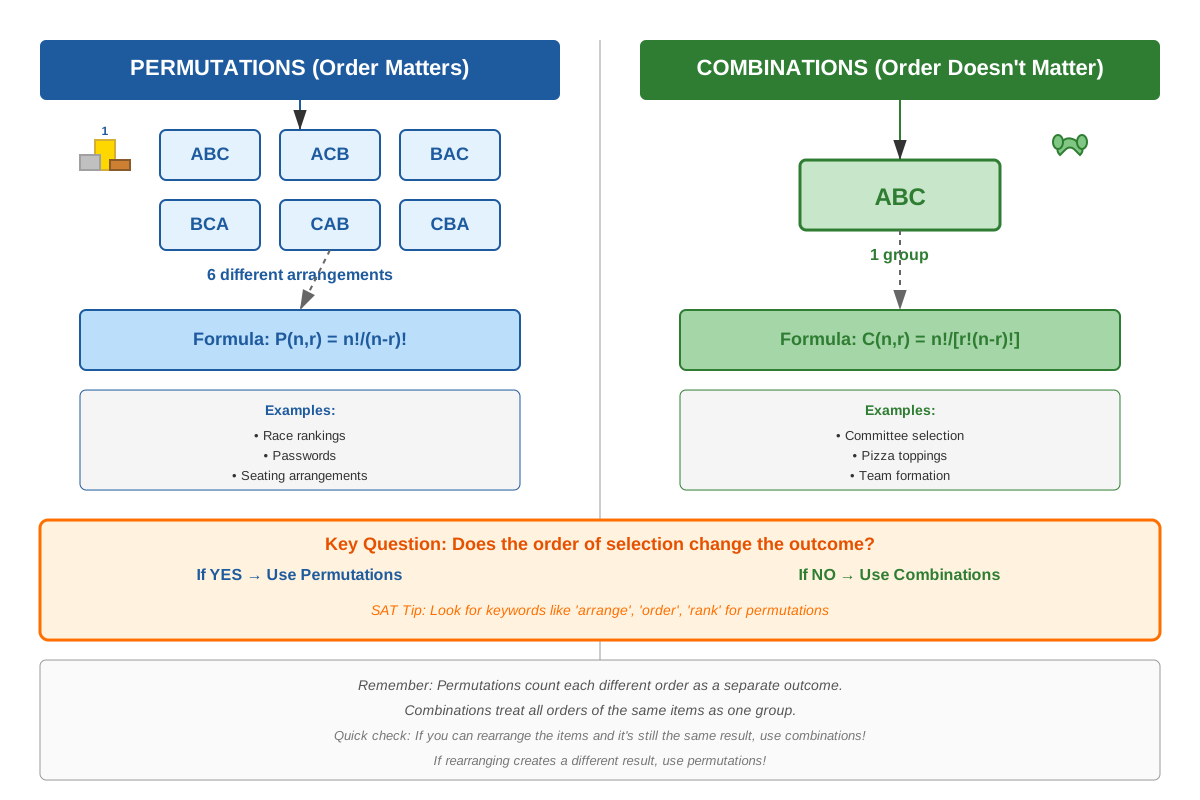
A permutation is an ordered arrangement of objects selected from a set. The critical distinguishing feature is that order matters—changing the sequence creates a different permutation. For example, if selecting 2 letters from {A, B, C}, the permutations AB and BA are distinct arrangements. This contrasts with combinations, where AB and BA would be considered identical because only the selection matters, not the sequence.
The notation n! (read as "n factorial") represents the product of all positive integers from 1 to n. For example:
- 5! = 5 × 4 × 3 × 2 × 1 = 120
- 3! = 3 × 2 × 1 = 6
- 1! = 1
- 0! = 1 (by mathematical convention)
Factorial notation provides the foundation for all permutation calculations because it represents the total number of ways to arrange n distinct objects.
Permutations of n Objects
When arranging all n objects from a set, the number of possible permutations equals n!. This follows from the fundamental counting principle: for the first position, there are n choices; for the second position, n-1 remaining choices; for the third position, n-2 choices, and so forth. Multiplying these choices together yields n × (n-1) × (n-2) × ... × 2 × 1 = n!.
Example: How many ways can 4 different books be arranged on a shelf?
- Solution: 4! = 4 × 3 × 2 × 1 = 24 ways
This concept appears frequently on the SAT when questions ask about total arrangements without restrictions.
Permutations of r Objects from n Objects
Often, problems require selecting and arranging only some objects from a larger set. The formula for permutations of r objects chosen from n objects is:
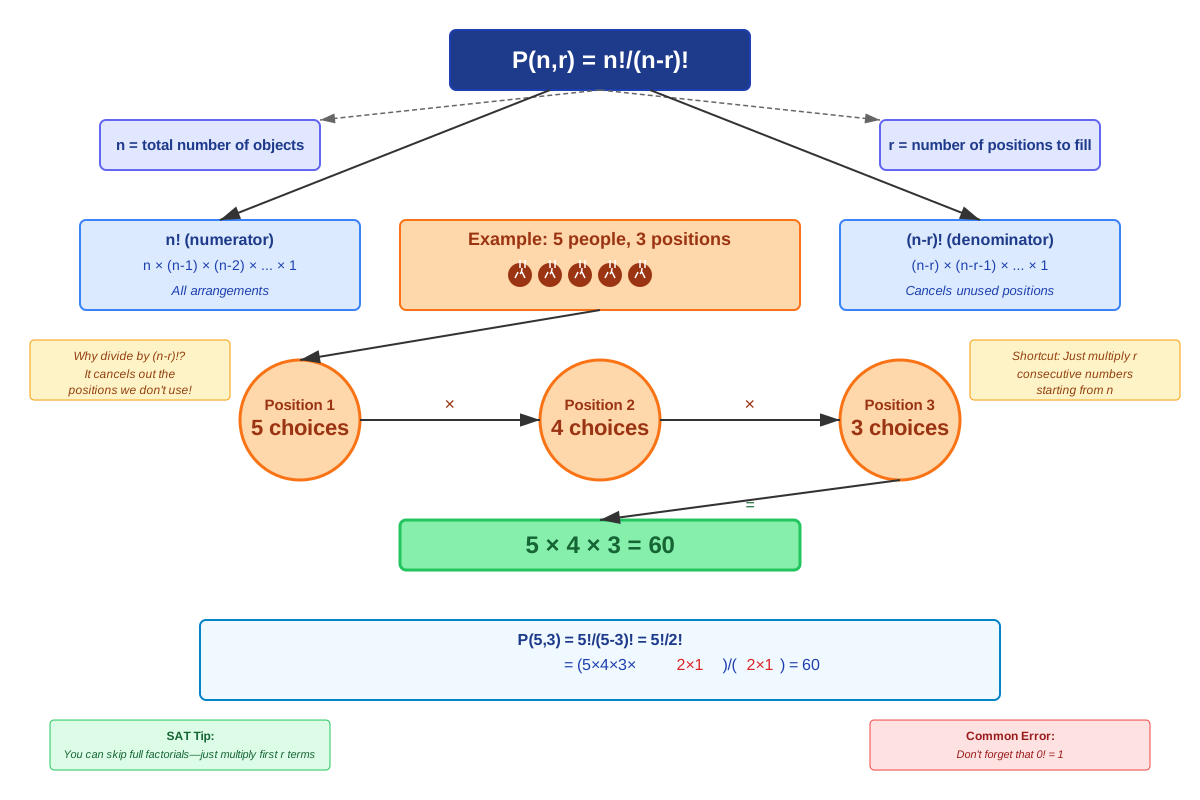
P(n,r) = n!/(n-r)!Alternative notations include nPr or ₙPᵣ. This formula calculates the number of ways to select r objects from n objects and arrange them in order.
Reasoning behind the formula: When selecting r objects from n objects:
- First position: n choices
- Second position: n-1 choices
- Third position: n-2 choices
- Continue for r positions: (n-r+1) choices for the rth position
Multiplying these gives: n × (n-1) × (n-2) × ... × (n-r+1)
This product equals n!/(n-r)! because dividing n! by (n-r)! cancels all terms from (n-r) down to 1, leaving only the terms from n down to (n-r+1).
Example: How many 3-letter "words" (arrangements) can be formed from the letters A, B, C, D, E without repetition?
- Solution: P(5,3) = 5!/(5-3)! = 5!/2! = (5 × 4 × 3 × 2 × 1)/(2 × 1) = 120/2 = 60
Permutations with Restrictions
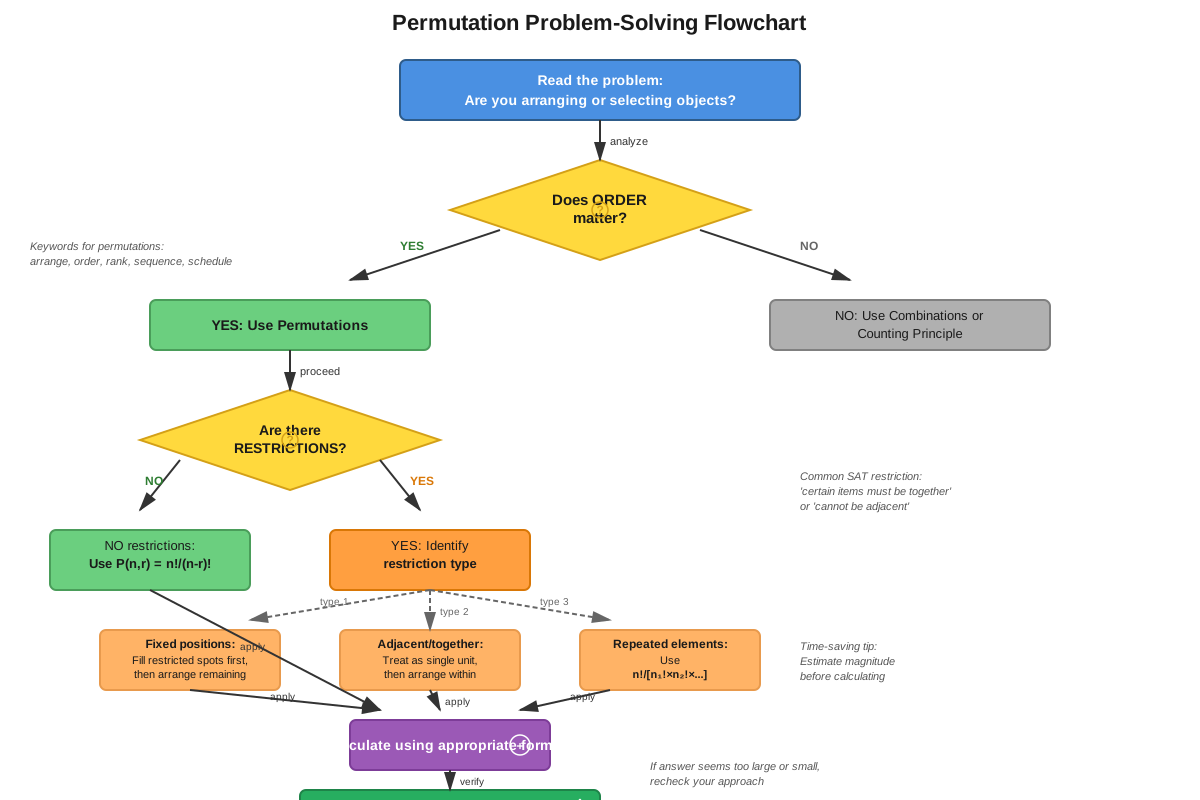
SAT questions frequently include restrictions that limit which arrangements are valid. Common restriction types include:
Fixed position restrictions: Certain objects must occupy specific positions.
- Strategy: Place the restricted objects first, then arrange the remaining objects in the remaining positions.
Adjacent or non-adjacent restrictions: Certain objects must be (or cannot be) next to each other.
- Strategy for "must be adjacent": Treat the objects that must be together as a single unit, arrange the units, then arrange objects within each unit.
- Strategy for "cannot be adjacent": Use complementary counting (total arrangements minus arrangements where they are adjacent).
Starting or ending restrictions: Arrangements must begin or end with specific objects.
- Strategy: Fill the restricted position(s) first, then arrange remaining objects in remaining positions.
Distinguishing Permutations from Combinations
| Feature | Permutations | Combinations |
|---|---|---|
| Order matters? | Yes | No |
| Formula | P(n,r) = n!/(n-r)! | C(n,r) = n!/[r!(n-r)!] |
| Example context | Race rankings, passwords, seating arrangements | Team selection, committee formation, choosing items |
| Relative size | P(n,r) ≥ C(n,r) | Smaller value |
Key distinction: If rearranging the selected objects creates a different outcome, use permutations. If only the selection matters regardless of order, use combinations.
Permutations with Repetition
When objects can be repeated (used multiple times), the calculation changes. If selecting r objects from n objects with replacement (repetition allowed), the number of permutations is:
n^rThis follows because each of the r positions has n independent choices.
Example: How many 4-digit PIN codes can be formed using digits 0-9 with repetition allowed?
- Solution: 10⁴ = 10,000 codes
Permutations of Objects with Identical Elements
When some objects in a set are identical, the permutation formula must account for overcounting. The formula for permutations of n objects where there are n₁ identical objects of type 1, n₂ identical objects of type 2, etc., is:
n!/(n₁! × n₂! × ... × nₖ!)Example: How many distinct arrangements exist for the letters in MISSISSIPPI?
- Total letters: 11
- I appears 4 times, S appears 4 times, P appears 2 times, M appears 1 time
- Solution: 11!/(4! × 4! × 2! × 1!) = 34,650
Concept Relationships
The fundamental counting principle serves as the conceptual foundation for all permutation formulas. This principle states that if one event can occur in m ways and a second independent event can occur in n ways, then both events together can occur in m × n ways. Permutations extend this principle to multiple sequential selections where each choice affects subsequent options.
Relationship flow: Fundamental Counting Principle → Factorial Notation → Basic Permutations (n!) → Partial Permutations P(n,r) → Restricted Permutations → Permutations with Repetition
Permutations connect directly to combinations through the relationship: P(n,r) = C(n,r) × r!. This equation shows that permutations equal combinations multiplied by the arrangements of the selected objects. Understanding this relationship helps students choose the correct approach when facing ambiguous problems.
Within probability problems, permutations often appear in the numerator or denominator when calculating probabilities of ordered outcomes. For example, finding the probability that three specific people finish first, second, and third in a race requires permutation calculations. This connects permutations to the broader probability unit and demonstrates their role as a computational tool within larger problem-solving frameworks.
Restricted permutations build upon basic permutations by adding logical constraints. These problems require combining permutation formulas with strategic reasoning about which objects to place first. This connection develops higher-order thinking skills that transfer to other SAT math topics requiring multi-step logical reasoning.
Quick check — test yourself on Permutations basics so far.
Try Flashcards →High-Yield Facts
⭐ The number of ways to arrange n distinct objects is n!
⭐ The permutation formula P(n,r) = n!/(n-r)! calculates arrangements of r objects selected from n objects
⭐ Order matters in permutations; changing the sequence creates a different permutation
⭐ When objects can repeat, the number of r-length arrangements from n objects is n^r
⭐ For permutations with restrictions, place restricted objects first, then arrange the remaining objects
- 0! equals 1 by mathematical definition, which is essential for formulas when r = n
- P(n,n) = n! because selecting all objects means (n-n)! = 0! = 1 in the denominator
- Permutations always yield larger or equal values compared to combinations for the same n and r
- Adjacent restriction problems often use the "treat as one unit" strategy
- Complementary counting (total minus unwanted) efficiently solves "cannot be adjacent" problems
- Permutations with identical elements divide by the factorial of each group of identical objects
- The SAT never requires calculating factorials larger than 10! without a calculator
- Grid-in permutation answers typically result from small values of n and r (usually n ≤ 10)
- Most SAT permutation questions can be solved in under 2 minutes with proper formula recognition
- Calculator functions for permutations (nPr) are allowed and recommended on calculator-permitted sections
Common Misconceptions
Misconception: Permutations and combinations are interchangeable terms for counting arrangements.
Correction: Permutations count ordered arrangements where sequence matters (ABC ≠ BAC), while combinations count selections where order doesn't matter (ABC = BAC). Use permutations for rankings, passwords, and seating orders; use combinations for team selection and choosing items.
Misconception: P(n,r) = n!/r! is the correct permutation formula.
Correction: The correct formula is P(n,r) = n!/(n-r)!. The denominator is (n-r)!, not r!. This error confuses the permutation formula with the combination formula C(n,r) = n!/[r!(n-r)!].
Misconception: When objects can repeat, use the same formula as when they cannot repeat.
Correction: Repetition fundamentally changes the calculation. Without repetition, use P(n,r) = n!/(n-r)!. With repetition allowed, use n^r because each position has n independent choices regardless of previous selections.
Misconception: 0! = 0 because multiplying by zero gives zero.
Correction: By mathematical definition, 0! = 1. This convention ensures formulas work correctly when r = n, giving P(n,n) = n!/0! = n!/1 = n!, which correctly represents arranging all n objects.
Misconception: For "must be adjacent" problems, simply multiply the number of adjacent pairs by the arrangements of other objects.
Correction: Treat adjacent objects as a single unit, calculate arrangements of all units, then multiply by arrangements within each unit. For example, if A and B must be adjacent among {A,B,C,D}, treat AB as one unit: 3! arrangements of {AB,C,D} × 2! arrangements within AB = 12 total arrangements.
Misconception: Larger values of n and r always produce larger permutation values.
Correction: While P(n,r) increases with n, it doesn't always increase with r for fixed n. For example, P(5,5) = 120 but P(5,3) = 60. However, P(10,3) = 720 > P(5,3) = 60, showing n has a stronger effect than r.
Misconception: All permutation problems on the SAT require using the permutation formula.
Correction: Some problems are more efficiently solved using the fundamental counting principle directly. For example, "How many 3-digit numbers can be formed using digits 1-5 without repetition?" is quickly solved as 5 × 4 × 3 = 60 without writing the formula P(5,3).
Worked Examples
Example 1: Basic Permutation with Restrictions
Problem: A student council has 8 members. In how many ways can a president, vice president, and secretary be chosen if no person can hold more than one position?
Solution:
Step 1: Identify the problem type. This is a permutation problem because:
- We're selecting 3 people from 8 people
- Order matters (president ≠ vice president ≠ secretary)
- No repetition (one person cannot hold multiple positions)
Step 2: Identify n and r.
- n = 8 (total members)
- r = 3 (positions to fill)
Step 3: Apply the permutation formula.
P(8,3) = 8!/(8-3)! = 8!/5!
Step 4: Calculate.
P(8,3) = (8 × 7 × 6 × 5!)/(5!)
P(8,3) = 8 × 7 × 6 = 336
Alternative approach using fundamental counting principle:
- President position: 8 choices
- Vice president position: 7 remaining choices
- Secretary position: 6 remaining choices
- Total: 8 × 7 × 6 = 336
Answer: 336 ways
Connection to learning objectives: This example demonstrates applying permutations to SAT-style questions and identifying key features (order matters, no repetition).
Example 2: Permutation with Multiple Restrictions
Problem: Five people (A, B, C, D, E) are standing in a line for a photo. How many arrangements are possible if person A must be at one end (either first or last) and persons B and C must stand next to each other?
Solution:
Step 1: Break down the restrictions.
- Restriction 1: A must be first OR last
- Restriction 2: B and C must be adjacent
Step 2: Handle the "must be adjacent" restriction.
Treat B and C as a single unit [BC]. Now we have 4 units to arrange: A, [BC], D, E
Step 3: Handle the "A at an end" restriction.
- Case 1: A is first
- Remaining 3 units {[BC], D, E} can be arranged in the remaining 4 positions
- But A must be first, so arrange 3 units in 3 positions: 3! = 6 ways
- Case 2: A is last
- Similarly, arrange 3 units {[BC], D, E} in the first 3 positions: 3! = 6 ways
Step 4: Account for arrangements within the [BC] unit.
B and C can be arranged as BC or CB: 2! = 2 ways
Step 5: Apply the multiplication principle.
- Case 1 (A first): 3! × 2! = 6 × 2 = 12 arrangements
- Case 2 (A last): 3! × 2! = 6 × 2 = 12 arrangements
- Total: 12 + 12 = 24 arrangements
Answer: 24 arrangements
Connection to learning objectives: This example demonstrates solving multi-step permutation problems with restrictions, a key skill for high-difficulty SAT questions.
Exam Strategy
Recognition triggers: Watch for these keywords and phrases that signal permutation problems:
- "How many ways to arrange..."
- "How many different orders..."
- "How many sequences..."
- "Rankings," "positions," "first, second, third"
- "Without repetition" or "without replacement"
- "Distinct arrangements"
Systematic approach for SAT permutation questions:
- Determine if order matters (2-3 seconds): Ask "Does rearranging create a different outcome?" If yes, use permutations; if no, consider combinations.
- Identify restrictions (5-10 seconds): Note any constraints like fixed positions, adjacency requirements, or starting/ending conditions.
- Choose your method (2-3 seconds):
- Simple problems: Use fundamental counting principle (multiply choices)
- Standard problems: Use P(n,r) formula
- Complex restrictions: Use strategic placement or complementary counting
- Calculate efficiently (30-60 seconds): Use calculator nPr function when available; simplify factorials before multiplying.
- Verify reasonableness (5 seconds): Check if your answer makes logical sense given the problem constraints.
Process of elimination tips:
- Eliminate answers larger than n! when arranging n objects
- Eliminate answers that don't account for restrictions (usually the largest option)
- For "with repetition" problems, eliminate answers using factorial notation
- If two answer choices differ by a factor of r!, one likely confuses permutations with combinations
Time allocation: Budget 1-2 minutes for straightforward permutation problems and 2-3 minutes for problems with multiple restrictions. If a problem requires more than 3 minutes, mark it and return later.
Calculator usage: On calculator-permitted sections, use the nPr function to avoid arithmetic errors. Access this through the MATH → PRB menu on most calculators. However, understand the underlying concept—don't rely solely on calculator functions without comprehension.
Memory Techniques
Permutation vs. Combination mnemonic: "P for Position matters, C for Choosing only"
- Permutation: Position/order is important
- Combination: Just Choosing, order doesn't matter
Formula memory device: "Permutation formula: n! over (n minus r)!"
Visualize: P(n,r) = n!/(n-r)! as "start with all arrangements (n!), then divide out what you didn't use (n-r)!"
Factorial visualization: Picture factorial as a "countdown multiplication"
- 5! = 5 → 4 → 3 → 2 → 1 (multiply all the way down)
- This mental image helps when simplifying expressions like 8!/5! = 8 × 7 × 6
Restriction strategy acronym: FIRST
- Fix restricted positions first
- Identify remaining objects
- Rearrange remaining objects
- Separate cases if needed (OR situations)
- Total by multiplying (AND situations) or adding (OR situations)
Adjacent objects technique: "Bundle and Arrange"
- Bundle objects that must be together into a single unit
- Arrange the units
- Arrange within each bundle
- Multiply the results
Repetition reminder: "Repeat means Power"
- When repetition is allowed, use n^r (n to the power of r)
- No repetition = use permutation formula with factorials
Summary
Permutations basics represent ordered arrangements where sequence matters, forming an essential component of SAT math probability and counting problems. The fundamental formula P(n,r) = n!/(n-r)! calculates the number of ways to select and arrange r objects from n objects without repetition, while n^r handles cases with repetition allowed. Success on SAT permutation questions requires recognizing when order matters (distinguishing permutations from combinations), applying appropriate formulas efficiently, and handling restrictions through strategic placement or complementary counting. The key to mastery lies in understanding the underlying logic—each position has a certain number of choices, and these choices multiply together—rather than memorizing formulas blindly. Students must practice identifying trigger words, selecting efficient solution methods, and verifying answers for reasonableness. With systematic practice, permutation problems transform from intimidating challenges into reliable point opportunities, as they follow predictable patterns and reward methodical thinking.
Key Takeaways
- Permutations count ordered arrangements where changing the sequence creates a different outcome (ABC ≠ BAC)
- The formula P(n,r) = n!/(n-r)! calculates arrangements of r objects selected from n objects without repetition
- When repetition is allowed, use n^r instead of the permutation formula
- For restriction problems, place restricted objects first, then arrange remaining objects in remaining positions
- Distinguish permutations from combinations by asking: "Does rearranging the selected objects create a different outcome?"
- Use the fundamental counting principle (multiply choices for each position) for straightforward problems to save time
- Adjacent restriction problems use the "treat as one unit" strategy: bundle, arrange units, arrange within units, then multiply
Related Topics
Combinations: After mastering permutations, study combinations where order doesn't matter. Understanding the relationship C(n,r) = P(n,r)/r! connects these concepts and enables solving complex selection problems.
Probability with Permutations: Many probability questions require permutation calculations as intermediate steps. Mastering permutations enables calculating probabilities of ordered outcomes like specific race finishes or card sequences.
Fundamental Counting Principle: This broader principle underlies all permutation formulas. Deeper study reveals how to solve complex multi-stage counting problems beyond standard permutation scenarios.
Binomial Theorem: Advanced applications connect permutations and combinations to algebraic expansions, appearing occasionally on the most challenging SAT questions.
Conditional Probability: Some SAT problems combine permutations with conditional probability, requiring sequential application of both concepts.
Practice CTA
Now that you've mastered the core concepts of permutations basics, reinforce your understanding by attempting the practice questions and reviewing the flashcards. These resources provide targeted SAT-style problems that mirror actual test conditions, helping you build speed and accuracy. Remember, permutation problems reward systematic thinking and formula recognition—skills that improve dramatically with focused practice. Each problem you solve strengthens your pattern recognition and builds confidence for test day. Start practicing now to transform permutations from a challenging topic into a reliable source of points on the SAT!
Sign up free to keep reading
Create a free AnvayaPrep account to finish this SAT guide on Permutations basics — plus flashcards and practice questions.