Overview
Two-way table probability is a fundamental statistical concept that appears consistently on the SAT math section, typically in 1-3 questions per test. These tables organize data into rows and columns based on two categorical variables, allowing test-takers to calculate probabilities, conditional probabilities, and analyze relationships between variables. Mastering this topic is essential because it combines data interpretation skills with probability calculations—two high-yield areas that the College Board emphasizes in the Problem Solving and Data Analysis domain.
On the SAT, two-way tables (also called contingency tables or cross-tabulation tables) present real-world scenarios involving surveys, experiments, or observational studies. Students must extract information from these tables to answer questions about likelihood, conditional relationships, and proportions. The beauty of sat two-way table probability questions lies in their predictability: once you understand the structure and calculation methods, these become some of the most reliable points on the exam.
This topic connects directly to broader mathematical concepts including fractions, ratios, percentages, and basic probability theory. It also reinforces critical thinking skills needed for data analysis questions throughout the SAT. Understanding two-way tables provides a foundation for more advanced statistical concepts and serves as a practical tool for interpreting research findings, survey results, and demographic data—skills valuable far beyond standardized testing.
Learning Objectives
- [ ] Identify key features of two-way table probability
- [ ] Explain how two-way table probability appears on the SAT
- [ ] Apply two-way table probability to answer SAT-style questions
- [ ] Calculate marginal probabilities from row and column totals
- [ ] Determine conditional probabilities given specific constraints
- [ ] Distinguish between joint probability and conditional probability in table contexts
- [ ] Analyze independence of events using two-way table data
Prerequisites
- Basic probability concepts: Understanding that probability equals favorable outcomes divided by total outcomes is essential for all two-way table calculations
- Fractions and percentages: Two-way table problems require converting between fractions, decimals, and percentages fluently
- Reading tables and charts: Ability to extract numerical information from organized data displays forms the foundation of interpretation
- Basic arithmetic operations: Addition, subtraction, multiplication, and division are used constantly when working with table values
Why This Topic Matters
Two-way tables represent one of the most practical applications of probability in everyday life. Medical researchers use them to analyze treatment effectiveness, businesses employ them to understand customer preferences, and social scientists rely on them to study demographic patterns. The ability to read and interpret these tables is a fundamental data literacy skill in our information-rich world.
On the SAT, two-way table probability questions appear with remarkable consistency. Approximately 2-3 questions per test involve these tables, accounting for roughly 3-5% of the total math score. These questions typically appear in both the calculator and no-calculator sections, with difficulty ranging from medium to medium-hard. The College Board favors these questions because they efficiently test multiple skills: data interpretation, probability calculation, logical reasoning, and attention to detail.
Common SAT presentations include survey results (e.g., student preferences by grade level), experimental outcomes (e.g., treatment success by age group), demographic data (e.g., employment status by education level), and quality control scenarios (e.g., defective products by manufacturing plant). Questions may ask for simple probabilities, conditional probabilities, or require students to identify whether events are independent. The tables themselves range from simple 2×2 grids to more complex 3×4 or 4×3 arrangements, though the underlying principles remain constant.
Core Concepts
Structure of Two-Way Tables
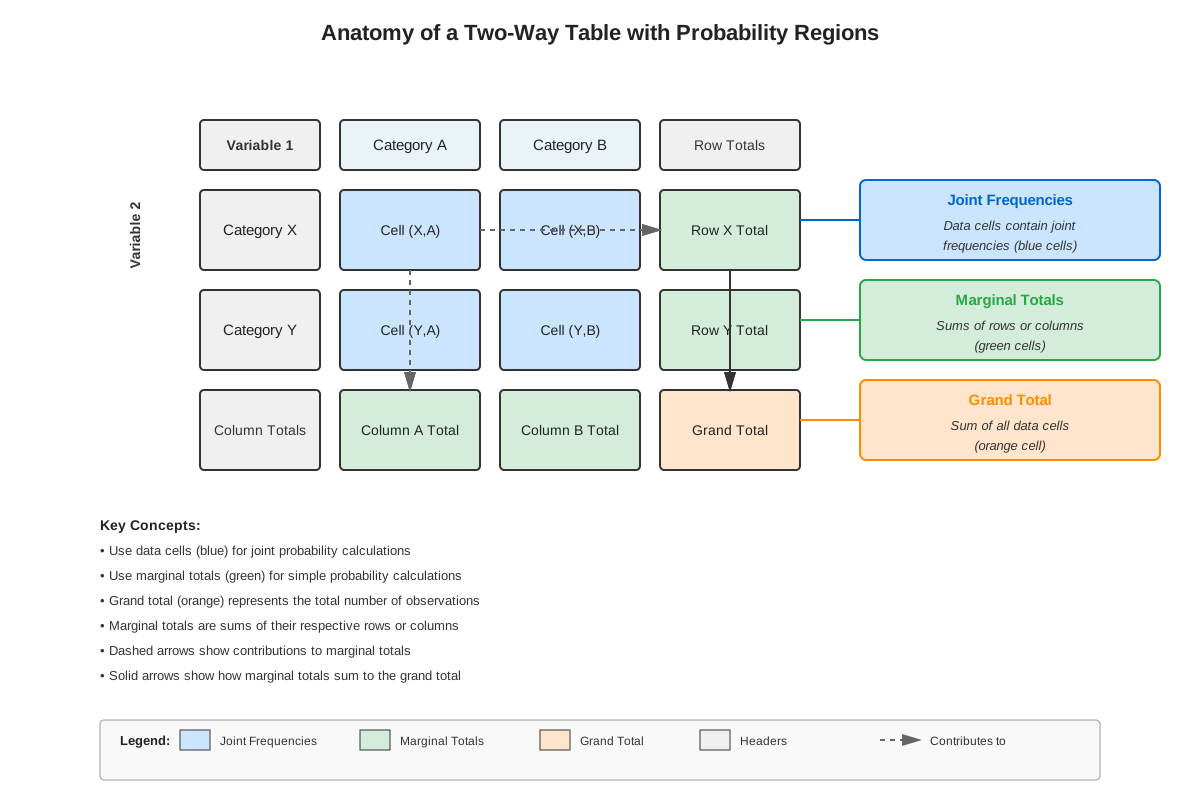
A two-way table organizes data based on two categorical variables, with one variable defining the rows and another defining the columns. Each cell in the interior of the table represents the count or frequency of observations that fall into both categories simultaneously. The rightmost column typically shows row totals (called marginal totals), the bottom row shows column totals, and the bottom-right cell displays the grand total of all observations.
Consider this basic structure:
| Category B1 | Category B2 | Row Total | |
|---|---|---|---|
| Category A1 | Cell (A1,B1) | Cell (A1,B2) | Total A1 |
| Category A2 | Cell (A2,B1) | Cell (A2,B2) | Total A2 |
| Column Total | Total B1 | Total B2 | Grand Total |
Each interior cell represents a joint frequency—the number of observations that satisfy both row and column conditions. The marginal totals represent the frequency of each individual category, regardless of the other variable.
Basic Probability from Two-Way Tables
The fundamental probability formula applies directly to two-way tables:
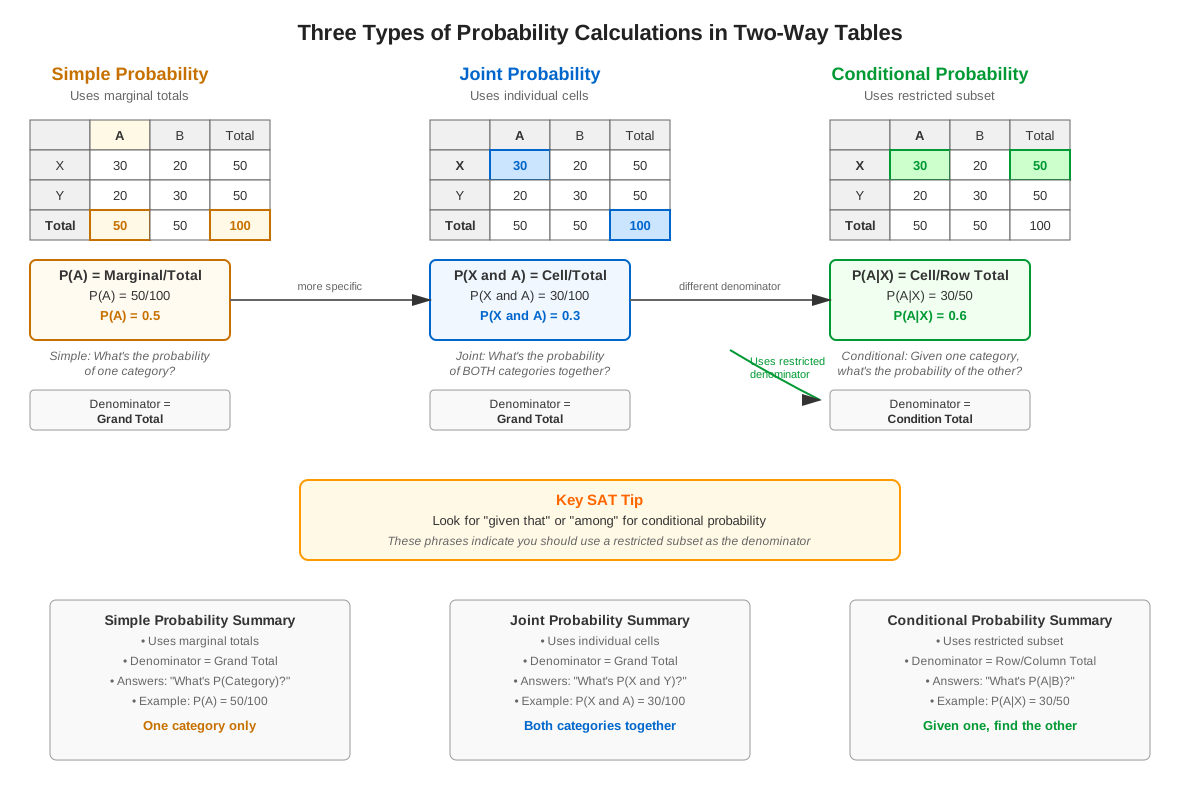
P(Event) = Number of favorable outcomes / Total number of outcomesWhen calculating probability from a two-way table, the denominator is typically the grand total (bottom-right cell), while the numerator is the specific cell or sum of cells that satisfy the event condition. For example, if a table shows 45 students who prefer pizza out of 200 total students surveyed, the probability of randomly selecting a pizza-preferring student is 45/200 = 0.225 or 22.5%.
Conditional Probability
Conditional probability represents the likelihood of an event occurring given that another event has already occurred. This is where two-way tables become particularly powerful and where SAT questions frequently focus. The notation P(A|B) reads as "the probability of A given B."
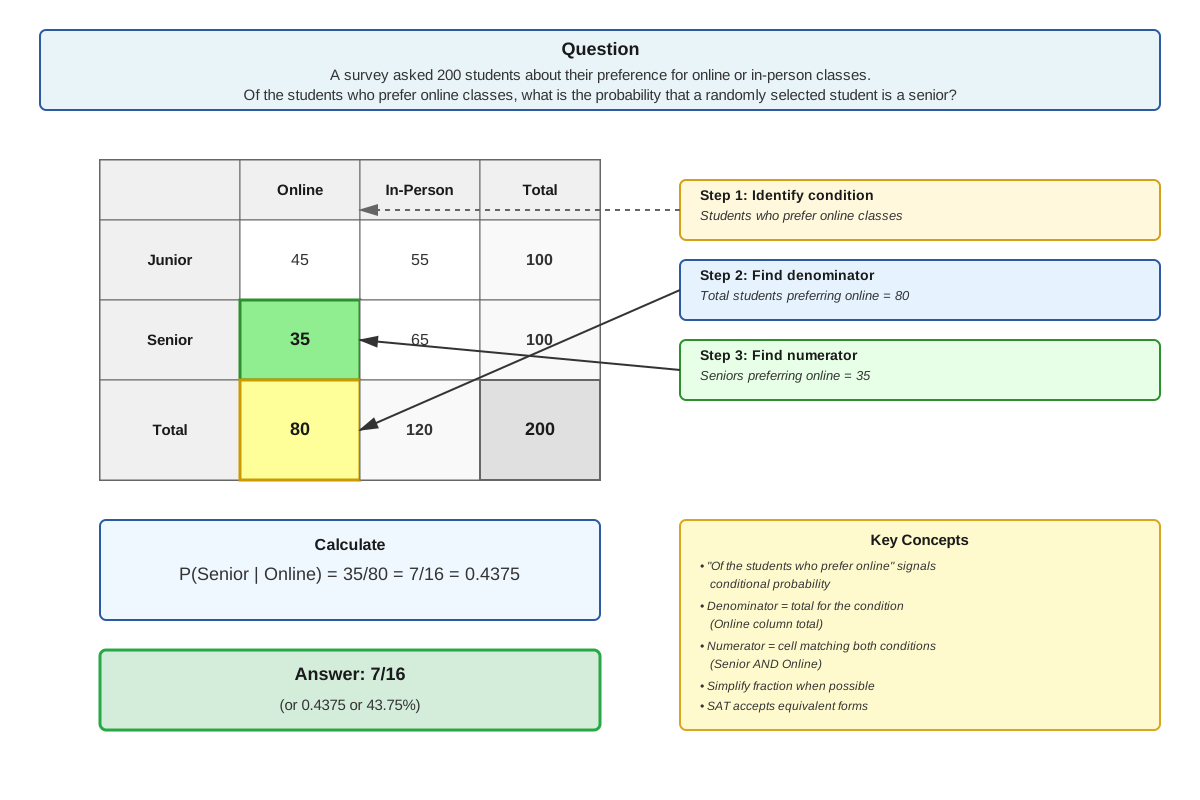
The key insight for conditional probability in two-way tables: when a condition is given, the total changes. Instead of using the grand total as the denominator, use the total for the given condition.
For example, if asked "What is the probability a student prefers pizza given that the student is a senior?" the denominator becomes the total number of seniors (not all students), and the numerator is the number of seniors who prefer pizza.
The formula becomes:
P(A|B) = Number satisfying both A and B / Number satisfying BThis is equivalent to the formal definition P(A|B) = P(A and B) / P(B), but working directly with table values is more intuitive and less error-prone on the SAT.
Marginal Probability
Marginal probability refers to the probability of a single event without any conditions. These probabilities come from the marginal totals (row totals or column totals) divided by the grand total. For instance, the probability of randomly selecting a senior from all students would use the senior row total divided by the grand total.
Marginal probabilities answer questions like "What is the probability of selecting someone who prefers pizza?" (regardless of grade level) or "What is the probability of selecting a junior?" (regardless of food preference).
Joint Probability
Joint probability represents the likelihood that two events occur simultaneously. In a two-way table, this corresponds to a single interior cell divided by the grand total. The notation P(A and B) represents joint probability.
For example, the probability of randomly selecting a student who is both a senior AND prefers pizza would be calculated by taking the cell value at the intersection of "senior" and "pizza" and dividing by the grand total.
Independence in Two-Way Tables
Two events A and B are independent if the occurrence of one does not affect the probability of the other. Mathematically, events are independent if:
P(A|B) = P(A)Or equivalently:
P(A and B) = P(A) × P(B)In two-way table contexts, you can test independence by checking whether the conditional probability equals the marginal probability. If knowing someone is a senior doesn't change the probability they prefer pizza compared to the general population, then grade level and pizza preference are independent.
Reading Two-Way Tables Strategically
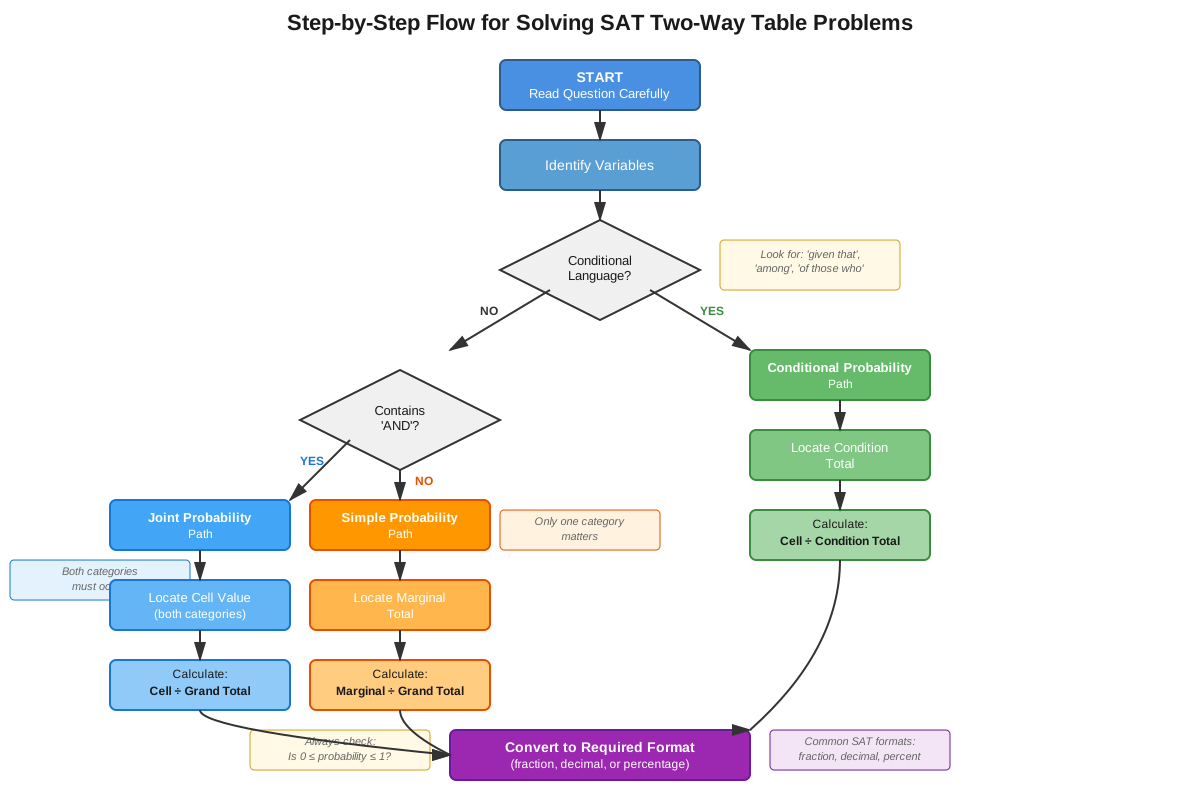
Successful SAT test-takers develop a systematic approach to two-way tables:
- Identify the two variables: Determine what the rows represent and what the columns represent
- Locate the grand total: Find the bottom-right cell to understand the total sample size
- Understand what's being asked: Determine whether the question asks for basic probability, conditional probability, or independence
- Identify the relevant cells: Circle or mentally note which cells contain the information needed
- Choose the correct denominator: Use grand total for basic probability, conditional total for conditional probability
Concept Relationships
The concepts within two-way table probability build hierarchically. Understanding table structure forms the foundation—students must identify rows, columns, cells, and totals before performing any calculations. This structural knowledge leads directly to basic probability calculations, where students divide specific cell values by the grand total.
Marginal probability and joint probability represent two different ways of extracting probability information from tables: marginal probabilities use the edge totals, while joint probabilities use interior cells. Both use the grand total as the denominator, making them conceptually similar but applied to different parts of the table.
Conditional probability builds upon joint probability by changing the reference population. Instead of considering all observations (grand total), conditional probability restricts focus to a subset (a row total or column total). This concept represents the most sophisticated application and appears most frequently in challenging SAT questions.
Independence serves as the capstone concept, requiring students to compare conditional and marginal probabilities. Testing independence demands mastery of both calculation types and the logical reasoning to interpret what equality or inequality means about the relationship between variables.
The relationship map flows as follows:
Table Structure → Basic Probability → Marginal & Joint Probability → Conditional Probability → Independence Testing
This topic connects to prerequisite knowledge of fractions (for probability calculations), percentages (for expressing probabilities), and basic probability theory (favorable/total outcomes). It also relates to other SAT topics including scatter plots (both involve two variables), data interpretation, and logical reasoning.
High-Yield Facts
⭐ The denominator for basic probability is always the grand total (bottom-right cell)
⭐ The denominator for conditional probability is the total of the given condition (specific row or column total)
⭐ Conditional probability P(A|B) means "given B has occurred," so B's total becomes the new denominator
⭐ To find joint probability P(A and B), use the interior cell where row A and column B intersect, divided by grand total
⭐ Events are independent if P(A|B) = P(A), meaning the condition doesn't change the probability
- Marginal totals appear in the rightmost column and bottom row of two-way tables
- The sum of all interior cells in a row equals that row's marginal total
- The sum of all interior cells in a column equals that column's marginal total
- When calculating "given" probabilities, ignore all data outside the given condition's row or column
- Two-way tables can represent frequencies (counts) or relative frequencies (proportions/percentages)
- The probability of selecting from a specific cell given a row condition equals that cell divided by the row total
- SAT questions often ask for answers as fractions in lowest terms, decimals, or percentages—read carefully
- If a table shows percentages instead of counts, you may need to work backwards to find actual numbers
- The complement rule applies: P(not A) = 1 - P(A), useful for "at least one" questions
Quick check — test yourself on Two-way table probability so far.
Try Flashcards →Common Misconceptions
Misconception: Using the grand total as the denominator for all probability questions, including conditional probability.
Correction: Conditional probability requires using the total of the given condition as the denominator. If asked for P(A|B), the denominator must be the total for B, not the grand total. This is the single most common error on SAT two-way table questions.
Misconception: Confusing P(A|B) with P(B|A), thinking they're interchangeable.
Correction: These represent different probabilities. P(A|B) means "probability of A given B" (denominator is B's total), while P(B|A) means "probability of B given A" (denominator is A's total). The order matters critically.
Misconception: Believing that if P(A|B) ≠ P(B|A), the events cannot be independent.
Correction: Independence is determined by comparing P(A|B) to P(A), not to P(B|A). Two events are independent when knowing one doesn't change the probability of the other, which means P(A|B) = P(A) and P(B|A) = P(B).
Misconception: Adding probabilities from different cells without considering whether they're mutually exclusive.
Correction: You can only add probabilities when events are mutually exclusive (cannot occur simultaneously). For overlapping events, use the addition rule: P(A or B) = P(A) + P(B) - P(A and B).
Misconception: Assuming that a larger cell value always means higher probability.
Correction: Probability depends on both the numerator and denominator. A cell with value 50 out of 100 total (50% probability) represents higher probability than a cell with value 80 out of 200 total (40% probability), despite 80 being larger than 50.
Misconception: Thinking that row percentages and column percentages are the same thing.
Correction: Row percentages divide each cell by its row total, showing distribution across columns within each row. Column percentages divide each cell by its column total, showing distribution across rows within each column. These yield different values and answer different questions.
Worked Examples
Example 1: Basic and Conditional Probability
A school surveyed 300 students about their preferred extracurricular activity. The results are shown below:
| Sports | Music | Drama | Row Total | |
|---|---|---|---|---|
| Freshmen | 45 | 30 | 15 | 90 |
| Sophomores | 50 | 35 | 25 | 110 |
| Juniors | 40 | 30 | 30 | 100 |
| Column Total | 135 | 95 | 70 | 300 |
Question A: What is the probability that a randomly selected student prefers sports?
Solution: This asks for a marginal probability—the probability of preferring sports regardless of grade level.
- Favorable outcomes: Total students who prefer sports = 135 (column total)
- Total outcomes: All students surveyed = 300 (grand total)
- P(Sports) = 135/300 = 9/20 = 0.45 or 45%
Question B: What is the probability that a randomly selected student is a sophomore who prefers music?
Solution: This asks for a joint probability—both conditions must be satisfied simultaneously.
- Favorable outcomes: Sophomores who prefer music = 35 (interior cell)
- Total outcomes: All students surveyed = 300 (grand total)
- P(Sophomore AND Music) = 35/300 = 7/60 ≈ 0.117 or 11.7%
Question C: Given that a student is a junior, what is the probability the student prefers drama?
Solution: This asks for conditional probability. The phrase "given that" signals we need to change our denominator.
- Favorable outcomes: Juniors who prefer drama = 30 (interior cell)
- Total outcomes: All juniors = 100 (row total for juniors, NOT grand total)
- P(Drama|Junior) = 30/100 = 3/10 = 0.30 or 30%
Connection to Learning Objectives: This example demonstrates identifying table features (rows, columns, totals), applying probability formulas to SAT-style questions, and calculating both marginal and conditional probabilities.
Example 2: Independence and Comparison
A company tested two manufacturing processes (A and B) and recorded whether products were defective:
| Defective | Not Defective | Row Total | |
|---|---|---|---|
| Process A | 12 | 188 | 200 |
| Process B | 24 | 276 | 300 |
| Column Total | 36 | 464 | 500 |
Question: Are the events "using Process B" and "producing a defective product" independent?
Solution: Events are independent if P(Defective|Process B) = P(Defective). We need to calculate both and compare.
Step 1: Calculate P(Defective|Process B)
- This is conditional probability given Process B
- Favorable outcomes: Defective products from Process B = 24
- Total outcomes: All products from Process B = 300
- P(Defective|Process B) = 24/300 = 2/25 = 0.08 or 8%
Step 2: Calculate P(Defective)
- This is marginal probability
- Favorable outcomes: All defective products = 36
- Total outcomes: All products = 500
- P(Defective) = 36/500 = 9/125 = 0.072 or 7.2%
Step 3: Compare the probabilities
- P(Defective|Process B) = 0.08
- P(Defective) = 0.072
- Since 0.08 ≠ 0.072, the events are NOT independent
Interpretation: Process B produces defective items at a slightly higher rate (8%) than the overall defect rate (7.2%). Knowing a product came from Process B does change the probability it's defective, so these events are dependent.
Connection to Learning Objectives: This example shows how to test independence using two-way tables, applies conditional probability concepts, and demonstrates the type of analytical reasoning the SAT requires.
Exam Strategy
Trigger Phrase Alert: Watch for "given that," "if," "among," "of those who," or "for students who"—these signal conditional probability and mean you should NOT use the grand total as your denominator.
When approaching SAT two-way table questions, follow this systematic process:
Step 1: Scan the question first before studying the table in detail. Knowing what's being asked helps you identify relevant information quickly.
Step 2: Identify the question type:
- "What is the probability that..." (no conditions) → Basic probability, use grand total
- "Given that..." or "If..." → Conditional probability, use conditional total
- "Are events independent..." → Calculate and compare conditional vs. marginal probability
Step 3: Circle or mentally note the relevant cells and totals. This prevents calculation errors from using wrong values.
Step 4: Set up your fraction before calculating. Write numerator/denominator clearly to catch errors.
Step 5: Simplify carefully. SAT answers are typically in simplest form. Double-check your arithmetic.
Time allocation: Two-way table questions should take 60-90 seconds each. If you're spending more than 2 minutes, you may be overcomplicating the problem. These questions test careful reading and basic arithmetic, not complex mathematical reasoning.
Process of elimination tips:
- Eliminate any answer choice greater than 1 or less than 0 (probabilities must be between 0 and 1)
- For conditional probability, eliminate choices that used the grand total if you can identify them
- If the question asks for a probability "given" a condition that represents half the sample, the answer will likely be close to but not exactly the marginal probability
- Check whether the answer should be larger or smaller than 50% based on the table values
Common trap answers: The SAT often includes the result of using the wrong denominator as a distractor. If you calculate conditional probability but accidentally use the grand total, your wrong answer will likely appear as one of the choices.
Memory Techniques
GRAND Mnemonic for Basic Probability:
- Grand total is the denominator
- Right cell for the numerator
- Always simplify
- Numerator over denominator
- Double-check your arithmetic
"Given Changes the Game": Whenever you see the word "given," remember that the denominator changes from the grand total to the conditional total. The "game" (total sample space) has changed.
The Corner Rule: The bottom-right corner (grand total) is your denominator for basic probability. Any other total (row or column) means you're working with conditional probability.
Independence Check Acronym - SAME:
- Separate the conditional probability P(A|B)
- Also find the marginal probability P(A)
- Match them up—are they equal?
- Equal means independent, unequal means dependent
Visualization Strategy: Picture the two-way table as a neighborhood. The grand total is the entire town. When asked about conditional probability, you're zooming into just one street (row) or one type of building (column). You're no longer considering the whole town, just that specific area.
Row vs. Column Memory Aid: "Rows run" (horizontally, like running across) and "Columns climb" (vertically, like climbing up). This helps you quickly identify which direction to look for totals.
Summary
Two-way table probability is a high-yield SAT topic that combines data interpretation with probability calculations. These tables organize data by two categorical variables, creating a grid where interior cells show joint frequencies, edges show marginal totals, and the bottom-right shows the grand total. Success requires distinguishing between three probability types: basic probability (using grand total), conditional probability (using row or column total when "given" information), and joint probability (using interior cells). The most critical skill is recognizing when a question asks for conditional probability—trigger words like "given," "if," or "among" signal that the denominator changes from the grand total to the specific condition's total. Independence testing requires comparing conditional probability to marginal probability; if they're equal, events are independent. These questions appear 2-3 times per SAT and are highly predictable once you master the systematic approach of identifying question type, selecting the correct denominator, and performing careful arithmetic.
Key Takeaways
- Two-way tables organize data by two categorical variables with marginal totals on edges and grand total in bottom-right corner
- Basic probability always uses the grand total as denominator; conditional probability uses the row or column total of the given condition
- "Given that" or "if" signals conditional probability—the denominator must change to reflect the restricted sample space
- Joint probability P(A and B) uses a single interior cell divided by grand total; marginal probability uses edge totals divided by grand total
- Events are independent when P(A|B) = P(A), meaning knowing B doesn't change A's probability
- The most common error is using grand total for conditional probability questions—always identify whether a condition restricts the sample
- These questions reward systematic approaches: identify question type, locate relevant cells, choose correct denominator, calculate carefully
Related Topics
Scatter Plots and Correlation: Like two-way tables, scatter plots examine relationships between two variables, but with quantitative rather than categorical data. Mastering two-way tables builds the foundation for understanding how variables relate.
Probability of Compound Events: Two-way tables provide concrete examples of "and" (joint probability) and "or" (addition rule) probability, connecting to more abstract compound event problems.
Statistical Sampling and Surveys: Understanding how survey data gets organized into two-way tables helps with questions about sampling methods, bias, and data collection—other high-yield SAT topics.
Ratios and Proportions: The probability calculations in two-way tables are fundamentally ratios, connecting this topic to the broader SAT emphasis on proportional reasoning.
Data Analysis and Interpretation: Two-way tables represent just one type of data display on the SAT. Mastering these tables develops the careful reading and analytical skills needed for graphs, charts, and other data representations.
Practice CTA
Now that you've mastered the concepts, structure, and strategies for two-way table probability, it's time to cement your understanding through practice. Attempt the practice questions to apply these techniques to SAT-style problems, and use the flashcards to reinforce key definitions and formulas. Remember: two-way table questions are among the most predictable on the SAT—consistent practice transforms them from challenging problems into reliable points. Every practice question you complete builds the pattern recognition and confidence you need to excel on test day!
Sign up free to keep reading
Create a free AnvayaPrep account to finish this SAT guide on Two-way table probability — plus flashcards and practice questions.