Overview
Complex roots represent one of the most sophisticated concepts tested in SAT math, bridging the gap between basic algebra and advanced mathematical reasoning. When a quadratic equation has no real solutions—meaning its graph never crosses the x-axis—the solutions exist in the complex number system, involving the imaginary unit i, where i² = -1. Understanding sat complex roots is crucial because the College Board regularly tests students' ability to recognize when complex solutions occur, manipulate expressions involving imaginary numbers, and interpret the discriminant to determine the nature of roots without actually solving the equation.
This topic typically appears 1-2 times per SAT exam, often in the calculator or no-calculator sections as medium to hard difficulty questions. Students who master complex roots gain a significant competitive advantage because these questions frequently stump test-takers who haven't developed fluency with imaginary numbers. The concept connects directly to the discriminant (b² - 4ac), quadratic formula applications, and the fundamental theorem of algebra, which states that every polynomial equation has exactly as many roots as its degree when complex numbers are included.
Complex roots also serve as a gateway to understanding more advanced mathematical concepts tested on college placement exams and in STEM coursework. The ability to work confidently with complex numbers demonstrates mathematical maturity and problem-solving flexibility that extends beyond the SAT itself. Students who understand why complex roots emerge—and how to work with them—develop deeper insight into the structure of polynomial equations and the completeness of the number system.
Learning Objectives
- [ ] Identify key features of complex roots, including when they occur and their conjugate pair property
- [ ] Explain how complex roots appears on the SAT, including discriminant-based questions and direct computation problems
- [ ] Apply complex roots to answer SAT-style questions involving quadratic equations with negative discriminants
- [ ] Determine the nature of roots (real vs. complex) using the discriminant without solving the equation
- [ ] Perform arithmetic operations with complex numbers, including addition, subtraction, and multiplication
- [ ] Recognize that complex roots of polynomials with real coefficients always occur in conjugate pairs
Prerequisites
- Quadratic equations and the quadratic formula: Essential for understanding when and how complex roots arise as solutions
- Basic algebraic manipulation: Required to simplify expressions involving i and combine like terms
- The concept of square roots: Necessary to understand why √(-1) requires extending the number system
- Graphing parabolas: Helps visualize why some quadratic equations have no real solutions (no x-intercepts)
- The discriminant (b² - 4ac): The primary tool for determining whether roots are real or complex
Why This Topic Matters
Complex roots represent a fundamental expansion of the number system that mathematicians developed to ensure every polynomial equation has solutions. In real-world applications, complex numbers appear in electrical engineering (AC circuit analysis), quantum mechanics, signal processing, and control systems theory. Engineers use complex numbers to model oscillations, waves, and rotational phenomena that cannot be adequately described using only real numbers.
On the SAT, complex roots questions appear with moderate frequency—typically 1-2 questions per test administration. These questions usually fall into three categories: (1) discriminant analysis questions asking students to determine conditions under which roots are complex, (2) direct computation questions requiring students to simplify expressions involving i, and (3) conceptual questions about properties of complex roots, such as conjugate pairs. According to College Board data, approximately 5-8% of SAT math questions involve complex numbers or their properties.
The topic most commonly appears in questions that ask students to determine the value of a parameter that makes a quadratic equation have no real solutions, or to simplify expressions like i³ or (2 + 3i)(2 - 3i). These questions test both procedural fluency and conceptual understanding, making them excellent discriminators between students at different skill levels. Students who can quickly recognize complex root scenarios and apply the appropriate techniques save valuable time and boost their scores significantly.
Core Concepts
The Imaginary Unit and Complex Numbers
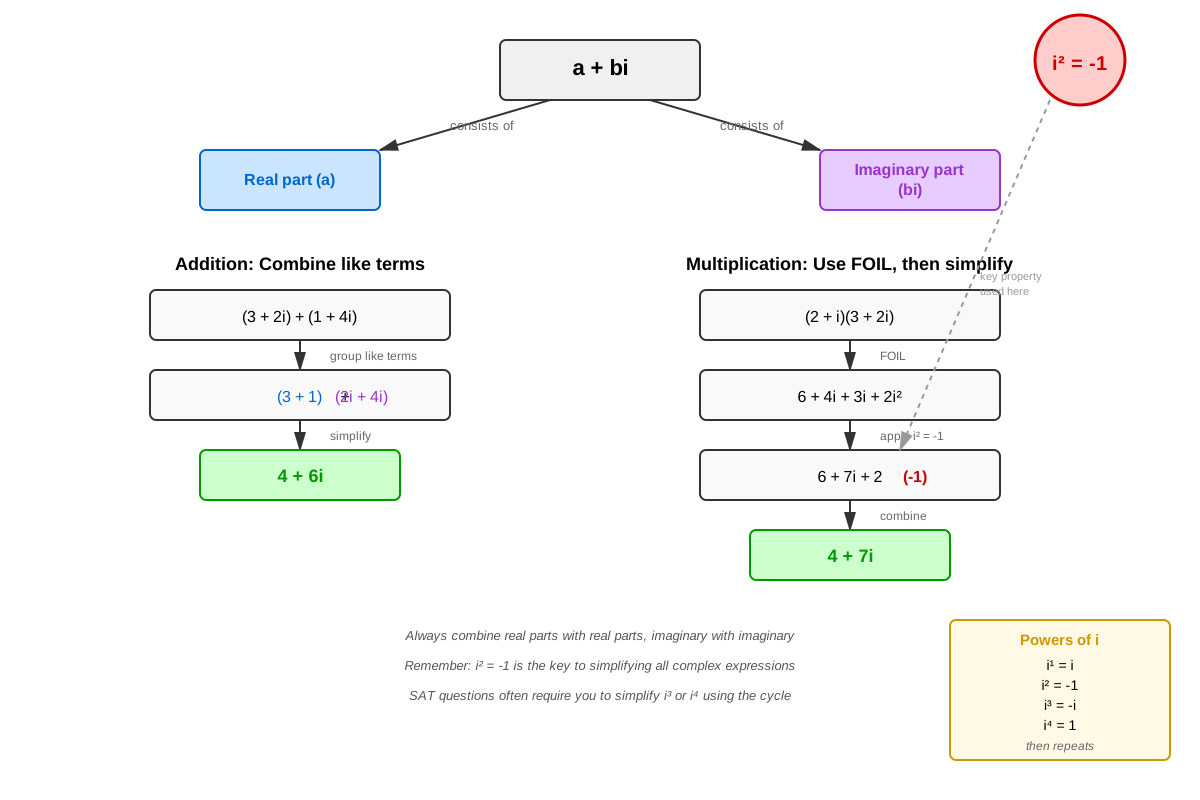
The foundation of complex roots begins with the imaginary unit i, defined as i = √(-1), which means i² = -1. This definition extends the real number system to include solutions to equations like x² = -1, which have no real solutions. A complex number takes the form a + bi, where a is the real part and b is the imaginary part. When b = 0, the number is purely real; when a = 0 and b ≠ 0, the number is purely imaginary.
Key powers of i follow a cyclical pattern that repeats every four terms:
- i¹ = i
- i² = -1
- i³ = i² · i = -1 · i = -i
- i⁴ = i² · i² = (-1)(-1) = 1
- i⁵ = i⁴ · i = 1 · i = i (the cycle repeats)
To evaluate any power of i, divide the exponent by 4 and use the remainder: iⁿ = i^(remainder when n÷4).
When Complex Roots Occur
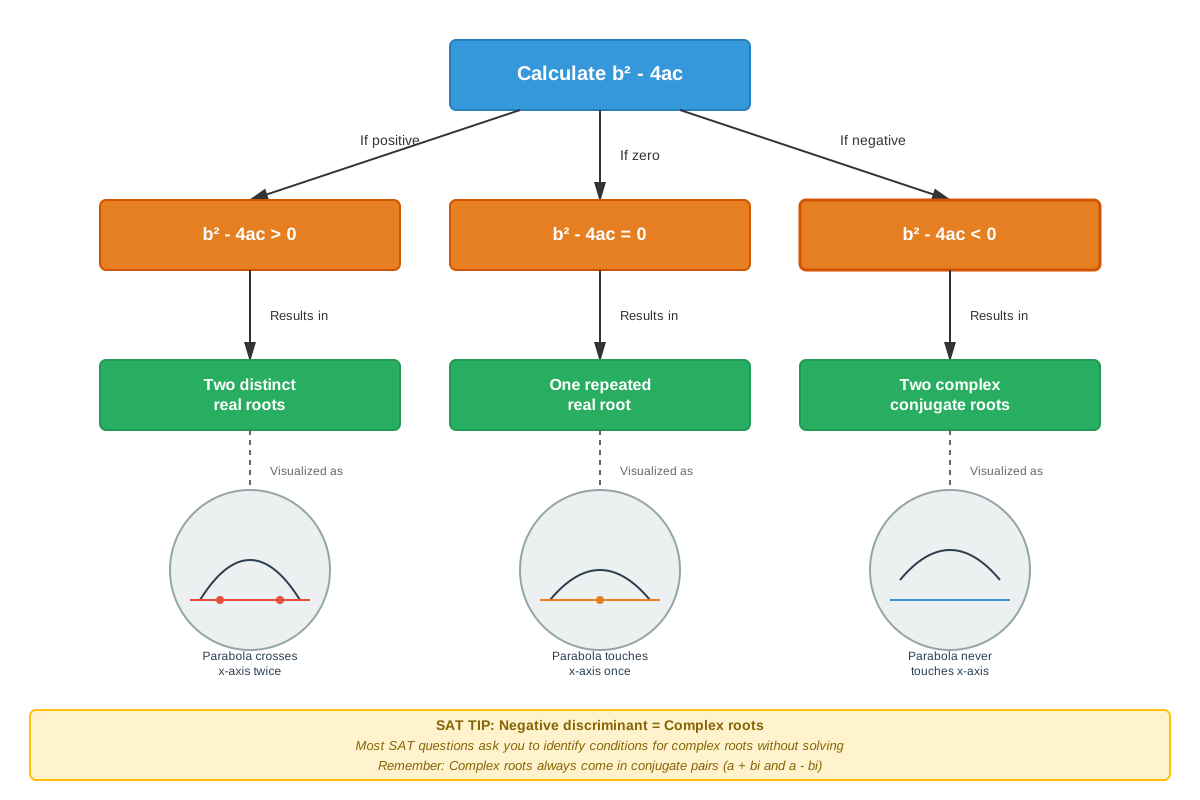
Complex roots arise when solving quadratic equations of the form ax² + bx + c = 0 where the discriminant Δ = b² - 4ac is negative. The discriminant determines the nature of the roots:
| Discriminant Value | Nature of Roots | Number of x-intercepts |
|---|---|---|
| Δ > 0 | Two distinct real roots | 2 |
| Δ = 0 | One repeated real root | 1 (vertex touches x-axis) |
| Δ < 0 | Two complex conjugate roots | 0 (parabola doesn't cross x-axis) |
When Δ < 0, the quadratic formula yields:
x = (-b ± √(b² - 4ac)) / (2a) = (-b ± √(negative number)) / (2a)Since the square root of a negative number involves i, the solutions become complex numbers.
The Quadratic Formula with Complex Roots
When applying the quadratic formula to equations with negative discriminants, factor out i from the square root:
x = (-b ± √(-(|Δ|))) / (2a) = (-b ± i√|Δ|) / (2a)For example, solving x² + 2x + 5 = 0:
- Discriminant: Δ = 2² - 4(1)(5) = 4 - 20 = -16
- Since Δ < 0, roots are complex
- x = (-2 ± √(-16)) / 2 = (-2 ± 4i) / 2 = -1 ± 2i
The two solutions are x = -1 + 2i and x = -1 - 2i.
Complex Conjugates
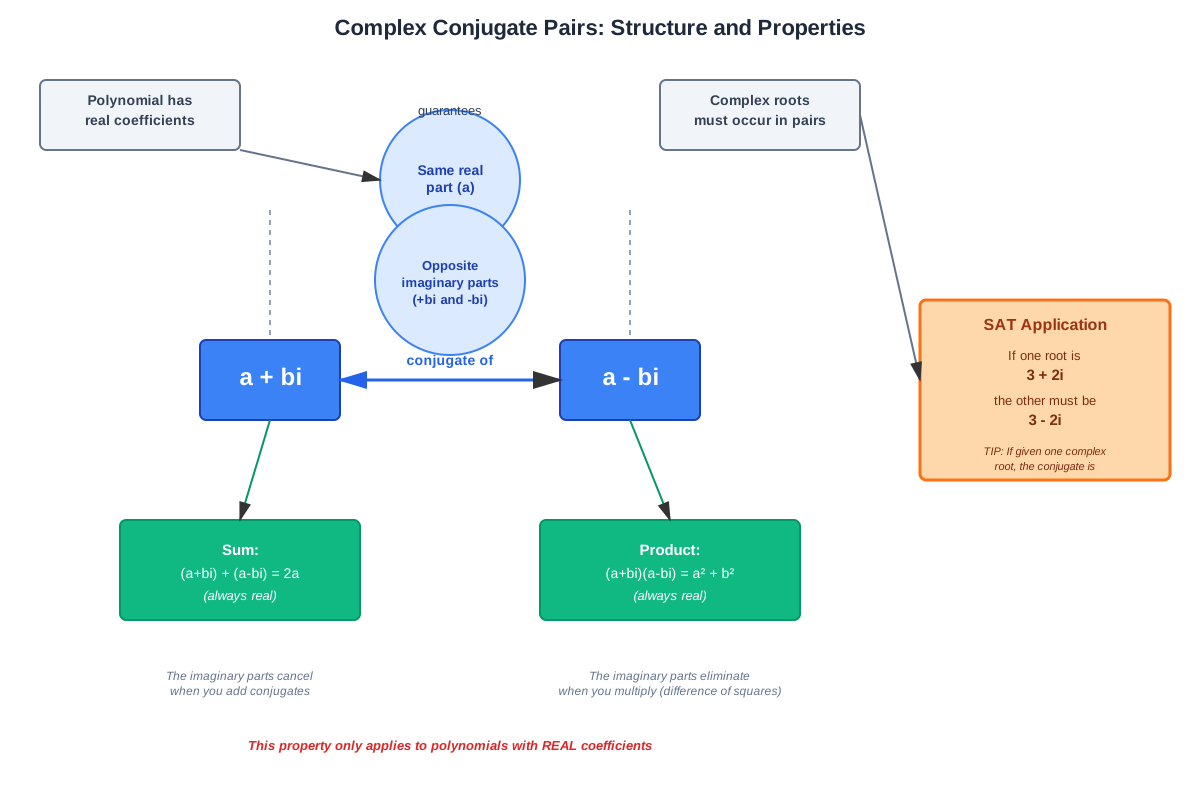
A critical property of polynomials with real coefficients is that complex roots always occur in conjugate pairs. If a + bi is a root, then a - bi must also be a root. Two complex numbers are conjugates if they have the same real part but opposite imaginary parts.
This conjugate pair property has important implications:
- The sum of conjugate roots is always real: (a + bi) + (a - bi) = 2a
- The product of conjugate roots is always real: (a + bi)(a - bi) = a² + b²
- For a quadratic with real coefficients, if one root is known to be complex, the other root is immediately determined
Operations with Complex Numbers
Addition and Subtraction: Combine like terms (real with real, imaginary with imaginary)
- (3 + 4i) + (2 - 5i) = (3 + 2) + (4 - 5)i = 5 - i
Multiplication: Use the distributive property and remember i² = -1
- (2 + 3i)(1 + 4i) = 2 + 8i + 3i + 12i² = 2 + 11i + 12(-1) = -10 + 11i
Multiplying Conjugates: Results in a real number
- (a + bi)(a - bi) = a² - (bi)² = a² - b²i² = a² + b²
Finding Equations from Complex Roots
If the roots of a quadratic equation are known, the equation can be reconstructed. For complex conjugate roots r₁ = a + bi and r₂ = a - bi:
(x - r₁)(x - r₂) = 0
[x - (a + bi)][x - (a - bi)] = 0
[(x - a) - bi][(x - a) + bi] = 0
(x - a)² - (bi)² = 0
(x - a)² + b² = 0
x² - 2ax + (a² + b²) = 0
For example, if roots are 3 + 2i and 3 - 2i:
- (x - 3 - 2i)(x - 3 + 2i) = [(x - 3) - 2i][(x - 3) + 2i]
- = (x - 3)² + 4 = x² - 6x + 9 + 4 = x² - 6x + 13 = 0
Concept Relationships
The concept of complex roots emerges directly from the discriminant of quadratic equations. When students evaluate b² - 4ac and obtain a negative value, this signals that the parabola represented by the equation never intersects the x-axis, necessitating complex solutions. This connects to graphing quadratic functions, where the number and nature of roots correspond to x-intercepts.
The relationship flows as follows: Quadratic equation → Calculate discriminant → Discriminant < 0 → Complex roots exist → Apply quadratic formula with i → Obtain conjugate pair solutions.
Complex roots also connect to the fundamental theorem of algebra, which guarantees that every polynomial of degree n has exactly n roots (counting multiplicity) in the complex number system. For quadratics (degree 2), this means exactly two roots always exist—either both real, or a complex conjugate pair.
The conjugate pair property links to polynomial factorization: if you know one complex root of a polynomial with real coefficients, you automatically know another root. This relationship extends beyond quadratics to higher-degree polynomials, though the SAT focuses primarily on quadratic applications.
Operations with complex numbers (addition, multiplication) connect to algebraic manipulation skills developed in earlier algebra courses, with the added rule that i² = -1. The multiplication of conjugates specifically relates to difference of squares patterns: (a + bi)(a - bi) = a² + b².
Quick check — test yourself on Complex roots so far.
Try Flashcards →High-Yield Facts
⭐ The discriminant b² - 4ac determines root type: positive = two real roots, zero = one repeated real root, negative = two complex conjugate roots
⭐ Complex roots of polynomials with real coefficients always occur in conjugate pairs: if a + bi is a root, then a - bi is also a root
⭐ The imaginary unit i is defined as √(-1), so i² = -1
⭐ Powers of i cycle every four terms: i, -i, -1, 1, then repeat
⭐ When the discriminant is negative, factor out i from the square root: √(-k) = i√k where k > 0
- The product of complex conjugates is always a real number: (a + bi)(a - bi) = a² + b²
- The sum of complex conjugates is always a real number: (a + bi) + (a - bi) = 2a
- A quadratic equation with complex roots has no x-intercepts on its graph
- To simplify iⁿ, divide n by 4 and use the remainder: i^remainder
- Complex numbers are written in standard form as a + bi, where a and b are real numbers
- If a quadratic has integer coefficients and one root is 2 + 3i, the equation must have the form k(x² - 4x + 13) = 0 for some constant k
Common Misconceptions
Misconception: Complex roots mean there are no solutions to the equation.
Correction: Complex roots are valid solutions; they simply aren't real numbers. The equation is still solved completely when complex roots are found.
Misconception: i = √(-1) means i² = 1 (incorrectly squaring both sides).
Correction: By definition, i² = -1. When you square i = √(-1), you get (i)² = (√(-1))² = -1, not 1.
Misconception: √(-16) = -4.
Correction: √(-16) = 4i, not -4. The negative sign under the radical requires factoring out i: √(-16) = √(16 · -1) = 4i.
Misconception: Complex roots can occur individually; if one root is 3 + 2i, the other root could be any number.
Correction: For polynomials with real coefficients, complex roots must occur in conjugate pairs. If 3 + 2i is a root, then 3 - 2i must be the other root.
Misconception: When multiplying complex numbers, treat i like a variable and leave i² in the answer.
Correction: Always simplify i² to -1. For example, (2i)(3i) = 6i² = 6(-1) = -6, not 6i².
Misconception: A negative discriminant means the quadratic equation is unsolvable or has an error.
Correction: A negative discriminant simply indicates complex solutions. This is a valid mathematical scenario, not an error. The parabola opens upward or downward without crossing the x-axis.
Misconception: i³ = i because you can "cancel" the squares.
Correction: i³ = i² · i = (-1) · i = -i. Always use the definition i² = -1 when simplifying powers of i.
Worked Examples
Example 1: Determining Root Type and Finding Complex Roots
Problem: For what value of k does the equation x² - 6x + k = 0 have complex roots? If k = 13, find the roots.
Solution:
Step 1: Identify when complex roots occur. Complex roots exist when the discriminant is negative: b² - 4ac < 0.
Step 2: Set up the discriminant inequality. For x² - 6x + k = 0, we have a = 1, b = -6, c = k.
Δ = b² - 4ac = (-6)² - 4(1)(k) = 36 - 4kStep 3: Determine the condition for complex roots.
36 - 4k < 0
36 < 4k
9 < k
Therefore, the equation has complex roots when k > 9.
Step 4: Find the roots when k = 13. Since 13 > 9, we expect complex roots.
Δ = 36 - 4(13) = 36 - 52 = -16Step 5: Apply the quadratic formula.
x = (-b ± √Δ) / (2a) = (6 ± √(-16)) / 2Step 6: Simplify the square root of the negative number.
√(-16) = √(16 · -1) = 4iStep 7: Complete the calculation.
x = (6 ± 4i) / 2 = 3 ± 2iAnswer: The equation has complex roots when k > 9. When k = 13, the roots are x = 3 + 2i and x = 3 - 2i (a conjugate pair, as expected).
Example 2: Simplifying Complex Expressions
Problem: Simplify (2 - 3i)(2 + 3i) and i⁴⁷.
Solution for Part 1:
Step 1: Recognize this as a product of conjugates, which follows the pattern (a - bi)(a + bi) = a² + b².
Step 2: Apply the formula with a = 2 and b = 3.
(2 - 3i)(2 + 3i) = 2² + 3² = 4 + 9 = 13Alternatively, using FOIL:
(2 - 3i)(2 + 3i) = 4 + 6i - 6i - 9i² = 4 - 9(-1) = 4 + 9 = 13Solution for Part 2:
Step 1: Use the fact that powers of i cycle every 4 terms. Divide the exponent by 4.
47 ÷ 4 = 11 remainder 3Step 2: Therefore, i⁴⁷ = i³.
Step 3: Evaluate i³.
i³ = i² · i = (-1) · i = -iAnswer: (2 - 3i)(2 + 3i) = 13 and i⁴⁷ = -i.
This example demonstrates the high-yield fact that multiplying conjugates always produces a real number, and shows the efficient method for simplifying high powers of i.
Exam Strategy
When approaching SAT questions involving complex roots, first identify the question type: Is it asking about when roots are complex (discriminant analysis), asking you to compute complex roots (quadratic formula application), or asking you to simplify complex expressions (operations with i)?
Trigger words and phrases to watch for:
- "No real solutions" or "no real roots" → discriminant < 0
- "Imaginary solutions" → complex roots
- "For what value of [parameter]" → often discriminant analysis
- "Simplify" with i present → apply i² = -1 and power rules
- "Conjugate" → look for pairs of form a ± bi
Process-of-elimination strategies:
- If a question asks which value makes roots complex, eliminate any answer choice that makes the discriminant zero or positive
- For simplification questions, eliminate answers that still contain i² or higher powers without simplification
- If asked about properties of complex roots, eliminate options suggesting roots can be complex without conjugate pairs (for real coefficient polynomials)
- When computing roots, eliminate answers that aren't conjugate pairs if the original equation has real coefficients
Time allocation: Discriminant analysis questions typically take 30-60 seconds if you recognize the pattern immediately. Direct computation of complex roots using the quadratic formula takes 60-90 seconds. Simplification of complex expressions should take 30-45 seconds. If a question is taking longer, mark it and return later—these questions often have elegant shortcuts that become apparent on a second look.
Quick checks: After finding complex roots, verify they're conjugates (same real part, opposite imaginary parts). When simplifying products of conjugates, the answer must be real. When evaluating iⁿ, the answer must be one of four values: i, -i, 1, or -1.
Exam Tip: If you see a quadratic equation and need to determine root type quickly, calculate only the discriminant—don't waste time solving unless specifically asked for the roots themselves.
Memory Techniques
For powers of i (the "I Can" mnemonic):
- i¹ = i → Imaginary
- i² = -1 → Count negative
- i³ = -i → Anti-imaginary (negative imaginary)
- i⁴ = 1 → Normal (back to real positive)
For discriminant interpretation (the "PZN" rule):
- Positive discriminant → Pair of real roots (two distinct)
- Zero discriminant → Zero separation (one repeated root)
- Negative discriminant → No real roots (complex conjugates)
For complex conjugates (the "Same-Opposite" rule):
- Same real part
- Opposite imaginary part
Visualization for complex roots: Picture a parabola floating entirely above or below the x-axis. Since it never touches, there are no real x-intercepts, but the roots exist in the complex plane. The vertex's x-coordinate is the real part of both roots (the average of the conjugates).
Acronym for conjugate multiplication (DIRT):
- Difference
- Is
- Real
- Total
(a + bi)(a - bi) = a² + b², which is always real)
Summary
Complex roots emerge when quadratic equations have negative discriminants, indicating that the parabola never crosses the x-axis and solutions involve the imaginary unit i, where i² = -1. These roots always occur in conjugate pairs (a + bi and a - bi) for polynomials with real coefficients, and they represent valid mathematical solutions despite not being real numbers. The discriminant b² - 4ac serves as the primary diagnostic tool: when negative, it signals complex roots; when zero or positive, roots are real. Students must be proficient in three key skills: (1) analyzing discriminants to determine root nature without solving, (2) applying the quadratic formula with negative discriminants by factoring out i from square roots of negative numbers, and (3) performing operations with complex numbers, particularly recognizing that i² = -1 and that powers of i cycle every four terms. On the SAT, complex root questions test both procedural fluency and conceptual understanding, appearing as discriminant analysis problems, direct computation exercises, and simplification tasks. Mastery requires recognizing patterns quickly, applying the conjugate pair property, and efficiently simplifying expressions involving i.
Key Takeaways
- Complex roots occur when the discriminant b² - 4ac is negative, indicating no real solutions and no x-intercepts on the graph
- The imaginary unit i is defined as √(-1), making i² = -1, which is essential for all complex number operations
- Complex roots of polynomials with real coefficients always appear as conjugate pairs: if a + bi is a root, then a - bi must also be a root
- To find complex roots, apply the quadratic formula and factor i out of the square root: √(-k) = i√k
- Powers of i cycle every four terms (i, -1, -i, 1), so divide the exponent by 4 and use the remainder
- Multiplying complex conjugates always yields a real number: (a + bi)(a - bi) = a² + b²
- On the SAT, quickly determine root type using only the discriminant before attempting to solve, saving valuable time
Related Topics
Higher-Degree Polynomials with Complex Roots: Extends complex root concepts to cubic, quartic, and higher-degree equations, where multiple conjugate pairs can exist. Mastering quadratic complex roots provides the foundation for understanding how complex roots appear in more advanced polynomial equations.
The Complex Plane: Visualizes complex numbers as points in a two-dimensional plane with real and imaginary axes, providing geometric interpretation of complex arithmetic. Understanding complex roots algebraically prepares students for this geometric perspective.
Polynomial Division and the Remainder Theorem: Connects to complex roots through the factor theorem—if r is a root, then (x - r) is a factor. When roots are complex, this leads to quadratic factors with real coefficients.
Rational Root Theorem and Descartes' Rule of Signs: These theorems help predict the nature and number of real roots, complementing discriminant analysis for determining when complex roots must exist.
Systems of Equations with Complex Solutions: Extends the concept of complex roots to systems where variables can take complex values, building on the foundational understanding developed with quadratic equations.
Practice CTA
Now that you've mastered the core concepts of complex roots, it's time to solidify your understanding through active practice. Work through the practice questions to test your ability to identify when complex roots occur, compute them using the quadratic formula, and simplify complex expressions efficiently. The flashcards will help you memorize key facts like the powers of i and the discriminant conditions. Remember: complex roots questions are high-value opportunities on the SAT—students who can confidently handle them gain a significant competitive advantage. Challenge yourself with timed practice to build both accuracy and speed, and review any mistakes carefully to identify gaps in understanding. You've got this!
Sign up free to keep reading
Create a free AnvayaPrep account to finish this SAT guide on Complex roots — plus flashcards and practice questions.