Overview
The discriminant is one of the most powerful tools in algebra for analyzing quadratic equations without actually solving them. Derived from the quadratic formula, the discriminant is the expression b² - 4ac that appears under the square root sign. This single value reveals critical information about a quadratic equation's solutions: whether they are real or complex, rational or irrational, and most importantly for the SAT, how many real solutions exist. Understanding the discriminant allows students to quickly determine the nature of solutions and make strategic decisions about how to approach problems involving parabolas, roots, and intersections.
On the SAT Math section, discriminant questions appear regularly in both the calculator and no-calculator portions, typically testing whether students can determine the number of solutions to a quadratic equation or analyze conditions under which certain solution types exist. These questions often involve algebraic manipulation, parameter analysis, and connections to graphical representations of parabolas. The discriminant bridges multiple mathematical concepts, linking algebraic equations to geometric interpretations and providing a shortcut that saves valuable time during the exam.
Mastery of the discriminant concept is essential because it connects to broader mathematical themes tested on the SAT, including the relationship between algebraic and graphical representations, the structure of the quadratic formula, and the behavior of parabolas. This topic frequently appears in multi-step problems where recognizing the role of the discriminant can unlock an efficient solution path. Students who understand the discriminant gain a significant advantage in tackling complex problems involving systems of equations, optimization, and real-world modeling scenarios that the SAT commonly presents.
Learning Objectives
- [ ] Identify key features of the discriminant and its components
- [ ] Explain how the discriminant appears on the SAT in various question formats
- [ ] Apply the discriminant to answer SAT-style questions efficiently
- [ ] Determine the number and nature of solutions to any quadratic equation using the discriminant
- [ ] Analyze how changes in coefficients affect the discriminant value and solution types
- [ ] Connect discriminant values to graphical representations of parabolas and their x-intercepts
- [ ] Solve parameter problems where the discriminant must satisfy specific conditions
Prerequisites
- Quadratic equations in standard form (ax² + bx + c = 0): The discriminant formula directly uses these coefficients, making recognition of standard form essential
- The quadratic formula: The discriminant is the expression under the radical in the quadratic formula, so understanding its origin provides context
- Basic properties of square roots: Interpreting discriminant values requires knowing when square roots produce real versus complex numbers
- Graphing parabolas: Connecting discriminant values to x-intercepts requires understanding how parabolas intersect the x-axis
- Algebraic manipulation: Simplifying expressions and solving inequalities involving the discriminant demands solid algebra skills
Why This Topic Matters
The discriminant appears in real-world applications whenever quadratic relationships need analysis. Engineers use discriminant analysis to determine whether physical systems have viable solutions—for example, whether a projectile will reach a certain height or whether a bridge design will support specific loads. Economists apply discriminant concepts when analyzing profit functions to determine break-even points. In physics, the discriminant helps determine whether certain motion equations have real solutions, indicating physically possible scenarios versus impossible ones.
On the SAT, discriminant questions appear approximately 2-3 times per test, making this a high-yield topic that directly impacts scores. These questions typically appear as multiple-choice problems worth 1 point each, but they often serve as gatekeepers in multi-step problems worth more points. The College Board frequently tests the discriminant in three main formats: direct calculation questions asking for the number of solutions, parameter problems where students must find values that produce specific solution types, and graphical interpretation questions connecting discriminant values to parabola intersections with the x-axis.
Common SAT question patterns include: "For what value of k does the equation have exactly one solution?", "How many real solutions does the equation have?", and "Which of the following equations has two distinct real solutions?" The discriminant also appears implicitly in questions about parabola intersections with lines or other curves, where recognizing the discriminant's role can dramatically reduce solution time. Understanding this topic enables students to bypass lengthy algebraic solutions and arrive at answers through efficient analysis.
Core Concepts
The Discriminant Formula
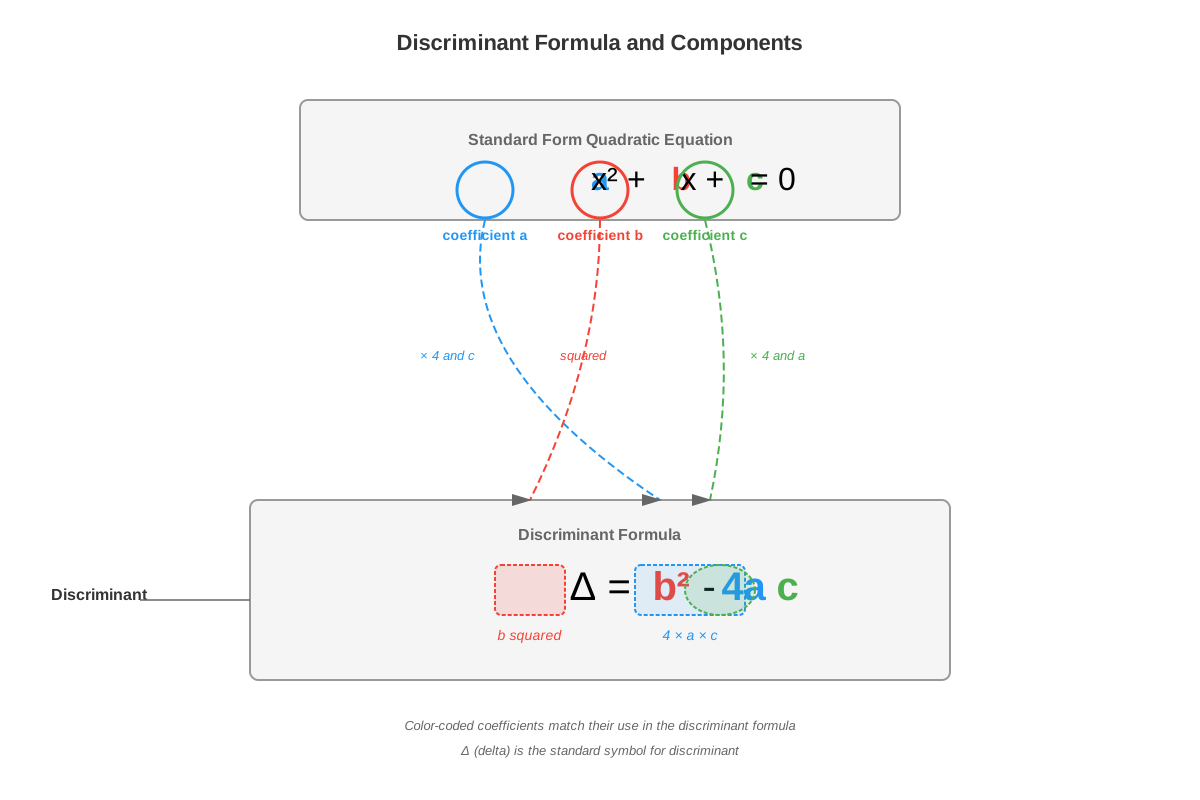
The discriminant is the expression b² - 4ac, where a, b, and c are the coefficients from a quadratic equation written in standard form: ax² + bx + c = 0. This expression appears under the square root in the quadratic formula:
x = (-b ± √(b² - 4ac)) / (2a)The discriminant is typically denoted by the Greek letter Δ (delta) or simply D. Its value determines what happens when the quadratic formula is applied, specifically what type of number appears under the square root. Since the discriminant is the only part of the quadratic formula that can vary in sign (positive, negative, or zero), it controls the nature of the solutions.
To calculate the discriminant, follow these steps:
- Identify the quadratic equation and ensure it's in standard form (ax² + bx + c = 0)
- Extract the coefficients: a (coefficient of x²), b (coefficient of x), and c (constant term)
- Substitute into the formula: D = b² - 4ac
- Simplify the expression completely
- Interpret the result based on whether D is positive, negative, or zero
Discriminant Values and Solution Types
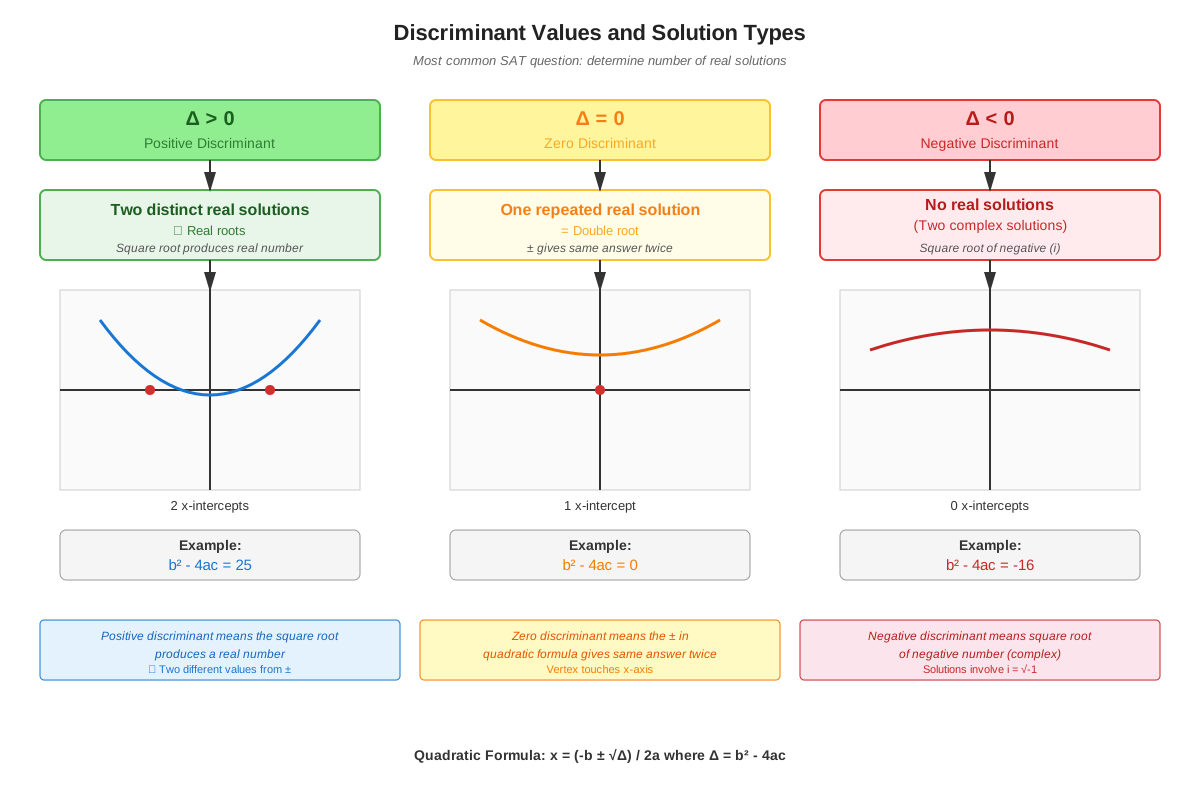
The discriminant's value directly determines the number and type of solutions a quadratic equation possesses. This relationship is fundamental to SAT discriminant problems:
| Discriminant Value | Number of Real Solutions | Nature of Solutions | Graphical Interpretation |
|---|---|---|---|
| D > 0 (positive) | Two distinct real solutions | If D is a perfect square: two rational solutions; If D is not a perfect square: two irrational solutions | Parabola crosses x-axis at two points |
| D = 0 (zero) | Exactly one real solution (repeated root) | One rational solution (counted with multiplicity 2) | Parabola touches x-axis at exactly one point (vertex on x-axis) |
| D < 0 (negative) | No real solutions | Two complex conjugate solutions | Parabola does not intersect x-axis |
When D > 0: The square root of a positive number produces a real number, and the ± symbol in the quadratic formula creates two different solutions. For example, if D = 16, then √16 = 4, and the formula gives two distinct values: (-b + 4)/(2a) and (-b - 4)/(2a).
When D = 0: The square root of zero is zero, so the ± symbol becomes irrelevant—both "plus zero" and "minus zero" give the same result. This produces one solution: x = -b/(2a). Geometrically, this represents a parabola whose vertex sits exactly on the x-axis.
When D < 0: The square root of a negative number is not a real number (it's imaginary), so the equation has no real solutions. On the SAT, this typically means "no solutions" in the context of real-world problems, though advanced students recognize these as complex solutions.
Perfect Square Discriminants
A special case occurs when the discriminant is a perfect square (a number like 1, 4, 9, 16, 25, etc.). When D is a perfect square, the solutions to the quadratic equation are rational numbers—they can be expressed as fractions or integers. This matters on the SAT because:
- Questions may ask whether solutions are rational or irrational
- Perfect square discriminants often indicate that factoring is possible
- These equations can typically be solved without the quadratic formula
For example, consider x² - 5x + 6 = 0:
- D = (-5)² - 4(1)(6) = 25 - 24 = 1
- Since 1 is a perfect square, the solutions are rational
- Indeed, this factors as (x - 2)(x - 3) = 0, giving x = 2 and x = 3
Parameter Problems with the Discriminant
SAT questions frequently present equations with an unknown parameter (often k, m, or n) and ask students to find values that produce specific solution types. These problems require setting up an equation or inequality involving the discriminant:
For exactly one solution: Set D = 0 and solve for the parameter
- Example: For what value of k does x² + 6x + k = 0 have exactly one solution?
- Set up: 6² - 4(1)(k) = 0
- Solve: 36 - 4k = 0 → k = 9
For two distinct real solutions: Set D > 0 and solve the inequality
- Example: For which values of m does x² + 4x + m = 0 have two real solutions?
- Set up: 4² - 4(1)(m) > 0
- Solve: 16 - 4m > 0 → m < 4
For no real solutions: Set D < 0 and solve the inequality
- Example: For which values of p does 2x² - 3x + p = 0 have no real solutions?
- Set up: (-3)² - 4(2)(p) < 0
- Solve: 9 - 8p < 0 → p > 9/8
Graphical Connections
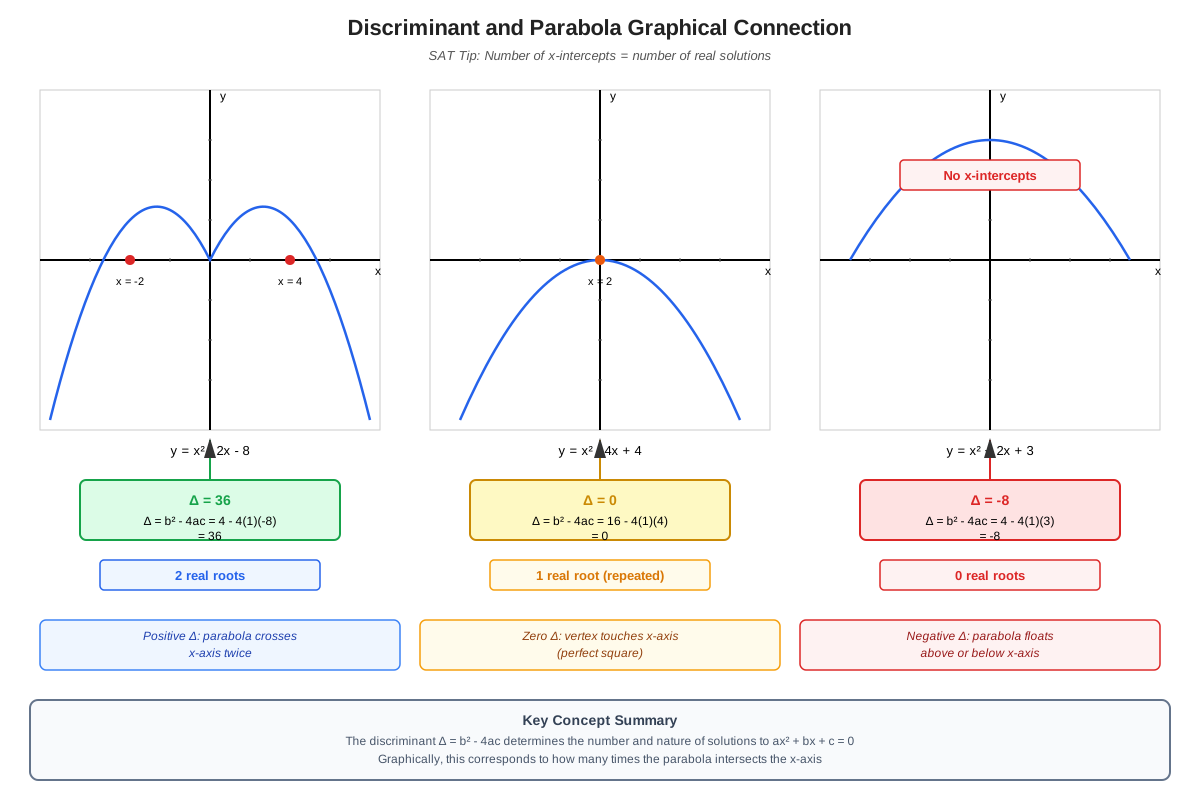
The discriminant provides a bridge between algebraic and geometric representations. The x-intercepts of a parabola (where y = 0) correspond to the real solutions of the quadratic equation. Therefore:
- D > 0: The parabola has two x-intercepts (crosses the x-axis twice)
- D = 0: The parabola has one x-intercept (touches the x-axis at the vertex)
- D < 0: The parabola has no x-intercepts (doesn't touch the x-axis)
This connection allows students to answer graphical questions using algebraic analysis or vice versa. If a question shows a parabola that doesn't intersect the x-axis, students immediately know the discriminant is negative. Conversely, if asked how many x-intercepts a parabola has, calculating the discriminant provides the answer without graphing.
Concept Relationships
The discriminant serves as a central hub connecting multiple quadratic concepts. Standard form equations (ax² + bx + c = 0) provide the coefficients that feed into the discriminant formula (b² - 4ac). The discriminant value then determines the number of solutions, which connects to the quadratic formula where the discriminant appears under the radical. This relationship flows as: Standard Form → Discriminant Calculation → Solution Type Determination → Quadratic Formula Application.
The discriminant also bridges algebra and geometry. Algebraic discriminant values directly correspond to graphical x-intercepts: positive discriminants indicate two x-intercepts, zero indicates one (vertex on x-axis), and negative indicates none. This connection extends to systems of equations where finding intersections between a parabola and a line reduces to analyzing the discriminant of the resulting quadratic equation.
Parameter problems create another relationship layer. When equations contain unknown coefficients, the discriminant becomes a function of those parameters. Setting conditions on the discriminant (D > 0, D = 0, or D < 0) creates equations or inequalities that must be solved to find parameter values. This connects discriminant analysis to inequality solving and algebraic manipulation skills.
The relationship map flows: Quadratic Equation → Extract Coefficients → Calculate Discriminant → Interpret Value → Determine Solution Type → Connect to Graph → Apply to Problem Context. Each step builds on the previous, creating a comprehensive problem-solving framework.
Quick check — test yourself on Discriminant so far.
Try Flashcards →High-Yield Facts
⭐ The discriminant formula is D = b² - 4ac, where a, b, and c come from ax² + bx + c = 0
⭐ When D > 0, the quadratic equation has two distinct real solutions
⭐ When D = 0, the quadratic equation has exactly one real solution (a repeated root)
⭐ When D < 0, the quadratic equation has no real solutions
⭐ The discriminant determines the number of x-intercepts a parabola has
- A perfect square discriminant indicates rational solutions
- The discriminant appears under the square root in the quadratic formula
- For parameter problems asking for "exactly one solution," set the discriminant equal to zero
- A parabola that touches but doesn't cross the x-axis has a discriminant of zero
- The sign of the discriminant (positive, negative, or zero) is more important than its exact value for determining solution types
- When a = 1, the discriminant simplifies to b² - 4c
- Changing the constant term c has a direct linear effect on the discriminant (each unit change in c changes D by 4a units)
- The discriminant can be used to determine if a quadratic expression can be factored over the integers
Common Misconceptions
Misconception: The discriminant tells you what the solutions are. → Correction: The discriminant only tells you how many real solutions exist and their nature (rational vs. irrational), not the actual solution values. To find the solutions themselves, you must use the quadratic formula or another solving method.
Misconception: A negative discriminant means the equation has no solutions at all. → Correction: A negative discriminant means no real solutions exist, but the equation does have two complex (imaginary) solutions. On the SAT, "no solutions" typically refers to no real solutions in the context of real-world problems.
Misconception: The discriminant formula is b² - 4ac regardless of the equation form. → Correction: The discriminant formula only applies when the equation is in standard form (ax² + bx + c = 0). If the equation is in a different form, it must first be rearranged to standard form before identifying a, b, and c.
Misconception: When D = 0, the equation has no solutions. → Correction: When D = 0, the equation has exactly one real solution (a repeated root). This is sometimes called a "double root" because the same value satisfies the equation with multiplicity 2.
Misconception: A larger discriminant value means more solutions. → Correction: The number of real solutions depends only on whether the discriminant is positive, negative, or zero—not on its magnitude. An equation with D = 1 has the same number of real solutions (two) as one with D = 100.
Misconception: The discriminant can be negative only if a is negative. → Correction: The discriminant can be negative regardless of the sign of a. It depends on the relationship between all three coefficients. For example, x² + x + 1 = 0 has a positive a but a negative discriminant (1 - 4 = -3).
Misconception: If the discriminant is positive, the solutions must be positive numbers. → Correction: A positive discriminant means two distinct real solutions exist, but those solutions can be positive, negative, or one of each. The sign of the discriminant relates to the nature of solutions, not their numerical signs.
Worked Examples
Example 1: Determining the Number of Solutions
Problem: How many real solutions does the equation 2x² - 7x + 3 = 0 have?
Solution:
Step 1: Identify the equation is in standard form ax² + bx + c = 0
- a = 2, b = -7, c = 3
Step 2: Calculate the discriminant using D = b² - 4ac
- D = (-7)² - 4(2)(3)
- D = 49 - 24
- D = 25
Step 3: Interpret the discriminant value
- Since D = 25 > 0, the equation has two distinct real solutions
Step 4: Additional observation (bonus insight)
- Since 25 is a perfect square (5²), the solutions are rational numbers
- This means the equation can be factored: 2x² - 7x + 3 = (2x - 1)(x - 3) = 0
- Solutions are x = 1/2 and x = 3
Connection to Learning Objectives: This example demonstrates identifying the discriminant's key features (positive value indicating two solutions) and applying the concept to answer a typical SAT question format.
Example 2: Parameter Problem
Problem: For what value of k does the equation x² + 8x + k = 0 have exactly one real solution?
Solution:
Step 1: Recognize that "exactly one real solution" means D = 0
- This is a key trigger phrase on the SAT
Step 2: Identify coefficients in terms of k
- a = 1, b = 8, c = k
Step 3: Set up the discriminant equation
- D = b² - 4ac = 0
- 8² - 4(1)(k) = 0
- 64 - 4k = 0
Step 4: Solve for k
- 64 = 4k
- k = 16
Step 5: Verify the answer
- With k = 16, the equation becomes x² + 8x + 16 = 0
- This factors as (x + 4)² = 0, giving x = -4 as a repeated root
- Confirmation: D = 64 - 4(1)(16) = 64 - 64 = 0 ✓
Connection to Learning Objectives: This example shows how to apply the discriminant to solve parameter problems, a high-frequency SAT question type that tests deeper understanding of the concept.
Example 3: Graphical Interpretation
Problem: A parabola defined by y = -x² + 6x + c intersects the x-axis at two distinct points. Which of the following could be the value of c?
(A) -10 (B) -9 (C) -8 (D) -7
Solution:
Step 1: Recognize that x-axis intersections occur when y = 0
- This creates the equation: -x² + 6x + c = 0
Step 2: "Two distinct points" means D > 0
- We need b² - 4ac > 0
Step 3: Identify coefficients
- a = -1, b = 6, c = c (the unknown)
Step 4: Set up the inequality
- 6² - 4(-1)(c) > 0
- 36 + 4c > 0
- 4c > -36
- c > -9
Step 5: Evaluate answer choices
- (A) -10: Not valid (less than -9)
- (B) -9: Not valid (equal to -9, not greater)
- (C) -8: Valid (greater than -9) ✓
- (D) -7: Valid (greater than -9) ✓
If only one answer is allowed, both (C) and (D) work, but typically the SAT would ask "which could be" allowing multiple correct answers, or provide only one option that satisfies the condition.
Connection to Learning Objectives: This demonstrates connecting discriminant analysis to graphical representations and applying the concept to answer SAT-style questions involving parabola intersections.
Exam Strategy
When approaching discriminant questions on the SAT, first identify whether the question asks about the number of solutions, the nature of solutions, or requires finding a parameter value. Trigger phrases to watch for include: "how many real solutions," "exactly one solution," "two distinct solutions," "no real solutions," "intersects the x-axis," "touches the x-axis," and "for what value of [parameter]."
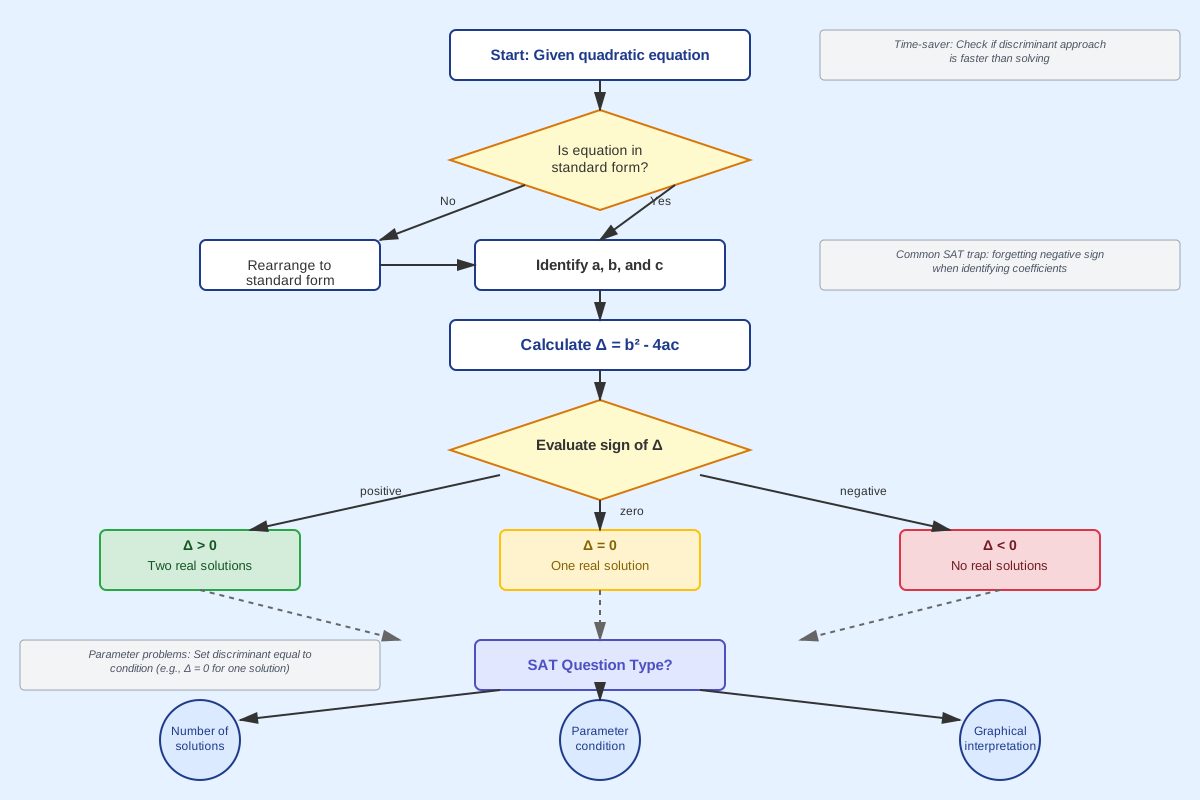
The most efficient approach follows this decision tree:
- Identify the question type: Is it asking for the number of solutions (calculate D and interpret) or a parameter value (set up equation/inequality with D)?
- Ensure standard form: Before extracting coefficients, verify the equation is in ax² + bx + c = 0 form. If not, rearrange first.
- Calculate carefully: The most common errors occur in the calculation step, particularly with negative signs. When b is negative, remember that b² is always positive.
- Use process of elimination: For multiple-choice questions about parameter values, you can often eliminate answers by testing boundary cases or using inequality reasoning rather than solving completely.
Time allocation: Straightforward discriminant calculation questions should take 30-45 seconds. Parameter problems requiring equation solving may take 60-90 seconds. Don't spend more than 2 minutes on any single discriminant question—if stuck, mark it and return later.
Calculator usage: On calculator-permitted sections, use your calculator to compute b² - 4ac, but be careful entering negative values. Use parentheses liberally: (b)^2 - 4(a)(c). On no-calculator sections, look for opportunities to simplify before calculating (for example, if a = 1, the formula becomes b² - 4c).
Common traps: The SAT often includes answer choices that result from common errors, such as forgetting the negative sign in -4ac, using 2ac instead of 4ac, or confusing the conditions (thinking D = 0 means no solutions). Always double-check your discriminant interpretation against the standard rules.
Memory Techniques
Mnemonic for discriminant values: "Positive = Pair, Zero = Zing (one), Negative = None" helps remember that positive discriminants give two solutions, zero gives one, and negative gives none (in the real numbers).
Visual memory aid: Picture a parabola in three positions:
- Smiling face crossing a line twice (D > 0, two x-intercepts)
- Smiling face kissing a line once (D = 0, one x-intercept at vertex)
- Smiling face floating above a line (D < 0, no x-intercepts)
Formula memory: Remember "Big Before Four All Combined" for b² - 4ac: the b term is squared and comes before 4 times all the other coefficients combined (a and c multiplied).
Perfect square recognition: Memorize perfect squares up to 15²: 1, 4, 9, 16, 25, 36, 49, 64, 81, 100, 121, 144, 169, 196, 225. This allows instant recognition of rational solutions.
Parameter problem strategy: "One Zero, Two Positive, None Negative" reminds you that for one solution set D = 0 (zero), for two solutions set D > 0 (positive), and for no solutions set D < 0 (negative).
Summary
The discriminant (b² - 4ac) is a powerful analytical tool that reveals the number and nature of solutions to any quadratic equation in standard form without requiring complete solution. By calculating this single value and interpreting its sign, students can determine whether a quadratic has two distinct real solutions (D > 0), exactly one real solution (D = 0), or no real solutions (D < 0). This concept bridges algebraic and geometric representations, as discriminant values directly correspond to the number of x-intercepts on a parabola's graph. SAT questions test the discriminant through direct calculation problems, parameter problems requiring students to find coefficient values that produce specific solution types, and graphical interpretation questions connecting algebraic conditions to visual representations. Mastery requires understanding the formula derivation from the quadratic formula, recognizing trigger phrases in questions, accurately calculating with attention to negative signs, and efficiently applying the concept to various problem formats. The discriminant represents one of the highest-yield topics in SAT quadratic equations, appearing regularly and serving as a gateway to solving more complex multi-step problems efficiently.
Key Takeaways
- The discriminant D = b² - 4ac determines the number of real solutions: positive means two, zero means one, negative means none
- The discriminant appears under the square root in the quadratic formula and controls whether real solutions exist
- Graphically, the discriminant value corresponds to the number of x-intercepts a parabola has
- For parameter problems, set D = 0 for exactly one solution, D > 0 for two solutions, or D < 0 for no real solutions
- Perfect square discriminants indicate rational solutions and suggest the equation can be factored
- Always ensure the equation is in standard form (ax² + bx + c = 0) before identifying coefficients
- The sign of the discriminant matters more than its magnitude for determining solution types
Related Topics
Completing the Square: This algebraic technique provides an alternative method for solving quadratics and helps derive the quadratic formula, showing where the discriminant originates. Mastering the discriminant makes completing the square more intuitive.
Vertex Form of Quadratics: Understanding how to convert between standard form and vertex form (y = a(x - h)² + k) connects to discriminant analysis, as the vertex's position relative to the x-axis relates to discriminant sign.
Systems of Equations with Quadratics: When solving systems involving a quadratic and linear equation, the discriminant of the resulting quadratic determines how many intersection points exist, extending discriminant applications to more complex scenarios.
Polynomial Functions: The discriminant concept generalizes to higher-degree polynomials through the study of resultants and discriminants of cubic and quartic equations, though these appear rarely on the SAT.
Complex Numbers: Understanding what happens when D < 0 leads naturally to complex number solutions, an advanced topic that provides complete understanding of quadratic solution behavior.
Practice CTA
Now that you've mastered the discriminant concept, it's time to solidify your understanding through practice! Attempt the practice questions to test your ability to calculate discriminants, interpret their values, and solve parameter problems under timed conditions. Use the flashcards to reinforce the key relationships between discriminant values and solution types until they become automatic. Remember, the discriminant appears on nearly every SAT, making this practice time a high-yield investment in your score. Approach each practice problem strategically, identifying trigger phrases and applying the efficient methods you've learned. Your confidence with discriminants will translate directly to points on test day!
Sign up free to keep reading
Create a free AnvayaPrep account to finish this SAT guide on Discriminant — plus flashcards and practice questions.