Overview
The vertex form of a quadratic equation is one of the most powerful tools in the SAT math arsenal. While quadratic equations can be expressed in multiple forms—standard form, factored form, and vertex form—the vertex form provides immediate visual access to the parabola's most important feature: its vertex, or turning point. On the SAT, understanding vertex form enables students to quickly identify maximum and minimum values, determine axis of symmetry, and solve optimization problems without lengthy calculations.
Vertex form appears regularly on both the calculator and no-calculator sections of the SAT Math test, typically in 2-4 questions per exam. These questions often involve real-world scenarios such as projectile motion, profit maximization, or area optimization. The College Board favors vertex form questions because they test conceptual understanding rather than mere computational ability. Students who master vertex form gain a significant strategic advantage, as they can solve complex problems in seconds that might take others several minutes using alternative methods.
Understanding vertex form also strengthens comprehension of function transformations, a broader concept that extends beyond quadratics to exponential, absolute value, and trigonometric functions. The skills developed while working with vertex form—recognizing horizontal and vertical shifts, identifying stretches and compressions, and visualizing graph behavior—transfer directly to other areas of SAT math and provide a foundation for college-level mathematics.
Learning Objectives
- [ ] Identify key features of vertex form including the vertex coordinates and direction of opening
- [ ] Explain how vertex form appears on the SAT in both pure math and applied contexts
- [ ] Apply vertex form to answer SAT-style questions involving optimization and graph analysis
- [ ] Convert between vertex form and standard form of quadratic equations
- [ ] Determine the axis of symmetry and maximum or minimum value from vertex form
- [ ] Analyze the effects of parameter changes on the graph of a quadratic function in vertex form
Prerequisites
- Standard form of quadratic equations (ax² + bx + c): Vertex form is an alternative representation of the same quadratic relationship, and students must understand that different forms reveal different features
- Coordinate plane and graphing basics: Vertex form directly provides coordinates (h, k) that must be plotted and interpreted on a coordinate system
- Function notation: Vertex form uses f(x) or y notation, requiring comfort with input-output relationships
- Completing the square: This algebraic technique is the primary method for converting from standard form to vertex form
- Basic parabola properties: Understanding that quadratics create U-shaped curves with a single turning point provides context for why the vertex is significant
Why This Topic Matters
In real-world applications, vertex form solves optimization problems that appear constantly in business, engineering, and science. When a company wants to maximize profit, an engineer needs to determine the highest point a projectile reaches, or an architect must calculate the minimum amount of material needed for a parabolic arch, vertex form provides immediate answers. The vertex represents the optimal solution—the maximum revenue, the peak height, or the minimum cost—making this mathematical tool invaluable for decision-making.
On the SAT, vertex form questions appear with remarkable consistency. Statistical analysis of released SAT exams shows that approximately 15-20% of algebra questions involve quadratic functions, and roughly 30-40% of those specifically test vertex form concepts. This translates to 2-4 questions per exam worth 2-4 points each. The College Board particularly favors questions that combine vertex form with real-world contexts, asking students to interpret the meaning of the vertex in scenarios involving physics, economics, or geometry.
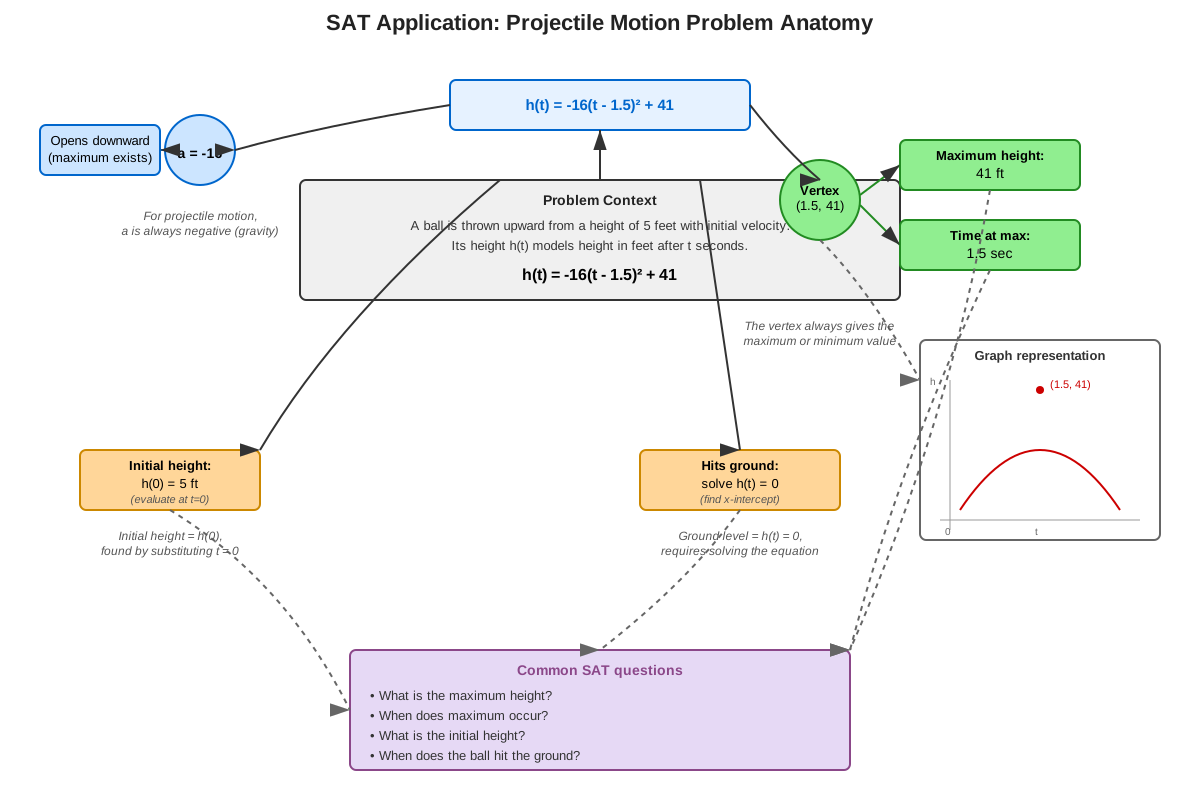
Common SAT question types include: identifying the vertex from an equation, determining whether a vertex represents a maximum or minimum, writing a quadratic function in vertex form given specific conditions, interpreting the meaning of parameters in context, and using vertex form to solve optimization problems. Questions may present the equation directly or require students to recognize vertex form among multiple-choice options. Grid-in questions often ask for the x-coordinate or y-coordinate of the vertex, or the maximum/minimum value of the function.
Core Concepts
The Vertex Form Equation
The vertex form of a quadratic function is expressed as:
f(x) = a(x - h)² + kor equivalently:
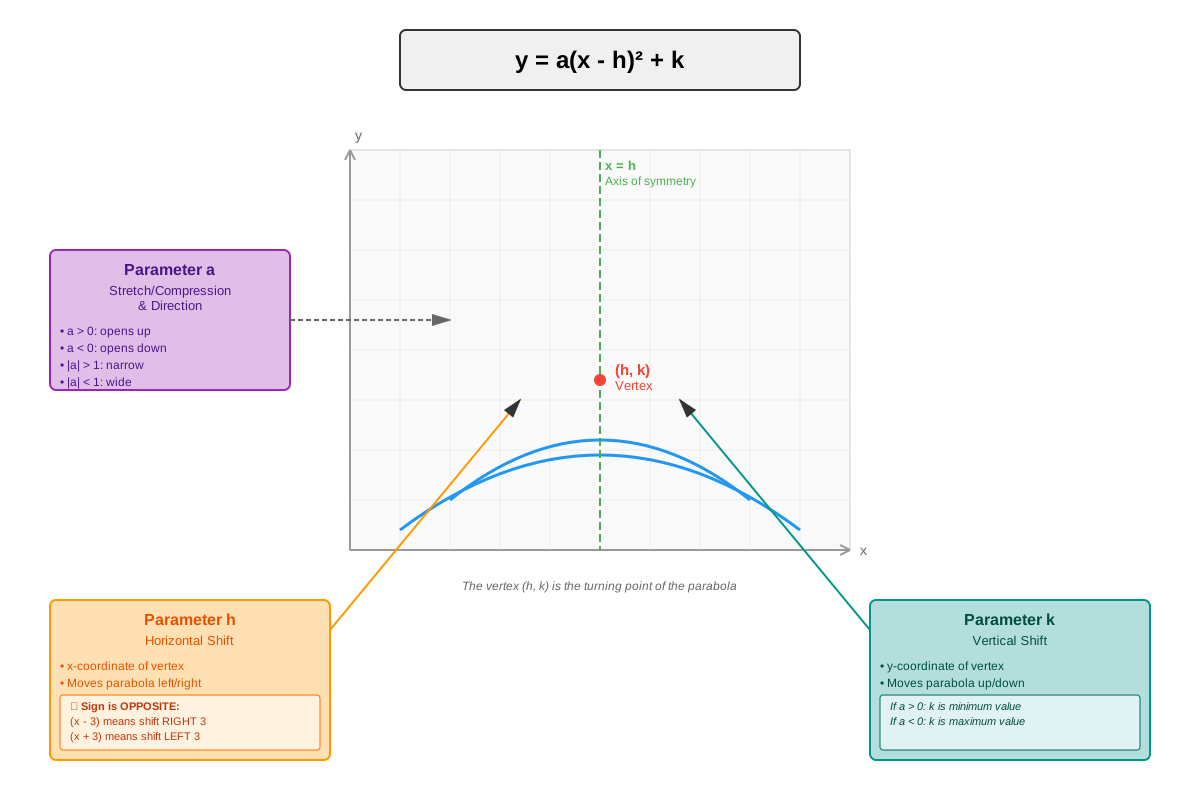
y = a(x - h)² + kIn this form, the point (h, k) represents the vertex of the parabola—the point where the function reaches its maximum or minimum value. The parameter a determines both the direction the parabola opens and how "wide" or "narrow" it appears. This compact representation immediately reveals the parabola's most important features without requiring any calculations.
Understanding the Parameters
Each parameter in vertex form controls a specific aspect of the parabola's appearance and behavior:
| Parameter | Effect | Key Information | ||||
|---|---|---|---|---|---|---|
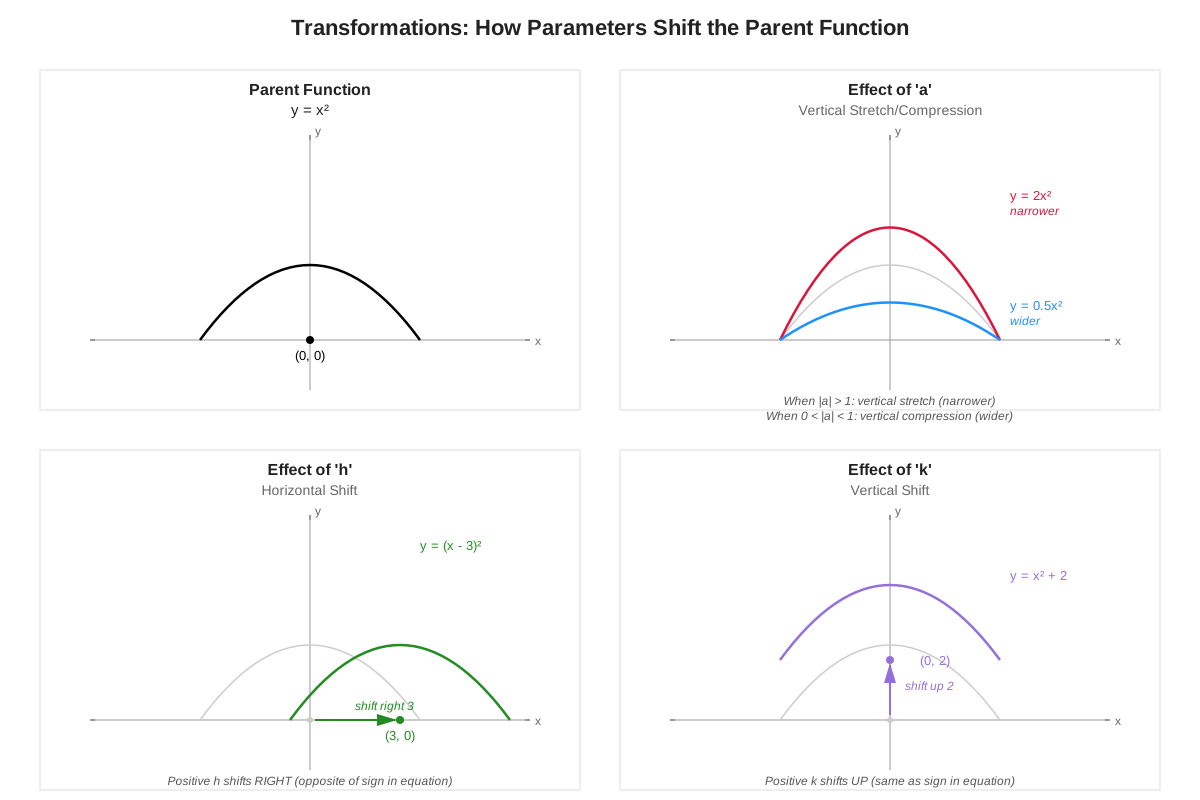
| a | Vertical stretch/compression and direction | If a > 0, parabola opens upward (minimum at vertex); if a < 0, opens downward (maximum at vertex); | a | > 1 creates narrower parabola; 0 < | a | < 1 creates wider parabola |
| h | Horizontal shift | Moves the vertex left or right; positive h shifts right, negative h shifts left; note the subtraction in (x - h) | ||||
| k | Vertical shift | Moves the vertex up or down; positive k shifts up, negative k shifts down |
The Vertex and Its Significance
The vertex (h, k) serves multiple critical functions:
- Optimal value location: The y-coordinate k represents the maximum value (when a < 0) or minimum value (when a > 0) of the function
- Axis of symmetry: The vertical line x = h divides the parabola into mirror images
- Turning point: The parabola changes from increasing to decreasing (or vice versa) at the vertex
- Starting point for graphing: Plotting the vertex first, then using symmetry to plot additional points, creates an efficient graphing strategy
Sign Conventions and Common Pitfalls
The most frequent error students make involves the sign of h. In the expression (x - h)², the vertex has an x-coordinate of positive h, even though the equation shows subtraction. For example:
- f(x) = (x - 3)² + 2 has vertex at (3, 2), not (-3, 2)
- f(x) = (x + 4)² - 1 can be rewritten as f(x) = (x - (-4))² - 1, so the vertex is at (-4, -1)
This counterintuitive sign relationship stems from the fact that (x - h)² equals zero when x = h, which is precisely where the vertex occurs.
Converting from Standard Form to Vertex Form
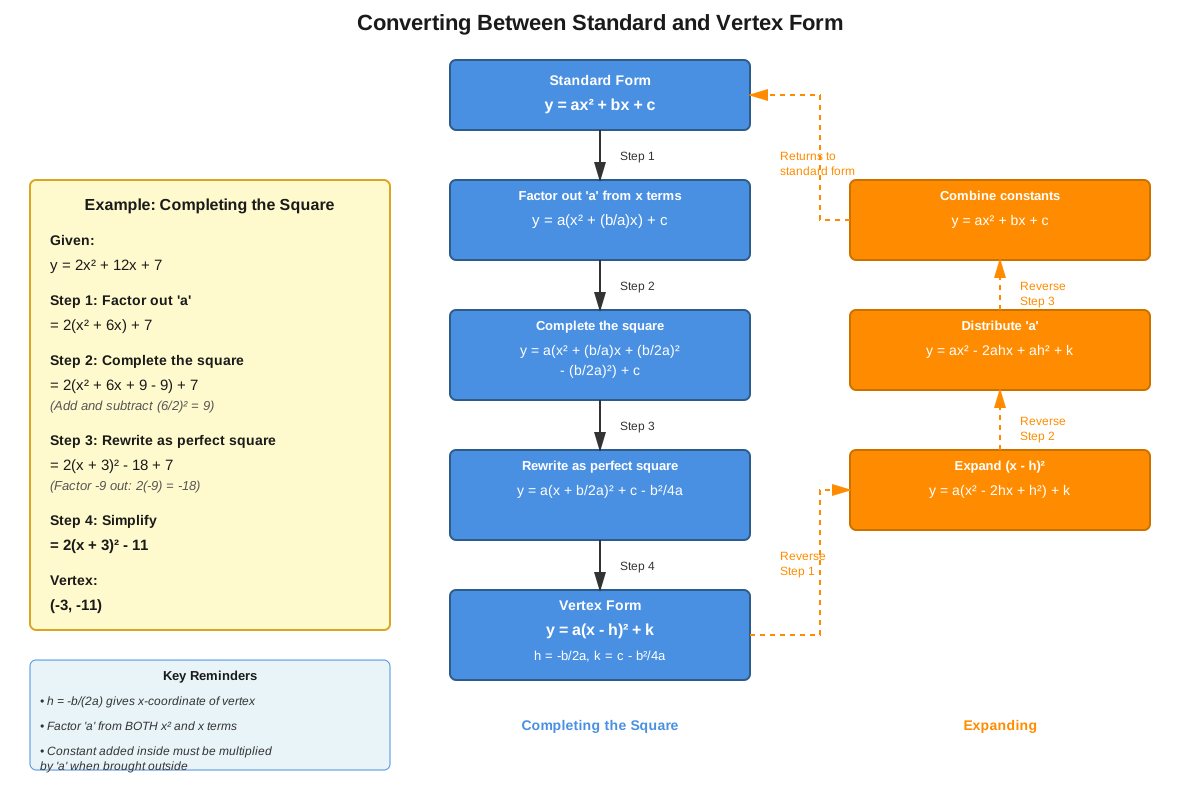
The process of converting from standard form (ax² + bx + c) to vertex form requires completing the square:
Step 1: Factor out the coefficient of x² from the first two terms (if a ≠ 1)
Step 2: Take half of the coefficient of x, square it, and add/subtract this value inside the parentheses
Step 3: Simplify and rewrite in vertex form
Step 4: Verify by identifying the vertex coordinates
For example, converting f(x) = 2x² + 12x + 10:
- Factor: f(x) = 2(x² + 6x) + 10
- Complete the square: f(x) = 2(x² + 6x + 9 - 9) + 10
- Simplify: f(x) = 2(x² + 6x + 9) - 18 + 10 = 2(x + 3)² - 8
- Vertex: (-3, -8)
Graphing Using Vertex Form
Vertex form makes graphing efficient and accurate:
- Plot the vertex (h, k) as the first point
- Determine direction: Check whether a is positive (opens up) or negative (opens down)
- Find additional points: Choose x-values on either side of h, calculate corresponding y-values
- Use symmetry: Points equidistant from the axis of symmetry have the same y-value
- Sketch the parabola: Draw a smooth curve through the points
Applications in SAT Contexts
The SAT frequently embeds vertex form in real-world scenarios. Common contexts include:
- Projectile motion: h(t) = -16t² + v₀t + h₀ can be converted to vertex form to find maximum height and time to reach it
- Business optimization: Revenue or profit functions in vertex form reveal maximum profit and optimal pricing
- Geometry: Area functions for rectangles with constrained perimeters often appear in vertex form
- Physics: Parabolic paths of objects under gravity naturally express in vertex form
Concept Relationships
Vertex form connects to multiple mathematical concepts in a hierarchical structure. At the foundation, completing the square serves as the algebraic bridge between standard form and vertex form, making it an essential prerequisite skill. The relationship flows: Standard Form → Completing the Square → Vertex Form.
Within quadratic functions, the three forms create a conceptual triangle. Standard form (ax² + bx + c) reveals the y-intercept immediately; factored form (a(x - r₁)(x - r₂)) shows the x-intercepts directly; and vertex form (a(x - h)² + k) displays the vertex instantly. Each form has strategic advantages, and SAT questions often require recognizing which form best suits a particular question.
Vertex form also connects upward to the broader concept of function transformations. The parameters h and k represent horizontal and vertical translations, while a represents vertical stretching/compression and reflection. These transformation principles apply identically to other function families (exponential, absolute value, radical), making vertex form a gateway to understanding transformations generally.
The relationship map: Completing the Square → Vertex Form → Vertex Identification → Optimization Problems → Real-World Applications. Additionally: Vertex Form → Transformation Understanding → Other Function Families.
High-Yield Facts
⭐ The vertex form of a quadratic function is f(x) = a(x - h)² + k, where (h, k) is the vertex
⭐ If a > 0, the parabola opens upward and the vertex represents a minimum; if a < 0, it opens downward and the vertex represents a maximum
⭐ The axis of symmetry is the vertical line x = h
⭐ The sign of h in the equation is opposite to the sign of the x-coordinate of the vertex: (x - 3)² has vertex at x = 3, while (x + 3)² has vertex at x = -3
⭐ The y-coordinate of the vertex (k) equals the maximum or minimum value of the function
- The vertex form can be obtained from standard form by completing the square
- When |a| > 1, the parabola is narrower than the parent function y = x²; when 0 < |a| < 1, it is wider
- Two points equidistant from the axis of symmetry have identical y-values
- The vertex lies on the axis of symmetry
- In real-world problems, the vertex often represents the optimal solution (maximum profit, minimum cost, maximum height, etc.)
- The domain of any quadratic function in vertex form is all real numbers
- The range depends on the vertex and direction: if opening upward, range is [k, ∞); if opening downward, range is (-∞, k]
Quick check — test yourself on Vertex form so far.
Try Flashcards →Common Misconceptions
Misconception: The vertex of f(x) = (x + 3)² - 2 is at (3, -2)
Correction: The vertex is at (-3, -2). The sign of h is opposite to what appears in the equation because of the subtraction in (x - h)². The equation (x + 3)² can be rewritten as (x - (-3))², revealing that h = -3.
Misconception: The value of a only determines whether the parabola opens up or down
Correction: The parameter a serves three functions: it determines direction (positive = up, negative = down), width (|a| > 1 = narrow, |a| < 1 = wide), and the rate of increase/decrease away from the vertex. A parabola with a = 3 opens upward and is narrower than one with a = 1.
Misconception: The maximum or minimum value of the function is h
Correction: The maximum or minimum value is k, the y-coordinate of the vertex. The value h represents where (at what x-value) this maximum or minimum occurs, not the maximum or minimum itself.
Misconception: Vertex form and standard form are completely different functions
Correction: They are equivalent representations of the same quadratic function. Converting between forms doesn't change the function or its graph; it only changes which features are immediately visible. Every quadratic can be expressed in both forms.
Misconception: When a is negative, the vertex represents a minimum
Correction: When a is negative, the parabola opens downward, so the vertex represents a maximum. The vertex is the highest point on the graph. When a is positive, the parabola opens upward, and the vertex represents a minimum.
Misconception: The axis of symmetry is y = h
Correction: The axis of symmetry is the vertical line x = h, not y = h. This vertical line passes through the vertex and divides the parabola into two mirror-image halves.
Worked Examples
Example 1: Identifying Features and Solving an Optimization Problem
Problem: A company's daily profit in dollars is modeled by the function P(x) = -2(x - 15)² + 450, where x represents the number of units sold. (a) What is the maximum daily profit? (b) How many units must be sold to achieve this maximum? (c) What is the profit when 10 units are sold?
Solution:
This function is already in vertex form: P(x) = -2(x - 15)² + 450
Identifying the parameters:
- a = -2 (negative, so parabola opens downward)
- h = 15 (vertex x-coordinate)
- k = 450 (vertex y-coordinate)
(a) Maximum daily profit:
Since a = -2 < 0, the parabola opens downward, meaning the vertex represents a maximum. The maximum value of the function is the y-coordinate of the vertex, k = 450.
Answer: The maximum daily profit is $450.
(b) Units sold to achieve maximum:
The maximum occurs at the x-coordinate of the vertex, h = 15.
Answer: 15 units must be sold to achieve maximum profit.
(c) Profit when 10 units are sold:
Substitute x = 10 into the function:
P(10) = -2(10 - 15)² + 450
P(10) = -2(-5)² + 450
P(10) = -2(25) + 450
P(10) = -50 + 450
P(10) = 400
Answer: The profit when 10 units are sold is $400.
Connection to learning objectives: This example demonstrates identifying key features (vertex, maximum value), explaining how vertex form appears in SAT contexts (business optimization), and applying vertex form to answer questions (finding maximum and evaluating the function).
Example 2: Converting to Vertex Form and Analyzing the Graph
Problem: Given the quadratic function f(x) = x² - 8x + 19, (a) convert to vertex form, (b) identify the vertex, (c) determine whether the vertex is a maximum or minimum, and (d) state the axis of symmetry.
Solution:
(a) Converting to vertex form by completing the square:
Start with: f(x) = x² - 8x + 19
Step 1: Group the x-terms: f(x) = (x² - 8x) + 19
Step 2: Complete the square inside the parentheses. Take half of -8, which is -4, then square it: (-4)² = 16. Add and subtract 16:
f(x) = (x² - 8x + 16 - 16) + 19
f(x) = (x² - 8x + 16) - 16 + 19
Step 3: Factor the perfect square trinomial and simplify:
f(x) = (x - 4)² + 3
Answer: Vertex form is f(x) = (x - 4)² + 3
(b) Identifying the vertex:
From f(x) = (x - 4)² + 3, we have:
- h = 4 (note: x - 4 means h = 4, not -4)
- k = 3
Answer: The vertex is (4, 3)
(c) Maximum or minimum:
The coefficient a = 1 (positive), so the parabola opens upward. When a parabola opens upward, the vertex represents the lowest point.
Answer: The vertex is a minimum. The minimum value of the function is 3.
(d) Axis of symmetry:
The axis of symmetry is the vertical line passing through the vertex, which has equation x = h.
Answer: The axis of symmetry is x = 4
Connection to learning objectives: This example demonstrates converting between forms (standard to vertex), identifying all key features from vertex form, and analyzing the graph's behavior based on the parameters.
Exam Strategy
When approaching SAT vertex form questions, begin by identifying whether the equation is already in vertex form or requires conversion. If the equation appears as a(x - h)² + k or a(x + h)² + k, immediately extract the vertex coordinates, being careful with the sign of h. If the equation is in standard form and the question asks about the vertex or maximum/minimum value, completing the square is likely the most efficient approach.
Trigger words and phrases that signal vertex form questions include:
- "maximum value" or "minimum value"
- "vertex of the parabola"
- "highest point" or "lowest point"
- "optimal" or "optimum"
- "axis of symmetry"
- "at what value of x does the function reach its maximum/minimum"
For multiple-choice questions, use process of elimination strategically. If asked to identify the vertex, eliminate any answer choices where the sign of the x-coordinate doesn't match the equation structure. If asked whether a vertex is a maximum or minimum, check the sign of a first—this alone eliminates half the choices. When questions provide a graph and ask for the equation, identify the vertex from the graph, then eliminate any equations that don't produce that vertex.
Time allocation: Vertex form questions typically require 45-90 seconds. If a question requires converting from standard form to vertex form, allocate the full 90 seconds. If the equation is already in vertex form and asks for a straightforward feature like the vertex or maximum value, aim for 30-45 seconds. Don't spend time converting to vertex form unless the question specifically requires information about the vertex or optimization—sometimes standard form or factored form is more efficient.
For grid-in questions asking for the x-coordinate or y-coordinate of the vertex, double-check the sign before entering your answer. The most common error is entering the wrong sign for h due to the (x - h)² structure.
Memory Techniques
Mnemonic for vertex form structure: "Always Handle Karefully" reminds you of the three parameters: A(x - H)² + K
Sign reminder: "Subtraction Switches Sign" - the Subtraction in (x - h)² Switches the Sign of h when finding the vertex x-coordinate
Maximum vs. minimum: "Negative Nose Dives Down" - when a is Negative, the parabola opens Downward (like a Nose Dive), creating a maximum at the vertex. Conversely, positive a means the parabola opens upward with a minimum.
Visualization strategy: Picture the vertex as the "turning point" where the parabola changes direction. Imagine a ball rolling along the parabola—it must stop and reverse direction at the vertex. If the parabola opens upward (positive a), the ball rolls down to the vertex (minimum) then back up. If it opens downward (negative a), the ball rolls up to the vertex (maximum) then back down.
Acronym for graphing steps: "Very Determined People Succeed Smoothly"
- Vertex: Plot the vertex first
- Direction: Determine if opening up or down
- Points: Find additional points
- Symmetry: Use symmetry to find more points
- Sketch: Draw the smooth parabola
Summary
Vertex form, expressed as f(x) = a(x - h)² + k, provides immediate access to a quadratic function's most important feature: its vertex at point (h, k). This form reveals whether the function has a maximum (when a < 0) or minimum (when a > 0), where that optimal value occurs (at x = h), and what that optimal value equals (k). The parameter a also determines the parabola's width and direction of opening. On the SAT, vertex form appears in 2-4 questions per exam, often embedded in real-world optimization contexts involving projectile motion, business profit, or geometric constraints. Success requires careful attention to the sign of h—the vertex x-coordinate has the opposite sign from what appears in (x - h)²—and understanding that k represents the actual maximum or minimum value. Converting from standard form to vertex form through completing the square is a high-yield skill that enables students to extract vertex information from any quadratic equation. Mastering vertex form provides both computational efficiency and conceptual understanding, making it an essential component of SAT math preparation.
Key Takeaways
- Vertex form f(x) = a(x - h)² + k immediately reveals the vertex at (h, k), where k is the maximum or minimum value
- The sign of a determines direction: positive a opens upward (minimum at vertex), negative a opens downward (maximum at vertex)
- The vertex x-coordinate h has the opposite sign from what appears in the equation: (x - 3)² gives h = 3, while (x + 3)² gives h = -3
- The axis of symmetry is the vertical line x = h, dividing the parabola into mirror images
- Converting from standard form to vertex form requires completing the square, a critical SAT skill
- In real-world SAT problems, the vertex typically represents the optimal solution to the problem
- The magnitude of a affects parabola width: |a| > 1 creates a narrower parabola, 0 < |a| < 1 creates a wider parabola
Related Topics
Quadratic Formula and Discriminant: After mastering vertex form, students can explore how the quadratic formula relates to finding x-intercepts and how the discriminant determines the number of solutions. Understanding vertex form helps visualize why some parabolas cross the x-axis twice, once, or not at all.
Function Transformations: The principles learned in vertex form—horizontal shifts (h), vertical shifts (k), and vertical stretches/compressions (a)—apply to all function families including exponential, absolute value, and radical functions. Mastering transformations in the quadratic context builds a foundation for more advanced function analysis.
Systems of Equations with Quadratics: Vertex form becomes particularly useful when solving systems involving a quadratic and linear equation, as the vertex location can help determine whether solutions exist and estimate their approximate values.
Polynomial Functions: Understanding how the leading coefficient affects parabola direction and shape prepares students for analyzing higher-degree polynomials, where similar principles govern end behavior and turning points.
Practice CTA
Now that you've mastered the core concepts of vertex form, it's time to solidify your understanding through practice. Attempt the practice questions to test your ability to identify vertices, convert between forms, and solve optimization problems. Use the flashcards to reinforce the key formulas, sign conventions, and strategic approaches. Remember, vertex form questions appear consistently on the SAT and offer quick points when you recognize the patterns—your investment in practice now will pay dividends on test day. You've built the foundation; now build the confidence through repetition and application!
Sign up free to keep reading
Create a free AnvayaPrep account to finish this SAT guide on Vertex form — plus flashcards and practice questions.