Overview
Factoring quadratics is one of the most fundamental and frequently tested skills in SAT math. A quadratic expression takes the form ax² + bx + c, and factoring means rewriting this expression as a product of two binomials. This algebraic technique appears in approximately 10-15% of SAT Math questions, making it a high-yield topic that directly impacts test scores. Students who master factoring can solve equations more efficiently, identify key features of parabolas, and tackle complex word problems involving quadratic relationships.
The importance of sat factoring quadratics extends beyond isolated algebra questions. Factoring serves as a gateway skill that connects to solving quadratic equations, graphing parabolas, finding zeros of functions, and analyzing real-world scenarios involving projectile motion, area optimization, and revenue maximization. On the SAT, factoring questions may appear as straightforward "factor this expression" problems, but more commonly, they're embedded within multi-step problems requiring students to factor as an intermediate step toward finding solutions or interpreting results.
Understanding factoring quadratics creates a foundation for advanced mathematical reasoning. The skill reinforces pattern recognition, develops algebraic manipulation fluency, and builds the conceptual framework needed for polynomial operations, rational expressions, and even calculus concepts tested on advanced placement exams. For the SAT specifically, rapid and accurate factoring can save precious time, allowing students to allocate more minutes to challenging geometry or data analysis questions while maintaining accuracy on algebra problems.
Learning Objectives
- [ ] Identify key features of factoring quadratics, including coefficients, constant terms, and factor pairs
- [ ] Explain how factoring quadratics appears on the SAT in various question formats and contexts
- [ ] Apply factoring quadratics to answer SAT-style questions efficiently and accurately
- [ ] Factor quadratics with leading coefficients of 1 using inspection and the sum-product method
- [ ] Factor quadratics with leading coefficients greater than 1 using grouping or trial-and-error methods
- [ ] Recognize special factoring patterns including difference of squares and perfect square trinomials
- [ ] Connect factored form to solutions of quadratic equations and x-intercepts of parabolas
Prerequisites
- Basic algebraic operations: Multiplying binomials using FOIL or the distributive property is essential because factoring is the reverse process
- Integer operations: Understanding positive and negative number multiplication helps identify correct factor pairs that produce the required constant term
- Combining like terms: Necessary for verifying factored expressions and simplifying quadratic expressions before factoring
- Understanding variables and exponents: Recognizing that x² represents x·x and manipulating variable expressions forms the foundation of factoring
Why This Topic Matters
Factoring quadratics represents a cornerstone skill in algebra that appears across multiple mathematical disciplines and real-world applications. Engineers use factoring to optimize designs, economists apply it to model profit and cost functions, and physicists employ it to analyze projectile trajectories. The ability to factor efficiently demonstrates mathematical maturity and problem-solving flexibility that extends far beyond the SAT.
On the SAT specifically, factoring quadratics appears in 3-5 questions per test, accounting for approximately 8-12% of the total math score. These questions manifest in several formats: direct factoring problems, solving quadratic equations where factoring is the most efficient method, identifying x-intercepts from graphs, and word problems requiring quadratic models. The College Board frequently embeds factoring within multi-step problems, testing whether students can recognize when factoring provides the optimal solution path versus alternative methods like the quadratic formula or completing the square.
Common SAT question types involving factoring include: finding values that make expressions equal to zero, determining dimensions in area problems, analyzing revenue or profit scenarios, identifying equivalent algebraic expressions, and interpreting the meaning of factors in context. Questions may present quadratics in standard form requiring factoring, or provide factored form requiring students to identify key features. The versatility of factoring makes it an indispensable tool in the SAT math arsenal, and students who can factor quickly and accurately gain significant competitive advantages in both time management and problem-solving efficiency.
Core Concepts
Understanding Quadratic Structure
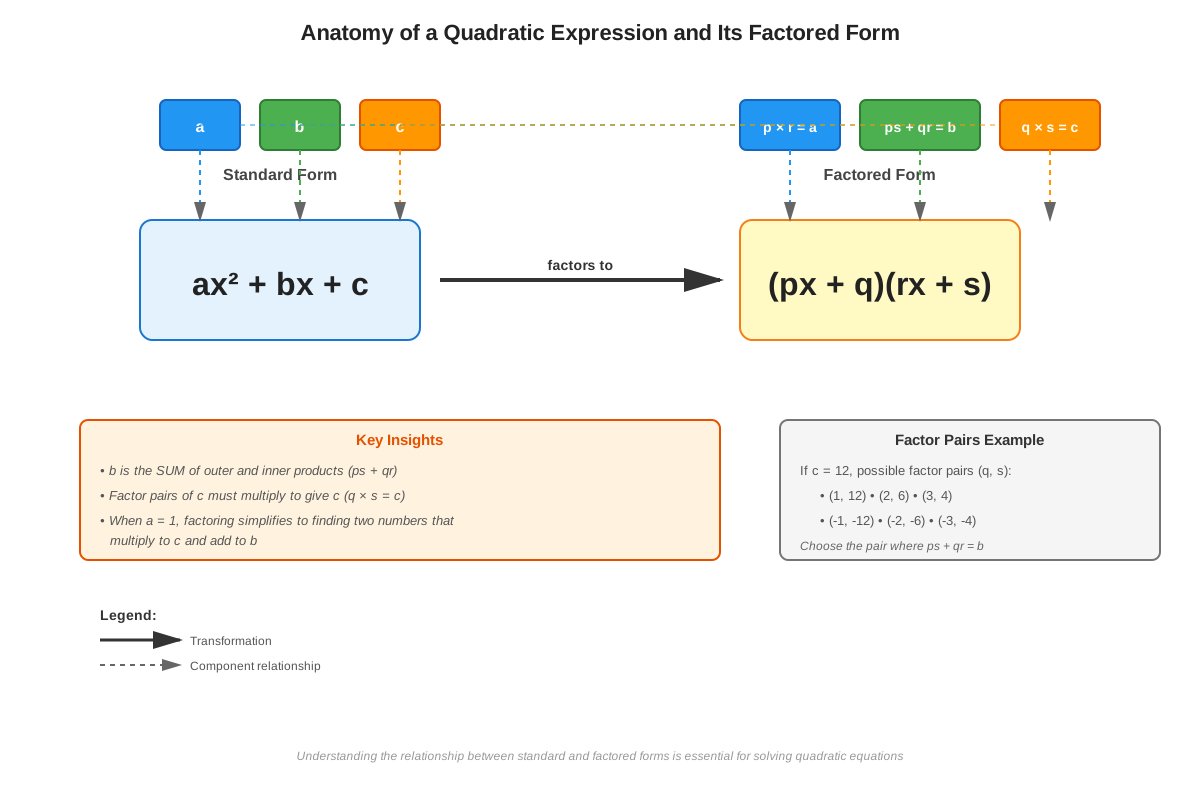
A quadratic expression in standard form is written as ax² + bx + c, where a, b, and c are constants and a ≠ 0. The factored form of a quadratic is (mx + p)(nx + q), where the product of these two binomials equals the original quadratic. When multiplying binomials, the First, Outer, Inner, Last (FOIL) method produces: mx·nx + mx·q + p·nx + p·q = mnx² + (mq + pn)x + pq. Factoring reverses this process, decomposing the quadratic back into its binomial factors.
The relationship between standard and factored forms reveals critical information. The coefficient a equals mn (the product of the leading coefficients in each binomial), the coefficient b equals mq + pn (the sum of the outer and inner products), and the constant c equals pq (the product of the constant terms). Understanding these relationships enables systematic factoring approaches and helps verify solutions.
Factoring When a = 1
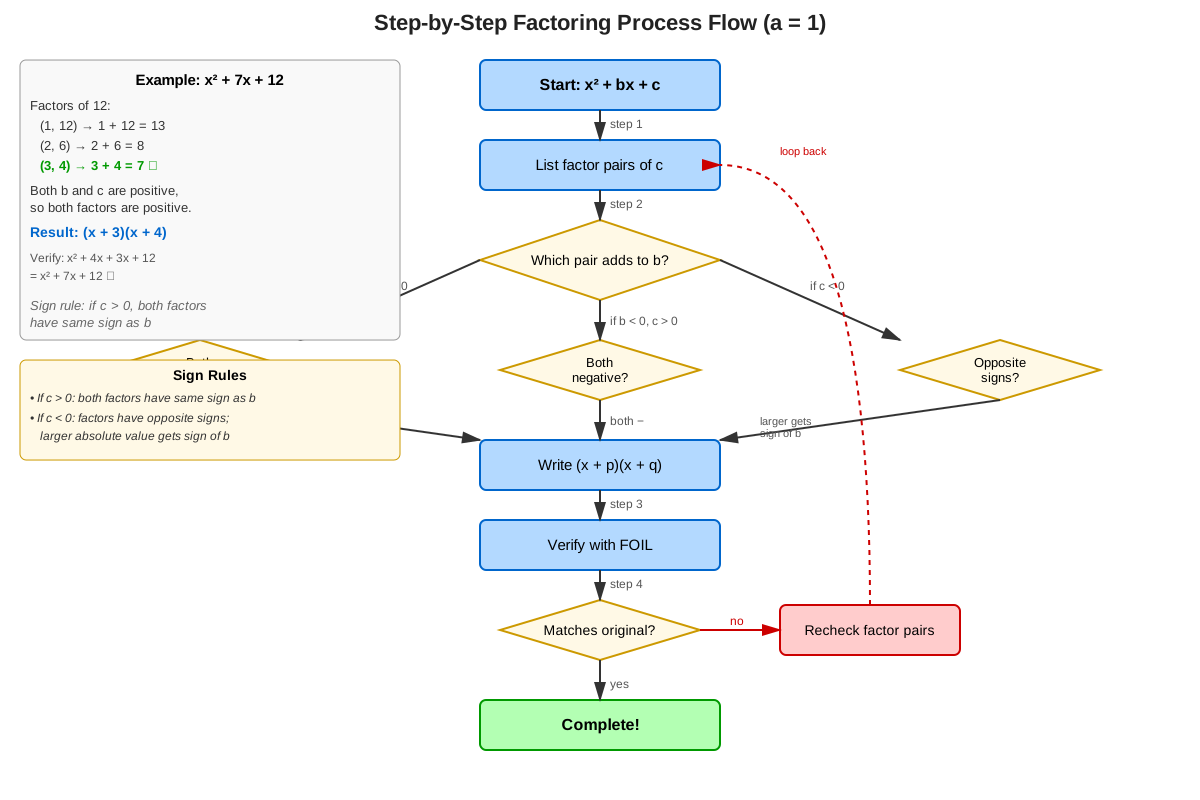
When the leading coefficient equals 1, the quadratic takes the form x² + bx + c, and factoring becomes more straightforward. The goal is finding two numbers that multiply to c and add to b. These two numbers become the constant terms in the factored binomials: (x + p)(x + q).
Step-by-step process:
- Identify the constant term (c) and the coefficient of x (b)
- List all factor pairs of c (considering both positive and negative factors)
- Determine which factor pair adds to b
- Write the factored form as (x + first number)(x + second number)
- Verify by expanding using FOIL
For example, to factor x² + 7x + 12:
- Constant term: 12, coefficient of x: 7
- Factor pairs of 12: (1,12), (2,6), (3,4)
- Which pair adds to 7? 3 + 4 = 7
- Factored form: (x + 3)(x + 4)
- Verification: (x + 3)(x + 4) = x² + 4x + 3x + 12 = x² + 7x + 12 ✓
Sign Patterns in Factoring
Understanding how signs affect factoring is crucial for efficiency:
| Quadratic Form | Sign of c | Sign of b | Factor Pattern | Example |
|---|---|---|---|---|
| x² + bx + c | Positive | Positive | Both factors positive | x² + 5x + 6 = (x + 2)(x + 3) |
| x² - bx + c | Positive | Negative | Both factors negative | x² - 5x + 6 = (x - 2)(x - 3) |
| x² + bx - c | Negative | Either | Factors have opposite signs, larger absolute value matches sign of b | x² + x - 6 = (x + 3)(x - 2) |
| x² - bx - c | Negative | Either | Factors have opposite signs, larger absolute value is negative | x² - x - 6 = (x - 3)(x + 2) |
Factoring When a ≠ 1
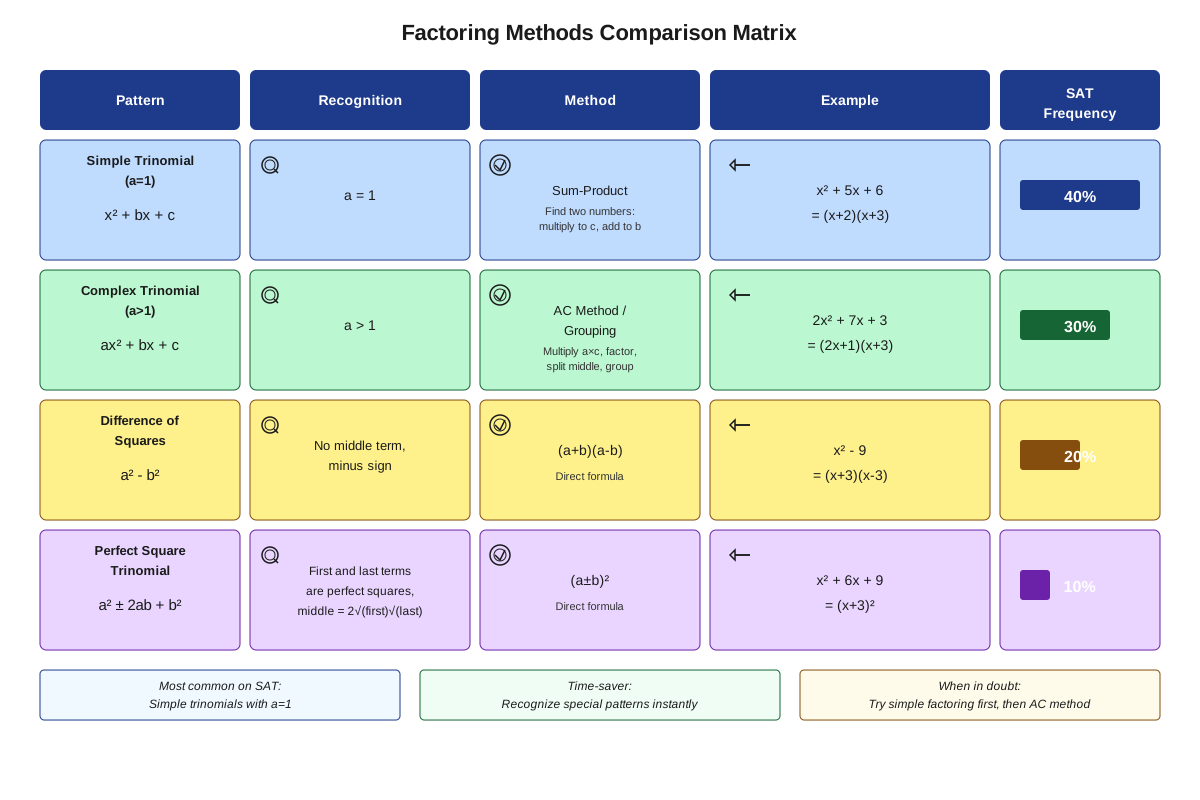
When the leading coefficient is not 1, the quadratic takes the form ax² + bx + c where a > 1. This scenario requires finding factors of both a and c that combine properly. The AC method (also called grouping) provides a systematic approach:
- Multiply a and c to get AC
- Find two numbers that multiply to AC and add to b
- Rewrite the middle term (bx) using these two numbers
- Factor by grouping: factor out common terms from the first two terms and last two terms
- Factor out the common binomial
For example, to factor 2x² + 7x + 3:
- AC = 2 × 3 = 6
- Find two numbers that multiply to 6 and add to 7: 6 and 1
- Rewrite: 2x² + 6x + 1x + 3
- Group: (2x² + 6x) + (1x + 3)
- Factor each group: 2x(x + 3) + 1(x + 3)
- Factor out common binomial: (x + 3)(2x + 1)
Special Factoring Patterns
Certain quadratics follow predictable patterns that enable instant factoring:
Difference of Squares: a² - b² = (a + b)(a - b)
This pattern applies when there's no middle term and the constant is negative. Examples include x² - 9 = (x + 3)(x - 3) and 4x² - 25 = (2x + 5)(2x - 5).
Perfect Square Trinomials: a² + 2ab + b² = (a + b)² and a² - 2ab + b² = (a - b)²
These occur when the first and last terms are perfect squares and the middle term equals twice the product of their square roots. For instance, x² + 6x + 9 = (x + 3)² because 6x = 2(x)(3).
Recognizing these patterns saves significant time on the SAT, as they appear in approximately 2-3 questions per test.
Connecting Factoring to Solutions
The Zero Product Property states that if ab = 0, then a = 0 or b = 0. This principle connects factoring to solving equations. When a quadratic equation is set equal to zero and factored, each factor can be set to zero independently to find solutions (also called roots, zeros, or x-intercepts).
For example, if x² + 5x + 6 = 0:
- Factor: (x + 2)(x + 3) = 0
- Set each factor to zero: x + 2 = 0 or x + 3 = 0
- Solutions: x = -2 or x = -3
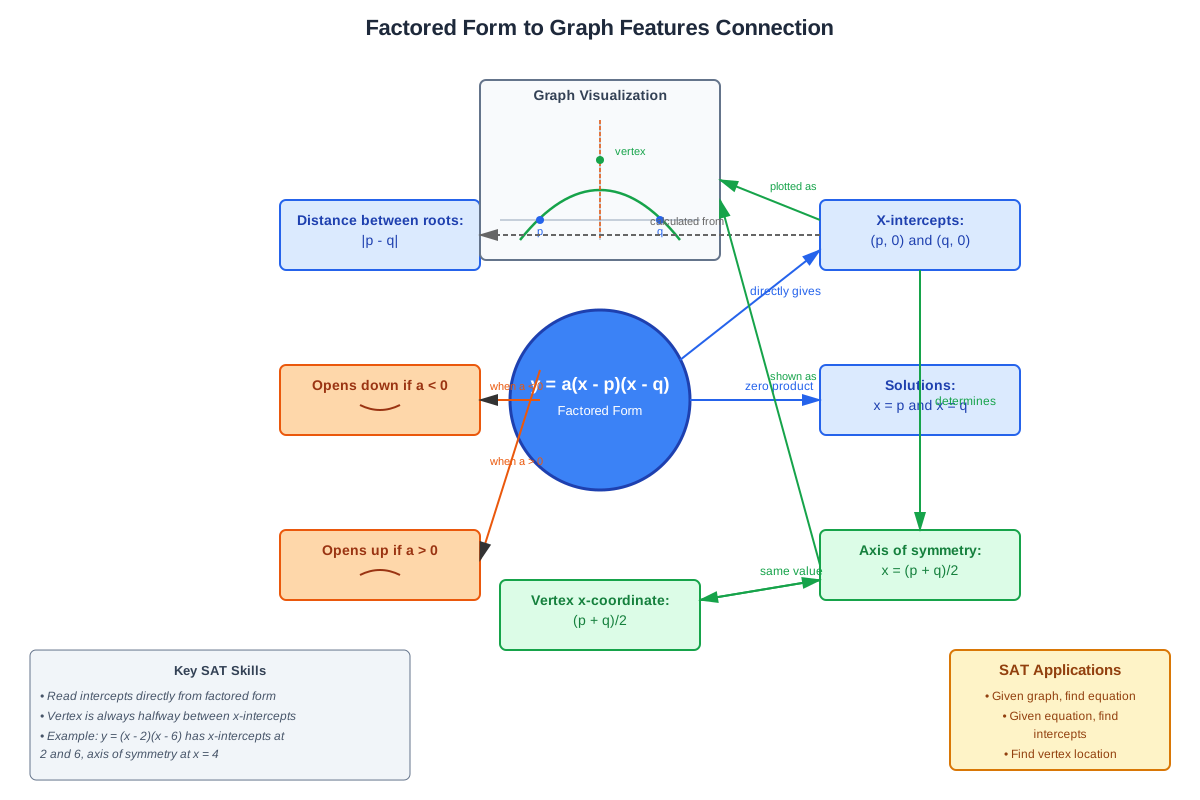
These solutions represent where the parabola crosses the x-axis, making factoring essential for graphing and interpreting quadratic functions.
Concept Relationships
Factoring quadratics sits at the intersection of multiple algebraic concepts, serving as both a destination and a starting point for mathematical reasoning. The process begins with multiplying binomials → which produces quadratic expressions in standard form → which can be reversed through factoring → which enables solving quadratic equations → which reveals x-intercepts of parabolas → which supports graphing and analyzing quadratic functions.
Within the factoring process itself, concepts build hierarchically. Understanding integer operations and factor pairs → enables identifying numbers that multiply and add to specific values → which supports factoring when a = 1 → which provides the foundation for factoring when a ≠ 1 → while special patterns offer shortcuts that bypass standard procedures.
Factoring also connects laterally to other SAT math topics. The skill relates to polynomial operations (factoring is one type of polynomial manipulation), rational expressions (factoring numerators and denominators enables simplification), systems of equations (factored quadratics can be used to solve certain systems), and function analysis (factored form immediately reveals zeros and helps identify key features).
The relationship between factored form and graphical representation is particularly important for the SAT. The factored form (x - r₁)(x - r₂) directly shows that the parabola crosses the x-axis at x = r₁ and x = r₂, while standard form ax² + bx + c obscures this information. This connection between algebraic and graphical representations frequently appears in SAT questions requiring students to match equations to graphs or interpret features from different forms.
Quick check — test yourself on Factoring quadratics so far.
Try Flashcards →High-Yield Facts
⭐ The sum-product relationship: When factoring x² + bx + c, find two numbers that multiply to c and add to b
⭐ Zero Product Property: If (x - r₁)(x - r₂) = 0, then x = r₁ or x = r₂
⭐ Difference of squares: x² - a² always factors as (x + a)(x - a) with no middle term
⭐ Sign rule for negative constants: When c is negative, the factors have opposite signs, with the larger absolute value matching the sign of b
⭐ AC method: For ax² + bx + c where a ≠ 1, find two numbers that multiply to ac and add to b, then factor by grouping
- Perfect square trinomials have the form a² ± 2ab + b² and factor as (a ± b)²
- Factored form (x - p)(x - q) reveals x-intercepts at x = p and x = q
- Always verify factoring by expanding the result using FOIL or distribution
- When a quadratic cannot be factored using integers, it's called "prime" or "irreducible" over the integers
- The greatest common factor (GCF) should always be factored out first before attempting other factoring methods
- On the SAT, if factoring seems extremely difficult, consider whether the quadratic formula or completing the square might be more efficient
- Factoring is the reverse of multiplying binomials; understanding FOIL deeply makes factoring more intuitive
Common Misconceptions
Misconception: The factors of x² + 5x + 6 are (x + 5)(x + 6) because you just put the coefficients into the binomials.
Correction: You must find two numbers that multiply to the constant term (6) and add to the middle coefficient (5). The correct factors are (x + 2)(x + 3) because 2 × 3 = 6 and 2 + 3 = 5.
Misconception: When factoring x² - 9, the answer is (x - 3)(x - 3) or (x - 3)².
Correction: This is a difference of squares, which factors as (x + 3)(x - 3). The pattern a² - b² = (a + b)(a - b) requires one factor with addition and one with subtraction. You can verify: (x - 3)² = x² - 6x + 9, not x² - 9.
Misconception: If a quadratic has a leading coefficient other than 1, you cannot factor it.
Correction: Quadratics with a ≠ 1 can often be factored using the AC method or trial-and-error. For example, 2x² + 7x + 3 factors as (2x + 1)(x + 3). The process is more complex but entirely feasible.
Misconception: The solutions to x² + 4x + 4 = 0 are x = 4 and x = 4.
Correction: First factor correctly: (x + 2)(x + 2) = 0 or (x + 2)² = 0. Setting x + 2 = 0 gives x = -2. This is a repeated root, meaning the parabola touches the x-axis at exactly one point (x = -2), but the solution is -2, not 4.
Misconception: When c is negative, both factors must be negative.
Correction: When the constant term is negative, the factors have opposite signs (one positive, one negative). For example, x² + 2x - 8 = (x + 4)(x - 2), where +4 and -2 have opposite signs and multiply to -8.
Misconception: You can factor x² + 4 as (x + 2)(x + 2).
Correction: Expanding (x + 2)(x + 2) gives x² + 4x + 4, not x² + 4. The expression x² + 4 is prime over the real numbers and cannot be factored using real number factors. On the SAT, if you cannot find factors, the expression may be prime, or you may need to use a different solution method.
Worked Examples
Example 1: Standard Factoring with a = 1
Problem: Factor x² - 3x - 18 and use the result to solve x² - 3x - 18 = 0.
Solution:
Step 1: Identify the structure. This is a quadratic with a = 1, b = -3, and c = -18.
Step 2: Find two numbers that multiply to -18 and add to -3. Since c is negative, the factors have opposite signs.
Factor pairs of 18: (1,18), (2,9), (3,6)
Considering signs:
- 1 and -18: 1 + (-18) = -17 ✗
- -1 and 18: -1 + 18 = 17 ✗
- 2 and -9: 2 + (-9) = -7 ✗
- -2 and 9: -2 + 9 = 7 ✗
- 3 and -6: 3 + (-6) = -3 ✓
- -3 and 6: -3 + 6 = 3 ✗
Step 3: The numbers are 3 and -6. Write the factored form: (x + 3)(x - 6)
Step 4: Verify by expanding: (x + 3)(x - 6) = x² - 6x + 3x - 18 = x² - 3x - 18 ✓
Step 5: Solve the equation using the Zero Product Property:
(x + 3)(x - 6) = 0
x + 3 = 0 or x - 6 = 0
x = -3 or x = 6
Connection to learning objectives: This example demonstrates identifying key features (the coefficients and constant), applying factoring techniques systematically, and connecting factored form to solutions—all essential SAT skills.
Example 2: Factoring with a ≠ 1 Using the AC Method
Problem: Factor 3x² - 10x + 8 completely.
Solution:
Step 1: Identify a = 3, b = -10, c = 8.
Step 2: Calculate AC = 3 × 8 = 24.
Step 3: Find two numbers that multiply to 24 and add to -10. Since both AC and b are negative, both numbers must be negative.
Factor pairs of 24: (1,24), (2,12), (3,8), (4,6)
With negative signs:
- -1 and -24: (-1) + (-24) = -25 ✗
- -2 and -12: (-2) + (-12) = -14 ✗
- -3 and -8: (-3) + (-8) = -11 ✗
- -4 and -6: (-4) + (-6) = -10 ✓
Step 4: Rewrite the middle term using -4 and -6:
3x² - 10x + 8 = 3x² - 4x - 6x + 8
Step 5: Factor by grouping:
= (3x² - 4x) + (-6x + 8)
= x(3x - 4) - 2(3x - 4)
Step 6: Factor out the common binomial (3x - 4):
= (3x - 4)(x - 2)
Step 7: Verify by expanding:
(3x - 4)(x - 2) = 3x² - 6x - 4x + 8 = 3x² - 10x + 8 ✓
Connection to learning objectives: This example shows how factoring quadratics appears in more complex SAT problems where a ≠ 1, requiring systematic application of the AC method—a technique that frequently appears on the test.
Exam Strategy
When approaching SAT questions involving factoring quadratics, begin by identifying whether the question explicitly asks for factoring or whether factoring is an intermediate step toward another goal (solving an equation, finding intercepts, or simplifying an expression). This recognition determines your strategic approach and time allocation.
Trigger words and phrases that signal factoring may be useful include: "solve for x," "find the zeros," "x-intercepts," "where the graph crosses the x-axis," "factor completely," "write in factored form," "find the values that make the expression equal to zero," and "simplify the expression." When you see these phrases, immediately assess whether the quadratic is factorable before considering alternative methods like the quadratic formula.
Process-of-elimination strategies specific to factoring:
- If answer choices are in factored form, expand one or two to eliminate incorrect options quickly
- For multiple-choice questions asking for solutions, substitute answer choices into the original equation rather than factoring if factoring seems difficult
- When answer choices contain different factor combinations, check the constant term first—it must equal the product of the constants in the factors
- If the quadratic has a large leading coefficient or constant term, consider whether the question might be testing special patterns (difference of squares, perfect square trinomials) rather than general factoring
Time allocation advice: Allocate 30-45 seconds for straightforward factoring when a = 1, and 60-90 seconds when a ≠ 1 or when factoring is embedded in a multi-step problem. If you cannot identify factors within 30 seconds, consider alternative approaches. On the SAT, efficiency matters as much as accuracy—spending three minutes on a single factoring problem sacrifices time needed for other questions.
Exam Tip: Always verify your factored form by expanding it, especially on grid-in questions where you cannot rely on answer choices. This five-second check prevents careless errors that cost points.
Strategic decision-making: Factoring is typically faster than the quadratic formula when the quadratic factors cleanly with small integers. However, if you attempt factoring for more than 30 seconds without success, switch to the quadratic formula or completing the square. The SAT occasionally includes quadratics that don't factor nicely, testing whether students can recognize when to change methods.
Memory Techniques
FOIL Reversal Mnemonic: "Find Factors, Observe Operations, Identify Integers, Link Logically" reminds you that factoring reverses FOIL by finding the factors that produce the First, Outer, Inner, and Last terms.
Sum-Product Rhyme: "Multiply to the end, add to the friend" helps remember that factors must multiply to c (the end term) and add to b (the coefficient of x, the "friend" of x).
Sign Pattern Visualization: Create a mental 2×2 grid:
         c positive    |    c negative
    _____________________|____________________
b positive  | both +          | larger +, smaller -
b negative  | both -          | larger -, smaller +
AC Method Acronym: "Always Combine Middle Expressions Together Helpfully Organized Directly" represents the steps: find AC, identify the two numbers, rewrite the Middle term, factor Each group, extract The common binomial, verify by expanding using HOD (a playful reminder to check your work).
Difference of Squares Visualization: Picture two squares of different sizes. The difference in their areas equals the product of (sum of sides)(difference of sides). Visualize: (big square) - (small square) = (big + small)(big - small).
Perfect Square Trinomial Check: "Square Roots Twice" (SRT) reminds you to take the square root of the first term, square root of the last term, and check if twice their product equals the middle term.
Summary
Factoring quadratics is an essential SAT math skill that involves rewriting quadratic expressions from standard form (ax² + bx + c) into factored form as a product of two binomials. When the leading coefficient equals 1, factoring requires finding two numbers that multiply to the constant term and add to the middle coefficient. When the leading coefficient exceeds 1, the AC method provides a systematic approach through grouping. Special patterns like difference of squares (a² - b² = (a + b)(a - b)) and perfect square trinomials (a² ± 2ab + b² = (a ± b)²) enable rapid factoring when recognized. The connection between factored form and solutions through the Zero Product Property makes factoring invaluable for solving equations and identifying x-intercepts. Success on SAT factoring questions requires recognizing when factoring is the optimal approach, executing the appropriate technique efficiently, and verifying results through expansion. Mastery of factoring provides both direct point-scoring opportunities and enables efficient problem-solving across multiple question types.
Key Takeaways
- Factoring reverses the multiplication of binomials, transforming ax² + bx + c into (mx + p)(nx + q)
- For quadratics with a = 1, find two numbers that multiply to c and add to b
- When c is negative, factors have opposite signs; when c is positive, factors have the same sign
- The AC method handles quadratics where a ≠ 1 by finding numbers that multiply to ac and add to b, then factoring by grouping
- Special patterns (difference of squares and perfect square trinomials) provide instant factoring shortcuts
- Factored form directly reveals solutions through the Zero Product Property and shows x-intercepts graphically
- Always verify factoring by expanding the result to catch errors before finalizing answers
Related Topics
Solving Quadratic Equations: Factoring is one of three primary methods (along with the quadratic formula and completing the square) for solving quadratic equations. Mastering factoring enables students to choose the most efficient solution method based on the equation's structure.
Graphing Quadratic Functions: Understanding factored form (y = a(x - r₁)(x - r₂)) reveals x-intercepts immediately and connects algebraic and graphical representations, a frequent SAT testing point.
Polynomial Operations: Factoring quadratics builds the foundation for factoring higher-degree polynomials and understanding polynomial division, both of which appear on advanced math assessments.
Rational Expressions: Simplifying rational expressions requires factoring numerators and denominators to identify and cancel common factors, making quadratic factoring a prerequisite skill.
Systems of Equations: Some SAT problems involve systems where one equation is quadratic, requiring factoring to find intersection points or solution sets.
Practice CTA
Now that you've mastered the core concepts of factoring quadratics, it's time to solidify your understanding through active practice. Attempt the practice questions designed specifically to mirror SAT question formats and difficulty levels. Use the flashcards to reinforce key patterns, special cases, and common factor pairs until recognition becomes automatic. Remember, factoring is a skill that improves dramatically with deliberate practice—each problem you solve strengthens your pattern recognition and increases your speed. The investment you make in practicing factoring now will pay dividends across multiple SAT math questions, potentially adding valuable points to your score. Approach each practice problem strategically, verify your answers, and learn from any mistakes. You've got this!
Sign up free to keep reading
Create a free AnvayaPrep account to finish this SAT guide on Factoring quadratics — plus flashcards and practice questions.