Overview
Quadratic word problems represent one of the most frequently tested applications of algebra on the SAT math section. These problems require students to translate real-world scenarios into quadratic equations, solve them using appropriate methods, and interpret the solutions within the context of the original problem. Unlike straightforward algebraic manipulation questions, quadratic word problems assess both mathematical reasoning and reading comprehension skills simultaneously.
The SAT consistently includes sat quadratic word problems that involve scenarios such as projectile motion, area optimization, revenue maximization, and geometric relationships. These questions typically appear in both the calculator and no-calculator sections, with 2-4 questions per test directly testing this skill. Mastery of this topic is essential because it bridges pure algebraic manipulation with practical problem-solving—a core competency the College Board seeks to measure.
Understanding quadratic word problems connects directly to broader mathematical concepts including functions, graphing parabolas, systems of equations, and optimization. Students who excel at these problems demonstrate the ability to model situations mathematically, a skill that extends beyond the SAT into college-level coursework in STEM fields, economics, and data analysis. The ability to recognize when a situation requires a quadratic model and how to extract meaningful information from the solution distinguishes high-scoring students from average performers.
Learning Objectives
- [ ] Identify key features of quadratic word problems including the variables, constraints, and what the question asks
- [ ] Explain how quadratic word problems appears on the SAT, including common contexts and question formats
- [ ] Apply quadratic word problems to answer SAT-style questions by setting up equations and solving them correctly
- [ ] Translate verbal descriptions of quadratic relationships into algebraic equations
- [ ] Determine which solution(s) to a quadratic equation are valid within the context of the problem
- [ ] Interpret the meaning of vertices, zeros, and other key features of quadratic functions in real-world contexts
- [ ] Select the most efficient solution method (factoring, quadratic formula, completing the square, or graphing) based on the problem structure
Prerequisites
- Solving quadratic equations: Students must be able to solve quadratics using factoring, the quadratic formula, and completing the square, as these are the tools needed to find numerical answers
- Understanding quadratic functions: Knowledge of parabola properties, vertex form, and standard form enables interpretation of solutions in context
- Basic algebraic manipulation: Setting up equations from word problems requires comfort with variables, expressions, and equation-building
- Linear word problems: Experience translating verbal descriptions into mathematical equations provides the foundation for more complex quadratic scenarios
- Geometric formulas: Many quadratic word problems involve area, perimeter, and volume calculations that require formula knowledge
Why This Topic Matters
Quadratic word problems appear with remarkable consistency on the SAT, representing approximately 10-15% of all algebra questions. The College Board uses these problems to assess higher-order thinking skills that go beyond rote memorization. Students encounter these questions in both multiple-choice and student-produced response formats, making them unavoidable for anyone seeking a competitive math score.
In real-world applications, quadratic relationships model countless phenomena: the trajectory of a basketball, the profit function of a business, the area of a fenced enclosure with limited materials, and the relationship between price and demand. Engineers use quadratic models to design bridges and predict structural loads. Economists employ them to analyze market equilibrium and optimize production. Even in everyday life, understanding how changing one variable affects another in a quadratic relationship helps with decision-making about investments, construction projects, and resource allocation.
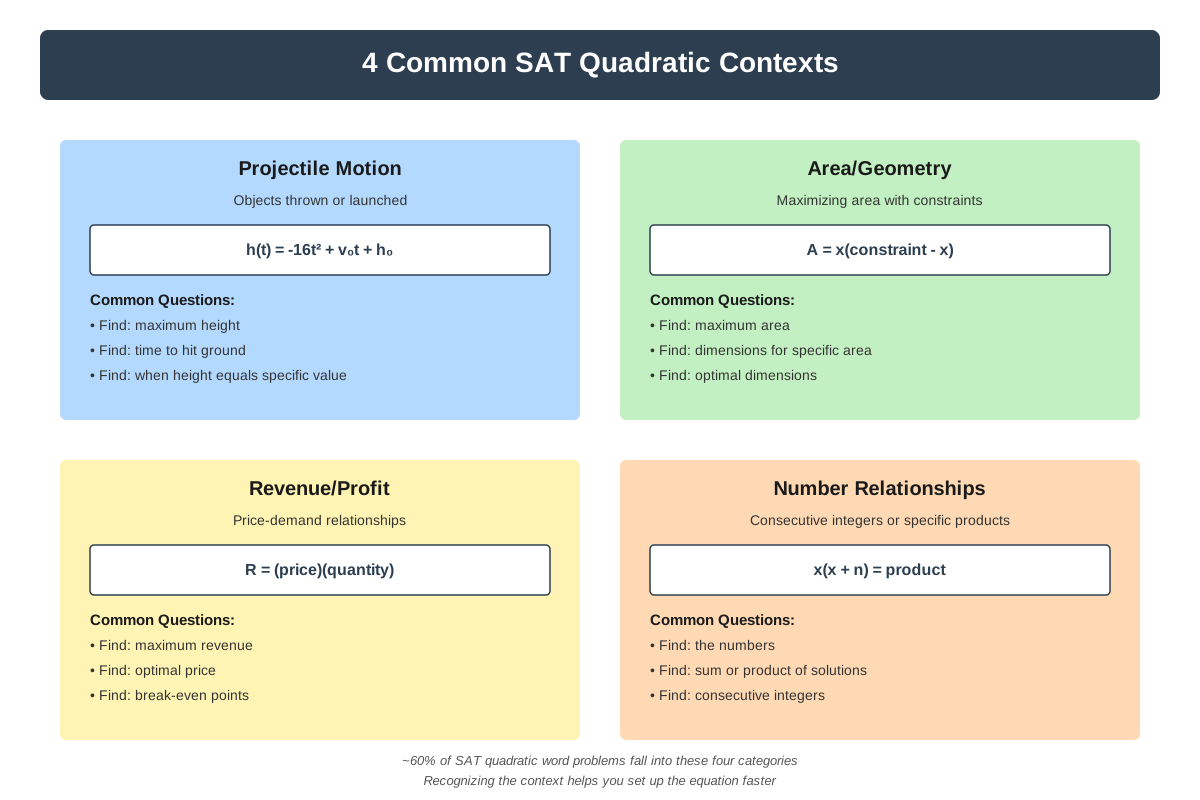
On the SAT specifically, quadratic word problems commonly appear as:
- Projectile motion scenarios asking for maximum height or time to reach the ground
- Area optimization problems involving rectangles, gardens, or fenced regions
- Revenue and profit functions where price and quantity sold have an inverse relationship
- Geometric problems involving the Pythagorean theorem or similar figures
- Number relationship problems where the product or sum of numbers follows a pattern
The College Board deliberately designs these questions to test whether students can move fluidly between verbal, algebraic, and graphical representations of the same relationship—a skill that predicts success in college mathematics.
Core Concepts
Understanding Quadratic Relationships in Context
A quadratic word problem presents a real-world situation where the relationship between variables follows a quadratic pattern, meaning one variable depends on the square of another. The general form of a quadratic function is f(x) = ax² + bx + c, where a ≠ 0. In word problems, students must identify which quantity represents the independent variable (x) and which represents the dependent variable (f(x) or y).
The key distinguishing feature of quadratic relationships is that they involve a squared term. Common indicators include:
- Phrases like "area of a rectangle" (length × width, where both dimensions may vary)
- "Height of an object over time" in projectile motion (gravity creates the squared term)
- "Revenue" when calculated as (price)(quantity sold) and price affects quantity
- Any situation involving the Pythagorean theorem (a² + b² = c²)
The Problem-Solving Process
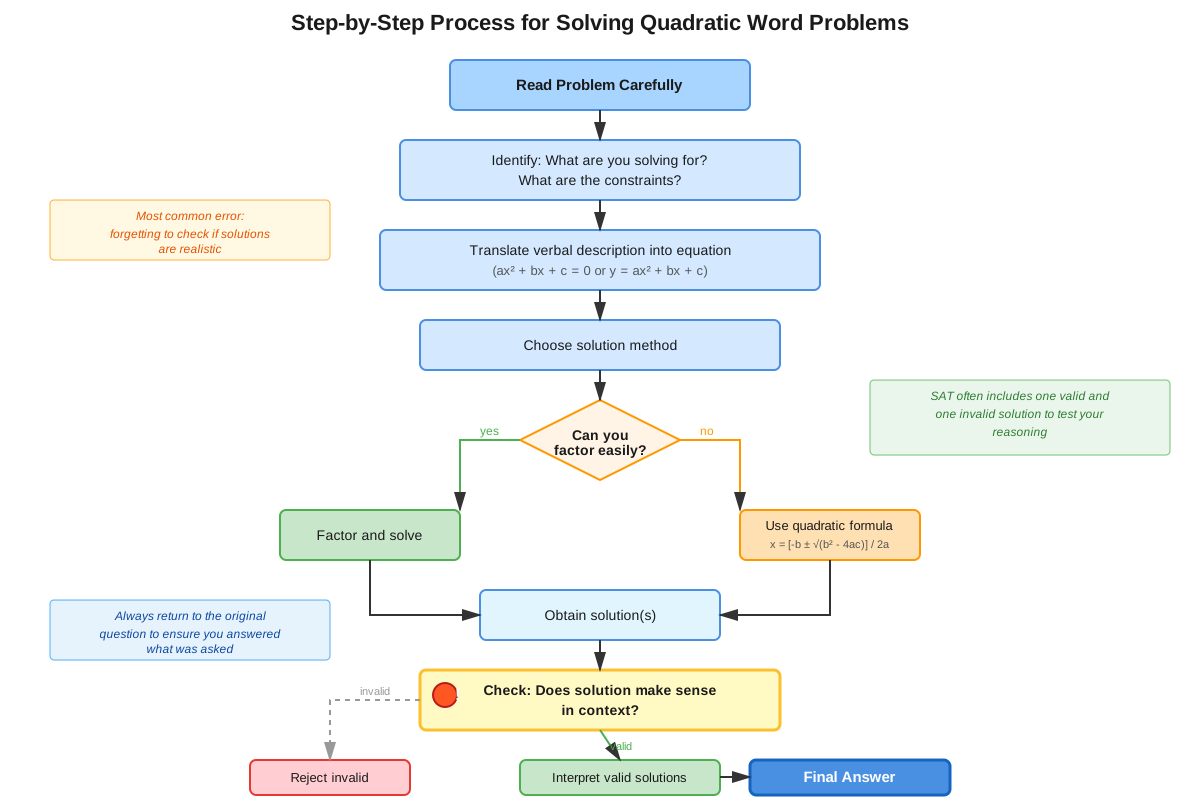
Successfully solving sat quadratic word problems requires a systematic approach:
- Read carefully and identify what the problem asks: Determine the unknown quantity and what information is given
- Define variables: Assign letters to represent unknown quantities, being explicit about units
- Translate relationships into equations: Convert verbal descriptions into algebraic expressions
- Set up the quadratic equation: Combine expressions to create an equation in standard form
- Solve the equation: Use factoring, the quadratic formula, or another appropriate method
- Check solutions for validity: Determine whether both solutions make sense in context
- Answer the specific question: Ensure the final answer addresses what was asked
Common Quadratic Word Problem Types
Projectile Motion Problems
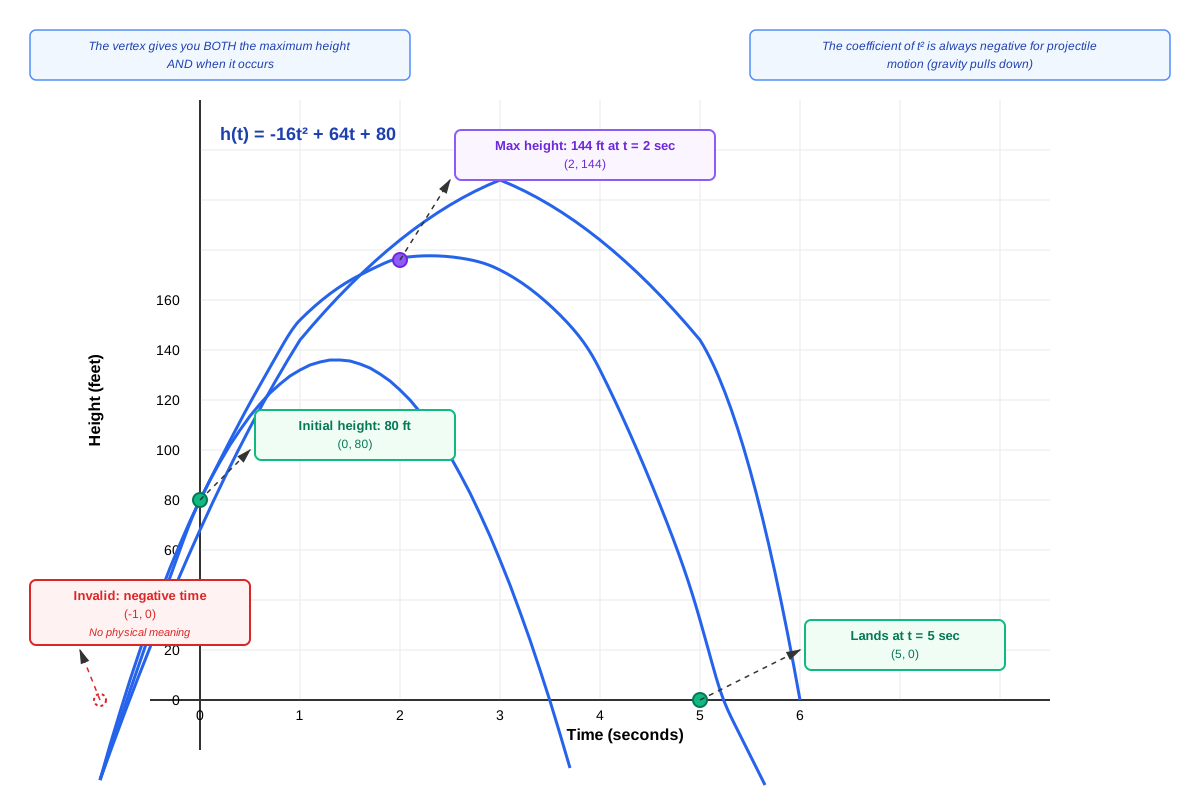
These problems model objects moving under the influence of gravity. The height h (in feet or meters) of an object at time t (in seconds) follows the equation:
h(t) = -16t² + v₀t + h₀  (feet)
or
h(t) = -4.9t² + v₀t + h₀  (meters)
Where v₀ is initial velocity and h₀ is initial height. The coefficient (-16 or -4.9) represents half the acceleration due to gravity. Questions typically ask for:
- Maximum height (the y-coordinate of the vertex)
- Time to reach maximum height (the x-coordinate of the vertex)
- Time when the object hits the ground (when h = 0)
- Height at a specific time (substitute t and evaluate)
Area and Perimeter Problems
These involve geometric figures where dimensions are related. For a rectangle with perimeter P and one side x:
- The other side is (P/2 - x)
- Area A = x(P/2 - x) = (P/2)x - x², which is quadratic
Questions might ask for dimensions that produce a specific area or the maximum possible area given a fixed perimeter.
Revenue and Profit Problems
Revenue equals price times quantity sold. When price affects demand, the relationship becomes quadratic:
- If price p = 100 - 2x (where x is quantity)
- Then Revenue R = px = (100 - 2x)x = 100x - 2x²
These problems often ask for the price or quantity that maximizes revenue, requiring students to find the vertex of the parabola.
Number Relationship Problems
These present relationships between numbers, such as:
- "Two consecutive integers whose product is 132"
- "A number and its square differ by 42"
- "The sum of a number and its reciprocal is 2.5"
Interpreting Solutions in Context
A critical skill in quadratic word problems is determining which solution(s) are valid. When solving a quadratic equation, students typically obtain two solutions. However:
- Negative solutions may be invalid if the variable represents a physical quantity like length, time, or population
- Both solutions may be valid if the variable can logically take both values (e.g., two different dimensions that produce the same area)
- Extraneous solutions may arise from the algebraic process but not satisfy the original problem constraints
| Problem Type | Common Invalid Solutions | Reason |
|---|---|---|
| Projectile motion (time) | Negative time values | Time cannot be negative in these contexts |
| Geometric dimensions | Negative lengths | Physical lengths must be positive |
| Revenue problems | Quantities exceeding capacity | Real-world constraints limit production |
| Age problems | Non-integer or negative ages | Ages must be positive and often whole numbers |
Vertex Form and Optimization
Many SAT quadratic word problems involve finding maximum or minimum values. The vertex of a parabola f(x) = ax² + bx + c occurs at:
x = -b/(2a)The y-coordinate of the vertex is found by substituting this x-value back into the function. For optimization problems:
- If a > 0, the parabola opens upward and the vertex represents a minimum
- If a < 0, the parabola opens downward and the vertex represents a maximum
This is particularly useful for:
- Finding maximum height in projectile problems
- Determining maximum revenue or profit
- Optimizing area with fixed perimeter
Concept Relationships
The concepts within quadratic word problems form an interconnected web of skills. Problem comprehension leads to variable definition, which enables equation setup. The equation setup determines which solution method is most efficient. After obtaining algebraic solutions, students must apply contextual interpretation to determine validity, and finally perform answer verification to ensure the solution addresses the original question.
Quadratic word problems connect to prerequisite topics in essential ways. Linear word problems provide the foundation for translating verbal descriptions into equations, but quadratic problems add complexity through squared terms and two potential solutions. Solving quadratic equations supplies the technical tools needed once the equation is established. Function concepts help students understand that word problems often describe functional relationships where one quantity depends on another.
The relationship map flows as follows:
Reading comprehension → Identifying quadratic indicators → Variable assignment → Equation building → Algebraic manipulation → Solution finding → Context checking → Answer selection
Additionally, quadratic word problems connect forward to more advanced topics. They provide practice with function modeling, which extends to exponential and polynomial functions. The optimization skills developed here preview calculus concepts of maxima and minima. The ability to interpret multiple solutions prepares students for systems of equations and rational equations where solution validity must be checked.
High-Yield Facts
⭐ The vertex of a parabola f(x) = ax² + bx + c occurs at x = -b/(2a), which gives the maximum or minimum value
⭐ In projectile motion problems, the coefficient of t² is always negative (-16 for feet, -4.9 for meters), indicating the parabola opens downward
⭐ When a quadratic equation yields two solutions, always check both against the problem context to determine which are valid
⭐ Area problems involving rectangles with fixed perimeter always produce quadratic equations in one dimension
⭐ Revenue = (price)(quantity), and when price depends on quantity, the relationship is quadratic
- The discriminant b² - 4ac determines the number of real solutions: positive gives two, zero gives one, negative gives none
- Maximum height in projectile problems occurs at the vertex, which is halfway between the two times when the object is at ground level
- When consecutive integers are involved, if the first is n, the next is n + 1, and their product is n(n + 1) = n² + n
- The sum of the roots of ax² + bx + c = 0 equals -b/a, and their product equals c/a
- In optimization problems with constraints, the quadratic equation often comes from substituting one constraint into another
- Time cannot be negative in projectile motion problems, so always reject negative time solutions
- The axis of symmetry of a parabola passes through the vertex and has equation x = -b/(2a)
Quick check — test yourself on Quadratic word problems so far.
Try Flashcards →Common Misconceptions
Misconception: Both solutions to a quadratic equation are always valid in word problems.
Correction: Solutions must be checked against the problem context. Negative values for time, length, or quantity often don't make physical sense and should be rejected. Always ask whether each solution is reasonable given what the variable represents.
Misconception: The larger solution is always the correct answer.
Correction: The correct answer depends on what the question asks. If asking for "time to hit the ground," the larger time value is typically correct. If asking for "dimensions that give a specific area," either or both solutions might be valid. Always read what the question specifically requests.
Misconception: Projectile motion problems always ask for maximum height.
Correction: These problems can ask for various quantities: time to reach maximum height, time to hit the ground, height at a specific time, or initial velocity. Carefully identify what the question asks before solving.
Misconception: In revenue problems, maximizing price always maximizes revenue.
Correction: Revenue is the product of price and quantity sold. As price increases, quantity typically decreases. Maximum revenue occurs at the vertex of the revenue parabola, which represents an optimal balance between price and quantity, not the highest possible price.
Misconception: The quadratic formula is always the best solution method.
Correction: While the quadratic formula always works, factoring is faster when the quadratic factors easily, and finding the vertex using x = -b/(2a) is more efficient for optimization problems. Choose the method that matches the problem type and the form of the equation.
Misconception: Area problems always involve squares.
Correction: Quadratic area problems most commonly involve rectangles where both dimensions vary according to some constraint. The equation becomes quadratic because area equals length times width, and one dimension is expressed in terms of the other.
Worked Examples
Example 1: Projectile Motion
Problem: A ball is thrown upward from the top of a 96-foot building with an initial velocity of 80 feet per second. The height h (in feet) of the ball above the ground after t seconds is given by h(t) = -16t² + 80t + 96. How many seconds after being thrown will the ball hit the ground?
Solution:
Step 1: Identify what the problem asks. We need to find the time when the ball hits the ground, which means h = 0.
Step 2: Set up the equation:
0 = -16t² + 80t + 96Step 3: Simplify by dividing all terms by -16:
0 = t² - 5t - 6Step 4: Factor the quadratic:
0 = (t - 6)(t + 1)Step 5: Solve for t:
t - 6 = 0  or  t + 1 = 0
t = 6  or  t = -1
Step 6: Check solutions in context. Time cannot be negative, so t = -1 is not valid. The ball hits the ground at t = 6 seconds.
Step 7: Verify by substituting back:
h(6) = -16(36) + 80(6) + 96 = -576 + 480 + 96 = 0 ✓Answer: The ball hits the ground 6 seconds after being thrown.
This problem demonstrates the importance of rejecting invalid solutions (negative time) and connects to the learning objective of applying quadratic word problems to SAT-style questions.
Example 2: Area Optimization
Problem: A farmer has 200 feet of fencing to enclose a rectangular garden. One side of the garden will be against an existing wall, so fencing is needed for only three sides. What dimensions will maximize the area of the garden, and what is that maximum area?
Solution:
Step 1: Define variables. Let x = length of each side perpendicular to the wall (in feet), and let y = length of the side parallel to the wall (in feet).
Step 2: Set up constraint equation. The total fencing is:
2x + y = 200Step 3: Solve for y in terms of x:
y = 200 - 2xStep 4: Write the area function:
A(x) = xy = x(200 - 2x) = 200x - 2x²Step 5: This is a quadratic function with a = -2, b = 200, c = 0. Since a < 0, the parabola opens downward and has a maximum at the vertex.
Step 6: Find the x-coordinate of the vertex:
x = -b/(2a) = -200/(2(-2)) = -200/(-4) = 50Step 7: Find the corresponding y-value:
y = 200 - 2(50) = 200 - 100 = 100Step 8: Calculate maximum area:
A = xy = 50(100) = 5000 square feetStep 9: Verify this makes sense. The dimensions are positive, use exactly 200 feet of fencing (2(50) + 100 = 200), and represent a reasonable garden size.
Answer: The dimensions that maximize area are 50 feet perpendicular to the wall and 100 feet parallel to the wall, giving a maximum area of 5,000 square feet.
This problem illustrates optimization using the vertex formula and demonstrates how constraints lead to quadratic equations, addressing multiple learning objectives including identifying key features and applying solution methods.
Exam Strategy
When approaching quadratic word problems on the SAT, begin by reading the entire problem carefully to understand the scenario before attempting any calculations. Identify the trigger words that signal a quadratic relationship: "area," "product," "height over time," "revenue," "maximum," "minimum," or any mention of squared quantities.
Time allocation: Spend 1.5-2.5 minutes on typical quadratic word problems. If a problem seems to require more time, mark it and return after completing easier questions. These problems are worth the same points as simpler questions, so don't let one difficult problem consume excessive time.
Process-of-elimination strategies:
- Eliminate answer choices that are negative when the context requires positive values (lengths, times in projectile problems)
- Eliminate choices that violate stated constraints (dimensions that exceed available materials, times that are unreasonably large)
- For maximum/minimum problems, eliminate extreme values; the answer typically lies between the given constraints
- Check units carefully; eliminate answers with incorrect units
Approach by problem type:
For projectile motion: Immediately identify whether the question asks for maximum height (vertex), time to maximum height (x-coordinate of vertex), or time to hit ground (solve for h = 0). This determines your solution method before you begin calculations.
For area problems: Draw a quick diagram labeling dimensions with variables. Write the constraint equation first, then express area in terms of a single variable. This visual approach prevents errors in equation setup.
For revenue problems: Remember that Revenue = (price)(quantity). If given a relationship between price and quantity, substitute to create a quadratic function, then find the vertex for maximum revenue.
Calculator usage: On calculator-permitted sections, use the graphing function to visualize the parabola and identify the vertex or zeros. This provides a quick check of algebraic work and can help eliminate incorrect answer choices.
Common question formats:
- "What is the maximum/minimum value?" → Find the y-coordinate of the vertex
- "At what value does the maximum/minimum occur?" → Find the x-coordinate of the vertex
- "When does [quantity] equal zero?" → Solve the quadratic equation
- "What are the possible dimensions?" → Solve and check both solutions for validity
Memory Techniques
VERTEX mnemonic for optimization problems:
- Variable definition comes first
- Equation setup using constraints
- Rewrite in terms of one variable
- Take the derivative (or use x = -b/2a)
- Evaluate to find maximum/minimum
- X-check your answer in context
"Negative Time Never": Remember that in projectile motion and most real-world scenarios, negative time values are invalid. This simple phrase helps eliminate incorrect solutions quickly.
The "GROUND is ZERO" rule: When projectile problems ask when an object hits the ground, set height equal to zero. This direct association prevents confusion about what equation to solve.
Area = Length × Width = Quadratic: Visualize that whenever both dimensions of a rectangle can vary, multiplying them creates a squared term, making the relationship quadratic.
Parabola Direction Determines Optimization:
- Frown (opens down, a < 0) → Maximum at vertex
- Smile (opens up, a > 0) → Minimum at vertex
Picture a sad face for maximum (the vertex is at the top) and a happy face for minimum (the vertex is at the bottom).
The "Two Solutions, One Context" reminder: Quadratic equations give two solutions, but word problems often accept only one. Always ask: "Does this solution make sense in the real world?"
Summary
Quadratic word problems on the SAT require students to translate real-world scenarios into quadratic equations, solve them using appropriate algebraic methods, and interpret solutions within the original context. These problems consistently appear in multiple formats, including projectile motion, area optimization, revenue maximization, and geometric relationships. Success requires a systematic approach: careful reading to identify the quadratic relationship, precise variable definition, accurate equation setup, efficient solution using factoring or the quadratic formula, and critical evaluation of which solutions are valid in context. The vertex formula x = -b/(2a) is essential for optimization problems, while understanding that negative solutions often lack physical meaning prevents common errors. Students must recognize trigger words like "area," "maximum," "height over time," and "revenue" that signal quadratic relationships. Mastery of these problems demonstrates the ability to move fluidly between verbal descriptions, algebraic representations, and graphical interpretations—a core competency the SAT measures and a skill essential for college-level mathematics.
Key Takeaways
- Quadratic word problems appear 2-4 times per SAT and test the ability to model real-world situations mathematically
- Always check both solutions from a quadratic equation against the problem context; negative values for time, length, or quantity are often invalid
- The vertex formula x = -b/(2a) quickly finds maximum or minimum values in optimization problems
- Projectile motion problems use h(t) = -16t² + v₀t + h₀ (feet) or h(t) = -4.9t² + v₀t + h₀ (meters), with the negative coefficient indicating downward-opening parabolas
- Area problems involving rectangles with constraints produce quadratic equations when one dimension is expressed in terms of the other
- Revenue problems become quadratic when price affects quantity sold, and maximum revenue occurs at the vertex of the parabola
- Systematic problem-solving—read carefully, define variables, set up equations, solve, check validity, answer the question—prevents errors and saves time
Related Topics
Systems of Equations with Quadratics: Building on single quadratic word problems, students learn to solve scenarios where a quadratic equation intersects with a linear equation, representing situations where two different relationships must be satisfied simultaneously.
Polynomial Functions: Quadratic word problems provide the foundation for understanding higher-degree polynomial functions, where similar modeling and optimization techniques apply to more complex relationships.
Exponential Growth and Decay: While quadratic functions model situations with constant acceleration, exponential functions model constant percentage change. Understanding when each model applies is crucial for advanced problem-solving.
Rational Equations in Context: Some word problems involve rates and work, leading to rational equations. The problem-solving framework developed for quadratic word problems transfers directly to these more complex scenarios.
Trigonometric Applications: Advanced projectile motion problems may incorporate angles and trigonometry, extending the basic quadratic model to two-dimensional motion.
Practice CTA
Now that you've mastered the core concepts of quadratic word problems, it's time to solidify your understanding through practice. Attempt the practice questions designed specifically for this topic, focusing on applying the systematic approach outlined in this guide. Use the flashcards to reinforce key formulas, trigger words, and solution strategies. Remember that proficiency with quadratic word problems comes from recognizing patterns across different contexts—each practice problem strengthens your ability to identify quadratic relationships quickly and solve them efficiently. Your investment in practice now will pay dividends on test day when you encounter these high-value questions with confidence and speed. You've got this!
Sign up free to keep reading
Create a free AnvayaPrep account to finish this SAT guide on Quadratic word problems — plus flashcards and practice questions.