Overview
Revenue quadratic problems represent one of the most practical and frequently tested applications of quadratic functions on the SAT math section. These problems model real-world business scenarios where revenue depends on price and quantity sold, creating a parabolic relationship that students must analyze to find maximum revenue, optimal pricing, or break-even points. Understanding revenue quadratics bridges abstract algebraic concepts with tangible economic situations, making them both conceptually accessible and mathematically rigorous.
The SAT consistently features sat revenue quadratic problems because they efficiently test multiple mathematical competencies simultaneously: interpreting word problems, translating verbal descriptions into algebraic expressions, manipulating quadratic equations, and extracting meaningful information from parabolic graphs. These problems typically appear in both calculator and no-calculator sections, often as medium-to-hard difficulty questions worth valuable points. Students who master revenue quadratics gain confidence in tackling complex multi-step problems that require both computational accuracy and conceptual understanding.
Within the broader landscape of quadratic equations, revenue problems serve as the practical application that demonstrates why students learn to find vertices, interpret coefficients, and work with parabolas. They connect directly to function analysis, coordinate geometry, and optimization—skills that extend beyond the SAT into calculus, economics, and business mathematics. Mastering this topic provides a framework for approaching any real-world optimization problem involving quadratic relationships.
Learning Objectives
- [ ] Identify key features of Revenue quadratic problems
- [ ] Explain how Revenue quadratic problems appears on the SAT
- [ ] Apply Revenue quadratic problems to answer SAT-style questions
- [ ] Construct revenue functions from verbal descriptions involving price and quantity relationships
- [ ] Determine maximum revenue using vertex formulas and graphical analysis
- [ ] Interpret the meaning of coefficients, intercepts, and vertices in revenue contexts
- [ ] Solve for specific revenue values and corresponding prices or quantities
Prerequisites
- Quadratic functions in standard form (ax² + bx + c): Essential for recognizing and manipulating revenue equations that naturally appear in this format
- Vertex form of quadratics (a(x-h)² + k): Necessary for quickly identifying maximum revenue points without extensive calculation
- Finding the vertex using x = -b/(2a): The primary method for locating optimal pricing or quantity in revenue problems
- Graphing parabolas and identifying key features: Required to visualize revenue relationships and understand how changes affect outcomes
- Basic algebraic manipulation: Needed to expand expressions, combine like terms, and solve equations arising from revenue scenarios
- Understanding of linear relationships: Foundation for the demand equations that combine with price to create quadratic revenue functions
Why This Topic Matters
Revenue quadratic problems represent the intersection of mathematics and real-world decision-making. Businesses constantly face questions about optimal pricing: charge too much and lose customers; charge too little and sacrifice profit. These scenarios naturally produce quadratic relationships because revenue equals price times quantity, and quantity typically decreases linearly as price increases. Understanding these relationships empowers students to analyze business strategies, evaluate economic policies, and make data-driven decisions in their future careers.
On the SAT, revenue quadratics appear with remarkable consistency—typically 1-2 questions per test, accounting for approximately 2-4% of the math section. These questions appear in multiple formats: pure algebraic manipulation, graph interpretation, word problem translation, and multi-step reasoning problems. The College Board favors revenue contexts because they test mathematical modeling, a key component of the SAT's emphasis on "Problem Solving and Data Analysis" and "Heart of Algebra" domains. Questions may ask students to find maximum revenue, determine break-even points, calculate specific revenue values, or interpret the meaning of function components.
Common SAT presentations include: describing a business scenario with a linear demand function and asking for maximum revenue; providing a revenue function and requesting interpretation of its vertex; presenting a graph of revenue versus price and asking comparative questions; or giving partial information and requiring students to construct the complete revenue model. The topic's versatility allows test makers to assess everything from basic quadratic manipulation to sophisticated function interpretation within a single, coherent context.
Core Concepts
The Revenue Function Structure
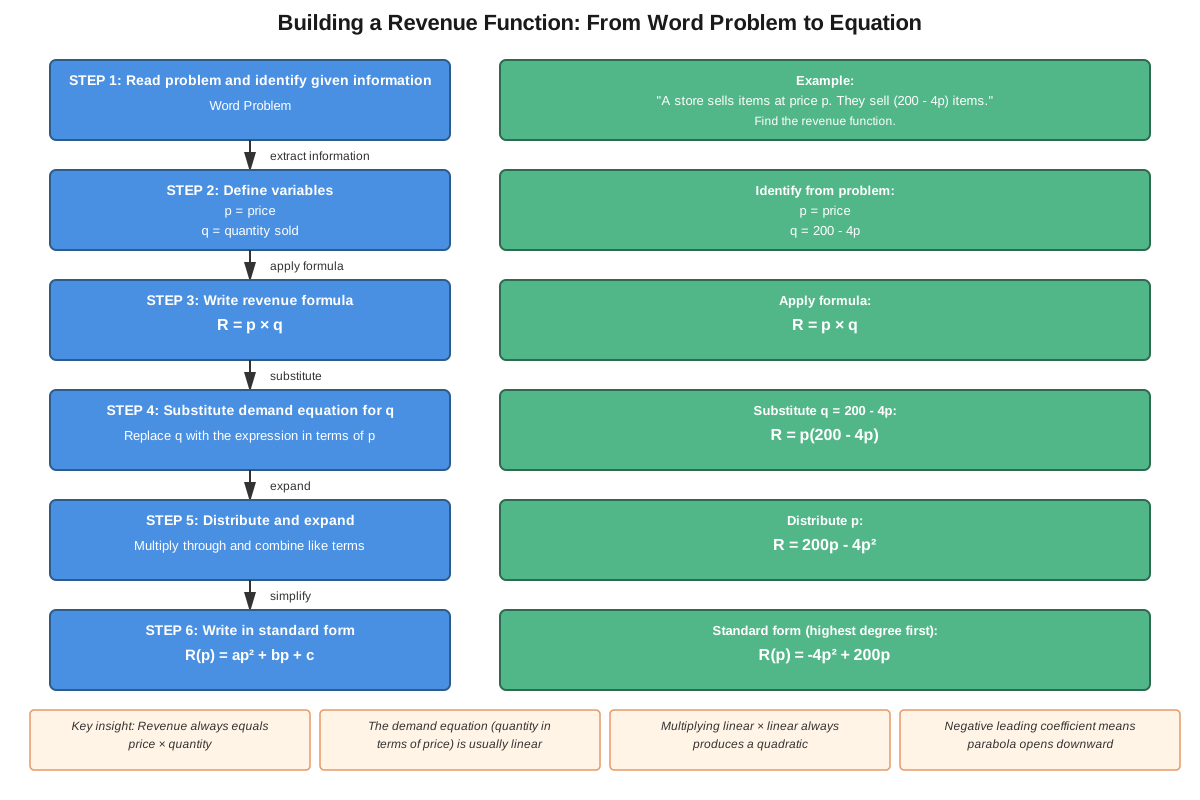
The fundamental revenue quadratic problems formula begins with the basic economic principle: Revenue = Price × Quantity. In most SAT scenarios, as price increases, the quantity sold decreases linearly, creating the quadratic relationship. If we denote price as p and quantity as q, and quantity depends on price according to a linear demand function like q = m - np (where m and n are positive constants), then:
R(p) = p × q = p(m - np) = mp - np²This produces a quadratic function in standard form where the coefficient of p² is negative, ensuring a downward-opening parabola with a maximum value. The negative leading coefficient is crucial—it guarantees that revenue increases to a maximum point and then decreases, reflecting the real-world trade-off between price and sales volume.
Components and Their Meanings
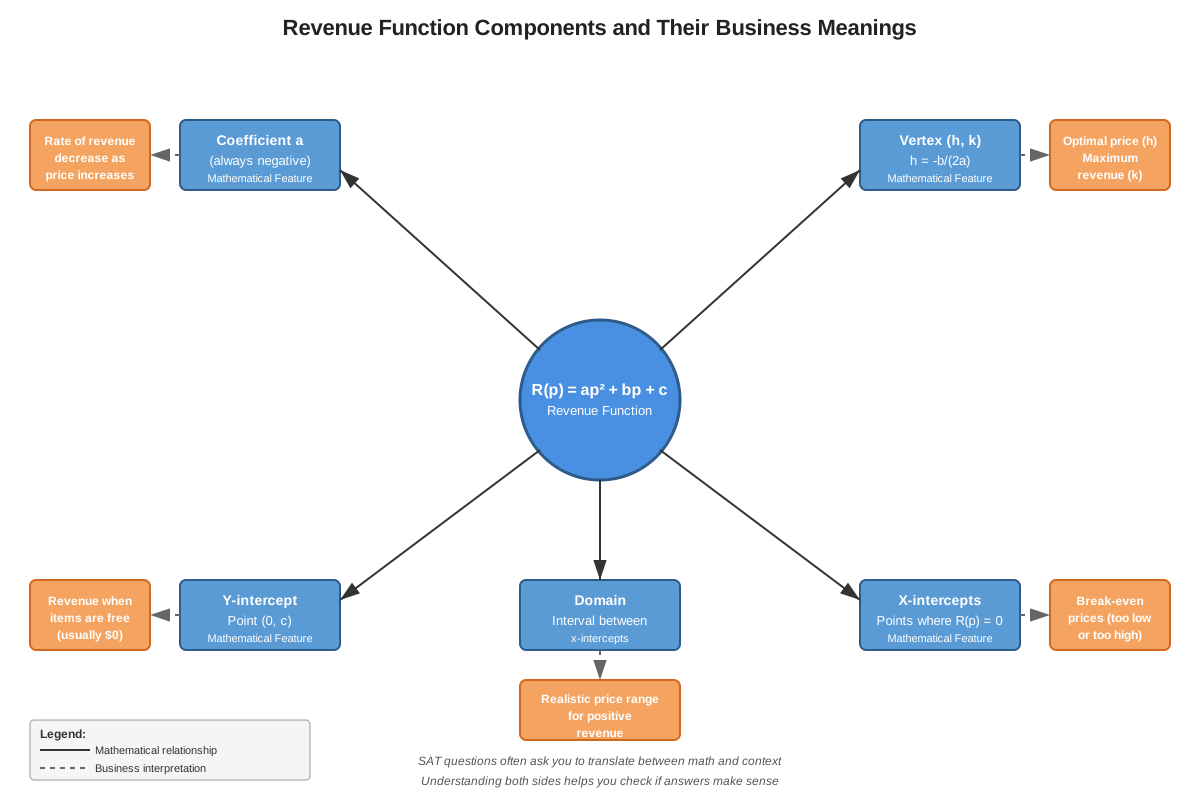
Each element of a revenue function carries specific economic significance:
| Component | Mathematical Form | Economic Interpretation |
|---|---|---|
| Leading coefficient (a) | Always negative in revenue problems | Rate at which revenue decreases as price moves away from optimal |
| Linear coefficient (b) | Positive value | Initial rate of revenue increase with price |
| Constant term (c) | Often zero in pure revenue problems | Revenue when price is zero (usually zero or representing fixed revenue) |
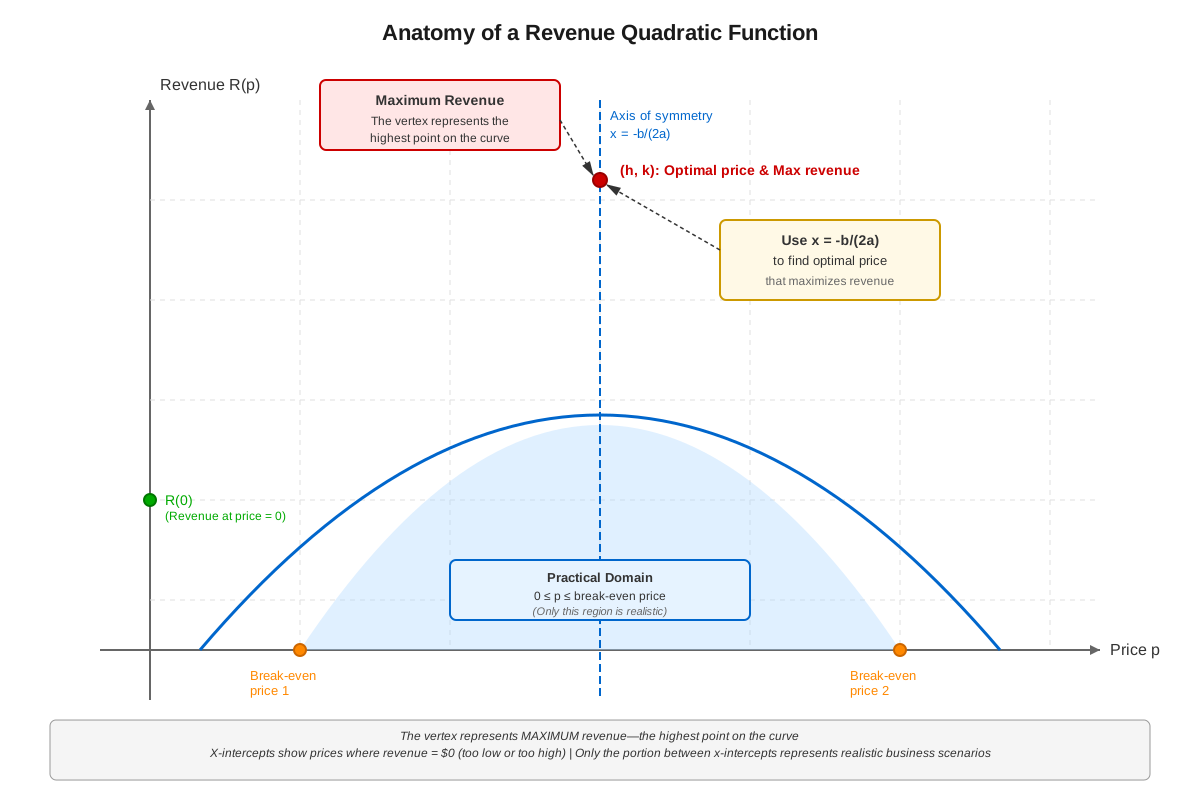
| Vertex x-coordinate | p = -b/(2a) | Optimal price that maximizes revenue |
| Vertex y-coordinate | R(p_max) | Maximum possible revenue |
| x-intercepts | Solutions to R(p) = 0 | Prices that generate zero revenue (too low or too high) |
Finding Maximum Revenue
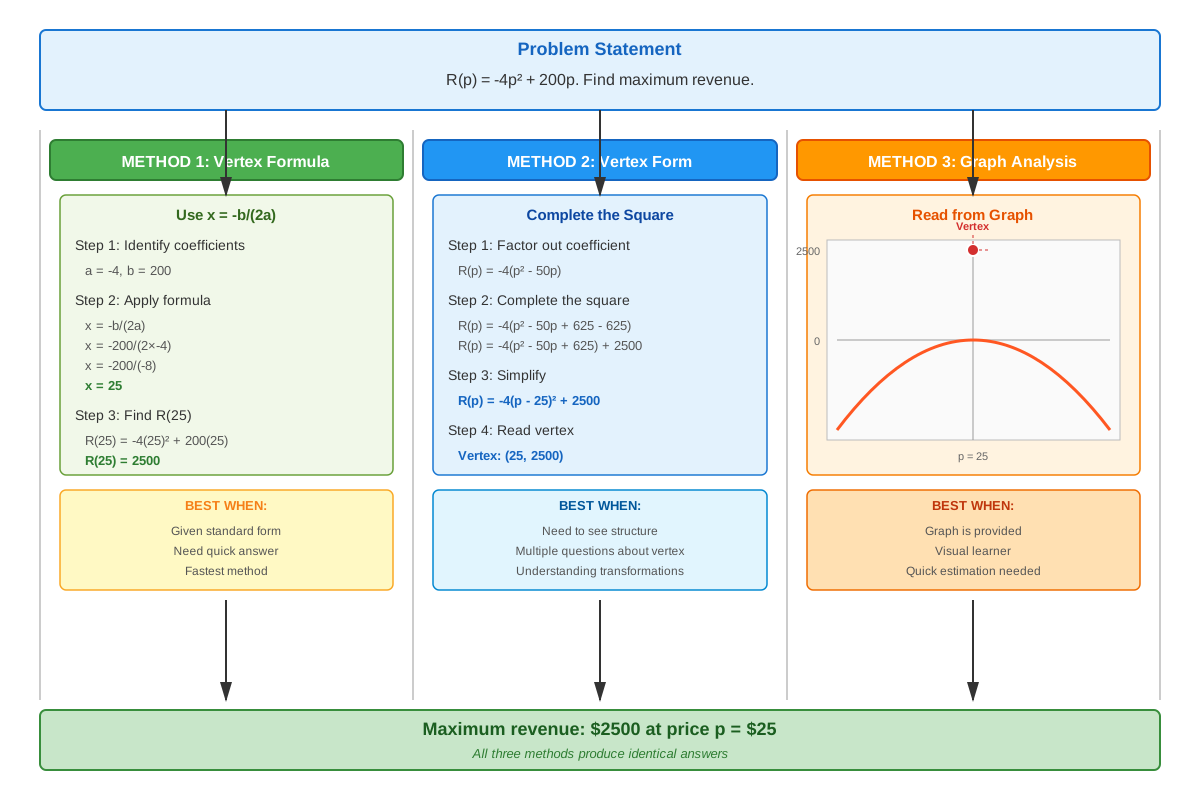
The vertex of a revenue parabola represents the optimal business decision—the price that generates maximum revenue. Three methods exist for finding this critical point:
Method 1: Vertex Formula
For R(p) = ap² + bp + c, the price that maximizes revenue is:
p_optimal = -b/(2a)Then substitute back to find maximum revenue: R_max = R(p_optimal)
Method 2: Completing the Square
Convert standard form to vertex form a(p - h)² + k, where (h, k) is the vertex. The h-value gives optimal price, k gives maximum revenue.
Method 3: Graphical Analysis
When given a graph, identify the highest point on the parabola. The x-coordinate is optimal price; the y-coordinate is maximum revenue.
Constructing Revenue Functions from Word Problems
SAT questions frequently require translating verbal descriptions into algebraic expressions. The systematic approach involves:
- Identify the variables: Determine what represents price and what represents quantity
- Extract the demand relationship: Find how quantity depends on price (usually linear: "for every dollar increase in price, 10 fewer items sell")
- Write the quantity function: Express q in terms of p
- Multiply to get revenue: R = p × q
- Expand and simplify: Convert to standard quadratic form
Example translation: "A theater sells tickets at price p. Currently, 500 people attend when tickets cost $10. For each $1 increase in price, 20 fewer people attend."
- Current situation: p = 10, q = 500
- Demand function: q = 500 - 20(p - 10) = 500 - 20p + 200 = 700 - 20p
- Revenue function: R(p) = p(700 - 20p) = 700p - 20p²
Interpreting Revenue Function Features
Beyond finding maximum revenue, SAT questions test deeper understanding of what various features mean:
- The axis of symmetry (x = -b/2a) represents the optimal price and divides the parabola into two symmetric regions where prices equidistant from optimal generate equal revenue
- The y-intercept (when p = 0) typically equals zero in pure revenue problems, representing that giving products away generates no revenue
- The x-intercepts represent break-even prices: the lower intercept is often zero (giving items away), while the upper intercept shows the price so high that nobody buys
- The domain in real-world contexts is restricted to positive prices that make economic sense
- The range extends from zero to the maximum revenue value at the vertex
Revenue vs. Profit Distinction
While less common, some SAT problems distinguish between revenue and profit. Revenue represents total income (price × quantity), while profit subtracts costs:
Profit = Revenue - Cost = R(p) - C(p)If costs are constant or linear, and revenue is quadratic, profit remains quadratic with the same vertex x-coordinate (optimal price) but a different maximum value. Understanding this distinction prevents confusion when problems introduce cost considerations.
Concept Relationships
The core concepts in revenue quadratic problems form an interconnected web of mathematical relationships. The demand function (linear relationship between price and quantity) serves as the foundation → when multiplied by price, it generates the revenue function (quadratic relationship) → which can be analyzed using vertex formulas to find the optimal price → which then determines maximum revenue when substituted back into the function.
This topic connects directly to prerequisite knowledge of quadratic functions: the standard form learned earlier provides the framework for revenue equations, while vertex-finding techniques become the primary tool for optimization. The graphing skills developed with general parabolas translate directly to visualizing revenue scenarios, where the vertex gains concrete meaning as a business decision point rather than an abstract mathematical feature.
Revenue problems also bridge to broader mathematical concepts. They exemplify mathematical modeling—translating real situations into algebraic expressions. They demonstrate function composition (revenue as a function of price, which affects quantity). They connect to systems of equations when problems involve multiple products or comparative scenarios. Finally, they preview calculus optimization, where derivatives replace the vertex formula but the underlying logic remains identical.
The relationship map flows: Linear Demand → Quadratic Revenue → Vertex Analysis → Optimal Decision → Real-World Interpretation. Each step depends on the previous, and SAT questions may enter this chain at any point, requiring students to work forward or backward through the relationships.
High-Yield Facts
⭐ Revenue functions from linear demand relationships always produce downward-opening parabolas (negative leading coefficient), guaranteeing a maximum revenue point.
⭐ The optimal price that maximizes revenue is always x = -b/(2a) when the revenue function is in standard form R(x) = ax² + bx + c.
⭐ Maximum revenue occurs at the vertex of the parabola, and this value is found by substituting the optimal price back into the revenue function.
⭐ Revenue equals price times quantity (R = p × q), and this multiplication creates the quadratic relationship when quantity depends linearly on price.
⭐ The axis of symmetry divides the parabola so that two different prices equidistant from optimal generate identical revenue, a fact often tested through comparison questions.
- Revenue functions typically have domain restrictions (price must be positive and below the upper x-intercept) that reflect real-world constraints.
- The y-intercept of a revenue function usually equals zero, representing that zero price generates zero revenue.
- When a problem states "for every $1 increase, quantity decreases by n units," the demand function has slope -n.
- The x-intercepts of a revenue function represent prices that generate zero revenue: one is typically zero, the other represents a price too high for any sales.
- Converting to vertex form a(x - h)² + k immediately reveals optimal price (h) and maximum revenue (k) without additional calculation.
- The coefficient of the squared term indicates how sharply revenue drops as price moves away from optimal: larger absolute values mean steeper declines.
- In comparative revenue problems, the function with the higher vertex has greater maximum revenue potential, regardless of other features.
Quick check — test yourself on Revenue quadratic problems so far.
Try Flashcards →Common Misconceptions
Misconception: The highest price always generates the most revenue.
Correction: Revenue is maximized at an intermediate price point (the vertex). Prices too high reduce quantity sold so much that total revenue decreases despite the higher per-unit price.
Misconception: The vertex formula x = -b/(2a) gives the maximum revenue value.
Correction: The vertex formula gives the optimal price (x-coordinate). To find maximum revenue, substitute this price back into the revenue function to get the y-coordinate.
Misconception: Revenue and profit are the same thing.
Correction: Revenue is total income (price × quantity) before considering costs. Profit subtracts costs from revenue. A business can have high revenue but low or negative profit if costs are substantial.
Misconception: When quantity decreases by a fixed amount per price increase, the relationship is quadratic.
Correction: The quantity-price relationship is linear (q = m - np). The revenue becomes quadratic because it's the product of price and this linear quantity function.
Misconception: Both x-intercepts of a revenue function represent viable business prices.
Correction: While mathematically both intercepts give zero revenue, typically only the positive intercept represents a real scenario (price too high for sales). The zero or negative intercept often falls outside the practical domain.
Misconception: A larger coefficient on the p² term means higher maximum revenue.
Correction: The coefficient's magnitude affects the parabola's width and how quickly revenue changes with price, but maximum revenue depends on the vertex's y-coordinate, which involves all coefficients together.
Worked Examples
Example 1: Complete Revenue Analysis
Problem: A coffee shop sells specialty drinks. Market research shows that at a price of $4, they sell 200 drinks per day. For each $0.50 increase in price, they sell 15 fewer drinks.
(a) Write a revenue function R(p) where p is the price per drink.
(b) Find the price that maximizes revenue.
(c) Calculate the maximum daily revenue.
(d) Determine the revenue if drinks are priced at $6.
Solution:
(a) Constructing the revenue function:
First, establish the demand function. At p = $4, quantity q = 200.
For each $0.50 increase, quantity decreases by 15.
The rate of change is -15/0.50 = -30 drinks per dollar.
Using point-slope form: q - 200 = -30(p - 4)
Simplifying: q = 200 - 30p + 120 = 320 - 30p
Revenue function: R(p) = p × q = p(320 - 30p)
Expanding: R(p) = 320p - 30p² or R(p) = -30p² + 320p
(b) Finding optimal price:
Using the vertex formula with a = -30 and b = 320:
p_optimal = -b/(2a) = -320/(2(-30)) = -320/(-60) = 320/60 = 16/3 ≈ $5.33The price that maximizes revenue is $5.33 (or exactly $16/3).
(c) Calculating maximum revenue:
Substitute p = 16/3 into the revenue function:
R(16/3) = -30(16/3)² + 320(16/3)
R(16/3) = -30(256/9) + 320(16/3)
R(16/3) = -7680/9 + 5120/3
R(16/3) = -7680/9 + 15360/9 = 7680/9 ≈ $853.33
Maximum daily revenue is approximately $853.33.
(d) Revenue at $6:
R(6) = -30(6)² + 320(6) = -30(36) + 1920 = -1080 + 1920 = $840At $6 per drink, daily revenue is $840, which is less than maximum because $6 exceeds the optimal price.
Connection to learning objectives: This example demonstrates identifying key features (demand relationship, vertex), constructing the revenue function from verbal description, and applying vertex formulas—all essential SAT skills.
Example 2: Graph Interpretation and Comparison
Problem: The graph below shows revenue R as a function of price p for two competing products, A and B. Product A's revenue is represented by the solid curve, Product B by the dashed curve.
[Description: Solid parabola with vertex at (8, 640), x-intercepts at 0 and 16. Dashed parabola with vertex at (10, 600), x-intercepts at 0 and 20.]
(a) Which product has higher maximum revenue, and what is that maximum?
(b) At what price do both products generate equal revenue?
(c) For what price range does Product B generate more revenue than Product A?
Solution:
(a) Comparing maximum revenue:
Maximum revenue occurs at each parabola's vertex.
- Product A: vertex at (8, 640), so maximum revenue = $640 at price $8
- Product B: vertex at (10, 600), so maximum revenue = $600 at price $10
Product A has higher maximum revenue of $640.
(b) Finding equal revenue points:
The parabolas intersect where they generate equal revenue. From the graph description, both pass through (0, 0). They intersect again where the curves cross. Using the symmetry and intercepts:
Product A: R_A(p) = ap(16 - p) for some constant a
Product B: R_B(p) = bp(20 - p) for some constant b
At vertex, Product A: p = 8 gives R = 640, so 640 = a(8)(8) = 64a, thus a = 10
Product A: R_A(p) = 10p(16 - p) = 160p - 10p²
At vertex, Product B: p = 10 gives R = 600, so 600 = b(10)(10) = 100b, thus b = 6
Product B: R_B(p) = 6p(20 - p) = 120p - 6p²
Setting equal: 160p - 10p² = 120p - 6p²
Simplifying: 40p - 4p² = 0
Factoring: 4p(10 - p) = 0
Solutions: p = 0 or p = 10
Both products generate equal revenue at p = $0 and p = $10.
(c) Determining when Product B exceeds Product A:
Product B generates more revenue between the intersection points where its curve is above Product A's curve. From part (b), they intersect at p = 0 and p = 10. Checking a test point like p = 12:
R_A(12) = 160(12) - 10(144) = 1920 - 1440 = 480
R_B(12) = 120(12) - 6(144) = 1440 - 864 = 576
Since R_B(12) > R_A(12), Product B generates more revenue for p > $10 (specifically, for $10 < p < 16, where Product A reaches zero revenue).
Connection to learning objectives: This example emphasizes graph interpretation, comparing key features, and understanding how revenue functions behave across different price ranges—critical skills for SAT graph-based questions.
Exam Strategy
When approaching sat revenue quadratic problems, begin by identifying the problem type: are you given a function to analyze, a verbal description to translate, or a graph to interpret? This initial classification determines your solution pathway and prevents wasted time on incorrect approaches.
Trigger words and phrases signal revenue quadratic problems:
- "maximize revenue," "optimal price," "greatest income"
- "for each increase/decrease in price, quantity changes by..."
- "revenue as a function of price"
- "break-even point," "zero revenue"
- "at what price does revenue equal..."
When translating word problems, create a systematic variable list before writing equations. Explicitly write "Let p = price" and "Let q = quantity" to avoid confusion. Extract the demand relationship carefully—watch for whether the problem describes total quantity or change in quantity, and whether price changes are described as increases from a base price or absolute prices.
Process-of-elimination strategies for multiple-choice revenue questions:
- Eliminate any answer with a positive coefficient on the squared term (revenue parabolas open downward)
- If asked for maximum revenue, eliminate answers that give the optimal price instead (common trap)
- For optimal price questions, eliminate values outside the reasonable domain (negative prices, prices beyond the upper x-intercept)
- When comparing two revenue functions, eliminate answers that contradict vertex positions
Time allocation: Budget 2-3 minutes for straightforward revenue function questions (finding maximum revenue from a given function), 3-4 minutes for word problems requiring function construction, and 2 minutes for graph interpretation questions. If a problem requires both constructing a function AND finding multiple features, consider whether you can answer the specific question asked without completing all steps—sometimes the SAT rewards strategic shortcuts.
Calculator usage: For calculator-permitted sections, verify your vertex calculations by graphing the revenue function and using the calculator's maximum feature. This provides both a check and a faster alternative for complex coefficients. However, understand the algebraic method thoroughly, as no-calculator sections require manual computation.
Common question variations:
- Direct: "What price maximizes revenue?" → Use vertex formula
- Indirect: "What is the maximum revenue?" → Find vertex, then substitute
- Comparative: "How much more revenue at optimal vs. current price?" → Calculate both, subtract
- Reverse: "At what price is revenue $X?" → Set R(p) = X, solve quadratic
- Interpretation: "What does the coefficient represent?" → Understand economic meaning
Memory Techniques
R-P-Q Mnemonic: "Revenue Produces Quadratics" reminds you that Revenue = Price × Quantity, and when quantity depends linearly on price, the product creates a quadratic function.
V-MAX Acronym: For finding maximum revenue, remember Vertex Method Always X-coordinate first:
- Vertex formula: x = -b/(2a)
- Maximum found by substitution
- Always check the x-coordinate gives price
- X-coordinate is optimal, y-coordinate is maximum revenue
Visualization Strategy: Picture a hill representing the revenue parabola. Walking up the hill (increasing price from zero) initially increases revenue as you climb. The peak represents optimal price and maximum revenue. Walking down the other side (increasing price beyond optimal) decreases revenue as fewer customers buy. This mental image reinforces why revenue has a maximum and why prices on either side of optimal can generate equal revenue.
Coefficient Memory: "Negative Leads to Maximum" — the Negative Leading coefficient ensures a Maximum exists (downward-opening parabola). If you ever construct a revenue function with a positive leading coefficient, you've made an error.
Intercept Interpretation: "Zero Price, Zero Revenue; High Price, No Sales" captures both x-intercepts: at zero price, revenue is zero (giving away products); at the high price intercept, nobody buys, so revenue returns to zero.
Summary
Revenue quadratic problems represent a crucial intersection of algebra and real-world application on the SAT, testing students' ability to model business scenarios mathematically. The fundamental principle—revenue equals price times quantity—creates quadratic functions when quantity depends linearly on price, producing downward-opening parabolas with meaningful vertices representing optimal pricing decisions. Mastery requires three core competencies: translating verbal descriptions into algebraic revenue functions, analyzing these functions to find maximum revenue using vertex formulas (x = -b/2a), and interpreting results in economic context. Students must recognize that the vertex's x-coordinate gives optimal price while the y-coordinate gives maximum revenue, understand that prices equidistant from optimal generate equal revenue due to parabolic symmetry, and distinguish between revenue (total income) and profit (income minus costs). Success on SAT revenue questions demands both computational accuracy in manipulating quadratic expressions and conceptual understanding of what each mathematical feature represents in the business scenario, enabling students to answer questions about optimization, comparison, and interpretation with confidence.
Key Takeaways
- Revenue quadratic problems arise from the formula R = p × q when quantity depends linearly on price, creating a downward-opening parabola with a maximum revenue point
- The optimal price that maximizes revenue is found using x = -b/(2a) from the standard form; substitute this back to find maximum revenue
- Every revenue function component has economic meaning: the vertex represents optimal business decisions, x-intercepts show break-even prices, and the negative leading coefficient ensures a maximum exists
- Translating word problems requires systematically identifying variables, extracting demand relationships, and multiplying price by quantity to construct the revenue function
- Graph interpretation questions test understanding of vertex significance, symmetry properties, and comparative analysis between multiple revenue scenarios
- The axis of symmetry divides the parabola so prices equidistant from optimal generate identical revenue—a frequently tested concept
- Domain restrictions matter: revenue functions only make sense for positive prices below the upper x-intercept where quantity becomes zero
Related Topics
Profit Optimization Problems: Building on revenue quadratics by incorporating cost functions, these problems require finding maximum profit rather than maximum revenue, introducing subtraction of linear or quadratic cost expressions from revenue functions.
Systems of Quadratic Equations: When comparing multiple products or finding intersection points of revenue functions, students apply systems-solving techniques to quadratic equations, extending single-function analysis to multi-function scenarios.
Quadratic Inequalities in Context: Revenue problems naturally lead to inequality questions like "for what prices does revenue exceed $500?" requiring students to solve quadratic inequalities and interpret solution intervals.
Polynomial Function Transformations: Understanding how changing coefficients affects parabola shape, position, and maximum values deepens revenue function analysis and enables prediction of how business changes affect revenue curves.
Calculus Preview - Optimization: Revenue quadratics provide the perfect foundation for calculus optimization using derivatives, where the vertex formula x = -b/(2a) emerges naturally from setting the derivative equal to zero.
Practice CTA
Now that you've mastered the core concepts of revenue quadratic problems, it's time to solidify your understanding through active practice. Attempt the practice questions to apply vertex formulas, translate word problems into functions, and interpret graphs in exam-realistic scenarios. Use the flashcards to reinforce high-yield facts and key formulas until they become automatic. Remember: the SAT rewards both speed and accuracy, and these come only through deliberate practice. Each problem you solve strengthens your pattern recognition and builds the confidence needed to tackle any revenue quadratic question on test day. Your investment in practice now directly translates to points earned later—make it count!
Sign up free to keep reading
Create a free AnvayaPrep account to finish this SAT guide on Revenue quadratic problems — plus flashcards and practice questions.