Overview
SAT quadratic traps represent one of the most strategically important categories of questions in the math section of the SAT. These questions are specifically designed to catch students who rush through problems or rely solely on memorized procedures without understanding the underlying concepts. The College Board deliberately constructs these problems to include answer choices that correspond to common errors—such as solving for the wrong variable, forgetting to consider both solutions, or stopping the problem before reaching the actual answer requested.
Understanding quadratic traps is essential because they appear frequently across multiple question types in the SAT math section. These traps don't just test whether students can solve quadratic equations; they assess whether students can read carefully, think critically about what's being asked, and avoid predictable mistakes. A student might execute perfect algebraic manipulation yet still select the wrong answer if they fall into one of these carefully constructed traps. Mastery of this topic can easily translate to 40-60 additional points on the SAT, as these questions typically appear 3-5 times per test.
Quadratic traps connect to broader mathematical reasoning skills tested throughout the SAT. They build upon foundational algebra concepts including factoring, the quadratic formula, and systems of equations, while also requiring careful attention to detail—a skill that applies to word problems, data interpretation, and geometric reasoning. Recognizing these traps develops the kind of strategic test-taking awareness that benefits performance across all SAT math domains.
Learning Objectives
- [ ] Identify key features of SAT quadratic traps
- [ ] Explain how SAT quadratic traps appears on the SAT
- [ ] Apply SAT quadratic traps to answer SAT-style questions
- [ ] Distinguish between the solution to a quadratic equation and the answer to the question being asked
- [ ] Recognize when a problem requires finding a related expression rather than the variable itself
- [ ] Evaluate answer choices strategically by predicting common trap answers before solving
Prerequisites
- Solving quadratic equations by factoring: Essential for quickly finding solutions that may or may not be the final answer
- The quadratic formula: Necessary when factoring isn't possible and for understanding the relationship between coefficients and solutions
- Basic algebraic manipulation: Required to transform expressions and recognize what the question actually asks for
- Understanding of function notation: Helps identify when questions ask for f(x) values rather than x values
- Systems of equations: Some quadratic traps involve finding intersection points or solving simultaneous equations
Why This Topic Matters
In real-world applications, the ability to solve quadratic equations correctly matters less than understanding what question needs answering. Engineers don't just solve equations—they interpret what those solutions mean for physical constraints. Financial analysts must determine which solution makes sense in context. This metacognitive skill of "solving the right problem" is precisely what quadratic traps assess.
On the SAT, quadratic-related questions appear in approximately 15-20% of all math questions, with roughly 3-5 questions per test specifically designed as trap questions. These appear in both the calculator and no-calculator sections, across multiple-choice and grid-in formats. The College Board reports that these questions have among the highest discrimination indices, meaning they effectively separate high scorers from middle scorers.
Common manifestations include: word problems where the quadratic solution represents an intermediate step; questions asking for expressions like x² + x rather than x itself; problems requesting the sum or product of solutions without requiring individual solutions; scenarios where only one of two solutions satisfies contextual constraints; and questions where the answer involves manipulating the original equation rather than solving it. Each format creates specific opportunities for trap answers that correspond to predictable student errors.
Core Concepts
The Anatomy of a Quadratic Trap
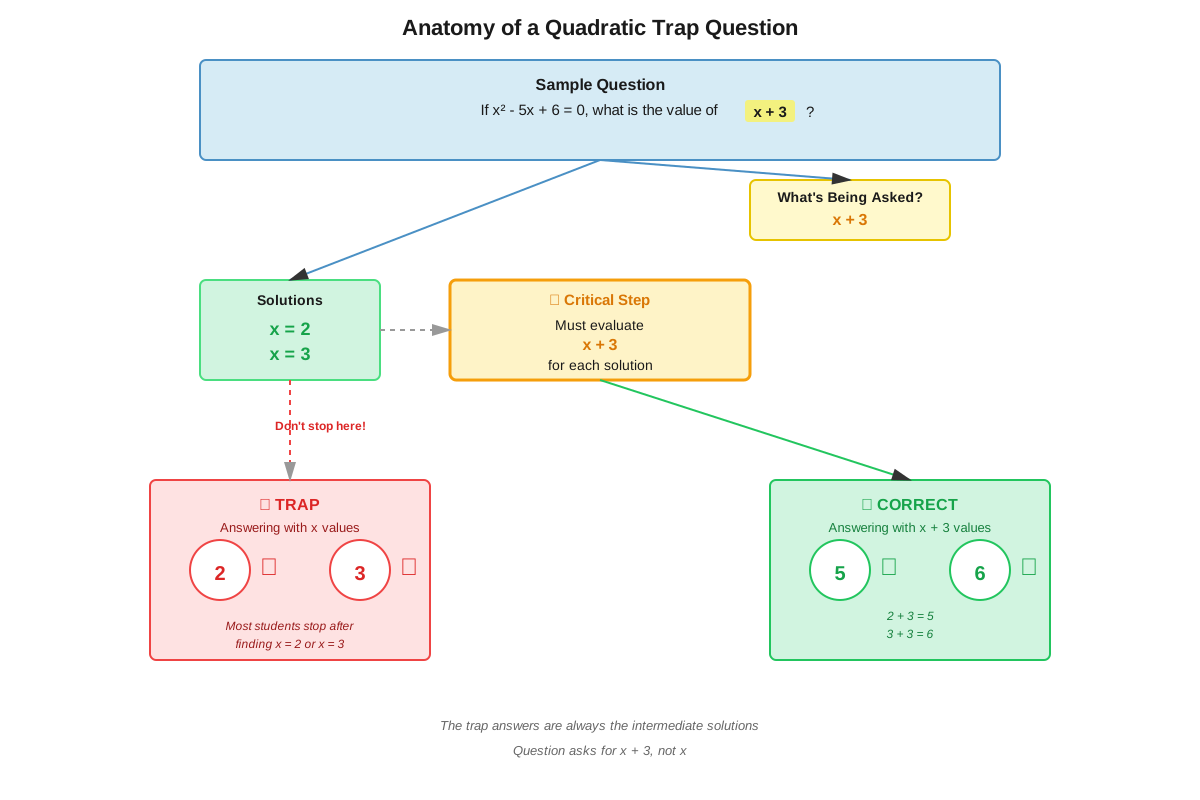
A sat quadratic trap is a deliberately constructed question where the most common student errors lead directly to incorrect answer choices. These traps exploit predictable patterns in student thinking. The typical structure includes: (1) a quadratic equation or scenario that generates two solutions, (2) a question that asks for something other than the direct solutions, and (3) answer choices that include the direct solutions, partial solutions, or results from common algebraic errors.
Understanding this structure helps students approach these problems defensively. The trap isn't in the mathematics itself—it's in the gap between what students automatically solve for and what the question actually requests.
Types of Quadratic Traps
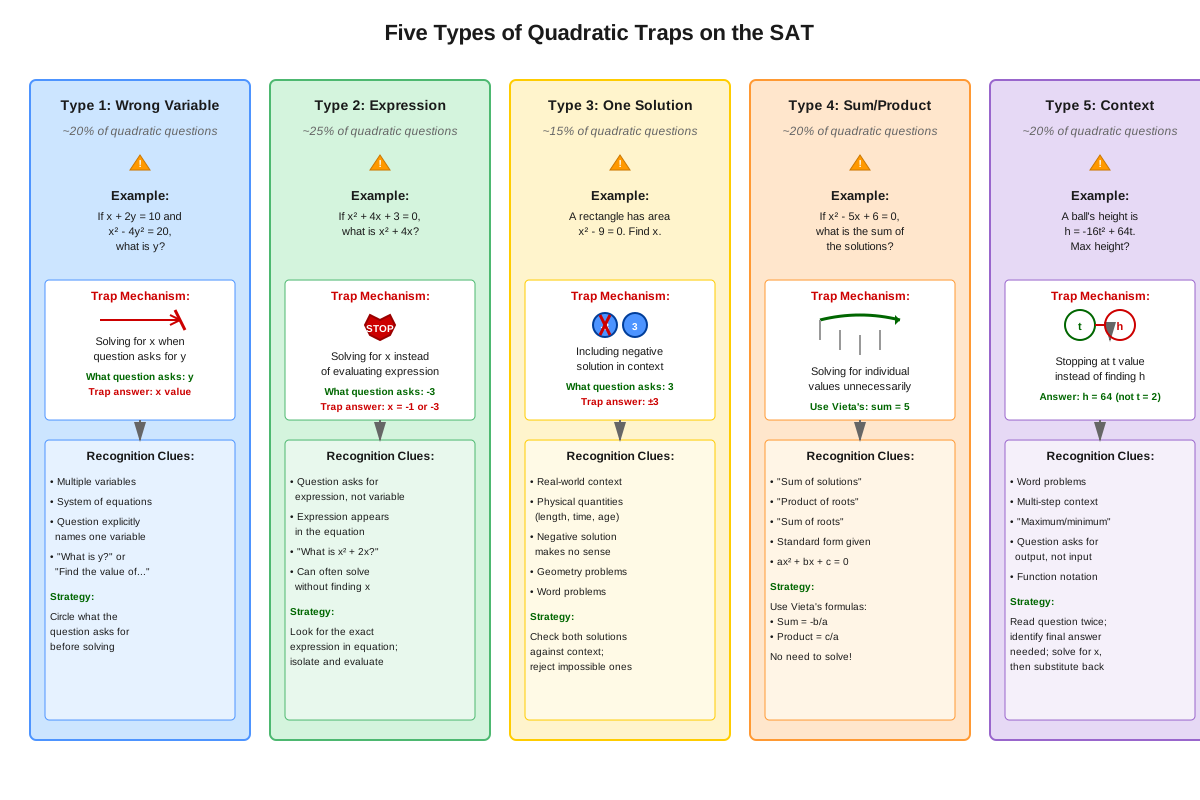
Trap Type 1: Solving for the Wrong Variable
The most common sat sat quadratic traps involve solving correctly for one variable when the question asks for a different expression. For example, if x² - 5x + 6 = 0, students correctly find x = 2 or x = 3, but the question asks for the value of x² - 1. The trap answers include 2 and 3 (the x values), while the correct answer requires substituting back: either 2² - 1 = 3 or 3² - 1 = 8.
| What Students Solve | What Question Asks | Trap Answer | Correct Approach |
|---|---|---|---|
| x = 3 | x² - 1 = ? | 3 | Substitute: 3² - 1 = 8 |
| x = 2 or x = 5 | 2x + 1 = ? | 2 or 5 | Calculate: 2(2)+1=5 or 2(5)+1=11 |
| y = -4 | y² + 2y = ? | -4 | Substitute: 16 + (-8) = 8 |
Trap Type 2: Forgetting the Second Solution
When quadratic equations yield two solutions, students often find one solution and stop, especially when factoring. If (x - 3)(x + 2) = 0, the solutions are x = 3 and x = -2. Questions might ask "What is the positive value of x?" (answer: 3) or "What is the sum of all possible values?" (answer: 1). Trap answers include just one solution when both are needed, or both solutions listed separately when their sum or product is requested.
Trap Type 3: The "Not Quite Done" Trap
These problems require solving a quadratic equation as an intermediate step toward the final answer. A word problem might establish that x² - 7x + 12 = 0 where x represents the number of hours worked, then ask for the total payment at $15 per hour. Students solve to get x = 3 or x = 4, see these values in the answer choices, and select one—but the question asks for payment, requiring multiplication by 15 (giving $45 or $60).
Trap Type 4: Context-Dependent Solutions
Real-world scenarios often impose constraints that eliminate one mathematical solution. If a quadratic models the height of an object over time, negative time values are meaningless. If x represents a physical dimension, negative lengths don't apply. The trap answer includes both solutions or the contextually impossible one, while the correct answer recognizes the constraint.
Trap Type 5: Sum and Product Traps
For a quadratic ax² + bx + c = 0 with solutions r and s, Vieta's formulas give us r + s = -b/a and rs = c/a. Questions might ask for the sum or product of solutions without requiring students to find individual solutions. Students who solve completely and then add or multiply waste time and risk arithmetic errors. The trap is doing unnecessary work when the answer is directly available from the coefficients.
Recognition Strategies
Identifying quadratic traps before falling into them requires active reading. Key warning signs include:
- Question stem language: Phrases like "what is the value of..." followed by an expression rather than a simple variable
- Answer choice patterns: When answer choices include obvious intermediate results (like the solutions themselves) alongside other values
- Word problem complexity: When the setup seems more elaborate than necessary for a simple "solve for x" question
- Multiple solutions possible: Any time a quadratic generates two solutions, verify which one(s) the question needs
- Units or context: When the question involves real-world units, the answer likely requires an additional calculation beyond solving the equation
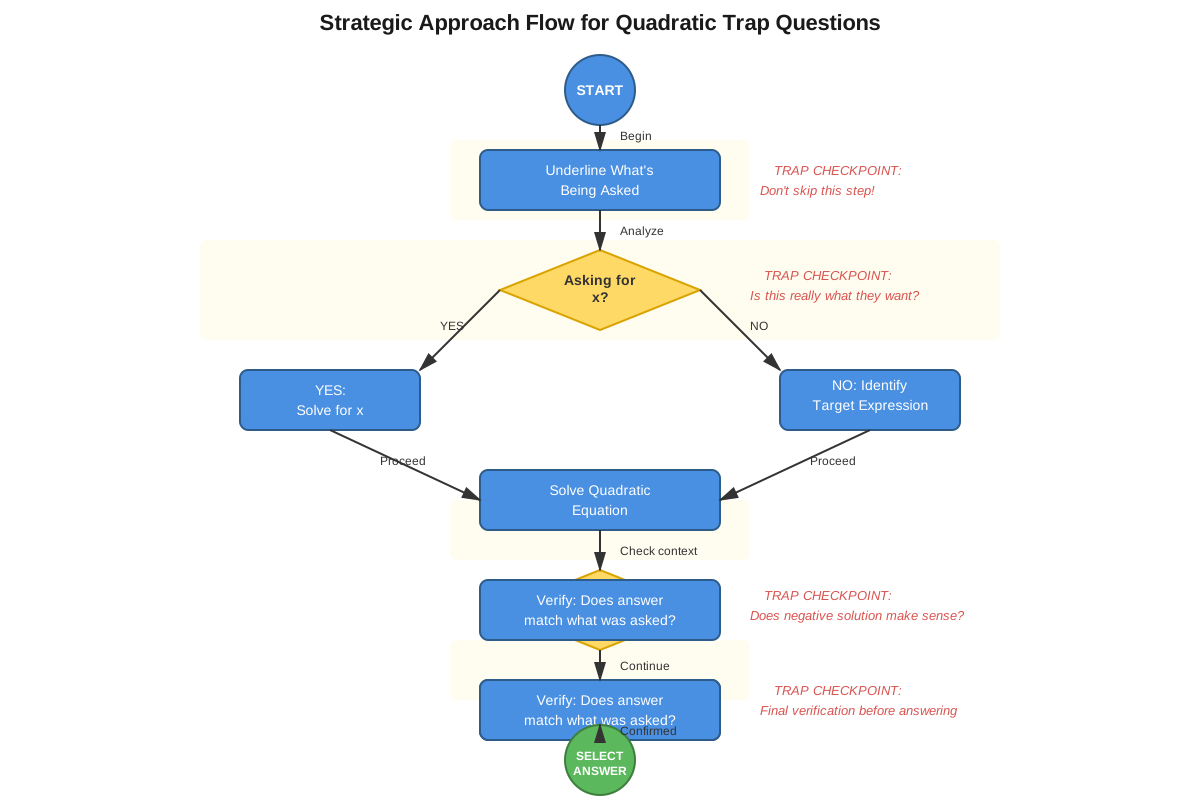
The "What Are They Really Asking?" Protocol
Before solving any quadratic problem on the SAT, students should:
- Read the entire question twice
- Underline or circle exactly what the question asks for
- Predict what trap answers might appear (usually the direct solutions)
- Solve the equation
- Return to what was underlined and calculate that specific value
- Verify the answer makes sense in context
This protocol adds only 10-15 seconds but dramatically reduces trap errors.
Concept Relationships
The concepts within quadratic traps form a hierarchical relationship: Recognition (identifying that a trap exists) → Analysis (determining what type of trap) → Strategic solving (choosing the most efficient solution path) → Verification (confirming the answer matches what was asked).
Quadratic traps connect backward to prerequisite topics in essential ways. Factoring skills enable quick solution finding, which is necessary but insufficient—students must then apply the solutions correctly. The quadratic formula provides solutions when factoring fails, but again, finding solutions is just the first step. Algebraic manipulation becomes crucial when the question asks for expressions like x² + 3x rather than x itself.
Forward connections include more complex SAT topics. Systems of equations often combine with quadratic traps when finding intersection points—students might correctly find the x-coordinate but forget the question asks for the y-coordinate. Function problems frequently incorporate traps where students find the input value when the question asks for the output, or vice versa. Word problems across all domains use the same "solve for one thing, question asks for another" structure.
The relationship map: Quadratic equation → Solutions found → Question analysis → Correct expression calculated → Context verification → Final answer. Breaking this chain at any point leads to trap answers.
Quick check — test yourself on SAT quadratic traps so far.
Try Flashcards →High-Yield Facts
⭐ The most common SAT quadratic trap involves solving correctly for x but answering with x when the question asks for an expression involving x
⭐ When a quadratic equation has two solutions, always check whether the question asks for one specific solution, both solutions, their sum, or their product
⭐ Answer choices on quadratic trap questions typically include the direct solutions as trap answers
⭐ Word problems with quadratic equations usually require an additional calculation after solving the equation
⭐ For ax² + bx + c = 0, the sum of solutions equals -b/a and the product equals c/a—use these shortcuts when questions ask for sum or product
- Negative solutions may be mathematically correct but contextually impossible in real-world scenarios
- Grid-in questions with quadratic traps often accept multiple correct answers (either solution), but only when the question explicitly asks for "a possible value"
- The phrase "positive value" or "negative value" indicates one solution should be eliminated
- Questions asking for "the value of x²" or similar expressions never want the x value itself
- Factored form (x - r)(x - s) = 0 immediately reveals solutions r and s, but verify what the question requests before answering
Common Misconceptions
Misconception: If I solve the quadratic equation correctly, I've answered the question. → Correction: Solving the equation is often just the first step; the question frequently asks for a related value, expression, or calculation based on the solution.
Misconception: When I see my calculated value in the answer choices, it must be correct. → Correction: The College Board deliberately includes intermediate results and common errors as trap answers; always verify your answer matches what the question asks for, not just what you calculated.
Misconception: Both solutions to a quadratic equation are always valid answers. → Correction: Context matters—real-world constraints often eliminate one mathematical solution (negative time, impossible dimensions, etc.), and sometimes the question specifies "positive value" or similar restrictions.
Misconception: I need to find both solutions individually before I can answer questions about their sum or product. → Correction: Vieta's formulas allow you to find the sum (-b/a) and product (c/a) of solutions directly from coefficients without solving the equation, saving time and reducing error risk.
Misconception: Quadratic trap questions are harder mathematically than other quadratic problems. → Correction: These questions typically involve standard algebraic techniques; the difficulty lies in careful reading and matching your solution to what's actually requested, not in complex mathematics.
Misconception: If the question mentions a quadratic equation, I must use the quadratic formula. → Correction: Many quadratic trap questions can be solved more efficiently through factoring, completing the square, or using coefficient relationships; the quadratic formula is one tool among several.
Worked Examples
Example 1: The Classic "Wrong Expression" Trap
Problem: If x² - 6x + 8 = 0, what is the value of x² - 6x + 3?
Step 1 - Identify what's being asked: The question asks for x² - 6x + 3, NOT for x itself. Underline this expression.
Step 2 - Recognize the trap structure: Notice that x² - 6x appears in both the equation and the question. This is a key insight.
Step 3 - Solve strategically: Rather than solving for x, recognize that if x² - 6x + 8 = 0, then x² - 6x = -8.
Step 4 - Substitute: The question asks for x² - 6x + 3. Since x² - 6x = -8, we have: -8 + 3 = -5.
Step 5 - Verify trap answers: If we had solved for x (getting x = 2 or x = 4) and these appeared in answer choices, they would be traps. The correct answer is -5.
Connection to learning objectives: This example demonstrates identifying the trap (asking for an expression, not x), explaining how it appears (similar expressions in equation and question), and applying strategic solving (substitution rather than complete solution).
Example 2: Context-Dependent Solution Trap
Problem: A rectangular garden has a length that is 3 meters more than its width. If the area of the garden is 40 square meters, what is the perimeter of the garden in meters?
Step 1 - Set up the equation: Let w = width. Then length = w + 3. Area equation: w(w + 3) = 40, which gives w² + 3w - 40 = 0.
Step 2 - Solve the quadratic: Factoring: (w + 8)(w - 5) = 0, so w = -8 or w = 5.
Step 3 - Apply context: Width cannot be negative, so w = 5 meters. Length = 5 + 3 = 8 meters.
Step 4 - Answer what's asked: The question asks for perimeter, not width! Perimeter = 2(5 + 8) = 26 meters.
Step 5 - Identify trap answers: Trap answers would include: 5 (the width), 8 (the length), -8 (the invalid solution), or 13 (half the perimeter). The correct answer is 26.
Connection to learning objectives: This demonstrates multiple trap types: contextual elimination of one solution, solving for an intermediate value when the question asks for something else, and recognizing that answer choices will include these common errors.
Exam Strategy
Approaching Quadratic Trap Questions
When encountering any quadratic-related question on the SAT, implement this systematic approach:
Before solving: Read the question stem completely, then read it again. Physically mark or underline exactly what the question asks for. Ask yourself: "Am I solving for x, or for something involving x?"
During solving: Solve the equation efficiently using the most appropriate method (factoring, quadratic formula, or coefficient relationships). Write down both solutions if they exist. Before looking at answer choices, calculate the specific value the question requests.
After solving: Check whether your answer makes sense in context. If it's a word problem, verify units and reasonableness. Look at the answer choices last, and confirm your calculated value appears there.
Trigger Words and Phrases
Watch for these high-alert phrases that signal potential traps:
- "What is the value of [expression]" rather than "What is the value of x"
- "What is the [positive/negative/greater/lesser] value"
- "What is the sum of all possible values"
- "What is the product of the solutions"
- Any question asking for a quantity with units (dollars, meters, hours) after setting up an equation
- "Which of the following could be a value" (may accept multiple answers)
Process of Elimination Tips
Use answer choice patterns to your advantage:
- Identify obvious trap answers: If you solved for x = 3 and x = 7, and both appear as answer choices, they're likely traps unless the question explicitly asks for "a possible value of x"
- Check for sum/product patterns: If answer choices include values like 10 and -6, and your solutions are 3 and 7, notice that 10 = 3 + 7 (sum trap) and -6 might relate to other coefficient relationships
- Eliminate contextually impossible answers: Negative values for physical quantities, non-integer answers when the context requires whole numbers, or values that violate stated constraints
- Look for "too easy" answers: If an answer choice matches your first calculation without any additional work, double-check that the question didn't ask for something more
Time Allocation
Quadratic trap questions deserve 60-90 seconds each—slightly more than average SAT math questions. The extra 15-20 seconds spent on careful reading and verification prevents errors worth far more than the time cost. If you find yourself solving quickly (under 30 seconds), you've likely fallen into a trap; slow down and reread what's being asked.
Memory Techniques
The "SQUAT" Protocol for quadratic traps:
- Stop and read the question twice
- Question: What are they really asking for?
- Underline the specific expression or value requested
- Answer the equation (solve it)
- Transform your solution to match what was underlined
Visualization Strategy: Picture a target with three rings. The outer ring is "solving the equation" (necessary but not sufficient), the middle ring is "finding what the question asks for" (the actual goal), and the bullseye is "verifying the answer makes sense" (mastery). Most students stop at the outer ring.
The "Two-Step Dance" Mnemonic: For word problems, remember "Solve, then Solve again"—first solve the equation, then solve for what the question actually wants (total cost, perimeter, etc.).
Acronym for Solution Checking - BOTH:
- Both solutions found?
- One eliminated by context?
- The question asks for what exactly?
- Have I calculated that specific value?
Summary
SAT quadratic traps represent a critical intersection of mathematical skill and strategic test-taking. These questions don't primarily test whether students can solve quadratic equations—they assess whether students can read carefully, think critically about what's being asked, and avoid predictable errors. The traps manifest in several forms: solving for the wrong variable or expression, forgetting to consider both solutions or their relationships, stopping before completing the final calculation, and failing to apply contextual constraints. Success requires a defensive approach: reading questions twice, underlining what's actually requested, predicting trap answers before solving, and verifying that the final answer matches the question's request. The mathematics involved is typically straightforward; the challenge lies in the gap between automatic solving behavior and careful question analysis. Mastering these traps can significantly impact SAT scores because they appear frequently and effectively discriminate between careful, strategic test-takers and those who rush through problems.
Key Takeaways
- SAT quadratic traps test reading comprehension and strategic thinking as much as algebraic skill—the mathematics is usually straightforward, but the question design is deliberately deceptive
- Always identify what the question asks for before solving—underline the specific expression, value, or quantity requested to avoid solving for the wrong thing
- Answer choices deliberately include common errors—if your solution appears too obviously in the choices, verify you've answered the actual question
- Context eliminates solutions—real-world constraints often make one mathematical solution invalid, and questions may specify "positive value" or similar restrictions
- Use Vieta's formulas for sum and product questions—when questions ask for the sum or product of solutions, calculate directly from coefficients rather than finding individual solutions
- Implement the SQUAT protocol—Stop, Question what's asked, Underline it, Answer the equation, Transform to match what was underlined
- Allocate extra time for careful reading—spending an additional 15-20 seconds on verification prevents errors and improves accuracy significantly
Related Topics
Systems of Equations with Quadratics: Builds on quadratic trap awareness by adding complexity—students must find intersection points and determine which coordinate (x or y) the question requests, creating additional trap opportunities.
Function Notation and Composition: Extends the "solving for the wrong thing" trap into function contexts where students might find f(x) when asked for x, or vice versa, requiring similar careful reading skills.
Word Problems Across All Domains: The fundamental skill of "solve for one thing, question asks for another" appears throughout SAT math in geometry, statistics, and arithmetic contexts, making quadratic trap mastery transferable.
Quadratic Functions and Graphs: Understanding vertex form, axis of symmetry, and graphical representations adds another layer where questions might ask for features of the graph rather than solutions to equations.
Polynomial Factoring and Roots: Advanced extension where similar trap principles apply to higher-degree polynomials, with questions about sum of roots, product of roots, or specific root relationships.
Mastering quadratic traps provides the foundation for recognizing similar patterns throughout the SAT math section, developing the metacognitive awareness that separates good test-takers from exceptional ones.
Practice CTA
Now that you understand the structure and strategy behind SAT quadratic traps, it's time to put this knowledge into action. Work through the practice questions carefully, applying the SQUAT protocol to each problem. Pay special attention to underlining what each question actually asks for before you begin solving. The flashcards will help reinforce recognition of trap patterns and trigger phrases. Remember: every trap question you learn to recognize is worth the same points as any other question, but these are specifically designed to catch unprepared students. Your awareness of these patterns gives you a significant competitive advantage. Approach each practice problem as an opportunity to strengthen your defensive test-taking skills—the investment you make now will pay dividends on test day!
Sign up free to keep reading
Create a free AnvayaPrep account to finish this SAT guide on SAT quadratic traps — plus flashcards and practice questions.