Overview
Solving by graphing is a fundamental technique in algebra that allows students to find solutions to equations—particularly quadratic equations—by visualizing them on a coordinate plane. On the SAT math section, this approach bridges algebraic manipulation with geometric interpretation, making it an essential skill for tackling a variety of problem types. When solving quadratic equations by graphing, students identify the x-intercepts (also called roots or zeros) of a parabola, which represent the values of x that make the equation equal to zero. This visual method not only provides solutions but also offers insights into the number of solutions, the nature of those solutions, and the overall behavior of the function.
Understanding sat solving by graphing is crucial because the SAT frequently tests students' ability to interpret graphs, connect algebraic and graphical representations, and extract information from visual displays of functions. Questions may ask students to identify solutions from a given graph, determine how many solutions exist based on the graph's appearance, or match equations to their corresponding graphs. This topic appears across multiple question formats, including multiple-choice and grid-in questions, and often integrates with other concepts such as systems of equations, function transformations, and real-world modeling scenarios.
The relationship between solving by graphing and other math concepts is extensive. It builds directly on knowledge of coordinate geometry, function notation, and the properties of quadratic functions. It also connects forward to more advanced topics like systems of equations (where graphing helps find intersection points), inequalities (where shaded regions represent solution sets), and function analysis. Mastering this topic strengthens overall mathematical reasoning by developing the ability to move fluidly between different representations of the same mathematical relationship—a skill that the SAT values highly and tests repeatedly.
Learning Objectives
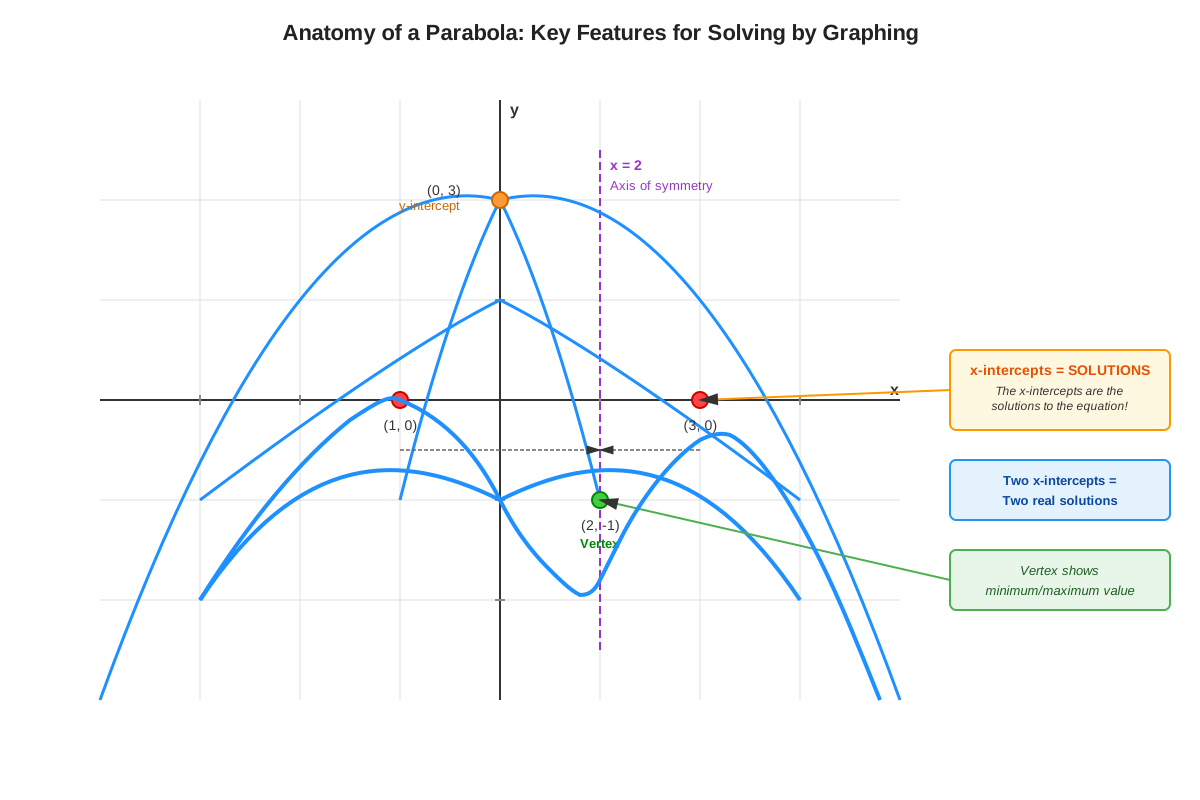
- [ ] Identify key features of solving by graphing, including x-intercepts, y-intercepts, and the vertex of parabolas
- [ ] Explain how solving by graphing appears on the SAT, including question formats and common scenarios
- [ ] Apply solving by graphing to answer SAT-style questions involving quadratic equations and systems
- [ ] Determine the number of solutions to a quadratic equation by analyzing its graph
- [ ] Connect algebraic solutions to their graphical representations on the coordinate plane
- [ ] Interpret graphs to extract solution information without performing algebraic calculations
Prerequisites
- Coordinate plane basics: Understanding x and y axes, plotting points, and reading coordinates is essential for interpreting any graph
- Quadratic functions: Knowledge of parabola shape, vertex, axis of symmetry, and standard form y = ax² + bx + c provides the foundation for graphing
- Function notation: Familiarity with f(x) notation helps students understand that solutions occur where f(x) = 0
- Basic graphing skills: Ability to sketch simple functions and identify key features enables visualization of solutions
- Solving linear equations: Understanding what a "solution" means algebraically helps connect to graphical solutions
Why This Topic Matters
In real-world applications, solving by graphing appears in physics (projectile motion), economics (profit maximization), engineering (optimization problems), and data analysis (trend identification). The ability to visualize mathematical relationships helps professionals make quick decisions based on graphical data without always needing precise algebraic calculations. For instance, engineers might graph a parabolic trajectory to determine where a projectile lands, or business analysts might graph revenue functions to identify break-even points.
On the SAT, solving by graphing appears in approximately 10-15% of math questions, making it a high-yield topic for test preparation. Questions typically fall into several categories: identifying solutions from a provided graph, determining the number of solutions based on graph characteristics, matching equations to graphs, and solving systems of equations graphically. The College Board frequently combines this topic with other concepts, creating multi-step problems that test both graphical interpretation and algebraic reasoning.
Common SAT question formats include: showing a parabola and asking which x-values are solutions; providing two functions and asking where they intersect; presenting a real-world scenario modeled by a quadratic function and asking students to interpret the graph; or giving multiple graphs and asking which represents a specific equation. The test also includes questions where students must recognize that the number of x-intercepts indicates the number of real solutions, or where they must use graphical information to eliminate incorrect answer choices.
Core Concepts
Understanding Solutions Graphically
A solution to an equation is any value that makes the equation true. When solving quadratic equations by graphing, solutions appear as the x-intercepts (also called zeros or roots) of the parabola—the points where the graph crosses or touches the x-axis. At these points, the y-value equals zero, which means the equation f(x) = 0 is satisfied. For example, if a parabola crosses the x-axis at x = 2 and x = -3, then 2 and -3 are the solutions to the equation.
The graphical approach provides immediate visual information about solutions that algebraic methods might obscure. Students can instantly see whether solutions exist, how many there are, and their approximate values. This makes graphing particularly valuable for checking algebraic work or for quickly eliminating incorrect answer choices on multiple-choice questions.
Types of Solutions Based on Graph Characteristics
The number and nature of solutions to a quadratic equation depend entirely on how the parabola interacts with the x-axis:
| Graph Characteristic | Number of Solutions | Description |
|---|---|---|
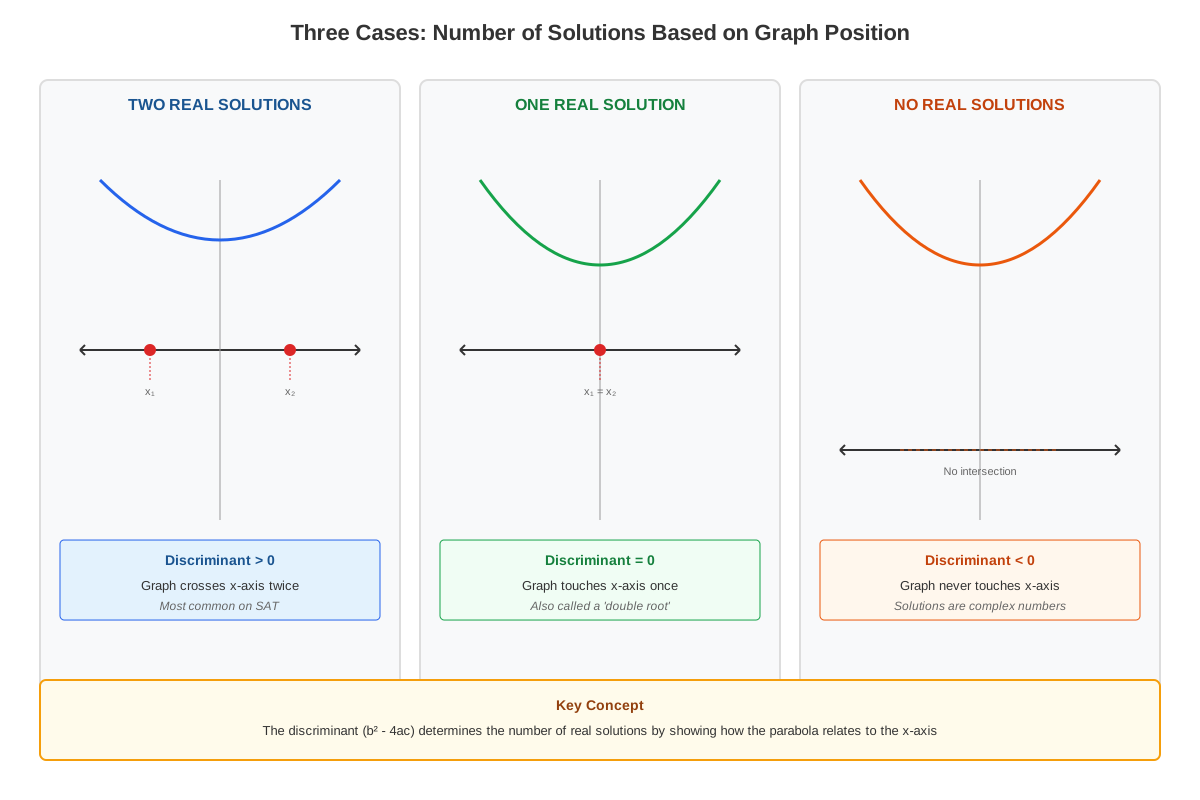
| Parabola crosses x-axis twice | Two distinct real solutions | The graph intersects the x-axis at two different points |
| Parabola touches x-axis once | One repeated real solution | The vertex lies exactly on the x-axis |
| Parabola doesn't touch x-axis | No real solutions | The entire parabola lies above or below the x-axis |
For an upward-opening parabola (a > 0), if the vertex is above the x-axis, there are no real solutions. If the vertex is on the x-axis, there is one solution. If the vertex is below the x-axis, there are two solutions. The opposite logic applies for downward-opening parabolas (a < 0).
Reading Solutions from a Graph
To extract solutions from a graph on the SAT:
- Locate the x-intercepts: Find where the parabola crosses or touches the x-axis
- Read the x-coordinates: The x-values at these intersection points are the solutions
- Verify the y-coordinate is zero: Confirm that at these points, y = 0
- Check for approximate values: SAT graphs may not show exact values, so estimate carefully
When a graph shows a parabola with x-intercepts at x = -1 and x = 4, the solutions to the corresponding equation are x = -1 and x = 4. These values can be verified algebraically by substituting them back into the original equation.
Graphing to Solve Quadratic Equations
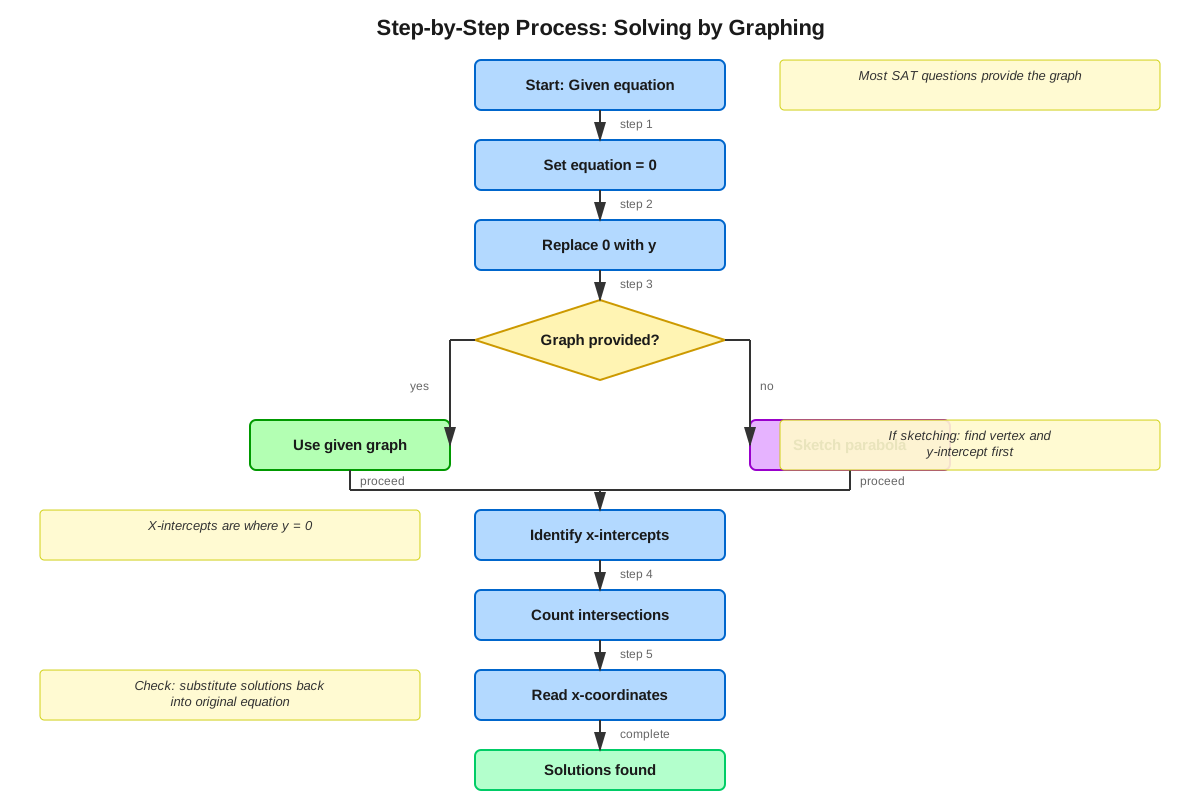
The systematic process for solving quadratic equations by graphing involves:
- Rewrite the equation in standard form: Ensure the equation is in the form ax² + bx + c = 0
- Graph the related function: Plot y = ax² + bx + c on the coordinate plane
- Identify key features: Locate the vertex, axis of symmetry, and direction of opening
- Find x-intercepts: Determine where the graph crosses the x-axis
- State the solutions: The x-coordinates of the intercepts are the solutions
For equations not equal to zero (like ax² + bx + c = k), students should rearrange to standard form by subtracting k from both sides before graphing.
Using Technology and Graph Features
On the SAT calculator-permitted section, graphing calculators provide powerful tools for solving by graphing. Students can:
- Enter the function and view its graph instantly
- Use the "zero" or "root" function to find x-intercepts precisely
- Adjust the viewing window to see all relevant features
- Verify solutions by checking that y = 0 at those x-values
However, students must still understand the underlying concepts, as the SAT includes calculator-prohibited sections and questions designed to test conceptual understanding rather than computational ability.
Solving Systems of Equations Graphically
Solving by graphing extends beyond single equations to systems of equations. When two functions are graphed on the same coordinate plane, their intersection points represent solutions to the system—values of x and y that satisfy both equations simultaneously. For a system involving a quadratic and a linear function, there may be zero, one, or two intersection points, corresponding to zero, one, or two solutions.
To solve a system graphically:
- Graph both equations on the same coordinate plane
- Identify all intersection points
- Read both the x and y coordinates of each intersection
- Verify that these coordinates satisfy both original equations
This method is particularly useful on the SAT when graphs are provided, as it allows for quick visual identification of solutions without algebraic manipulation.
Connecting Algebraic and Graphical Solutions
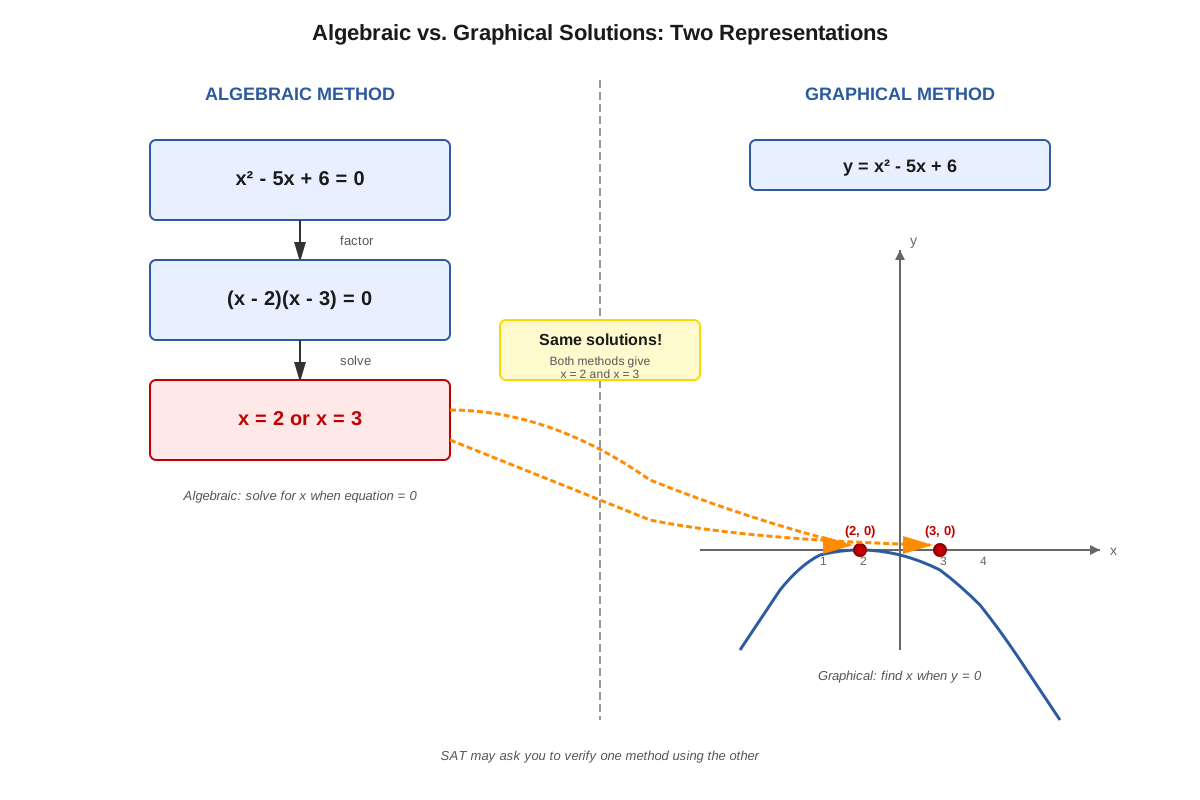
The power of solving by graphing lies in its connection to algebraic methods. When factoring yields solutions x = 2 and x = -5, the graph must show x-intercepts at these exact points. When the quadratic formula produces complex solutions (with imaginary components), the graph confirms this by showing no x-intercepts. This bidirectional relationship allows students to check their work and build deeper understanding of quadratic behavior.
The discriminant (b² - 4ac) from the quadratic formula directly predicts graphical behavior: positive discriminant means two x-intercepts, zero discriminant means one x-intercept (vertex on x-axis), and negative discriminant means no x-intercepts (parabola doesn't touch x-axis).
Concept Relationships
The concepts within solving by graphing form an interconnected web of understanding. Solutions as x-intercepts serves as the foundational concept, leading directly to determining the number of solutions based on graph characteristics. This connects to reading solutions from graphs, which requires understanding coordinate plane basics. The process of graphing to solve equations integrates all these concepts into a systematic approach.
Systems of equations extend the single-equation concepts by introducing intersection points as solutions, which builds on the same graphical interpretation skills. The connection between algebraic and graphical solutions serves as the overarching framework that ties everything together, showing that different solution methods yield consistent results.
Prerequisite topics connect forward into solving by graphing: coordinate plane knowledge enables graph reading, quadratic function properties determine parabola shape and position, and function notation clarifies what f(x) = 0 means graphically. These concepts then connect forward to more advanced topics like polynomial functions (which have multiple x-intercepts), rational functions (which have asymptotes and discontinuities), and calculus (where graphical analysis becomes even more sophisticated).
The relationship map flows as: Coordinate Plane Basics → Graphing Quadratic Functions → Identifying X-Intercepts → Reading Solutions → Solving Single Equations → Extending to Systems → Connecting to Algebraic Methods → Advanced Function Analysis
Quick check — test yourself on Solving by graphing so far.
Try Flashcards →High-Yield Facts
⭐ Solutions to quadratic equations appear as x-intercepts on the graph of the related function
⭐ A parabola can have zero, one, or two x-intercepts, corresponding to zero, one, or two real solutions
⭐ When the vertex of a parabola lies on the x-axis, the equation has exactly one repeated solution
⭐ The intersection points of two graphs represent solutions to the system of equations formed by those functions
⭐ If a parabola opens upward and its vertex is above the x-axis, the equation has no real solutions
- The x-coordinate of an x-intercept is the solution; the y-coordinate is always zero
- For downward-opening parabolas, if the vertex is below the x-axis, there are no real solutions
- Graphing calculators can find x-intercepts using the "zero" or "root" function
- The discriminant (b² - 4ac) predicts the number of x-intercepts: positive = 2, zero = 1, negative = 0
- Solutions found graphically should match solutions found algebraically (factoring, quadratic formula)
- On the SAT, graphs may show approximate values, requiring estimation skills
- A system of a linear and quadratic equation can have 0, 1, or 2 solutions based on intersection points
- The axis of symmetry of a parabola passes through the midpoint of the two x-intercepts when they exist
- Reading graphs accurately requires attention to scale and labeled points
- Graphical solutions provide quick verification of algebraic work
Common Misconceptions
Misconception: The vertex of a parabola is always a solution to the equation.
Correction: The vertex is only a solution when it lies exactly on the x-axis (y = 0). Otherwise, the vertex represents the maximum or minimum value of the function, not a solution.
Misconception: If a parabola doesn't cross the x-axis, the equation has no solutions at all.
Correction: The equation has no real solutions, but it does have complex (imaginary) solutions. On the SAT, "no solutions" typically means "no real solutions" in the context of graphing.
Misconception: The y-intercept of a parabola is one of the solutions.
Correction: Solutions are x-intercepts (where y = 0), not y-intercepts (where x = 0). The y-intercept shows the constant term c in the equation y = ax² + bx + c.
Misconception: A parabola that touches the x-axis at one point has no solutions.
Correction: When a parabola touches (is tangent to) the x-axis at exactly one point, that point represents one repeated real solution, also called a double root.
Misconception: You can only solve by graphing if you have a calculator.
Correction: While calculators help with precision, the SAT often provides graphs or asks conceptual questions about graphs that don't require plotting. Understanding graph interpretation is more important than plotting ability.
Misconception: The solutions to a system of equations are only the x-coordinates of intersection points.
Correction: Solutions to systems are ordered pairs (x, y) that include both coordinates of the intersection points, as both values are needed to satisfy both equations.
Misconception: If two graphs don't appear to intersect on a given viewing window, they never intersect.
Correction: Graphs might intersect outside the visible window. Always consider the domain and range, and adjust the viewing window if necessary.
Worked Examples
Example 1: Finding Solutions from a Given Graph
Problem: The graph of y = x² - 3x - 4 is shown on a coordinate plane. The parabola crosses the x-axis at two points. One x-intercept appears to be at x = -1. What is the other solution to the equation x² - 3x - 4 = 0?
Solution:
Step 1: Understand what we're looking for. Solutions to the equation are x-intercepts of the graph.
Step 2: We're told one x-intercept is at x = -1. We need to find the other.
Step 3: Use the axis of symmetry property. For a parabola y = ax² + bx + c, the axis of symmetry is x = -b/(2a).
For our equation: a = 1, b = -3, c = -4
Axis of symmetry: x = -(-3)/(2·1) = 3/2 = 1.5
Step 4: The axis of symmetry passes through the midpoint of the two x-intercepts. If one intercept is at x = -1 and the axis is at x = 1.5:
Midpoint formula: (x₁ + x₂)/2 = 1.5
(-1 + x₂)/2 = 1.5
-1 + x₂ = 3
x₂ = 4
Step 5: Verify by factoring: x² - 3x - 4 = (x - 4)(x + 1) = 0
Solutions: x = 4 or x = -1 ✓
Answer: The other solution is x = 4.
Connection to Learning Objectives: This example demonstrates identifying key features (axis of symmetry), applying solving by graphing to find solutions, and connecting algebraic verification to graphical interpretation.
Example 2: Determining Number of Solutions from Graph Description
Problem: A quadratic function f(x) = -2x² + 8x + k is graphed on a coordinate plane. If the vertex of the parabola is at the point (2, 10), how many real solutions does the equation -2x² + 8x + k = 0 have?
Solution:
Step 1: Identify key information. The parabola opens downward (a = -2 < 0) and has vertex at (2, 10).
Step 2: Determine the vertex's position relative to the x-axis. The vertex has a y-coordinate of 10, which is positive, meaning it's above the x-axis.
Step 3: Visualize the parabola. Since it opens downward and the highest point (vertex) is above the x-axis at y = 10, the parabola must cross the x-axis on both sides of the vertex.
Step 4: Apply the solution rule. A downward-opening parabola with its vertex above the x-axis crosses the x-axis at two points.
Step 5: Verify using the vertex form. We can write f(x) = -2(x - 2)² + 10.
At the x-intercepts, f(x) = 0:
-2(x - 2)² + 10 = 0
-2(x - 2)² = -10
(x - 2)² = 5
This equation has two real solutions: x = 2 + √5 and x = 2 - √5 ✓
Answer: The equation has two real solutions.
Connection to Learning Objectives: This example shows how to explain how solving by graphing appears on the SAT (through vertex information), identify key features (vertex position and parabola direction), and determine the number of solutions without actually graphing.
Exam Strategy
When approaching SAT questions on solving by graphing, begin by identifying what the question asks: Are you finding actual solution values, determining how many solutions exist, or matching equations to graphs? This initial classification helps select the most efficient approach.
Trigger words and phrases to watch for include: "x-intercept," "crosses the x-axis," "zeros of the function," "roots," "solutions to the equation," "where the graph intersects," and "how many real solutions." These phrases signal that graphical interpretation is required. Also watch for "system of equations" combined with "intersection point," which indicates solving by finding where graphs meet.
For process of elimination, use these strategies specific to solving by graphing:
- If a question shows a graph with no x-intercepts, immediately eliminate any answer choice that lists real number solutions
- When matching equations to graphs, check the y-intercept first (the constant term c) as it's easiest to verify
- For questions about number of solutions, eliminate choices that contradict the vertex position relative to the x-axis
- If given solution values, check whether they're symmetric about the axis of symmetry; if not, eliminate that choice
Time allocation for graphing questions should be approximately 45-60 seconds for straightforward graph-reading questions, and 90-120 seconds for multi-step problems involving systems or requiring both graphical and algebraic reasoning. If a calculator is permitted and you have a graphing calculator, use it to verify solutions quickly, but don't spend more than 20 seconds setting up the graph.
On calculator-prohibited sections, sketch quick, rough graphs when helpful. You don't need artistic precision—just enough to visualize whether the parabola opens up or down, where the vertex approximately sits, and how many x-intercepts exist. This 10-second sketch can prevent careless errors and clarify your thinking.
Always verify that your answer makes sense graphically. If you calculated x = 5 as a solution but the graph clearly shows x-intercepts near x = -2 and x = 3, you've made an error. Let the graph serve as a reasonableness check for algebraic work.
Memory Techniques
X-INTERCEPT = SOLUTION: Remember this fundamental equation by visualizing an X marking the spot where the treasure (solution) is buried on the x-axis.
"Two, One, or None" mnemonic for parabola solutions: Count on your fingers while checking the vertex position. If the vertex is on the "wrong side" of the x-axis (above for upward-opening, below for downward-opening), show zero fingers (no solutions). If it's exactly on the x-axis, show one finger. If it's on the "right side," show two fingers.
VERTEX position acronym - ABOVE/BELOW:
- Above x-axis, opens Up = No solutions (AUN)
- Below x-axis, opens Down = No solutions (BDN)
- Opposite cases = Two solutions (T for Two)
Visualization strategy: Picture a parabola as a smile (opens up) or frown (opens down). A smile above the ground (x-axis) never touches it—no solutions. A frown below the ground never touches it—no solutions. But a smile below ground or frown above ground must cross the ground twice—two solutions.
Intersection = Solution: For systems, remember "INT = SOL" (Intersection equals Solution). Every time graphs intersect, that's one solution to the system.
Summary
Solving by graphing is a powerful visual method for finding solutions to quadratic equations and systems of equations by identifying where graphs cross the x-axis or intersect each other. On the SAT, this topic requires students to interpret graphs, connect algebraic and graphical representations, and extract solution information efficiently. The fundamental principle is that solutions to an equation f(x) = 0 appear as x-intercepts of the graph y = f(x), and the number of x-intercepts (zero, one, or two) depends on the vertex position and parabola direction. For systems of equations, solutions appear as intersection points of the graphs. Mastery requires understanding how to read solutions from graphs, determine the number of solutions based on graph characteristics, and verify that graphical solutions match algebraic results. This topic integrates coordinate geometry, function analysis, and algebraic reasoning, making it essential for success on multiple SAT question types.
Key Takeaways
- Solutions to quadratic equations are the x-intercepts of the parabola—points where the graph crosses or touches the x-axis
- The number of real solutions (0, 1, or 2) depends on how many times the parabola intersects the x-axis, which is determined by vertex position and opening direction
- For systems of equations, solutions are the intersection points of the graphs, with both x and y coordinates needed
- Graphical and algebraic solution methods must yield consistent results; use one to verify the other
- The SAT tests solving by graphing through graph interpretation, solution counting, equation-graph matching, and systems problems
- Quick visualization of parabola position relative to the x-axis enables rapid elimination of incorrect answer choices
- Understanding the connection between the discriminant and the number of x-intercepts strengthens both algebraic and graphical reasoning
Related Topics
Quadratic Formula and Discriminant: Mastering solving by graphing enables deeper understanding of how the discriminant (b² - 4ac) predicts the number of real solutions, as this algebraic value directly corresponds to the number of x-intercepts visible on a graph.
Function Transformations: Understanding how changes to a, b, c, and k in various forms of quadratic equations affect the graph's position and shape builds on graphical solution skills and enables prediction of solution changes.
Systems of Linear and Quadratic Equations: Solving by graphing extends naturally to finding intersection points of different function types, a common SAT topic that combines multiple algebraic skills.
Inequalities and Shaded Regions: Graphical solution methods expand to inequalities, where solution sets become regions rather than points, requiring similar graph interpretation skills.
Polynomial Functions: The concept of x-intercepts as solutions extends to higher-degree polynomials, where functions may have three, four, or more real solutions visible as multiple x-intercepts.
Practice CTA
Now that you've mastered the concepts of solving by graphing, it's time to put your knowledge to the test! Work through the practice questions to reinforce your understanding and build the speed and accuracy you'll need on test day. The flashcards will help you memorize key facts and relationships, ensuring that you can quickly recall essential information during the exam. Remember, the SAT rewards both conceptual understanding and efficient problem-solving—practice is what bridges the gap between knowing the material and scoring points. You've got this!
Sign up free to keep reading
Create a free AnvayaPrep account to finish this SAT guide on Solving by graphing — plus flashcards and practice questions.