Overview
Equivalent rational forms represent one of the most frequently tested algebraic concepts on the SAT Math section. At its core, this topic involves recognizing that a single rational expression—a fraction containing polynomials in the numerator and denominator—can be written in multiple ways that are mathematically identical. Just as 1/2 and 2/4 represent the same value, complex rational expressions can be manipulated through algebraic operations to reveal different but equivalent forms. Mastering this skill enables students to simplify complex expressions, solve equations efficiently, and recognize when two seemingly different expressions are actually the same.
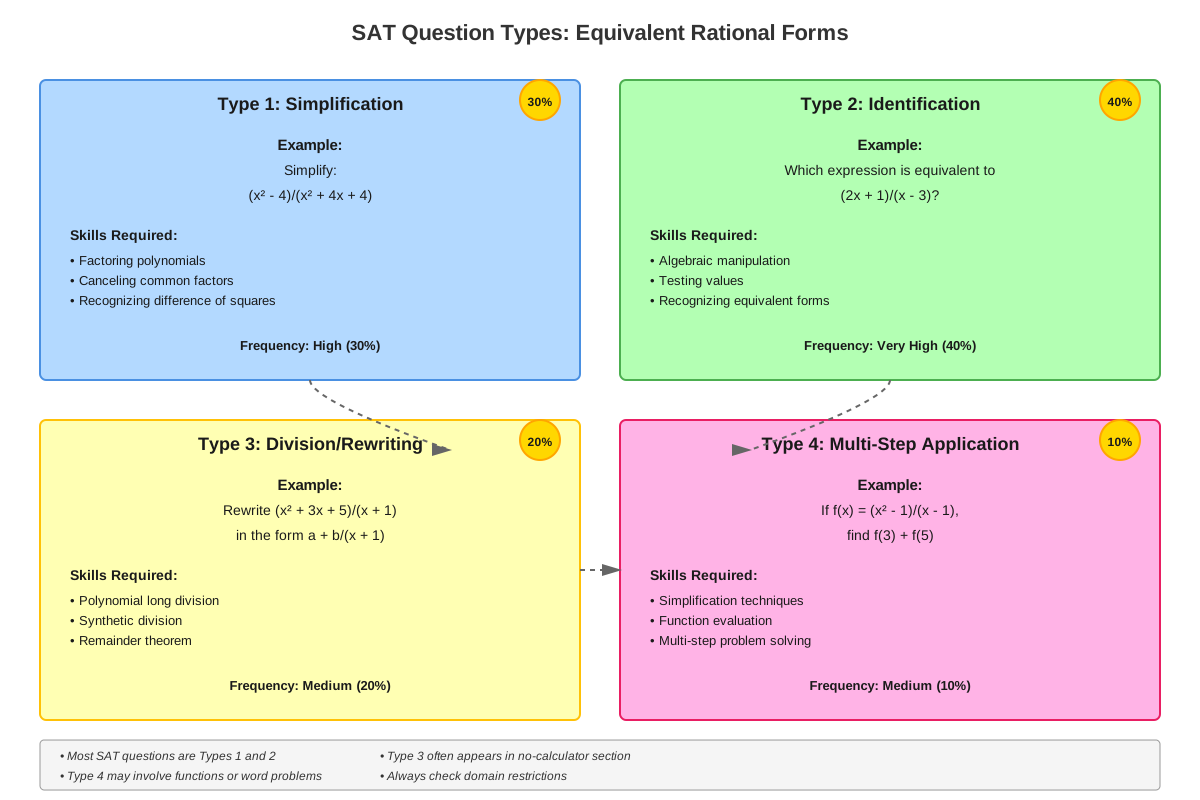
The SAT frequently tests this concept by presenting a rational expression in one form and asking students to identify which answer choice represents an equivalent expression, or by requiring students to manipulate an expression into a specific form to solve a problem. Questions may involve factoring polynomials, canceling common factors, performing polynomial division, or combining multiple rational expressions. Understanding equivalent rational forms is not merely about mechanical manipulation—it requires recognizing structural patterns, identifying strategic approaches, and selecting the most efficient path to a solution.
This topic sits at the intersection of several fundamental algebraic skills. It builds upon polynomial operations, factoring techniques, and fraction arithmetic while serving as a foundation for more advanced topics like rational equations and function analysis. The ability to recognize and generate equivalent forms is essential for success on approximately 10-15% of SAT math questions, making it a high-yield area that deserves focused attention and practice.
Learning Objectives
- [ ] Identify key features of equivalent rational forms
- [ ] Explain how equivalent rational forms appears on the SAT
- [ ] Apply equivalent rational forms to answer SAT-style questions
- [ ] Simplify rational expressions by factoring and canceling common factors
- [ ] Perform polynomial long division and synthetic division to rewrite rational expressions
- [ ] Recognize when two different-looking rational expressions are equivalent
- [ ] Convert between improper rational forms and mixed polynomial forms
Prerequisites
- Polynomial operations (addition, subtraction, multiplication): Essential for manipulating numerators and denominators in rational expressions
- Factoring techniques (GCF, difference of squares, trinomial factoring): Required to identify common factors that can be canceled
- Properties of fractions and fraction arithmetic: Fundamental understanding that equivalent fractions represent the same value
- Basic algebraic manipulation: Necessary for rearranging terms and simplifying expressions
- Understanding of domain restrictions: Critical for recognizing when simplifications are valid (when denominators are non-zero)
Why This Topic Matters
In real-world applications, equivalent rational forms appear throughout science, engineering, and economics. Engineers use them to simplify complex formulas in electrical circuit analysis, physicists employ them in kinematic equations, and economists utilize them in cost-benefit analyses. The ability to recognize that different forms of an expression represent the same relationship is fundamental to problem-solving across disciplines.
On the SAT, equivalent rational forms questions appear with remarkable consistency. Approximately 2-3 questions per test directly assess this skill, and many additional questions require it as an intermediate step. These questions typically appear in both the calculator and no-calculator sections, with difficulty ranging from medium to hard. The College Board particularly favors questions that combine multiple skills: factoring, simplification, and algebraic reasoning.
Common SAT question formats include: (1) "Which of the following is equivalent to the given expression?" where students must identify the correct simplified form among distractors; (2) "For what value of x is the expression undefined?" requiring students to find domain restrictions; (3) "Simplify the expression" where students must perform operations to reach a specific form; and (4) word problems where setting up and simplifying a rational expression is necessary to find the solution. The test writers deliberately create answer choices that represent common errors, making it essential to work carefully and verify results.
Core Concepts
Understanding Rational Expressions
A rational expression is a fraction where both the numerator and denominator are polynomials. Just as 6/8 can be simplified to 3/4 by dividing both numerator and denominator by their greatest common factor (2), rational expressions can be simplified by factoring and canceling common polynomial factors. The expression (x² - 4)/(x - 2) and (x + 2) are equivalent rational forms for all values of x except x = 2, where the original expression is undefined.
The fundamental principle underlying equivalent rational forms is that multiplying or dividing both the numerator and denominator by the same non-zero expression produces an equivalent expression. This principle allows us to both simplify expressions (by dividing out common factors) and create more complex forms (by multiplying by strategic forms of 1).
Simplification Through Factoring
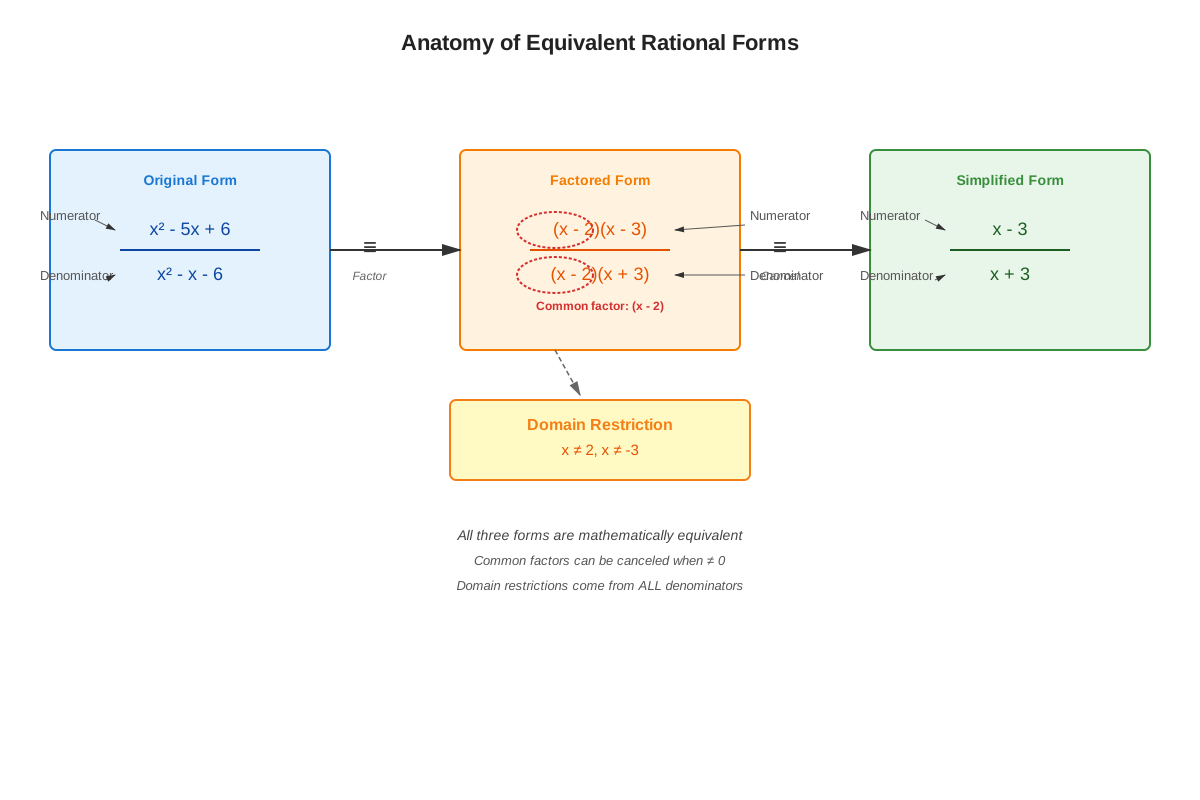
The most common method for creating equivalent rational forms involves factoring polynomials and canceling common factors. Consider the expression:
(x² + 5x + 6)/(x² - 9)To simplify, factor both numerator and denominator:
- Numerator: x² + 5x + 6 = (x + 2)(x + 3)
- Denominator: x² - 9 = (x + 3)(x - 3)
The factored form becomes:
[(x + 2)(x + 3)]/[(x + 3)(x - 3)]Since (x + 3) appears in both numerator and denominator, it can be canceled (provided x ≠ -3):
(x + 2)/(x - 3)This simplified form is equivalent to the original for all x except x = -3 and x = 3 (where the expressions are undefined).
Domain Restrictions and Excluded Values
A critical aspect of equivalent rational forms is understanding domain restrictions. When we cancel a common factor, we must remember that the original expression was undefined wherever that factor equaled zero. In the previous example, even though (x + 3) was canceled, the original expression is still undefined at x = -3. Both forms are undefined at x = 3 (where the denominator equals zero in both forms), but only the original form explicitly shows the restriction at x = -3.
On the SAT, questions may ask "For which value of x is the expression undefined?" or "What is the domain of the function?" Understanding that canceled factors still create restrictions is essential for answering these questions correctly.
Polynomial Long Division
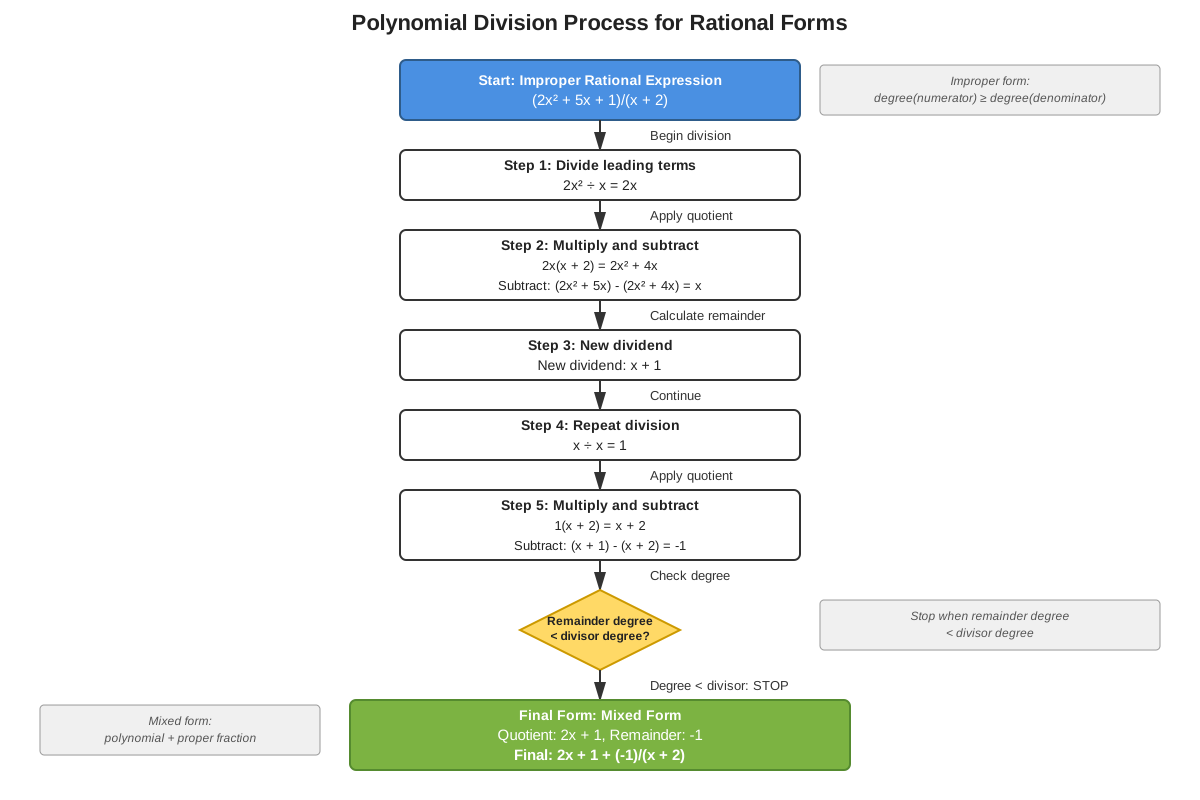
When the degree of the numerator is greater than or equal to the degree of the denominator, polynomial long division can rewrite an improper rational expression as a polynomial plus a proper rational expression (where the numerator has lower degree than the denominator). This creates an equivalent form that may be more useful for certain problems.
For example, dividing (x² + 3x + 5) by (x + 1):
- x² ÷ x = x (first term of quotient)
- Multiply: x(x + 1) = x² + x
- Subtract: (x² + 3x + 5) - (x² + x) = 2x + 5
- 2x ÷ x = 2 (second term of quotient)
- Multiply: 2(x + 1) = 2x + 2
- Subtract: (2x + 5) - (2x + 2) = 3 (remainder)
Result: (x² + 3x + 5)/(x + 1) = x + 2 + 3/(x + 1)
Both forms are equivalent, but the second form clearly shows the behavior of the expression for large values of x (it approaches x + 2).
Complex Rational Expressions
Some SAT questions involve complex rational expressions—fractions that contain fractions in the numerator, denominator, or both. To simplify these, multiply both the numerator and denominator by the least common denominator (LCD) of all the smaller fractions involved.
For example, to simplify:
(1/x + 1/y)/(1/x - 1/y)Multiply numerator and denominator by xy (the LCD):
[xy(1/x + 1/y)]/[xy(1/x - 1/y)] = (y + x)/(y - x)This technique transforms a complex rational expression into a simple one.
Adding and Subtracting Rational Expressions
Creating equivalent forms often requires combining multiple rational expressions through addition or subtraction. This process requires finding a common denominator, just as with numerical fractions.
To add 3/(x - 2) + 5/(x + 1):
- Find LCD: (x - 2)(x + 1)
- Convert each fraction: [3(x + 1)]/[(x - 2)(x + 1)] + [5(x - 2)]/[(x - 2)(x + 1)]
- Combine numerators: [3(x + 1) + 5(x - 2)]/[(x - 2)(x + 1)]
- Simplify numerator: (3x + 3 + 5x - 10)/[(x - 2)(x + 1)] = (8x - 7)/[(x - 2)(x + 1)]
The single rational expression (8x - 7)/[(x - 2)(x + 1)] is equivalent to the sum of the two original expressions.
Recognizing Equivalent Forms
The SAT often presents answer choices that look different but may be equivalent. Developing the ability to quickly recognize equivalent forms is crucial. Common equivalent forms include:
| Original Form | Equivalent Form | Method |
|---|---|---|
| (x² - 4)/(x - 2) | x + 2 | Factor and cancel |
| (x² + 2x)/(x) | x + 2 | Factor and cancel |
| (2x + 4)/(2) | x + 2 | Factor and cancel |
| (x³ - 8)/(x - 2) | x² + 2x + 4 | Polynomial division |
| 1/(x - 3) | -1/(3 - x) | Factor out -1 |
Concept Relationships
The concepts within equivalent rational forms build upon each other in a logical progression. Factoring serves as the foundation → enabling simplification through cancellation → which requires understanding domain restrictions → while polynomial division provides an alternative method for creating equivalent forms → and combining rational expressions requires all previous skills working together.
This topic connects directly to prerequisite knowledge of polynomial operations and factoring. Every simplification requires factoring skills, and every combination of rational expressions requires polynomial arithmetic. The topic also connects forward to rational equations (where finding equivalent forms is often the key to solving) and function analysis (where different forms reveal different properties of functions).
The relationship map: Polynomial Factoring → Common Factor Identification → Cancellation → Simplified Form → Domain Analysis. Alternatively: Multiple Rational Expressions → Common Denominator → Combined Expression → Simplification → Final Equivalent Form.
Quick check — test yourself on Equivalent rational forms so far.
Try Flashcards →High-Yield Facts
⭐ Any factor that appears in both numerator and denominator can be canceled, provided that factor does not equal zero
⭐ When a common factor is canceled, the values that made that factor zero remain excluded from the domain
⭐ To add or subtract rational expressions, first find a common denominator, then combine numerators
⭐ Polynomial long division converts an improper rational expression (numerator degree ≥ denominator degree) into a polynomial plus a proper rational expression
⭐ Two rational expressions are equivalent if they produce the same output for all values in their common domain
- The expression a/b = c/d if and only if ad = bc (cross-multiplication property)
- Factoring the numerator and denominator completely is always the first step in simplification
- The LCD of rational expressions is the product of all unique factors, each raised to its highest power
- Multiplying numerator and denominator by the same non-zero expression always produces an equivalent form
- Complex rational expressions can be simplified by multiplying by the LCD of all internal fractions
- The expression 1/(a - b) = -1/(b - a) because (a - b) = -(b - a)
- When simplifying, always check if further factoring is possible after canceling
- Equivalent forms may look completely different but will have the same graph (except possibly at excluded points)
Common Misconceptions
Misconception: Canceling terms that are added or subtracted rather than factors that are multiplied
Correction: Only factors (expressions connected by multiplication) can be canceled. In (x + 3)/(x + 5), the x's cannot cancel because they are terms, not factors. You can only cancel factors like in (x + 3)(x - 2)/(x + 3) where (x + 3) is a factor of both numerator and denominator.
Misconception: Believing that canceling a factor has no effect on the domain
Correction: Even after canceling a common factor, the values that made that factor zero remain excluded from the domain. The expression (x² - 4)/(x - 2) simplifies to (x + 2), but x = 2 is still excluded from the domain of the original expression.
Misconception: Thinking that (a + b)/(c + d) can be split into a/c + b/d
Correction: Fractions cannot be split this way. The expression (x + 3)/(x + 5) does NOT equal x/x + 3/5. Only when a single term is divided by the entire denominator can you split: (a + b)/c = a/c + b/c.
Misconception: Forgetting to find a common denominator before adding or subtracting rational expressions
Correction: Just like numerical fractions, rational expressions must have a common denominator before their numerators can be combined. You cannot add 1/x + 1/y to get 2/(x + y); you must first convert to y/(xy) + x/(xy) = (x + y)/(xy).
Misconception: Assuming that if two expressions look different, they cannot be equivalent
Correction: Equivalent expressions can appear very different. The expressions (x² - 1)/(x - 1), (x + 1), and (x² + 2x + 1)/(x + 1) all equal (x + 1) for appropriate domain values. Always simplify or test values to check equivalence.
Misconception: Canceling before factoring completely
Correction: Always factor numerator and denominator completely before canceling. In (x² - 4)/(x² + 4x + 4), students might not see common factors until both are factored: (x - 2)(x + 2)/(x + 2)² reveals that (x + 2) can be canceled.
Worked Examples
Example 1: Simplifying a Rational Expression
Problem: Simplify the expression (2x² - 8)/(x² + 4x + 4) and state any domain restrictions.
Solution:
Step 1: Factor the numerator completely.
- 2x² - 8 = 2(x² - 4) = 2(x - 2)(x + 2)
Step 2: Factor the denominator completely.
- x² + 4x + 4 = (x + 2)(x + 2) = (x + 2)²
Step 3: Write the factored form.
- [2(x - 2)(x + 2)]/[(x + 2)²]
Step 4: Cancel common factors.
- The factor (x + 2) appears once in the numerator and twice in the denominator, so we can cancel one instance:
- [2(x - 2)]/(x + 2)
Step 5: Identify domain restrictions.
- The original denominator equals zero when (x + 2)² = 0, which occurs at x = -2
- Therefore, the domain is all real numbers except x = -2
Final Answer: 2(x - 2)/(x + 2) or equivalently (2x - 4)/(x + 2), with domain restriction x ≠ -2
This example demonstrates the complete process: factor completely, cancel common factors, and identify domain restrictions. This addresses the learning objective of simplifying rational expressions and recognizing key features.
Example 2: Combining Rational Expressions
Problem: Write (3/(x - 1)) - (2/(x + 2)) as a single rational expression in simplest form.
Solution:
Step 1: Identify the LCD.
- The denominators are (x - 1) and (x + 2), which have no common factors
- LCD = (x - 1)(x + 2)
Step 2: Convert each fraction to have the LCD.
- 3/(x - 1) = [3(x + 2)]/[(x - 1)(x + 2)]
- 2/(x + 2) = [2(x - 1)]/[(x - 1)(x + 2)]
Step 3: Subtract the numerators.
- [3(x + 2) - 2(x - 1)]/[(x - 1)(x + 2)]
Step 4: Expand and simplify the numerator.
- Numerator: 3(x + 2) - 2(x - 1) = 3x + 6 - 2x + 2 = x + 8
Step 5: Write the final expression.
- (x + 8)/[(x - 1)(x + 2)]
Step 6: Check if further simplification is possible.
- The numerator (x + 8) shares no common factors with the denominator
- The expression is fully simplified
Final Answer: (x + 8)/[(x - 1)(x + 2)], with domain restrictions x ≠ 1 and x ≠ -2
This example shows how to combine rational expressions, a common SAT task that requires finding common denominators and careful algebraic manipulation. This directly applies the learning objective of applying equivalent rational forms to solve SAT-style questions.
Exam Strategy
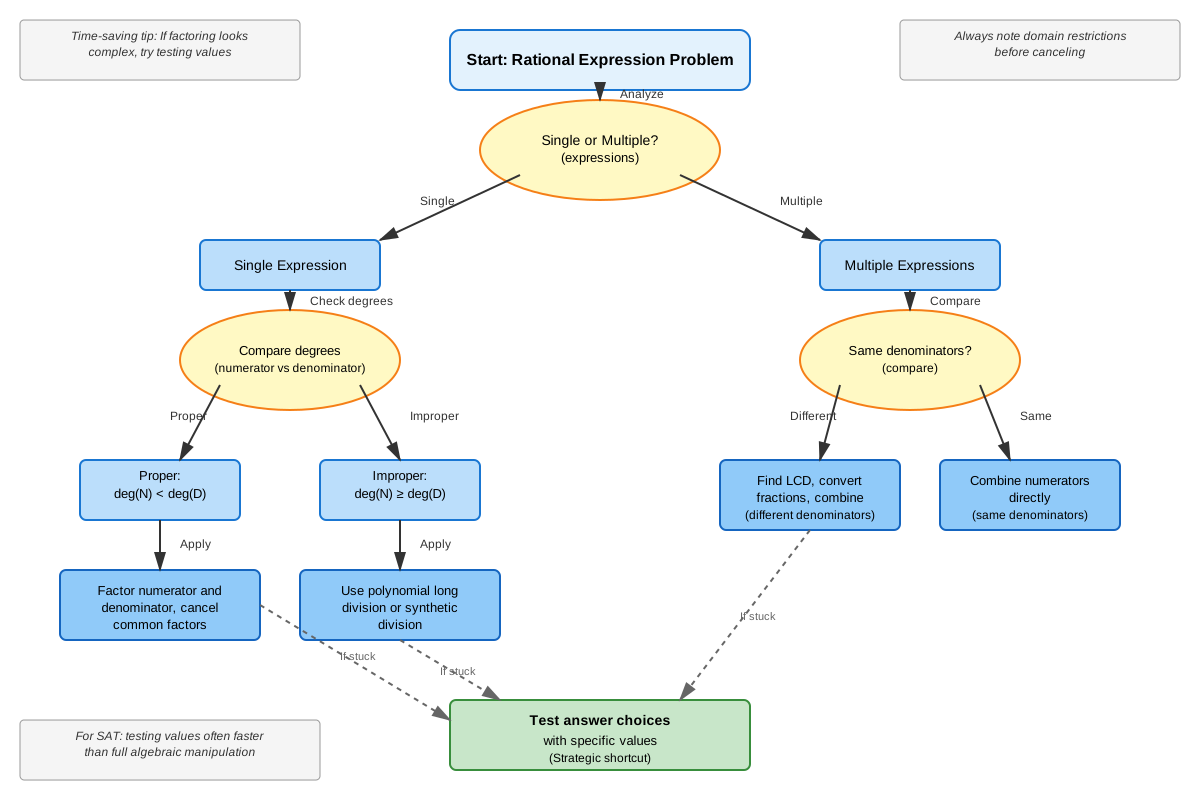
When approaching SAT equivalent rational forms questions, begin by quickly scanning the answer choices to determine what form they're in. If answer choices are simplified, you'll need to simplify the given expression. If they're expanded, you may need to multiply out. This preview saves time by showing you the destination before you start the journey.
Trigger words and phrases to watch for include: "equivalent to," "simplified form," "which expression equals," "for all values except," and "undefined when." These phrases signal that you'll need to manipulate rational expressions. The phrase "for all values of x" suggests you should verify equivalence by testing values or by algebraic manipulation.
For process of elimination, test x = 0 first (if allowed by the domain) because it's the easiest value to calculate. If an answer choice gives a different result than the original expression at x = 0, eliminate it immediately. Then test x = 1 or x = -1 to eliminate additional wrong answers. This strategy is particularly effective when algebraic manipulation seems complex or time-consuming.
Time allocation: Spend 15-20 seconds analyzing the problem and answer choices, 45-60 seconds on algebraic manipulation, and 15-20 seconds verifying your answer. If you're not making progress after one minute, use the testing-values strategy instead. Remember that on the SAT, efficiency matters as much as accuracy.
Exam Tip: Always factor completely before canceling. Many wrong answer choices represent partially simplified expressions that result from canceling before complete factoring.
When stuck, remember that you can work backwards from answer choices. Multiply answer choices by the original denominator to see which produces the original numerator. This reverse-engineering approach can be faster than forward simplification for complex expressions.
Memory Techniques
FACTOR - A mnemonic for the simplification process:
- Factor numerator and denominator completely
- Analyze for common factors
- Cancel common factors (only factors, not terms!)
- Track domain restrictions
- Observe if further simplification is possible
- Rewrite in simplest form
The "Fraction Sandwich" visualization: Picture the numerator and denominator as two pieces of bread. Common factors are the filling that can be removed, but you must keep track of where that filling was (domain restrictions). The bread that remains is your simplified expression.
LCD Acronym - "Least Common Denominator" becomes "Locate Common Denominators": When combining rational expressions, your first task is always to locate (find) the common denominator before proceeding.
The "Cancel Carefully" rule: Remember that you can only cancel factors (multiplication), never terms (addition/subtraction). Visualize factors as connected by invisible multiplication dots, and only expressions connected by dots can cancel.
Domain Restriction Reminder: "Canceled but not forgotten" - factors that are canceled still create domain restrictions. Imagine them as ghosts that haunt the expression even after they disappear.
Summary
Equivalent rational forms represent one of the most important algebraic skills tested on the SAT Math section. The core principle is that rational expressions—fractions containing polynomials—can be written in multiple equivalent ways through factoring, canceling common factors, polynomial division, or combining multiple expressions. Mastery requires understanding that simplification always begins with complete factoring, that only factors (not terms) can be canceled, and that canceled factors still create domain restrictions. Students must be able to recognize when two different-looking expressions are equivalent, combine multiple rational expressions by finding common denominators, and convert between different forms strategically. The SAT tests this concept through direct simplification questions, equivalence identification problems, and domain restriction questions. Success requires both algebraic fluency and strategic thinking—knowing when to simplify, when to test values, and when to work backwards from answer choices. The ability to manipulate rational expressions efficiently is essential not only for dedicated rational expression questions but also for solving rational equations, analyzing functions, and tackling complex word problems throughout the SAT Math section.
Key Takeaways
- Equivalent rational forms are created by factoring and canceling common factors, performing polynomial division, or combining multiple rational expressions
- Only factors (expressions connected by multiplication) can be canceled; terms connected by addition or subtraction cannot be canceled
- Domain restrictions occur wherever the denominator equals zero, and these restrictions persist even after common factors are canceled
- To combine rational expressions through addition or subtraction, first find the least common denominator (LCD), convert all expressions to that denominator, then combine numerators
- Testing simple values (like x = 0, 1, or -1) in both the original expression and answer choices provides a quick way to eliminate incorrect answers
- Complete factoring before canceling is essential—many SAT wrong answers represent partially simplified expressions
- Polynomial long division converts improper rational expressions into a polynomial plus a proper rational expression, revealing different properties of the expression
Related Topics
Rational Equations: After mastering equivalent rational forms, students progress to solving equations containing rational expressions. The simplification skills learned here become essential tools for clearing denominators and solving for variables.
Function Analysis and Asymptotes: Different equivalent forms of rational functions reveal different features—factored forms show zeros and holes, while divided forms show end behavior and horizontal asymptotes. This topic builds directly on equivalent forms.
Partial Fraction Decomposition: An advanced technique that reverses the process of combining rational expressions, breaking a complex rational expression into simpler components. This requires mastery of all equivalent forms concepts.
Systems of Equations with Rational Expressions: Combining the skills of equivalent rational forms with systems of equations creates more complex problems that appear on the SAT and in advanced mathematics courses.
Practice CTA
Now that you've mastered the core concepts of equivalent rational forms, it's time to solidify your understanding through practice. Attempt the practice questions to test your ability to simplify expressions, identify equivalent forms, and recognize domain restrictions under timed conditions. Use the flashcards to reinforce key facts and procedures until they become automatic. Remember, the difference between knowing these concepts and scoring points on test day is practice. Each problem you solve builds the pattern recognition and algebraic fluency that will make SAT questions feel familiar and manageable. You've built a strong foundation—now strengthen it through deliberate practice!
Sign up free to keep reading
Create a free AnvayaPrep account to finish this SAT guide on Equivalent rational forms — plus flashcards and practice questions.