Overview
Extraneous solutions represent one of the most critical yet frequently misunderstood concepts in SAT math. An extraneous solution is a value that emerges from the algebraic manipulation of an equation but does not actually satisfy the original equation. These "false solutions" typically arise when solving rational equations, radical equations, or when both sides of an equation are multiplied or squared during the solution process. Understanding how to identify and eliminate extraneous solutions is essential for avoiding careless errors that can cost valuable points on test day.
The SAT regularly tests this concept because it assesses both computational skills and conceptual understanding. Students must not only solve equations correctly but also verify their answers—a critical thinking skill that distinguishes high-scoring test-takers from those who simply follow procedures mechanically. Questions involving sat extraneous solutions often appear in the calculator and no-calculator sections, typically worth 1-2 questions per test, making them high-yield material for focused study.
This topic connects directly to rational expressions and equations, radical equations, and absolute value equations—all core components of the SAT Math curriculum. Mastering extraneous solutions strengthens algebraic reasoning skills and reinforces the importance of checking work, a habit that benefits performance across all mathematical domains tested on the SAT.
Learning Objectives
- [ ] Identify key features of extraneous solutions
- [ ] Explain how extraneous solutions appears on the SAT
- [ ] Apply extraneous solutions to answer SAT-style questions
- [ ] Determine when extraneous solutions are likely to occur during equation solving
- [ ] Verify solutions by substituting back into original equations
- [ ] Recognize domain restrictions that invalidate potential solutions
- [ ] Distinguish between valid solutions and extraneous solutions in multi-step problems
Prerequisites
- Solving linear equations: Foundation for understanding how algebraic manipulations can introduce extraneous solutions
- Rational expressions: Necessary for recognizing when denominators equal zero, creating undefined expressions
- Radical equations: Understanding square roots and higher-order roots helps identify when squaring both sides introduces false solutions
- Domain and range concepts: Essential for determining which values are permissible in an equation
- Substitution and verification: Basic skill needed to check whether a solution satisfies the original equation
Why This Topic Matters
In real-world applications, extraneous solutions represent scenarios where mathematical models produce theoretically valid results that are practically impossible or meaningless. Engineers checking structural calculations, scientists analyzing experimental data, and financial analysts modeling economic scenarios all must verify that their solutions make sense in context—not just mathematically but practically.
On the SAT, extraneous solutions appear in approximately 2-4% of all math questions, typically manifesting in Problem Solving and Data Analysis or Passport to Advanced Math sections. These questions often combine multiple concepts, making them medium-to-high difficulty items that effectively differentiate between score ranges. The College Board specifically includes these problems to test whether students understand the "why" behind mathematical procedures, not just the "how."
Common SAT question formats include: solving rational equations where solutions make denominators zero; solving radical equations where squaring introduces invalid solutions; word problems where algebraic solutions don't match real-world constraints; and multi-step problems requiring verification of intermediate results. Questions may directly ask "which value is an extraneous solution?" or indirectly test the concept by asking for the sum of all valid solutions, requiring students to identify and exclude extraneous ones.
Core Concepts
Definition and Origin of Extraneous Solutions
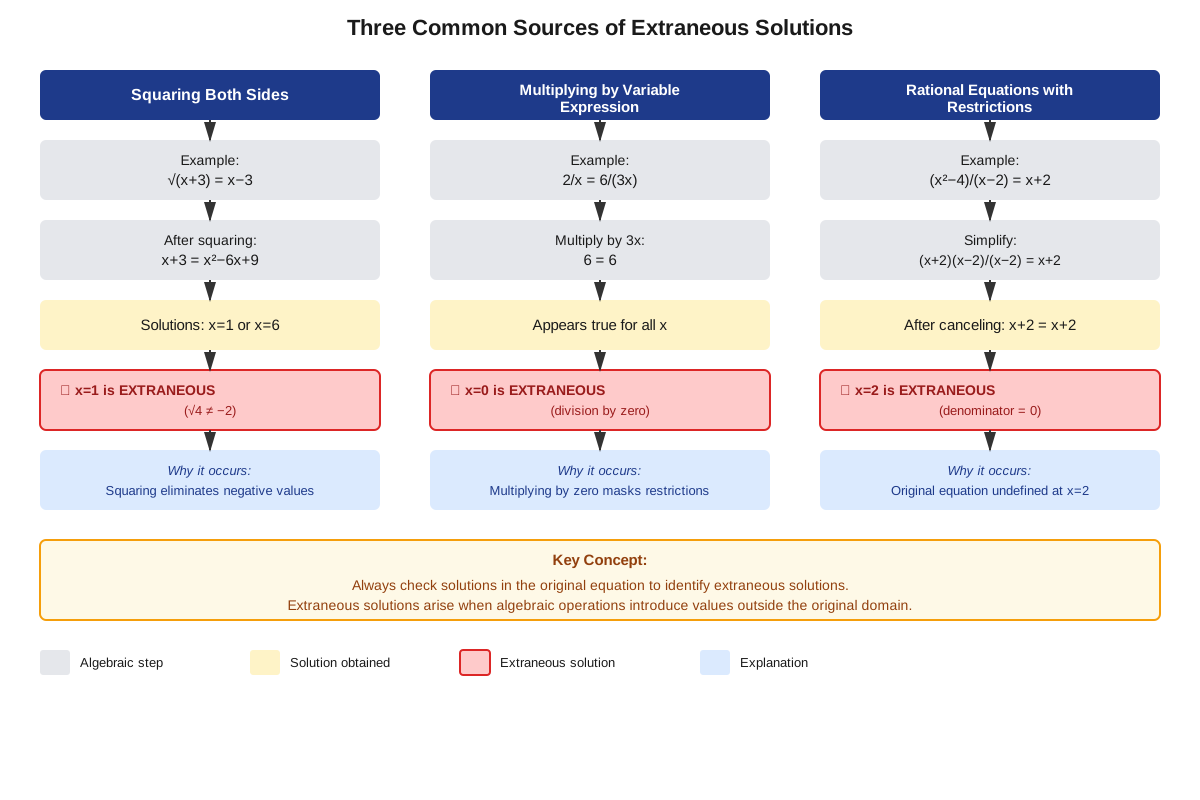
An extraneous solution is a solution obtained through correct algebraic procedures that does not satisfy the original equation when substituted back. These solutions are not errors in calculation but rather artifacts of the solution process itself. They emerge when certain algebraic operations—particularly squaring both sides, multiplying by variable expressions, or combining fractions—transform the original equation into a new equation with a different solution set.
The fundamental principle is that while some operations preserve equivalence (adding the same value to both sides), others expand the solution set. When we square both sides of an equation, for instance, we create an equation that includes solutions to both the original equation and its negative. Consider: if x = 3, then x² = 9, but x² = 9 has solutions x = 3 and x = -3. The negative solution is extraneous to the original equation x = 3.
When Extraneous Solutions Occur
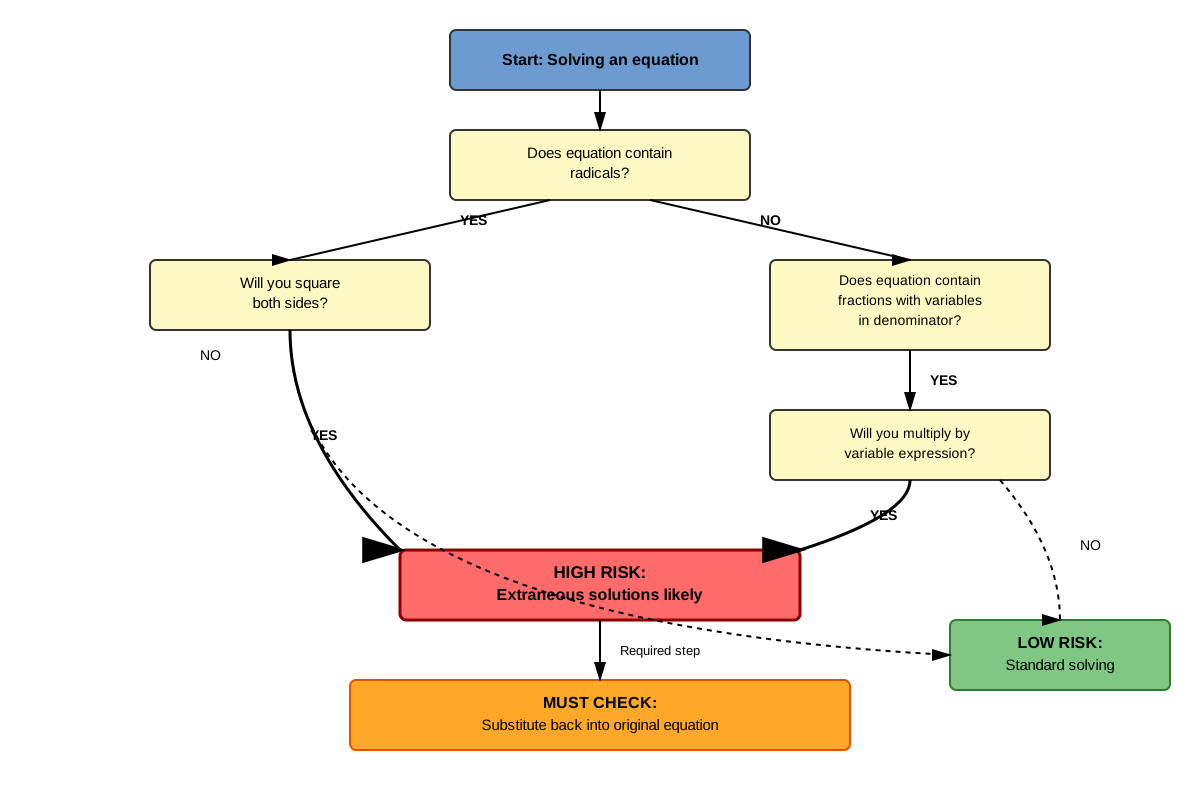
Extraneous solutions most commonly arise in four scenarios:
- Rational equations: When multiplying both sides by a variable expression that could equal zero
- Radical equations: When squaring both sides to eliminate square roots
- Absolute value equations: When removing absolute value bars by considering multiple cases
- Logarithmic equations: When applying logarithm properties that have domain restrictions
Solving Rational Equations and Identifying Extraneous Solutions
When solving rational equations, the standard approach involves multiplying both sides by the least common denominator (LCD) to eliminate fractions. This operation can introduce extraneous solutions because we're multiplying by an expression that might equal zero for certain values.
Step-by-step process:
- Identify all denominators and determine domain restrictions (values that make denominators zero)
- Find the LCD of all rational expressions
- Multiply every term by the LCD
- Solve the resulting polynomial equation
- Check each solution against domain restrictions
- Verify remaining solutions in the original equation
For example, consider the equation:
(x + 2)/(x - 3) = 4/(x - 3)The domain restriction is x ≠ 3 (since this makes the denominator zero). Multiplying both sides by (x - 3) gives:
x + 2 = 4
x = 2
Checking: x = 2 doesn't violate the domain restriction and satisfies the original equation, so it's valid. However, if our algebraic work had produced x = 3, this would be extraneous because it makes the original equation undefined.
Solving Radical Equations and Extraneous Solutions
Radical equations contain variables under radical signs (square roots, cube roots, etc.). Solving these requires isolating the radical and raising both sides to the appropriate power, which can introduce extraneous solutions.
Key principle: When we square both sides of an equation, we're solving x² = a² rather than x = a. This includes solutions where x = -a, which may not satisfy the original equation.
Systematic approach:
- Isolate the radical expression on one side
- Square both sides (or raise to the appropriate power)
- Solve the resulting equation
- Check all solutions in the original equation
- Reject any that produce false statements or negative values under even-index radicals
Domain Restrictions as the Primary Filter
Understanding domain restrictions is crucial for identifying extraneous solutions efficiently. Before solving any equation, identify values that would:
- Make any denominator equal zero
- Produce negative values under even-index radicals (square roots, fourth roots, etc.)
- Create logarithms of non-positive numbers
- Violate any stated constraints in word problems
| Operation Type | Common Domain Restriction | Why It Matters |
|---|---|---|
| Rational expression | Denominator ≠ 0 | Division by zero is undefined |
| Square root | Radicand ≥ 0 | Even roots of negative numbers aren't real |
| Logarithm | Argument > 0 | Logarithms of non-positive numbers are undefined |
| Even root | Radicand ≥ 0 | Principal roots must be non-negative |
Verification Process
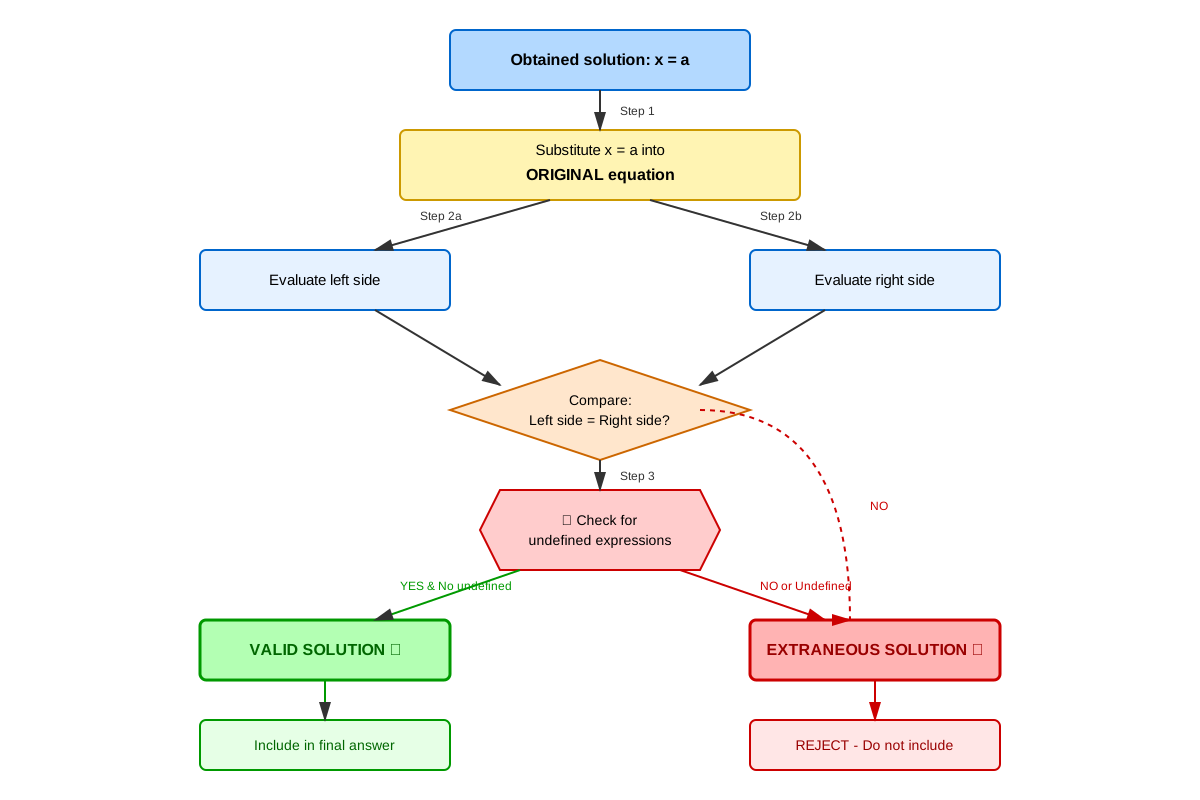
The verification step is non-negotiable when dealing with equations prone to extraneous solutions. This involves:
- Substitution: Replace the variable with each potential solution in the original equation
- Simplification: Carefully simplify both sides, watching for undefined expressions
- Comparison: Verify that both sides equal the same value
- Rejection: Eliminate any solution that produces a false statement or undefined expression
This process must use the original equation, not any transformed version, because the transformation itself may have introduced the extraneous solution.
Concept Relationships
The concept of extraneous solutions sits at the intersection of multiple algebraic principles. Domain restrictions serve as the foundation, determining which values are permissible before any solving begins. When students solve rational equations, they must consider domain restrictions to identify potential extraneous solutions that make denominators zero.
The relationship flows as follows: Rational expressions → require domain analysis → which reveals restricted values → that become extraneous solutions if they emerge from algebraic manipulation.
Similarly, radical equations connect to extraneous solutions through the squaring process: Isolating radicals → squaring both sides → expanding solution set → requiring verification → identifying extraneous solutions.
This topic also reinforces the broader principle that algebraic operations have consequences. Students learn that equation transformations aren't always reversible, connecting to concepts of function composition and inverse operations that appear elsewhere in the SAT curriculum. Understanding extraneous solutions deepens comprehension of equivalence versus implication in mathematical statements.
Quick check — test yourself on Extraneous solutions so far.
Try Flashcards →High-Yield Facts
⭐ An extraneous solution satisfies the transformed equation but not the original equation
⭐ Any value that makes a denominator zero in the original equation is automatically extraneous
⭐ Squaring both sides of an equation can introduce extraneous solutions
⭐ Always check solutions in the original equation, not the simplified version
⭐ Domain restrictions must be identified before solving begins
- Extraneous solutions are not calculation errors—they result from valid algebraic procedures
- Multiplying both sides by a variable expression can introduce extraneous solutions
- If a radical equation produces a negative value under an even-index radical when checking, that solution is extraneous
- The SAT may ask for the sum or product of all valid solutions, requiring identification of extraneous ones
- Some equations have only extraneous solutions, meaning no valid solutions exist
- Absolute value equations can produce extraneous solutions when cases are combined incorrectly
- Word problems may have algebraically correct but contextually impossible solutions (negative time, negative distance, etc.)
Common Misconceptions
Misconception: All solutions obtained through correct algebra are valid solutions.
Correction: Certain algebraic operations (squaring, multiplying by variable expressions) can introduce solutions that don't satisfy the original equation. Every solution must be verified.
Misconception: Extraneous solutions result from calculation mistakes.
Correction: Extraneous solutions arise from valid algebraic procedures that transform the equation. They represent correct solutions to the transformed equation but not the original one.
Misconception: Checking solutions is optional if the algebra was done carefully.
Correction: Verification is mandatory for equations involving radicals, rational expressions, or absolute values, regardless of computational confidence. The SAT specifically tests whether students perform this critical step.
Misconception: If a solution makes the denominator zero, it can still be valid if both sides become undefined equally.
Correction: Any solution that creates an undefined expression (like division by zero) is automatically invalid. Undefined ≠ undefined; rather, both sides are meaningless.
Misconception: Extraneous solutions only occur in radical equations.
Correction: While common in radical equations, extraneous solutions also appear in rational equations, absolute value equations, logarithmic equations, and any situation where equation transformations aren't perfectly reversible.
Misconception: Domain restrictions only need to be checked after solving.
Correction: Identifying domain restrictions before solving provides a filter for immediately recognizing extraneous solutions and can simplify the solution process.
Worked Examples
Example 1: Rational Equation with Extraneous Solution
Problem: Solve for x: (x)/(x - 2) + 2 = (4)/(x - 2)
Solution:
Step 1: Identify domain restrictions.
The denominator (x - 2) cannot equal zero, so x ≠ 2.
Step 2: Multiply both sides by the LCD, which is (x - 2).
(x - 2) · [x/(x - 2) + 2] = (x - 2) · [4/(x - 2)]
x + 2(x - 2) = 4
x + 2x - 4 = 4
3x - 4 = 4
3x = 8
x = 8/3
Step 3: Check against domain restrictions.
x = 8/3 ≠ 2, so it doesn't violate the domain restriction.
Step 4: Verify in the original equation.
(8/3)/(8/3 - 2) + 2 = 4/(8/3 - 2)
(8/3)/(2/3) + 2 = 4/(2/3)
4 + 2 = 6
6 = 6 ✓Answer: x = 8/3 is the valid solution. Note that if our algebra had produced x = 2, it would be extraneous because it violates the domain restriction.
Example 2: Radical Equation with Extraneous Solution
Problem: Solve for x: √(x + 5) = x - 1
Solution:
Step 1: Identify domain restrictions.
For the square root: x + 5 ≥ 0, so x ≥ -5
For the equation to make sense: x - 1 ≥ 0 (since square roots are non-negative), so x ≥ 1
Step 2: Square both sides.
(√(x + 5))² = (x - 1)²
x + 5 = x² - 2x + 1
0 = x² - 3x - 4
0 = (x - 4)(x + 1)
x = 4 or x = -1
Step 3: Check against domain restrictions.
x = 4 satisfies x ≥ 1 ✓
x = -1 does not satisfy x ≥ 1 ✗ (potential extraneous solution)
Step 4: Verify both solutions in the original equation.
For x = 4:
√(4 + 5) = 4 - 1
√9 = 3
3 = 3 ✓
For x = -1:
√(-1 + 5) = -1 - 1
√4 = -2
2 = -2 ✗Answer: x = 4 is the only valid solution. x = -1 is extraneous because it produces a false statement (2 ≠ -2) when substituted into the original equation. This demonstrates how squaring both sides introduced an additional solution that doesn't satisfy the original equation.
Exam Strategy
When approaching SAT questions involving potential extraneous solutions, follow this strategic framework:
Recognition triggers: Watch for these phrases and equation types:
- "Solve for x" followed by rational or radical equations
- "What is the sum of all solutions?"
- "How many solutions does the equation have?"
- "Which of the following is NOT a solution?"
- Any equation with variables in denominators
- Any equation with variables under radical signs
Systematic approach:
- Before solving, spend 10-15 seconds identifying domain restrictions
- Write down restricted values clearly (x ≠ 3, x ≥ 0, etc.)
- Solve the equation using standard algebraic techniques
- Immediately check each solution against domain restrictions
- Verify remaining solutions in the original equation
- If time is limited, prioritize checking solutions that seem "suspicious" (like values that appeared in denominators)
Time management: Allocate approximately 2-3 minutes for questions involving extraneous solutions. The verification step typically takes 30-45 seconds per solution but prevents losing points to careless errors. If a question asks for the sum of all valid solutions, budget extra time for checking multiple values.
Process of elimination: If answer choices are given:
- Eliminate any values that violate obvious domain restrictions
- Substitute remaining choices into the original equation
- The correct answer will satisfy the equation; extraneous solutions will not
- Be cautious of answer choices like "no solution" or "all of the above"—these often appear when all algebraic solutions are extraneous
Calculator usage: For calculator-permitted sections, use the calculator to verify solutions quickly by substituting values into the original equation. However, understand the concept well enough to solve without a calculator, as these questions also appear in no-calculator sections.
Memory Techniques
SOLVE mnemonic for handling equations with potential extraneous solutions:
- Spot domain restrictions first
- Operate algebraically to solve
- List all potential solutions
- Verify each in the original equation
- Eliminate extraneous solutions
Visualization strategy: Picture extraneous solutions as "imposters" that sneak in during algebraic transformations. They look like solutions, act like solutions in the transformed equation, but fail the "identity check" when substituted back into the original equation.
The "Zero Denominator Rule": Remember the phrase "Zero below, solution must go." Any value that makes a denominator zero cannot be a valid solution.
The "Square Root Reality Check": When solving radical equations, remember "Square it, doubt it." Whenever you square both sides, doubt all solutions until verified.
Acronym for common sources: RRAL
- Rational equations (multiplying by variable expressions)
- Radical equations (squaring both sides)
- Absolute value equations (splitting into cases)
- Logarithmic equations (applying log properties)
Summary
Extraneous solutions represent values that emerge from algebraically correct solution procedures but fail to satisfy the original equation. These false solutions typically arise when solving rational equations (through multiplication by variable expressions), radical equations (through squaring both sides), or other equations requiring transformations that aren't perfectly reversible. The key to mastering this concept lies in understanding that certain algebraic operations expand the solution set, introducing values that solve the transformed equation but not the original one. Success on SAT questions requires a three-step approach: identify domain restrictions before solving, solve using standard algebraic techniques, and verify all solutions in the original equation. Students must recognize that checking work isn't optional—it's an integral part of the solution process. The most common sources of extraneous solutions are denominators that become zero and negative values appearing under even-index radicals. By systematically applying domain analysis and verification procedures, students can confidently identify valid solutions and avoid the trap of accepting extraneous ones.
Key Takeaways
- Extraneous solutions are algebraically correct results that don't satisfy the original equation—they're not calculation errors but artifacts of equation transformations
- Always identify domain restrictions before solving; any value that makes a denominator zero or creates an undefined expression is automatically extraneous
- Squaring both sides of an equation is the most common operation that introduces extraneous solutions
- Verification in the original equation is mandatory, not optional—this step distinguishes valid solutions from extraneous ones
- The SAT frequently tests this concept by asking for sums of valid solutions or the number of solutions, requiring identification and elimination of extraneous values
- Domain restrictions serve as the first filter; verification serves as the final confirmation
- Understanding extraneous solutions demonstrates conceptual mastery beyond procedural fluency, a key distinction the SAT seeks to measure
Related Topics
Rational Expressions and Operations: Mastering extraneous solutions in rational equations builds directly on understanding how to add, subtract, multiply, and divide rational expressions. Further study should focus on complex rational expressions and their simplification.
Radical Equations and Functions: This topic extends naturally to more complex radical equations involving multiple radicals or higher-order roots (cube roots, fourth roots), where similar verification principles apply.
Absolute Value Equations: The concept of extraneous solutions appears when solving absolute value equations by considering multiple cases. Understanding this topic enables progression to absolute value inequalities.
Systems of Equations: When solving systems involving rational or radical equations, extraneous solutions can affect one or both equations, requiring careful verification of ordered pairs.
Function Composition and Inverses: The principle that not all operations are reversible connects to understanding why inverse functions have domain restrictions and how composition can introduce extraneous elements.
Practice CTA
Now that you've mastered the concept of extraneous solutions, it's time to solidify your understanding through active practice. Work through the practice questions carefully, applying the systematic approach outlined in this guide: identify domain restrictions, solve algebraically, and verify thoroughly. Use the flashcards to reinforce key definitions and recognition patterns. Remember, the difference between a good score and a great score often comes down to catching these subtle but critical details. Every practice problem you solve correctly builds the confidence and automaticity you'll need on test day. You've got this—now prove it to yourself through deliberate practice!
Sign up free to keep reading
Create a free AnvayaPrep account to finish this SAT guide on Extraneous solutions — plus flashcards and practice questions.