Overview
Inverse variation equations represent a fundamental relationship in algebra where two quantities change in opposite directions—as one increases, the other decreases proportionally. This relationship appears frequently on the SAT and forms a critical component of the math section's coverage of rational expressions and equations. Unlike direct variation where quantities increase together, inverse variation describes situations where the product of two variables remains constant, expressed mathematically as xy = k or y = k/x, where k is the constant of variation.
Understanding inverse variation equations is essential for SAT success because these problems test multiple mathematical skills simultaneously: algebraic manipulation, proportional reasoning, and the ability to translate between verbal descriptions and mathematical expressions. The College Board regularly includes 2-3 questions per test that either directly assess inverse variation or embed it within word problems involving rates, work, physics, or economics. Students who master this topic gain a significant advantage because these questions often appear in the medium-to-hard difficulty range where correct answers substantially impact scaled scores.
The concept of inverse variation connects deeply to other SAT math topics including direct variation, rational functions, hyperbolic graphs, and systems of equations. It serves as a bridge between basic proportional reasoning and more advanced function analysis, making it a cornerstone concept that supports understanding of asymptotic behavior, domain restrictions, and real-world modeling scenarios that appear throughout the exam.
Learning Objectives
- [ ] Identify key features of inverse variation equations including the constant of variation and the relationship between variables
- [ ] Explain how inverse variation equations appears on the SAT in both pure algebraic form and word problem contexts
- [ ] Apply inverse variation equations to answer SAT-style questions involving calculations, translations, and interpretations
- [ ] Distinguish between inverse variation and direct variation relationships when presented with tables, graphs, or verbal descriptions
- [ ] Solve multi-step problems that combine inverse variation with other algebraic operations
- [ ] Interpret the constant of variation in real-world contexts and explain its practical meaning
Prerequisites
- Basic algebraic manipulation: Solving equations for a variable, cross-multiplication, and working with fractions are essential for manipulating inverse variation formulas
- Understanding of proportional relationships: Recognizing how quantities relate proportionally provides the foundation for distinguishing inverse from direct variation
- Function notation and evaluation: Substituting values into equations and understanding y = f(x) notation helps interpret inverse variation as a function
- Graphing coordinate pairs: Plotting points and recognizing curve shapes supports visual identification of inverse variation relationships
Why This Topic Matters
Inverse variation equations model countless real-world phenomena that students encounter in science, economics, and everyday life. When driving a fixed distance, speed and time vary inversely—doubling your speed halves your travel time. In physics, the intensity of light or sound decreases as the square of distance increases (inverse square law). In economics, the relationship between price and demand often exhibits inverse variation. Manufacturing scenarios involving workers completing tasks, gear ratios in mechanical systems, and electrical resistance calculations all rely on inverse variation principles.
On the SAT, inverse variation appears in approximately 2-3 questions per test administration, representing roughly 4-6% of the math section. These questions typically appear in both the calculator and no-calculator portions, with difficulty ratings ranging from medium to hard. The College Board tests this concept through multiple question formats: pure algebraic problems asking students to identify or manipulate inverse variation equations, word problems requiring translation from verbal descriptions to mathematical expressions, and data interpretation questions presenting tables or graphs where students must recognize the inverse relationship pattern.
Common SAT question types include: identifying which equation represents an inverse variation relationship among multiple choices, calculating the constant of variation from given information, predicting values using the inverse variation model, determining whether data sets exhibit inverse variation, and solving real-world problems involving rates, work, or physical phenomena. Questions often combine inverse variation with other topics like systems of equations, requiring students to set up and solve more complex multi-step problems.
Core Concepts
Definition and Standard Form
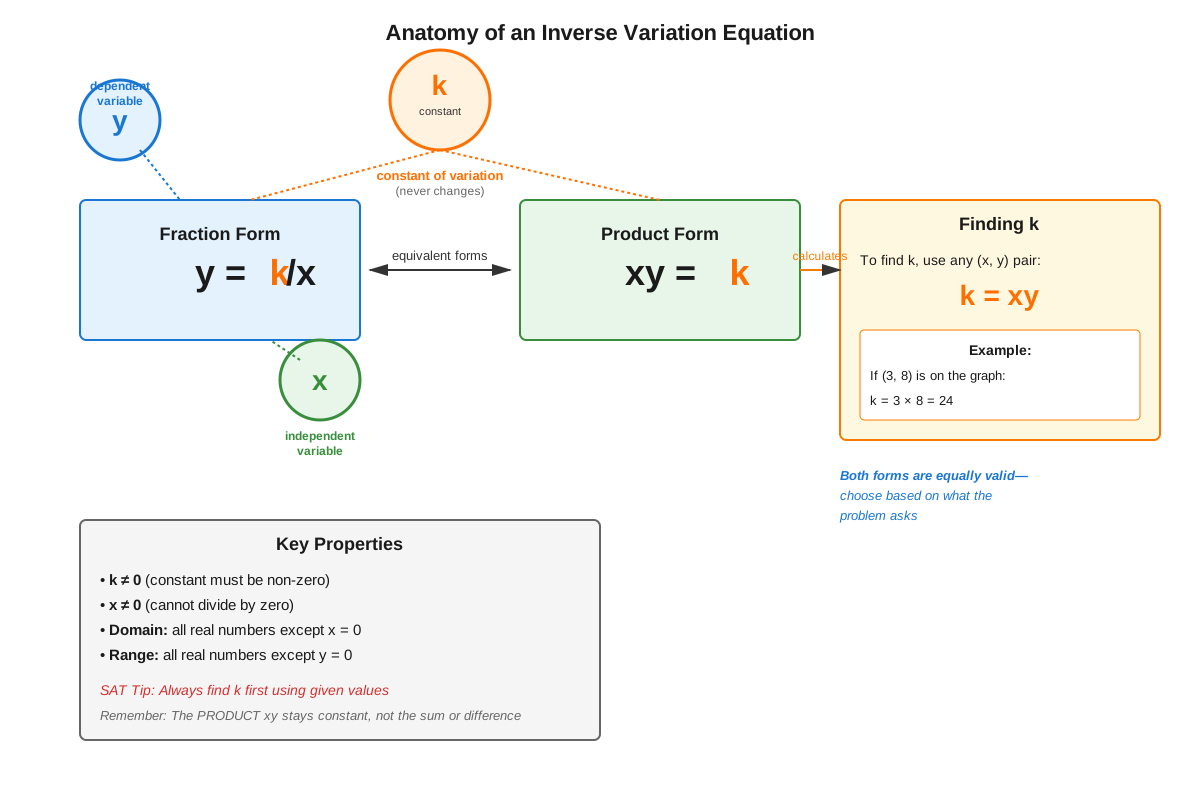
Inverse variation equations describe a relationship between two variables where their product remains constant. When two quantities x and y vary inversely, the equation takes the form:
xy = k or y = k/xwhere k is the constant of variation (also called the constant of proportionality), and k ≠ 0. The constant k represents the fixed product of the two variables regardless of their individual values. This relationship means that as x increases, y must decrease proportionally to maintain the constant product, and vice versa.
The standard forms can be written equivalently as:
- xy = k (product form)
- y = k/x (quotient form)
- x = k/y (solving for x)
- y varies inversely as x
- y is inversely proportional to x
Identifying Inverse Variation
Several methods help identify inverse variation relationships:
From an equation: An equation represents inverse variation if it can be rewritten in the form y = k/x where k is a non-zero constant. For example, y = 12/x shows inverse variation with k = 12, while y = 3/x + 2 does NOT represent pure inverse variation due to the added constant.
From a table of values: Calculate the product xy for each pair. If all products equal the same constant, the relationship is inverse variation.
| x | y | xy |
|---|---|---|
| 2 | 12 | 24 |
| 3 | 8 | 24 |
| 4 | 6 | 24 |
| 6 | 4 | 24 |
This table demonstrates inverse variation with k = 24.
From a verbal description: Key phrases signal inverse variation:
- "varies inversely as"
- "inversely proportional to"
- "product remains constant"
- "as one increases, the other decreases proportionally"
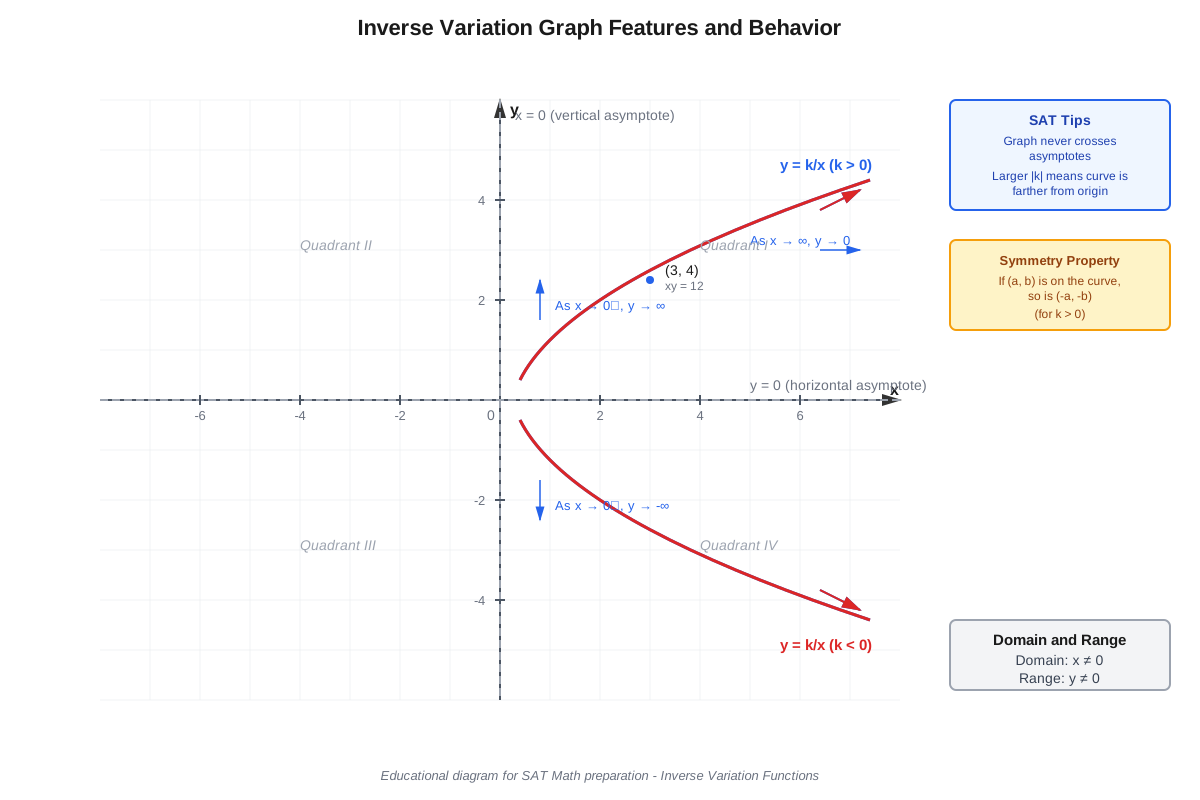
From a graph: Inverse variation produces a hyperbola with two branches in opposite quadrants (typically Quadrants I and III for positive k, or Quadrants II and IV for negative k). The graph approaches but never touches the x-axis and y-axis, which serve as asymptotes.
Finding the Constant of Variation
To determine k when given specific values:
- Substitute the known x and y values into xy = k
- Calculate the product to find k
- Write the complete inverse variation equation using this constant
Example: If y varies inversely as x, and y = 15 when x = 4, find k and write the equation.
Solution:
- xy = k
- (4)(15) = k
- k = 60
- The equation is y = 60/x or xy = 60
Solving Inverse Variation Problems
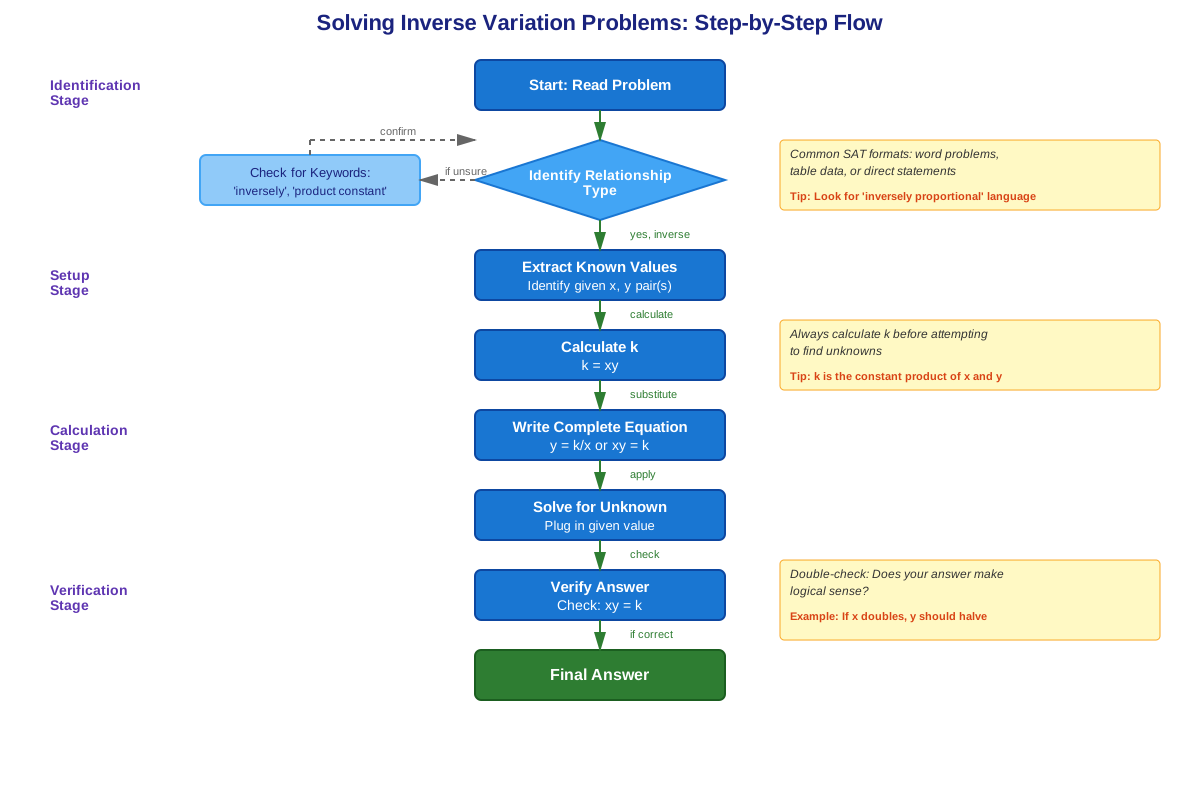
The standard problem-solving process involves:
- Identify that the relationship is inverse variation (from context or explicit statement)
- Find k using given information (one complete x, y pair)
- Write the equation in appropriate form
- Substitute the new value to find the unknown
- Check that the answer makes logical sense
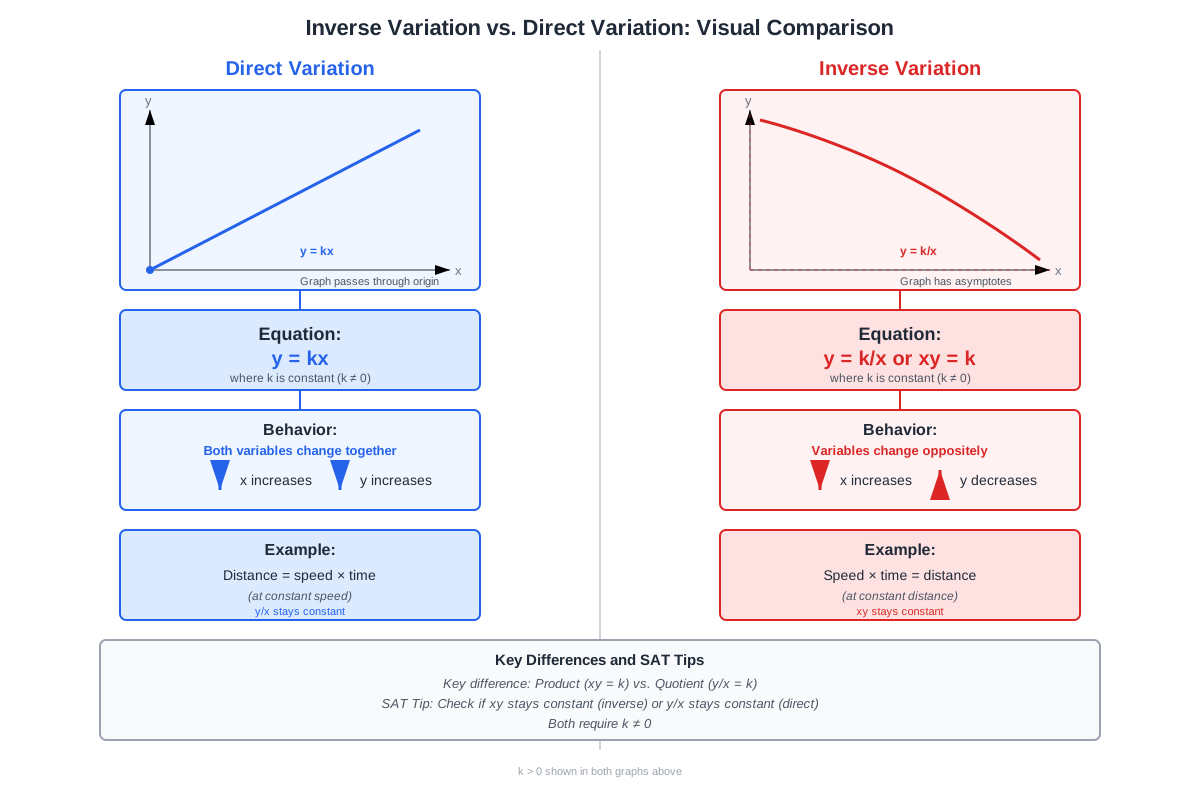
Inverse Variation vs. Direct Variation
Understanding the distinction between these two relationships is crucial for SAT success:
| Feature | Direct Variation | Inverse Variation |
|---|---|---|
| Equation | y = kx | y = k/x |
| Relationship | y/x = k (constant ratio) | xy = k (constant product) |
| As x increases | y increases | y decreases |
| Graph | Straight line through origin | Hyperbola |
| Verbal cue | "varies directly" | "varies inversely" |
Combined and Joint Variation
The SAT occasionally tests variations on the basic inverse relationship:
Inverse square variation: y varies inversely as the square of x
y = k/x²Joint variation with inverse component: y varies directly as x and inversely as z
y = kx/zThese compound relationships require careful attention to which variables appear in the numerator versus denominator.
Concept Relationships
Inverse variation equations connect to multiple mathematical concepts in a hierarchical structure. At the foundation, proportional reasoning provides the conceptual framework for understanding how quantities relate. This leads directly to direct variation (y = kx), which serves as a contrasting relationship that helps define inverse variation by opposition.
The relationship map flows as follows:
Proportional Reasoning → branches into → Direct Variation and Inverse Variation → both lead to → Rational Functions → which connect to → Hyperbolic Graphs and Asymptotic Behavior
Within inverse variation itself, understanding the constant of variation enables equation writing, which then allows value prediction and problem-solving. The graphical representation (hyperbola) connects inverse variation to function transformations and domain/range analysis, since inverse variation functions have restricted domains (x ≠ 0) and ranges (y ≠ 0).
Inverse variation also relates to systems of equations when problems require finding intersection points or solving multiple relationships simultaneously. The connection to rational expressions becomes evident when manipulating inverse variation equations algebraically, requiring skills in fraction operations and equation solving. Finally, inverse variation serves as a foundation for understanding more complex rational functions that appear in advanced algebra and precalculus contexts.
High-Yield Facts
⭐ Inverse variation equations have the form xy = k or y = k/x, where k is a non-zero constant
⭐ In inverse variation, as one variable increases, the other decreases proportionally so their product remains constant
⭐ To identify inverse variation from a table, calculate xy for each row; if all products equal the same value, the relationship is inverse variation
⭐ The graph of an inverse variation equation is a hyperbola with the x-axis and y-axis as asymptotes
⭐ To solve inverse variation problems: find k using given values, write the equation, then substitute to find unknowns
- The constant of variation k can be positive or negative, affecting which quadrants contain the hyperbola branches
- Inverse variation equations are undefined when x = 0 or y = 0, creating asymptotes at both axes
- Doubling x in an inverse variation relationship causes y to be halved; tripling x causes y to be divided by three
- Inverse square variation (y = k/x²) appears in physics problems involving light intensity, gravitational force, and sound intensity
- The phrase "inversely proportional" always indicates inverse variation, while "directly proportional" indicates direct variation
Quick check — test yourself on Inverse variation equations so far.
Try Flashcards →Common Misconceptions
Misconception: Inverse variation means the variables have opposite signs (one positive, one negative).
Correction: Inverse variation describes how variables change relative to each other (one increases while the other decreases), not their signs. Both variables can be positive, both negative, or have opposite signs depending on the value of k and the domain considered.
Misconception: Any equation with a variable in the denominator represents inverse variation.
Correction: Only equations that can be written as y = k/x (where k is a constant) represent pure inverse variation. Equations like y = 3/x + 5 or y = (x+2)/x do NOT represent inverse variation because they cannot be simplified to the form y = k/x.
Misconception: In inverse variation, the sum x + y remains constant.
Correction: In inverse variation, the PRODUCT xy remains constant, not the sum. This is a critical distinction that students frequently confuse. For example, if xy = 12, the pairs (2, 6), (3, 4), and (1, 12) all satisfy the relationship, but their sums (8, 7, and 13) are all different.
Misconception: Inverse variation graphs are straight lines with negative slope.
Correction: Inverse variation graphs are hyperbolas (curved), not straight lines. While both decrease as x increases (when k > 0), the rate of decrease differs. Linear functions decrease at a constant rate, while inverse variation functions decrease rapidly at first, then more slowly, approaching but never reaching zero.
Misconception: If y varies inversely as x, then x varies directly as y.
Correction: If y varies inversely as x, then x also varies inversely as y. The relationship is symmetric—both xy = k and yx = k express the same inverse variation. Neither variable varies directly as the other in an inverse relationship.
Misconception: The constant k in inverse variation must always be positive.
Correction: The constant k can be any non-zero real number, including negative values. When k < 0, the hyperbola branches appear in Quadrants II and IV instead of Quadrants I and III, but the inverse relationship still holds.
Worked Examples
Example 1: Identifying and Solving Basic Inverse Variation
Problem: The time t (in hours) required to complete a construction project varies inversely as the number of workers n assigned to the project. When 8 workers are assigned, the project takes 15 hours to complete. How long will the project take if 12 workers are assigned?
Solution:
Step 1: Identify the relationship. The problem states "varies inversely," so we know tn = k.
Step 2: Find the constant of variation using the given information (n = 8, t = 15).
tn = k
(15)(8) = k
k = 120
Step 3: Write the complete equation.
tn = 120 or t = 120/nStep 4: Substitute the new value (n = 12) to find the unknown time.
t = 120/12
t = 10
Step 5: Verify the answer makes sense. With more workers (12 vs. 8), the time should decrease (10 vs. 15), which matches our expectation for inverse variation. ✓
Answer: The project will take 10 hours with 12 workers.
Connection to Learning Objectives: This problem demonstrates identifying inverse variation from a verbal description, finding the constant of variation, and applying the equation to answer an SAT-style word problem.
Example 2: Distinguishing Inverse Variation from Tables
Problem: Which of the following tables represents an inverse variation relationship between x and y?
Table A:
| x | y |
|---|---|
| 2 | 10 |
| 4 | 8 |
| 6 | 6 |
| 8 | 4 |
Table B:
| x | y |
|---|---|
| 1 | 24 |
| 2 | 12 |
| 3 | 8 |
| 4 | 6 |
Solution:
For Table A, calculate the product xy for each row:
- Row 1: (2)(10) = 20
- Row 2: (4)(8) = 32
- Row 3: (6)(6) = 36
- Row 4: (8)(4) = 32
The products are NOT constant (20, 32, 36, 32), so Table A does NOT represent inverse variation.
For Table B, calculate the product xy for each row:
- Row 1: (1)(24) = 24
- Row 2: (2)(12) = 24
- Row 3: (3)(8) = 24
- Row 4: (4)(6) = 24
The products are ALL equal to 24, so Table B DOES represent inverse variation with k = 24.
Answer: Table B represents inverse variation with the equation xy = 24 or y = 24/x.
Connection to Learning Objectives: This problem tests the ability to identify key features of inverse variation equations from data tables, a common SAT question format that requires systematic calculation and pattern recognition.
Exam Strategy
When approaching SAT inverse variation equations questions, follow this strategic framework:
Recognition Phase: Identify inverse variation through trigger words and phrases. Watch for "varies inversely," "inversely proportional," "product remains constant," or scenarios describing opposite changes (one quantity increasing while another decreases). In word problems, situations involving work rates, speed-time relationships for fixed distances, or intensity-distance relationships typically involve inverse variation.
Setup Phase: Immediately write down the basic form xy = k or y = k/x. This visual reminder helps organize your work and prevents confusion with direct variation (y = kx). If given a table, quickly calculate products for the first two rows—if they match, you likely have inverse variation and can verify with one more row.
Calculation Strategy: Always find k first before attempting to answer the question. Many students try to shortcut this step and make errors. Once you have k, write the complete equation before substituting new values. This two-step process (find k, then use k) prevents calculation mistakes and provides a clear audit trail for checking work.
Process of Elimination Tips:
- Eliminate any equation with x in the numerator and denominator (like y = x/x+2) unless it simplifies to y = k/x
- Eliminate answer choices where variables are added or subtracted rather than multiplied or divided
- For table questions, eliminate options immediately if the first two xy products differ
- If a graph is shown, eliminate straight lines—inverse variation always produces curves
Time Management: Inverse variation problems typically require 60-90 seconds. If you're spending more than 2 minutes, you may be overcomplicating the problem. The SAT rarely requires more than finding k and one substitution. Budget approximately:
- 15 seconds: Read and identify relationship type
- 20 seconds: Find constant k
- 20 seconds: Write equation and substitute
- 15 seconds: Calculate and verify answer
Common Trap Awareness: The SAT often includes direct variation equations (y = kx) among answer choices for inverse variation questions. Always double-check that your equation has the variable in the denominator. Also watch for problems that give you multiple x, y pairs—use the first pair to find k, then verify with the second pair before proceeding.
Memory Techniques
INVERSE Acronym for problem-solving steps:
- Identify the relationship (inverse variation)
- Note the given values
- Verify by checking if xy = constant
- Establish k (constant of variation)
- Record the equation (y = k/x)
- Substitute new values
- Evaluate and check reasonableness
Product vs. Ratio Mnemonic: "Inverse = Product" and "Direct = Ratio" (IP and DR). This helps remember that inverse variation maintains constant products (xy = k) while direct variation maintains constant ratios (y/x = k).
Visualization Strategy: Picture a seesaw or balance scale. When one side goes up (x increases), the other must come down (y decreases) to maintain balance (constant product). This physical metaphor reinforces the inverse relationship and helps distinguish it from direct variation where both sides move together.
Hyperbola Recognition: Remember "Hyperbola for Inverse" by visualizing the letters H and I. The H has two separate parts (like the two branches of a hyperbola), while the I is straight (like direct variation's linear graph).
Formula Memory: Think "inverse means upside-down" → the variable goes on the bottom (denominator) in y = k/x. This simple association prevents confusion with direct variation's y = kx.
Summary
Inverse variation equations represent a fundamental mathematical relationship where two variables maintain a constant product, expressed as xy = k or y = k/x. This relationship appears regularly on the SAT in both pure algebraic contexts and real-world word problems involving rates, work, and physical phenomena. Success with inverse variation requires three core competencies: recognizing the relationship from verbal descriptions, tables, or graphs; calculating the constant of variation from given information; and applying the equation to find unknown values. The key distinguishing feature is that as one variable increases, the other decreases proportionally, maintaining a constant product rather than a constant ratio. Students must differentiate inverse variation from direct variation, recognize the hyperbolic graph shape, and understand that the equation form always places one variable in the denominator. Mastering this topic provides a foundation for understanding rational functions and enables students to tackle medium-to-hard SAT questions worth valuable points toward their target scores.
Key Takeaways
- Inverse variation equations follow the form xy = k or y = k/x, where k is the non-zero constant of variation representing the fixed product of the variables
- To identify inverse variation from a table, calculate xy for each row; if all products equal the same constant, the relationship is inverse variation
- The standard solution process is: identify the relationship, find k using given values, write the complete equation, substitute new values, and verify the answer makes logical sense
- Inverse variation graphs are hyperbolas with asymptotes at both axes, never straight lines, distinguishing them visually from direct variation's linear graphs
- Key verbal triggers include "varies inversely," "inversely proportional," and scenarios where one quantity increases while another decreases proportionally
- The constant k can be found by multiplying any corresponding x and y values that satisfy the relationship, then this constant applies to all other pairs in that relationship
- Common SAT applications include work-rate problems, speed-time relationships for fixed distances, and intensity-distance relationships in physics contexts
Related Topics
Direct Variation: Understanding direct variation (y = kx) provides essential contrast to inverse variation and helps students distinguish between constant ratios and constant products. Mastering inverse variation makes direct variation problems easier by comparison.
Rational Functions: Inverse variation equations are the simplest form of rational functions. This topic serves as a gateway to understanding more complex rational expressions, asymptotic behavior, and function analysis that appears in advanced algebra.
Systems of Equations: Many SAT problems combine inverse variation with systems of equations, requiring students to solve multiple relationships simultaneously. Strong inverse variation skills enable tackling these multi-step problems efficiently.
Proportional Reasoning: This broader category encompasses both direct and inverse variation, providing the conceptual framework for understanding how quantities relate. Inverse variation deepens proportional reasoning skills applicable across mathematics.
Function Transformations: Understanding how inverse variation graphs (hyperbolas) transform with different values of k connects to broader function transformation concepts including shifts, stretches, and reflections.
Practice CTA
Now that you've mastered the core concepts of inverse variation equations, it's time to solidify your understanding through active practice. Challenge yourself with the practice questions designed specifically to mirror SAT question formats and difficulty levels. Use the flashcards to reinforce key definitions, formulas, and problem-solving steps until they become automatic. Remember, inverse variation questions represent high-value opportunities on the SAT—students who can quickly recognize and solve these problems gain a significant competitive advantage. Your investment in practicing this topic will pay dividends on test day when you confidently tackle these medium-to-hard questions while other students struggle. Start practicing now to transform your understanding into exam-day success!
Sign up free to keep reading
Create a free AnvayaPrep account to finish this SAT guide on Inverse variation equations — plus flashcards and practice questions.