Overview
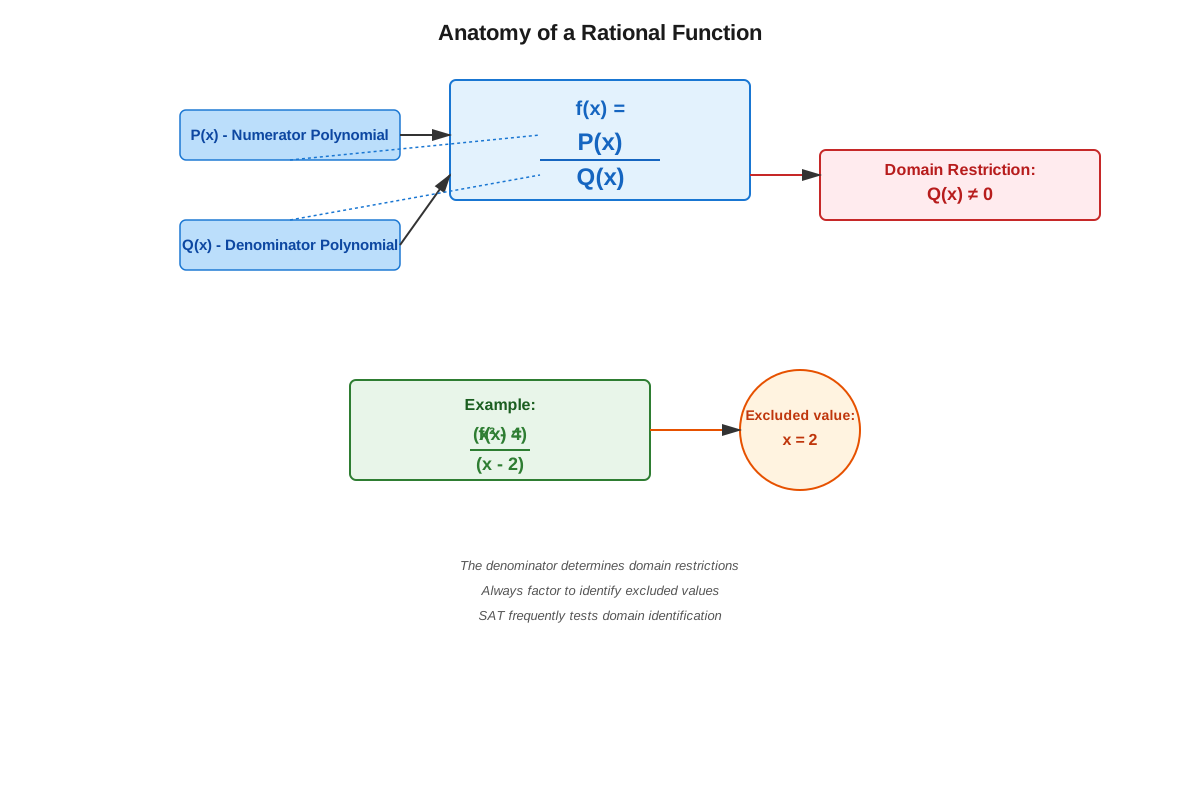
Rational function basics form a critical component of the SAT Math section, appearing regularly in both calculator and no-calculator portions of the exam. A rational function is any function that can be expressed as the ratio of two polynomials, written in the form f(x) = P(x)/Q(x), where P(x) and Q(x) are polynomials and Q(x) ≠ 0. Understanding these functions requires synthesizing knowledge of polynomial behavior, algebraic manipulation, and graphical interpretation—skills that the SAT tests extensively across multiple question formats.
The SAT frequently tests rational functions through questions about domain restrictions, asymptotic behavior, simplification, and real-world modeling scenarios. Students must recognize that rational functions behave differently from polynomial functions, particularly near values that make the denominator zero. These discontinuities create vertical asymptotes or holes in the graph, concepts that appear in approximately 3-5 questions per SAT administration. Mastery of sat rational function basics enables students to tackle complex algebraic problems efficiently and recognize patterns in function behavior.
Within the broader math curriculum, rational functions bridge fundamental algebra and advanced function analysis. They connect directly to polynomial operations, factoring techniques, equation solving, and coordinate geometry. Students who master rational function basics gain powerful tools for analyzing rates of change, understanding inverse relationships, and modeling real-world phenomena where one quantity depends on the reciprocal or ratio of others—contexts that appear frequently in SAT word problems and data interpretation questions.
Learning Objectives
- [ ] Identify key features of rational function basics including domain, range, and asymptotes
- [ ] Explain how rational function basics appears on the SAT through various question formats
- [ ] Apply rational function basics to answer SAT-style questions efficiently and accurately
- [ ] Determine domain restrictions by identifying values that make denominators equal to zero
- [ ] Simplify rational expressions by factoring and canceling common factors
- [ ] Distinguish between vertical asymptotes and removable discontinuities (holes)
- [ ] Evaluate rational functions at specific input values and interpret results in context
Prerequisites
- Polynomial operations and factoring: Essential for simplifying rational expressions and identifying common factors between numerators and denominators
- Solving linear and quadratic equations: Required to find domain restrictions and determine where rational functions equal specific values
- Function notation and evaluation: Necessary to substitute values into rational functions and interpret outputs correctly
- Coordinate plane graphing: Helps visualize asymptotic behavior and understand how rational functions behave across different intervals
- Basic fraction arithmetic: Fundamental for manipulating rational expressions and performing operations with algebraic fractions
Why This Topic Matters
Rational functions model countless real-world phenomena where relationships involve ratios, rates, or inverse proportions. In physics, they describe electrical resistance in parallel circuits and gravitational forces. In economics, they model average cost functions and supply-demand equilibrium. In biology, they represent enzyme kinetics and population dynamics with limiting factors. Understanding rational function basics provides the mathematical foundation for analyzing any scenario where one quantity varies inversely with another or where rates change based on input values.
On the SAT, rational function questions appear with remarkable consistency, comprising approximately 4-6% of all math questions. This translates to roughly 2-3 questions per test administration, making them high-yield content for score improvement. The College Board tests rational functions through multiple question types: identifying domain restrictions (most common), simplifying expressions, solving rational equations, interpreting graphs with asymptotes, and applying rational models to word problems. Questions range from straightforward identification of excluded values to complex multi-step problems requiring factoring, simplification, and algebraic reasoning.
The SAT particularly favors questions that combine rational functions with other algebraic concepts. Students might encounter a rational equation embedded in a word problem about average speed, a graph interpretation question requiring asymptote identification, or an algebraic manipulation problem where simplifying a rational expression reveals a key relationship. The exam also tests whether students understand the conceptual difference between vertical asymptotes (where functions approach infinity) and holes (removable discontinuities where factors cancel). This conceptual understanding separates high-scoring students from those who merely memorize procedures.
Core Concepts
Definition and Structure of Rational Functions
A rational function is defined as any function that can be written as f(x) = P(x)/Q(x), where both P(x) and Q(x) are polynomials and Q(x) is not identically zero. The numerator P(x) and denominator Q(x) can be any polynomial expressions, from simple constants to complex higher-degree polynomials. The most important restriction is that the denominator cannot equal zero, as division by zero is undefined in mathematics. This fundamental constraint creates the domain restrictions that the SAT tests extensively.
The simplest rational functions take the form f(x) = k/x, where k is a constant. This basic reciprocal function exhibits characteristic behavior: as x approaches zero, the function values grow infinitely large (approaching positive or negative infinity depending on direction), and as x grows infinitely large, the function values approach zero. More complex rational functions like f(x) = (2x + 3)/(x - 5) or f(x) = (x² - 4)/(x² - 9) follow similar patterns but with additional features determined by the degrees and factors of their numerator and denominator polynomials.
Domain and Domain Restrictions
The domain of a rational function consists of all real numbers except those values that make the denominator equal to zero. Finding domain restrictions is the single most tested concept related to rational functions on the SAT. To identify these restrictions, set the denominator equal to zero and solve for x. These solutions are the values excluded from the domain.
For example, consider f(x) = (x + 2)/(x² - 9). To find domain restrictions:
- Set the denominator equal to zero: x² - 9 = 0
- Factor: (x + 3)(x - 3) = 0
- Solve: x = -3 or x = 3
- State the domain: all real numbers except x = -3 and x = 3
The SAT often presents domain questions in multiple formats: asking which value is NOT in the domain, requesting the domain in interval notation, or embedding domain restrictions within word problems where certain input values don't make physical sense. Students must recognize that domain restrictions arise purely from mathematical constraints (denominator = 0) and sometimes from contextual constraints in applied problems.
Vertical Asymptotes
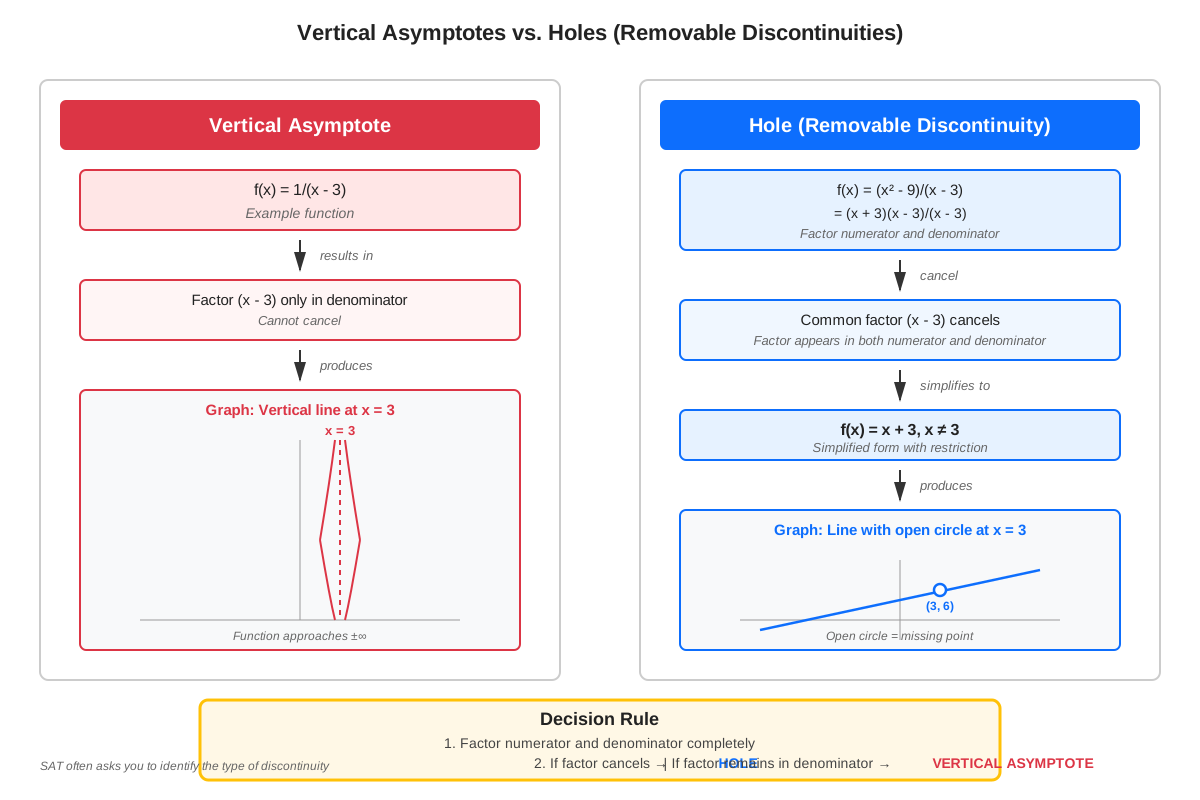
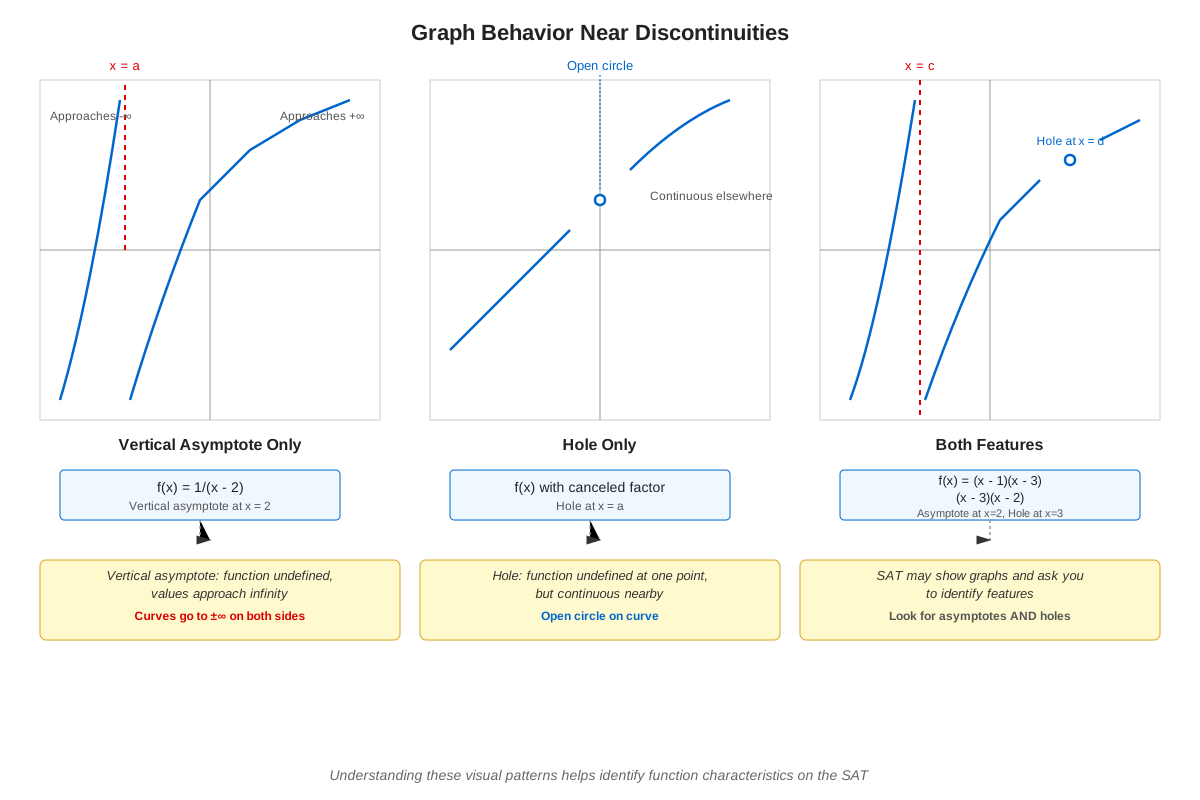
A vertical asymptote occurs at x = a when the denominator of a rational function equals zero at x = a, but the numerator does not equal zero at that same value. Graphically, the function approaches positive or negative infinity as x approaches the asymptote from either side. The line x = a becomes a vertical boundary that the function never crosses or touches.
To identify vertical asymptotes:
- Factor both numerator and denominator completely
- Identify values that make the denominator zero
- Check if these same values make the numerator zero
- If the numerator is non-zero at that value, a vertical asymptote exists there
For f(x) = (x + 1)/(x² - 4x - 5), factor the denominator: (x - 5)(x + 1). The denominator equals zero when x = 5 or x = -1. However, (x + 1) also appears in the numerator, so x = -1 creates a different feature (discussed below). Only x = 5 produces a vertical asymptote because the numerator equals 6 when x = 5 (non-zero).
Holes (Removable Discontinuities)
A hole or removable discontinuity occurs when both the numerator and denominator share a common factor that equals zero at the same x-value. When this common factor cancels during simplification, it removes the zero from the denominator, but the original function remains undefined at that point, creating a "hole" in the graph—a single missing point.
Consider f(x) = (x² - 9)/(x - 3). Factor the numerator: (x + 3)(x - 3)/(x - 3). The factor (x - 3) appears in both numerator and denominator, so it cancels: f(x) = x + 3, with the restriction that x ≠ 3. The simplified function is a line, but the original function has a hole at x = 3. To find the y-coordinate of the hole, substitute x = 3 into the simplified function: y = 3 + 3 = 6. The hole is located at the point (3, 6).
The distinction between vertical asymptotes and holes is crucial for SAT success:
| Feature | Vertical Asymptote | Hole |
|---|---|---|
| Cause | Denominator = 0, numerator ≠ 0 | Common factor cancels |
| Graph behavior | Function approaches ±∞ | Single point missing |
| Simplified form | Denominator still has factor | Factor cancels completely |
| SAT frequency | Very high | Moderate |
Simplifying Rational Expressions
Simplifying rational expressions requires factoring both numerator and denominator completely, then canceling any common factors. This process is identical to simplifying numerical fractions but uses algebraic factoring techniques. The SAT tests this skill both as a standalone task and as a necessary step in solving more complex problems.
Standard simplification process:
- Factor the numerator completely
- Factor the denominator completely
- Identify common factors
- Cancel common factors (noting domain restrictions)
- State the simplified expression with restrictions
Example: Simplify (2x² - 8)/(x² - 5x + 6)
- Factor numerator: 2(x² - 4) = 2(x + 2)(x - 2)
- Factor denominator: (x - 2)(x - 3)
- Cancel common factor (x - 2): 2(x + 2)/(x - 3)
- Note restriction: x ≠ 2, x ≠ 3
The simplified form is 2(x + 2)/(x - 3), but students must remember that x = 2 remains excluded from the domain even though that factor canceled.
Evaluating Rational Functions
Evaluating a rational function means substituting a specific value for x and calculating the resulting output. This straightforward operation becomes more complex when the input value is near or at a domain restriction. The SAT tests whether students can correctly evaluate functions at valid domain points and recognize when evaluation is impossible due to domain restrictions.
To evaluate f(x) = (3x - 6)/(x² - 4) at x = 5:
- Substitute: f(5) = (3(5) - 6)/(5² - 4)
- Simplify numerator: (15 - 6)/(25 - 4)
- Simplify denominator: 9/21
- Reduce: 3/7
If asked to evaluate at x = 2, students must recognize that x = 2 makes the denominator zero (4 - 4 = 0), so the function is undefined at this point. The correct answer is "undefined" or "not in the domain," not an attempt to calculate with zero in the denominator.
Horizontal Asymptotes and End Behavior
While less frequently tested than vertical asymptotes, horizontal asymptotes describe the behavior of rational functions as x approaches positive or negative infinity. The horizontal asymptote depends on the relationship between the degrees of the numerator and denominator polynomials:
- If degree of numerator < degree of denominator: horizontal asymptote at y = 0
- If degree of numerator = degree of denominator: horizontal asymptote at y = (leading coefficient of numerator)/(leading coefficient of denominator)
- If degree of numerator > degree of denominator: no horizontal asymptote (function grows without bound)
For f(x) = (3x² + 2x - 1)/(x² - 4), both polynomials have degree 2, so the horizontal asymptote is y = 3/1 = 3. As x becomes very large (positive or negative), the function values approach 3.
Concept Relationships
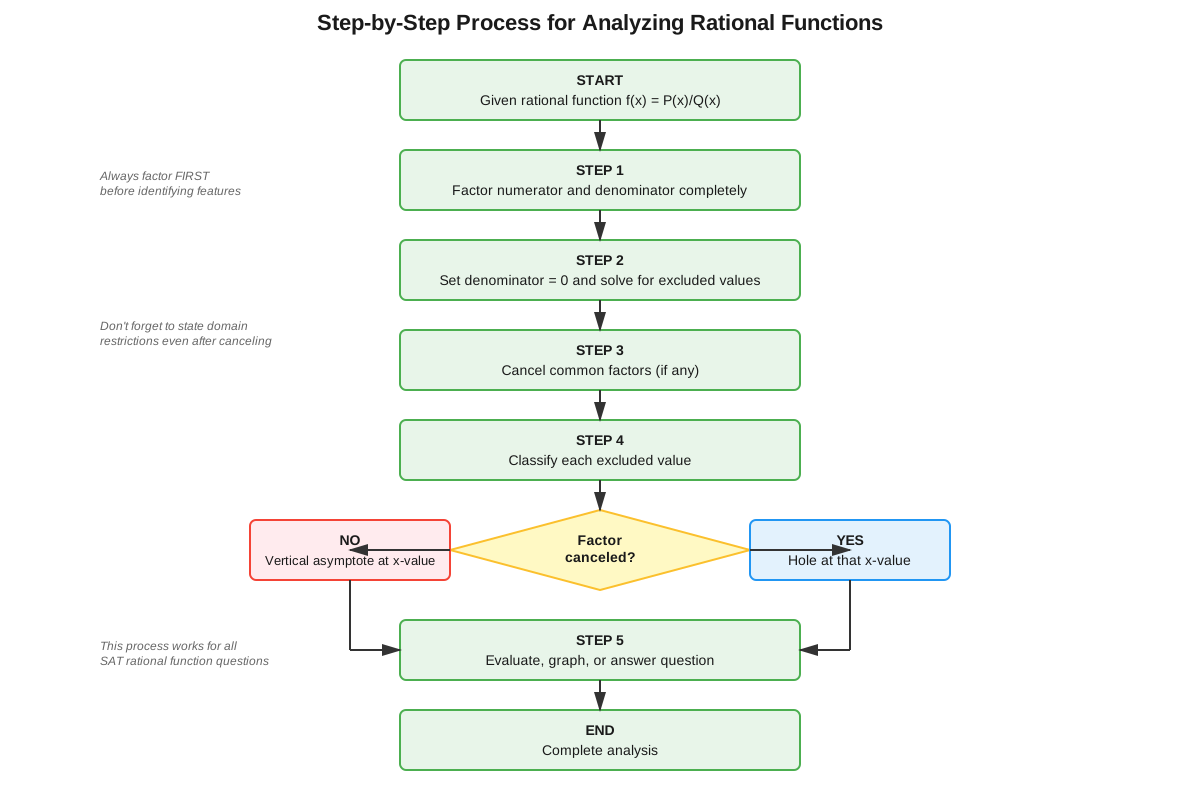
The concepts within rational function basics form an interconnected web of mathematical relationships. Domain restrictions serve as the foundation, determining where all other features can occur. These restrictions arise from setting the denominator equal to zero, which directly connects to polynomial factoring and equation solving. Once domain restrictions are identified, they bifurcate into two categories: values that create vertical asymptotes (when only the denominator equals zero) and values that create holes (when both numerator and denominator equal zero due to common factors).
The process of simplifying rational expressions unifies these concepts by requiring complete factoring of both numerator and denominator, revealing common factors that indicate holes and remaining factors that indicate vertical asymptotes. After simplification, evaluating rational functions becomes straightforward at valid domain points but requires careful attention to excluded values. Horizontal asymptotes operate independently of domain restrictions, depending instead on polynomial degrees and leading coefficients, but they complete the picture of overall function behavior.
Relationship map: Domain restrictions → Factoring → Common factors? → Yes: Holes / No: Vertical asymptotes → Simplification → Evaluation at valid points. Separately: Polynomial degrees → Horizontal asymptotes → End behavior.
These concepts connect to prerequisite knowledge of polynomial operations (necessary for factoring), equation solving (required to find restrictions), and function notation (essential for evaluation). They also lead forward to more advanced topics like rational equations (setting rational functions equal to values and solving), rational inequalities (determining where rational functions satisfy inequality conditions), and function transformations (shifting and scaling rational functions).
Quick check — test yourself on Rational function basics so far.
Try Flashcards →High-Yield Facts
⭐ The domain of a rational function excludes all values that make the denominator equal to zero
⭐ A vertical asymptote occurs at x = a when the denominator equals zero at x = a but the numerator does not
⭐ A hole occurs when a common factor in numerator and denominator equals zero at the same x-value
⭐ To find domain restrictions, set the denominator equal to zero and solve for x
⭐ Simplifying rational expressions requires factoring both numerator and denominator completely before canceling common factors
- The horizontal asymptote of f(x) = P(x)/Q(x) where deg(P) = deg(Q) equals the ratio of leading coefficients
- Rational functions are undefined at domain restrictions; attempting to evaluate at these points yields "undefined," not a numerical answer
- When a factor cancels during simplification, the x-value that makes that factor zero creates a hole, not a vertical asymptote
- The y-coordinate of a hole is found by substituting the x-value into the simplified function
- Multiple vertical asymptotes can exist in a single rational function if the denominator has multiple distinct factors
- Rational functions can cross horizontal asymptotes but never cross vertical asymptotes
- The SAT never requires finding slant (oblique) asymptotes, which occur when numerator degree exceeds denominator degree by exactly one
Common Misconceptions
Misconception: All domain restrictions create vertical asymptotes.
Correction: Domain restrictions create vertical asymptotes only when the numerator is non-zero at that point. If both numerator and denominator equal zero (common factor), a hole exists instead of an asymptote.
Misconception: After canceling a common factor, the domain restriction associated with that factor disappears.
Correction: Domain restrictions persist even after simplification. If (x - 3) cancels from numerator and denominator, x = 3 remains excluded from the domain of the original function, creating a hole at that point.
Misconception: Rational functions equal zero whenever the numerator equals zero.
Correction: A rational function equals zero only when the numerator equals zero AND the denominator does not equal zero at that same point. If both equal zero simultaneously, the function is undefined there.
Misconception: Horizontal asymptotes represent values the function can never reach.
Correction: Unlike vertical asymptotes, rational functions can cross their horizontal asymptotes at finite x-values. Horizontal asymptotes only describe behavior as x approaches infinity, not behavior at specific finite points.
Misconception: Simplifying a rational expression changes the function.
Correction: Simplification creates an equivalent function with the same domain restrictions. The simplified form is easier to work with but represents the same function with the same excluded values.
Misconception: If a rational function has no real solutions when the denominator is set to zero, the domain is all real numbers.
Correction: This is correct. For example, f(x) = (x + 1)/(x² + 4) has domain of all real numbers because x² + 4 never equals zero for real values of x.
Worked Examples
Example 1: Identifying Domain Restrictions and Asymptotes
Problem: For the function f(x) = (x² - x - 6)/(x² - 9), determine:
a) The domain
b) Any vertical asymptotes
c) Any holes
d) The horizontal asymptote
Solution:
Step 1: Factor both numerator and denominator completely.
- Numerator: x² - x - 6 = (x - 3)(x + 2)
- Denominator: x² - 9 = (x - 3)(x + 3)
Step 2: Identify domain restrictions by finding where denominator equals zero.
- (x - 3)(x + 3) = 0
- x = 3 or x = -3
- Domain: all real numbers except x = 3 and x = -3
Step 3: Determine which restrictions create vertical asymptotes vs. holes.
- At x = 3: Both numerator and denominator have factor (x - 3), so this creates a hole
- At x = -3: Only denominator has factor (x + 3), so this creates a vertical asymptote
Step 4: Find the coordinates of the hole.
- Cancel common factor: f(x) = (x + 2)/(x + 3), x ≠ 3
- Substitute x = 3 into simplified form: f(3) = (3 + 2)/(3 + 3) = 5/6
- Hole at point (3, 5/6)
Step 5: Confirm vertical asymptote.
- Vertical asymptote at x = -3
Step 6: Find horizontal asymptote.
- Both numerator and denominator have degree 2
- Leading coefficients: 1/1 = 1
- Horizontal asymptote: y = 1
Answers:
a) Domain: all real numbers except x = 3 and x = -3
b) Vertical asymptote at x = -3
c) Hole at (3, 5/6)
d) Horizontal asymptote at y = 1
This problem demonstrates the complete analysis process that the SAT might test across multiple questions or within a single complex problem.
Example 2: Solving a Rational Equation in Context
Problem: The average cost C (in dollars) to produce x units of a product is modeled by C(x) = (500 + 3x)/x.
a) What is the domain of this function in the context of the problem?
b) Find the average cost per unit when 100 units are produced.
c) As production increases without bound, what value does the average cost approach?
Solution:
Step 1: Determine mathematical domain.
- Denominator cannot equal zero: x ≠ 0
- Mathematical domain: all real numbers except x = 0
Step 2: Apply contextual constraints.
- Cannot produce negative units: x > 0
- Cannot produce zero units (division by zero and no production)
- Contextual domain: x > 0 (positive real numbers)
Answer to part a: Domain is x > 0 (must produce at least some positive number of units)
Step 3: Evaluate at x = 100.
- C(100) = (500 + 3(100))/100
- C(100) = (500 + 300)/100
- C(100) = 800/100 = 8
Answer to part b: The average cost per unit when producing 100 units is $8.
Step 4: Analyze end behavior (horizontal asymptote).
- Rewrite: C(x) = 500/x + 3
- As x → ∞, the term 500/x → 0
- Therefore, C(x) → 3
Answer to part c: As production increases without bound, the average cost approaches $3 per unit.
Interpretation: The $500 represents fixed costs (spread across more units as production increases), while $3 represents the variable cost per unit. This problem illustrates how rational functions model real-world scenarios where average quantities depend on scale.
Exam Strategy
When approaching SAT questions on rational functions, begin by identifying what the question asks: domain restrictions, asymptotes, holes, simplification, or evaluation. Trigger words include "undefined," "excluded from the domain," "vertical asymptote," "approaches," and "simplify." Questions asking "for which value of x is the function undefined?" directly test domain restrictions—immediately set the denominator equal to zero.
For domain questions, the fastest approach is to factor the denominator and identify zeros without fully simplifying the expression. The SAT often provides answer choices that include common wrong answers: values that make the numerator zero (which don't restrict domain) or values from incorrect factoring. Eliminate choices by substituting them into the denominator—only values that make it zero are excluded from the domain.
When questions involve graphs of rational functions, focus on vertical asymptotes first. The graph will show the function approaching infinity near these x-values. Distinguish vertical asymptotes from holes by checking whether the graph shows a break with infinite behavior (asymptote) or just a single missing point (hole). The SAT rarely provides graphs detailed enough to clearly show holes, so rely on algebraic analysis when both graph and equation are given.
For simplification problems, factor completely before canceling anything. The SAT includes trap answers that result from canceling terms incorrectly (like canceling x from x + 3 and x + 5) or from incomplete factoring. After simplifying, verify your answer by substituting a simple value like x = 0 or x = 1 into both original and simplified expressions—they should yield the same result at valid domain points.
Time allocation: Straightforward domain questions should take 30-45 seconds. Simplification problems requiring factoring need 60-90 seconds. Complex problems combining multiple concepts (like Example 1 above) may require 2-3 minutes. If a problem requires finding both vertical asymptotes and holes, budget extra time for complete factoring and analysis.
Process of elimination tips:
- Eliminate domain answers that make the numerator (not denominator) zero
- Eliminate asymptote answers where both numerator and denominator equal zero (these are holes)
- For horizontal asymptotes, eliminate answers that don't match the degree relationship rule
- When simplifying, eliminate answers with different degrees than the original expression
Memory Techniques
DOVE for domain restrictions:
- Denominator
- Only (not numerator)
- Values that make it
- Equal zero
VAN vs. HOLE for distinguishing features:
- Vertical Asymptote: Numerator ≠ 0
- Hole: Only when Like factors Exist (common factors cancel)
HAL for horizontal asymptotes:
- Higher degree on top: Asymptote is Lacking (none exists)
- Lower degree on top: Asymptote at Height zero
- Equal degrees: Asymptote at Leading coefficient ratio
Visualize rational functions as fractions with variables. Just as you cannot divide by zero with numbers (5/0 is undefined), you cannot divide by zero with variables (x/0 is undefined). This fundamental fraction rule governs all domain restrictions.
For remembering that holes have coordinates, picture a physical hole in a piece of paper—it exists at a specific location with both x and y coordinates. To find that location, use the simplified function (the paper with the hole filled in) and substitute the x-value.
Create the acronym SAFE for the simplification process:
- Separate into factors (factor completely)
- Analyze for common factors
- Factor out (cancel) common terms
- Exclude original restrictions (maintain domain)
Summary
Rational function basics encompass the fundamental properties and behaviors of functions expressed as ratios of polynomials. The cornerstone concept is domain restriction: rational functions are undefined wherever their denominators equal zero, and identifying these excluded values is the most frequently tested skill on the SAT. Students must distinguish between two types of domain restrictions—those creating vertical asymptotes (where functions approach infinity) and those creating holes (removable discontinuities where common factors cancel). Simplifying rational expressions requires complete factoring of numerators and denominators followed by canceling common factors while maintaining awareness of original domain restrictions. Evaluating rational functions involves straightforward substitution at valid domain points but requires recognizing undefined points. Horizontal asymptotes, determined by comparing polynomial degrees, describe end behavior as input values grow infinitely large. Mastery requires integrating factoring skills, equation-solving abilities, and conceptual understanding of function behavior—connecting algebraic manipulation with graphical interpretation to solve diverse problem types efficiently.
Key Takeaways
- The domain of any rational function excludes all values that make the denominator equal to zero; find these by setting the denominator to zero and solving
- Vertical asymptotes occur at domain restrictions where only the denominator equals zero; holes occur where common factors cancel
- Always factor both numerator and denominator completely before simplifying or analyzing features
- Domain restrictions persist even after simplification—canceled factors create holes, not permission to use those x-values
- Horizontal asymptotes depend on polynomial degrees: equal degrees give y = ratio of leading coefficients, lower numerator degree gives y = 0
- The SAT tests rational functions through domain questions, simplification problems, asymptote identification, and contextual modeling scenarios
- Distinguish between "undefined" (at domain restrictions) and "equals zero" (when numerator is zero and denominator is not)
Related Topics
Rational Equations: Building on rational function basics, rational equations involve setting rational expressions equal to values and solving for variables. This requires multiplying by common denominators and checking solutions against domain restrictions—a natural extension of the domain analysis practiced here.
Rational Inequalities: These problems ask where rational functions are positive, negative, or satisfy inequality conditions. Success requires understanding asymptotic behavior and sign changes, making mastery of vertical asymptotes and domain restrictions essential prerequisites.
Polynomial Division: Long division and synthetic division of polynomials connect to rational functions when the numerator degree exceeds the denominator degree. These techniques reveal slant asymptotes and rewrite rational functions in alternative forms.
Function Transformations: Shifting, stretching, and reflecting rational functions builds on the basic forms studied here. Understanding how transformations affect asymptotes and domain requires solid grasp of the parent function f(x) = 1/x.
Partial Fraction Decomposition: Advanced algebra courses decompose complex rational expressions into sums of simpler fractions. This technique reverses the process of adding rational expressions and relies heavily on factoring skills developed in rational function basics.
Practice CTA
Now that you've mastered the core concepts of rational function basics, it's time to cement your understanding through active practice. Work through the practice questions to apply domain restriction identification, simplification techniques, and asymptote analysis to SAT-style problems. Use the flashcards to reinforce high-yield facts and test your ability to quickly recall key concepts under time pressure. Remember: the SAT rewards both accuracy and speed, and deliberate practice with these resources will build the automaticity you need to confidently tackle rational function questions on test day. Every practice problem you solve strengthens the neural pathways that lead to higher scores—start practicing now!
Sign up free to keep reading
Create a free AnvayaPrep account to finish this SAT guide on Rational function basics — plus flashcards and practice questions.