Overview
Restrictions on domain represent one of the most fundamental yet frequently tested concepts in SAT Math, particularly within the realm of rational expressions and equations. The domain of a function or expression refers to all possible input values (typically x-values) for which the expression is defined and produces a valid output. When certain input values cause mathematical impossibilities—such as division by zero or taking the square root of a negative number in real-number contexts—these values must be excluded from the domain, creating what we call domain restrictions.
Understanding domain restrictions is essential for SAT success because these concepts appear across multiple question types, from straightforward algebraic manipulation problems to complex function analysis questions. The College Board frequently tests whether students can identify values that make denominators equal to zero, recognize undefined expressions, and work with functions that have limited domains. Questions may ask directly about excluded values, or they may embed domain restrictions within larger problems involving rational equations, function composition, or real-world modeling scenarios.
This topic connects deeply to broader math concepts including rational expressions, function notation, equation solving, and inequality reasoning. Mastery of domain restrictions provides the foundation for understanding more advanced topics like asymptotes in graphing, limits in precalculus, and the behavior of complex rational functions. On the SAT, domain restriction questions often serve as gatekeepers—students who understand these concepts can quickly eliminate incorrect answer choices and avoid common traps, while those who don't may struggle with seemingly simple problems.
Learning Objectives
- [ ] Identify key features of restrictions on domain
- [ ] Explain how restrictions on domain appears on the SAT
- [ ] Apply restrictions on domain to answer SAT-style questions
- [ ] Determine all values that must be excluded from the domain of rational expressions
- [ ] Solve equations while accounting for extraneous solutions created by domain restrictions
- [ ] Analyze composite functions and identify cumulative domain restrictions
- [ ] Interpret domain restrictions in real-world context problems
Prerequisites
- Basic algebraic manipulation: Ability to solve linear and quadratic equations is necessary to find values that create domain restrictions
- Understanding of fractions: Recognition that division by zero is undefined forms the foundation of most domain restriction problems
- Function notation: Familiarity with f(x) notation helps interpret domain questions and function composition problems
- Factoring techniques: Factoring denominators reveals the specific values that must be excluded from domains
- Square root properties: Knowledge that square roots of negative numbers are undefined in real-number contexts identifies another source of restrictions
Why This Topic Matters
Domain restrictions appear in real-world applications whenever mathematical models have inherent limitations. Engineers must consider domain restrictions when calculating stress tolerances (negative dimensions are meaningless), economists work with demand functions where negative prices or quantities don't make sense, and physicists encounter domain restrictions in formulas involving division by mass, time, or distance (where zero values would be physically impossible or undefined).
On the SAT, domain restriction questions appear with remarkable frequency—typically 2-4 questions per test directly address this concept, with additional questions incorporating domain considerations as part of larger problems. These questions appear in both the calculator and no-calculator sections, across difficulty levels from easy to hard. The College Board particularly favors questions that combine domain restrictions with equation solving, asking students to find solutions and then identify which solutions are valid given domain constraints.
Common SAT question formats include: identifying values that make expressions undefined, solving rational equations and checking for extraneous solutions, determining the domain of composite functions, interpreting domain restrictions in word problems (such as "for what values of x is this model valid?"), and analyzing piecewise functions with restricted domains. The topic also appears indirectly in questions about vertical asymptotes, discontinuities, and function behavior.
Core Concepts
Understanding Domain and Its Restrictions
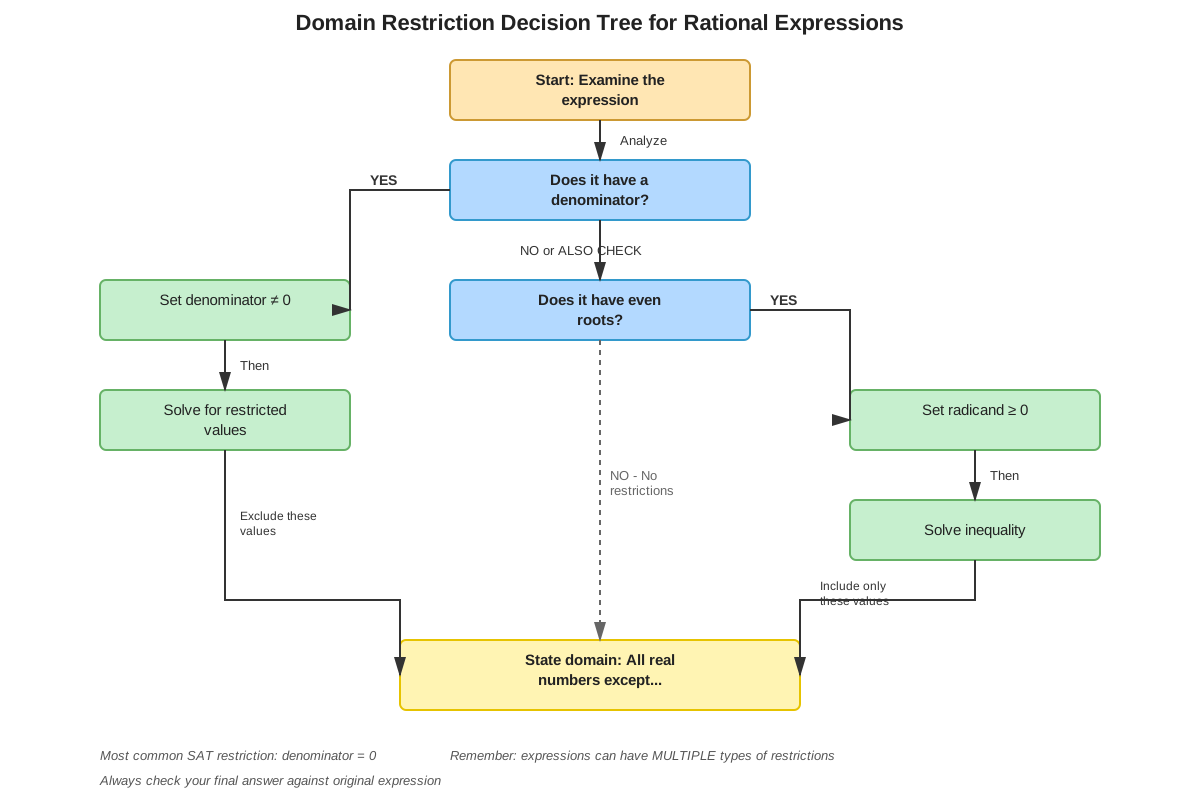
The domain of an expression or function consists of all real numbers that can be substituted for the variable without creating an undefined or invalid result. In the context of SAT restrictions on domain, students must identify and exclude problematic values. The most common sources of domain restrictions are:
- Division by zero: Any expression with a variable in the denominator
- Even roots of negative numbers: Square roots, fourth roots, etc., of negative values (in real-number contexts)
- Logarithms of non-positive numbers: Though less common on the SAT, log functions require positive arguments
- Context-based restrictions: Real-world scenarios where certain values don't make physical sense
Division by Zero: The Primary Source of Restrictions
The most frequently tested domain restriction on the SAT involves rational expressions—fractions with variables in the denominator. For any expression of the form:
f(x) = P(x)/Q(x)The domain excludes all values where Q(x) = 0. To find these restrictions:
- Set the denominator equal to zero
- Solve the resulting equation
- Exclude all solutions from the domain
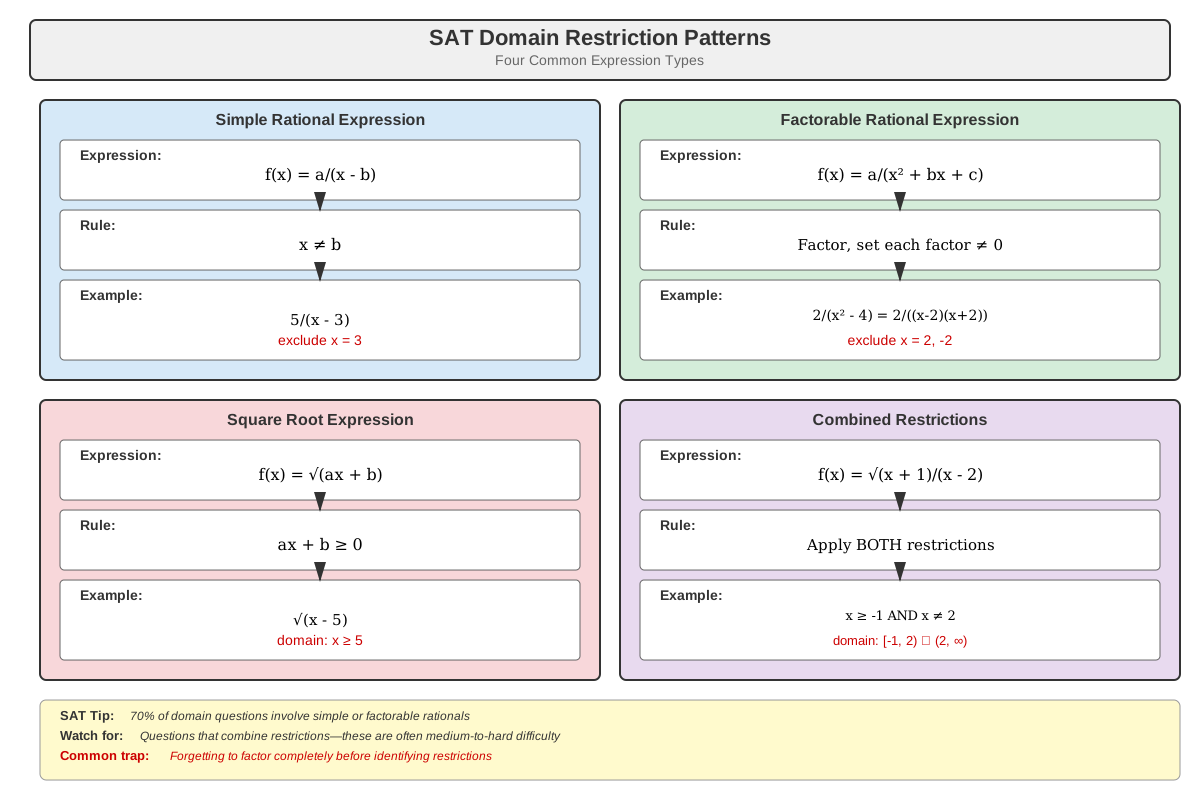
Example: For f(x) = (x + 3)/(x - 5), set x - 5 = 0, giving x = 5. Therefore, the domain is all real numbers except x = 5, written as {x | x ≠ 5} or (-∞, 5) ∪ (5, ∞).
Multiple Restrictions in Complex Denominators
When denominators contain products, sums, or more complex expressions, multiple values may need exclusion. Consider:
g(x) = 1/((x - 2)(x + 4))Set (x - 2)(x + 4) = 0. By the zero product property, either x - 2 = 0 or x + 4 = 0, yielding x = 2 or x = -4. Both values must be excluded: domain is {x | x ≠ 2 and x ≠ -4}.
For quadratic denominators, factor first if possible:
h(x) = (x + 1)/(x² - 9) = (x + 1)/((x - 3)(x + 3))The restrictions are x ≠ 3 and x ≠ -3.
Domain Restrictions and Equation Solving
A critical SAT skill involves solving equations with rational expressions while checking for extraneous solutions—values that satisfy the algebraic manipulation but violate domain restrictions. The process:
- Identify domain restrictions before solving
- Solve the equation using standard techniques
- Check each solution against the restrictions
- Reject any solution that equals a restricted value
Example: Solve (x + 2)/(x - 3) = 2
First, note x ≠ 3 (domain restriction). Multiply both sides by (x - 3):
- x + 2 = 2(x - 3)
- x + 2 = 2x - 6
- 8 = x
Since x = 8 doesn't equal 3, it's a valid solution.
Composite Functions and Cumulative Restrictions
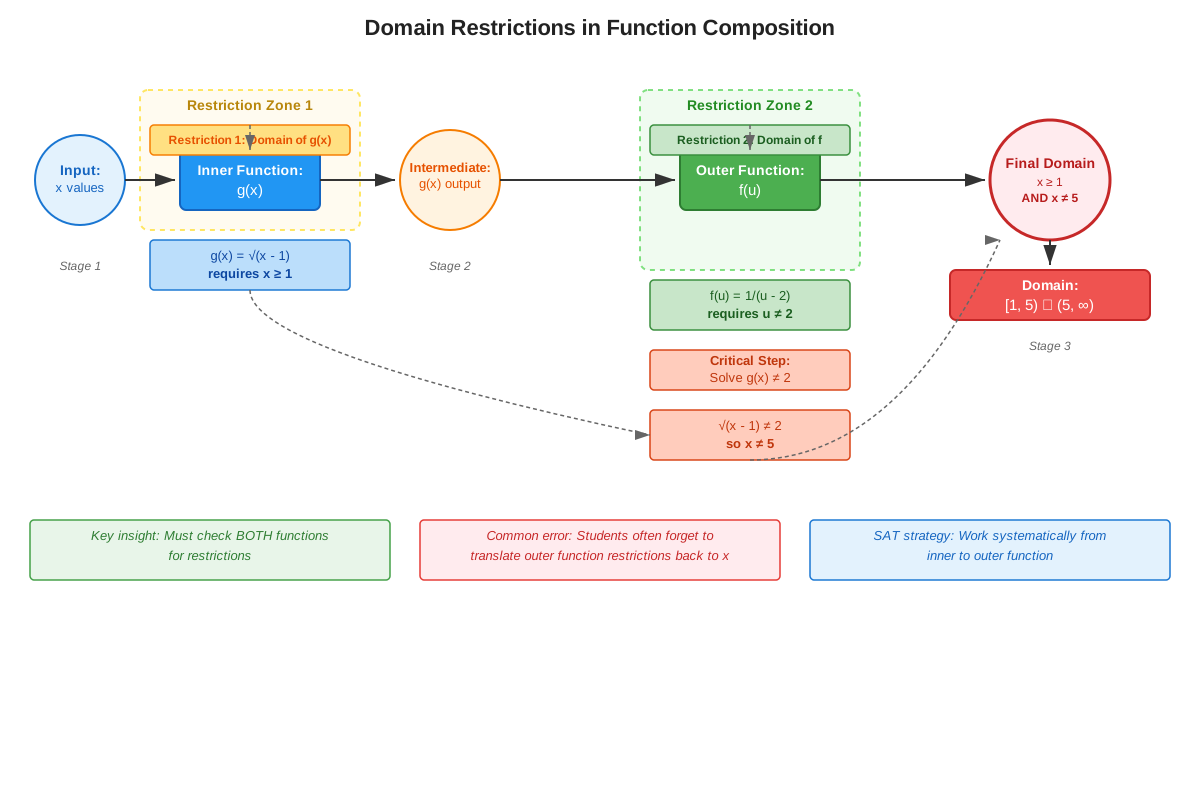
When functions are composed, domain restrictions accumulate. For f(g(x)), the domain must satisfy:
- All restrictions from g(x)
- All restrictions from f(x) applied to g(x)
Example: If f(x) = 1/x and g(x) = x - 5, then f(g(x)) = 1/(x - 5).
- g(x) has no restrictions (all real numbers)
- f requires its input ≠ 0, so g(x) ≠ 0, meaning x - 5 ≠ 0, thus x ≠ 5
- Combined domain: {x | x ≠ 5}
Square Root Restrictions
Expressions involving even roots require non-negative radicands (in real-number contexts):
f(x) = √(x - 4)Requires x - 4 ≥ 0, so x ≥ 4. The domain is [4, ∞).
When combined with rational expressions:
g(x) = √(x + 2)/(x - 1)Requires both x + 2 ≥ 0 (so x ≥ -2) AND x ≠ 1. Domain: [-2, 1) ∪ (1, ∞).
Context-Based Domain Restrictions
SAT word problems often impose additional restrictions based on real-world constraints. A function modeling the cost per person for a group trip might have the form C(n) = 500/n, where n represents the number of people. Mathematically, n ≠ 0, but contextually, n must also be a positive integer (you can't have negative or fractional people). The practical domain is {1, 2, 3, 4, ...}.
| Restriction Type | Mathematical Cause | Example | Excluded Values |
|---|---|---|---|
| Division by zero | Variable in denominator | 1/(x - 3) | x = 3 |
| Even root | Negative radicand | √(x - 5) | x < 5 |
| Logarithm | Non-positive argument | ln(x + 2) | x ≤ -2 |
| Context | Real-world constraints | Cost = 100/n people | n ≤ 0, non-integers |
Concept Relationships
Domain restrictions serve as the foundation for understanding rational expressions → which leads to → solving rational equations → which connects to → identifying extraneous solutions. This linear progression represents the typical SAT problem-solving sequence.
The concept also branches horizontally: domain restrictions → relate to → function behavior and graphing → specifically → vertical asymptotes (which occur at restricted domain values) and → discontinuities in piecewise functions.
Moving upward in complexity: simple domain restrictions (single denominator) → combine with → composite functions → requiring → analysis of multiple simultaneous restrictions. Similarly, domain restrictions → merge with → inequality solving when dealing with square root expressions.
The relationship to prerequisite knowledge flows as: factoring skills → enable → identification of multiple restrictions in complex denominators, while equation-solving ability → supports → finding exact restricted values, and function notation → facilitates → understanding domain in function composition.
Quick check — test yourself on Restrictions on domain so far.
Try Flashcards →High-Yield Facts
⭐ The domain of a rational expression excludes all values that make the denominator equal to zero
⭐ To find domain restrictions, set the denominator equal to zero and solve for the variable
⭐ Extraneous solutions are values that satisfy the algebraic steps but violate the original domain restrictions
⭐ For composite functions f(g(x)), restrictions come from both the inner function g(x) and from applying f to g(x)
⭐ Square roots (and all even roots) require the radicand to be greater than or equal to zero in real-number contexts
- When a denominator factors into multiple terms, each factor that equals zero creates a separate restriction
- Domain restrictions must be checked BEFORE simplifying rational expressions, as cancellation can hide restrictions
- In word problems, context may impose additional restrictions beyond mathematical ones (like requiring positive integers)
- The domain can be expressed in set notation {x | x ≠ a}, interval notation (-∞, a) ∪ (a, ∞), or as an inequality x ≠ a
- Multiple restrictions are connected with "and" (all must be satisfied simultaneously)
- A quadratic denominator may have zero, one, or two real restrictions depending on whether it factors over the reals
Common Misconceptions
Misconception: After canceling common factors in a rational expression, the domain restrictions disappear.
Correction: Domain restrictions are determined by the ORIGINAL expression before any simplification. If (x² - 4)/(x - 2) simplifies to (x + 2), the restriction x ≠ 2 still applies because the original expression was undefined at x = 2.
Misconception: The domain restriction is the value that makes the numerator zero.
Correction: Only the denominator creates restrictions through division by zero. Values that make the numerator zero are perfectly valid domain values (they simply make the entire expression equal to zero).
Misconception: When solving rational equations, any solution that satisfies the algebraic steps is valid.
Correction: Solutions must be checked against the original domain restrictions. A solution that equals a restricted value is extraneous and must be rejected, even if it satisfies the simplified equation.
Misconception: For √(x - 3), the domain is x > 3.
Correction: The domain is x ≥ 3 (greater than or equal to). The square root of zero is defined (it equals zero), so the boundary value must be included.
Misconception: In composite functions, only the outer function's restrictions matter.
Correction: Both functions contribute restrictions. The inner function must be defined, AND the output of the inner function must satisfy the domain requirements of the outer function.
Misconception: Domain restrictions only apply to rational expressions.
Correction: While rational expressions are the most common source on the SAT, domain restrictions also arise from square roots, logarithms, and real-world context constraints.
Worked Examples
Example 1: Finding Domain Restrictions in a Complex Rational Expression
Problem: What values must be excluded from the domain of f(x) = (2x + 1)/(x² - 5x + 6)?
Solution:
Step 1: Identify that domain restrictions come from the denominator. Set x² - 5x + 6 = 0.
Step 2: Factor the quadratic: (x - 2)(x - 3) = 0
Step 3: Apply the zero product property: x - 2 = 0 or x - 3 = 0
Step 4: Solve each equation: x = 2 or x = 3
Step 5: State the restrictions: The domain is all real numbers except x = 2 and x = 3.
Answer: x ≠ 2 and x ≠ 3 (or in interval notation: (-∞, 2) ∪ (2, 3) ∪ (3, ∞))
Connection to Learning Objectives: This example demonstrates identifying key features of domain restrictions (multiple excluded values from a factorable quadratic denominator) and applies the systematic process used on SAT questions.
Example 2: Solving a Rational Equation with Extraneous Solutions
Problem: Solve for x: (x + 3)/(x - 4) = (x - 1)/(x - 4)
Solution:
Step 1: Identify domain restrictions FIRST. The denominator x - 4 cannot equal zero, so x ≠ 4.
Step 2: Since both sides have the same denominator (and we know x ≠ 4), we can equate the numerators:
x + 3 = x - 1
Step 3: Subtract x from both sides:
3 = -1
Step 4: This is a contradiction! This means there is no solution to this equation.
Alternative approach: Multiply both sides by (x - 4):
x + 3 = x - 1 (same result)
Answer: No solution (the equation has no values of x that satisfy it)
Important note: If the equation had been (x + 3)/(x - 4) = (x + 7)/(x - 4), we would get x + 3 = x + 7, leading to 3 = 7 (still no solution). However, if we had gotten x = 4 as a solution, we would need to reject it as extraneous because x = 4 violates the domain restriction.
Connection to Learning Objectives: This example shows how to apply domain restrictions when solving equations and demonstrates the critical step of checking solutions against restrictions—a high-yield SAT skill.
Example 3: Composite Function Domain Analysis
Problem: If f(x) = √(x + 5) and g(x) = 1/(x - 2), what is the domain of f(g(x))?
Solution:
Step 1: Find g(x) = 1/(x - 2). This requires x ≠ 2.
Step 2: Find f(g(x)) = f(1/(x - 2)) = √(1/(x - 2) + 5)
Step 3: Simplify the expression under the square root:
√(1/(x - 2) + 5) = √((1 + 5(x - 2))/(x - 2)) = √((1 + 5x - 10)/(x - 2)) = √((5x - 9)/(x - 2))
Step 4: For the square root to be defined, we need (5x - 9)/(x - 2) ≥ 0
Step 5: This rational inequality is satisfied when both numerator and denominator have the same sign:
- Both positive: 5x - 9 ≥ 0 AND x - 2 > 0, giving x ≥ 9/5 AND x > 2, so x > 2
- Both negative: 5x - 9 ≤ 0 AND x - 2 < 0, giving x ≤ 9/5 AND x < 2, so x < 9/5
Step 6: Combine: x < 9/5 or x > 2, which in interval notation is (-∞, 9/5] ∪ (2, ∞)
Answer: Domain is (-∞, 9/5] ∪ (2, ∞)
Connection to Learning Objectives: This advanced example demonstrates how domain restrictions accumulate in composite functions and requires applying multiple concepts simultaneously—exactly what challenging SAT questions demand.
Exam Strategy
When approaching sat restrictions on domain questions, follow this systematic process:
Step 1: Identify the question type. Look for trigger phrases like "for what values is the expression undefined," "what is the domain," "which value must be excluded," or "solve and check for extraneous solutions."
Step 2: Find restrictions BEFORE manipulating. Always identify domain restrictions from the original expression before simplifying, factoring, or solving. Write them down explicitly.
Step 3: Focus on denominators first. On the SAT, 80% of domain restriction questions involve rational expressions. Immediately scan for variables in denominators.
Step 4: Factor when necessary. If the denominator is a polynomial, factor it completely to reveal all restrictions. Don't forget to check for difference of squares, perfect square trinomials, and common factoring patterns.
Step 5: Use process of elimination strategically. If answer choices list specific values, test each by substituting into the denominator. Any value that makes the denominator zero must be excluded.
Exam Tip: When solving rational equations, if you get a solution that equals one of your identified restrictions, that solution is extraneous—eliminate answer choices containing it.
Time allocation: Simple domain restriction questions (identifying one excluded value) should take 30-45 seconds. Complex problems involving equation solving or composite functions may require 90-120 seconds. If a problem is taking longer, mark it and return after completing easier questions.
Common trap answers: The College Board often includes the value that makes the NUMERATOR zero as a distractor. Remember: numerator zeros are valid domain values (they just make the expression equal zero). Also watch for answers that list only some restrictions when multiple exist.
Memory Techniques
DZERO Mnemonic for finding domain restrictions:
- Denominator is the key
- Zero is what it can't be
- Equate denominator to zero
- Resolve the equation
- Omit those values from domain
"Bottom Line" Visualization: Picture a fraction with the denominator as the "bottom line" that supports the expression. If the bottom line becomes zero, the entire structure collapses (becomes undefined). This visual reinforces why denominators create restrictions.
"Before and After" Rule: Always check domain restrictions BEFORE simplifying and verify solutions AFTER solving. Think "Before-After" as a two-step safety check.
Acronym for Restriction Sources - DSLC:
- Division (by zero)
- Square roots (of negatives)
- Logarithms (of non-positives)
- Context (real-world constraints)
The "Can't Divide by Zero" Chant: When you see a variable in a denominator, mentally say "can't divide by zero" to trigger the restriction-finding process. This simple phrase prevents overlooking restrictions.
Summary
Restrictions on domain represent values that must be excluded from the input of an expression or function because they create undefined or invalid results. On the SAT, domain restrictions most commonly arise from division by zero in rational expressions, requiring students to set denominators equal to zero and solve for excluded values. Additional restrictions come from even roots of negative numbers and real-world context constraints. Critical skills include identifying all restrictions before simplifying expressions, checking for extraneous solutions when solving rational equations, and analyzing cumulative restrictions in composite functions. Success requires systematic approaches: always examine denominators first, factor completely to reveal multiple restrictions, and verify that algebraic solutions don't violate original domain constraints. Understanding domain restrictions connects directly to broader concepts including function behavior, asymptotes, and equation solving—making this a foundational topic that appears across multiple SAT question types and difficulty levels.
Key Takeaways
- Domain restrictions exclude values that make expressions undefined, most commonly through division by zero in denominators
- To find restrictions, set the denominator equal to zero, solve completely, and exclude all solutions from the domain
- Extraneous solutions satisfy the algebraic steps but violate domain restrictions and must be rejected
- Always identify domain restrictions BEFORE simplifying or solving—cancellation can hide but doesn't eliminate restrictions
- Composite functions accumulate restrictions from both the inner and outer functions
- Square roots require non-negative radicands: √(expression) needs expression ≥ 0
- Context-based restrictions in word problems may impose additional constraints beyond mathematical ones
Related Topics
Rational Expressions and Simplification: Building on domain restrictions, this topic explores how to reduce rational expressions while maintaining awareness of excluded values—essential for advanced SAT algebra questions.
Solving Rational Equations: Extends domain restriction concepts to multi-step equation solving, incorporating techniques like finding common denominators and checking for extraneous solutions.
Function Composition and Transformation: Mastering domain restrictions enables analysis of complex composite functions, including determining domains of f(g(x)) and understanding how transformations affect valid input values.
Graphing Rational Functions: Domain restrictions directly correspond to vertical asymptotes and discontinuities in graphs, connecting algebraic and visual representations.
Inequalities with Rational Expressions: Combines domain restrictions with inequality solving, requiring sign analysis and interval testing—a high-level SAT skill.
Practice CTA
Now that you've mastered the core concepts of domain restrictions, it's time to solidify your understanding through active practice. Work through the practice questions to test your ability to identify restrictions quickly and accurately, and use the flashcards to reinforce key facts and procedures. Remember: domain restriction questions are high-yield on the SAT—investing time here will pay dividends on test day. Each practice problem you solve builds the pattern recognition and confidence needed to handle these questions efficiently under timed conditions. You've got this!
Sign up free to keep reading
Create a free AnvayaPrep account to finish this SAT guide on Restrictions on domain — plus flashcards and practice questions.