Overview
Simplifying rational expressions is a fundamental algebraic skill that appears consistently on the SAT Math section. A rational expression is a fraction where both the numerator and denominator are polynomials, such as (x² - 4)/(x - 2) or (3x + 6)/(x² + 5x + 6). The process of simplifying these expressions involves factoring polynomials and canceling common factors—skills that form the backbone of advanced algebraic manipulation. Students who master this topic gain a significant advantage on the SAT, as these expressions appear not only in dedicated algebra questions but also embedded within word problems, function questions, and complex multi-step problems.
Understanding how to simplify rational expressions is essential for the SAT because it directly tests algebraic fluency, pattern recognition, and the ability to manipulate symbolic representations—all core competencies measured by the exam. Questions involving sat simplifying rational expressions typically appear 2-4 times per test, often in both the calculator and no-calculator sections. These questions may ask students to identify equivalent expressions, determine restrictions on variables, or simplify complex fractions as part of solving equations. The ability to quickly recognize factorable patterns and cancel terms efficiently can save valuable time during the exam.
This topic connects to broader math concepts including polynomial operations, factoring techniques, solving rational equations, and understanding function behavior. Mastery of simplifying rational expressions provides the foundation for working with rational functions, analyzing asymptotes, and solving proportion problems—all of which appear regularly on the SAT. Additionally, the logical reasoning required to simplify these expressions strengthens overall problem-solving abilities that transfer to other mathematical domains tested on the exam.
Learning Objectives
- [ ] Identify key features of simplifying rational expressions
- [ ] Explain how simplifying rational expressions appears on the SAT
- [ ] Apply simplifying rational expressions to answer SAT-style questions
- [ ] Factor polynomials in both numerators and denominators to identify common factors
- [ ] Determine domain restrictions when simplifying rational expressions
- [ ] Recognize when a rational expression is already in simplest form
- [ ] Simplify complex rational expressions involving multiple terms and operations
Prerequisites
- Factoring polynomials: Essential for identifying common factors in numerators and denominators that can be canceled
- Understanding of fractions: The fundamental principle that a/a = 1 (for a ≠ 0) underlies all rational expression simplification
- Polynomial operations: Adding, subtracting, and multiplying polynomials is necessary for manipulating rational expressions
- Difference of squares and special products: These patterns appear frequently in SAT rational expressions and enable quick factoring
- Zero product property: Understanding when expressions equal zero helps identify domain restrictions
Why This Topic Matters
Simplifying rational expressions represents a critical intersection of algebraic skills that the SAT uses to assess mathematical maturity. In real-world applications, rational expressions model rates, proportions, and relationships between quantities—from calculating average speeds to determining mixture concentrations to analyzing economic efficiency ratios. Engineers use rational functions to model electrical resistance in parallel circuits, while scientists employ them to describe reaction rates and population dynamics. The ability to simplify these expressions allows for clearer interpretation and easier computation.
On the SAT, rational expression questions appear with high frequency, typically comprising 3-5% of all math questions. These problems appear in multiple formats: direct simplification questions worth 1 point, multi-step problems where simplification is an intermediate step, and Student-Produced Response (grid-in) questions where the simplified form must be entered. According to College Board data, questions involving rational expressions have appeared on every published SAT since the 2016 redesign, making this a consistently tested topic. The difficulty level ranges from straightforward factoring and canceling to complex expressions requiring multiple factoring techniques.
Common question formats include: identifying equivalent expressions from multiple choices, simplifying expressions with given variable restrictions, determining values that make expressions undefined, and using simplified forms to solve equations. The SAT particularly favors questions that combine simplification with other concepts, such as "For what value of x is the expression (x² - 9)/(x + 3) undefined?" or "Which of the following is equivalent to (2x² + 7x + 3)/(x² - 1)?" Understanding these patterns helps students recognize opportunities to apply simplification techniques efficiently during the exam.
Core Concepts
Definition of Rational Expressions
A rational expression is a fraction in which both the numerator and denominator are polynomials. The general form is P(x)/Q(x), where P(x) and Q(x) are polynomial expressions and Q(x) ≠ 0. Examples include simple expressions like (x + 2)/(x - 3) and more complex forms like (x³ - 8)/(x² + 2x + 4). The key characteristic distinguishing rational expressions from other algebraic fractions is that both parts must be polynomials—expressions containing only non-negative integer exponents and no variables in denominators or under radicals.
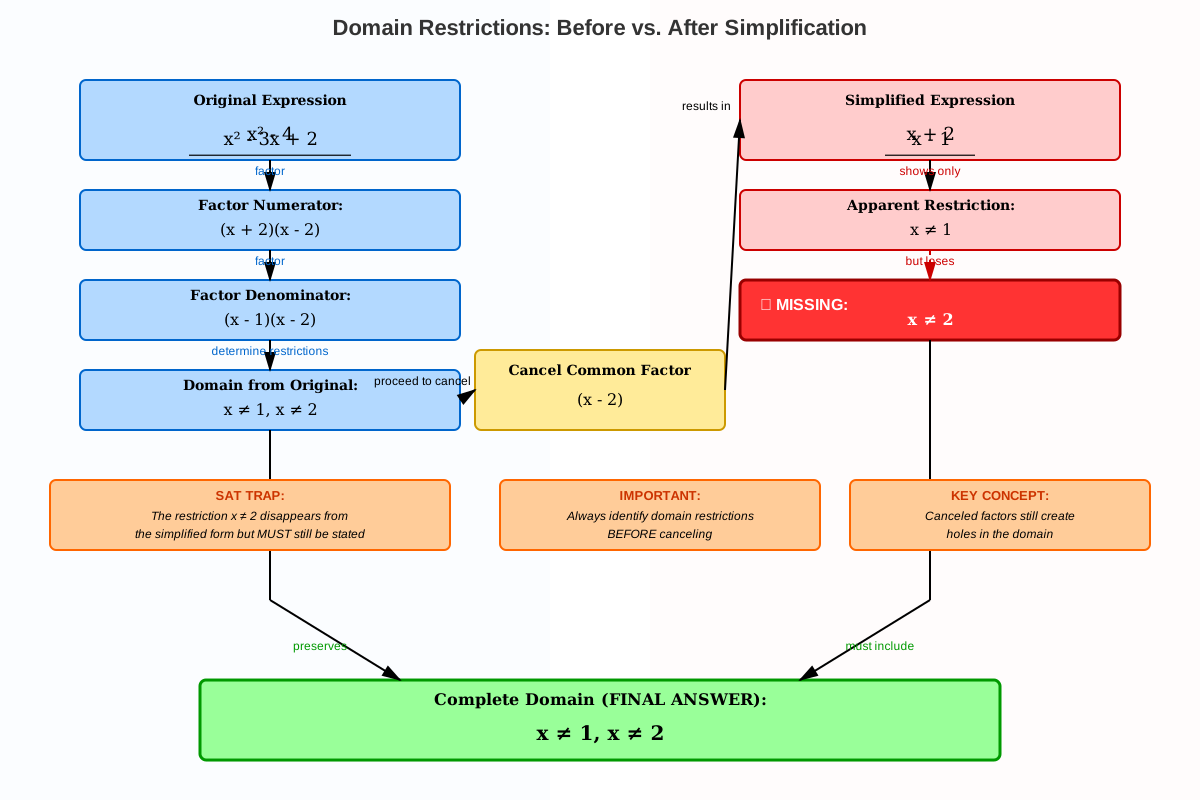
Just as numerical fractions can be simplified by canceling common factors (12/18 = 2/3), rational expressions can be simplified by factoring and canceling common polynomial factors. However, a critical difference exists: when we cancel factors containing variables, we must acknowledge that these factors cannot equal zero, creating domain restrictions. For example, when simplifying (x² - 4)/(x - 2) to (x + 2), we must note that x ≠ 2, even though this restriction isn't visible in the simplified form.
The Fundamental Principle of Simplification
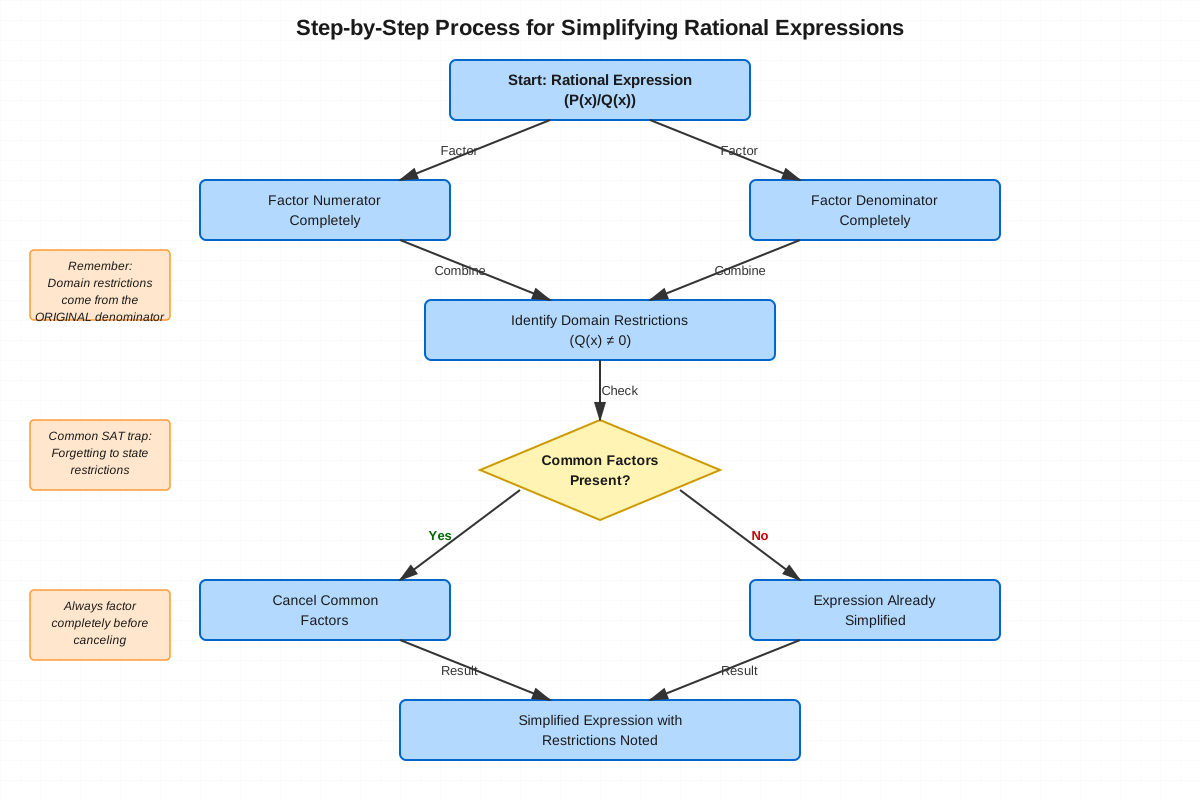
The process of simplifying rational expressions relies on the fundamental property that for any non-zero expression A: A/A = 1. This means we can cancel identical factors from the numerator and denominator. However, this cancellation is only valid when the factor being canceled is not equal to zero. The steps for simplification follow a systematic process:
- Factor completely: Factor both the numerator and denominator into their simplest polynomial factors
- Identify common factors: Look for factors that appear in both the numerator and denominator
- Cancel common factors: Divide out the common factors, remembering that each canceled factor creates a domain restriction
- State restrictions: Identify all values that make any denominator (original or factored) equal to zero
- Verify simplest form: Ensure no further factoring or canceling is possible
Factoring Techniques for Rational Expressions
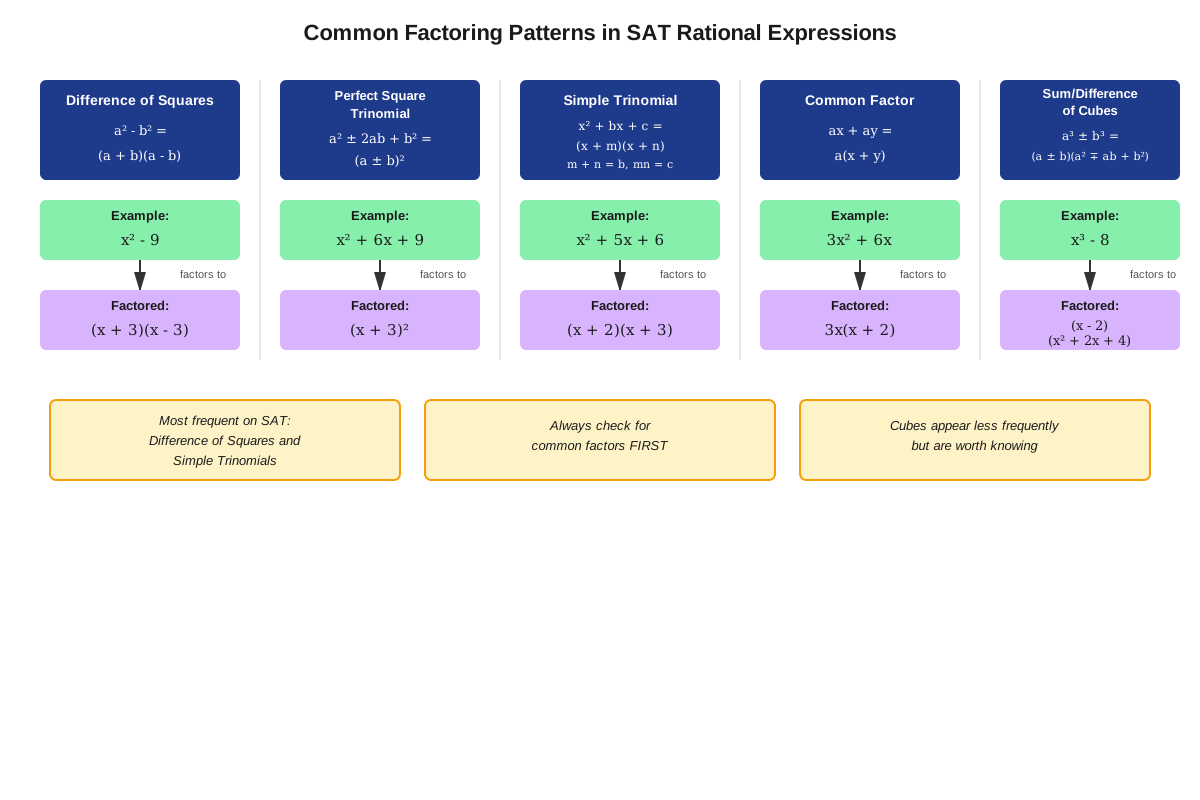
Success in simplifying rational expressions depends heavily on recognizing factorable patterns. The most common patterns on the SAT include:
| Pattern | Example | Factored Form |
|---|---|---|
| Greatest Common Factor (GCF) | 3x² + 6x | 3x(x + 2) |
| Difference of Squares | x² - 9 | (x + 3)(x - 3) |
| Perfect Square Trinomial | x² + 6x + 9 | (x + 3)² |
| Trinomial (a = 1) | x² + 5x + 6 | (x + 2)(x + 3) |
| Trinomial (a ≠ 1) | 2x² + 7x + 3 | (2x + 1)(x + 3) |
| Difference of Cubes | x³ - 8 | (x - 2)(x² + 2x + 4) |
| Sum of Cubes | x³ + 27 | (x + 3)(x² - 3x + 9) |
The SAT frequently tests the difference of squares pattern because it can be applied repeatedly. For example, x⁴ - 16 factors as (x² + 4)(x² - 4), and the second factor can be factored again as (x² + 4)(x + 2)(x - 2). Recognizing these nested patterns quickly is a high-yield skill for the exam.
Domain Restrictions and Excluded Values
A crucial aspect of simplifying rational expressions involves identifying domain restrictions—values that make the denominator equal to zero. These values must be excluded from the domain because division by zero is undefined. When simplifying, restrictions come from the original denominator, not the simplified form. Consider this example:
Original expression: (x² - 1)/(x - 1)
After factoring: (x + 1)(x - 1)/(x - 1)
After canceling: x + 1
The simplified form (x + 1) appears to be defined for all real numbers, but the original expression was undefined at x = 1. Therefore, the complete answer is: x + 1, where x ≠ 1. The SAT often tests whether students remember to maintain these restrictions after simplification.
Simplifying Complex Rational Expressions
Some SAT problems involve complex rational expressions—fractions that contain fractions in the numerator, denominator, or both. These require a multi-step approach:
Method 1: Multiply by the LCD
Find the least common denominator of all fractions within the complex fraction, then multiply both the numerator and denominator by this LCD to eliminate internal fractions.
Method 2: Simplify separately then divide
Simplify the numerator and denominator separately into single fractions, then multiply by the reciprocal of the denominator.
For example, to simplify [(1/x) + 2]/[(3/x) - 1], multiply both parts by x to get (1 + 2x)/(3 - x), which is already in simplest form with the restriction x ≠ 0 and x ≠ 3.
Recognizing Equivalent Forms
The SAT frequently asks students to identify which expression is equivalent to a given rational expression. This requires recognizing that expressions may look different but represent the same relationship. Key strategies include:
- Factor and compare: Factor all expressions to see if they reduce to the same form
- Test values: Substitute the same value into both expressions (avoiding restricted values) to verify equivalence
- Multiply out: Sometimes expanding a factored form helps reveal equivalence
- Check restrictions: Truly equivalent expressions must have the same domain restrictions
Special Cases and Patterns
Certain patterns appear repeatedly on the SAT and deserve special attention:
Opposite factors: When factors differ only in sign, such as (x - 3) and (3 - x), they are opposites. Since (3 - x) = -(x - 3), we can write: (3 - x)/(x - 3) = -1 (for x ≠ 3). Recognizing this pattern saves time and prevents errors.
Canceling terms vs. factors: A common error is attempting to cancel terms that are added or subtracted rather than factors that are multiplied. Only factors can be canceled: (x + 3)/(x + 5) cannot be simplified by canceling x, because x is a term, not a factor.
Rational expressions equal to constants: Sometimes a rational expression simplifies to a constant. For example, (x² - 4)/(x² + 4x + 4) ÷ (x - 2)/(x + 2) simplifies through multiple steps to eventually yield a numerical value for specific x values.
Concept Relationships
The process of simplifying rational expressions builds directly on polynomial factoring skills. Factoring polynomials → enables → identifying common factors → which allows → canceling to simplify expressions → leading to → cleaner forms for solving equations. Each step depends on the previous one, creating a linear progression of skills.
Within this topic, understanding domain restrictions connects intimately with the canceling process. Every time a factor is canceled, it creates a potential restriction because that factor could equal zero. This relationship means students cannot simply mechanically cancel factors—they must track what values would make canceled factors zero.
The concept also connects backward to prerequisite knowledge: fraction arithmetic provides the foundational principle that identical factors in numerator and denominator can be eliminated, while polynomial operations enable the manipulation needed to factor expressions. Looking forward, simplified rational expressions become essential for solving rational equations (setting expressions equal to values and solving), graphing rational functions (identifying asymptotes and holes), and working with proportions (cross-multiplying and solving).
A particularly important connection exists between simplifying rational expressions and function analysis. When a rational function has a common factor in numerator and denominator, the graph has a "hole" (removable discontinuity) rather than a vertical asymptote at the restricted value. Understanding this connection helps students interpret graphs and connect algebraic and graphical representations—a key SAT skill.
Quick check — test yourself on Simplifying rational expressions so far.
Try Flashcards →High-Yield Facts
⭐ A rational expression is simplified when the numerator and denominator have no common factors other than 1
⭐ Domain restrictions come from the original denominator before simplification, not the simplified form
⭐ The difference of squares pattern (a² - b²) = (a + b)(a - b) is the most frequently tested factoring pattern in SAT rational expressions
⭐ Only factors can be canceled, never terms that are added or subtracted
⭐ When a factor appears in both numerator and denominator, canceling it creates a restriction: that factor cannot equal zero
- Opposite binomials like (a - b) and (b - a) differ by a factor of -1: (b - a) = -(a - b)
- Complex rational expressions can be simplified by multiplying numerator and denominator by the LCD of all internal fractions
- A rational expression equals zero only when its numerator equals zero (and the denominator does not)
- Perfect square trinomials (a² + 2ab + b²) factor as (a + b)², creating a repeated factor that may cancel with a repeated factor in the denominator
- The sum or difference of cubes formulas (a³ ± b³) occasionally appear in challenging SAT problems and should be memorized
- Factoring by grouping is useful when expressions have four terms that can be paired
- After simplification, always check if the result can be factored further—some expressions require multiple rounds of factoring
Common Misconceptions
Misconception: Terms that appear in both numerator and denominator can be canceled, such as simplifying (x + 3)/(x + 5) to 3/5 by "canceling the x's."
Correction: Only factors (expressions that are multiplied) can be canceled, never terms (expressions that are added or subtracted). The expression (x + 3)/(x + 5) is already in simplest form because x + 3 and x + 5 share no common factors.
Misconception: After simplifying (x² - 9)/(x - 3) to (x + 3), the simplified expression is defined for all real numbers.
Correction: Domain restrictions from the original expression remain after simplification. Since x - 3 was in the original denominator, x ≠ 3 even in the simplified form. The complete answer is (x + 3), x ≠ 3.
Misconception: The expressions (x - 5) and (5 - x) are the same and cancel to 1.
Correction: These are opposite expressions, not identical ones. (5 - x) = -(x - 5), so (5 - x)/(x - 5) = -1, not 1. Recognizing opposite factors is crucial for correct simplification.
Misconception: When simplifying (x² + 2x)/(x² + 4x + 4), the x² terms cancel, leaving 2x/(4x + 4).
Correction: Canceling can only occur after complete factoring. The correct approach is to factor first: x(x + 2)/(x + 2)² = x/(x + 2), where x ≠ -2. Never cancel terms before factoring.
Misconception: A rational expression with a quadratic numerator and linear denominator cannot be simplified.
Correction: If the linear denominator is a factor of the quadratic numerator, simplification is possible. For example, (x² - 5x + 6)/(x - 2) factors as (x - 2)(x - 3)/(x - 2) = (x - 3), where x ≠ 2. Always attempt to factor before concluding an expression cannot be simplified.
Misconception: The simplified form of a rational expression is always simpler-looking than the original.
Correction: Sometimes the "simplified" form appears more complex, especially when factoring reveals multiple terms. The key is that the simplified form has no common factors, not that it has fewer symbols. For instance, (x³ - 1)/(x - 1) simplifies to x² + x + 1 (using difference of cubes), which has more terms but is properly simplified.
Worked Examples
Example 1: Standard Simplification with Domain Restrictions
Problem: Simplify the expression (2x² + 7x + 3)/(x² + 5x + 6) and state all restrictions.
Solution:
Step 1: Factor the numerator.
Looking for two numbers that multiply to (2)(3) = 6 and add to 7: these are 6 and 1.
Rewrite: 2x² + 6x + 1x + 3
Group: 2x(x + 3) + 1(x + 3)
Factor: (2x + 1)(x + 3)
Step 2: Factor the denominator.
Looking for two numbers that multiply to 6 and add to 5: these are 2 and 3.
Factor: (x + 2)(x + 3)
Step 3: Write the factored form.
(2x + 1)(x + 3) / (x + 2)(x + 3)
Step 4: Identify and cancel common factors.
The factor (x + 3) appears in both numerator and denominator.
Cancel: (2x + 1) / (x + 2)
Step 5: State domain restrictions.
From the original denominator: x + 2 ≠ 0, so x ≠ -2
From the canceled factor: x + 3 ≠ 0, so x ≠ -3
Final Answer: (2x + 1)/(x + 2), where x ≠ -2 and x ≠ -3
This example demonstrates the complete process and addresses the learning objective of applying simplification techniques while identifying domain restrictions—a common SAT question format.
Example 2: Complex Rational Expression
Problem: Simplify: [(x² - 4)/(x + 1)] ÷ [(x - 2)/(x² - 1)]
Solution:
Step 1: Rewrite division as multiplication by the reciprocal.
[(x² - 4)/(x + 1)] × [(x² - 1)/(x - 2)]
Step 2: Factor all polynomials.
x² - 4 = (x + 2)(x - 2) [difference of squares]
x² - 1 = (x + 1)(x - 1) [difference of squares]
The expression becomes: [(x + 2)(x - 2)/(x + 1)] × [(x + 1)(x - 1)/(x - 2)]
Step 3: Combine into a single fraction.
[(x + 2)(x - 2)(x + 1)(x - 1)] / [(x + 1)(x - 2)]
Step 4: Cancel common factors.
Cancel (x + 1) from numerator and denominator → creates restriction x ≠ -1
Cancel (x - 2) from numerator and denominator → creates restriction x ≠ 2
Step 5: Write the simplified result.
(x + 2)(x - 1)
Step 6: Expand if needed (SAT sometimes requires expanded form).
x² - x + 2x - 2 = x² + x - 2
Step 7: Identify all restrictions.
From original denominators: x ≠ -1 (from x + 1), x ≠ 2 (from x - 2)
Also x ≠ 1 (from x - 1 in the second denominator after reciprocal)
Final Answer: x² + x - 2, where x ≠ -1, x ≠ 1, and x ≠ 2
This example shows how to handle complex rational expressions involving division and multiple factoring patterns—a higher-difficulty SAT problem type that tests multiple skills simultaneously.
Exam Strategy
When approaching SAT questions on simplifying rational expressions, follow this strategic framework:
Recognition Phase: Identify that the question involves rational expressions by looking for fractions with polynomial numerators and denominators. Trigger phrases include "simplify the expression," "which is equivalent to," "for what value is the expression undefined," and "reduce to lowest terms."
Planning Phase: Before diving into algebra, scan the answer choices. If they're in factored form, keep your work factored. If they're expanded, you may need to expand your final answer. Notice the complexity of answer choices—if they're much simpler than the original expression, significant canceling will occur. If they're similar in complexity, minimal simplification may be possible.
Execution Phase: Follow this systematic approach:
- Factor completely (2-3 minutes maximum—if factoring takes longer, try a different approach)
- Cancel common factors while noting restrictions
- Check if further simplification is possible
- Verify your answer matches the format of the choices
Process of Elimination: Use these specific strategies for rational expression questions:
- Eliminate choices with different domain restrictions (test x-values that should be undefined)
- Substitute a simple value like x = 0 or x = 1 into both the original and answer choices (avoid restricted values)
- Eliminate choices that have different degrees in numerator or denominator after simplification
- Watch for sign errors—if your answer differs from a choice only by a negative sign, check for opposite factors
Time Management: Allocate 60-90 seconds for straightforward simplification problems and up to 2 minutes for complex rational expressions. If you cannot factor within 30 seconds, consider substituting values to test answer choices instead—this backup strategy can save time when factoring is difficult.
Common Traps: The SAT deliberately includes wrong answers that result from common errors:
- Canceling terms instead of factors
- Forgetting domain restrictions
- Incorrectly handling opposite factors (getting 1 instead of -1)
- Stopping before complete simplification
Always double-check that you've factored completely and that no further canceling is possible before selecting your answer.
Memory Techniques
FACTOR Mnemonic for the simplification process:
- Factor completely (both numerator and denominator)
- Analyze for common factors
- Cancel matching factors
- Track restrictions (note what makes denominators zero)
- Observe if further simplification possible
- Rewrite in required form
Difference of Squares Visualization: Picture a² - b² as a square with side length a with a smaller square of side length b cut from one corner. The remaining area can be rearranged into a rectangle with dimensions (a + b) and (a - b), reinforcing the factorization pattern.
"DOTS" for Difference of Two Squares: When you see subtraction between two perfect squares, think DOTS:
- Difference (subtraction sign)
- Of
- Two
- Squares
This triggers the pattern (a + b)(a - b).
Restriction Reminder: "Original Denominator Determines Domain" (ODDD). The domain restrictions always come from the original denominator before any simplification, not the final form.
Opposite Factor Rule: Remember "Flip the Fraction, Flip the Sign" (FFFS). When you have opposite factors like (a - b) and (b - a), rewriting one as the negative of the other introduces a negative sign: (b - a)/(a - b) = -(a - b)/(a - b) = -1.
Trinomial Factoring: Use the acronym FOIL in reverse—when you see a trinomial, think about what First, Outer, Inner, Last terms would multiply to create it, then work backward to find the binomial factors.
Summary
Simplifying rational expressions is a high-yield SAT math topic that combines factoring skills, algebraic manipulation, and careful attention to domain restrictions. The core process involves factoring both numerator and denominator completely, identifying common factors, canceling those factors while noting restrictions, and verifying the result is in simplest form. Success requires mastery of factoring patterns—especially difference of squares, trinomial factoring, and recognizing greatest common factors—along with understanding that only factors (not terms) can be canceled. Domain restrictions arise from any value that makes the original denominator zero, and these restrictions persist even after simplification makes them invisible. The SAT tests this topic through direct simplification questions, equivalence problems, and multi-step problems where simplification is an intermediate step. Students who systematically factor, carefully track restrictions, and recognize common patterns will efficiently handle these questions and avoid the typical traps of canceling terms, forgetting restrictions, or mishandling opposite factors. This topic connects to broader concepts including rational equations, function analysis, and proportional reasoning, making it foundational for success across multiple SAT math domains.
Key Takeaways
- Rational expressions are fractions with polynomial numerators and denominators that simplify through factoring and canceling common factors
- Only factors (multiplied expressions) can be canceled, never terms (added or subtracted expressions)
- Domain restrictions come from the original denominator before simplification and must be stated with the final answer
- The difference of squares pattern (a² - b²) = (a + b)(a - b) is the most frequently tested factoring technique on SAT rational expression problems
- Opposite factors like (x - a) and (a - x) differ by a factor of -1, so their ratio equals -1, not 1
- Complete factoring is essential before attempting to cancel—expressions may require multiple factoring techniques
- SAT questions often test whether students remember domain restrictions after simplification makes them non-obvious
Related Topics
Solving Rational Equations: After mastering simplification, the next step is solving equations that contain rational expressions by finding common denominators and clearing fractions—a frequent SAT problem type.
Rational Functions and Their Graphs: Understanding how simplified rational expressions relate to function behavior, including vertical asymptotes (from non-canceled denominator factors) and holes (from canceled factors).
Polynomial Long Division: When the degree of the numerator exceeds the degree of the denominator, division techniques extend simplification to include quotients and remainders.
Complex Fractions: Advanced problems involving fractions within fractions require simplification techniques combined with LCD methods.
Proportions and Rational Equations in Context: Word problems involving rates, mixtures, and work problems often require setting up and simplifying rational expressions before solving.
Practice CTA
Now that you've mastered the concepts of simplifying rational expressions, it's time to solidify your understanding through practice! Work through the practice questions to apply these techniques to SAT-style problems, and use the flashcards to reinforce key factoring patterns and common pitfalls. Remember, the difference between knowing these concepts and scoring points on test day is active practice. Each problem you solve strengthens your pattern recognition and builds the speed you'll need to excel on the SAT. You've got this—start practicing now!
Sign up free to keep reading
Create a free AnvayaPrep account to finish this SAT guide on Simplifying rational expressions — plus flashcards and practice questions.