Overview
Complex fractions are fractions that contain one or more fractions in their numerator, denominator, or both. These mathematical expressions appear frequently on the SAT and test a student's ability to manipulate rational expressions, simplify multi-layered fractions, and apply algebraic reasoning under time pressure. A complex fraction might look like (1/2)/(3/4) or contain variables such as (x/y)/(z/w). Mastering complex fractions is essential because they bridge fundamental fraction operations with more advanced algebraic manipulation, appearing in approximately 3-5 questions per SAT math section either directly or embedded within word problems, ratio questions, and rate problems.
Understanding complex fractions is crucial for SAT success because these problems test multiple skills simultaneously: fraction operations, algebraic manipulation, and logical reasoning. Students who can quickly recognize and simplify complex fractions gain a significant time advantage on the exam. These expressions often appear disguised within rate problems (such as miles per hour divided by gallons per mile), proportion questions, and algebraic simplification tasks. The ability to convert complex fractions into simpler forms is not just a mechanical skill—it demonstrates mathematical maturity and problem-solving flexibility that the SAT specifically targets.
Complex fractions connect to broader mathematical concepts including ratios, rates, proportions, rational expressions, and algebraic fractions. They serve as a gateway to understanding more sophisticated algebraic concepts while reinforcing fundamental arithmetic skills. On the SAT, complex fractions frequently appear alongside questions about unit conversion, work rates, and proportional reasoning, making them a high-yield topic that intersects with multiple areas of the math curriculum.
Learning Objectives
- [ ] Identify key features of complex fractions
- [ ] Explain how complex fractions appears on the SAT
- [ ] Apply complex fractions to answer SAT-style questions
- [ ] Simplify complex fractions using multiple methods (multiplication by reciprocal and LCD method)
- [ ] Recognize complex fractions embedded within word problems and rate questions
- [ ] Convert between complex fractions and simplified expressions efficiently under timed conditions
Prerequisites
- Basic fraction operations (addition, subtraction, multiplication, division): Essential for manipulating the numerators and denominators within complex fractions
- Understanding of reciprocals: Critical for the primary simplification method of dividing by a fraction
- Algebraic manipulation skills: Necessary when complex fractions contain variables
- Ratio and proportion concepts: Complex fractions often represent ratios or rates in disguised form
- Order of operations (PEMDAS): Required to correctly simplify multi-step expressions
Why This Topic Matters
Complex fractions appear in numerous real-world contexts that make them practically significant beyond standardized testing. Engineers use complex fractions when calculating compound rates, such as efficiency ratios that involve multiple conversion factors. Financial analysts work with complex fractions when computing compound interest rates or comparing investment returns with different time periods. Scientists encounter complex fractions in unit conversions, particularly when dealing with derived units like acceleration (meters per second per second) or density ratios.
On the SAT, complex fractions appear with notable frequency and variety. Statistical analysis of recent SAT exams shows that 2-4 questions per test directly involve complex fractions, while an additional 3-5 questions incorporate them indirectly within word problems. These questions typically appear in both the calculator and no-calculator sections, with difficulty ratings ranging from medium to hard. The College Board specifically includes complex fractions because they efficiently test multiple competencies: fraction fluency, algebraic reasoning, and the ability to recognize equivalent forms of expressions.
Common SAT question formats include: direct simplification problems where students must reduce a complex fraction to simplest form; word problems involving compound rates (like "miles per gallon per dollar"); proportion problems where the setup naturally creates a complex fraction; and algebraic expressions where complex fractions must be simplified before solving equations. Questions may ask students to identify equivalent expressions, solve for variables within complex fractions, or apply complex fractions to real-world scenarios involving rates, ratios, or unit conversions.
Core Concepts
Definition and Structure of Complex Fractions
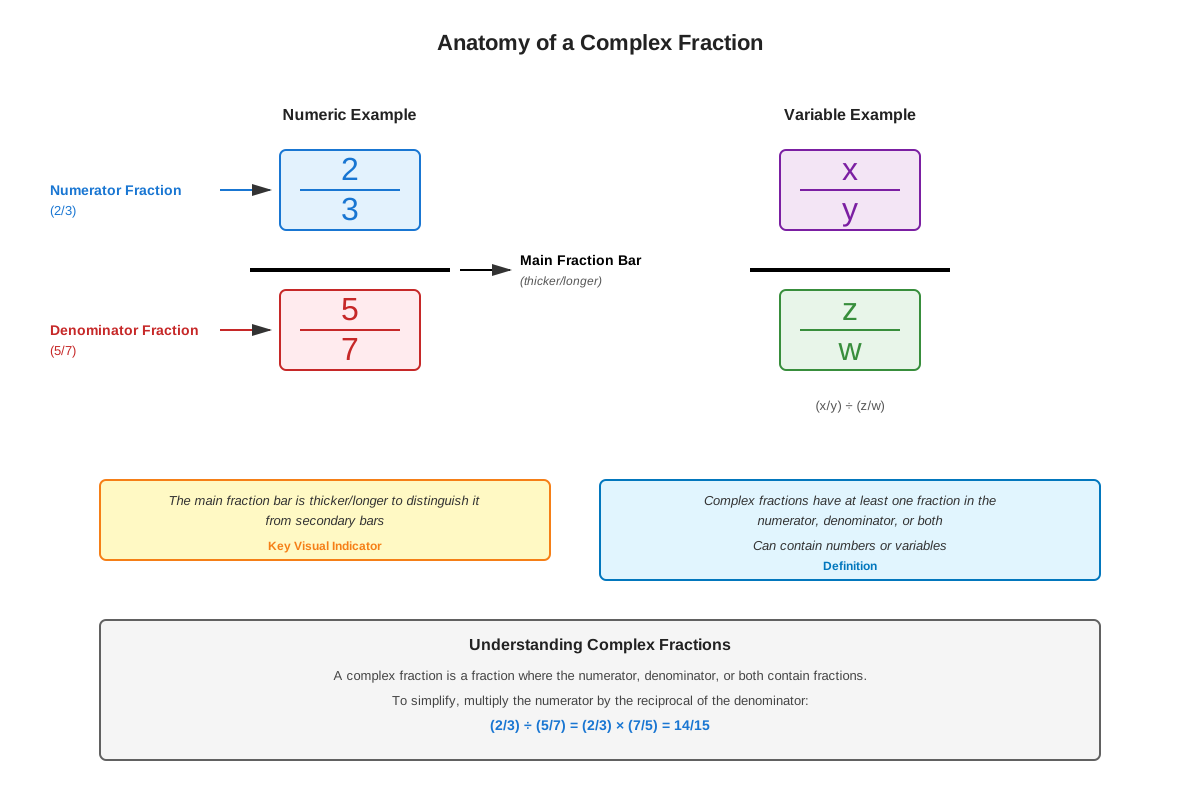
A complex fraction (also called a compound fraction) is a fraction in which the numerator, denominator, or both contain fractions themselves. The general form can be written as:
(a/b) / (c/d)where a, b, c, and d can be numbers, variables, or expressions. The key distinguishing feature is the presence of a "fraction within a fraction" structure. Complex fractions can also appear with addition or subtraction in the numerator or denominator, such as:
(1/2 + 1/3) / (1/4)The main fraction bar (the longest horizontal line) separates the overall numerator from the overall denominator. Everything above this main bar constitutes the numerator of the complex fraction, and everything below it forms the denominator. Recognizing this structure is the first step in simplification.
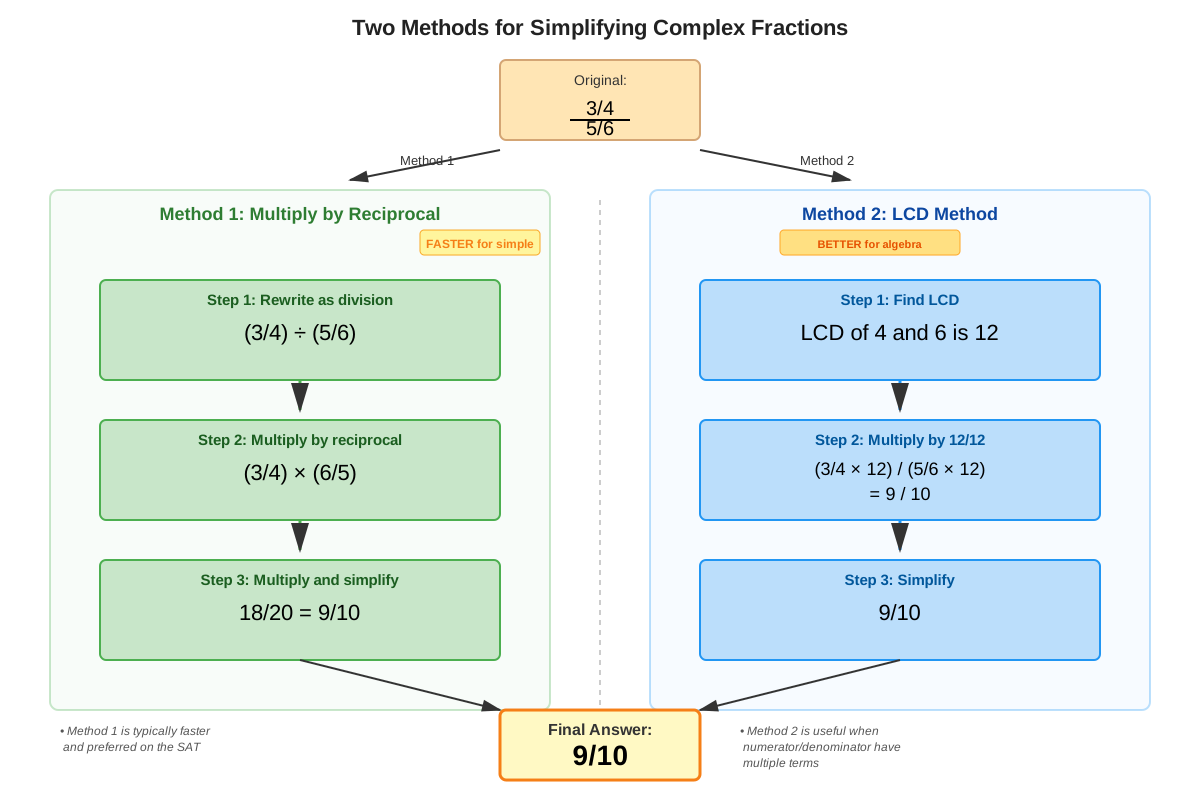
Method 1: Multiply by the Reciprocal
The most efficient and commonly used method for simplifying sat complex fractions involves treating the complex fraction as a division problem. Since dividing by a fraction is equivalent to multiplying by its reciprocal, the process follows these steps:
- Identify the main fraction bar that separates the overall numerator from the overall denominator
- Rewrite the complex fraction as a division problem: (numerator) ÷ (denominator)
- Convert the division to multiplication by taking the reciprocal of the denominator
- Multiply the fractions using standard multiplication rules (multiply numerators together, multiply denominators together)
- Simplify the resulting fraction by canceling common factors
Example: Simplify (2/3) / (4/5)
- Step 1: Recognize this as (2/3) ÷ (4/5)
- Step 2: Convert to multiplication: (2/3) × (5/4)
- Step 3: Multiply: (2×5)/(3×4) = 10/12
- Step 4: Simplify: 10/12 = 5/6
This method works efficiently because it reduces the complex fraction to a single multiplication problem, which is typically easier to compute and less prone to errors than other approaches.
Method 2: Least Common Denominator (LCD) Method
An alternative approach involves multiplying both the numerator and denominator of the complex fraction by the least common denominator (LCD) of all the smaller fractions within it. This method is particularly useful when the complex fraction contains addition or subtraction operations.
The steps are:
- Identify all denominators present in the complex fraction
- Find the LCD of all these denominators
- Multiply both the entire numerator and entire denominator by this LCD
- Simplify the resulting expression
- Reduce to lowest terms if necessary
Example: Simplify (1/2 + 1/3) / (1/4)
- Step 1: Denominators are 2, 3, and 4; LCD = 12
- Step 2: Multiply numerator and denominator by 12:
- Numerator: 12(1/2 + 1/3) = 6 + 4 = 10
- Denominator: 12(1/4) = 3
- Step 3: Result is 10/3
This method eliminates all fractions within the complex fraction, converting it to a simple fraction with integer numerator and denominator.
Complex Fractions with Variables
When complex fractions contain variables, the same principles apply, but algebraic manipulation becomes necessary. The key is to maintain proper algebraic form throughout the simplification process.
Example: Simplify (x/y) / (z/w)
Using the reciprocal method:
- (x/y) ÷ (z/w) = (x/y) × (w/z) = (xw)/(yz)
When variables appear in more complicated arrangements, students must be careful to:
- Factor expressions where possible before simplifying
- Cancel only common factors (not terms)
- Maintain restrictions on variables (denominators cannot equal zero)
Comparison of Methods
| Method | Best Used When | Advantages | Disadvantages |
|---|---|---|---|
| Reciprocal | Simple complex fractions with single fractions in numerator and denominator | Fast, intuitive, fewer steps | Less effective with addition/subtraction in numerator or denominator |
| LCD | Complex fractions with addition or subtraction operations | Eliminates all fractions at once, systematic | Requires finding LCD, more initial computation |
Recognizing Complex Fractions in Context
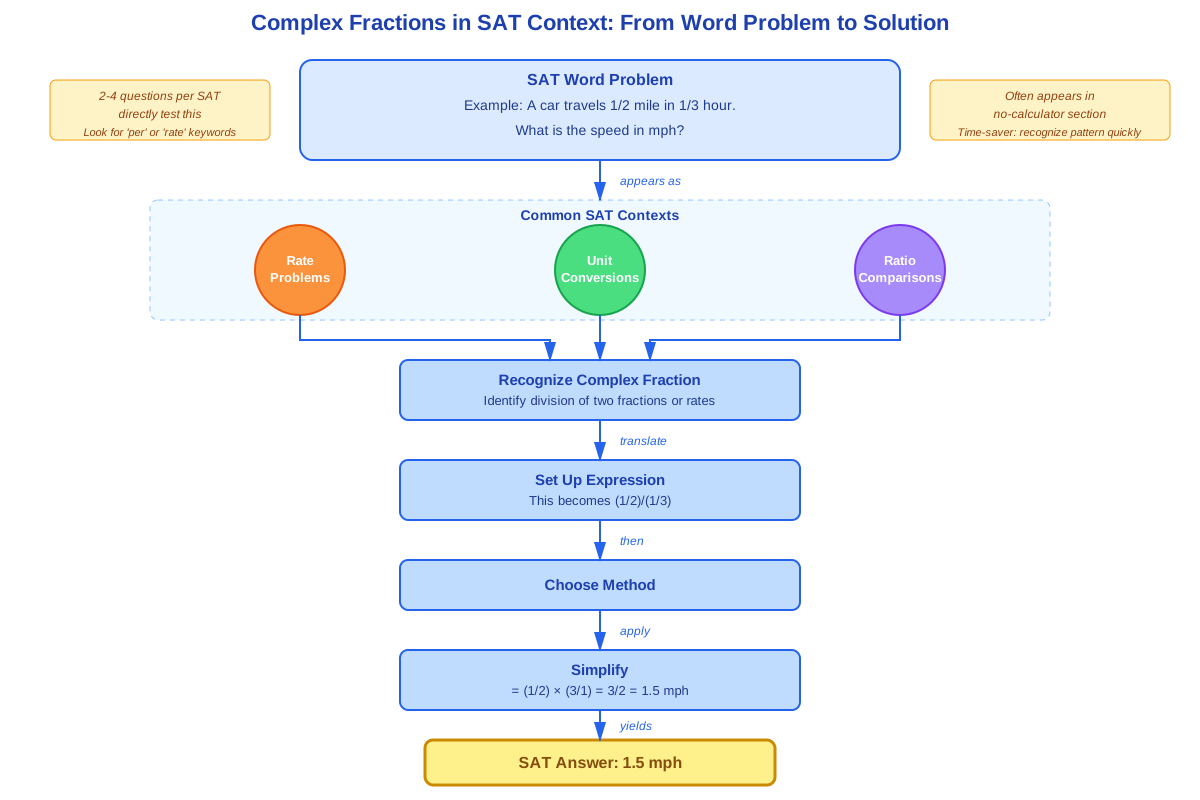
On the SAT, complex fractions don't always appear in standard mathematical notation. They may be embedded within:
- Rate problems: "If a car travels at 60 miles per hour and uses 1/30 gallons per mile, what is the fuel efficiency in miles per gallon?" This creates (60 miles/hour) / (1/30 gallons/mile)
- Work rate problems: "If Worker A completes 1/3 of a job per hour and Worker B completes 1/4 of a job per hour, what fraction of the job do they complete together?"
- Proportion problems: Setting up proportions can naturally create complex fractions
- Unit conversion: Converting compound units often requires simplifying complex fractions
Concept Relationships
Complex fractions build directly upon fundamental fraction operations, particularly division of fractions. The relationship can be mapped as:
Basic Fractions → Fraction Division → Complex Fractions → Rational Expressions
Within the topic itself, the concepts connect as follows:
Recognition of Structure → Choice of Method → Algebraic Manipulation → Simplification → Application to Word Problems
Complex fractions connect to prerequisite topics through their reliance on reciprocals (the multiplicative inverse concept), fraction multiplication and division rules, and the least common denominator technique from fraction addition. They extend forward to more advanced topics including rational expressions, algebraic fractions, and rational equations.
The relationship to ratios, rates, and proportions is particularly strong. A complex fraction is essentially a ratio of ratios, making it a natural representation for compound rates. When students encounter "per per" language in word problems (miles per gallon per dollar, or widgets per hour per worker), they're dealing with complex fractions in disguised form.
High-Yield Facts
⭐ A complex fraction is a fraction that contains one or more fractions in its numerator, denominator, or both
⭐ The fastest simplification method is usually to multiply the numerator by the reciprocal of the denominator
⭐ Dividing by a fraction is equivalent to multiplying by its reciprocal: (a/b) ÷ (c/d) = (a/b) × (d/c)
⭐ When a complex fraction contains addition or subtraction, the LCD method is often more efficient
⭐ Complex fractions frequently appear in SAT rate and proportion problems, often disguised within word problems
- The main fraction bar (the longest one) separates the overall numerator from the overall denominator
- Both the numerator and denominator of a complex fraction can be multiplied by the same non-zero value without changing the fraction's value
- Variables in complex fractions must be handled with care regarding domain restrictions (denominators cannot equal zero)
- Complex fractions can always be simplified to a simple fraction form
- On the SAT, recognizing that a word problem creates a complex fraction is often the key insight needed to solve it
- The LCD method works by eliminating all internal fractions simultaneously
- Complex fractions with variables follow the same simplification rules as those with numbers
- Canceling common factors should only occur after converting to a single multiplication problem
- The reciprocal of a/b is b/a (flip the numerator and denominator)
- Complex fractions are mathematically equivalent to division problems
Quick check — test yourself on Complex fractions so far.
Try Flashcards →Common Misconceptions
Misconception: The main fraction bar is the first one you see when reading from top to bottom → Correction: The main fraction bar is the longest horizontal line that separates the entire numerator from the entire denominator. In (1/2)/(3/4), the middle bar is the main fraction bar, not the bars in 1/2 or 3/4.
Misconception: You can cancel terms across the main fraction bar → Correction: You can only cancel common factors (from multiplication), never terms (from addition or subtraction). Before canceling, the complex fraction must be rewritten as a single multiplication problem.
Misconception: When simplifying (a/b)/(c/d), you can just "flip and multiply" any fraction → Correction: You specifically multiply the numerator (a/b) by the reciprocal of the denominator (d/c), not by the reciprocal of the numerator. The correct result is (a/b) × (d/c) = (ad)/(bc).
Misconception: Complex fractions with addition in the numerator can be split into separate fractions → Correction: You cannot separate a complex fraction like (1/2 + 1/3)/(1/4) into (1/2)/(1/4) + (1/3)/(1/4) until after you've simplified the numerator. You must first combine the numerator into a single fraction or use the LCD method.
Misconception: The LCD method and reciprocal method always give different answers → Correction: Both methods, when applied correctly, yield the same simplified result. They are different paths to the same destination, and the choice between them depends on which is more efficient for the specific problem structure.
Misconception: Complex fractions always simplify to proper fractions (numerator less than denominator) → Correction: Complex fractions can simplify to proper fractions, improper fractions, or whole numbers depending on the values involved. For example, (3/4)/(1/2) simplifies to 3/2, an improper fraction.
Worked Examples
Example 1: Numeric Complex Fraction with Single Fractions
Problem: Simplify (5/8) / (3/4)
Solution:
Step 1: Identify this as a complex fraction with 5/8 in the numerator and 3/4 in the denominator.
Step 2: Recognize that dividing by a fraction means multiplying by its reciprocal. The reciprocal of 3/4 is 4/3.
Step 3: Rewrite as multiplication:
(5/8) × (4/3)Step 4: Multiply numerators and denominators:
(5 × 4)/(8 × 3) = 20/24Step 5: Simplify by finding the GCF of 20 and 24, which is 4:
20/24 = 5/6Answer: 5/6
Connection to Learning Objectives: This example demonstrates the identification of key features (numerator and denominator fractions) and applies the reciprocal method to simplify, which is the most common approach tested on the SAT.
Example 2: Complex Fraction with Addition in Numerator
Problem: Simplify (1/3 + 1/6) / (2/9)
Solution:
Method 1 (Simplify numerator first, then use reciprocal):
Step 1: Simplify the numerator by finding a common denominator for 1/3 and 1/6. The LCD is 6:
1/3 + 1/6 = 2/6 + 1/6 = 3/6 = 1/2Step 2: Now the complex fraction becomes:
(1/2) / (2/9)Step 3: Multiply by the reciprocal of 2/9, which is 9/2:
(1/2) × (9/2) = 9/4Method 2 (LCD method):
Step 1: Identify all denominators: 3, 6, and 9. The LCD is 18.
Step 2: Multiply both the entire numerator and entire denominator by 18:
Numerator: 18(1/3 + 1/6) = 18(1/3) + 18(1/6) = 6 + 3 = 9
Denominator: 18(2/9) = 4
Step 3: The result is 9/4.
Answer: 9/4 or 2 1/4
Connection to Learning Objectives: This example shows how to handle complex fractions with operations in the numerator and demonstrates that multiple valid methods exist. It also reinforces the importance of recognizing when the LCD method might be more efficient.
Example 3: SAT-Style Word Problem
Problem: A machine produces 2/3 of a widget per minute. If each widget requires 1/6 of a pound of material, how many pounds of material does the machine use per minute?
Solution:
Step 1: Identify what we're looking for: pounds per minute.
Step 2: Set up the relationship. We have:
- Production rate: 2/3 widgets per minute
- Material per widget: 1/6 pounds per widget
Step 3: To find pounds per minute, multiply:
(2/3 widgets/minute) × (1/6 pounds/widget)Step 4: The "widgets" units cancel, leaving pounds/minute:
(2/3) × (1/6) = 2/18 = 1/9Answer: 1/9 pound per minute
Note: While this problem doesn't appear as a complex fraction initially, recognizing the structure helps solve it efficiently. If the problem asked "How many widgets per pound?" it would create the complex fraction (2/3)/(1/6).
Connection to Learning Objectives: This demonstrates how complex fractions appear embedded within SAT word problems, particularly those involving rates and unit conversions.
Exam Strategy
When approaching complex fraction questions on the SAT, follow this strategic framework:
Recognition Phase: Quickly identify whether you're dealing with a complex fraction. Look for trigger phrases like "per per," multiple fraction bars, or rate problems involving compound units. Scan the problem for the longest fraction bar—this is your main dividing line.
Method Selection: Choose your simplification method based on the structure:
- If the numerator and denominator are single fractions with no addition/subtraction: use the reciprocal method (faster)
- If there's addition or subtraction in the numerator or denominator: consider the LCD method
- If the problem involves variables: reciprocal method usually works well, but watch for factoring opportunities
Execution Tips:
- Write out the reciprocal explicitly before multiplying to avoid errors
- When using the LCD method, multiply every term by the LCD—missing even one term is a common mistake
- Cancel common factors only after converting to a single fraction
- Keep track of negative signs carefully, especially with variables
Time Management: Complex fraction problems should take 45-90 seconds on average. If you're exceeding 2 minutes, you may be using an inefficient method or making calculation errors. Consider:
- Checking if there's a simpler approach
- Using the answer choices to work backwards (if multiple choice)
- Estimating to eliminate obviously wrong answers first
Process of Elimination: When answer choices are given:
- Eliminate answers that have different denominators than what you'd expect from the calculation
- Check if the answer should be greater than or less than 1 by comparing numerator and denominator sizes
- Look for answers that represent common errors (like forgetting to take the reciprocal)
Trigger Words and Phrases:
- "per per" (miles per gallon per dollar)
- "rate of a rate"
- "ratio of ratios"
- "compound rate"
- "divided by a fraction"
- Problems with multiple fraction bars in the setup
Exam Tip: If you see a complex fraction in the no-calculator section, the numbers are designed to simplify nicely. Look for common factors before doing extensive multiplication.
Memory Techniques
Mnemonic for Method Selection: "SIMPLE-R, COMPLEX-L"
- SIMPLE-R: If the complex fraction is simple (single fractions top and bottom), use Reciprocal method
- COMPLEX-L: If the complex fraction is complex (addition/subtraction present), use LCD method
Visualization Strategy: Picture a complex fraction as a "fraction sandwich":
- Top bun = numerator fraction
- Middle = main fraction bar (the "plate")
- Bottom bun = denominator fraction
- To eat the sandwich, flip the bottom bun and stack it on top (reciprocal method)
Acronym for Reciprocal Method: "RICE"
- Recognize the main fraction bar
- Identify the denominator fraction
- Change to multiplication (flip the denominator)
- Execute the multiplication and simplify
Memory Aid for "Flip and Multiply": "When dividing fractions, don't be shy—flip the second and multiply!"
Conceptual Memory: Remember that a complex fraction is just a division problem in disguise. Whenever you see (something)/(something else), think "the first thing divided by the second thing."
Summary
Complex fractions are fractions containing one or more fractions in their numerator, denominator, or both, representing a critical SAT math topic that bridges basic fraction operations with algebraic reasoning. The two primary simplification methods—multiplying by the reciprocal and the LCD method—provide efficient pathways to reducing these expressions to simple fractions. The reciprocal method works best for straightforward complex fractions with single fractions in numerator and denominator, while the LCD method excels when addition or subtraction operations are present. On the SAT, complex fractions appear both as direct simplification problems and embedded within word problems involving rates, ratios, and proportions. Success requires recognizing the structure (identifying the main fraction bar), selecting the appropriate method, and executing the simplification accurately. Students must understand that dividing by a fraction is equivalent to multiplying by its reciprocal, and that both methods yield identical results when applied correctly. Mastery of complex fractions enables efficient problem-solving on 3-5 questions per SAT exam and provides essential skills for more advanced algebraic concepts.
Key Takeaways
- Complex fractions contain fractions within their numerator, denominator, or both, and can always be simplified to a single simple fraction
- The reciprocal method (multiply by the reciprocal of the denominator) is the fastest approach for simple complex fractions
- The LCD method (multiply numerator and denominator by the LCD of all internal fractions) works best when addition or subtraction is present
- On the SAT, complex fractions frequently appear disguised within rate problems, proportion questions, and word problems with compound units
- Dividing by a fraction is always equivalent to multiplying by its reciprocal: (a/b) ÷ (c/d) = (a/b) × (d/c)
- The main fraction bar (longest horizontal line) separates the overall numerator from the overall denominator
- Both simplification methods yield the same result—choose based on efficiency for the specific problem structure
Related Topics
Rational Expressions: Complex fractions with variables lead naturally to rational expressions, which are fractions containing polynomials. Mastering complex fractions provides the foundation for simplifying, adding, subtracting, multiplying, and dividing rational expressions.
Proportions and Cross-Multiplication: Complex fractions often arise when setting up proportions. Understanding how to manipulate complex fractions enhances the ability to solve proportion problems efficiently.
Unit Conversion and Dimensional Analysis: Complex fractions are essential for converting between compound units (like converting miles per hour to feet per second). This skill extends to chemistry, physics, and real-world applications.
Rate Problems: Work rates, speed problems, and efficiency questions frequently create complex fractions. Mastery of this topic directly improves performance on these high-yield SAT question types.
Algebraic Fractions and Rational Equations: The techniques learned for simplifying complex fractions extend to solving equations containing fractions, a common SAT algebra topic.
Practice CTA
Now that you've mastered the core concepts of complex fractions, it's time to solidify your understanding through practice! Attempt the practice questions to test your ability to recognize, simplify, and apply complex fractions under exam-like conditions. Use the flashcards to reinforce key definitions, methods, and common pitfalls. Remember, complex fractions appear on virtually every SAT exam, making this practice time a high-yield investment in your score. The more you practice identifying the structure and choosing the right method, the faster and more accurate you'll become on test day. You've got this—let's turn this knowledge into points!
Sign up free to keep reading
Create a free AnvayaPrep account to finish this SAT guide on Complex fractions — plus flashcards and practice questions.