Overview
Combining ratios is a critical skill in SAT math that involves working with multiple ratio relationships simultaneously to find unknown quantities or establish new proportional relationships. This topic appears frequently on the SAT because it tests both conceptual understanding of proportional reasoning and the ability to manipulate algebraic expressions systematically. Students encounter combining ratios problems when they must integrate information from two or more separate ratio statements—for example, when given that the ratio of A to B is 2:3 and the ratio of B to C is 4:5, then asked to determine the ratio of A to C.
The power of combining ratios lies in its application across diverse problem contexts. On the SAT, these questions may involve mixing solutions with different concentrations, comparing quantities across multiple groups, analyzing gear ratios in mechanical systems, or working with scaled measurements in geometry. The fundamental challenge is identifying a common term between ratios and using it as a bridge to create a unified relationship. This requires careful attention to which quantities appear in multiple ratios and strategic manipulation of ratio terms through multiplication or division.
Mastering sat combining ratios connects directly to broader mathematical concepts including proportional reasoning, algebraic manipulation, and systems of equations. The skills developed here strengthen a student's ability to work with fractions, find common denominators, and think systematically about relationships between quantities—all essential competencies for success across the entire SAT Math section. This topic typically appears 2-3 times per test and often distinguishes students scoring in the 650-750 range from those achieving 750+.
Learning Objectives
- [ ] Identify key features of combining ratios
- [ ] Explain how combining ratios appears on the SAT
- [ ] Apply combining ratios to answer SAT-style questions
- [ ] Determine the common term between two or more ratios and use it to create equivalent ratios
- [ ] Convert ratio notation to algebraic expressions and solve for unknown quantities
- [ ] Recognize when a problem requires combining ratios versus other ratio techniques
- [ ] Simplify combined ratios to their lowest terms and interpret the results in context
Prerequisites
- Basic ratio notation and simplification: Understanding how to express relationships as a:b and reduce ratios to simplest form is essential for manipulating combined ratios
- Proportional reasoning: The ability to set up and solve proportions provides the foundation for understanding why ratios can be scaled
- Least common multiples (LCM): Finding the LCM allows students to create equivalent ratios with matching terms
- Algebraic manipulation: Multiplying expressions, combining like terms, and solving for variables are necessary for working with ratio equations
- Fraction operations: Since ratios can be expressed as fractions, comfort with fraction multiplication and division supports ratio combination
Why This Topic Matters
In real-world applications, combining ratios appears in chemistry (mixing solutions of different concentrations), cooking (scaling recipes with multiple ingredients), finance (comparing investment returns across different time periods), and engineering (analyzing gear systems with multiple interconnected components). Professionals regularly combine multiple proportional relationships to make decisions, optimize processes, and solve complex problems.
On the SAT, combining ratios questions appear with high frequency—typically 2-3 questions per test, accounting for approximately 3-5% of the Math section. These questions often appear in the medium-to-hard difficulty range (questions 10-22 in each math module) and serve as effective discriminators between score ranges. The College Board values this skill because it demonstrates mathematical maturity: the ability to synthesize information from multiple sources and apply systematic problem-solving strategies.
Common SAT presentations include: word problems describing relationships between three or more quantities where students must find a specific ratio; geometry problems involving similar figures with multiple scale factors; data interpretation questions requiring students to combine information from different parts of a table or graph; and mixture problems where two substances with different ratios of components are combined. The topic frequently appears alongside other ratio concepts, requiring students to first combine ratios and then use the result to find actual quantities or percentages.
Core Concepts
Understanding Ratio Combination Fundamentals
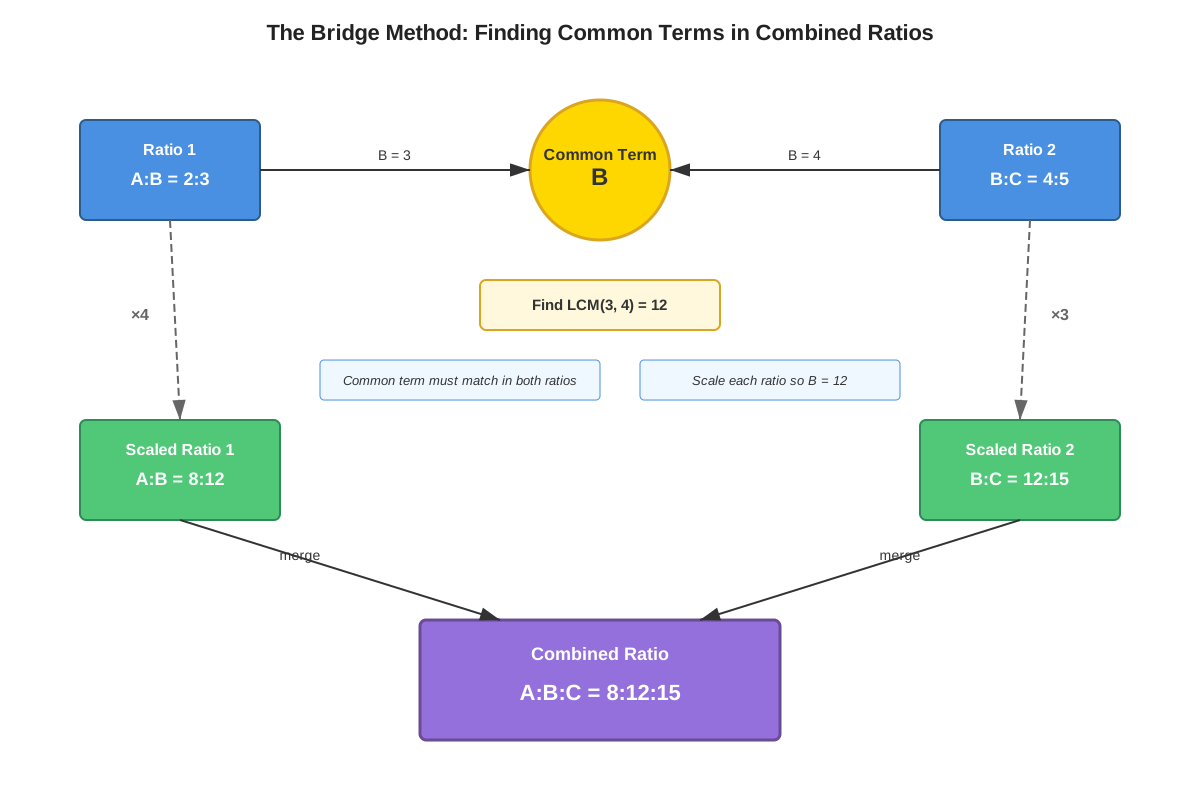
When combining ratios, the essential principle is that ratios sharing a common term can be linked together by making that common term equal in both ratios. Consider two ratios: A:B = 2:3 and B:C = 4:5. The common term B appears in both ratios but with different values (3 in the first ratio, 4 in the second). To combine these ratios into a single A:B:C relationship, the B values must be made equal.
The process involves finding a common multiple of the B values. The least common multiple of 3 and 4 is 12. Multiply the first ratio by 4 (giving A:B = 8:12) and the second ratio by 3 (giving B:C = 12:15). Now both ratios express B as 12, allowing them to be combined into A:B:C = 8:12:15.
This technique works because ratios represent proportional relationships that remain valid when all terms are multiplied by the same factor. Just as the fraction 2/3 equals 8/12, the ratio 2:3 equals 8:12. The key insight is that ratios are scale-independent—they describe relative sizes, not absolute quantities.
The Common Term Method
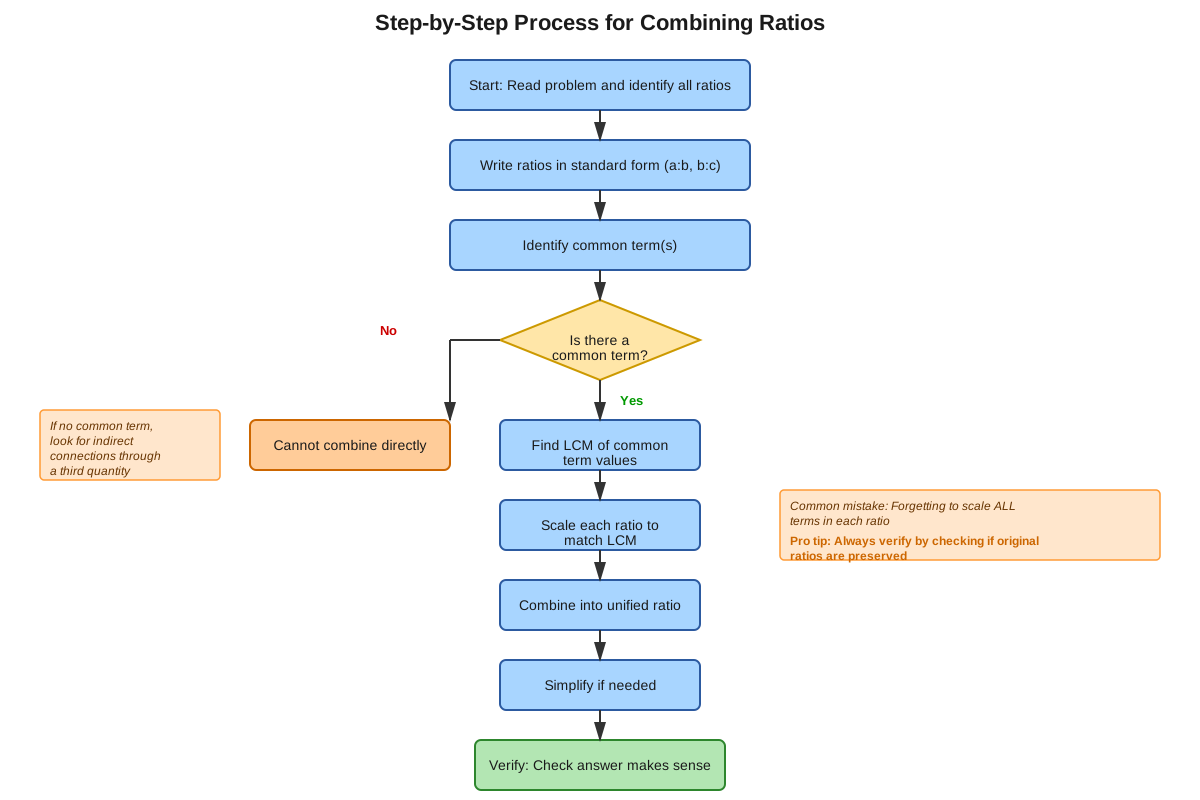
The common term method is the most reliable systematic approach for combining ratios. Follow these steps:
- Identify the common term: Determine which quantity appears in multiple ratios
- Find the LCM: Calculate the least common multiple of the common term's values across all ratios
- Scale each ratio: Multiply all terms in each ratio by the factor needed to make the common term equal to the LCM
- Combine the ratios: Write the unified ratio including all quantities, using the common term value only once
- Simplify if needed: Reduce the final ratio to lowest terms by dividing all terms by their greatest common divisor
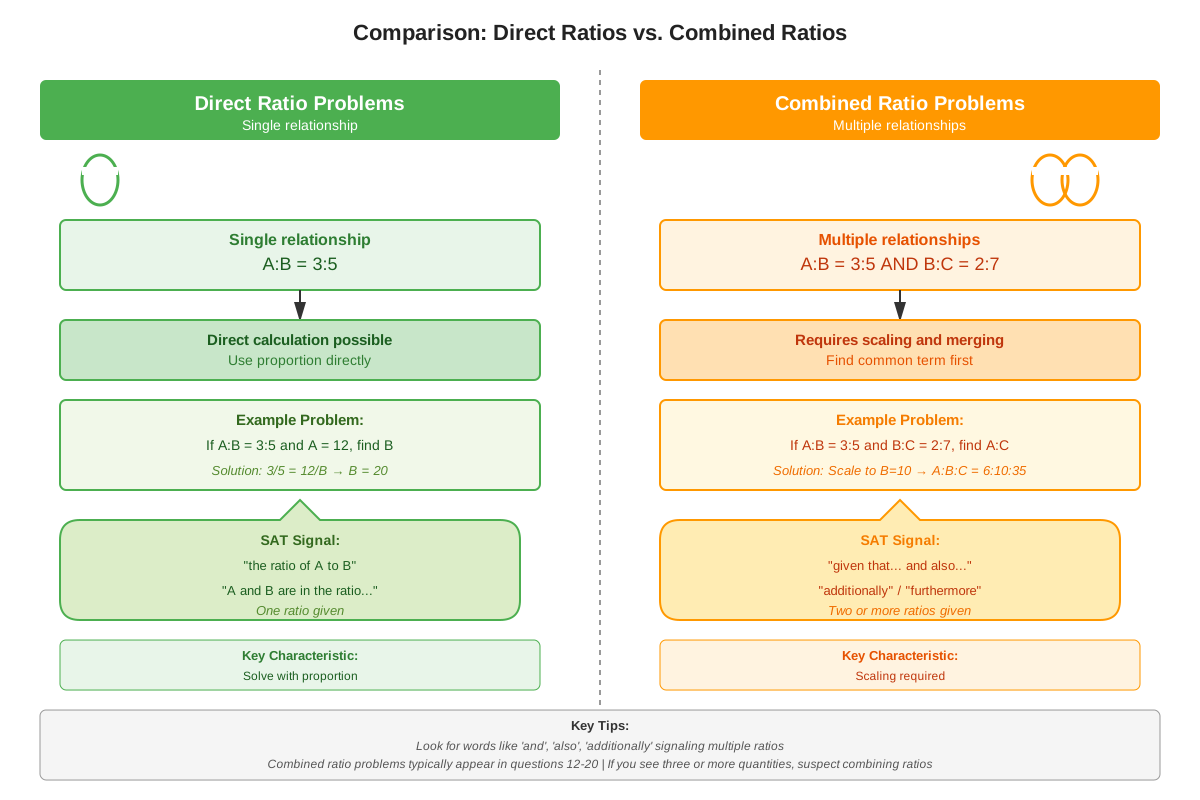
For example, combining A:B = 3:5 and B:C = 2:7:
- Common term: B (values are 5 and 2)
- LCM of 5 and 2: 10
- Scale first ratio by 2: A:B = 6:10
- Scale second ratio by 5: B:C = 10:35
- Combined ratio: A:B:C = 6:10:35
Algebraic Representation of Combined Ratios
Ratios can be expressed algebraically using a multiplier variable. If A:B = 2:3, then A = 2x and B = 3x for some positive value x. This representation is particularly powerful when combining ratios because it makes the mathematical relationships explicit.
Consider combining A:B = 2:3 and B:C = 4:5 using algebra:
- From the first ratio: A = 2x and B = 3x
- From the second ratio: B = 4y and C = 5y
- Since both expressions equal B: 3x = 4y
- Solving for y: y = (3x)/4
- Substituting into C: C = 5y = 5(3x/4) = 15x/4
- The combined relationship: A = 2x, B = 3x, C = 15x/4
- Multiplying by 4 to eliminate fractions: A = 8x, B = 12x, C = 15x
- Therefore A:B:C = 8:12:15
This algebraic approach is especially useful when dealing with complex problems or when the ratios involve larger numbers where finding the LCM mentally is challenging.
Three or More Ratios
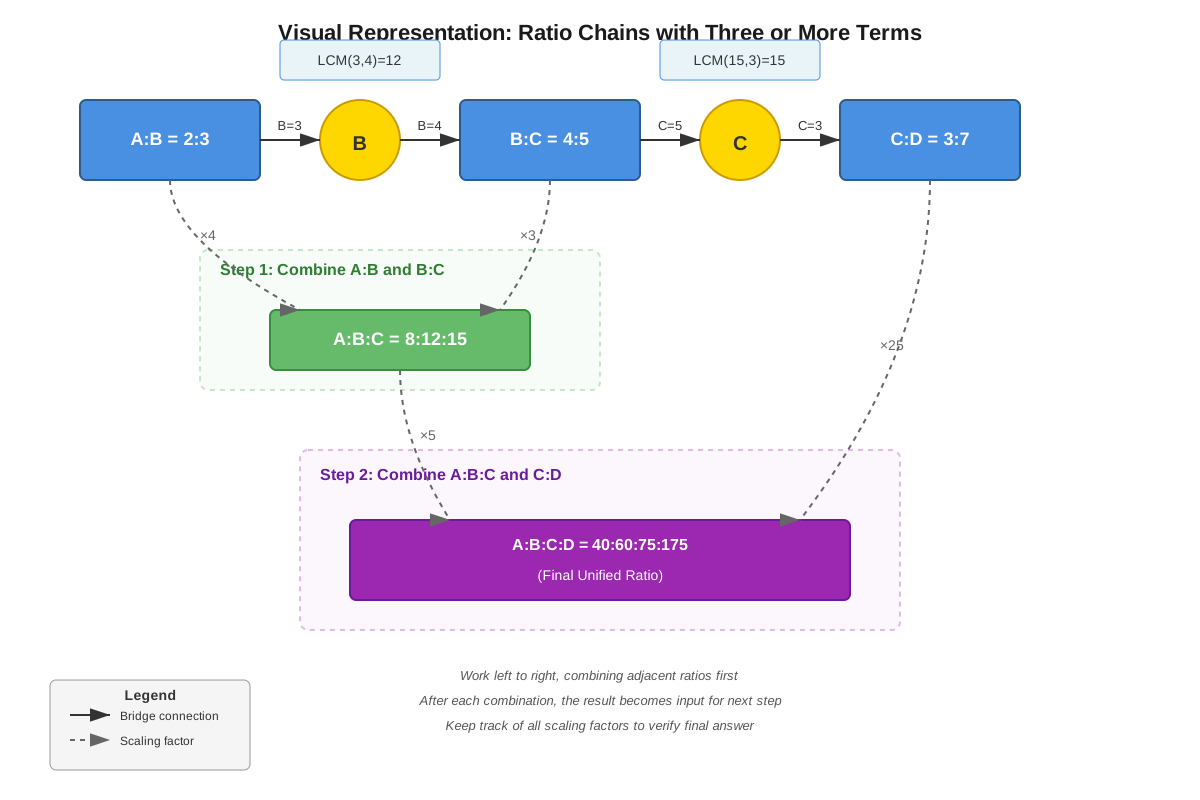
When combining three or more ratios, the process extends naturally. Consider A:B = 2:3, B:C = 4:5, and C:D = 6:7. The strategy is to combine ratios sequentially:
First, combine A:B and B:C (as shown earlier) to get A:B:C = 8:12:15. Then combine this result with C:D = 6:7. The common term is now C (values 15 and 6). The LCM of 15 and 6 is 30.
- Scale A:B:C by 2: A:B:C = 16:24:30
- Scale C:D by 5: C:D = 30:35
- Final combined ratio: A:B:C:D = 16:24:30:35
Ratio Combination in Context Problems
SAT questions often embed combining ratios within real-world contexts. A typical problem might state: "In a school, the ratio of teachers to students is 1:15, and the ratio of students to administrators is 30:1. What is the ratio of teachers to administrators?"
To solve:
- Teachers:Students = 1:15
- Students:Administrators = 30:1
- Common term: Students (values 15 and 30)
- LCM of 15 and 30: 30
- Scale first ratio by 2: Teachers:Students = 2:30
- Second ratio already has Students = 30: Students:Administrators = 30:1
- Combined: Teachers:Students:Administrators = 2:30:1
- Answer: Teachers:Administrators = 2:1
The key is translating the word problem into ratio notation, identifying the common term, and applying the systematic combination method.
Comparison Table: Methods for Combining Ratios
| Method | Best Used When | Advantages | Disadvantages |
|---|---|---|---|
| Common Term (LCM) | Ratios have small integer values | Quick, intuitive, minimal calculation | Can be cumbersome with large numbers |
| Algebraic Multipliers | Complex ratios or multiple steps | Systematic, reduces errors, shows relationships clearly | Requires more algebraic manipulation |
| Fraction Conversion | Two ratios only | Leverages fraction skills | Less intuitive for three+ ratios |
| Sequential Combination | Three or more ratios | Breaks problem into manageable steps | Requires careful tracking of intermediate results |
Concept Relationships
The foundation of combining ratios rests on proportional reasoning—understanding that ratios represent multiplicative relationships that remain constant when scaled. This connects directly to the prerequisite knowledge of equivalent fractions, since a ratio a:b can be written as the fraction a/b, and combining ratios often requires finding common denominators.
Within the topic itself, the concepts flow logically: identifying common terms → finding the LCM → scaling ratios → combining into unified ratios → simplifying results. Each step depends on the previous one, creating a systematic problem-solving pathway.
Combining ratios extends naturally to related topics in the Ratios, Rates, and Proportions unit. Once ratios are combined, students often need to use the result to find actual quantities (given a total or one specific value) or to calculate percentages (expressing one part relative to the whole). The combined ratio also serves as the foundation for mixture problems where substances with different component ratios are blended.
Looking beyond the immediate unit, combining ratios connects to systems of equations (each ratio represents a constraint), similar figures in geometry (where multiple scale factors may need to be combined), and probability (where compound events require combining probability ratios). The algebraic representation of ratios using multipliers directly parallels the use of parameters in linear equations and parametric representations in coordinate geometry.
Quick check — test yourself on Combining ratios so far.
Try Flashcards →High-Yield Facts
⭐ The common term between two ratios must be made equal before the ratios can be combined into a single unified ratio
⭐ To make common terms equal, multiply each ratio by the factor that converts the common term to the LCM of its values across all ratios
⭐ When combining A:B = m:n and B:C = p:q, the combined ratio A:B:C = mp:np:nq (after making B equal in both)
⭐ Combined ratios can always be simplified by dividing all terms by their greatest common divisor
⭐ The order of terms in a combined ratio matters—A:B:C is different from C:B:A
- Ratios can be combined sequentially when dealing with three or more relationships—combine the first two, then combine the result with the third
- If A:B = 2:3 and B:C = 4:5, then A:C can be found by eliminating B: A:C = (2×4):(3×5) = 8:15
- When a problem gives ratios with a common term appearing in different positions, rewrite the ratios to align the common term before combining
- Combined ratios preserve all proportional relationships—if A:B:C = 2:3:5, then A:B = 2:3, B:C = 3:5, and A:C = 2:5
- The algebraic multiplier method (A = 2x, B = 3x) is equivalent to the LCM method but provides more flexibility for complex problems
- In mixture problems, the ratio of components in the mixture equals the combined ratio weighted by the amounts of each substance mixed
- If ratios share multiple common terms, choose one common term to work with and verify the result using the other common terms
Common Misconceptions
Misconception: When combining A:B = 2:3 and B:C = 4:5, the result is simply A:B:C = 2:3:4:5
Correction: This incorrectly treats the ratios as independent. The common term B must have the same value in both ratios. The correct combined ratio is A:B:C = 8:12:15 (after making B equal to 12 in both ratios).
Misconception: The common term can be eliminated by adding the ratios together
Correction: Ratios represent multiplicative relationships, not additive ones. You cannot add 2:3 and 4:5 to get 6:8. Instead, scale the ratios so the common term matches, then combine.
Misconception: When combining ratios, always multiply the first ratio's terms by the second ratio's common term value
Correction: Both ratios must be scaled to make the common term equal to the LCM. If A:B = 2:3 and B:C = 4:5, multiply the first ratio by 4 AND the second ratio by 3 (since LCM(3,4) = 12).
Misconception: Combined ratios must always be simplified to lowest terms
Correction: While simplification is often helpful, the SAT may ask for ratios in specific forms. Always read what the question requests. Sometimes maintaining a particular scale is necessary for subsequent calculations.
Misconception: If A:B = 2:3 and B:C = 3:4, the common term is already equal so A:B:C = 2:3:4
Correction: This is actually correct! When the common term already has the same value in both ratios (B = 3 in both), the ratios can be directly combined. However, students often miss this shortcut and unnecessarily scale the ratios.
Misconception: The algebraic method and LCM method will give different final ratios
Correction: Both methods yield equivalent ratios. Any differences in the numerical values are due to different scaling factors, but the ratios represent the same proportional relationship. For example, 8:12:15 and 16:24:30 are equivalent.
Worked Examples
Example 1: Three-Quantity Ratio Combination
Problem: In a wildlife preserve, the ratio of deer to rabbits is 3:7, and the ratio of rabbits to foxes is 14:5. What is the ratio of deer to foxes?
Solution:
Step 1: Identify the given ratios and the common term
- Deer:Rabbits = 3:7
- Rabbits:Foxes = 14:5
- Common term: Rabbits (values are 7 and 14)
Step 2: Find the LCM of the common term values
- LCM(7, 14) = 14
Step 3: Scale each ratio to make the common term equal to 14
- First ratio: Multiply by 2 → Deer:Rabbits = 6:14
- Second ratio: Already has Rabbits = 14 → Rabbits:Foxes = 14:5
Step 4: Combine the ratios
- Deer:Rabbits:Foxes = 6:14:5
Step 5: Extract the requested ratio
- Deer:Foxes = 6:5
Answer: The ratio of deer to foxes is 6:5.
Connection to Learning Objectives: This problem demonstrates identifying the common term (rabbits), applying the systematic combination method, and extracting the specific ratio requested—all key features of combining ratios on the SAT.
Example 2: Four-Quantity Sequential Combination
Problem: A recipe calls for ingredients in the following ratios: flour to sugar is 5:2, sugar to butter is 4:3, and butter to eggs is 6:5. If the recipe uses 30 cups of flour, how many eggs are needed?
Solution:
Step 1: Set up the three ratios
- Flour:Sugar = 5:2
- Sugar:Butter = 4:3
- Butter:Eggs = 6:5
Step 2: Combine the first two ratios (common term: Sugar)
- Sugar values: 2 and 4
- LCM(2, 4) = 4
- Scale first ratio by 2: Flour:Sugar = 10:4
- Second ratio already has Sugar = 4: Sugar:Butter = 4:3
- Combined: Flour:Sugar:Butter = 10:4:3
Step 3: Combine the result with the third ratio (common term: Butter)
- Butter values: 3 and 6
- LCM(3, 6) = 6
- Scale previous result by 2: Flour:Sugar:Butter = 20:8:6
- Scale third ratio by 1: Butter:Eggs = 6:5
- Final combined: Flour:Sugar:Butter:Eggs = 20:8:6:5
Step 4: Use the combined ratio to find the actual quantity
- Flour:Eggs = 20:5 = 4:1
- If Flour = 30 cups, and the ratio is 4:1, then:
- 4x = 30, so x = 7.5
- Eggs = 1x = 7.5
Answer: 7.5 eggs are needed (or 8 eggs if the problem requires whole numbers).
Connection to Learning Objectives: This problem requires sequential combination of multiple ratios, demonstrates the algebraic multiplier approach (using x), and shows how combined ratios are applied to find actual quantities—a common SAT application.
Exam Strategy
When approaching sat combining ratios questions, begin by carefully reading the problem to identify all ratio relationships and determine what the question asks for. Underline or circle the quantities mentioned in each ratio and mark which quantity appears in multiple ratios—this is your common term and the key to solving the problem.
Trigger words and phrases to watch for include: "the ratio of A to B is...", "compared to", "for every", "per", and "proportional to". Questions often use phrases like "What is the ratio of X to Z?" when X and Z don't appear together in any given ratio, signaling that combination is necessary. Context clues like "mixture", "combined", "school with teachers, students, and administrators", or "gears with different sizes" often indicate combining ratios problems.
For process of elimination, if answer choices are given as ratios, check whether they maintain the correct proportional relationships with the given information. For instance, if you're told A:B = 2:3 and your answer for A:C is 2:5, verify that this is consistent with any B:C relationship you derived. Eliminate answers that would create impossible relationships (like making a larger quantity have a smaller ratio value than a smaller quantity when the context indicates otherwise).
Time allocation is critical. Simple two-ratio combinations should take 60-90 seconds. Three-ratio problems may require 2-3 minutes. If a problem seems to require combining four or more ratios, look for a shortcut—the SAT rarely requires more than three combinations. If you're spending more than 3 minutes, mark the question and return to it later.
Exam Tip: Always write out the ratios in consistent notation (A:B:C) rather than trying to track relationships mentally. This reduces errors and makes it easier to identify the common term and verify your final answer.
Set up your work systematically: write the given ratios, identify the common term, show the LCM calculation, display the scaled ratios, and write the combined ratio. This organized approach not only reduces errors but also makes it easier to check your work if time permits.
Memory Techniques
SCALE mnemonic for the combining ratios process:
- Spot the common term
- Calculate the LCM
- Adjust each ratio (multiply to reach LCM)
- Link the ratios together
- Eliminate redundancy (write common term once)
Visualization strategy: Picture ratios as chains with links. Each ratio is a chain segment, and the common term is the connecting link. To join two chains, the connecting links must be the same size—that's why you scale the ratios. The final combined ratio is one continuous chain from the first quantity to the last.
The "Bridge Term" metaphor: Think of the common term as a bridge between two islands (the other quantities). To cross from island A to island C, you must go through bridge B. The bridge must be the same on both sides (same value in both ratios) for the crossing to work.
Acronym for checking work - CROP:
- Common term appears only once in final ratio
- Ratios are properly scaled (multiply all terms, not just the common term)
- Original relationships preserved (A:B from the combined ratio matches the given A:B when simplified)
- Proportions make sense in context (larger quantities have larger ratio values when appropriate)
Finger counting technique: For simple problems with small numbers, use fingers to track the scaling. If combining 2:3 and 3:4, hold up 3 fingers for the common term, then count how many times 3 goes into 12 (the LCM) on each hand—4 times for the first ratio, 4 times for the second. This kinesthetic approach helps some students remember to scale both ratios.
Summary
Combining ratios is an essential SAT math skill that requires synthesizing multiple proportional relationships through a common term. The systematic approach involves identifying which quantity appears in multiple ratios, finding the least common multiple of that quantity's values, scaling each ratio so the common term equals the LCM, and then writing a unified ratio that includes all quantities. This process can be executed using either the LCM method (more intuitive for simple problems) or the algebraic multiplier method (more systematic for complex scenarios). The key insight is that ratios represent scale-independent proportional relationships that remain valid when all terms are multiplied by the same factor. On the SAT, combining ratios appears in diverse contexts including mixture problems, multi-group comparisons, and sequential proportional relationships. Success requires careful identification of common terms, systematic scaling of ratios, and verification that the final combined ratio preserves all original proportional relationships. Students must be comfortable with both the mechanical process of combination and the conceptual understanding of why the process works, enabling them to adapt the technique to novel problem presentations.
Key Takeaways
- The common term between ratios must be made equal (typically to the LCM) before ratios can be combined into a unified relationship
- Combining ratios preserves all proportional relationships—the combined ratio A:B:C contains the information from both A:B and B:C
- The systematic process (identify common term → find LCM → scale ratios → combine → simplify) works for any combining ratios problem
- Ratios can be combined sequentially when three or more relationships are given—combine two ratios, then combine the result with the next ratio
- Both the LCM method and algebraic multiplier method yield equivalent results; choose based on problem complexity and personal preference
- Always verify that your combined ratio makes sense in context and preserves the original given relationships
- Combining ratios frequently appears on the SAT in medium-to-hard questions and distinguishes high-scoring students from average performers
Related Topics
Ratio and Proportion Word Problems: After mastering combining ratios, students can tackle complex word problems that require first combining ratios and then using the result to find actual quantities or solve for unknowns. This builds on the combined ratio as a foundation for further calculations.
Mixture Problems: These problems involve combining substances with different component ratios (like solutions with different concentrations). Combining ratios provides the framework for determining the ratio of components in the final mixture.
Similar Figures and Scale Factors: In geometry, similar figures may have multiple related dimensions. Combining ratios of different dimensions helps solve problems involving area and volume scale factors, which depend on linear scale factors.
Systems of Equations: The algebraic representation of combined ratios (using multipliers like x and y) connects directly to solving systems of equations. Each ratio provides a constraint, and combining ratios is analogous to solving systems with multiple variables.
Rates and Unit Conversions: Combining ratios extends to combining rates (like speed and time to find distance) and chaining unit conversions (converting meters to feet to miles). The common term method applies directly to these scenarios.
Practice CTA
Now that you've mastered the concepts, strategies, and techniques for combining ratios, it's time to put your knowledge into action! Work through the practice questions to reinforce your understanding and build the speed and accuracy you need for test day. Each practice problem is designed to mirror actual SAT questions, giving you valuable experience with the types of challenges you'll face on the exam. Don't forget to review the flashcards to cement the key facts and formulas in your memory. Remember: combining ratios is a high-yield topic that can significantly boost your score—every practice problem you complete brings you closer to your target score. You've got this!
Sign up free to keep reading
Create a free AnvayaPrep account to finish this SAT guide on Combining ratios — plus flashcards and practice questions.