Overview
Map scale is a fundamental concept in the SAT math section that tests a student's ability to work with ratios, proportions, and unit conversions in a spatial context. A map scale represents the relationship between distances on a map and corresponding distances in the real world, typically expressed as a ratio such as 1:50,000 or as a statement like "1 inch represents 5 miles." Understanding map scale requires fluency with proportional reasoning, unit conversion, and the ability to set up and solve equations based on given relationships.
This topic appears regularly on the SAT because it elegantly combines multiple mathematical skills into practical problem-solving scenarios. SAT map scale questions assess whether students can translate between different representations of scale, calculate actual distances from map measurements, determine map distances from real-world measurements, and work with various units of measurement simultaneously. These problems often appear in the Problem Solving and Data Analysis domain, where they test quantitative literacy and the ability to apply mathematical concepts to real-world situations.
Map scale problems connect directly to broader mathematical concepts including ratios, rates, proportions, unit conversions, and dimensional analysis. Mastering this topic strengthens a student's overall proportional reasoning skills, which are essential for success across multiple SAT math domains. The ability to work confidently with map scale translates directly to success with similar proportion problems involving recipe scaling, speed and distance calculations, currency conversions, and other real-world applications that frequently appear on standardized tests.
Learning Objectives
- [ ] Identify key features of map scale, including the ratio format and unit relationships
- [ ] Explain how map scale appears on the SAT, including common question formats and variations
- [ ] Apply map scale to answer SAT-style questions involving distance calculations and conversions
- [ ] Convert between different map scale representations (ratio form, verbal form, and graphic form)
- [ ] Set up and solve proportions using map scale information to find unknown distances
- [ ] Work with multiple unit conversions within a single map scale problem
- [ ] Analyze complex scenarios involving multiple map measurements and real-world distances
Prerequisites
- Ratios and proportions: Map scale is fundamentally a ratio that requires setting up and solving proportions to find unknown values
- Unit conversion: Students must convert between different units (inches to feet, centimeters to kilometers) within map scale problems
- Basic algebra: Solving for unknown variables in equations is essential for calculating distances from scale information
- Multiplication and division with decimals: Map scale calculations frequently involve decimal operations and require computational accuracy
Why This Topic Matters
Map scale problems appear on virtually every SAT administration, making this a high-yield topic for test preparation. These questions typically appear 1-2 times per test in the calculator-permitted section, often as medium-difficulty problems worth the same points as easier questions. Students who master map scale can quickly earn these points while other test-takers struggle with the proportional reasoning required.
Beyond the exam room, map scale represents a practical skill used in navigation, architecture, urban planning, geography, and engineering. Understanding scale allows individuals to interpret maps, blueprints, and technical drawings accurately—skills that remain relevant in an increasingly data-driven world. The proportional reasoning developed through map scale problems transfers directly to countless real-world applications, from adjusting recipe quantities to calculating medication dosages to understanding data visualizations.
On the SAT, map scale questions commonly appear as word problems that provide a scale relationship and ask students to calculate either a real-world distance from a map measurement or vice versa. These problems may include diagrams showing map representations, tables with multiple measurements, or purely text-based scenarios. The SAT frequently combines map scale with other concepts such as area calculations (finding the actual area of a region shown on a map) or multi-step reasoning (using multiple measurements to verify or calculate scale factors).
Core Concepts
Understanding Map Scale Fundamentals
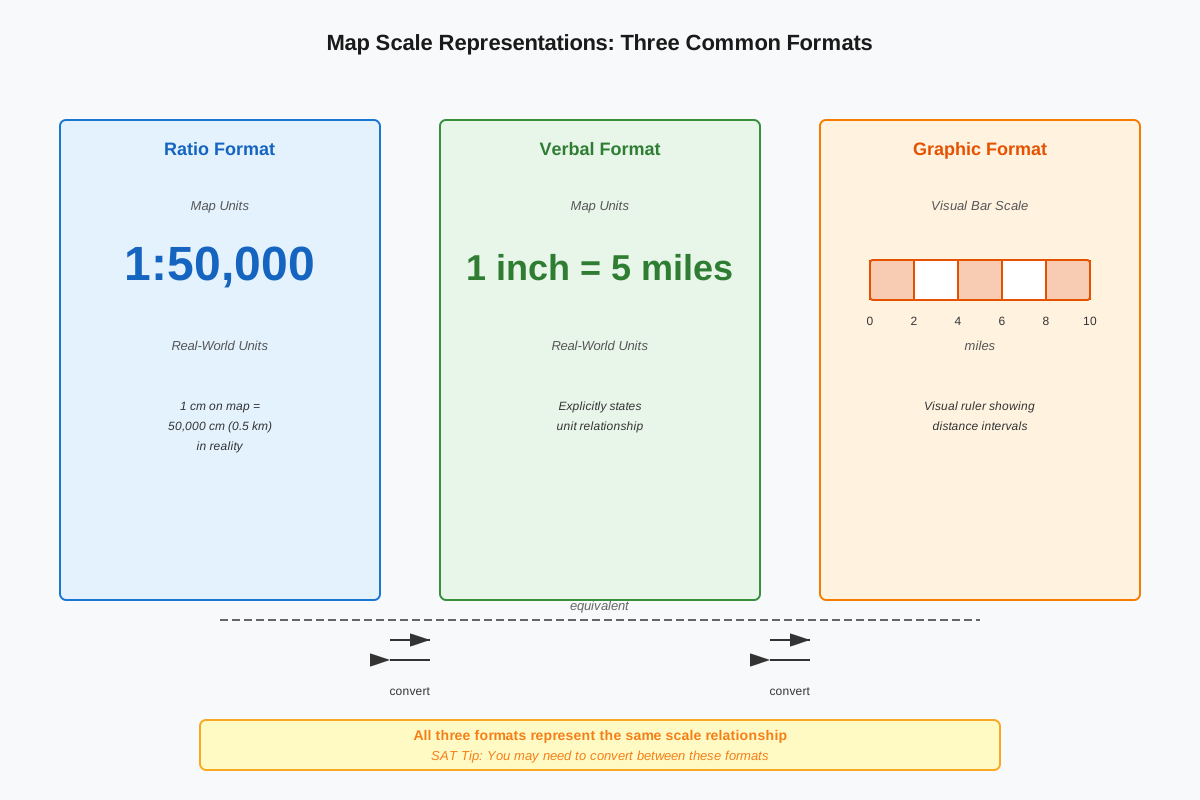
A map scale expresses the proportional relationship between distances measured on a map and the corresponding distances in reality. This relationship remains constant across the entire map, meaning that if 1 inch represents 10 miles in one location, this same ratio applies everywhere on that map. Map scales can be expressed in three primary formats:
Ratio format: Written as 1:50,000 or 1/50,000, meaning one unit on the map equals 50,000 of the same units in reality. This format uses consistent units on both sides of the ratio.
Verbal format: Stated in words such as "1 inch represents 5 miles" or "1 centimeter equals 2 kilometers." This format often uses different units for map distance and real-world distance.
Graphic format: Shown as a line segment with markings indicating distances, similar to a ruler. While less common on the SAT, students should recognize this representation.
The key principle underlying all map scale problems is that the ratio between map distance and actual distance remains constant. This allows us to set up proportions to solve for unknown values.
Setting Up Proportions with Map Scale
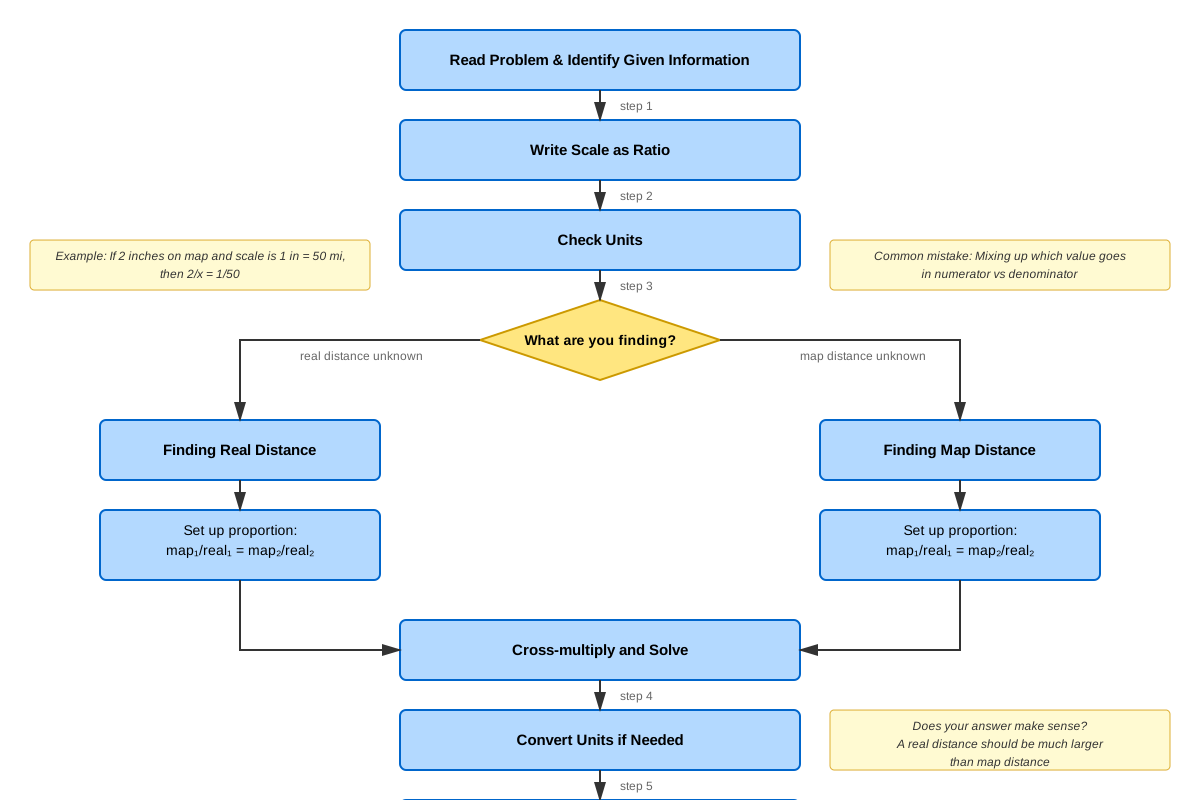
To solve map scale problems, students must construct accurate proportions that maintain consistent units and relationships. The standard proportion format is:
map distance 1 / actual distance 1 = map distance 2 / actual distance 2When setting up proportions, maintaining unit consistency is crucial. If the map scale uses inches and miles, all map measurements must be in inches and all actual measurements in miles before solving. Alternatively, students can convert all measurements to a common unit system.
Consider this example: If a map scale states "2 cm represents 15 km," and two cities are 6 cm apart on the map, the proportion becomes:
2 cm / 15 km = 6 cm / x kmCross-multiplying yields: 2x = 90, so x = 45 km.
Unit Conversion in Map Scale Problems
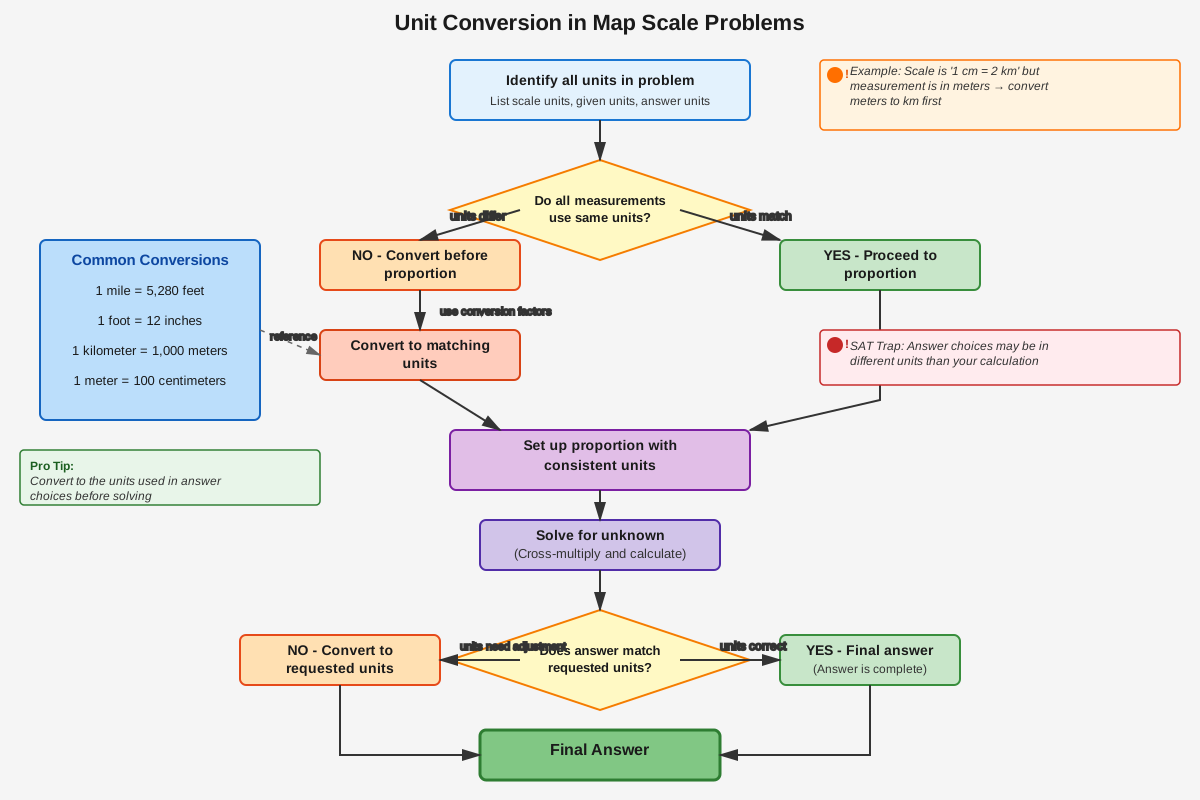
SAT map scale questions frequently require converting between different units, adding complexity to otherwise straightforward proportion problems. Students must be comfortable with common conversions:
| Unit Type | Common Conversions |
|---|---|
| Length (US) | 1 foot = 12 inches; 1 mile = 5,280 feet |
| Length (Metric) | 1 meter = 100 centimeters; 1 kilometer = 1,000 meters |
| Cross-system | 1 inch ≈ 2.54 centimeters; 1 mile ≈ 1.6 kilometers |
When a problem provides a scale in one unit system but asks for an answer in another, students should either convert the scale first or convert the final answer. Converting the scale first often reduces calculation errors.
Working with Scale Factors
The scale factor represents the multiplicative relationship between map measurements and actual measurements. If a map scale is 1:100,000, the scale factor is 100,000, meaning actual distances are 100,000 times larger than map distances. Understanding scale factors allows for quick mental calculations and provides an intuitive sense of whether calculated answers are reasonable.
For verbal scales like "1 inch represents 20 miles," the scale factor depends on the units used. Converting to consistent units first clarifies the scale factor: 1 inch represents 20 miles = 1 inch represents 1,267,200 inches, giving a scale factor of 1,267,200.
Area Calculations with Map Scale
Advanced SAT problems may ask students to calculate actual areas based on map measurements. Since area involves two dimensions, the scale factor must be squared. If the linear scale factor is 1:50,000, the area scale factor is 1:2,500,000,000 (50,000²).
For example, if a region measures 4 square centimeters on a map with scale 1 cm = 10 km, the actual area calculation requires:
- Finding the linear scale factor: 1 cm = 10 km = 1,000,000 cm, so the scale factor is 1,000,000
- Squaring the scale factor for area: 1,000,000² = 1,000,000,000,000
- Multiplying the map area by the squared scale factor: 4 cm² × 1,000,000,000,000 = 4,000,000,000,000 cm²
- Converting to appropriate units: 4,000,000,000,000 cm² = 400 km²
Concept Relationships
Map scale problems build directly on fundamental ratio and proportion concepts. The relationship flows as follows: Understanding ratios → enables → Setting up proportions → which allows → Solving map scale problems → that may require → Unit conversions → leading to → Complex multi-step calculations.
Within map scale problems themselves, concepts are interconnected. The scale ratio determines the scale factor, which can be applied through proportional reasoning to find unknown distances. When unit conversions are required, they interact with the scale factor to produce final answers in the requested units. Area calculations extend linear scale concepts into two dimensions, requiring students to square the scale factor.
Map scale connects to prerequisite topics by applying ratio and proportion skills in a specific context. The algebraic manipulation required to solve proportions uses equation-solving techniques from basic algebra. Unit conversion skills from measurement topics become essential tools for handling the different units commonly found in map scale problems.
This topic also relates to other SAT math concepts including rate problems (which use similar proportional reasoning), percent problems (which involve scaling), and geometric similarity (which applies scale factors to shapes). Mastering map scale strengthens the proportional reasoning skills needed across these related domains.
Quick check — test yourself on Map scale so far.
Try Flashcards →High-Yield Facts
⭐ Map scale represents a constant ratio between map distances and actual distances that applies across the entire map
⭐ To solve map scale problems, set up a proportion with map distance/actual distance on both sides of the equation
⭐ When units differ between map and actual measurements, convert all measurements to consistent units before solving
⭐ The scale factor is the number by which map measurements must be multiplied to obtain actual measurements
⭐ For area calculations, the scale factor must be squared because area involves two dimensions
- Map scales can be expressed as ratios (1:50,000), verbal statements (1 inch = 5 miles), or graphic representations
- Cross-multiplication is the standard method for solving proportions in map scale problems
- Common unit conversions include 1 mile = 5,280 feet and 1 kilometer = 1,000 meters
- If a map distance is unknown, place it as the variable in the proportion's numerator on one side
- Checking answer reasonableness by estimating with the scale factor prevents calculation errors
- SAT map scale problems may provide extra information that isn't needed for the solution
- Some problems require working backward from actual distance to find map distance
- Multi-step problems may require finding an intermediate value before calculating the final answer
- Scale ratios like 1:100,000 mean one unit on the map equals 100,000 of the same units in reality
- When comparing two different maps of the same region, the map with the smaller scale factor shows more detail
Common Misconceptions
Misconception: The scale ratio 1:50,000 means 1 inch on the map equals 50,000 miles in reality.
Correction: The ratio uses the same units on both sides. 1:50,000 means 1 inch equals 50,000 inches (or 1 cm equals 50,000 cm), which must then be converted to more practical units like miles or kilometers.
Misconception: When doubling the map distance, the actual distance is also doubled, regardless of the scale.
Correction: While this is actually correct due to the proportional relationship, students sometimes incorrectly apply this thinking when the scale itself changes or when working with areas. The proportional relationship only holds when using the same map scale.
Misconception: For area calculations, multiply the map area by the same scale factor used for linear distances.
Correction: Area calculations require squaring the linear scale factor because area involves two dimensions. If the linear scale is 1:1,000, the area scale is 1:1,000,000.
Misconception: All map scale problems require converting units.
Correction: Some problems provide scale and measurements in consistent units, requiring only proportion setup and solving. Always check whether units match before assuming conversion is necessary.
Misconception: A larger scale ratio (like 1:100,000 versus 1:50,000) means the map shows more detail.
Correction: A larger scale ratio actually means less detail. A 1:50,000 map shows more detail than a 1:100,000 map because each map unit represents less actual distance, allowing more features to be shown.
Misconception: The scale factor can be applied by dividing the actual distance by the map distance.
Correction: The scale factor is found by dividing actual distance by map distance, but to use it for calculations, multiply the map distance by the scale factor to get actual distance, or divide actual distance by the scale factor to get map distance.
Worked Examples
Example 1: Basic Map Scale Calculation
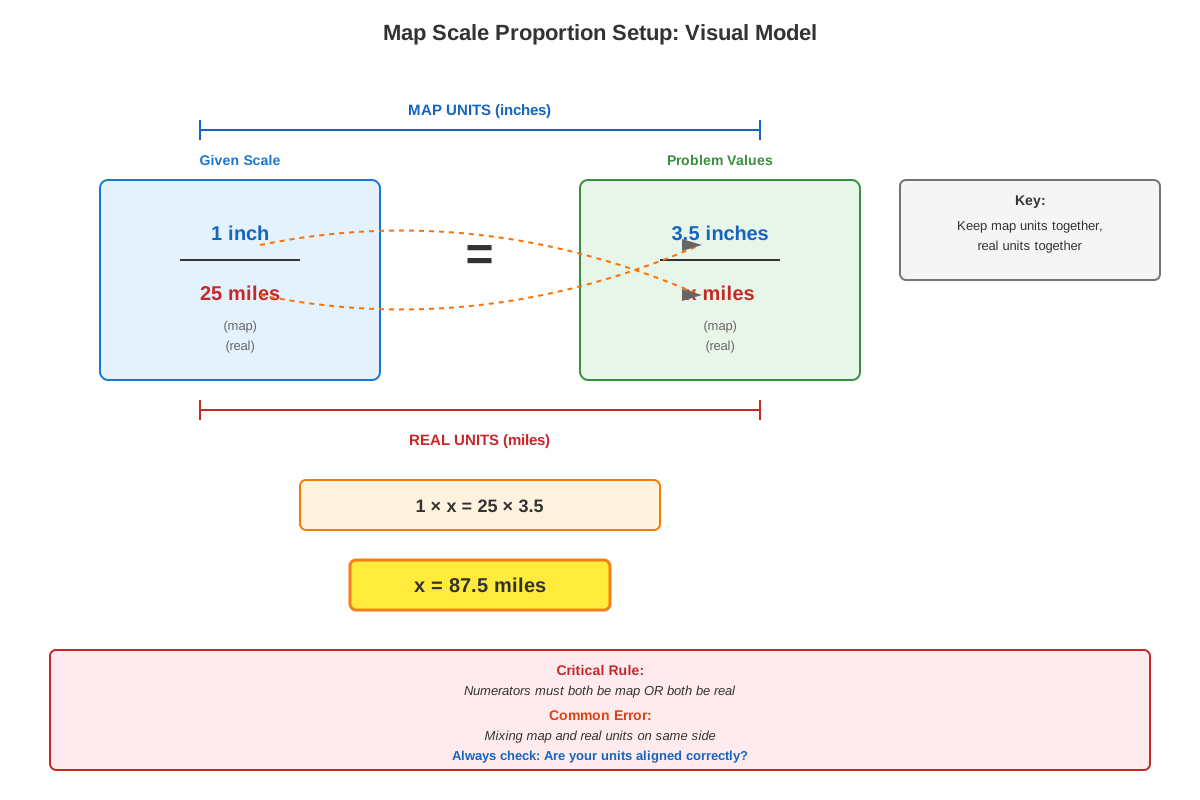
Problem: A map has a scale of 1 inch represents 25 miles. Two cities are 3.5 inches apart on the map. What is the actual distance between the cities?
Solution:
Step 1: Identify the given information
- Map scale: 1 inch = 25 miles
- Map distance: 3.5 inches
- Actual distance: unknown (x)
Step 2: Set up a proportion maintaining consistent relationships
1 inch / 25 miles = 3.5 inches / x milesStep 3: Cross-multiply to solve
1 × x = 25 × 3.5
x = 87.5 miles
Step 4: Verify the answer is reasonable
If 1 inch represents 25 miles, then 3.5 inches should represent about 3.5 times 25 miles, which equals 87.5 miles. ✓
Answer: The actual distance between the cities is 87.5 miles.
This problem directly addresses the learning objective of applying map scale to answer SAT-style questions by demonstrating the fundamental proportion-solving technique.
Example 2: Multi-Step Problem with Unit Conversion
Problem: On a map where 2 centimeters represents 5 kilometers, a rectangular park measures 0.8 cm by 1.2 cm. What is the actual area of the park in square meters?
Solution:
Step 1: Find the actual dimensions of the park
For the length (0.8 cm on map):
2 cm / 5 km = 0.8 cm / x km
2x = 4
x = 2 km
For the width (1.2 cm on map):
2 cm / 5 km = 1.2 cm / y km
2y = 6
y = 3 km
Step 2: Calculate the actual area
Area = length × width = 2 km × 3 km = 6 km²Step 3: Convert to square meters
1 km = 1,000 m
1 km² = 1,000,000 m²
6 km² = 6,000,000 m²
Step 4: Verify using the squared scale factor method
Linear scale factor: 2 cm represents 5 km = 500,000 cm, so scale factor = 250,000
Area scale factor: 250,000² = 62,500,000,000
Map area: 0.8 cm × 1.2 cm = 0.96 cm²
Actual area: 0.96 cm² × 62,500,000,000 = 60,000,000,000 cm² = 6 km² = 6,000,000 m² ✓
Answer: The actual area of the park is 6,000,000 square meters.
This problem demonstrates the application of map scale to area calculations and unit conversions, addressing multiple learning objectives simultaneously.
Exam Strategy
When approaching SAT map scale questions, begin by identifying what information is provided and what the question asks for. Circle or underline the scale relationship, the given measurement, and the unknown value. This prevents confusion about which value to solve for.
Trigger words and phrases that indicate map scale problems include: "scale of," "represents," "on a map," "actual distance," "map shows," and "scale drawing." When these appear, immediately recognize that proportional reasoning will be required.
Before setting up a proportion, check whether units are consistent. If the scale uses inches and miles but the given measurement is in feet, convert to inches first. This single step prevents the majority of errors on map scale problems. Write out the proportion clearly, ensuring that map distances are in corresponding positions (both numerators or both denominators) and actual distances are in corresponding positions.
For process of elimination on multiple-choice questions, use the scale factor to estimate the answer range. If 1 inch represents 20 miles and the map distance is about 3 inches, the actual distance should be approximately 60 miles. Eliminate any answer choices that are dramatically different (like 6 miles or 600 miles) before calculating precisely.
Time allocation: Most map scale problems should take 60-90 seconds. If a problem requires more than two minutes, check whether you're overcomplicating the setup. These problems test proportional reasoning, not complex multi-step calculations. Set up the proportion, solve, and move forward.
For problems involving area, immediately recognize that the scale factor must be squared. Write "square the scale factor" in the margin as a reminder. This prevents the most common error on advanced map scale problems.
When a problem provides a diagram, use it to verify your answer makes sense. If the map shows two cities relatively close together but your calculation yields thousands of miles, recheck your work.
Memory Techniques
MAPS - A mnemonic for solving map scale problems:
- Mark the scale relationship
- Align units consistently
- Proportion setup (map/actual = map/actual)
- Solve and verify
"Same Over Same" - Remember that in proportions, similar quantities go in the same positions: map distances both on top (or both on bottom), actual distances both on bottom (or both on top).
"Square for Area, Cube for Volume" - When working with two-dimensional measurements like area, square the linear scale factor. For three-dimensional measurements like volume, cube it. This prevents confusion about when to apply the scale factor directly versus when to modify it.
Visualization strategy: Picture yourself looking at a map and then zooming out to see the actual landscape. The map is a miniature version of reality, and the scale factor tells you how many times to "zoom out" to get from map to reality.
Unit conversion anchor: Remember "5-12-1000" for the most common conversions: 5,280 feet in a mile, 12 inches in a foot, 1,000 meters in a kilometer. These three numbers handle most SAT unit conversions.
Summary
Map scale problems on the SAT test proportional reasoning by asking students to convert between map distances and actual distances using a given scale relationship. Success requires understanding that map scale represents a constant ratio, setting up accurate proportions with consistent units, and solving for unknown values through cross-multiplication. Students must be comfortable converting between different units of measurement and recognizing when scale factors need to be squared for area calculations. The key to mastering this topic is recognizing the proportional relationship, maintaining unit consistency, and verifying that answers are reasonable given the scale factor. Map scale problems appear regularly on the SAT and represent high-yield opportunities for students who can quickly set up and solve proportions while managing unit conversions accurately.
Key Takeaways
- Map scale expresses a constant proportional relationship between map distances and actual distances that applies across the entire map
- Set up proportions with map distance/actual distance on both sides, ensuring units are consistent before solving
- Convert all measurements to matching units before calculating, or convert the final answer to the requested units
- For area calculations, square the linear scale factor because area involves two dimensions
- Use the scale factor to estimate answer reasonableness and eliminate incorrect multiple-choice options
- Common SAT map scale problems involve finding actual distances from map measurements, finding map distances from actual measurements, or calculating areas
- Practice identifying trigger words like "scale of" and "represents" to quickly recognize map scale problems on the exam
Related Topics
Ratio and Proportion Applications: Map scale is one specific application of ratio and proportion concepts. Mastering map scale builds skills applicable to recipe scaling, mixture problems, and similar triangles.
Rate Problems: Speed, distance, and time problems use similar proportional reasoning to map scale, with rates replacing scale factors as the constant relationship.
Unit Conversion and Dimensional Analysis: Advanced unit conversion problems extend the skills developed in map scale problems to more complex scenarios involving multiple conversion factors.
Geometric Similarity and Scale Drawings: Understanding how scale factors apply to similar figures connects directly to map scale concepts and extends into geometry problems involving proportional sides and areas.
Percent and Percent Change: Scaling relationships in percent problems use similar multiplicative reasoning to scale factors in map scale problems.
Practice CTA
Now that you've mastered the core concepts of map scale, it's time to solidify your understanding through practice. Attempt the practice questions to apply these concepts to SAT-style problems, and use the flashcards to reinforce key facts and formulas. Remember, map scale problems are high-yield opportunities on the SAT—students who can quickly set up and solve proportions while managing units confidently earn points that others leave on the table. Your investment in mastering this topic will pay dividends on test day and strengthen your proportional reasoning skills across the entire math section. Start practicing now to build the speed and accuracy that lead to top scores!
Sign up free to keep reading
Create a free AnvayaPrep account to finish this SAT guide on Map scale — plus flashcards and practice questions.