Overview
Nonproportional relationships represent a critical category of mathematical relationships that students must master for success on the SAT. Unlike proportional relationships where two quantities maintain a constant ratio, nonproportional relationships involve situations where the ratio between variables changes as the values change. These relationships are characterized by the presence of a constant term (often called the y-intercept) that prevents the relationship from passing through the origin when graphed.
Understanding nonproportional relationships is essential for the SAT because they appear frequently across multiple question types in the math section. Students encounter these relationships in word problems involving initial fees plus variable costs, linear equations that don't pass through the origin, and real-world scenarios like taxi fares, gym memberships, or phone plans. The College Board consistently tests whether students can distinguish between proportional and nonproportional situations, interpret the meaning of constants in equations, and apply these concepts to solve practical problems.
This topic connects fundamentally to broader mathematical concepts including linear functions, slope-intercept form, systems of equations, and data interpretation. Mastery of nonproportional relationships builds directly on understanding of ratios, rates, and proportions while serving as a foundation for more advanced algebraic reasoning. Students who can confidently identify and work with nonproportional relationships gain a significant advantage on the SAT, as these concepts integrate with geometry, data analysis, and problem-solving questions throughout the exam.
Learning Objectives
- [ ] Identify key features of nonproportional relationships
- [ ] Explain how nonproportional relationships appear on the SAT
- [ ] Apply nonproportional relationships to answer SAT-style questions
- [ ] Distinguish between proportional and nonproportional relationships in equations, tables, and graphs
- [ ] Interpret the real-world meaning of constants and coefficients in nonproportional relationships
- [ ] Construct equations representing nonproportional relationships from verbal descriptions
Prerequisites
- Understanding of proportional relationships: Recognition of constant ratios is necessary to identify when relationships deviate from proportionality
- Basic linear equation knowledge: Familiarity with y = mx + b form enables quick identification of nonproportional features
- Coordinate plane graphing: Ability to plot points and interpret graphs helps visualize the distinction between relationship types
- Rate and ratio concepts: Understanding unit rates provides the foundation for recognizing when additional constants affect relationships
- Algebraic manipulation skills: Solving equations and isolating variables is essential for working with nonproportional relationship problems
Why This Topic Matters
Nonproportional relationships model countless real-world situations that students encounter daily. Cell phone plans with base fees plus per-minute charges, gym memberships with initiation fees plus monthly dues, and taxi services with flat rates plus per-mile costs all exemplify nonproportional relationships. Understanding these relationships empowers students to make informed financial decisions, compare service options, and predict costs accurately in practical scenarios.
On the SAT, nonproportional relationships appear in approximately 8-12% of math questions, making them a high-yield topic for focused study. These questions typically appear in multiple formats: as word problems requiring equation construction, as table interpretation questions, as graph analysis problems, and as questions asking students to identify which scenario represents a nonproportional relationship. The College Board particularly favors questions that test whether students understand the significance of the constant term and can distinguish it from the rate of change.
Common SAT question formats include: comparing two pricing plans to determine break-even points, interpreting the meaning of the y-intercept in context, identifying which graph represents a nonproportional relationship, determining whether a table of values shows proportional or nonproportional data, and constructing equations from verbal descriptions that include initial values. Questions often embed nonproportional relationships within real-world contexts requiring students to extract relevant information and apply mathematical reasoning.
Core Concepts
Definition and Characteristics of Nonproportional Relationships
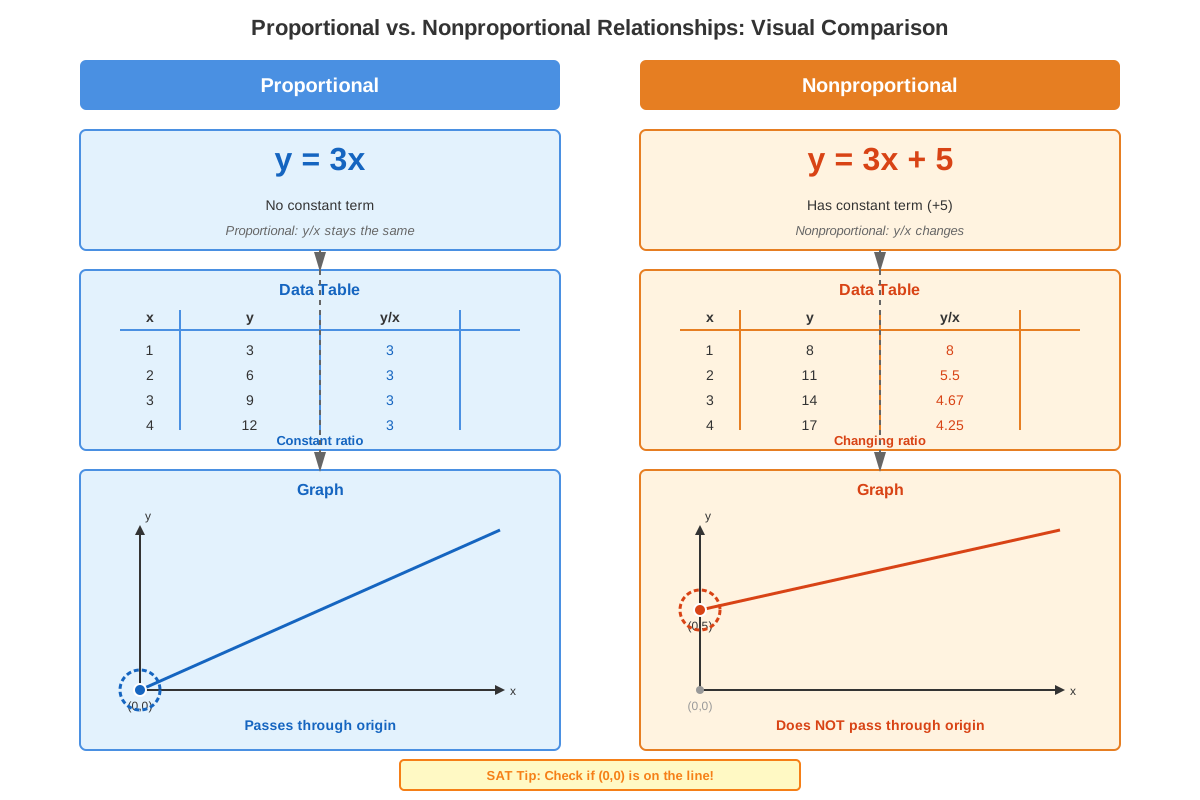
A nonproportional relationship exists when two quantities are related by an equation of the form y = mx + b where b ≠ 0. The defining characteristic is the presence of a constant term (b) that shifts the entire relationship away from the origin. In contrast to proportional relationships where y/x always equals the same constant, nonproportional relationships have ratios that change as x and y change.
Key identifying features include:
- The graph does not pass through the origin (0, 0)
- The equation contains a non-zero constant term
- The ratio y/x is not constant across different values
- Tables of values show that doubling x does not double y
- The relationship has both a rate of change (slope) and an initial value (y-intercept)
Equation Forms
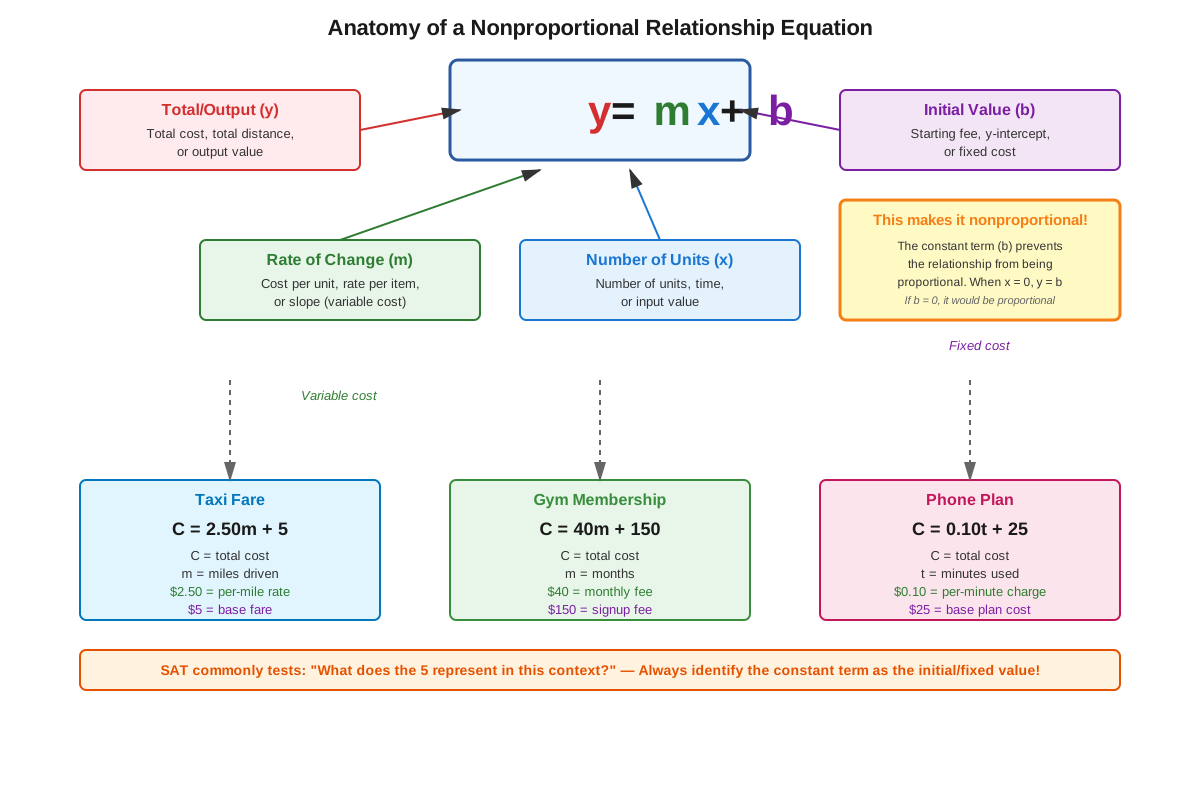
The standard form for nonproportional relationships is y = mx + b, where:
- m represents the rate of change or slope (how much y changes for each unit increase in x)
- b represents the y-intercept or initial value (the value of y when x = 0)
- x is the independent variable
- y is the dependent variable
For example, in the equation y = 3x + 5:
- The slope (3) means y increases by 3 units for every 1-unit increase in x
- The y-intercept (5) means when x = 0, y = 5
- This relationship is nonproportional because of the constant term 5
Graphical Representation
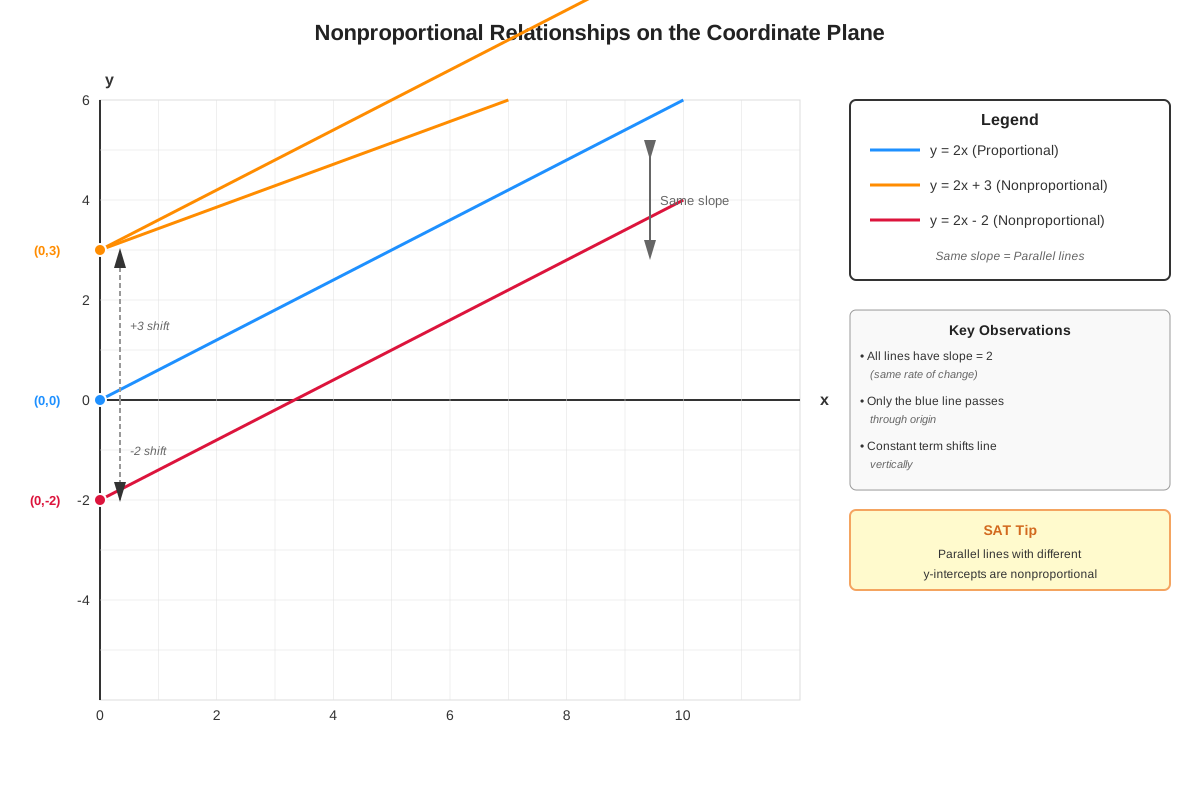
When graphed on a coordinate plane, nonproportional relationships appear as straight lines that do not pass through the origin. The y-intercept (b) determines where the line crosses the y-axis, while the slope (m) determines the steepness and direction of the line.
Visual characteristics:
- Positive slope with positive y-intercept: line rises from left to right, crossing y-axis above origin
- Positive slope with negative y-intercept: line rises from left to right, crossing y-axis below origin
- Negative slope with positive y-intercept: line falls from left to right, crossing y-axis above origin
- Negative slope with negative y-intercept: line falls from left to right, crossing y-axis below origin
Table Analysis
In tables representing nonproportional relationships, the ratio between corresponding x and y values changes. To identify nonproportional relationships in tables:
- Calculate y/x for multiple pairs of values
- If the ratios differ, the relationship is nonproportional
- Check if the differences between consecutive y-values are constant (indicating a linear relationship)
- Verify that when x = 0, y ≠ 0 (if x = 0 is included)
| x | y | y/x | Difference in y |
|---|---|---|---|
| 1 | 7 | 7 | - |
| 2 | 9 | 4.5 | 2 |
| 3 | 11 | 3.67 | 2 |
| 4 | 13 | 3.25 | 2 |
This table shows a nonproportional relationship (y = 2x + 5) because y/x changes while the difference in y remains constant at 2.
Real-World Applications
SAT nonproportional relationships frequently appear in contexts involving:
Fixed cost plus variable cost scenarios: A plumber charges $50 for a service call plus $40 per hour (C = 40h + 50)
Initial value plus growth: A plant is 3 inches tall and grows 2 inches per week (H = 2w + 3)
Base fee plus usage charges: A streaming service costs $10 monthly plus $3 per movie rental (T = 3m + 10)
Starting point plus rate of change: A car rental costs $30 per day plus a $75 insurance fee (C = 30d + 75)
Distinguishing from Proportional Relationships
| Feature | Proportional | Nonproportional |
|---|---|---|
| Equation form | y = kx | y = mx + b (b ≠ 0) |
| Graph | Passes through origin | Does not pass through origin |
| Ratio y/x | Constant | Changes with different values |
| Initial value | Always zero | Non-zero constant |
| Doubling x | Doubles y | Does not double y |
Concept Relationships
Nonproportional relationships build directly upon understanding of proportional relationships by adding the complexity of a constant term. The progression flows: basic ratios → proportional relationships (constant ratios) → nonproportional relationships (variable ratios with constant differences).
Within this topic, the core concepts interconnect as follows: equation form (y = mx + b) → determines → graphical representation (line not through origin) → manifests in → table patterns (changing ratios, constant differences) → applies to → real-world scenarios (fixed costs plus variable costs).
The relationship to broader mathematical concepts: nonproportional relationships → are specific cases of → linear functions → which are foundational to → systems of equations → and connect to → data modeling and interpretation.
Understanding slope and y-intercept in nonproportional relationships directly enables students to work with parallel and perpendicular lines, solve systems of equations graphically and algebraically, and interpret linear models in statistics. The constant term (b) that defines nonproportionality becomes the vertical shift in function transformations and the starting value in exponential growth models.
High-Yield Facts
⭐ A relationship is nonproportional if and only if its equation includes a non-zero constant term (b ≠ 0 in y = mx + b)
⭐ The graph of a nonproportional relationship never passes through the origin (0, 0)
⭐ In nonproportional relationships, the ratio y/x changes as x and y change
⭐ The y-intercept represents the initial value or starting amount before any changes occur
⭐ Doubling the x-value in a nonproportional relationship does not double the y-value
- The slope (m) in a nonproportional relationship represents the rate of change, just as in proportional relationships
- Tables showing nonproportional relationships have constant differences between consecutive y-values (for constant x-intervals) but non-constant ratios
- Real-world nonproportional scenarios typically involve a base fee, initial amount, or starting value plus a rate
- When x = 0, y equals the constant term (b) in the equation y = mx + b
- Nonproportional relationships are still linear functions; they produce straight-line graphs
- The equation of a nonproportional relationship can be determined from two points using point-slope form, then converting to slope-intercept form
- Parallel nonproportional lines have the same slope (m) but different y-intercepts (b)
Quick check — test yourself on Nonproportional relationships so far.
Try Flashcards →Common Misconceptions
Misconception: All linear relationships are proportional. → Correction: Linear relationships can be either proportional (passing through the origin) or nonproportional (not passing through the origin). Only linear relationships of the form y = kx with no constant term are proportional.
Misconception: If a relationship has a constant rate of change, it must be proportional. → Correction: Both proportional and nonproportional relationships can have constant rates of change (slopes). The distinguishing feature is whether there's an additional constant term. The relationship y = 3x + 5 has a constant rate of change (3) but is nonproportional due to the +5.
Misconception: The y-intercept and slope are the same thing. → Correction: The slope (m) represents the rate of change between variables, while the y-intercept (b) represents the initial value when x = 0. They serve completely different purposes in describing the relationship.
Misconception: If a table shows that y increases as x increases, the relationship is proportional. → Correction: Both proportional and nonproportional relationships can show y increasing with x. To determine proportionality, check whether the ratio y/x remains constant (proportional) or changes (nonproportional).
Misconception: A nonproportional relationship cannot have a y-intercept of zero. → Correction: This is backwards. A relationship with a y-intercept of zero (b = 0) is proportional, not nonproportional. Nonproportional relationships must have non-zero y-intercepts.
Misconception: In real-world problems, the larger number is always the slope and the smaller number is always the y-intercept. → Correction: The slope and y-intercept are determined by their roles in the relationship, not their magnitudes. A taxi might charge $5 base fare (y-intercept) plus $2 per mile (slope), or it might charge $50 base fare plus $0.50 per mile.
Misconception: Nonproportional relationships are always more expensive or larger than proportional ones. → Correction: Whether a nonproportional relationship yields larger or smaller values than a proportional one depends on the specific values of the slope and y-intercept and the range of x-values being considered.
Worked Examples
Example 1: Identifying Nonproportional Relationships from Tables
Problem: A student is comparing two phone plans. Plan A charges $0.10 per minute with no monthly fee. Plan B charges $20 per month plus $0.05 per minute. Create tables for both plans and determine which represents a nonproportional relationship.
Solution:
Plan A Table:
| Minutes (x) | Cost (y) | y/x |
|---|---|---|
| 0 | $0 | - |
| 100 | $10 | 0.10 |
| 200 | $20 | 0.10 |
| 300 | $30 | 0.10 |
Plan B Table:
| Minutes (x) | Cost (y) | y/x |
|---|---|---|
| 0 | $20 | - |
| 100 | $25 | 0.25 |
| 200 | $30 | 0.15 |
| 300 | $35 | 0.117 |
Analysis:
- Plan A shows a constant ratio (y/x = 0.10), indicating a proportional relationship with equation y = 0.10x
- Plan B shows changing ratios (0.25, 0.15, 0.117), indicating a nonproportional relationship
- Plan B has a non-zero value when x = 0 (y = $20), confirming nonproportionality
- Plan B's equation is y = 0.05x + 20, where 20 is the monthly fee (y-intercept) and 0.05 is the per-minute rate (slope)
Connection to Learning Objectives: This example demonstrates how to identify nonproportional relationships in tables by examining ratios and initial values, directly addressing the objective of identifying key features of nonproportional relationships.
Example 2: Constructing and Applying Nonproportional Equations
Problem: A gym charges a $150 enrollment fee plus $45 per month for membership.
a) Write an equation representing the total cost (C) after m months.
b) How much will a member pay after 8 months?
c) If someone has paid $600 total, how many months have they been a member?
d) Explain why this is a nonproportional relationship.
Solution:
a) Constructing the equation:
- Initial fee (y-intercept): $150
- Monthly rate (slope): $45
- Equation: C = 45m + 150
b) Finding cost after 8 months:
- Substitute m = 8 into the equation
- C = 45(8) + 150
- C = 360 + 150
- C = $510
c) Finding number of months for $600 total:
- Set C = 600 and solve for m
- 600 = 45m + 150
- 450 = 45m
- m = 10 months
d) Explaining nonproportionality:
- This is nonproportional because the equation has a non-zero constant term ($150)
- The graph would not pass through the origin (when m = 0, C = $150, not $0)
- The ratio C/m changes: after 1 month, C/m = 195/1 = 195; after 2 months, C/m = 240/2 = 120
- Doubling the months does not double the cost: 2 months costs $240, but 4 months costs $330 (not $480)
Connection to Learning Objectives: This comprehensive example addresses multiple objectives: constructing equations from verbal descriptions, applying nonproportional relationships to solve problems, and explaining the distinguishing features that make a relationship nonproportional.
Exam Strategy
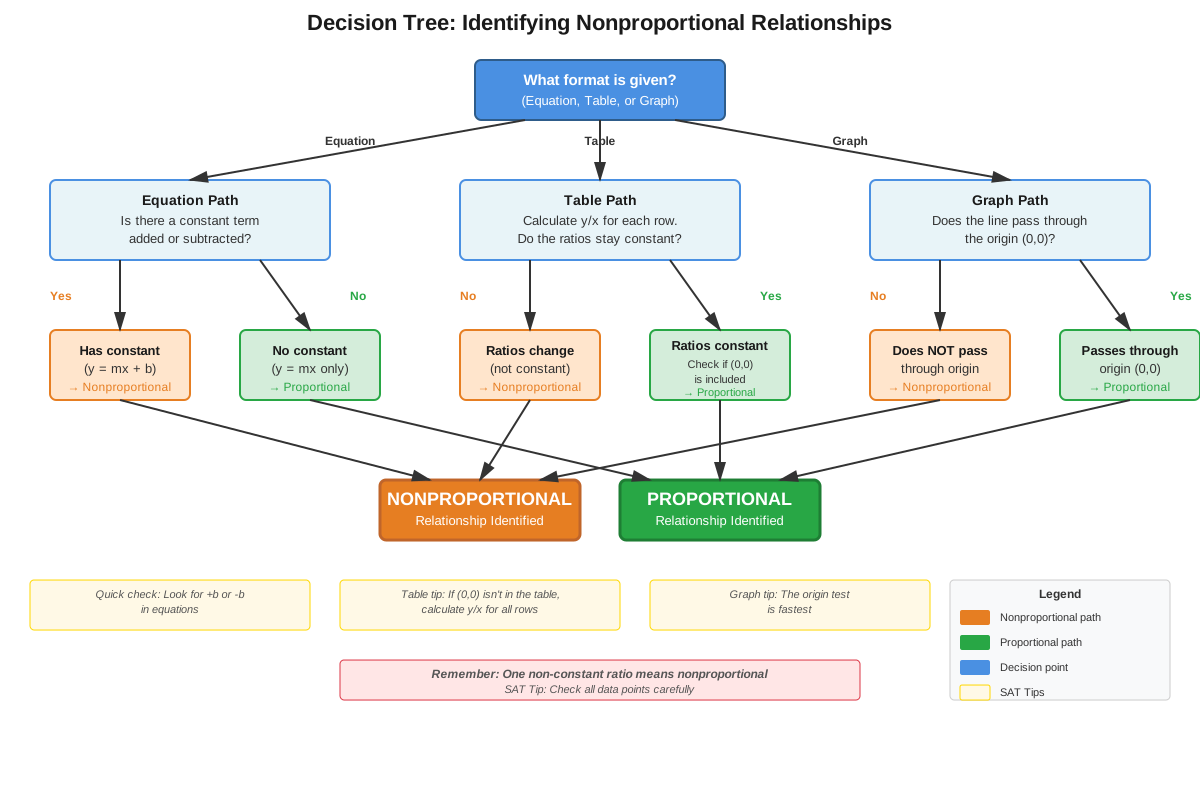
When approaching SAT nonproportional relationships questions, follow this systematic process:
Step 1: Identify the question type
- Look for keywords: "initial," "base fee," "starting," "plus," "in addition to," "flat rate"
- Recognize scenarios involving two components: a fixed amount and a variable amount
- Watch for questions asking you to distinguish between proportional and nonproportional
Step 2: Extract the components
- Identify the constant term (what happens when x = 0)
- Identify the rate of change (how much y changes per unit of x)
- Determine which variable is independent and which is dependent
Step 3: Choose your approach
- For equation construction: use y = mx + b format
- For table analysis: calculate ratios and check for consistency
- For graph interpretation: check whether the line passes through the origin
- For comparison problems: set equations equal or evaluate at specific points
Exam Tip: If a question provides a real-world scenario with costs, fees, or charges, immediately look for two components: a one-time or fixed amount (y-intercept) and a per-unit amount (slope). This structure almost always indicates a nonproportional relationship.
Trigger words and phrases to watch for:
- "Initial fee" or "enrollment fee" → y-intercept
- "Per [unit]" or "each" → slope
- "Plus" or "in addition to" → signals two separate components
- "Starting at" or "begins with" → initial value
- "Does not pass through the origin" → nonproportional
- "When x = 0" → asking for y-intercept
Process-of-elimination strategies:
- Eliminate any equation without a constant term if the problem describes an initial fee or starting value
- Eliminate graphs passing through the origin for nonproportional scenarios
- Eliminate tables showing constant ratios when asked for nonproportional relationships
- If doubling x doubles y in all cases, eliminate nonproportional as an answer choice
Time allocation advice:
- Spend 30-45 seconds identifying whether a relationship is proportional or nonproportional
- Allocate 60-90 seconds for equation construction and solving
- For multi-step problems, budget 2-3 minutes total
- If stuck, plug in answer choices to test which equation matches the scenario
Memory Techniques
Mnemonic for equation components: "My Brother" = Mx + B (slope times x plus y-intercept)
Visualization strategy: Picture a proportional relationship as a line shooting through the bullseye (origin), while a nonproportional relationship "misses the target" by starting above or below it.
Acronym for identifying nonproportional relationships: COIN
- Constant term present (b ≠ 0)
- Origin not on the graph
- Initial value exists
- Non-constant ratios
Memory aid for real-world scenarios: Think "BASE + RATE"
- BASE = the y-intercept (what you pay/have before anything happens)
- RATE = the slope (what you pay/gain per unit)
- If there's a BASE, it's nonproportional
Rhyme for quick identification: "If it starts at zero, it's a proportional hero. If it starts elsewhere, nonproportional is there."
Hand gesture technique: Hold your left hand flat at waist level (representing the x-axis). For proportional relationships, point your right index finger from your left palm upward (through the origin). For nonproportional relationships, start your finger above or below your left palm (not through the origin).
Summary
Nonproportional relationships represent linear relationships characterized by the presence of a non-zero constant term in the equation y = mx + b. Unlike proportional relationships that always pass through the origin and maintain constant ratios, nonproportional relationships have graphs that intersect the y-axis at points other than the origin and exhibit changing ratios between variables. These relationships model real-world situations involving initial values plus rates of change, such as service fees plus hourly charges or starting amounts plus growth rates. On the SAT, students must identify nonproportional relationships from equations, tables, and graphs; construct equations from verbal descriptions; and apply these concepts to solve practical problems. Mastery requires understanding that the y-intercept represents the initial value, the slope represents the rate of change, and the presence of both components creates the nonproportional nature of the relationship.
Key Takeaways
- Nonproportional relationships have the form y = mx + b where b ≠ 0, with the constant term preventing the graph from passing through the origin
- The y-intercept (b) represents the initial value or starting amount, while the slope (m) represents the rate of change
- In tables, nonproportional relationships show changing ratios (y/x) but constant differences between consecutive y-values
- Real-world nonproportional scenarios typically involve a base fee or initial amount plus a per-unit charge or rate
- Doubling the independent variable in a nonproportional relationship does not double the dependent variable
- SAT questions frequently test the ability to distinguish between proportional and nonproportional relationships and interpret the meaning of constants in context
- The key identifying feature is whether the relationship has a non-zero value when the independent variable equals zero
Related Topics
Linear Functions and Slope-Intercept Form: Nonproportional relationships are specific cases of linear functions, and deeper study of y = mx + b form, including transformations and function notation, builds directly on this foundation.
Systems of Linear Equations: Comparing two nonproportional relationships often involves solving systems of equations to find break-even points or intersection points, a critical SAT skill.
Direct and Inverse Variation: Understanding nonproportional relationships clarifies the distinction between these special proportional relationships and more general linear relationships.
Linear Inequalities: The concepts of slope and y-intercept extend to inequalities, where students must determine solution regions for nonproportional relationships.
Data Analysis and Linear Regression: Real-world data often exhibits nonproportional linear relationships, and interpreting line-of-best-fit equations requires understanding of y-intercepts and slopes in context.
Practice CTA
Now that you've mastered the core concepts of nonproportional relationships, it's time to solidify your understanding through practice! Attempt the practice questions to test your ability to identify, construct, and apply nonproportional relationships in various SAT-style formats. Use the flashcards to reinforce key definitions and features until you can instantly distinguish between proportional and nonproportional scenarios. Remember, consistent practice with these concepts will build the confidence and speed you need to excel on test day. Every problem you solve strengthens your mathematical reasoning and brings you closer to your target score!
Sign up free to keep reading
Create a free AnvayaPrep account to finish this SAT guide on Nonproportional relationships — plus flashcards and practice questions.