Overview
Slope-intercept form is one of the most fundamental and frequently tested concepts in the SAT math section, appearing in multiple questions across both the calculator and no-calculator portions of the exam. This algebraic representation of linear equations, expressed as y = mx + b, provides a direct and intuitive way to understand the behavior of straight lines on the coordinate plane. The form immediately reveals two critical characteristics of any linear relationship: the slope (m), which describes the rate of change or steepness of the line, and the y-intercept (b), which identifies where the line crosses the vertical axis.
Mastery of slope-intercept form extends far beyond simple equation recognition. On the SAT, students must demonstrate the ability to convert between different forms of linear equations, extract meaningful information from graphs and tables, interpret real-world scenarios involving linear relationships, and manipulate equations to solve complex multi-step problems. The College Board consistently includes 4-6 questions per test that directly or indirectly assess understanding of slope-intercept form, making it one of the highest-yield topics for focused study.
Understanding slope-intercept form serves as a gateway to more advanced mathematical concepts tested on the SAT, including systems of linear equations, linear inequalities, and the interpretation of functions. This topic connects directly to coordinate geometry, algebraic manipulation, and data analysis—three pillars of the SAT math curriculum. Students who develop fluency with slope-intercept form gain a powerful tool for quickly analyzing linear relationships, making strategic decisions about problem-solving approaches, and efficiently navigating time-constrained testing conditions.
Learning Objectives
- [ ] Identify key features of slope-intercept form, including slope and y-intercept values
- [ ] Explain how slope-intercept form appears on the SAT in various question formats
- [ ] Apply slope-intercept form to answer SAT-style questions involving graphs, tables, and word problems
- [ ] Convert between slope-intercept form and other linear equation forms (standard form, point-slope form)
- [ ] Interpret the meaning of slope and y-intercept in real-world contexts presented in SAT problems
- [ ] Determine equations of lines from graphs, tables, or verbal descriptions using slope-intercept form
- [ ] Analyze how changes to m or b values affect the graph and behavior of linear functions
Prerequisites
- Basic algebraic manipulation: Students must be comfortable solving for variables, distributing terms, and combining like terms, as these skills are essential for converting between equation forms and isolating variables
- Coordinate plane fundamentals: Understanding how to plot points, identify coordinates, and navigate the x-y plane is necessary for connecting algebraic equations to their graphical representations
- Fraction and decimal operations: Many slope calculations involve fractions or decimals, requiring proficiency with these number types for accurate computation
- Understanding of variables and constants: Distinguishing between variables (x, y) and constants (m, b) is crucial for correctly interpreting and manipulating slope-intercept equations
Why This Topic Matters
Slope-intercept form represents one of the most practical applications of algebra in everyday life. Linear relationships appear constantly in real-world scenarios: calculating costs based on unit prices, determining distance traveled at constant speed, analyzing business profit margins, predicting population growth, and understanding rate-based phenomena. The ability to quickly identify and work with these relationships provides valuable problem-solving skills that extend well beyond standardized testing.
On the SAT specifically, slope-intercept form appears with remarkable consistency. Statistical analysis of recent SAT administrations reveals that approximately 10-15% of all math questions involve linear equations, with slope-intercept form being the most commonly tested representation. Questions typically appear in several formats: identifying equations from graphs (2-3 questions per test), interpreting slope and intercept in context (1-2 questions), converting between equation forms (1-2 questions), and solving systems of equations where at least one equation is in slope-intercept form (1-2 questions). The Heart of Algebra domain, which comprises 33% of the SAT math section, heavily emphasizes linear relationships.
Common question types include: providing a graph and asking students to identify the correct equation; presenting a word problem describing a linear relationship and asking for the equation or a specific value; giving an equation in standard form and requesting conversion to slope-intercept form; displaying a table of values and asking for the equation; and presenting two lines and asking about their intersection point or relative slopes. The versatility of slope-intercept form makes it an essential tool for efficiently tackling these varied question formats.
Core Concepts
The Structure of Slope-Intercept Form
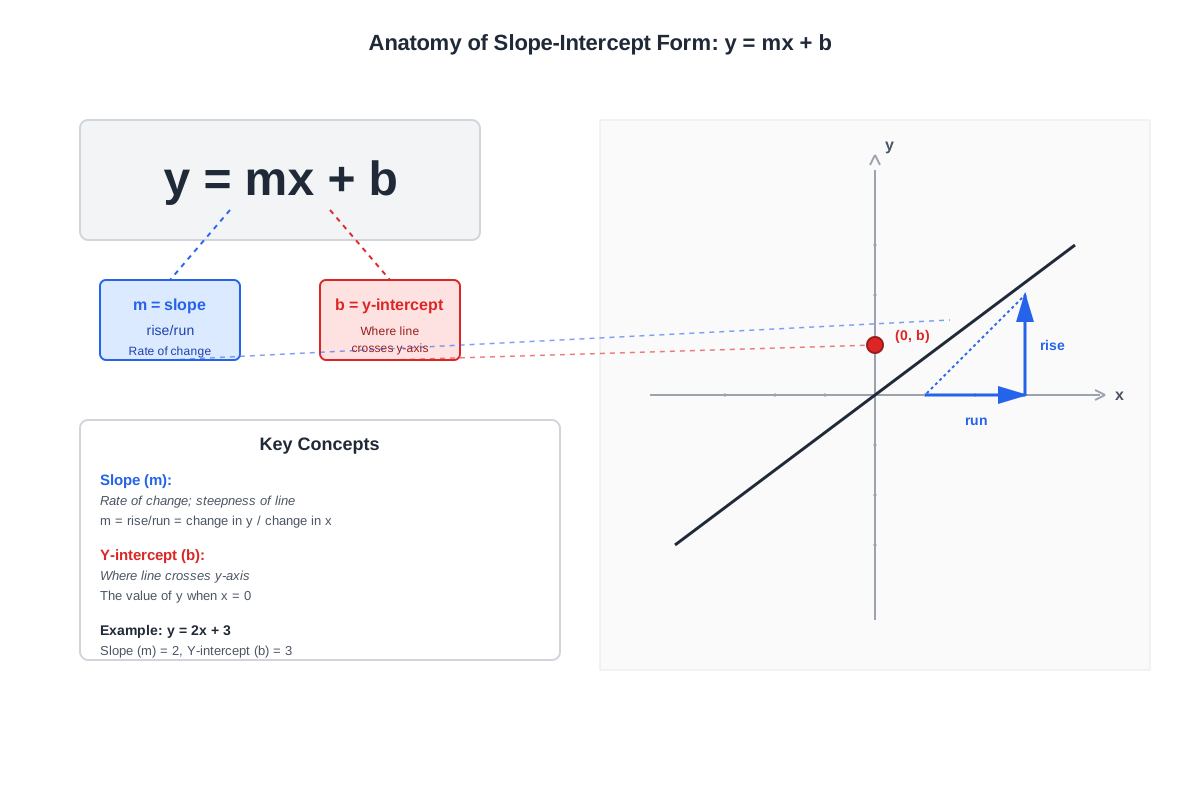
The slope-intercept form of a linear equation is written as:
y = mx + bIn this equation, each component carries specific meaning:
- y represents the dependent variable (output value)
- x represents the independent variable (input value)
- m represents the slope of the line
- b represents the y-intercept of the line
This form is called "slope-intercept" because it directly displays both the slope and the y-intercept without requiring any algebraic manipulation. The equation is solved for y, making it particularly useful for graphing and understanding how y changes as x changes.
Understanding Slope (m)
The slope quantifies the steepness and direction of a line. Mathematically, slope represents the rate of change of y with respect to x, calculated as:
m = (change in y) / (change in x) = (y₂ - y₁) / (x₂ - x₁)Slope interpretation follows these rules:
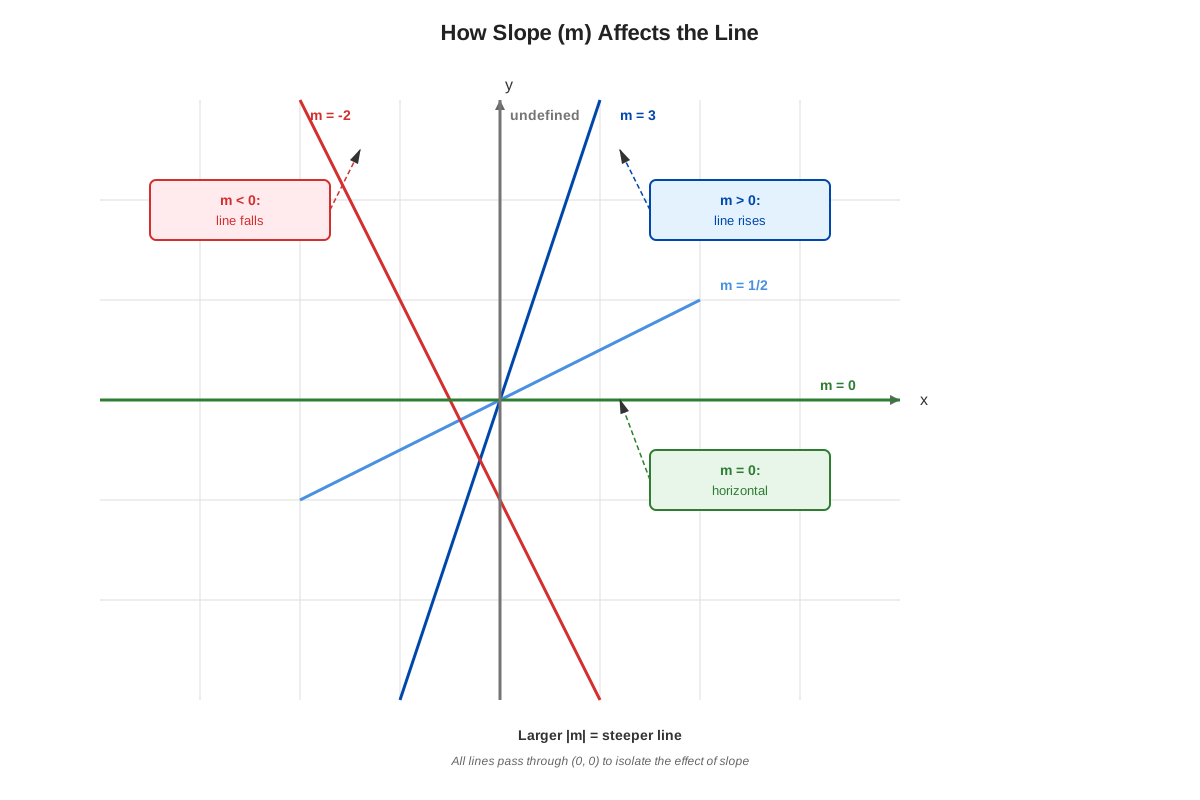
| Slope Value | Line Behavior | Visual Appearance |
|---|---|---|
| m > 0 | Positive slope | Line rises from left to right |
| m < 0 | Negative slope | Line falls from left to right |
| m = 0 | Zero slope | Horizontal line |
| m undefined | Undefined slope | Vertical line (not in slope-intercept form) |
The magnitude of the slope indicates steepness: larger absolute values mean steeper lines, while values closer to zero indicate flatter lines. For example, a line with m = 3 is steeper than a line with m = 1/2, and a line with m = -4 is steeper than a line with m = -1.
In SAT contexts, slope often represents real-world rates: dollars per hour, miles per gallon, degrees per minute, or any quantity that changes at a constant rate relative to another quantity.
Understanding Y-Intercept (b)
The y-intercept represents the y-coordinate where the line crosses the y-axis. This occurs when x = 0, making the y-intercept the initial value or starting point of the relationship. To find the y-intercept from an equation in slope-intercept form, simply identify the constant term b.
Graphically, the y-intercept is the point (0, b) on the coordinate plane. In real-world SAT problems, the y-intercept typically represents an initial condition, starting amount, fixed cost, or base value before any changes occur. For example, in a problem about taxi fares where the equation is C = 2.5m + 3.50, the y-intercept of 3.50 represents the initial fee charged before any miles are driven.
Graphing Using Slope-Intercept Form
The slope-intercept form provides an efficient method for graphing linear equations:
- Plot the y-intercept: Begin by marking the point (0, b) on the y-axis
- Apply the slope: From the y-intercept, use the slope as a ratio (rise/run) to find additional points
- Draw the line: Connect the points with a straight line extending in both directions
For example, to graph y = 2x + 3:
- Plot the y-intercept at (0, 3)
- Use slope m = 2 = 2/1, meaning rise 2 units and run 1 unit right
- From (0, 3), move up 2 and right 1 to reach (1, 5)
- Draw a line through these points
Converting to Slope-Intercept Form
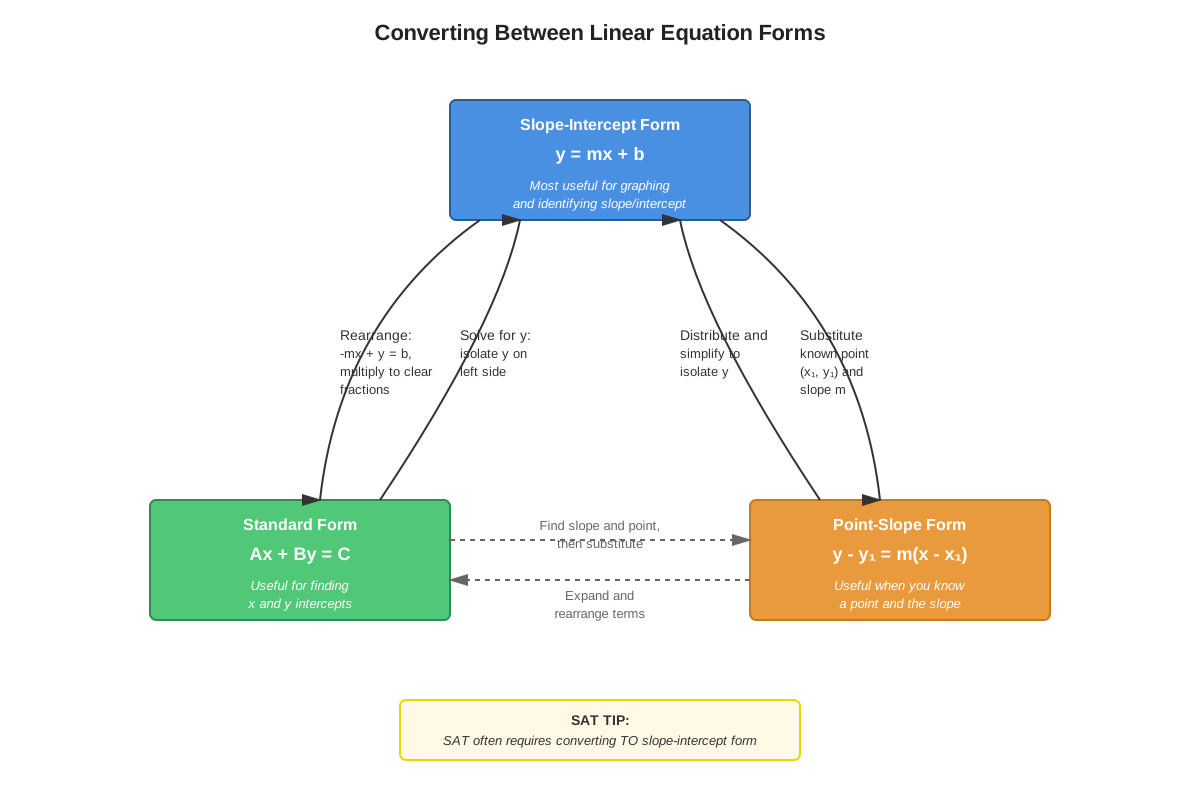
SAT questions frequently require converting equations from standard form (Ax + By = C) to slope-intercept form. The conversion process involves solving for y:
- Isolate the y-term on one side of the equation
- Divide all terms by the coefficient of y
- Simplify to match y = mx + b format
Example: Convert 3x + 2y = 12 to slope-intercept form
- Subtract 3x from both sides: 2y = -3x + 12
- Divide everything by 2: y = -3/2 x + 6
- The slope is -3/2 and the y-intercept is 6
Finding Equations from Information
The SAT regularly tests the ability to construct equations in slope-intercept form from various types of information:
From two points: Calculate slope using the slope formula, then substitute one point and the slope into y = mx + b to solve for b.
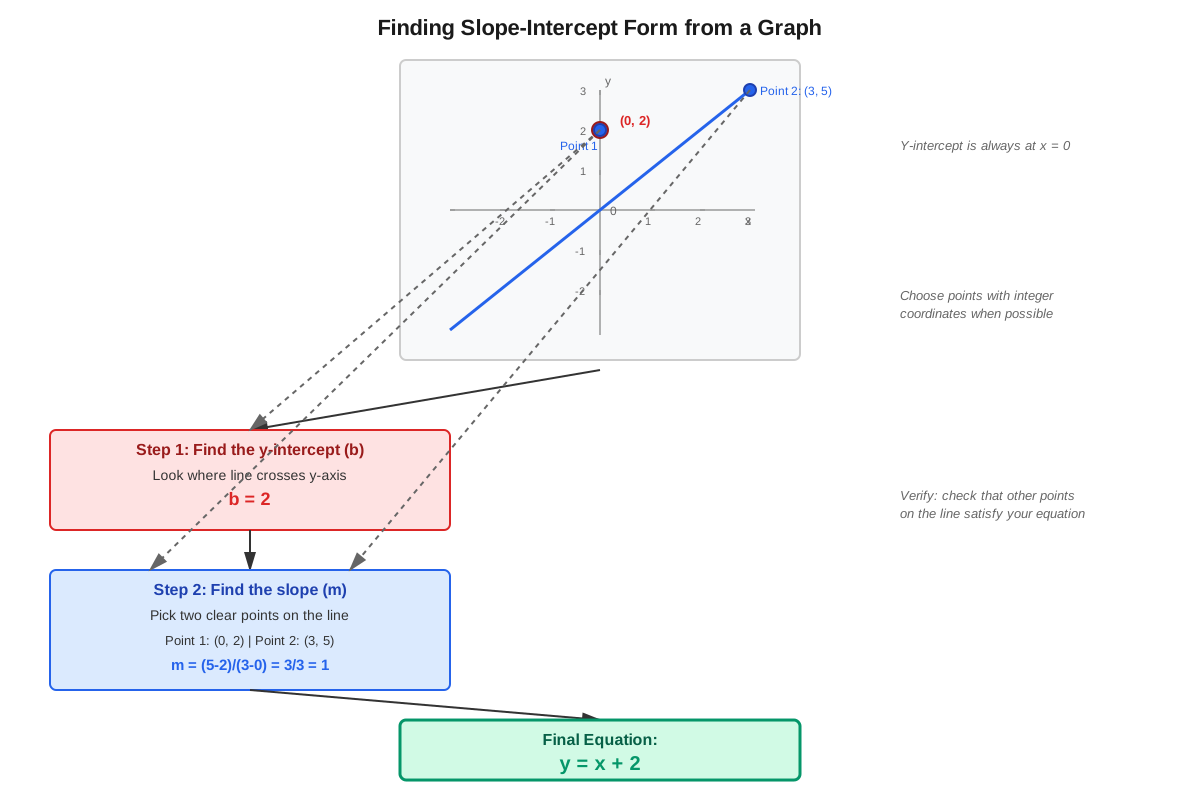
From a graph: Identify the y-intercept directly from where the line crosses the y-axis, then calculate slope by counting rise over run between two clear points on the line.
From a table: Select any two coordinate pairs from the table, calculate slope, then use one pair to find the y-intercept.
From a verbal description: Identify the rate of change (slope) and initial value (y-intercept) from the context, then construct the equation.
Parallel and Perpendicular Lines
Understanding line relationships is crucial for advanced SAT questions:
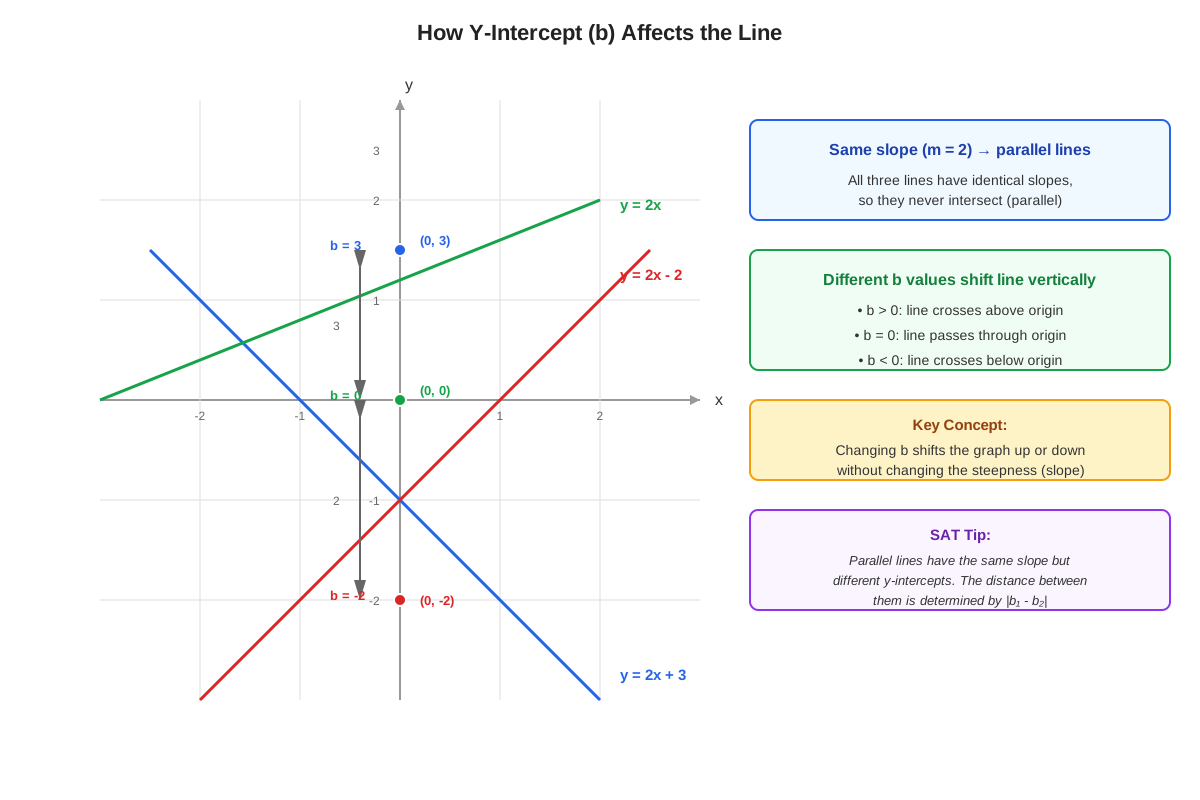
Parallel lines have identical slopes but different y-intercepts. If two lines are parallel, m₁ = m₂. For example, y = 3x + 2 and y = 3x - 5 are parallel because both have slope 3.
Perpendicular lines have slopes that are negative reciprocals of each other. If two lines are perpendicular, m₁ × m₂ = -1, or m₂ = -1/m₁. For example, y = 2x + 1 and y = -1/2 x + 3 are perpendicular because 2 × (-1/2) = -1.
Concept Relationships
Slope-intercept form serves as the central hub connecting multiple linear equation concepts. The form directly builds upon coordinate plane fundamentals, as the equation describes the relationship between x and y coordinates of all points on a line. Understanding ordered pairs and coordinate plotting enables students to verify whether specific points satisfy a given equation in slope-intercept form.
The relationship flow follows this pattern: Coordinate plane basics → Understanding slope as rate of change → Recognizing y-intercept as initial value → Combining into slope-intercept form → Applying to real-world contexts → Extending to systems of equations.
Slope-intercept form connects bidirectionally with standard form (Ax + By = C) and point-slope form [y - y₁ = m(x - x₁)]. Each form has advantages for different problem types, and SAT questions often require conversion between forms. Standard form is useful for identifying intercepts quickly and working with integer coefficients, while point-slope form excels when a point and slope are known but the y-intercept is not immediately available.
The concept extends naturally into systems of linear equations, where slope-intercept form facilitates graphical solution methods and comparison of line characteristics. When two equations are both in slope-intercept form, students can immediately compare slopes to determine if lines are parallel, perpendicular, or intersecting at a unique point. The intersection point represents the simultaneous solution to both equations.
Furthermore, slope-intercept form provides the foundation for understanding linear functions, where the equation y = mx + b can be rewritten as f(x) = mx + b. This function notation appears frequently in advanced SAT questions and connects linear equations to the broader concept of functions, domain, range, and function transformations.
Quick check — test yourself on Slope-intercept form so far.
Try Flashcards →High-Yield Facts
⭐ The slope-intercept form is y = mx + b, where m is the slope and b is the y-intercept
⭐ Slope represents the rate of change: m = (y₂ - y₁)/(x₂ - x₁)
⭐ The y-intercept is the y-coordinate where the line crosses the y-axis (when x = 0)
⭐ Positive slope means the line rises from left to right; negative slope means it falls
⭐ Parallel lines have equal slopes (m₁ = m₂) but different y-intercepts
- Perpendicular lines have slopes that are negative reciprocals (m₁ × m₂ = -1)
- To convert from standard form to slope-intercept form, solve for y
- A horizontal line has slope m = 0 and equation y = b
- A vertical line has undefined slope and cannot be written in slope-intercept form
- The slope of a line remains constant between any two points on that line
- In real-world problems, slope typically represents a rate (cost per item, speed, etc.)
- The y-intercept in context problems usually represents an initial value or fixed cost
- Lines with larger absolute value slopes are steeper than lines with smaller absolute value slopes
- To graph from slope-intercept form: plot b on the y-axis, then use m as rise/run
Common Misconceptions
Misconception: The slope is always positive in slope-intercept form.
Correction: Slope can be positive, negative, or zero. The sign of m determines whether the line rises (positive), falls (negative), or remains horizontal (zero). Always pay attention to negative signs in front of the x term.
Misconception: The y-intercept is the point where the line crosses either axis.
Correction: The y-intercept specifically refers to where the line crosses the y-axis only, occurring at the point (0, b). The x-intercept is a different value found by setting y = 0 and solving for x.
Misconception: In the equation y = 3x, there is no y-intercept.
Correction: When no constant term appears, the y-intercept is 0, meaning b = 0 and the line passes through the origin (0, 0). The equation is actually y = 3x + 0.
Misconception: Slope is calculated as (x₂ - x₁)/(y₂ - y₁).
Correction: Slope is the change in y divided by the change in x, not the reverse. The correct formula is m = (y₂ - y₁)/(x₂ - x₁). Reversing this gives the reciprocal of the actual slope.
Misconception: The equation 2y = 4x + 6 is in slope-intercept form.
Correction: Slope-intercept form requires the equation to be solved for y with a coefficient of 1. This equation must be divided by 2 to get y = 2x + 3, which is the proper slope-intercept form.
Misconception: If two lines have the same y-intercept, they are parallel.
Correction: Parallel lines must have the same slope, not the same y-intercept. Lines with identical y-intercepts but different slopes will intersect at the y-axis and diverge from there.
Misconception: A steeper line always has a larger slope value.
Correction: Steepness is determined by the absolute value of the slope. A line with slope -5 is steeper than a line with slope 2, even though -5 < 2, because |-5| > |2|.
Worked Examples
Example 1: Finding an Equation from a Graph
Problem: A line passes through the points (0, -2) and (3, 4) on a coordinate plane. What is the equation of this line in slope-intercept form?
Solution:
Step 1: Identify the y-intercept.
Since one point is (0, -2), and this point has x = 0, it lies on the y-axis. Therefore, the y-intercept b = -2.
Step 2: Calculate the slope using the two given points.
Using the slope formula with (x₁, y₁) = (0, -2) and (x₂, y₂) = (3, 4):
m = (y₂ - y₁)/(x₂ - x₁) = (4 - (-2))/(3 - 0) = (4 + 2)/3 = 6/3 = 2Step 3: Write the equation in slope-intercept form.
Substituting m = 2 and b = -2 into y = mx + b:
y = 2x + (-2)
y = 2x - 2Answer: y = 2x - 2
This example demonstrates the direct application of identifying key features (Learning Objective 1) and applying slope-intercept form to answer SAT-style questions (Learning Objective 3). The problem type—finding an equation from points—appears frequently on the SAT, making this a high-yield skill.
Example 2: Real-World Context Problem
Problem: A water tank contains 500 gallons of water. Water is being drained from the tank at a constant rate of 15 gallons per minute. Which equation represents the amount of water W, in gallons, remaining in the tank after t minutes?
A) W = 15t + 500
B) W = -15t + 500
C) W = 500t + 15
D) W = 500t - 15
Solution:
Step 1: Identify the initial value (y-intercept).
At time t = 0 (before any draining), the tank contains 500 gallons. This is the starting amount, so b = 500.
Step 2: Determine the rate of change (slope).
Water is being drained at 15 gallons per minute, meaning the amount decreases. Since the amount is decreasing, the slope must be negative: m = -15.
Step 3: Construct the equation.
Using the slope-intercept form W = mt + b:
W = -15t + 500Step 4: Verify the equation makes sense.
- At t = 0: W = -15(0) + 500 = 500 ✓ (correct initial amount)
- At t = 10: W = -15(10) + 500 = 350 ✓ (after 10 minutes, 150 gallons drained)
- The negative slope correctly represents decreasing water ✓
Answer: B) W = -15t + 500
This example illustrates how slope-intercept form appears on the SAT in real-world contexts (Learning Objective 2) and requires interpreting the meaning of slope and y-intercept (Learning Objective 5). The key insight is recognizing that decreasing quantities require negative slopes, a common source of errors on the SAT.
Exam Strategy
When approaching SAT questions involving slope-intercept form, employ these strategic techniques:
Trigger word recognition: Watch for phrases that signal slope-intercept form questions: "rate of change," "initial value," "starting amount," "per unit," "for each," "increases by," "decreases by," and "when x = 0." These phrases help identify which value represents slope and which represents the y-intercept.
Graph analysis approach: When a graph is provided, always identify the y-intercept first by looking where the line crosses the y-axis. Then calculate slope by finding two points with integer coordinates and counting rise over run. Avoid estimating—use precise grid points to ensure accuracy.
Elimination strategies:
- If the line rises from left to right, eliminate any answer choices with negative slopes
- If the line falls from left to right, eliminate any answer choices with positive slopes
- If the y-intercept is clearly positive, eliminate choices with negative b values
- If the line passes through the origin, eliminate any choices where b ≠ 0
Conversion efficiency: When converting from standard form to slope-intercept form, work carefully with negative signs and fractions. Double-check by substituting a known point into your final equation to verify correctness. This verification step takes only seconds but prevents careless errors.
Time allocation: Slope-intercept form questions typically require 45-90 seconds each. Straightforward identification questions should take closer to 45 seconds, while multi-step conversion or context problems may require up to 90 seconds. If a question exceeds this timeframe, mark it for review and move forward.
Context problem approach: For word problems, create a two-column table listing what you know:
- Left column: What changes (independent variable, x)
- Right column: What you're measuring (dependent variable, y)
- Identify the rate (slope) and initial value (y-intercept) from the problem description
- Construct the equation systematically
Calculator usage: On calculator-permitted sections, verify your equation by using the graphing function to check if the line passes through given points. This provides quick confirmation of your work.
Memory Techniques
Slope-Intercept Mnemonic: "Mountains have Slopes" and "Begins at Intercept"
- The letter M in y = mx + b stands for slope (mountains have slopes)
- The letter B stands for where the line begins on the y-axis (the intercept)
Slope Direction Memory: "Positive slopes Point Up" and "Negative slopes Nod Down"
- Positive slopes rise as you move from left to right (pointing upward)
- Negative slopes fall as you move from left to right (nodding downward)
Rise Over Run Visualization: Picture yourself climbing stairs
- The "rise" is how many steps up (or down) you go vertically
- The "run" is how many steps forward you go horizontally
- Slope = vertical steps / horizontal steps
Y-Intercept Location: "Y do we start here?"
- The y-intercept answers the question "What is y when we start (x = 0)?"
- It's where the line begins its journey on the y-axis
Parallel and Perpendicular: "Parallel lines are Pals with Perfectly Paired slopes" and "Perpendicular lines Flip and Negate"
- Parallel: same slope (pals stick together)
- Perpendicular: flip the fraction and change the sign (negative reciprocal)
Form Conversion Acronym: SIFY - "Solve for Y"
- When converting any linear equation to slope-intercept form, always Solve for Y
- This reminds you that y must be isolated with a coefficient of 1
Summary
Slope-intercept form (y = mx + b) represents the most versatile and frequently tested representation of linear equations on the SAT. The form directly reveals two essential characteristics: the slope (m), which quantifies the rate of change and determines the line's steepness and direction, and the y-intercept (b), which identifies the starting value where the line crosses the y-axis. Mastery requires the ability to identify these components from equations, graphs, tables, and verbal descriptions; convert between different equation forms; construct equations from given information; and interpret slope and y-intercept in real-world contexts. The SAT consistently tests these skills through multiple question formats, making slope-intercept form one of the highest-yield topics for focused preparation. Success depends on recognizing that positive slopes indicate lines rising from left to right while negative slopes indicate falling lines, understanding that parallel lines share identical slopes, and knowing that perpendicular lines have slopes that are negative reciprocals. Strategic approaches include identifying y-intercepts first when analyzing graphs, using elimination techniques based on slope direction and intercept signs, and systematically converting equations by solving for y.
Key Takeaways
- Slope-intercept form y = mx + b directly displays slope (m) and y-intercept (b) without requiring calculation
- Slope represents rate of change and determines line direction: positive slopes rise, negative slopes fall
- The y-intercept is the starting value where x = 0, often representing initial conditions in real-world problems
- Converting to slope-intercept form requires solving for y and ensuring its coefficient equals 1
- Parallel lines have identical slopes; perpendicular lines have slopes that are negative reciprocals
- SAT questions test slope-intercept form through graphs, tables, word problems, and equation conversions
- Strategic approaches include identifying y-intercepts first, using elimination based on slope signs, and verifying answers with known points
Related Topics
Standard Form of Linear Equations: Understanding Ax + By = C provides an alternative representation that facilitates finding both x- and y-intercepts quickly and is particularly useful for equations with integer coefficients. Mastering slope-intercept form enables efficient conversion to and from standard form.
Point-Slope Form: The equation y - y₁ = m(x - x₁) becomes accessible once slope-intercept form is mastered, offering advantages when a point and slope are known but the y-intercept requires calculation.
Systems of Linear Equations: Solving systems using substitution or elimination relies heavily on manipulating equations in slope-intercept form, and graphical solution methods require understanding how slope and y-intercept determine line position.
Linear Inequalities: Extending slope-intercept form to inequalities (y > mx + b or y ≤ mx + b) builds directly on understanding the equation form, with the added dimension of shaded regions representing solution sets.
Functions and Function Notation: Rewriting y = mx + b as f(x) = mx + b introduces function notation and connects linear equations to the broader concept of functions, domain, range, and transformations tested on the SAT.
Practice CTA
Now that you have thoroughly reviewed slope-intercept form, reinforce your understanding by attempting the practice questions and flashcards available for this topic. These resources provide targeted SAT-style problems that mirror actual test questions, allowing you to apply the strategies and concepts covered in this guide. Consistent practice with immediate feedback is the most effective method for converting knowledge into test-day performance. Challenge yourself to work through problems under timed conditions, and review any mistakes carefully to identify gaps in understanding. Your investment in deliberate practice with slope-intercept form will yield significant score improvements on the SAT math section!
Sign up free to keep reading
Create a free AnvayaPrep account to finish this SAT guide on Slope-intercept form — plus flashcards and practice questions.