Overview
Understanding percent as ratio is a foundational skill that appears frequently throughout the SAT math section. At its core, a percent represents a special type of ratio—a comparison to 100. When students grasp that "percent" literally means "per hundred" (from the Latin per centum), they unlock a powerful framework for solving a wide variety of problems involving proportional relationships, comparisons, and changes. This conceptual understanding transforms percent problems from memorized procedures into logical applications of ratio reasoning.
The SAT tests percent as ratio in multiple contexts: straightforward percent calculations, percent increase and decrease, comparing quantities using percentages, and multi-step problems that combine percents with other mathematical concepts. Questions may appear in both the calculator and no-calculator sections, and they frequently integrate with real-world scenarios involving finances, statistics, surveys, and scientific data. Mastering this topic is not optional—percent problems constitute approximately 10-15% of all SAT math questions, making them one of the highest-yield topics for score improvement.
Beyond isolated percent calculations, this topic connects deeply to proportional reasoning, algebraic equation-solving, and data interpretation. When students understand percents as ratios, they can seamlessly transition between fraction, decimal, and percent representations, apply proportional thinking to solve complex word problems, and recognize when percent reasoning provides the most efficient solution path. This conceptual flexibility is exactly what the SAT rewards, particularly in the higher-difficulty questions that separate good scores from exceptional ones.
Learning Objectives
- [ ] Identify key features of percent as ratio and recognize the fundamental relationship between percents, ratios, and fractions
- [ ] Explain how percent as ratio appears on the SAT across different question types and contexts
- [ ] Apply percent as ratio to answer SAT-style questions efficiently and accurately
- [ ] Convert fluently between percent, fraction, decimal, and ratio representations
- [ ] Solve multi-step problems involving percent increase, percent decrease, and successive percent changes
- [ ] Interpret percent-based data in tables, graphs, and word problems to extract relevant information
Prerequisites
- Basic fraction operations: Understanding equivalent fractions and simplification is essential because percents are fundamentally fractions with denominator 100
- Decimal notation and conversion: Percents translate directly to decimal form, requiring comfort with decimal place value and operations
- Ratio fundamentals: Since percents are special ratios, students must understand part-to-whole and part-to-part comparisons
- Basic algebraic manipulation: Many percent problems require setting up and solving equations with variables
- Proportional reasoning: Recognizing when two ratios are equivalent underlies all percent problem-solving
Why This Topic Matters
In real-world applications, percents appear everywhere: sales tax calculations, tip computations, interest rates, statistical reports, nutritional labels, election results, scientific measurements, and financial planning. The ability to think proportionally using percents enables informed decision-making about personal finances, critical evaluation of statistical claims in media, and quantitative reasoning in professional contexts. Understanding sat percent as ratio provides a mathematical lens for interpreting the quantitative information that saturates modern life.
On the SAT specifically, percent problems appear with remarkable consistency. Approximately 4-6 questions per test directly involve percent calculations, and many additional questions incorporate percents as part of more complex scenarios. These questions span all difficulty levels, from straightforward "What is 30% of 80?" calculations to sophisticated multi-step problems involving successive percent changes or algebraic expressions with percents. The College Board particularly favors questions that test conceptual understanding rather than rote calculation—for example, asking students to determine what percent one quantity is of another, or to work backward from a final value after a percent change.
Common SAT question formats include: calculating percent increase or decrease between two values, determining an original amount before a percent change was applied, finding what percent one quantity represents of another, solving word problems involving discounts and markups, interpreting percent-based data from tables or graphs, and setting up equations where percents appear as coefficients or constants. The topic also frequently appears in data analysis questions where students must calculate percentages from survey results or experimental data.
Core Concepts
The Fundamental Definition: Percent as a Ratio to 100
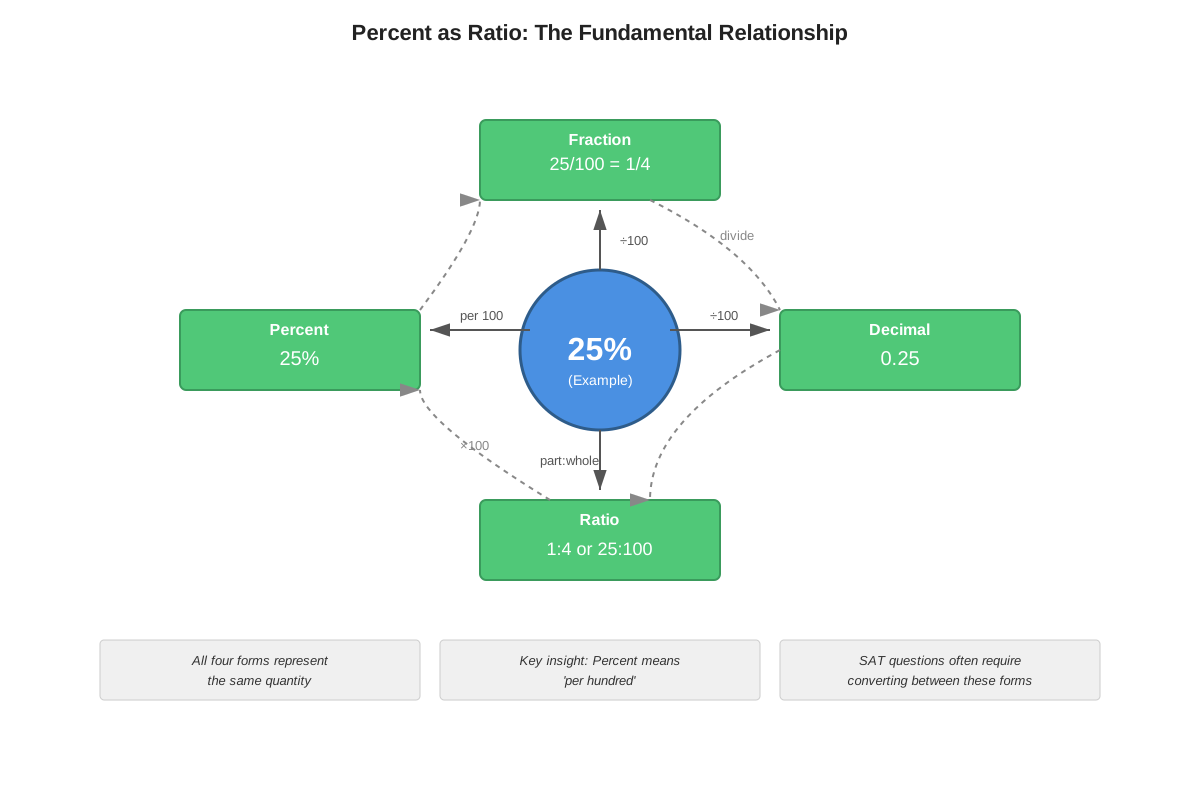
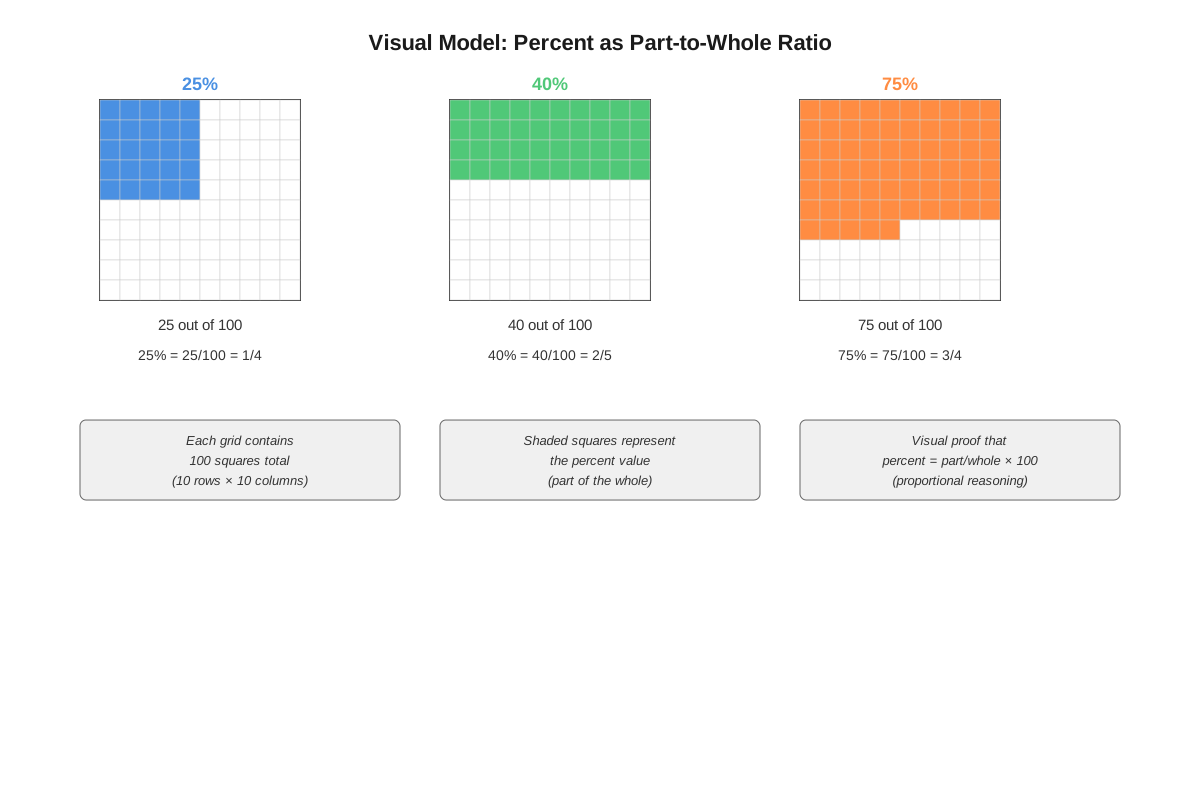
A percent is fundamentally a ratio that compares a quantity to 100. The word itself derives from Latin: per (for each) and centum (hundred). When we write 45%, we mean 45 per 100, which can be expressed as the ratio 45:100, the fraction 45/100, or the decimal 0.45. This equivalence is the cornerstone of all percent reasoning.
Understanding this definition allows for seamless conversion between representations:
- Percent to fraction: Write the percent value over 100, then simplify (e.g., 45% = 45/100 = 9/20)
- Percent to decimal: Divide by 100 by moving the decimal point two places left (e.g., 45% = 0.45)
- Fraction to percent: Convert to an equivalent fraction with denominator 100, or divide numerator by denominator and multiply by 100
- Decimal to percent: Multiply by 100 by moving the decimal point two places right (e.g., 0.45 = 45%)
The Three Basic Percent Problem Types
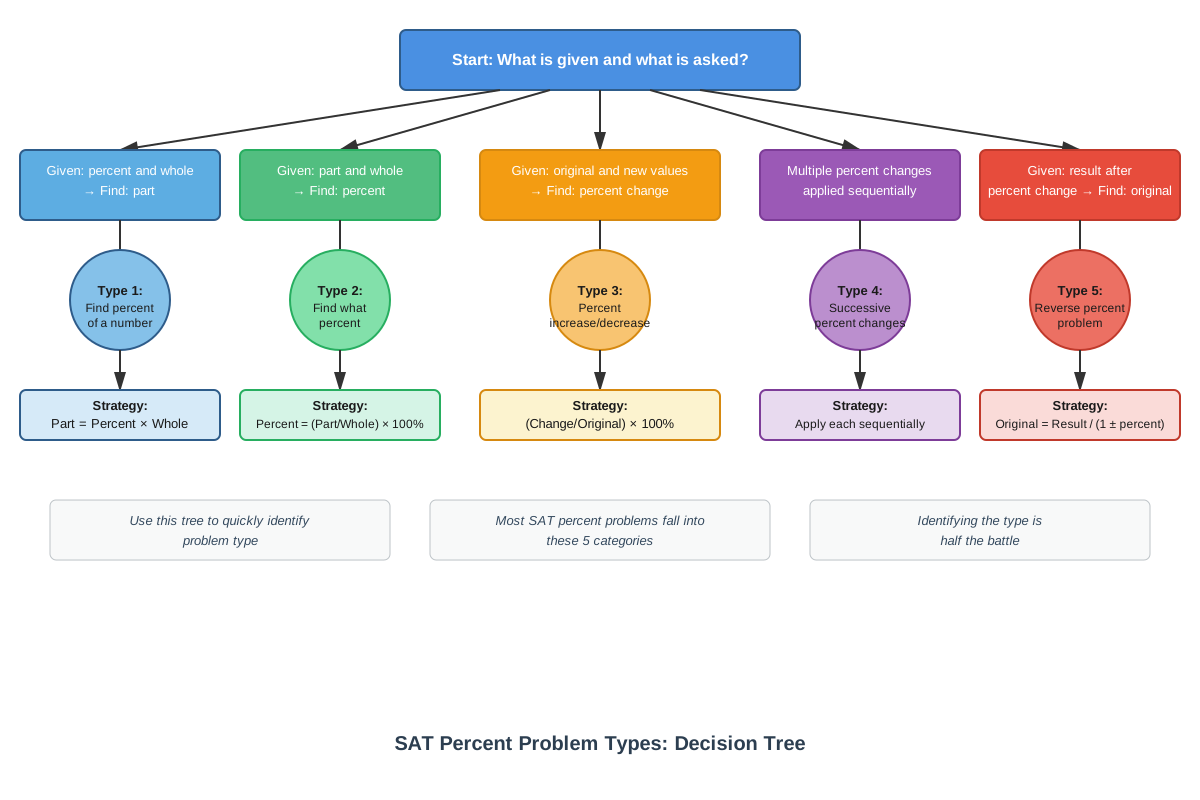
Every basic percent problem involves three quantities: the part, the whole (or base), and the percent. The fundamental relationship is:
Part = Percent × WholeOr equivalently: Part/Whole = Percent/100
The three problem types correspond to which quantity is unknown:
- Finding the part: "What is 30% of 80?" → Part = 0.30 × 80 = 24
- Finding the percent: "24 is what percent of 80?" → Percent = (24/80) × 100 = 30%
- Finding the whole: "24 is 30% of what number?" → Whole = 24/0.30 = 80
Recognizing which type of problem you're solving helps select the appropriate equation setup.
Percent Increase and Percent Decrease
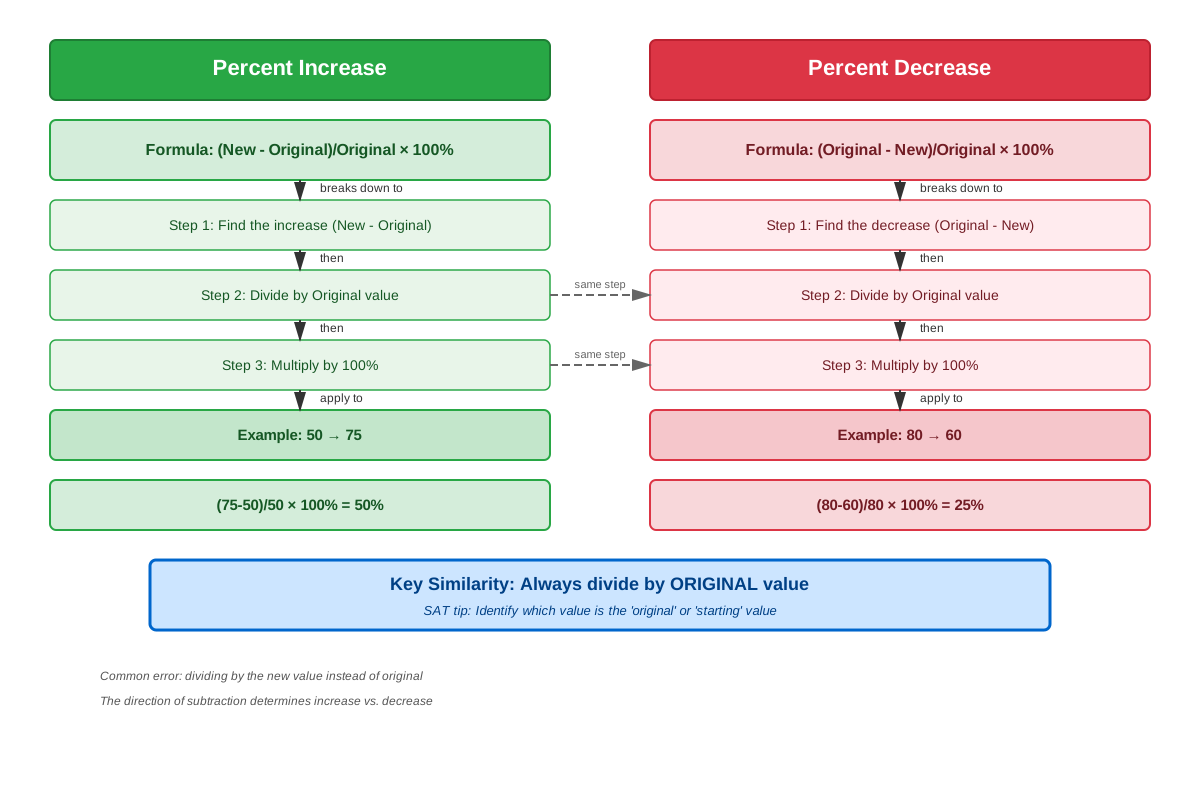
Percent change problems ask how much a quantity has increased or decreased relative to its original value. The formula is:
Percent Change = (New Value - Original Value) / Original Value × 100%Key points:
- Always divide by the original value (the starting point), not the new value
- Positive results indicate increase; negative results indicate decrease
- The change can exceed 100% (e.g., doubling represents a 100% increase)
Example: If a price increases from $40 to $50:
- Change = $50 - $40 = $10
- Percent increase = ($10/$40) × 100% = 25%
To find a new value after a percent change:
- After increase: New Value = Original × (1 + percent increase as decimal)
- After decrease: New Value = Original × (1 - percent decrease as decimal)
Example: A $60 item decreased by 15%:
- New Value = $60 × (1 - 0.15) = $60 × 0.85 = $51
Successive Percent Changes
A common SAT trap involves applying multiple percent changes sequentially. The crucial insight: successive percent changes are multiplicative, not additive.
If a quantity increases by 20% then decreases by 20%, it does NOT return to the original value. Instead:
- After +20%: Value = Original × 1.20
- After -20% of the new value: Final = (Original × 1.20) × 0.80 = Original × 0.96
The final value is 96% of the original—a net decrease of 4%.
For successive changes, multiply the multipliers:
- Original → (×1.20) → (×0.80) → Final
- Net multiplier = 1.20 × 0.80 = 0.96
Percent Greater Than and Percent Of
The SAT frequently tests the distinction between these phrases:
| Phrase | Meaning | Example |
|---|---|---|
| "A is 20% of B" | A = 0.20 × B | If B = 50, then A = 10 |
| "A is 20% greater than B" | A = B + 0.20B = 1.20B | If B = 50, then A = 60 |
| "A is 20% less than B" | A = B - 0.20B = 0.80B | If B = 50, then A = 40 |
Misreading these phrases is a common source of errors. "Greater than" and "less than" involve comparison and change; "of" involves direct multiplication.
Working Backward from Final Values
Many SAT problems give you the result after a percent change and ask for the original value. The key is to set up an equation where the unknown original value is multiplied by the appropriate factor.
Example: After a 25% discount, a jacket costs $60. What was the original price?
- Let x = original price
- After 25% discount: x × 0.75 = 60
- Solving: x = 60/0.75 = 80
The original price was $80.
Percent in Proportional Relationships
Since percents are ratios, they maintain proportional relationships. If 30% of a group has a certain characteristic, then in any proportionally similar group, 30% will have that characteristic. This principle enables scaling calculations up or down.
Example: In a survey of 200 people, 35% preferred option A. If the survey had included 500 people with the same preferences, how many would prefer option A?
- 35% of 500 = 0.35 × 500 = 175 people
Concept Relationships
The concepts within percent as ratio form a hierarchical structure. At the foundation lies the definition of percent as a ratio to 100, which enables all conversions between representations (fraction ↔ decimal ↔ percent). This foundational understanding leads directly to the three basic problem types (finding part, percent, or whole), which are simply different arrangements of the fundamental equation Part = Percent × Whole.
Building on basic calculations, percent change (increase/decrease) introduces the concept of comparing a change to an original value, which requires understanding both the basic percent formula and subtraction of quantities. This leads to successive percent changes, which combine percent change with multiplicative reasoning—recognizing that each change creates a new base for the next change.
The distinction between "percent of" versus "percent greater/less than" connects back to the fundamental definition while adding the concept of comparison and relative change. Finally, working backward from final values integrates algebraic equation-solving with percent reasoning, requiring students to reverse the typical calculation process.
These concepts connect to prerequisite knowledge of ratios (percents are special ratios), fractions (percents are fractions with denominator 100), and proportional reasoning (percent relationships scale proportionally). They also connect forward to more advanced topics like exponential growth and decay, compound interest, probability, and statistical analysis—all of which use percent reasoning as a foundation.
Relationship map:
Percent Definition → Basic Calculations → Percent Change → Successive Changes
↓
Conversions ↔ Proportional Reasoning
↓
Algebraic Applications (working backward)
Quick check — test yourself on Percent as ratio so far.
Try Flashcards →High-Yield Facts
⭐ A percent is a ratio with denominator 100: 45% = 45/100 = 0.45
⭐ The three quantities in percent problems are part, whole, and percent, related by: Part = (Percent/100) × Whole
⭐ Percent change always divides by the original value: Percent Change = (New - Original)/Original × 100%
⭐ To find a value after a percent increase of r%: New Value = Original × (1 + r/100)
⭐ To find a value after a percent decrease of r%: New Value = Original × (1 - r/100)
- Converting percent to decimal: divide by 100 (move decimal two places left)
- Converting decimal to percent: multiply by 100 (move decimal two places right)
- "A is 20% greater than B" means A = 1.20B, not A = 0.20B
- Successive percent changes multiply: a 10% increase followed by 10% decrease results in 1.10 × 0.90 = 0.99 (net 1% decrease)
- When working backward from a final value after a percent change, divide by the multiplier rather than multiply
- A 100% increase means doubling; a 50% decrease means halving
- Percent change can exceed 100% (e.g., tripling is a 200% increase)
- In "What percent of A is B?", calculate (B/A) × 100%
- The whole (base) in a percent problem is the quantity that follows "of" in the problem statement
- When a quantity increases by x% then decreases by x%, the net change is NOT zero
Common Misconceptions
Misconception: A 20% increase followed by a 20% decrease returns to the original value.
Correction: Successive percent changes are multiplicative, not additive. After +20% then -20%, the final value is Original × 1.20 × 0.80 = Original × 0.96, which is 4% less than the original. Each percent change applies to a different base value.
Misconception: "A is 30% of B" means the same thing as "A is 30% greater than B."
Correction: These are completely different relationships. "A is 30% of B" means A = 0.30B, while "A is 30% greater than B" means A = 1.30B. The first is direct multiplication; the second involves comparison and addition.
Misconception: To find the original price before a 25% discount, subtract 25% from the final price.
Correction: You must work backward algebraically. If the final price is F after a 25% discount, then F = Original × 0.75, so Original = F/0.75. Simply subtracting 25% of F gives an incorrect answer because you're taking 25% of the wrong base.
Misconception: When calculating percent change, it doesn't matter which value you use as the denominator.
Correction: The denominator must always be the original (starting) value. Percent change measures how much the value changed relative to where it started. Using the new value as the denominator produces a different, incorrect percentage.
Misconception: Converting 0.5 to a percent gives 0.5%.
Correction: To convert a decimal to a percent, multiply by 100 (move the decimal two places right). So 0.5 = 50%, not 0.5%. The error comes from forgetting that percent means "per hundred," so you must scale the decimal by 100.
Misconception: If a store offers "20% off" and you have an additional "10% off" coupon, you save 30% total.
Correction: The discounts apply successively, not additively. After 20% off, you pay 80% of the original. Then 10% off that amount means you pay 90% of 80%, which is 0.90 × 0.80 = 0.72 of the original price—a total discount of 28%, not 30%.
Worked Examples
Example 1: Multi-Step Percent Change Problem
Problem: A store marks up the wholesale price of a jacket by 60% to set the retail price. During a sale, the store offers 25% off the retail price. If the final sale price is $90, what was the original wholesale price?
Solution:
Step 1: Define the variable and set up the relationships.
- Let W = wholesale price
- After 60% markup: Retail price = W × 1.60
- After 25% discount: Sale price = Retail price × 0.75
Step 2: Combine the relationships.
- Sale price = (W × 1.60) × 0.75
- Sale price = W × 1.20
Step 3: Substitute the known sale price and solve.
- 90 = W × 1.20
- W = 90/1.20
- W = 75
Answer: The wholesale price was $75.
Verification: $75 × 1.60 = $120 (retail price); $120 × 0.75 = $90 (sale price) ✓
Connection to learning objectives: This problem requires applying percent as ratio in a multi-step context, converting percents to multipliers (60% markup → ×1.60, 25% discount → ×0.75), understanding successive percent changes, and working backward from a final value—integrating multiple core concepts.
Example 2: Comparing Quantities Using Percents
Problem: In a school election, Candidate A received 120 votes and Candidate B received 150 votes.
(a) What percent of Candidate B's votes did Candidate A receive?
(b) Candidate A's votes are what percent less than Candidate B's votes?
Solution:
Part (a): Finding what percent one quantity is of another.
- We need to find: 120 is what percent of 150?
- Set up the equation: 120/150 = x/100
- Solve: x = (120/150) × 100 = 0.80 × 100 = 80
Answer (a): Candidate A received 80% of Candidate B's votes.
Part (b): Finding percent decrease.
- Use the percent change formula: (New - Original)/Original × 100%
- Here, we're comparing A to B, so B is the reference (original)
- Percent difference = (120 - 150)/150 × 100%
- Percent difference = (-30/150) × 100% = -0.20 × 100% = -20%
Answer (b): Candidate A's votes are 20% less than Candidate B's votes.
Key insight: Part (a) asks "what percent of" (direct ratio), while part (b) asks "what percent less than" (percent change). These are different questions requiring different approaches. Notice that 80% of B's votes (part a) and 20% less than B's votes (part b) both describe the same relationship but from different perspectives.
Connection to learning objectives: This problem demonstrates the critical distinction between "percent of" and "percent less than," requires identifying which quantity serves as the base/whole, and applies the fundamental percent formulas in a comparison context typical of SAT questions.
Exam Strategy
When approaching SAT questions involving percent as ratio, begin by identifying which of the three basic quantities (part, whole, percent) are given and which is unknown. This classification immediately suggests the appropriate equation setup. Look for key phrases: "what percent of" signals finding a percent, "is X% of" signals finding a part, and "X is Y% of what number" signals finding the whole.
Trigger words and phrases to watch for:
- "percent increase/decrease" → use the change formula with original value in denominator
- "percent greater/less than" → involves comparison, not direct multiplication
- "marked up by" or "marked down by" → percent change from an original value
- "discount" → percent decrease from original price
- "of" → typically indicates the whole/base value
- "successive," "then," "followed by" → multiple percent changes that multiply
For process of elimination, use estimation and logical reasoning:
- If a quantity increases then decreases by the same percent, the final value must be less than the original (eliminate answer choices showing equality or net increase)
- A percent greater than 100% means more than doubling (eliminate unreasonably small values)
- After a discount, the final price must be less than the original (eliminate higher values)
- Check whether answer choices are in percent form or decimal form—convert if needed
Time allocation advice: Basic percent calculations should take 30-45 seconds. Multi-step problems involving successive changes or working backward may require 60-90 seconds. If a problem seems to require extensive calculation, look for a more efficient approach—often the SAT rewards conceptual understanding over computation. For example, recognizing that a 50% increase followed by a 50% decrease yields 0.75 of the original (not 1.0) can be faster than calculating with specific numbers.
Strategic approaches:
- When working backward from a final value, set up an equation with the unknown as a variable rather than trying to reverse operations mentally
- For successive percent changes, multiply the multipliers: (1 ± first change) × (1 ± second change)
- Convert percents to decimals before calculating to avoid errors with the percent symbol
- When comparing answer choices, check if they're asking for a percent (include % symbol) or a decimal/fraction
- If stuck, try plugging in the answer choices (especially effective when finding an original value)
Memory Techniques
Mnemonic for percent change formula: "New Minus Old, Over Old" (NMO/OO)
- (New - Old) / Old × 100%
- Remember: the denominator is always the Original/Old value
Visualization for successive changes: Picture a staircase where each step represents a percent change. You can't simply add the heights of the steps—you must follow the path, with each step starting from where the previous step ended. This reinforces that successive changes multiply rather than add.
Acronym for the three basic problem types: PPW (Part, Percent, Whole)
- Given Percent and Whole → find Part: multiply
- Given Part and Whole → find Percent: divide and multiply by 100
- Given Part and Percent → find Whole: divide
Memory device for "of" versus "greater than":
- "OF" = Operation is Finding (direct multiplication)
- "GREATER" = Going up from the Reference value (add to 100%)
Finger trick for decimal-percent conversion:
- Percent → Decimal: fingers move Left (two places) to make the number Less (smaller)
- Decimal → Percent: fingers move Right (two places) to make the number Rise (larger)
Summary
Percent as ratio is a high-yield SAT math topic that tests students' understanding that percents are fundamentally ratios comparing quantities to 100. Mastery requires fluency in converting between percent, decimal, and fraction forms; solving the three basic problem types (finding part, percent, or whole); calculating percent increase and decrease using the correct formula with the original value in the denominator; handling successive percent changes by multiplying multipliers rather than adding percents; distinguishing between "percent of" (direct multiplication) and "percent greater/less than" (comparison involving change); and working backward algebraically from final values to find original quantities. The SAT tests these concepts through straightforward calculations, multi-step word problems, data interpretation questions, and problems requiring conceptual understanding of how percents behave. Success depends on recognizing problem types quickly, setting up equations correctly, avoiding common traps like confusing successive changes with additive changes, and maintaining precision in calculations while working efficiently under time pressure.
Key Takeaways
- Percent means "per hundred": every percent is a ratio to 100, enabling conversion to fractions (divide by 100) and decimals (move decimal two places)
- The fundamental equation Part = Percent × Whole underlies all basic percent problems; identify which quantity is unknown to determine your solution approach
- Percent change always divides by the original value: (New - Original)/Original × 100%, never divide by the new value
- Successive percent changes multiply, not add: a 20% increase then 10% decrease yields 1.20 × 0.90 = 1.08 (net 8% increase), not 10%
- "Percent of" versus "percent greater than" are fundamentally different: "A is 30% of B" means A = 0.30B, while "A is 30% greater than B" means A = 1.30B
- Working backward requires algebraic setup: if a final value results from a percent change, set up an equation with the unknown original value and solve by dividing by the multiplier
- Estimation and answer choice analysis can save time and catch errors—use logical reasoning about whether values should increase or decrease
Related Topics
Ratios and Proportions: Percent as ratio builds directly on general ratio concepts; mastering proportional reasoning enables more sophisticated percent applications including scale factors and similar figures.
Linear Equations and Inequalities: Many percent problems require setting up and solving algebraic equations, particularly when working backward from final values or dealing with unknown quantities.
Functions and Function Notation: Percent change can be modeled as a function, and understanding exponential functions helps with repeated percent changes (compound interest, population growth).
Data Analysis and Statistics: Interpreting percentages in tables, graphs, and survey results requires combining percent reasoning with data literacy—a frequent SAT question type.
Word Problem Translation: Percent problems often appear embedded in real-world scenarios requiring careful reading and translation of verbal descriptions into mathematical expressions.
Practice CTA
Now that you've mastered the core concepts of percent as ratio, it's time to solidify your understanding through active practice. Work through the practice questions to apply these strategies to authentic SAT-style problems, and use the flashcards to reinforce key formulas and concepts until they become automatic. Remember: percent problems are among the most frequently tested topics on the SAT, and every question you master in this area directly translates to points on test day. Your investment in understanding these concepts deeply—not just memorizing procedures—will pay dividends across multiple question types. You've got this!
Sign up free to keep reading
Create a free AnvayaPrep account to finish this SAT guide on Percent as ratio — plus flashcards and practice questions.