Overview
Percent-rate connections represent a critical intersection of mathematical concepts that frequently appear on the SAT Math section. This topic bridges the understanding of percentages, rates of change, and proportional relationships—three fundamental areas that underpin numerous real-world applications and standardized test questions. When students master percent-rate connections, they develop the ability to translate between different representations of change: whether something increases by 25% or multiplies by a factor of 1.25, these are equivalent statements that describe the same mathematical relationship.
The SAT consistently tests percent-rate connections through word problems involving population growth, price changes, compound interest, successive discounts, and rate-of-work scenarios. Understanding these connections allows students to move fluidly between percentage language and multiplicative factors, which is essential for solving complex multi-step problems efficiently. For instance, recognizing that a 40% decrease followed by a 50% increase does not return to the original value requires understanding how percentages translate into multiplication factors (0.6 × 1.5 = 0.9, representing a net 10% decrease).
This topic serves as a cornerstone within the broader unit of Ratios, Rates, and Proportions, connecting directly to concepts like unit rates, proportional reasoning, and scale factors. Mastery of sat percent-rate connections enables students to tackle more advanced topics including exponential growth and decay, linear functions with percentage-based slopes, and data interpretation questions that require converting between different representations. The ability to recognize these connections quickly and apply them accurately distinguishes high-scoring students from those who struggle with math problem-solving under time pressure.
Learning Objectives
- [ ] Identify key features of Percent-rate connections
- [ ] Explain how Percent-rate connections appears on the SAT
- [ ] Apply Percent-rate connections to answer SAT-style questions
- [ ] Convert between percentage changes and multiplicative factors with automaticity
- [ ] Solve multi-step problems involving successive percentage changes
- [ ] Distinguish between percentage increase/decrease and percentage of a quantity
- [ ] Analyze rate problems that incorporate percentage-based changes over time
Prerequisites
- Basic percentage calculations: Understanding how to find percentages of quantities and convert between fractions, decimals, and percentages is essential for translating between different representations
- Multiplication and division with decimals: Percent-rate connections require fluency with decimal operations since percentages convert to decimal multipliers
- Proportional reasoning: The ability to set up and solve proportions underlies the relationship between rates and percentages
- Order of operations: Multi-step percent-rate problems require careful attention to the sequence of calculations
- Basic algebraic manipulation: Setting up equations with variables representing unknown quantities or rates
Why This Topic Matters
In real-world contexts, percent-rate connections appear constantly in financial literacy (interest rates, investment returns, sales tax, discounts), scientific measurements (error rates, concentration changes, population dynamics), and business analytics (growth rates, market share changes, productivity metrics). Understanding these connections empowers students to make informed decisions about loans, investments, and purchases, while also providing the mathematical foundation for careers in finance, economics, data science, and business management.
On the SAT, percent-rate connections appear in approximately 3-5 questions per test, making this a high-yield topic that significantly impacts overall scores. These questions typically appear in both the calculator and no-calculator sections, with difficulty ranging from straightforward single-step conversions to complex multi-step word problems. The College Board frequently embeds percent-rate connections within data interpretation questions, requiring students to calculate percentage changes from tables or graphs, or within algebraic contexts where students must write equations representing percentage-based relationships.
Common SAT question formats include: calculating the final amount after successive percentage changes (discounts followed by tax, or multiple years of growth); determining what percentage change is needed to return to an original value after an initial change; comparing different rate scenarios to determine which yields a better outcome; and interpreting real-world contexts where rates are expressed as percentages per unit time. The topic also appears in questions involving mixtures, concentrations, and weighted averages where percentages represent proportions of a whole.
Core Concepts
Converting Between Percentages and Multiplicative Factors
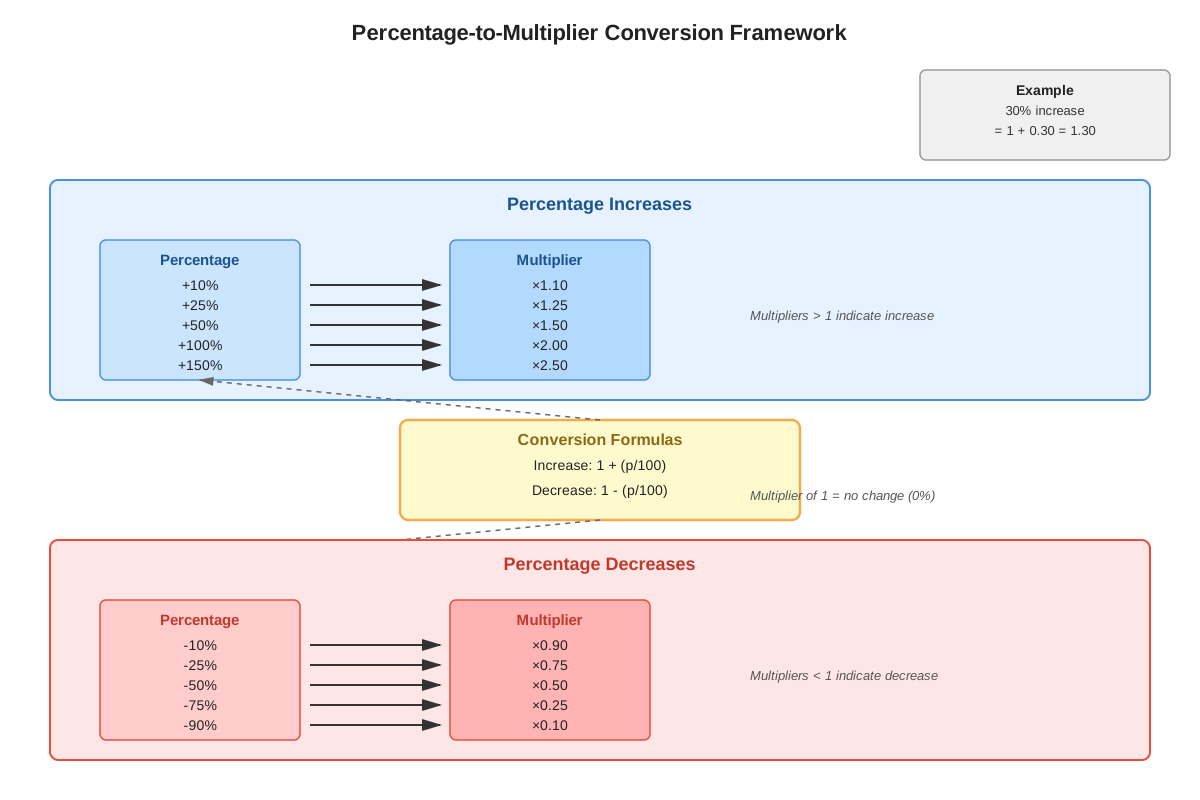
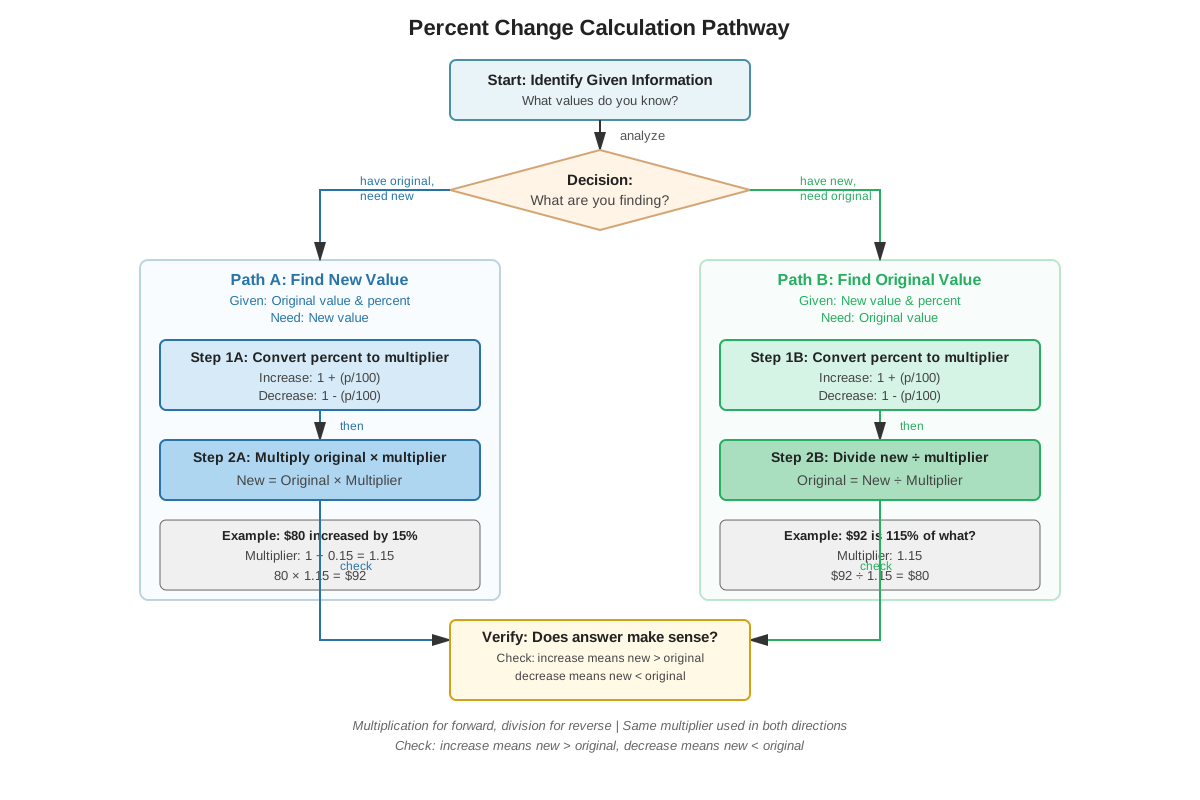
The fundamental principle of percent-rate connections lies in understanding that every percentage change corresponds to a multiplicative factor. When a quantity increases by a certain percentage, the new value equals the original value multiplied by (1 + the percentage expressed as a decimal). Conversely, when a quantity decreases, the multiplier is (1 - the percentage as a decimal).
For example:
- A 30% increase means multiplying by 1.30 (or 1 + 0.30)
- A 15% decrease means multiplying by 0.85 (or 1 - 0.15)
- A 100% increase means multiplying by 2.00 (doubling)
- A 50% decrease means multiplying by 0.50 (halving)
This conversion is bidirectional. If a quantity is multiplied by 1.45, this represents a 45% increase. If multiplied by 0.72, this represents a 28% decrease (since 1 - 0.72 = 0.28).
Successive Percentage Changes
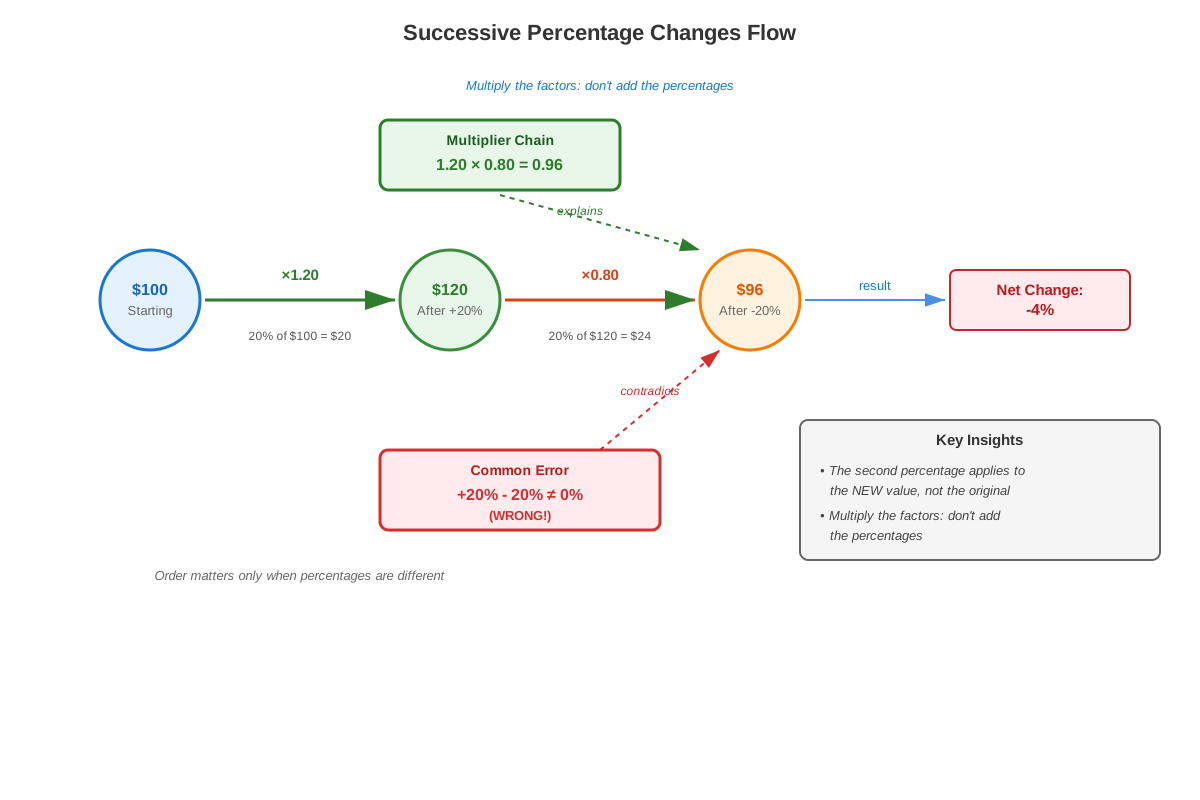
One of the most frequently tested aspects of percent-rate connections involves applying multiple percentage changes in sequence. A critical insight is that successive percentage changes are not additive—they are multiplicative. This means that a 20% increase followed by a 20% decrease does not return to the original value.
To calculate successive changes:
- Convert each percentage change to its multiplicative factor
- Multiply all factors together
- Convert the final product back to a percentage change
For instance, if a price increases by 25% and then decreases by 20%:
- First change: multiply by 1.25
- Second change: multiply by 0.80
- Combined effect: 1.25 × 0.80 = 1.00 (no net change)
The order of operations matters only when the base changes between steps, but when calculating the net effect on the original value, the order of multiplication does not matter due to the commutative property.
Percentage Points vs. Percentage Change
A crucial distinction that appears on the SAT involves the difference between percentage points and percentage change. If an interest rate increases from 5% to 8%, this represents:
- An increase of 3 percentage points (8 - 5 = 3)
- A percentage increase of 60% (3/5 = 0.60 or 60%)
This distinction frequently appears in data interpretation questions where students must calculate the correct type of change based on context clues in the question stem.
Rate-Percentage Connections in Time-Based Problems
When rates are expressed as percentages per unit time (such as "5% per year" or "2% per hour"), these connect to exponential growth and decay models. For SAT purposes, students must understand:
- Simple percentage change: The total change is the rate multiplied by time (linear growth)
- Compound percentage change: The rate applies to the current value at each time interval (exponential growth)
For simple change: Final Value = Initial Value × (1 + rate × time)
For compound change: Final Value = Initial Value × (1 + rate)^time
The SAT typically tests compound change scenarios, requiring students to recognize when a percentage rate applies repeatedly to changing values rather than always to the original value.
Percentage Increase and Decrease Relationships
An important mathematical relationship involves determining what percentage increase is needed to reverse a percentage decrease (and vice versa). If a value decreases by x%, the percentage increase needed to return to the original is not x%.
The formula for the required percentage increase after a decrease of d% is:
Required increase = d/(100-d) × 100%For example, after a 20% decrease (multiplying by 0.80), returning to the original requires a 25% increase (0.80 × 1.25 = 1.00). This asymmetry appears frequently in SAT problems involving price changes, population fluctuations, or measurement errors.
Percentage of a Percentage
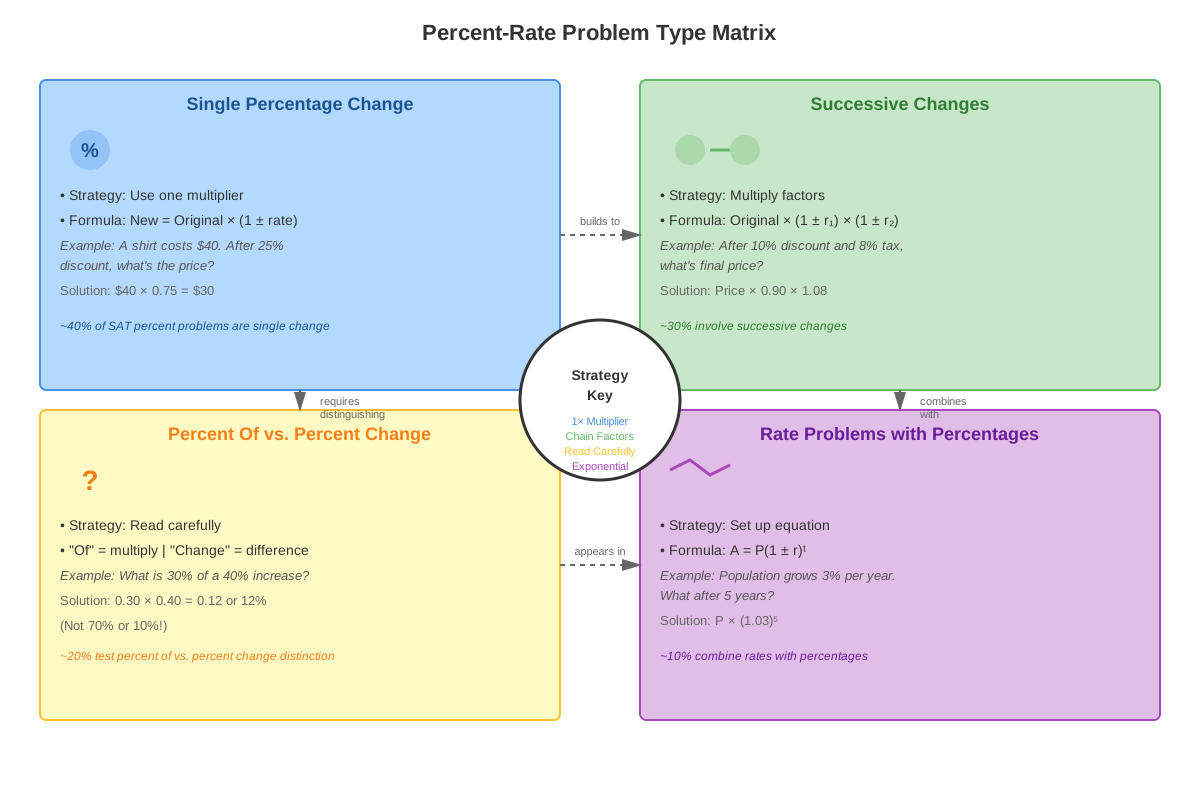
Some SAT questions require calculating a percentage of a quantity that is itself expressed as a percentage. For example, "What is 30% of a 40% discount?" This requires multiplying the percentages as decimals: 0.30 × 0.40 = 0.12 or 12%. This represents an additional 12% discount on the original price, not a 12% discount on the already-discounted price.
Concept Relationships
The concepts within percent-rate connections form a hierarchical structure where basic conversion skills enable more complex applications. Converting between percentages and multiplicative factors serves as the foundation → this enables successive percentage changes → which connects to compound rate problems → all of which require distinguishing percentage points from percentage change.
These internal connections link to prerequisite topics: proportional reasoning provides the conceptual framework for understanding why percentages represent parts of a whole, while decimal operations enable the computational fluency needed for conversions. The topic also connects forward to exponential functions (where percentage rates become the base of exponential expressions), linear modeling (where constant percentage changes create linear relationships), and data analysis (where percentage changes describe trends in datasets).
The relationship between rates and percentages manifests in the recognition that "per" language (miles per hour, dollars per item, percentage per year) always indicates a multiplicative relationship. This connects to unit rate concepts within the broader Ratios, Rates, and Proportions unit, creating a unified framework for understanding how quantities change relative to one another.
High-Yield Facts
⭐ A percentage increase of x% corresponds to multiplying by (1 + x/100), while a decrease corresponds to multiplying by (1 - x/100)
⭐ Successive percentage changes multiply their factors; they do not add their percentages
⭐ After a d% decrease, the percentage increase needed to return to the original is d/(100-d) × 100%
⭐ Percentage points measure absolute differences between percentages; percentage change measures relative differences
⭐ The order of successive percentage changes does not affect the final result when all changes apply to the same original value
- A 100% increase means doubling (multiplying by 2), while a 100% decrease means reducing to zero
- Multiplying by a factor less than 1 represents a decrease; multiplying by a factor greater than 1 represents an increase
- To find what percentage one number is of another, divide and multiply by 100: (part/whole) × 100%
- A 50% increase followed by a 50% decrease results in a 25% net decrease from the original (1.5 × 0.5 = 0.75)
- When a rate is given as "x% per time period," compound growth uses the formula: Final = Initial × (1 + x/100)^(number of periods)
- Converting a multiplier back to a percentage change: subtract 1 and multiply by 100 (e.g., 1.35 → 0.35 → 35% increase)
- The percentage change formula is: [(New - Original)/Original] × 100%
Quick check — test yourself on Percent-rate connections so far.
Try Flashcards →Common Misconceptions
Misconception: Adding successive percentage changes gives the total percentage change (e.g., +20% then +30% equals +50%)
Correction: Successive percentage changes multiply their factors. A 20% increase followed by a 30% increase means multiplying by 1.20 × 1.30 = 1.56, which is a 56% total increase, not 50%.
Misconception: A 20% increase followed by a 20% decrease returns to the original value
Correction: These changes do not cancel. Multiplying by 1.20 then 0.80 gives 0.96, representing a 4% net decrease from the original.
Misconception: Percentage points and percentage change are the same thing
Correction: If a value goes from 25% to 30%, this is an increase of 5 percentage points but a 20% increase (5/25 = 0.20). Percentage points measure absolute difference; percentage change measures relative difference.
Misconception: To reverse a 25% decrease, add 25% back
Correction: After decreasing by 25% (multiplying by 0.75), you need a 33.33% increase to return to the original (0.75 × 1.3333 = 1.00). The formula is 25/(100-25) × 100% = 33.33%.
Misconception: "30% of a 40% discount" means subtracting 30% from 40% to get 10%
Correction: This phrase means taking 30% of the 40% value: 0.30 × 0.40 = 0.12 or 12%. The calculation multiplies the percentages as decimals.
Misconception: When comparing percentage changes, a larger absolute change always represents a larger percentage change
Correction: Percentage change depends on the original value. An increase from 10 to 20 is a 100% increase, while an increase from 100 to 105 is only a 5% increase, despite the second having a larger absolute change.
Worked Examples
Example 1: Successive Discounts
Problem: A store offers a 30% discount on all items, and then applies an additional 20% discount at checkout. What is the total percentage discount on an item with an original price of $150?
Solution:
Step 1: Convert each discount to its multiplicative factor.
- First discount of 30%: multiply by (1 - 0.30) = 0.70
- Second discount of 20%: multiply by (1 - 0.20) = 0.80
Step 2: Multiply the factors to find the combined effect.
- Combined multiplier: 0.70 × 0.80 = 0.56
Step 3: Interpret the result.
- Multiplying by 0.56 means the customer pays 56% of the original price
- This represents a discount of (1 - 0.56) = 0.44 or 44%
Step 4: Calculate the final price (if needed).
- Final price: $150 × 0.56 = $84
- Total savings: $150 - $84 = $66
Key insight: The total discount (44%) is not equal to 30% + 20% = 50%. Successive discounts are always less favorable than their sum would suggest because the second discount applies to an already-reduced price.
Connection to learning objectives: This example demonstrates applying percent-rate connections to solve multi-step SAT problems and converting between percentage changes and multiplicative factors.
Example 2: Reversing a Percentage Change
Problem: A population decreased by 40% due to a natural disaster. By what percentage must the population increase to return to its original size?
Solution:
Step 1: Understand what the 40% decrease means.
- The population is now 60% of its original size (multiplied by 0.60)
Step 2: Set up an equation to find the required increase.
- Let x = the required percentage increase (as a decimal)
- Current population × (1 + x) = Original population
- 0.60 × (1 + x) = 1.00
Step 3: Solve for x.
- 1 + x = 1.00/0.60
- 1 + x = 1.6667
- x = 0.6667 or 66.67%
Step 4: Verify using the formula.
- Required increase = 40/(100-40) × 100% = 40/60 × 100% = 66.67% ✓
Alternative approach: Think multiplicatively from the start.
- Decreased to 0.60 of original
- To return to 1.00, multiply by 1.00/0.60 = 5/3 ≈ 1.6667
- This represents a 66.67% increase
Key insight: The percentage increase needed to reverse a decrease is always larger than the original decrease percentage. This asymmetry is a high-yield concept for SAT questions.
Connection to learning objectives: This example illustrates identifying key features of percent-rate connections (the asymmetry between increases and decreases) and applying these concepts to solve SAT-style problems.
Exam Strategy
When approaching SAT questions involving percent-rate connections, begin by identifying whether the problem involves a single percentage change or successive changes. Trigger words to watch for include: "then," "followed by," "after," "additional," and "successive"—all of which signal multiple percentage changes that must be multiplied, not added.
For questions asking about the "total" or "net" percentage change, immediately convert each percentage to its multiplicative factor and multiply them together. Avoid the temptation to add percentages, which is the most common trap answer the SAT provides. If you see an answer choice that equals the sum of the given percentages, it is almost certainly incorrect.
When time is limited, use estimation strategically. For a 20% increase followed by a 30% increase, you know the answer must be greater than 30% but less than 50% (since 1.2 × 1.3 = 1.56, or 56%). This allows you to eliminate answer choices quickly. Similarly, for any increase followed by a decrease (or vice versa), the net change will be less than the larger of the two individual changes.
Process of elimination tips:
- Eliminate any answer that simply adds or subtracts the given percentages
- For successive changes of the same type (both increases or both decreases), the result must be more extreme than either individual change
- For opposite changes (one increase, one decrease), the result must be less extreme than the larger change
- If a question asks for the percentage needed to reverse a change, eliminate the answer that equals the original change percentage
Time allocation: Straightforward conversion problems should take 30-45 seconds. Multi-step word problems may require 90-120 seconds. If a problem requires more than two minutes, mark it and return later—there may be a simpler approach you're missing.
Always read carefully to distinguish between "percentage of" (multiplication), "percentage increase/decrease" (change from original), and "percentage points" (absolute difference). The SAT deliberately uses these phrases to test precise understanding.
Memory Techniques
Mnemonic for conversion: "Plus for Positive, Minus for Minus"
- Percentage increase: 1 Plus the decimal (1 + 0.25 for 25% increase)
- Percentage decrease: 1 Minus the decimal (1 - 0.25 for 25% decrease)
Visualization for successive changes: Picture a ladder where each rung represents a percentage change. You can't skip rungs (add percentages); you must climb each one (multiply factors). The height you reach depends on climbing each rung in sequence.
Acronym for percentage change formula: "NOW"
- New minus Old, over Old, times 100 = Whole percentage change
- Formula: [(New - Old)/Old] × 100%
Memory anchor for asymmetry: Remember the "50-50 rule"—a 50% increase followed by a 50% decrease leaves you at 75% of the original (1.5 × 0.5 = 0.75). This memorable example helps recall that opposite changes don't cancel.
Rhyme for percentage points: "Points are plain, change is relative—don't let the SAT be negative!" This reminds you that percentage points are simple subtraction (plain), while percentage change requires division (relative to the original).
Summary
Percent-rate connections form a critical bridge between percentage concepts and multiplicative reasoning, enabling students to solve complex SAT problems involving successive changes, rate comparisons, and real-world applications. The core principle is that every percentage change corresponds to a multiplicative factor: increases use (1 + decimal), decreases use (1 - decimal). Successive percentage changes multiply their factors rather than adding their percentages, creating a net effect that differs from simple addition. Understanding the asymmetry between increases and decreases—where reversing a percentage change requires a different percentage in the opposite direction—is essential for avoiding common traps. The distinction between percentage points (absolute differences) and percentage change (relative differences) appears frequently in data interpretation questions. Mastery requires fluent conversion between percentages and multipliers, recognition of compound versus simple change scenarios, and the ability to set up multi-step calculations efficiently. These skills connect to broader mathematical concepts including exponential functions, proportional reasoning, and algebraic modeling, making percent-rate connections a high-yield topic that impacts performance across multiple SAT Math question types.
Key Takeaways
- Convert percentages to multipliers: increase by x% means multiply by (1 + x/100); decrease by x% means multiply by (1 - x/100)
- Successive changes multiply: never add percentages for sequential changes; convert to factors and multiply them together
- Opposite changes don't cancel: a 20% increase followed by a 20% decrease results in a 4% net decrease, not zero change
- Reversing changes requires different percentages: after a d% decrease, you need d/(100-d) × 100% increase to return to the original
- Distinguish percentage points from percentage change: points measure absolute differences; change measures relative differences
- Order doesn't matter for multiplication: 1.2 × 0.8 = 0.8 × 1.2, so successive changes can be calculated in any sequence
- Watch for compound versus simple change: rates "per time period" typically indicate compound change where the percentage applies to the current value repeatedly
Related Topics
Exponential Growth and Decay: Percent-rate connections provide the foundation for understanding exponential functions where the base represents (1 + rate). Mastering percentage-to-multiplier conversions enables quick recognition of growth factors in exponential models.
Linear Functions and Slope: When percentage changes occur at constant rates over time, they create linear relationships. Understanding how rates connect to percentages helps interpret slope as a rate of change.
Ratio and Proportion: Percentages are special ratios (parts per hundred), so percent-rate connections deepen understanding of how ratios scale and how proportional relationships manifest in different forms.
Data Analysis and Statistics: Calculating percentage changes from tables and graphs, interpreting percentage-based trends, and comparing rates across datasets all rely on the concepts developed in this topic.
Financial Mathematics: Interest rates, investment returns, loan calculations, and compound interest all build directly on percent-rate connections, making this topic essential for real-world financial literacy.
Practice CTA
Now that you've mastered the core concepts of percent-rate connections, it's time to solidify your understanding through active practice. Attempt the practice questions to test your ability to convert between percentages and multipliers, calculate successive changes, and solve multi-step word problems under timed conditions. Use the flashcards to drill the high-yield facts and formulas until they become automatic. Remember: understanding the concepts is the first step, but achieving SAT success requires applying them quickly and accurately under pressure. Each practice problem you solve builds the pattern recognition and computational fluency that will help you confidently tackle any percent-rate question on test day. You've got this!
Sign up free to keep reading
Create a free AnvayaPrep account to finish this SAT guide on Percent-rate connections — plus flashcards and practice questions.