Overview
Rates in graphs represent one of the most frequently tested concepts on the SAT math section, appearing in approximately 10-15% of all quantitative questions. This topic combines algebraic reasoning with visual interpretation skills, requiring students to extract numerical relationships from coordinate planes, line graphs, and other visual representations. Understanding how rates manifest graphically is essential because the SAT consistently tests whether students can translate between different representations of the same mathematical relationship—moving fluidly from equations to tables to graphs and back again.
The fundamental principle underlying this topic is that rates describe how one quantity changes relative to another, and when displayed graphically, this relationship becomes visible as slope, steepness, or the pattern of change over time. On the SAT, students encounter rate problems involving distance-time relationships, cost-quantity relationships, work-rate scenarios, and proportional reasoning—all presented through various graphical formats. Mastering sat rates in graphs requires both computational skills and visual literacy, as questions often demand that students identify the meaning of specific graph features like intercepts, slopes, intersection points, and intervals of increase or decrease.
This topic serves as a bridge between multiple mathematical domains tested on the SAT. It connects directly to linear functions, systems of equations, data analysis, and problem-solving in context. Students who excel at interpreting rates in graphs demonstrate higher-order thinking by recognizing that the same real-world situation can be represented multiple ways, and they can leverage graphical information to solve problems more efficiently than purely algebraic approaches would allow.
Learning Objectives
- [ ] Identify key features of rates in graphs, including slope, intercepts, and intervals of change
- [ ] Explain how rates in graphs appears on the SAT, including common question formats and contexts
- [ ] Apply rates in graphs to answer SAT-style questions involving real-world scenarios
- [ ] Calculate rates from graphical information by determining slope between two points
- [ ] Compare multiple rates presented simultaneously on the same coordinate plane
- [ ] Interpret the meaning of graphical features (intercepts, intersections, steepness) in context
- [ ] Translate between graphical, tabular, and algebraic representations of rates
Prerequisites
- Basic coordinate plane understanding: Students must know how to read ordered pairs (x, y) and understand the Cartesian coordinate system, as all rate graphs use this framework
- Slope concept: Familiarity with rise over run and the meaning of positive, negative, zero, and undefined slopes is essential for interpreting rate information
- Unit rates and ratios: Understanding how to express relationships between quantities (miles per hour, dollars per item) provides the foundation for graphical rate interpretation
- Linear equation basics: Knowledge of y = mx + b form helps connect algebraic and graphical representations of rates
- Reading tables and charts: Basic data literacy skills enable students to extract information from various visual formats
Why This Topic Matters
In real-world applications, rates in graphs appear constantly in professional and personal contexts. Financial analysts interpret stock price changes over time, scientists track reaction rates in experiments, engineers monitor speed and acceleration in vehicle design, and healthcare professionals analyze patient vital signs trending over hours or days. The ability to quickly extract rate information from visual displays is a critical skill for data-driven decision-making across virtually every career field.
On the SAT specifically, rates in graphs questions appear in both the calculator and no-calculator sections, typically comprising 3-5 questions per test. These questions most commonly appear as:
- Distance-time graphs requiring calculation of speed or velocity
- Cost-quantity graphs asking students to determine unit prices or compare pricing structures
- Work-rate scenarios showing progress over time for one or more workers/machines
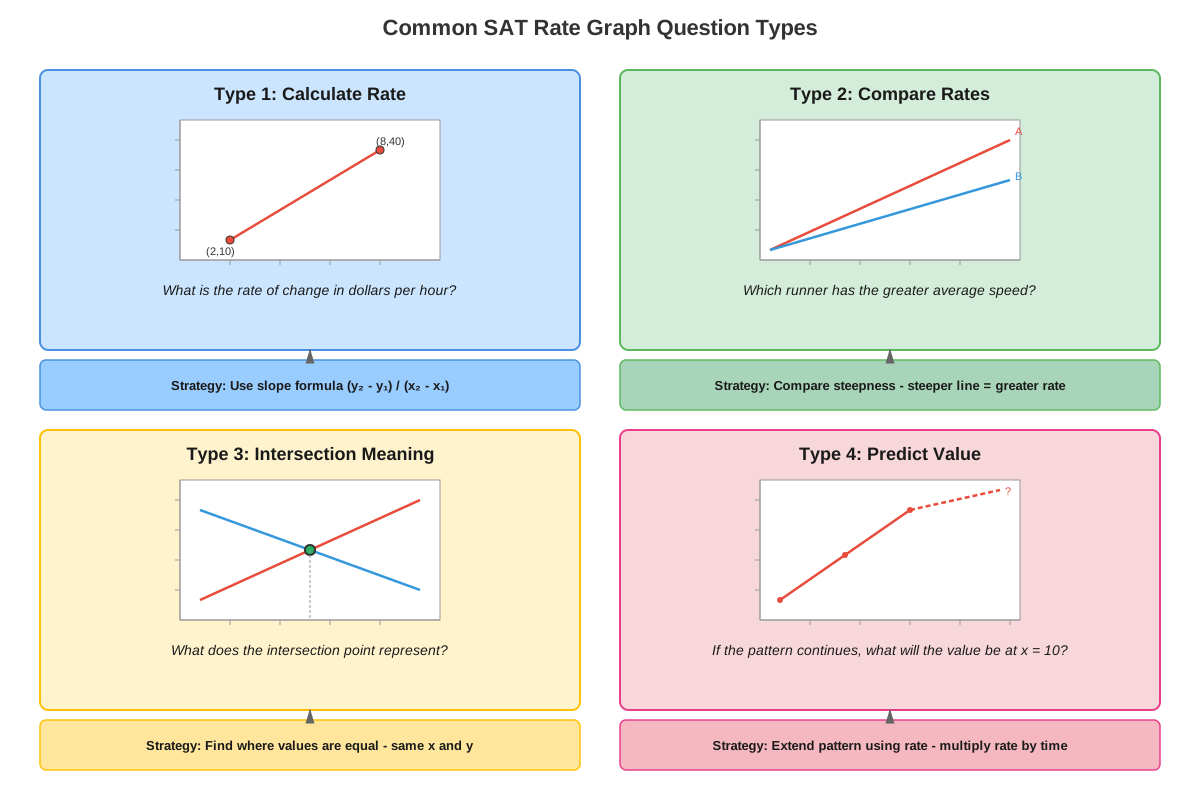
- Comparison problems presenting multiple lines on the same graph and asking which represents a faster/slower rate
- Interpretation questions requiring students to explain what a specific graph feature means in context
The College Board consistently includes these questions because they assess multiple competencies simultaneously: mathematical reasoning, visual interpretation, contextual understanding, and the ability to move between representations. Questions range from straightforward slope calculations to complex multi-step problems requiring synthesis of graphical and algebraic information.
Core Concepts
Understanding Rate as Slope
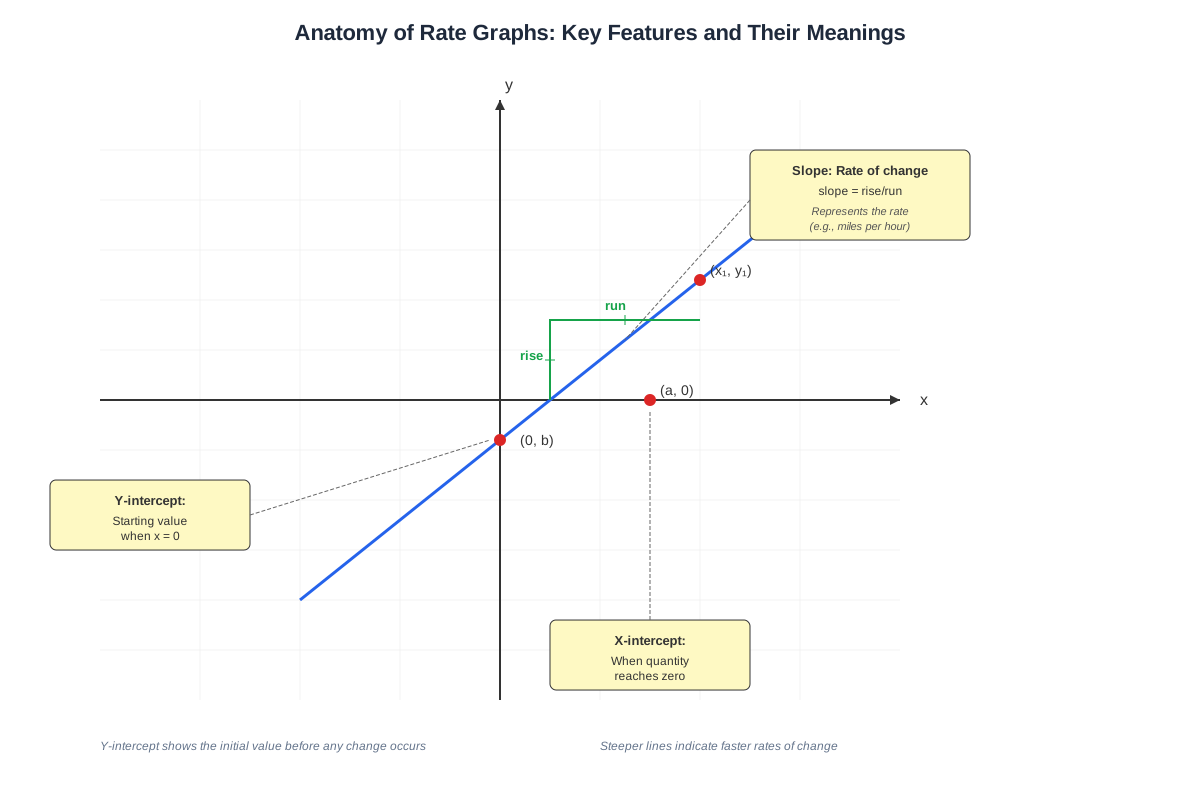
The most fundamental concept in rates in graphs is that rate equals slope. When a graph displays how one quantity changes with respect to another, the steepness of the line—its slope—represents the rate of change. Mathematically, slope is calculated as:
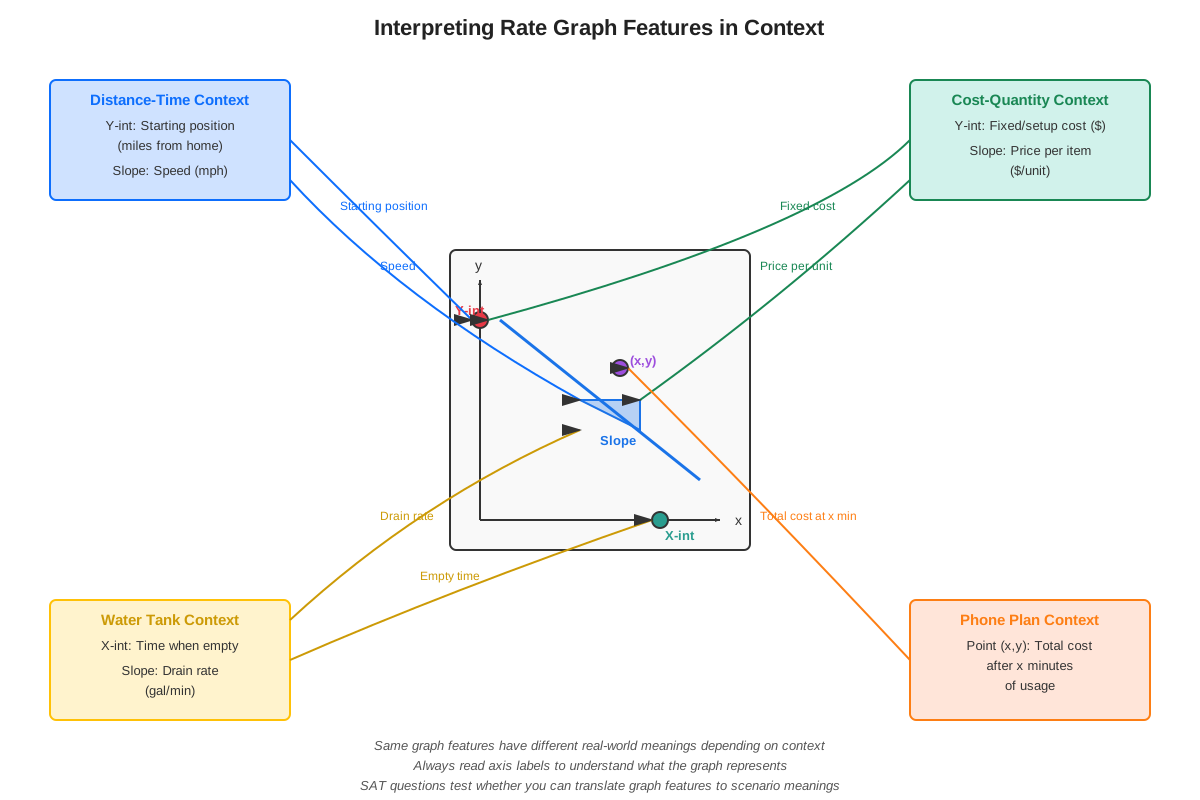
slope = (change in y) / (change in x) = (y₂ - y₁) / (x₂ - x₁)For a distance-time graph, slope represents speed (distance per unit time). For a cost-quantity graph, slope represents unit price (cost per item). The units of the rate always match the units of the vertical axis divided by the units of the horizontal axis. A steeper line indicates a faster rate, while a flatter line indicates a slower rate. Horizontal lines (slope = 0) represent zero rate of change, meaning the y-value remains constant regardless of x-value changes.
Interpreting Y-Intercepts in Rate Contexts
The y-intercept—where a line crosses the vertical axis—carries specific meaning in rate problems. This point represents the initial value or starting condition when the independent variable (x) equals zero. In a distance-time graph, the y-intercept shows the starting position or initial distance from a reference point. In a cost scenario, it often represents a fixed fee, base charge, or initial cost before any units are purchased. Understanding y-intercepts is crucial because many SAT questions ask students to interpret what this value means in the context of the problem, not just identify its numerical value.
Comparing Multiple Rates on One Graph
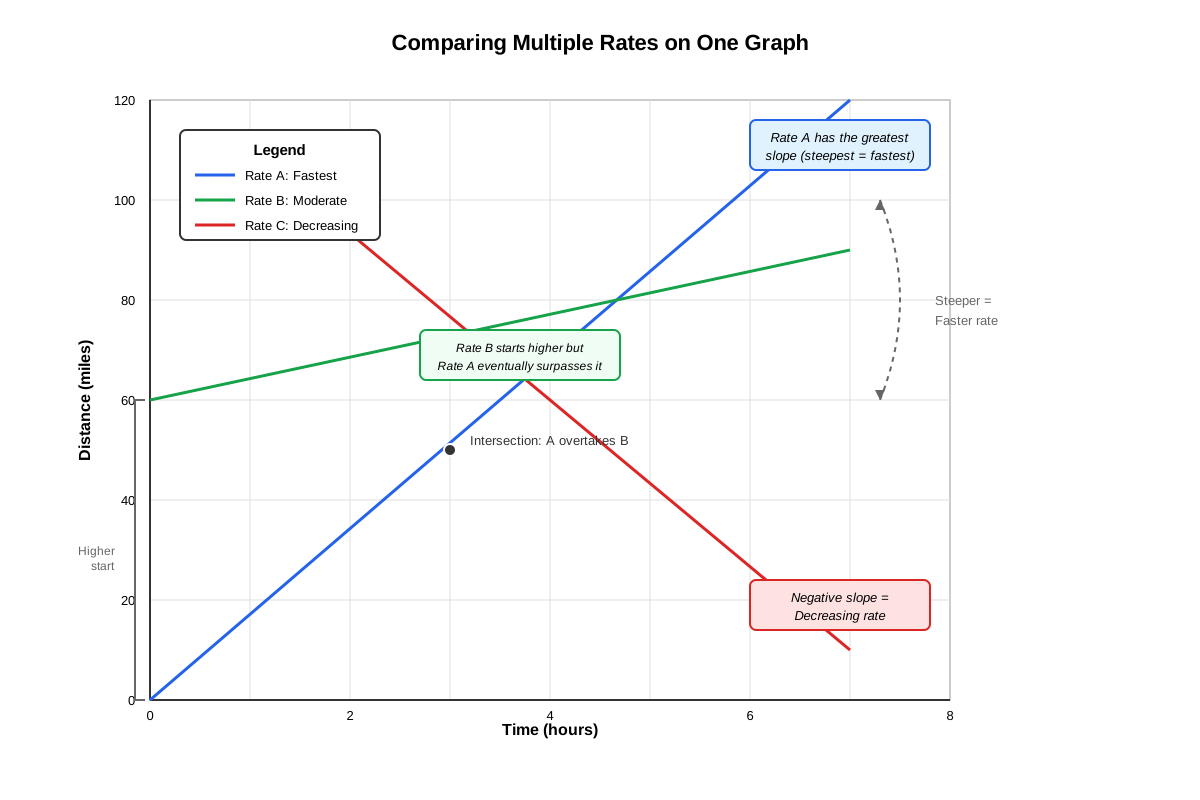
SAT questions frequently present multiple lines on a single coordinate plane, requiring students to compare rates between different scenarios. When comparing rates graphically:
| Graph Feature | Rate Comparison | Interpretation |
|---|---|---|
| Steeper slope | Faster rate | Greater change per unit |
| Flatter slope | Slower rate | Smaller change per unit |
| Parallel lines | Equal rates | Same slope, different starting points |
| Intersection point | Rates equal at that moment | Values are the same at that x-coordinate |
| Lines diverging | Rate difference increasing | Gap between values growing |
| Lines converging | Rate difference decreasing | Values approaching each other |
The line with the greater slope represents the faster rate. If two lines intersect, they have equal values at the intersection point, but their rates (slopes) determine which will be greater before and after that point.
Non-Linear Rate Graphs
While many SAT rate problems involve linear relationships, some questions present curved graphs where the rate itself changes. For these graphs, the rate at any point is represented by the slope of the tangent line at that point. A curve that becomes steeper indicates an increasing rate, while a curve that becomes flatter indicates a decreasing rate. Students should recognize that:
- Concave up curves (opening upward) show accelerating rates
- Concave down curves (opening downward) show decelerating rates
- Inflection points mark where the rate of change shifts from increasing to decreasing or vice versa
Piecewise Rate Graphs
Many real-world scenarios involve rates that change at specific points, creating piecewise linear graphs with distinct segments. For example, a taxi fare might have one rate for the first mile and a different rate for additional miles, or a worker might complete a task at one rate initially and then slow down. These graphs show connected line segments with different slopes. SAT questions often ask students to:
- Calculate the rate during a specific interval
- Identify when the rate changed
- Determine the total change across multiple intervals
- Explain what caused the rate change in context
Negative Rates and Decreasing Relationships
When a line slopes downward from left to right, it represents a negative rate—the y-value decreases as the x-value increases. In context, this might represent distance from home decreasing over time (traveling toward home), account balance decreasing over time (spending money), or temperature dropping over hours. The absolute value of the slope still indicates the rate's magnitude, but the negative sign shows the direction of change. Students must carefully interpret whether a question asks for the rate of decrease (which could be stated as a positive number) or the rate of change (which would be negative).
Reading Rates from Points
When a graph doesn't show a continuous line but instead displays discrete points, students must calculate rate by selecting two points and applying the slope formula. The SAT often presents scatter plots or data points and asks for the average rate of change between specific points. The key is identifying the correct points to use—typically those specified in the question or those at the boundaries of the interval of interest.
Concept Relationships
The concepts within rates in graphs form an interconnected system where understanding one element enhances comprehension of others. Rate as slope serves as the foundational concept, from which all other interpretations flow. This connects directly to y-intercepts, as together they form the complete linear equation (y = mx + b) that describes the rate relationship algebraically.
Comparing multiple rates builds upon the slope concept by requiring students to evaluate relative steepness, which then connects to intersection points where equal rates occur. The ability to interpret piecewise graphs requires mastery of both single-rate interpretation and the comparison skills needed to understand how rates change across intervals.
Negative rates represent a special case of the general slope concept, requiring students to consider both magnitude and direction. This connects back to prerequisite knowledge of the coordinate plane and signed numbers.
The relationship map flows as follows:
Coordinate Plane Basics → Slope Calculation → Rate as Slope → Single Rate Interpretation → Multiple Rate Comparison → Intersection Analysis → Piecewise and Complex Graphs
Simultaneously: Y-intercept Understanding + Rate as Slope → Complete Linear Model → Contextual Interpretation
These concepts also connect to broader SAT math topics: rates in graphs link to linear functions (same mathematical structure), systems of equations (intersection points represent solutions), data analysis (interpreting real-world data), and problem-solving in context (translating between representations).
Quick check — test yourself on Rates in graphs so far.
Try Flashcards →High-Yield Facts
⭐ The slope of a line on a rate graph equals the rate of change; steeper slopes indicate faster rates
⭐ On distance-time graphs, slope represents speed or velocity (distance per unit time)
⭐ The y-intercept represents the initial value or starting condition when x = 0
⭐ When two lines intersect on a rate graph, the quantities are equal at that point, but the rates (slopes) may differ
⭐ Horizontal lines (slope = 0) indicate no change in the y-variable regardless of x-variable changes
- Parallel lines on a rate graph have equal rates but different starting values (same slope, different y-intercepts)
- A line with negative slope represents a decreasing relationship where y decreases as x increases
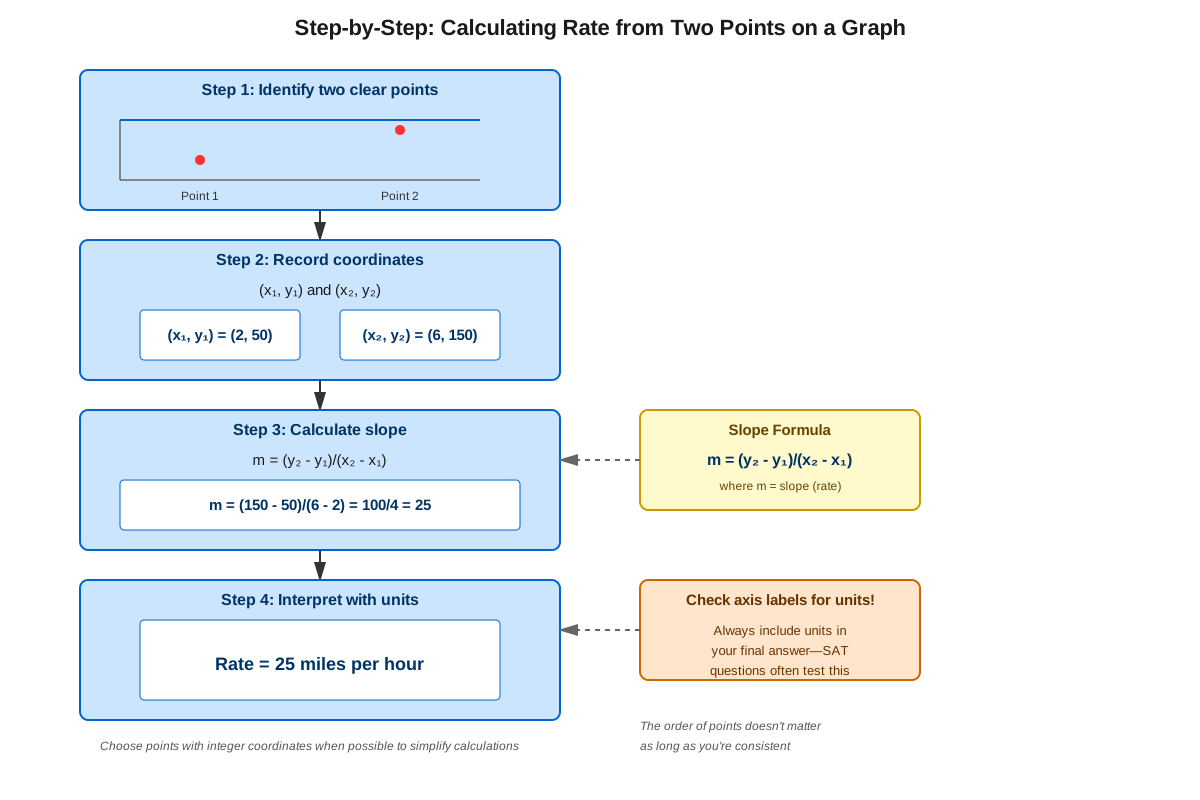
- The rate between any two points can be calculated using (y₂ - y₁)/(x₂ - x₁)
- On cost-quantity graphs, the slope represents unit price or cost per item
- Piecewise linear graphs show different rates during different intervals, with slope changes at transition points
- The steeper of two lines will eventually have the greater y-value if both have positive slopes and the steeper line starts at or above the other
- For curved graphs, the rate is changing continuously, with steeper sections indicating faster rates at those points
- The units of a rate always equal the units of the y-axis divided by the units of the x-axis
Common Misconceptions
Misconception: The y-intercept always represents zero or the starting point of an event → Correction: The y-intercept represents the y-value when x = 0, which may not be the actual starting point of the scenario. For example, if time starts at x = 2, the y-intercept shows a hypothetical value that may not have real-world meaning.
Misconception: A steeper line always means a better or more desirable outcome → Correction: Steepness indicates rate magnitude, not value judgment. A steeper line on a cost graph means higher prices (typically undesirable), while a steeper line on an earnings graph means higher income (typically desirable). Context determines interpretation.
Misconception: The intersection point of two lines means the rates are equal → Correction: The intersection point means the y-values are equal at that x-value, but the rates (slopes) are different unless the lines are identical. The rates are represented by the slopes, not by the intersection.
Misconception: Negative slope means a negative rate → Correction: While the slope value is negative, the rate of change is negative, but the rate's magnitude (absolute value) is positive. For example, "decreasing at 5 mph" has a rate of change of -5 mph but a speed (rate magnitude) of 5 mph.
Misconception: All rate graphs are straight lines → Correction: Many real-world rates change over time, creating curved graphs. Straight lines represent constant rates, while curves represent variable rates. The SAT includes both types.
Misconception: You need the equation to find the rate from a graph → Correction: The rate can be calculated directly from any two points on the graph using the slope formula, without needing the equation. Visual information is sufficient.
Misconception: The x-axis always represents time → Correction: While time is common, the x-axis can represent any independent variable—quantity purchased, distance traveled, number of items, etc. Always check axis labels.
Worked Examples
Example 1: Distance-Time Graph Comparison
Problem: The graph below shows the distance from home over time for two cyclists, Alex and Bailey. Alex's journey is represented by the steeper line, and Bailey's by the flatter line. Both start from the same location at time t = 0. If Alex's line passes through points (0, 0) and (2, 30), and Bailey's line passes through points (0, 0) and (2, 20), answer the following:
(a) What is each cyclist's speed in miles per hour?
(b) After 3 hours, how much farther from home is Alex compared to Bailey?
Solution:
(a) To find speed, calculate the slope of each line (rate = distance/time):
Alex's speed:
slope = (30 - 0)/(2 - 0) = 30/2 = 15 miles per hourBailey's speed:
slope = (20 - 0)/(2 - 0) = 20/2 = 10 miles per hourAlex travels at 15 mph, and Bailey travels at 10 mph.
(b) To find the distance after 3 hours, use the rate to calculate:
Alex's distance after 3 hours: 15 mph × 3 hours = 45 miles
Bailey's distance after 3 hours: 10 mph × 3 hours = 30 miles
Difference: 45 - 30 = 15 miles
Alex is 15 miles farther from home than Bailey after 3 hours.
Connection to Learning Objectives: This problem requires identifying key features (slope as rate), calculating rates from graphical information, and comparing multiple rates—addressing three core learning objectives simultaneously.
Example 2: Cost Graph with Y-Intercept
Problem: A phone company's monthly bill is represented by a linear graph where the x-axis shows gigabytes of data used and the y-axis shows total cost in dollars. The line passes through points (0, 25) and (5, 45).
(a) What does the y-intercept represent in this context?
(b) What is the cost per gigabyte of data?
(c) Write an equation representing the total cost.
Solution:
(a) The y-intercept is 25, which occurs when x = 0 (zero gigabytes used). This represents the base monthly fee or fixed charge before any data is used. Even if a customer uses no data, they pay $25.
(b) The cost per gigabyte is the slope (rate):
slope = (45 - 25)/(5 - 0) = 20/5 = 4 dollars per gigabyteEach gigabyte of data costs $4.
(c) Using slope-intercept form (y = mx + b):
- m (slope/rate) = 4
- b (y-intercept) = 25
- Equation: y = 4x + 25 or Cost = 4(gigabytes) + 25
Connection to Learning Objectives: This problem demonstrates how to interpret y-intercepts in context, calculate rates from graphs, and translate between graphical and algebraic representations—all essential SAT skills for rates in graphs.
Exam Strategy
When approaching SAT questions on rates in graphs, follow this systematic process:
Step 1: Identify what the axes represent. Read the axis labels carefully and note the units. Understanding what quantities are being related is essential before attempting any calculations. Look for time, distance, cost, quantity, or other variables.
Step 2: Determine what the question asks. SAT questions may ask for the rate itself, a specific value at a given point, a comparison between rates, or an interpretation of a graph feature. Underline or circle the specific question being asked.
Step 3: Locate relevant points. Identify the coordinates you need—either given explicitly, readable from the graph, or calculable from other information. For rate calculations, you need two points on the line.
Step 4: Calculate or compare as needed. Apply the slope formula if calculating a rate, or visually compare steepness if determining which rate is faster. Show your work systematically.
Exam Tip: When comparing rates, you don't always need to calculate exact values. If the question asks "which is faster," visual comparison of steepness is often sufficient and saves time.
Trigger words and phrases to watch for:
- "Rate of change" → calculate slope
- "Initially" or "at the start" → look at y-intercept
- "Faster" or "slower" → compare slopes
- "When are they equal" → find intersection point
- "During the interval" → focus on a specific section of the graph
- "Per unit" → the rate is being requested
- "How much more/less" → calculate difference between values
Process-of-elimination tips:
- Eliminate answers with incorrect units (rate units should be y-axis units per x-axis units)
- Eliminate answers that contradict the visual (if line A is clearly steeper, eliminate answers saying line B is faster)
- For interpretation questions, eliminate answers that confuse rate with value or slope with y-intercept
- Check extreme cases: if an answer doesn't make sense at x = 0 or at large x-values, eliminate it
Time allocation: Spend 30-45 seconds reading and understanding the graph, 30-60 seconds on calculations, and 15-30 seconds checking your answer against the context. Don't rush the interpretation phase—misunderstanding what the graph represents causes more errors than calculation mistakes.
Memory Techniques
RISE mnemonic for slope/rate:
- Rate
- Is
- Slope
- Everywhere (on graphs)
"Steep Speed" visualization: Picture a steep hill—the steeper it is, the faster you'd roll down it. Similarly, steeper lines mean faster rates. This visual connection helps remember that steepness = rate magnitude.
Y-intercept = "Year Zero" analogy: Think of the y-intercept as what happens at "year zero" or the beginning before anything else occurs. This helps remember it represents the initial or starting value.
"Intersection = Equal" phrase: When lines intersect, they're "meeting as equals"—their values are equal at that point. This distinguishes intersection (equal values) from parallel (equal rates).
Units acronym - YOYO (Y Over X, Obviously):
Rate units are always Y-axis units Over (divided by) X-axis units. This prevents unit confusion.
Negative slope = "Negative Nancy going down": Visualize a character walking downhill (left to right) to remember that negative slopes decrease as you move right.
Summary
Rates in graphs represent one of the highest-yield topics on the SAT math section, testing students' ability to interpret visual representations of quantitative relationships. The core principle is that rate equals slope—the steepness of a line directly indicates how quickly one quantity changes relative to another. Students must master calculating slope from two points, interpreting y-intercepts as initial values, comparing multiple rates by evaluating relative steepness, and translating between graphical, algebraic, and contextual representations. Common graph types include distance-time (where slope is speed), cost-quantity (where slope is unit price), and work-rate scenarios. Key skills include identifying when lines intersect (equal values at that point), recognizing that parallel lines have equal rates but different starting values, and understanding that negative slopes represent decreasing relationships. Success on SAT questions requires both computational accuracy and contextual interpretation—students must not only calculate rates correctly but also explain what those rates mean in real-world terms.
Key Takeaways
- Rate equals slope: The steepness of a line on a graph directly represents the rate of change between the two variables
- Steeper means faster: When comparing multiple rates on one graph, the line with the greater slope represents the faster rate
- Y-intercept shows initial value: The point where a line crosses the y-axis represents the starting condition when the x-variable equals zero
- Intersection means equal values: When two lines cross, the quantities are equal at that specific x-value, though their rates (slopes) differ
- Units matter: Rate units always equal y-axis units divided by x-axis units; checking units helps verify answer reasonableness
- Context drives interpretation: The same graph feature (like a negative slope) means different things depending on what the axes represent
- Visual and algebraic skills combine: SAT questions require both the ability to extract information from graphs and to perform calculations with that information
Related Topics
Linear Functions and Equations: Understanding rates in graphs provides direct preparation for more complex linear function problems, including writing equations from graphs, solving systems graphically, and modeling real-world situations with linear relationships.
Systems of Equations: The intersection points on rate graphs represent solutions to systems of equations, connecting graphical and algebraic solution methods. Mastering rate graph interpretation makes systems problems more intuitive.
Data Analysis and Scatterplots: Rate concepts extend to analyzing trends in data, calculating lines of best fit, and interpreting correlation—all frequent SAT topics that build on rate graph foundations.
Quadratic and Exponential Functions: After mastering linear rates, students progress to variable rates represented by curves, requiring understanding of how rate changes across a function's domain.
Word Problems and Modeling: Rate graph skills directly support solving complex word problems by providing a visual framework for understanding relationships between quantities before attempting algebraic solutions.
Practice CTA
Now that you've mastered the core concepts of rates in graphs, it's time to solidify your understanding through active practice. Attempt the practice questions designed specifically for this topic—they mirror actual SAT question formats and difficulty levels. Use the flashcards to reinforce key definitions and relationships until you can recall them instantly. Remember, the SAT rewards both accuracy and speed, and the only way to develop both is through deliberate practice. Each problem you solve strengthens your pattern recognition and builds the confidence you need to excel on test day. You've built the foundation—now construct mastery through application!
Sign up free to keep reading
Create a free AnvayaPrep account to finish this SAT guide on Rates in graphs — plus flashcards and practice questions.