Overview
Ratio word problems are among the most frequently tested question types in SAT math, appearing in both the calculator and no-calculator sections. These problems require students to interpret relationships between quantities expressed as ratios and use proportional reasoning to solve real-world scenarios. Unlike straightforward computational questions, sat ratio word problems demand careful reading comprehension, translation of verbal descriptions into mathematical relationships, and strategic problem-solving approaches.
Mastering ratio word problems is essential for SAT success because they test multiple mathematical competencies simultaneously: algebraic thinking, proportional reasoning, and the ability to set up equations from contextual information. These questions typically appear 3-5 times per test and can range from straightforward two-part ratios to complex multi-step problems involving combined ratios, scaling, and unit conversions. The College Board consistently includes these problems because they assess mathematical reasoning skills that extend far beyond memorized procedures.
Ratio word problems connect to broader mathematical concepts including proportions, rates, percentages, and linear relationships. They serve as a foundation for understanding more advanced topics like direct and inverse variation, similar figures in geometry, and probability. Students who develop strong ratio problem-solving skills gain a versatile toolkit applicable across multiple SAT math domains, making this topic a high-leverage investment of study time.
Learning Objectives
- [ ] Identify key features of ratio word problems, including the quantities being compared and the relationship structure
- [ ] Explain how ratio word problems appear on the SAT, including common formats and question stems
- [ ] Apply ratio word problems strategies to answer SAT-style questions efficiently and accurately
- [ ] Translate verbal ratio descriptions into mathematical expressions and equations
- [ ] Solve multi-step ratio problems involving scaling, combining ratios, and finding unknown quantities
- [ ] Recognize when to use part-to-part versus part-to-whole ratio interpretations
- [ ] Verify solutions by checking whether they satisfy the original ratio relationships
Prerequisites
- Basic fraction operations: Ratios are fundamentally fractions, requiring comfort with simplification, multiplication, and division of fractions
- Algebraic equation solving: Most ratio problems require setting up and solving linear equations with one or more variables
- Unit analysis: Understanding how to work with different units and convert between them when necessary
- Proportional reasoning: Recognizing when two ratios are equivalent and understanding cross-multiplication
- Word problem interpretation: Ability to extract numerical information and relationships from written descriptions
Why This Topic Matters
Ratio word problems appear throughout everyday life: adjusting recipe quantities, understanding map scales, comparing prices per unit, analyzing financial ratios, and interpreting statistical data. In professional contexts, ratios are fundamental to fields including architecture (scale drawings), medicine (dosage calculations), business (financial analysis), and engineering (gear ratios and scaling). Developing ratio reasoning strengthens quantitative literacy essential for informed decision-making.
On the SAT, ratio word problems appear with high frequency—typically 3-5 questions per test across both math sections. These questions account for approximately 8-12% of the total math score, making them one of the highest-yield topics for focused study. The College Board favors ratio problems because they efficiently assess multiple mathematical practices: making sense of problems, reasoning abstractly, attending to precision, and looking for structure.
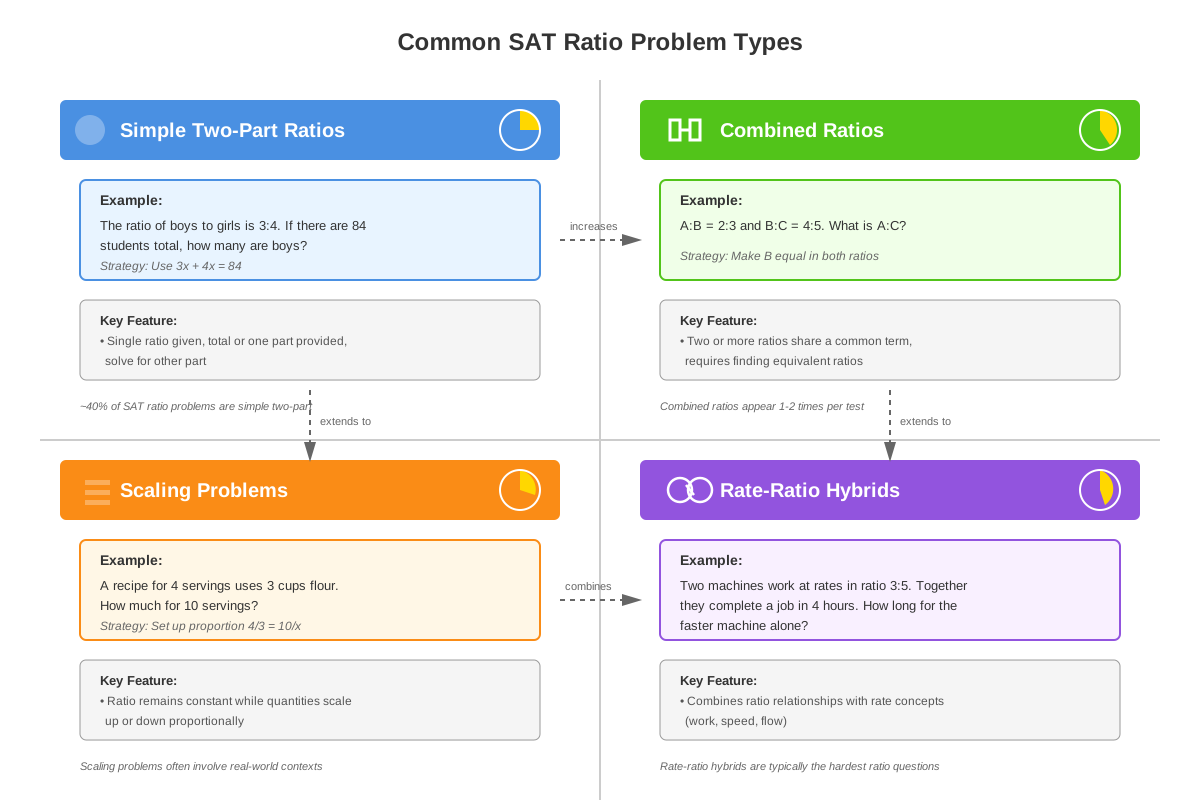
Common SAT formats include: comparing quantities in recipes or mixtures, analyzing survey or population data expressed as ratios, solving problems involving scale drawings or models, determining unknown quantities when a total and ratio are given, and working with combined ratios involving three or more quantities. Questions may appear as multiple-choice, grid-in responses, or as part of multi-step problems that integrate other mathematical concepts.
Core Concepts
Understanding Ratio Notation and Meaning
A ratio expresses the relationship between two or more quantities, showing how many times one value contains or is contained within another. Ratios can be written in three equivalent forms: using the word "to" (3 to 5), using a colon (3:5), or as a fraction (3/5). On the SAT, all three notations appear, though fraction form is most common in calculations.
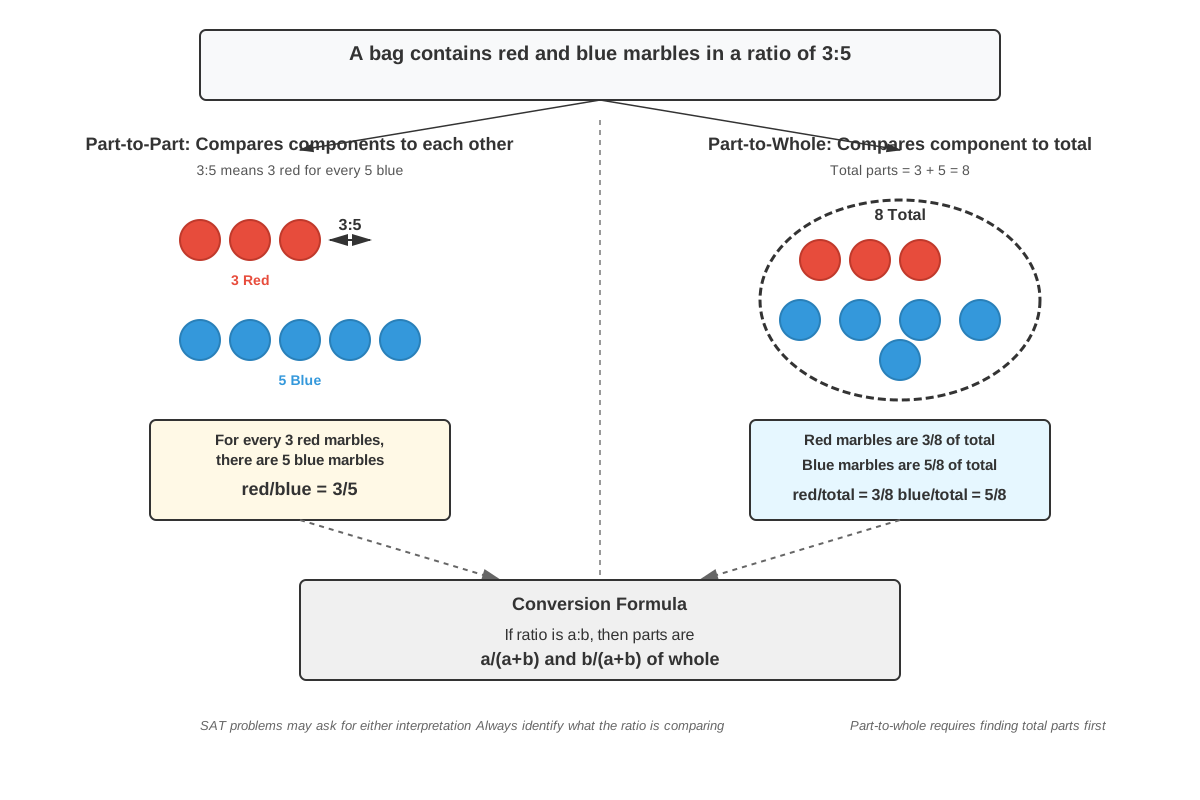
Ratios can represent part-to-part or part-to-whole relationships. In a part-to-part ratio like "boys to girls is 3:5," the ratio compares two distinct groups. The total number of students would be 3 + 5 = 8 parts. In a part-to-whole ratio like "boys to total students is 3:8," the ratio compares one group to the entire population. Distinguishing between these interpretations is critical for setting up problems correctly.
The Ratio Multiplier Method
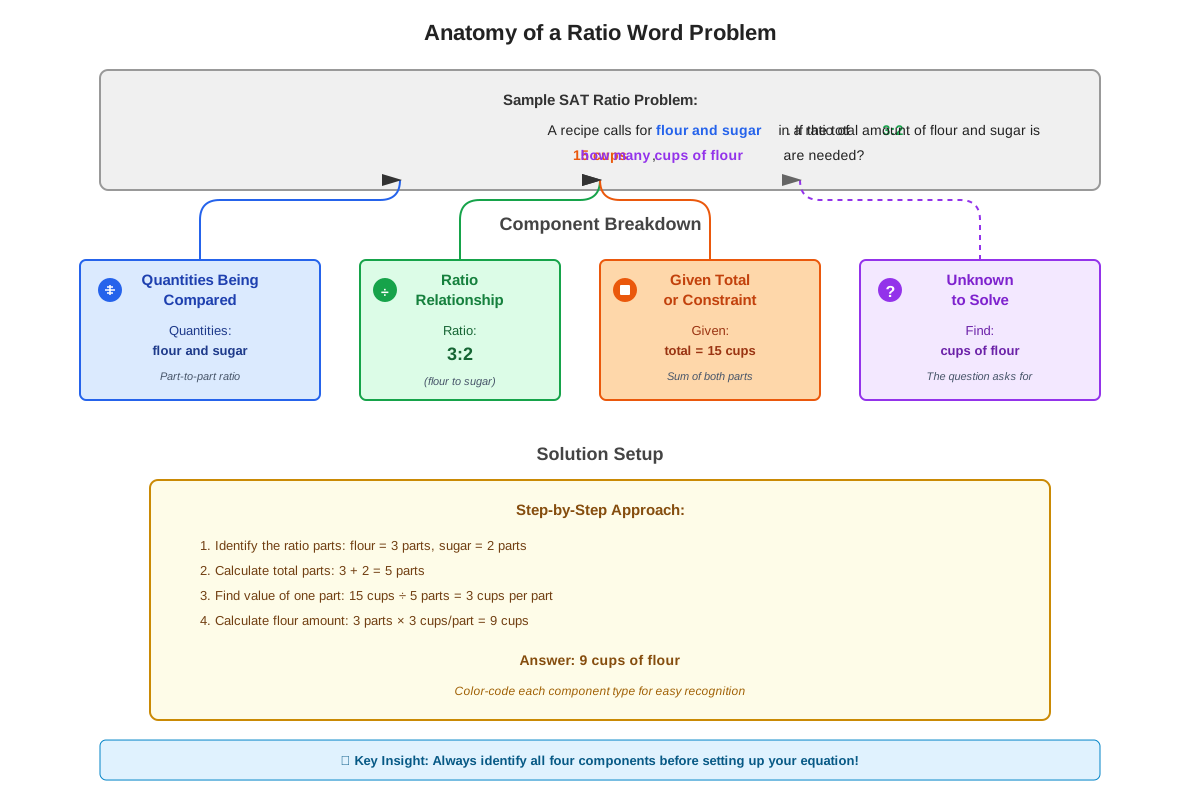
The most powerful technique for solving ratio word problems involves the ratio multiplier (also called the scaling factor). When a ratio is given as a:b, the actual quantities can be expressed as ax and bx, where x is the multiplier. This approach transforms ratio problems into algebraic equations.
For example, if the ratio of cats to dogs is 2:3 and there are 15 total animals, we can write:
- Cats = 2x
- Dogs = 3x
- Total: 2x + 3x = 15
- Solving: 5x = 15, so x = 3
- Therefore: Cats = 2(3) = 6, Dogs = 3(3) = 9
This method works for any number of quantities in a ratio and provides a systematic approach that reduces errors.
Setting Up Ratio Equations from Word Problems
Translating verbal descriptions into mathematical expressions requires careful attention to the specific language used. Key phrases include:
| Phrase | Mathematical Meaning |
|---|---|
| "The ratio of A to B is 3:4" | A/B = 3/4 or A = 3x, B = 4x |
| "A and B are in the ratio 3:4" | A/B = 3/4 |
| "For every 3 A's there are 4 B's" | A/B = 3/4 |
| "A is to B as 3 is to 4" | A/B = 3/4 |
| "The ratio of A to B to C is 2:3:5" | A = 2x, B = 3x, C = 5x |
The order of quantities in the ratio statement must match the order in your mathematical expression. "The ratio of boys to girls is 3:5" means boys/girls = 3/5, not girls/boys.
Working with Combined and Complex Ratios
Some SAT problems involve combined ratios where you must find a common term to link two separate ratios. For example, if the ratio of A to B is 2:3 and the ratio of B to C is 4:5, you need to find the ratio of A to B to C.
The process involves:
- Identify the common term (B in this example)
- Find a common multiple for B's values (3 and 4 → LCM is 12)
- Scale both ratios so B has the same value
- A:B = 2:3 becomes 8:12 (multiply by 4)
- B:C = 4:5 becomes 12:15 (multiply by 3)
- Combined ratio A:B:C = 8:12:15
Ratio Problems Involving Totals
A common SAT question type provides a ratio and a total, asking for one of the parts. The systematic approach:
- Express each part using the ratio multiplier
- Write an equation setting the sum equal to the total
- Solve for the multiplier
- Calculate the requested quantity
Example: A solution contains water and alcohol in a ratio of 7:3. If there are 40 liters total, how much water is present?
- Water = 7x, Alcohol = 3x
- 7x + 3x = 40
- 10x = 40
- x = 4
- Water = 7(4) = 28 liters
Ratio Changes and Adjustments
More challenging problems involve changing ratios when quantities are added or removed. The key is to set up equations for both the initial and final states.
Example: The ratio of red to blue marbles is 5:3. After adding 6 red marbles, the ratio becomes 3:2. How many blue marbles are there?
- Initial: Red = 5x, Blue = 3x
- Final: Red = 5x + 6, Blue = 3x (unchanged)
- New ratio: (5x + 6)/3x = 3/2
- Cross-multiply: 2(5x + 6) = 3(3x)
- 10x + 12 = 9x
- x = -12 (check work—this suggests an error in problem setup)
This type requires careful tracking of what changes and what remains constant.
Scale and Proportion Applications
Ratios appear in scale problems involving maps, models, and drawings. A scale like "1 inch : 50 miles" means every inch on the map represents 50 miles in reality. These problems use proportional reasoning:
If 1 inch = 50 miles, then 3.5 inches = 3.5 × 50 = 175 miles
Or set up a proportion: 1/50 = 3.5/x, then cross-multiply to solve.
Concept Relationships
The core concepts in ratio word problems build upon each other in a logical progression. Understanding ratio notation forms the foundation, enabling students to interpret problem statements correctly. This understanding leads directly to distinguishing part-to-part versus part-to-whole relationships, which determines how equations are set up.
The ratio multiplier method emerges as the primary problem-solving technique, connecting ratio notation to algebraic equation solving. This method enables systematic approaches to problems involving totals, where the sum of ratio parts equals a given value. The multiplier method also extends to combined ratios, where multiple ratio relationships must be reconciled through finding common terms.
Ratio changes and adjustments represent an advanced application that combines the multiplier method with algebraic equation solving for both initial and final states. These problems connect to the prerequisite concept of solving systems of equations.
Scale and proportion applications demonstrate how ratios connect to geometric concepts and real-world measurement, linking this topic to geometry and unit conversion skills.
The relationship map: Ratio Notation → Part-to-Part vs. Part-to-Whole → Ratio Multiplier Method → Problems with Totals → Combined Ratios → Ratio Changes → Scale Applications
Quick check — test yourself on Ratio word problems so far.
Try Flashcards →High-Yield Facts
⭐ The ratio a:b means the first quantity equals ax and the second equals bx for some multiplier x
⭐ When given a ratio and a total, add all ratio parts to find the multiplier equation
⭐ Part-to-part ratios require adding parts to find the whole; part-to-whole ratios already include the total
⭐ The order of quantities in a ratio statement must match the order in your mathematical expression
⭐ To combine ratios with a common term, find the LCM of that term's values in both ratios
- Ratios can be simplified like fractions by dividing all parts by their GCD
- Cross-multiplication works for solving proportions: if a/b = c/d, then ad = bc
- When a ratio problem involves adding or removing quantities, set up separate equations for before and after
- Scale problems are ratio problems where one quantity represents another at a fixed rate
- Equivalent ratios form a proportion, and any two equivalent ratios can be set equal to solve for unknowns
- In three-part ratios a:b:c, the total is (a+b+c)x where x is the multiplier
- Ratio problems often require working backwards from a total to find individual parts
- Unit consistency matters—ensure all quantities use the same units before setting up ratios
- The ratio of A to B being 3:4 does NOT mean A = 3 and B = 4 unless explicitly stated
- Checking your answer by verifying it satisfies the original ratio prevents calculation errors
Common Misconceptions
Misconception: A ratio of 3:5 means the quantities are 3 and 5.
Correction: The ratio 3:5 means the quantities are in the relationship 3x and 5x for some multiplier x. The actual values could be 6 and 10, or 30 and 50, or any pair maintaining that 3:5 relationship.
Misconception: In a ratio problem with a total, you can just use the ratio numbers directly as the answers.
Correction: You must first find the multiplier by dividing the total by the sum of ratio parts, then multiply each ratio part by this multiplier to find actual quantities.
Misconception: The ratio of boys to girls being 2:3 means 2/3 of students are boys.
Correction: This is a part-to-part ratio. Boys represent 2/(2+3) = 2/5 of total students, not 2/3. The 2:3 ratio compares boys to girls, not boys to total.
Misconception: When combining ratios, you can simply write them side by side.
Correction: To combine A:B = 2:3 and B:C = 4:5 into A:B:C, you must scale both ratios so B has the same value in each (finding LCM), resulting in A:B:C = 8:12:15.
Misconception: In ratio change problems, all quantities change proportionally.
Correction: Carefully identify which quantities change and which remain constant. Often one part changes while others stay the same, creating a new ratio relationship.
Misconception: Ratios and fractions are completely different concepts.
Correction: Ratios can be expressed as fractions and follow the same mathematical rules for simplification and equivalence. The ratio a:b is equivalent to the fraction a/b.
Misconception: You can add ratios like you add fractions.
Correction: Ratios don't add directly. If one group has a 2:3 ratio and another has a 1:4 ratio, the combined ratio isn't 3:7. You must work with actual quantities or use weighted averages.
Worked Examples
Example 1: Basic Ratio with Total
Problem: At a school event, the ratio of students to teachers is 12:1. If there are 156 people total at the event, how many students are present?
Solution:
Step 1: Identify the ratio and what it represents.
- Students to teachers = 12:1 (part-to-part ratio)
Step 2: Express quantities using the ratio multiplier.
- Students = 12x
- Teachers = 1x (or simply x)
Step 3: Set up an equation using the total.
- Students + Teachers = Total
- 12x + x = 156
- 13x = 156
Step 4: Solve for the multiplier.
- x = 156 ÷ 13
- x = 12
Step 5: Find the requested quantity.
- Students = 12x = 12(12) = 144
Step 6: Verify the answer.
- Students = 144, Teachers = 12
- Ratio: 144:12 = 12:1 ✓
- Total: 144 + 12 = 156 ✓
Answer: 144 students
This problem demonstrates the fundamental ratio multiplier method and connects to Learning Objective 3 (applying ratio word problems to answer SAT-style questions).
Example 2: Combined Ratios
Problem: In a wildlife preserve, the ratio of eagles to hawks is 3:5, and the ratio of hawks to owls is 2:3. If there are 24 eagles, how many owls are there?
Solution:
Step 1: Write out both ratios.
- Eagles : Hawks = 3:5
- Hawks : Owls = 2:3
Step 2: Identify the common term (Hawks) and find the LCM of its values.
- Hawks appears as 5 in the first ratio and 2 in the second
- LCM(5, 2) = 10
Step 3: Scale both ratios so Hawks = 10.
- Eagles : Hawks = 3:5 → multiply by 2 → 6:10
- Hawks : Owls = 2:3 → multiply by 5 → 10:15
Step 4: Write the combined ratio.
- Eagles : Hawks : Owls = 6:10:15
Step 5: Use the given information to find the multiplier.
- Eagles = 6x = 24
- x = 4
Step 6: Calculate the requested quantity.
- Owls = 15x = 15(4) = 60
Step 7: Verify.
- Eagles:Hawks = 24:40 = 3:5 ✓
- Hawks:Owls = 40:60 = 2:3 ✓
Answer: 60 owls
This problem illustrates combined ratio techniques and connects to Learning Objective 4 (translating verbal descriptions into mathematical expressions).
Exam Strategy
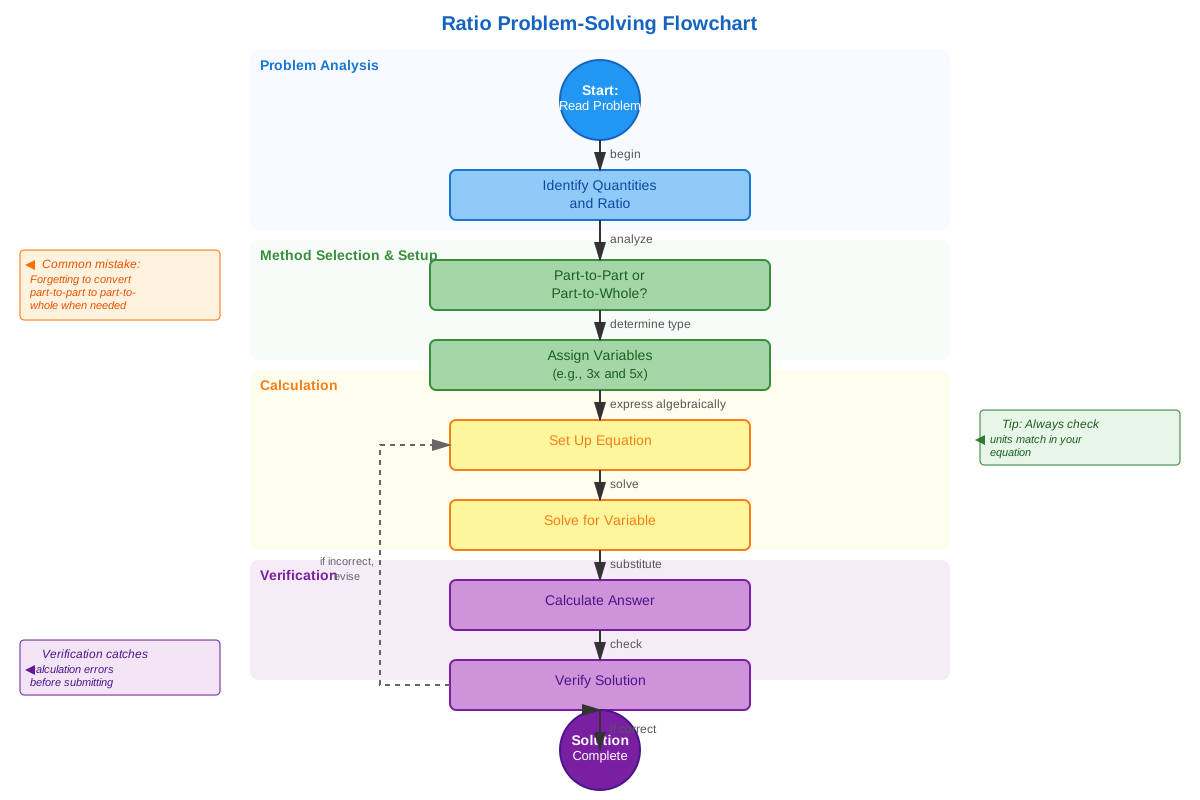
When approaching ratio word problems on the SAT, begin by carefully reading the entire problem to identify what quantities are being compared and what information is given versus what is being asked. Underline or circle the ratio relationship and the total or specific value provided.
Trigger words and phrases to watch for include: "ratio of," "for every," "to every," "per," "out of," and "proportion." These signal that ratio reasoning is required. Pay special attention to whether the problem states "ratio of A to B" (establishing order) or provides a total that represents the sum of parts.
Process-of-elimination tips:
- Eliminate answer choices that don't maintain the correct ratio relationship when checked
- Rule out answers that would create impossible situations (negative quantities, non-integer results when integers are required)
- Check whether answer choices represent the correct quantity being asked (don't confuse parts with totals)
- Verify that your answer makes logical sense in context (e.g., if the ratio suggests more of quantity A than B, your answer should reflect this)
Time allocation: Most ratio word problems should take 1-2 minutes. If you find yourself spending more than 2.5 minutes, mark the question and return to it later. The ratio multiplier method, when practiced, provides a quick systematic approach that saves time compared to guess-and-check methods.
Strategic approach sequence:
- Identify the ratio and what it compares (15 seconds)
- Determine if it's part-to-part or part-to-whole (10 seconds)
- Set up expressions using the multiplier method (20 seconds)
- Write and solve the equation (45 seconds)
- Calculate the requested quantity (15 seconds)
- Verify your answer satisfies the original ratio (15 seconds)
For grid-in questions, double-check that you're entering the correct quantity (not the multiplier or a different part of the ratio).
Memory Techniques
Mnemonic for the Ratio Multiplier Method: "RAVE"
- Read the ratio carefully
- Assign variables (use the multiplier x)
- Verify what's being asked
- Equate and solve
Visualization strategy: Picture ratio problems as physical objects in containers. If the ratio of red to blue marbles is 2:3, visualize 2 red marbles and 3 blue marbles as one "unit set." Multiple unit sets make up the total. This concrete visualization helps prevent the misconception that ratios represent actual quantities.
Acronym for combined ratios: "CLSC"
- Common term identification
- LCM of common term values
- Scale both ratios
- Combine into single ratio
Memory aid for part-to-part vs. part-to-whole: "Part-to-part needs PLUS (add parts to get whole); part-to-whole is COMPLETE (already includes everything)."
Checking technique: "RAT check" - Ratio maintained? Answer reasonable? Total correct? This quick three-point verification catches most errors.
Summary
Ratio word problems are high-frequency SAT questions that test proportional reasoning, algebraic thinking, and problem interpretation skills simultaneously. The fundamental concept involves understanding that a ratio a:b represents quantities ax and bx, where x is the multiplier that scales the ratio to actual values. Success requires distinguishing between part-to-part ratios (comparing distinct groups) and part-to-whole ratios (comparing a part to the total), then systematically applying the ratio multiplier method to set up and solve equations. Combined ratios require finding common terms through LCM calculations, while ratio change problems demand careful tracking of which quantities vary and which remain constant. The most efficient approach involves reading carefully to identify the ratio structure, assigning variables using the multiplier, setting up an equation based on given totals or relationships, solving algebraically, and verifying that the answer satisfies the original ratio. Mastery of these techniques provides a reliable framework for tackling the 3-5 ratio problems that appear on each SAT, contributing significantly to overall math scores.
Key Takeaways
- The ratio multiplier method (expressing quantities as ax, bx, cx) provides a systematic approach to all ratio word problems
- Always distinguish between part-to-part ratios (which require adding parts to find the whole) and part-to-whole ratios (which already include the total)
- The order of quantities in a ratio statement must match your mathematical expression exactly
- Combined ratios require finding the LCM of the common term's values before scaling and combining
- Verification is essential—check that your answer maintains the original ratio relationship and produces the correct total
- Ratio problems appear 3-5 times per SAT and represent approximately 8-12% of the math score
- Most ratio word problems can be solved in under 2 minutes using the structured RAVE approach
Related Topics
Proportions and Cross-Multiplication: Direct extension of ratio concepts, focusing on solving equations where two ratios are set equal. Mastering ratios makes proportion problems straightforward.
Rates and Unit Rates: Special type of ratio comparing quantities with different units (miles per hour, dollars per pound). Understanding ratios provides the foundation for rate calculations.
Percent Problems: Percentages are ratios with a denominator of 100. Strong ratio skills translate directly to solving percent increase/decrease and percent composition problems.
Similar Figures in Geometry: Geometric similarity relies on proportional side lengths, which are ratio relationships. Ratio mastery enables solving problems involving scale factors and corresponding sides.
Probability: Probability can be expressed as ratios of favorable to total outcomes. Understanding part-to-whole ratios supports probability calculations.
Direct and Inverse Variation: These algebraic relationships involve proportional reasoning and ratio concepts extended to functional relationships.
Practice CTA
Now that you've mastered the core concepts and strategies for ratio word problems, it's time to solidify your understanding through active practice. Attempt the practice questions to apply the ratio multiplier method, combined ratio techniques, and verification strategies you've learned. Use the flashcards to reinforce key definitions and trigger words that signal ratio relationships. Remember, ratio problems are among the highest-yield topics on the SAT—your focused practice here will directly translate to points on test day. Approach each practice problem systematically using the RAVE method, and don't forget to verify your answers. You've got this!
Sign up free to keep reading
Create a free AnvayaPrep account to finish this SAT guide on Ratio word problems — plus flashcards and practice questions.