Overview
Unit rates represent one of the most fundamental and frequently tested concepts in SAT math, appearing consistently across multiple question types in both the calculator and no-calculator sections. A unit rate expresses a ratio as a quantity per one unit of another quantity—for example, miles per hour, dollars per pound, or words per minute. This seemingly simple concept serves as the foundation for solving complex real-world problems involving speed, pricing, efficiency, and resource allocation.
Understanding unit rates is essential for SAT success because these problems appear in various disguises throughout the exam. Students encounter unit rate questions in word problems, data interpretation scenarios, and multi-step reasoning challenges. The College Board frequently tests whether students can extract relevant information from complex scenarios, convert between different rates, and apply proportional reasoning to reach correct solutions. Mastery of this topic directly impacts performance on approximately 8-12% of SAT math questions.
Unit rates connect intimately with broader mathematical concepts including ratios, proportions, linear relationships, and algebraic reasoning. They form the bridge between abstract mathematical thinking and practical problem-solving, making them invaluable not only for exam success but also for developing quantitative literacy. Students who master unit rates gain powerful tools for analyzing data, making comparisons, and solving optimization problems—skills that extend far beyond the SAT into college coursework and professional applications.
Learning Objectives
- [ ] Identify key features of unit rates in various contexts and problem formats
- [ ] Explain how unit rates appears on the SAT across different question types
- [ ] Apply unit rates to answer SAT-style questions with accuracy and efficiency
- [ ] Convert complex rates into unit rates through appropriate mathematical operations
- [ ] Compare multiple unit rates to determine optimal choices or identify relationships
- [ ] Solve multi-step problems that require combining unit rates with other mathematical concepts
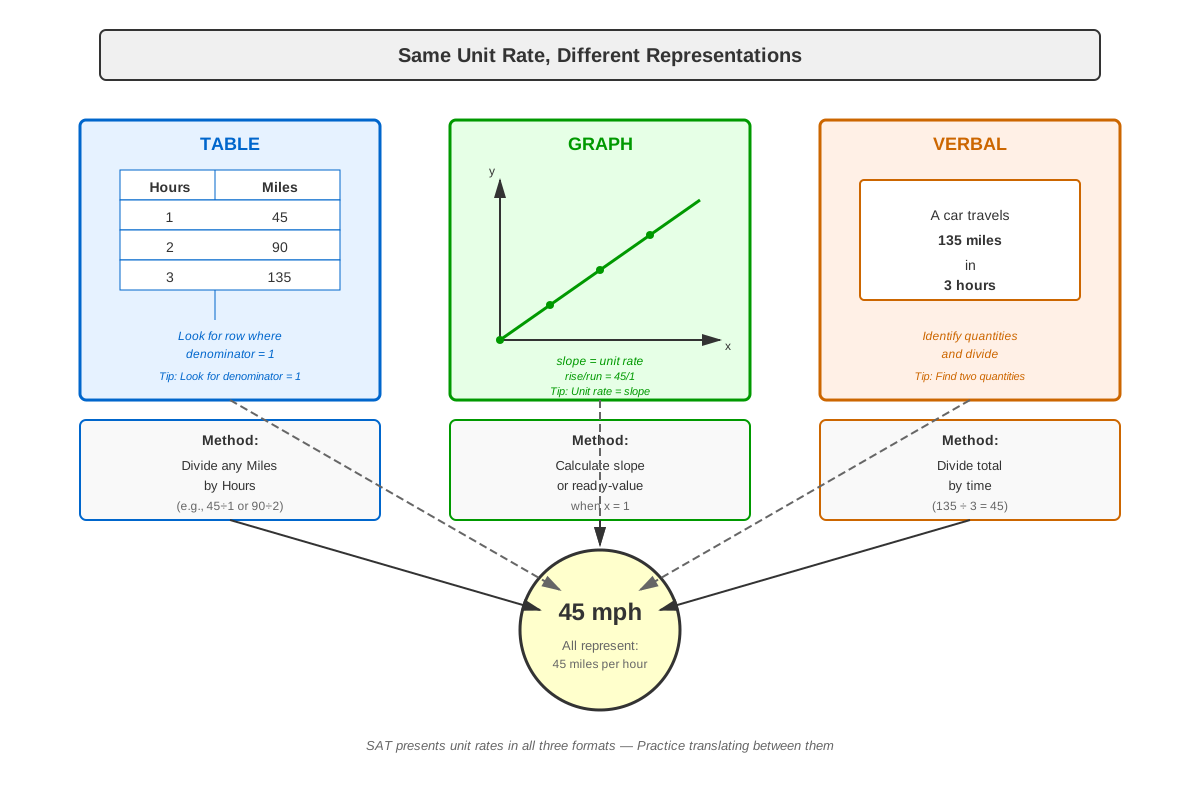
- [ ] Interpret unit rates from tables, graphs, and verbal descriptions
Prerequisites
- Basic fraction operations: Unit rate calculations frequently require dividing quantities, which involves fraction manipulation and simplification
- Ratio understanding: Unit rates are specialized ratios where the denominator equals one, making ratio comprehension foundational
- Unit conversion knowledge: Problems often require converting between measurement systems (feet to miles, minutes to hours) before calculating unit rates
- Basic algebraic manipulation: Setting up and solving equations involving unit rates requires comfort with variables and algebraic expressions
- Proportional reasoning: Understanding that unit rates remain constant in proportional relationships enables problem-solving across various contexts
Why This Topic Matters
Unit rates pervade everyday decision-making and quantitative reasoning. Consumers compare prices using unit rates (cost per ounce), travelers calculate trip durations using speed (miles per hour), and workers evaluate productivity using efficiency metrics (tasks per hour). The ability to calculate and interpret unit rates empowers informed decision-making in personal finance, time management, and resource optimization. This practical relevance makes unit rates one of the most applicable mathematical concepts students will encounter.
On the SAT, unit rate questions appear with remarkable consistency, typically comprising 2-4 questions per exam administration. These questions span multiple formats: straightforward calculation problems, word problems requiring rate extraction from context, data interpretation questions involving tables or graphs, and complex multi-step scenarios combining rates with other concepts. The College Board particularly favors questions that test whether students can identify which rate to calculate, convert between different rate expressions, and apply rates to predict outcomes or make comparisons.
Common SAT manifestations include: comparing shopping options to find the best value, calculating travel times or distances using speed, determining work completion rates for individuals or teams, analyzing data tables showing rates of change, and solving mixture or concentration problems. The exam frequently embeds unit rate calculations within longer word problems, requiring students to recognize when rate analysis provides the solution pathway. Questions may also present rates in non-standard forms, testing whether students can manipulate expressions to extract meaningful unit rates.
Core Concepts
Definition and Structure of Unit Rates
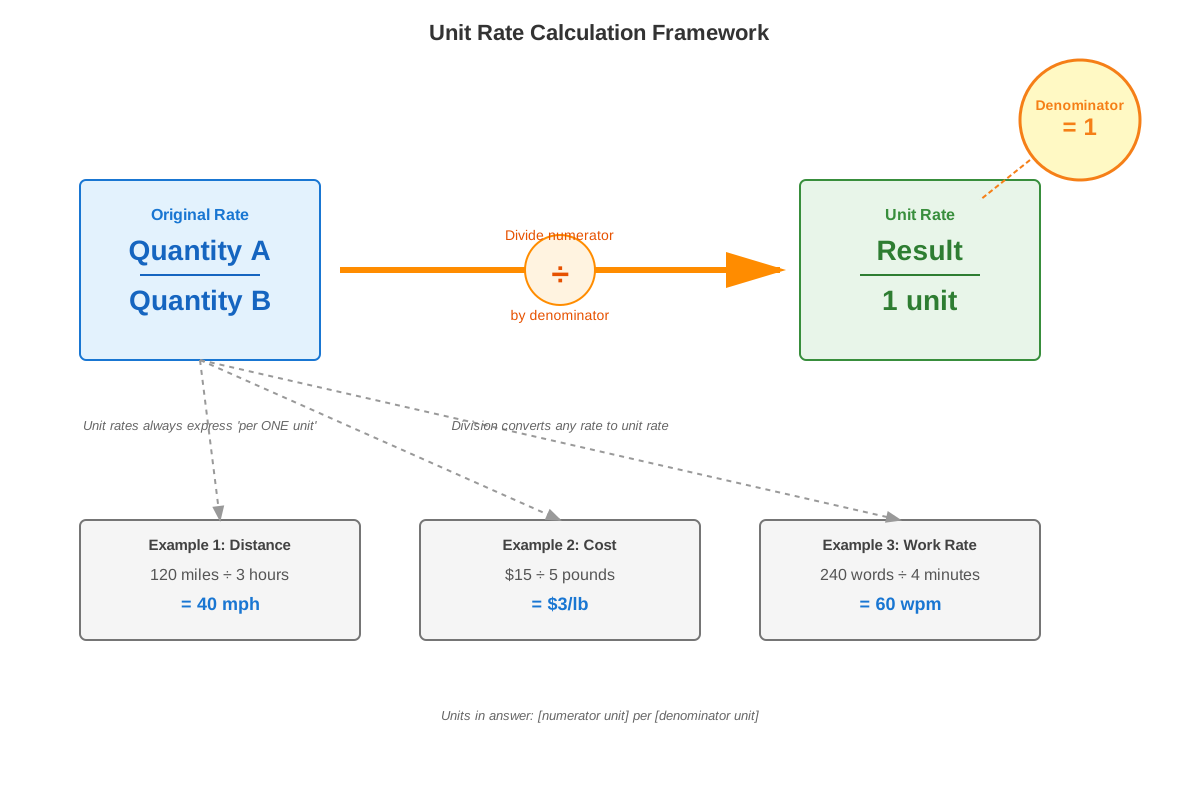
A unit rate expresses a ratio as a quantity per single unit of another quantity. Mathematically, if a ratio compares quantity A to quantity B, the unit rate is calculated as A ÷ B, resulting in "A per 1 B" or simply "A per B." The denominator always equals one in a true unit rate, though it's typically omitted in standard notation. For example, if a car travels 240 miles in 4 hours, the unit rate is 240 ÷ 4 = 60 miles per hour, meaning the car travels 60 miles for every single hour of travel.
The fundamental structure involves three components: the numerator quantity (what is being measured), the denominator quantity (the reference unit), and the division operation connecting them. Understanding this structure enables students to identify unit rates in various contexts and formats. The phrase "per" signals division and indicates which quantity serves as the denominator. Common unit rate expressions include miles per hour (mph), dollars per pound ($/lb), meters per second (m/s), and calories per serving.
Calculating Unit Rates from Given Information
To calculate a unit rate from a given ratio or relationship, divide the first quantity by the second quantity. The systematic process involves:
- Identify the two quantities being compared in the problem
- Determine which quantity should be "per one" (the denominator)
- Divide the numerator quantity by the denominator quantity
- Simplify and include appropriate units in the answer
For example, if 15 pounds of apples cost $22.50, the unit rate (price per pound) is calculated as $22.50 ÷ 15 pounds = $1.50 per pound. This tells us each single pound costs $1.50. Conversely, if we want pounds per dollar, we calculate 15 pounds ÷ $22.50 = 0.667 pounds per dollar, indicating how many pounds one dollar purchases.
Unit Rate Comparisons
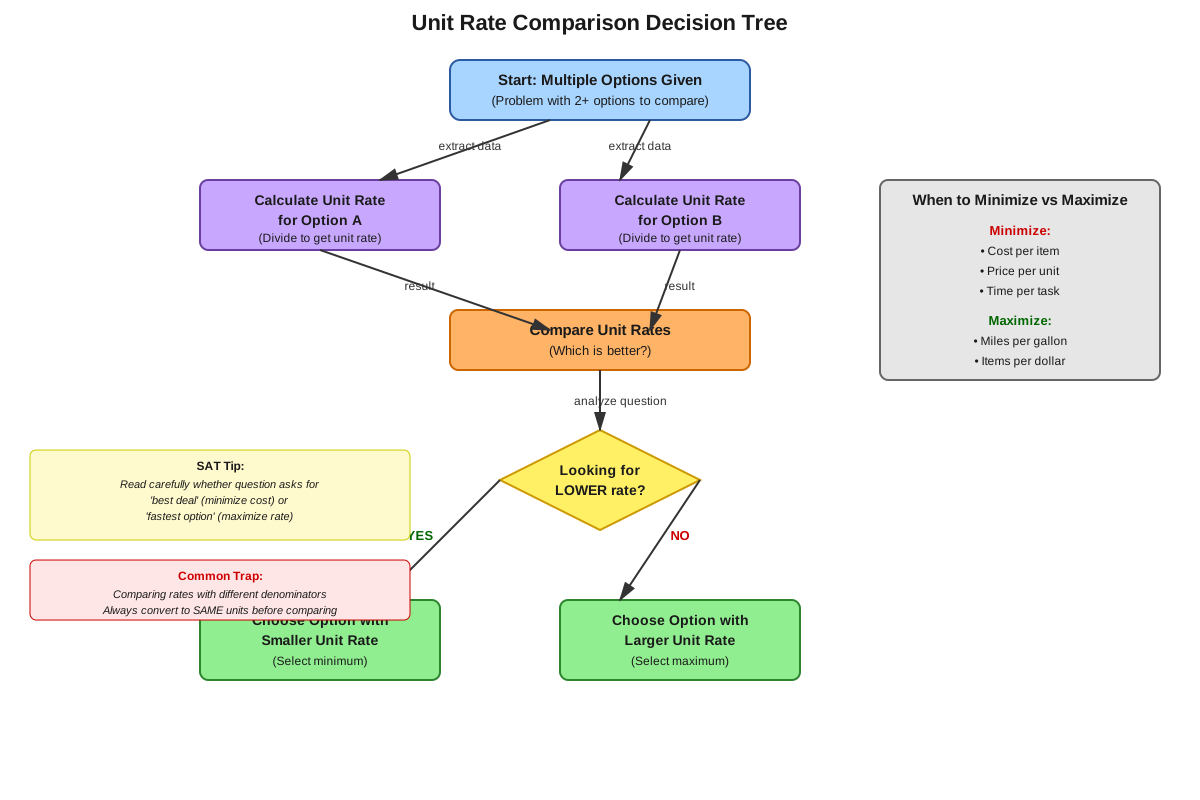
SAT unit rates problems frequently require comparing multiple rates to determine which option is best, fastest, cheapest, or most efficient. When comparing rates, ensure all rates express the same relationship with consistent units. For instance, when comparing prices, all rates should be in dollars per ounce or dollars per pound—not a mixture of both.
| Item | Total Cost | Total Weight | Unit Rate ($/lb) |
|---|---|---|---|
| Brand A | $8.40 | 3 pounds | $2.80 per pound |
| Brand B | $10.50 | 5 pounds | $2.10 per pound |
| Brand C | $6.75 | 2.5 pounds | $2.70 per pound |
In this comparison, Brand B offers the lowest unit rate and therefore the best value per pound. This type of analysis appears frequently on the SAT, testing whether students can calculate multiple unit rates and make appropriate comparisons.
Converting Between Rate Expressions
Many SAT problems require converting rates from one form to another. If given a rate like 45 miles per hour, students might need to express this as miles per minute, feet per second, or another equivalent form. Conversion requires multiplying or dividing by appropriate conversion factors while maintaining dimensional consistency.
For example, converting 60 miles per hour to miles per minute:
- 60 miles per hour means 60 miles per 60 minutes
- Divide both by 60: 1 mile per minute
Converting 30 meters per second to meters per minute:
- 30 meters per second means 30 meters per 1 second
- Multiply by 60 seconds per minute: 30 × 60 = 1,800 meters per minute
Applying Unit Rates to Solve Problems
Once a unit rate is established, it serves as a multiplier for solving related problems. If a unit rate is known, multiply it by the desired number of units to find the total. If someone types 65 words per minute, the number of words typed in 12 minutes is 65 × 12 = 780 words. This application appears in distance-rate-time problems, cost calculations, work-rate problems, and efficiency scenarios.
The general formula structure is: Total = Unit Rate × Number of Units. This relationship works bidirectionally—if the total and unit rate are known, divide to find the number of units. If the total and number of units are known, divide to find the unit rate. Recognizing which form of the relationship applies to a given problem is crucial for SAT success.
Complex Unit Rate Scenarios
Advanced SAT questions combine unit rates with other mathematical concepts. These might involve:
- Combined work rates: When two or more entities work together, their individual unit rates add to create a combined rate
- Inverse relationships: Some situations involve inverse rates (time per unit rather than units per time)
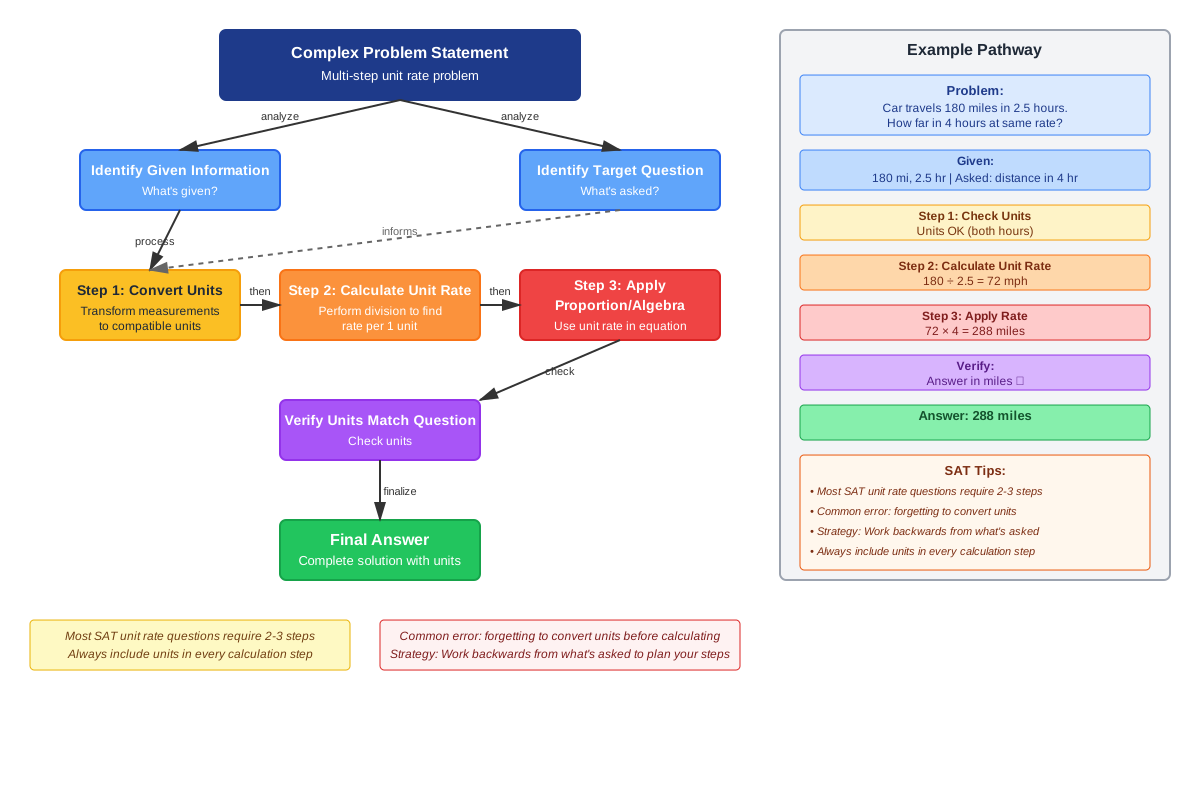
- Multi-step calculations: Finding one rate, then using it to calculate another rate or quantity
- Rate of change: Interpreting slopes of lines as unit rates in graphical contexts
For combined work rates, if Person A completes 5 tasks per hour and Person B completes 3 tasks per hour, together they complete 5 + 3 = 8 tasks per hour. This principle extends to various collaborative scenarios including filling tanks, completing projects, or traveling together.
Concept Relationships
Unit rates emerge directly from ratio concepts—they represent ratios standardized to a denominator of one. This standardization enables meaningful comparisons and practical applications. The relationship flows: Basic Ratios → Unit Rates → Proportional Relationships → Linear Functions. Understanding ratios provides the foundation for calculating unit rates, which in turn enable solving proportion problems and recognizing linear relationships.
Within the topic itself, the core calculation skill (dividing to find rate per one unit) connects to comparison skills (evaluating multiple unit rates), which then extends to application skills (using rates to solve real-world problems). The conversion skill (changing rate expressions) bridges to unit conversion knowledge from measurement topics. Combined rate problems connect unit rates to addition and algebraic thinking.
Unit rates also connect forward to more advanced topics. In algebra, the slope of a line represents a unit rate of change (rise per run). In physics and science contexts, velocity, acceleration, and density all represent unit rates. In statistics, rates of change and trends involve unit rate analysis. Mastering unit rates thus provides essential groundwork for success across multiple mathematical domains and real-world applications.
Quick check — test yourself on Unit rates so far.
Try Flashcards →High-Yield Facts
- ⭐ A unit rate always expresses a quantity per ONE unit of another quantity (denominator equals 1)
- ⭐ To calculate a unit rate, divide the first quantity by the second quantity: Unit Rate = Quantity A ÷ Quantity B
- ⭐ The word "per" indicates division and signals a rate relationship in word problems
- ⭐ When comparing options, calculate the unit rate for each option using the same units, then compare the results
- ⭐ To find a total using a unit rate, multiply: Total = Unit Rate × Number of Units
- Unit rates can be expressed in various equivalent forms (60 mph = 1 mile per minute = 88 feet per second)
- Combined work rates add together: if A works at rate r₁ and B works at rate r₂, together they work at rate r₁ + r₂
- The reciprocal of a rate gives the inverse rate (if 60 mph, then 1/60 hour per mile)
- Unit rates remain constant in proportional relationships, making them useful for predictions
- SAT problems often hide the rate calculation within complex word problems requiring careful information extraction
- Converting between rate expressions requires multiplying or dividing by appropriate conversion factors
- The slope of a linear graph represents a unit rate of change (vertical change per horizontal unit)
Common Misconceptions
Misconception: Unit rates always have time in the denominator (per hour, per minute, etc.)
Correction: Unit rates can express any quantity per any other quantity. While rates involving time are common (speed, work rate), unit rates also include price per pound, cost per item, miles per gallon, students per teacher, and countless other relationships where neither quantity involves time.
Misconception: When comparing prices, the item with the lowest total cost is always the best value
Correction: The best value depends on the unit rate (price per unit of quantity), not the total price. A larger package might cost more in total but less per ounce, making it the better value. Always calculate and compare unit rates, not just total costs.
Misconception: To find a unit rate, always divide the larger number by the smaller number
Correction: The division order depends on which quantity should be "per one," not which number is larger. If finding price per pound, divide price by pounds regardless of which is larger. If finding pounds per dollar, divide pounds by price. The context determines the division order.
Misconception: Unit rates and ratios are the same thing
Correction: While related, unit rates are a specific type of ratio where the denominator equals one. The ratio 240:4 is not a unit rate, but when simplified to 60:1 (or expressed as 60), it becomes the unit rate. Unit rates are standardized ratios that enable direct comparisons and applications.
Misconception: Combined work rates should be averaged (added and divided by 2)
Correction: When two entities work together, their rates add directly without averaging. If Person A works at 5 units/hour and Person B at 3 units/hour, together they work at 8 units/hour, not 4 units/hour. The combined output equals the sum of individual outputs.
Misconception: Unit rates cannot be less than one
Correction: Unit rates can be any positive number, including fractions or decimals less than one. For example, if 5 items cost $3, the unit rate is $0.60 per item. If someone walks 2 miles in 3 hours, the rate is 0.667 miles per hour. Small unit rates are perfectly valid and common.
Worked Examples
Example 1: Comparing Shopping Options
Problem: A grocery store offers three sizes of olive oil. The 16-ounce bottle costs $11.20, the 24-ounce bottle costs $15.60, and the 32-ounce bottle costs $22.40. Which size offers the best value per ounce?
Solution:
Step 1: Calculate the unit rate (price per ounce) for each option.
For the 16-ounce bottle:
- Unit rate = $11.20 ÷ 16 ounces = $0.70 per ounce
For the 24-ounce bottle:
- Unit rate = $15.60 ÷ 24 ounces = $0.65 per ounce
For the 32-ounce bottle:
- Unit rate = $22.40 ÷ 32 ounces = $0.70 per ounce
Step 2: Compare the unit rates.
- 16-ounce: $0.70/oz
- 24-ounce: $0.65/oz (lowest)
- 32-ounce: $0.70/oz
Step 3: Identify the best value.
The 24-ounce bottle offers the best value at $0.65 per ounce, which is $0.05 less per ounce than the other two options.
Connection to Learning Objectives: This example demonstrates identifying unit rates from given information, calculating multiple unit rates, and comparing them to make an informed decision—all essential SAT skills for unit rate problems.
Example 2: Multi-Step Rate Application
Problem: Maria drives from City A to City B, a distance of 180 miles, at an average speed of 60 miles per hour. She then drives from City B to City C, a distance of 135 miles, at an average speed of 45 miles per hour. What is her average speed for the entire trip from City A to City C?
Solution:
Step 1: Calculate the time for each segment using the relationship: Time = Distance ÷ Speed
For City A to City B:
- Time = 180 miles ÷ 60 mph = 3 hours
For City B to City C:
- Time = 135 miles ÷ 45 mph = 3 hours
Step 2: Find the total distance and total time.
- Total distance = 180 + 135 = 315 miles
- Total time = 3 + 3 = 6 hours
Step 3: Calculate the average speed (unit rate) for the entire trip.
- Average speed = Total distance ÷ Total time
- Average speed = 315 miles ÷ 6 hours = 52.5 miles per hour
Important Note: The average speed (52.5 mph) is NOT the average of the two speeds (60 + 45) ÷ 2 = 52.5 mph. While they happen to equal in this case due to equal time segments, this is coincidental. Always calculate average speed using total distance divided by total time, not by averaging the individual speeds.
Connection to Learning Objectives: This problem requires applying unit rates in a multi-step context, understanding the relationship between distance, rate, and time, and recognizing that average rates require total quantities, not simple averaging of individual rates.
Exam Strategy
When approaching SAT unit rates questions, begin by identifying what rate the problem asks for—this determines which quantity becomes the numerator and which becomes the denominator. Look for the word "per" or phrases like "for each," "for every," or "each" to identify rate relationships. Circle or underline these trigger words to maintain focus on what the question actually asks.
Exam Tip: If a problem provides a rate and asks for a total, multiply. If it provides a total and asks for a rate, divide. If it provides multiple options and asks for comparison, calculate the unit rate for each option.
Process-of-elimination strategies work effectively on unit rate problems. If answer choices differ significantly in magnitude, estimate the unit rate rather than calculating precisely—this often eliminates 2-3 incorrect answers immediately. For comparison questions, eliminate any answer that doesn't require calculating unit rates (such as "the one with the lowest total price" when asking for best value per unit).
Watch for unit consistency in answer choices. If the question asks for miles per hour but an answer choice expresses miles per minute, it's likely a trap answer for students who calculated correctly but forgot to convert units. Similarly, if calculating cost per pound, ensure the answer is in dollars (or cents) per pound, not pounds per dollar.
Time allocation for unit rate problems should typically be 45-75 seconds for straightforward calculations and 90-120 seconds for multi-step problems. If a problem requires more than two minutes, mark it for review and move forward—these problems often become clearer on a second pass. Practice recognizing unit rate problems quickly so minimal time is spent determining the solution approach.
For calculator-permitted sections, use the calculator for division to avoid arithmetic errors, but set up the problem on paper first to ensure correct operation order. For no-calculator sections, look for numbers that divide evenly or simplify easily—the SAT rarely requires complex decimal division without a calculator.
Memory Techniques
"PER means DIVIDE": Remember that the word "per" always indicates division. Whatever comes before "per" is the numerator; whatever comes after "per" is the denominator. "Miles per hour" means miles ÷ hours.
"Total = Unit × Units" (TUU): This acronym helps remember the fundamental relationship. Total equals Unit rate times number of Units. Rearrange as needed: Unit rate = Total ÷ Units, or Units = Total ÷ Unit rate.
The "One Dollar Test": When comparing prices, imagine you have exactly one dollar. Calculate how much product each option gives you for that dollar (quantity per dollar). The option giving you the most product per dollar is the best value. This inverse perspective sometimes clarifies comparisons.
Visual Rate Bar: Visualize a rate as a fraction bar with the numerator quantity on top and denominator quantity on bottom. This mental image helps maintain correct division order and unit placement.
"Same Units, Same Comparison": Before comparing any rates, chant this phrase to remember that all rates must express the same relationship with identical units. You cannot compare dollars per pound with dollars per ounce without conversion.
Combined Work Addition: Remember "Workers Add, Work Multiplies"—when workers combine efforts, add their individual rates to get the combined rate. When calculating total work done, multiply the rate by time.
Summary
Unit rates represent quantities expressed per single unit of another quantity, forming a cornerstone of SAT math problem-solving. Calculating unit rates requires dividing one quantity by another, with the division order determined by which quantity should be "per one." These rates enable meaningful comparisons between options, predictions of outcomes, and solutions to complex real-world scenarios. The SAT tests unit rates through direct calculation problems, comparison questions, multi-step applications, and embedded rate concepts within larger word problems. Success requires recognizing rate relationships in various contexts, performing accurate calculations, maintaining unit consistency, and applying rates appropriately to find totals or make comparisons. Combined rate problems add individual rates together, while average rates require dividing total quantities rather than averaging individual rates. Mastery of unit rates provides essential tools for SAT success and develops quantitative reasoning skills applicable far beyond the exam.
Key Takeaways
- Unit rates express a quantity per ONE unit of another quantity, calculated by dividing the first quantity by the second
- The word "per" signals division and indicates a rate relationship in problems
- To compare options effectively, calculate the unit rate for each using consistent units, then compare the results
- Apply unit rates using the relationship: Total = Unit Rate × Number of Units (rearrange as needed)
- Combined work rates add together; average rates require total distance divided by total time, not averaging individual rates
- SAT unit rate problems appear in multiple formats including direct calculations, comparisons, multi-step applications, and embedded contexts
- Always verify unit consistency between your calculation and the answer choices to avoid trap answers
Related Topics
Ratios and Proportions: Unit rates build directly on ratio concepts and enable proportion problem-solving. Mastering unit rates strengthens proportional reasoning skills essential for advanced algebra and geometry problems.
Linear Functions and Slope: The slope of a line represents a unit rate of change (rise per run). Understanding unit rates provides intuitive comprehension of linear relationships and graphical interpretation.
Distance-Rate-Time Problems: These classic SAT problems rely entirely on unit rate concepts, particularly speed as a unit rate. Mastery of unit rates makes these problems significantly more accessible.
Percent and Percent Change: Percentages represent special unit rates (per 100), and percent change problems involve rate calculations. Unit rate skills transfer directly to percentage problem-solving.
Unit Conversion and Dimensional Analysis: Converting between measurement systems requires rate-based thinking. Strong unit rate skills facilitate complex conversion problems involving multiple steps.
Practice CTA
Now that you've mastered the core concepts of unit rates, it's time to solidify your understanding through practice. Attempt the practice questions to apply these concepts in SAT-style scenarios, and use the flashcards to reinforce key definitions and relationships. Remember, unit rates appear consistently on every SAT administration—your investment in mastering this topic will pay dividends on test day. Approach each practice problem systematically, identify the rate relationship, perform the calculation carefully, and verify your answer makes sense in context. You've built a strong foundation; now strengthen it through deliberate practice!
Sign up free to keep reading
Create a free AnvayaPrep account to finish this SAT guide on Unit rates — plus flashcards and practice questions.