Overview
Speed rate problems are among the most frequently tested question types in the SAT Math section, appearing in both the calculator and no-calculator portions of the exam. These problems involve calculating distances, speeds, times, and rates of travel for objects, people, or vehicles moving in various scenarios. Mastery of speed rate problems requires understanding the fundamental relationship between distance, rate (speed), and time, expressed by the formula: distance = rate × time (d = rt).
The SAT tests speed rate problems in multiple contexts: single-object motion, two objects moving toward or away from each other, round-trip scenarios, and problems involving average speed. These questions assess not only computational skills but also the ability to set up equations, interpret word problems, and reason through multi-step scenarios. Students who struggle with sat speed rate problems often lose valuable points because these questions appear consistently across multiple test administrations, making them high-yield study material.
Understanding speed rate problems connects directly to broader math concepts tested on the SAT, including ratios, proportions, linear equations, and systems of equations. The skills developed through mastering these problems—translating verbal descriptions into mathematical expressions, manipulating algebraic equations, and checking answers for reasonableness—transfer to numerous other question types. Additionally, speed rate problems frequently integrate with unit conversion, percentage calculations, and data interpretation, making them a cornerstone topic within the Ratios, Rates, and Proportions unit.
Learning Objectives
- [ ] Identify key features of Speed rate problems
- [ ] Explain how Speed rate problems appears on the SAT
- [ ] Apply Speed rate problems to answer SAT-style questions
- [ ] Construct and solve equations for multi-object motion scenarios
- [ ] Calculate average speed for trips with varying rates
- [ ] Convert between different units of speed and time efficiently
- [ ] Analyze complex scenarios involving relative motion and meeting/overtaking problems
Prerequisites
- Basic algebraic manipulation: Solving for variables in single-variable equations is essential because speed rate problems require isolating distance, rate, or time
- Understanding of ratios and proportions: Speed itself is a ratio (distance per unit time), and many problems involve proportional reasoning
- Unit awareness: Recognizing and converting between miles/kilometers, hours/minutes, and other measurement units prevents calculation errors
- Linear equation solving: Many speed rate problems result in linear equations or systems that must be solved systematically
Why This Topic Matters
Speed rate problems have immediate real-world applications that students encounter daily: calculating travel times for trips, determining fuel efficiency, estimating arrival times, and understanding GPS navigation systems. Professional fields including logistics, transportation planning, engineering, and physics rely heavily on rate calculations. The ability to reason through motion problems develops critical thinking skills applicable far beyond mathematics.
On the SAT, speed rate problems appear with remarkable consistency. Approximately 2-4 questions per test directly involve speed, rate, and time calculations, representing roughly 5-10% of the total Math section. These problems appear in both multiple-choice and student-produced response (grid-in) formats. The College Board frequently tests these concepts because they assess multiple competencies simultaneously: reading comprehension, algebraic reasoning, and quantitative literacy.
Common SAT presentations include: word problems describing vehicles traveling between cities, runners or cyclists moving at different speeds, objects meeting or overtaking each other, round-trip scenarios with different speeds in each direction, and average speed calculations that require careful attention to the distinction between average speed and the average of two speeds. The SAT particularly favors problems that require students to recognize that average speed equals total distance divided by total time, not the arithmetic mean of individual speeds—a common trap for unprepared test-takers.
Core Concepts
The Fundamental Distance-Rate-Time Relationship
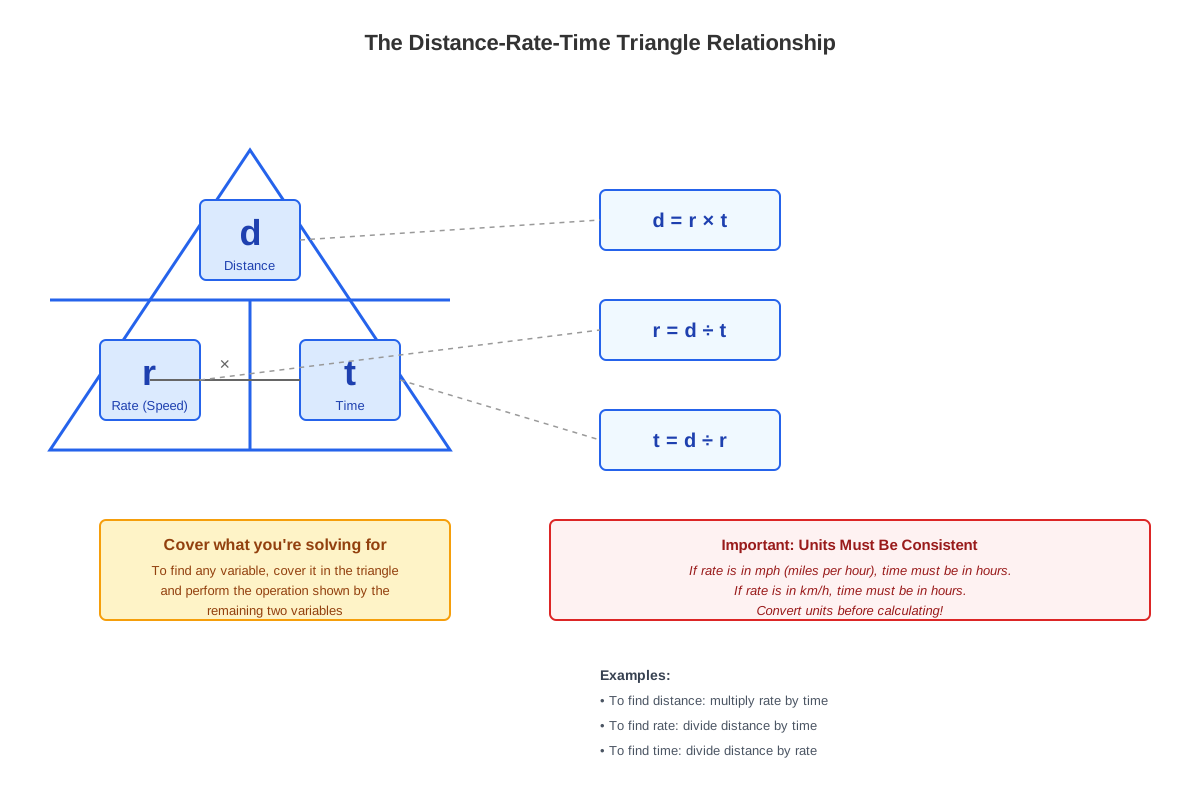
The foundation of all speed rate problems is the equation d = rt, where d represents distance, r represents rate (speed), and t represents time. This formula can be algebraically manipulated into three equivalent forms:
d = rt
r = d/t
t = d/r
Each form proves useful depending on which variable the problem asks to find. Understanding that these three equations are simply different arrangements of the same relationship is crucial for flexibility in problem-solving. The rate (r) represents how much distance is covered per unit of time, such as miles per hour (mph), kilometers per hour (km/h), or meters per second (m/s).
Single-Object Motion Problems
The simplest speed rate problems involve one object traveling at a constant speed. These problems provide two of the three variables (distance, rate, time) and ask for the third. The key strategy involves:
- Identifying which variables are given
- Determining which variable to solve for
- Selecting the appropriate form of d = rt
- Substituting known values and solving
For example, if a car travels at 60 mph for 2.5 hours, the distance covered is d = 60 × 2.5 = 150 miles. Conversely, if a train travels 240 miles at 80 mph, the time taken is t = 240/80 = 3 hours.
Two-Object Motion: Meeting Problems
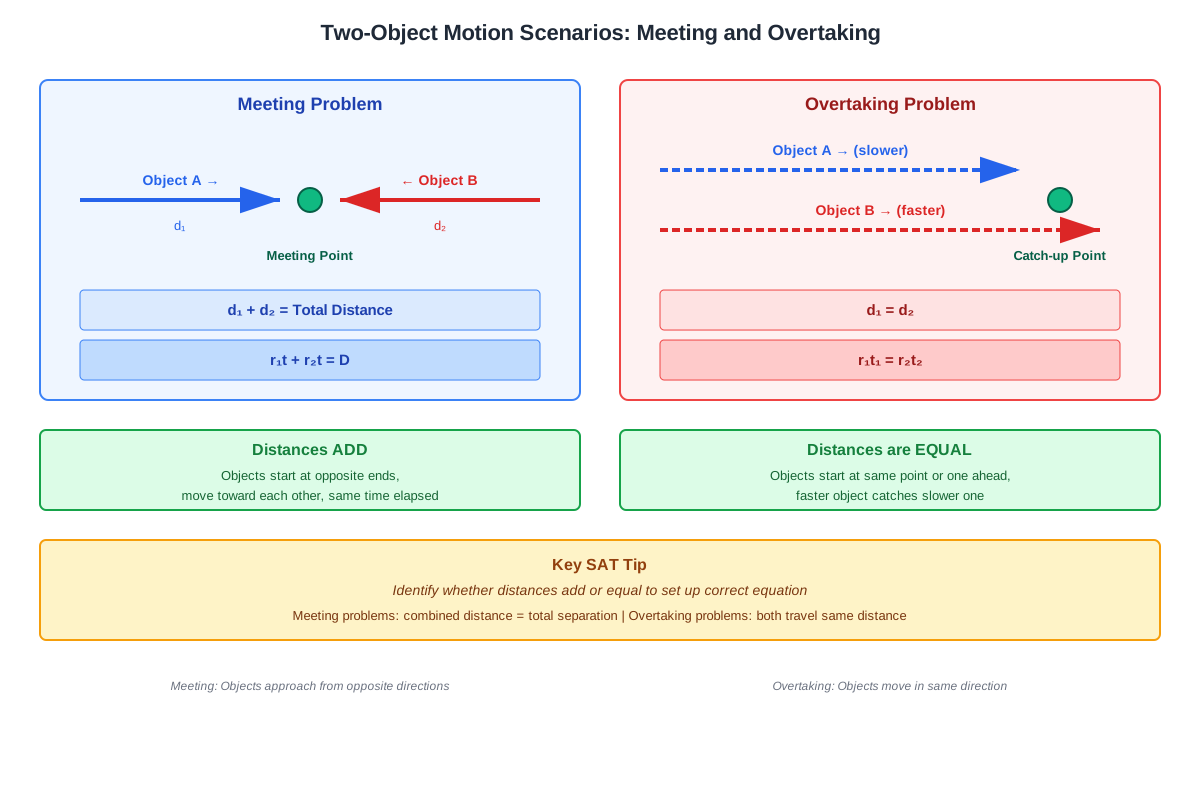
When two objects move toward each other, they meet when the sum of their individual distances equals the total distance between their starting points. If two cars start 300 miles apart and drive toward each other at 50 mph and 70 mph respectively, they meet when:
distance₁ + distance₂ = total distance
50t + 70t = 300
120t = 300
t = 2.5 hours
The critical insight is that both objects travel for the same amount of time until they meet. Their combined rate of approach is the sum of their individual rates (50 + 70 = 120 mph in this example).
Two-Object Motion: Overtaking Problems
When two objects move in the same direction with one catching up to the other, the faster object overtakes the slower one when their distances from a common starting point become equal. If a faster car traveling at 70 mph leaves 1 hour after a slower car traveling at 50 mph, the overtaking time is found by:
distance_fast = distance_slow
70t = 50(t + 1)
70t = 50t + 50
20t = 50
t = 2.5 hours
Note that the slower car has a 1-hour head start, so its time is (t + 1) when the faster car has traveled for time t.
Round-Trip and Average Speed
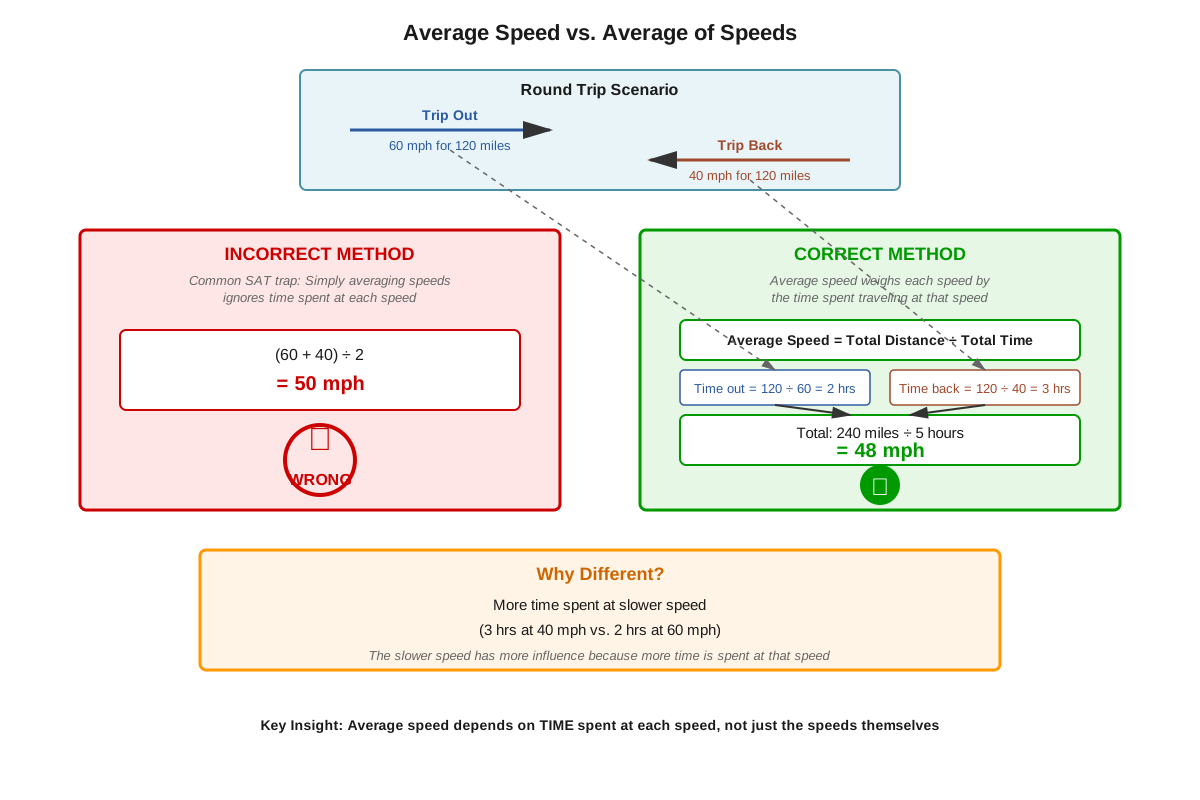
A frequent SAT trap involves average speed calculations. The average speed for a trip is NOT the arithmetic mean of the speeds but rather:
Average Speed = Total Distance / Total TimeIf a car travels 60 miles at 30 mph and returns 60 miles at 60 mph, the average speed is:
Total Distance = 60 + 60 = 120 miles
Time₁ = 60/30 = 2 hours
Time₂ = 60/60 = 1 hour
Total Time = 3 hours
Average Speed = 120/3 = 40 mph
Notice that 40 mph ≠ (30 + 60)/2 = 45 mph. The average speed is weighted by the time spent at each speed, not simply the arithmetic mean.
Unit Conversion in Speed Problems
SAT problems may require converting between units. Common conversions include:
| From | To | Conversion |
|---|---|---|
| Hours | Minutes | Multiply by 60 |
| Minutes | Hours | Divide by 60 |
| Miles | Feet | Multiply by 5,280 |
| Kilometers | Meters | Multiply by 1,000 |
| mph | feet per second | Multiply by 1.467 |
When rates are given in different units, convert to a common unit before calculating. If a problem states a speed in miles per hour but asks for distance in feet, convert either the rate or the final answer appropriately.
Relative Speed and Closing Speed
Relative speed describes how fast objects approach or separate from each other. When moving toward each other, relative speed equals the sum of individual speeds. When moving in the same direction, relative speed equals the difference of speeds. This concept simplifies many two-object problems by treating them as single-object problems with the relative speed as the rate.
Concept Relationships
The fundamental d = rt relationship serves as the anchor for all speed rate problems. Single-object motion problems provide the foundation → which extends to two-object meeting problems (where distances sum) → and overtaking problems (where distances equal). Both meeting and overtaking scenarios rely on the principle that objects travel for equal time periods, connecting back to algebraic equation-solving skills.
Average speed calculations build upon single-object motion but require understanding that total distance and total time must be calculated separately before dividing, connecting to the prerequisite knowledge of ratios and proportions. This concept relationship can be mapped as:
Basic d = rt → Single-object problems → Two-object problems (meeting/overtaking) → Complex scenarios (round trips, average speed)
Additionally, unit conversion skills intersect with every type of speed rate problem, requiring constant attention to dimensional analysis. The ability to set up equations from word problems (a prerequisite skill) enables the translation of verbal descriptions into the mathematical framework of d = rt, which then connects to systems of equations when multiple objects are involved.
Quick check — test yourself on Speed rate problems so far.
Try Flashcards →High-Yield Facts
- ⭐ The fundamental formula is d = rt, which can be rearranged to r = d/t or t = d/r
- ⭐ Average speed equals total distance divided by total time, NOT the average of two speeds
- ⭐ When two objects move toward each other, their combined rate of approach is the sum of their individual rates
- When two objects move in the same direction, the relative speed is the difference of their speeds
- ⭐ In meeting problems, both objects travel for the same amount of time until they meet
- In overtaking problems, set the distances equal and account for any head start in time
- ⭐ Always check that units are consistent before performing calculations (hours with hours, miles with miles)
- If a round trip involves the same distance at different speeds, the average speed is closer to the slower speed (weighted by time)
- Speed is always positive; direction is indicated by context or sign conventions in the problem
- ⭐ Converting mph to feet per second requires multiplying by approximately 1.467 (or exactly 22/15)
- When distance is constant but speeds vary, the time spent at each speed determines the average speed
- A 10% increase in speed results in approximately a 9% decrease in travel time for the same distance
Common Misconceptions
Misconception: Average speed is calculated by adding the two speeds and dividing by 2.
Correction: Average speed equals total distance divided by total time. The arithmetic mean of speeds only equals average speed when equal time (not distance) is spent at each speed.
Misconception: In a meeting problem, each object travels half the total distance.
Correction: Each object travels a distance proportional to its speed. A faster object covers more distance before meeting. Only when speeds are equal does each travel half the distance.
Misconception: If you double your speed, you halve your travel time.
Correction: This is actually TRUE and not a misconception, but students often fail to apply it. Understanding this inverse relationship helps check answers for reasonableness.
Misconception: When two objects start at the same time and place, the faster one is always ahead.
Correction: This is true only if they move in the same direction. If moving in opposite directions, they separate but neither is "ahead" in the traditional sense.
Misconception: You can add distances in miles to times in hours.
Correction: Distance and time are different quantities with different units. Only like quantities can be added. Always maintain dimensional consistency.
Misconception: In an overtaking problem, the faster object must travel farther than the slower object.
Correction: At the moment of overtaking, both objects are at the same location, having traveled the same distance from their respective starting points. However, if they started at different times, the slower object has been traveling longer.
Worked Examples
Example 1: Round-Trip Average Speed
Problem: Sarah drives from City A to City B, a distance of 120 miles, at an average speed of 40 mph. She returns from City B to City A at an average speed of 60 mph. What is her average speed for the entire round trip?
Solution:
Step 1: Identify what we know and what we need to find.
- Distance from A to B: 120 miles
- Distance from B to A: 120 miles
- Speed A to B: 40 mph
- Speed B to A: 60 mph
- Find: Average speed for entire trip
Step 2: Calculate the time for each leg of the trip.
- Time A to B: t₁ = d/r = 120/40 = 3 hours
- Time B to A: t₂ = d/r = 120/60 = 2 hours
Step 3: Calculate total distance and total time.
- Total distance = 120 + 120 = 240 miles
- Total time = 3 + 2 = 5 hours
Step 4: Calculate average speed.
- Average speed = Total distance / Total time = 240/5 = 48 mph
Answer: 48 mph
Key Insight: Notice that 48 mph is NOT equal to (40 + 60)/2 = 50 mph. The average speed is weighted toward the slower speed because Sarah spent more time (3 hours) traveling at 40 mph than at 60 mph (2 hours). This connects to Learning Objective: Apply speed rate problems to answer SAT-style questions.
Example 2: Two Objects Meeting
Problem: Two trains are 450 miles apart and traveling toward each other on parallel tracks. Train A travels at 60 mph, and Train B travels at 75 mph. If they both start at 2:00 PM, at what time will they meet?
Solution:
Step 1: Set up the problem using the meeting concept.
- When they meet: distance_A + distance_B = 450 miles
- Both trains travel for the same time t
Step 2: Express each distance using d = rt.
- distance_A = 60t
- distance_B = 75t
Step 3: Write and solve the equation.
- 60t + 75t = 450
- 135t = 450
- t = 450/135 = 10/3 hours = 3 hours and 20 minutes
Step 4: Calculate the meeting time.
- Start time: 2:00 PM
- Add 3 hours 20 minutes: 5:20 PM
Answer: 5:20 PM
Verification: Check by calculating individual distances:
- Train A: 60 × (10/3) = 200 miles
- Train B: 75 × (10/3) = 250 miles
- Total: 200 + 250 = 450 miles ✓
This example demonstrates the key feature of meeting problems: the sum of distances equals the total separation, and both objects travel for equal time. This addresses Learning Objective: Construct and solve equations for multi-object motion scenarios.
Exam Strategy
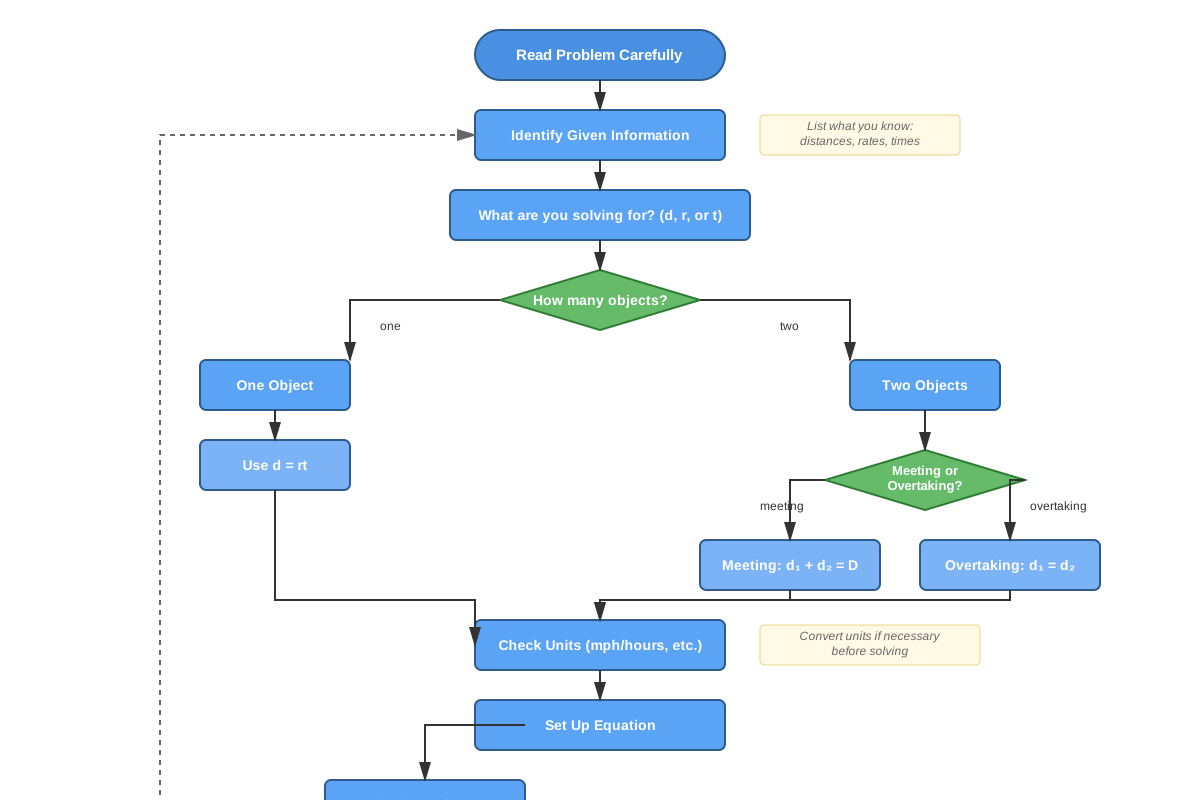
When approaching sat speed rate problems on test day, follow this systematic process:
Step 1: Read carefully and identify the scenario type
- Single object? Two objects meeting? Overtaking? Round trip?
- Trigger words: "toward each other" (meeting), "catches up" (overtaking), "average speed" (total distance/total time)
Step 2: Create a visual representation
- Draw a simple diagram showing starting positions, directions, and distances
- Label known values directly on the diagram
- Use arrows to indicate direction of motion
Step 3: Set up your equation(s)
- Write d = rt for each object or leg of journey
- For meeting problems: d₁ + d₂ = total distance
- For overtaking problems: d₁ = d₂
- For average speed: average = total distance / total time
Step 4: Check units before calculating
- Are all speeds in the same units (mph, km/h)?
- Are all times in the same units (hours, minutes)?
- Convert if necessary before substituting into equations
Step 5: Solve and verify reasonableness
- Does the answer make logical sense?
- Is the faster object traveling farther in meeting problems?
- Is the average speed between the two given speeds?
Exam Tip: If a problem asks for average speed and provides two different speeds, immediately recognize that the answer is NOT the arithmetic mean. Calculate total distance and total time separately.
Time allocation: Spend 1-1.5 minutes on straightforward single-object problems, 2-3 minutes on two-object or average speed problems. If stuck after 2 minutes, mark for review and move on.
Process of elimination for multiple choice:
- Eliminate answers that are outside the range of given speeds (for average speed problems)
- Eliminate answers with incorrect units
- Eliminate answers that violate basic logic (negative times, speeds faster than light)
Memory Techniques
Mnemonic for d = rt: "Distance Requires Time" - Remember that distance is the product of rate and time.
Mnemonic for average speed: "Total Distance Takes Time" - Average speed = Total Distance / Total Time (not average of speeds)
Visualization for meeting problems: Picture two people walking toward each other across a room. They meet somewhere in the middle, with the faster person having covered more floor space. The total floor space is fixed.
Acronym for problem-solving steps: DRIVES
- Draw a diagram
- Read for what's given and what's asked
- Identify the scenario type
- Verify units match
- Equate using d = rt
- Solve and check reasonableness
Memory aid for unit conversion: "60 minutes in an hour" - When converting between hours and minutes, multiply or divide by 60. To remember which direction: hours are bigger units, so fewer of them (divide to get hours from minutes).
Relative speed visualization: When objects move toward each other, imagine standing on one object—the other appears to approach at the combined speed. When moving in the same direction, imagine being on the faster object—the slower one appears to move backward at the difference in speeds.
Summary
Speed rate problems form a critical component of SAT Math, testing the fundamental relationship d = rt through various scenarios including single-object motion, two-object meeting and overtaking problems, and average speed calculations. Success requires recognizing problem types, setting up appropriate equations, maintaining unit consistency, and avoiding the common trap of calculating average speed as the arithmetic mean of speeds. The key insight is that average speed always equals total distance divided by total time, weighted by the time spent at each speed. Meeting problems involve objects whose distances sum to the total separation, while overtaking problems set distances equal. All speed rate problems connect to broader mathematical concepts including ratios, proportions, linear equations, and algebraic manipulation. Mastery comes from systematic problem-solving: identifying the scenario, drawing diagrams, setting up equations with consistent units, solving algebraically, and verifying that answers are reasonable within the problem context.
Key Takeaways
- The fundamental formula d = rt can be rearranged to solve for any of the three variables: distance, rate, or time
- Average speed equals total distance divided by total time, NOT the arithmetic mean of individual speeds
- In meeting problems, the sum of distances equals total separation, and both objects travel for equal time
- In overtaking problems, set distances equal and account for any head start in the slower object's time
- Always verify unit consistency before performing calculations—convert all measurements to common units
- Draw diagrams to visualize motion scenarios and identify which equation setup applies
- Check answer reasonableness: average speeds fall between given speeds, faster objects cover more distance in equal time
Related Topics
Systems of Linear Equations: Many complex speed rate problems with multiple objects require setting up and solving systems of equations, building directly on the d = rt framework established here.
Unit Conversion and Dimensional Analysis: Deeper exploration of converting between measurement systems (metric/imperial) and compound units enhances speed problem-solving efficiency.
Work Rate Problems: These follow an identical mathematical structure to speed rate problems (work = rate × time) and mastering speed problems provides direct transfer to work scenarios.
Proportional Relationships: Understanding that speed is fundamentally a ratio (distance per time) connects to broader proportional reasoning tested throughout SAT Math.
Linear Functions and Graphs: Plotting distance versus time creates linear functions where the slope represents speed, connecting algebraic and graphical representations.
Practice CTA
Now that you've mastered the core concepts of speed rate problems, it's time to solidify your understanding through practice. Attempt the practice questions to apply these strategies to SAT-style problems, and use the flashcards to reinforce key formulas and concepts. Remember: speed rate problems appear on virtually every SAT, making them one of the highest-yield topics for your study time. Each problem you practice builds the pattern recognition and problem-solving speed that translates directly to points on test day. You've got this!
Sign up free to keep reading
Create a free AnvayaPrep account to finish this SAT guide on Speed rate problems — plus flashcards and practice questions.