Overview
Break-even problems are a critical category of applied math questions that appear regularly on the SAT, testing students' ability to work with systems of linear equations in real-world business contexts. These problems involve finding the point at which total revenue equals total costs—the moment when a business neither makes a profit nor incurs a loss. Understanding break-even analysis requires synthesizing multiple algebraic skills: setting up equations from word problems, solving systems of equations, and interpreting solutions within practical constraints.
On the SAT, sat break-even problems typically present scenarios involving production costs, sales revenue, and the need to determine how many units must be sold to cover expenses. These questions assess whether students can translate verbal descriptions into mathematical models, manipulate linear equations, and extract meaningful conclusions from their solutions. The problems often involve fixed costs (expenses that remain constant regardless of production volume) and variable costs (expenses that change with each unit produced), concepts that mirror real business operations.
Mastery of break-even problems demonstrates proficiency in the broader domain of systems of linear equations, a foundational topic in SAT Math. These problems connect algebraic manipulation with practical reasoning, requiring students to move fluidly between abstract mathematical representations and concrete interpretations. Success with break-even questions signals readiness for more complex applications of linear systems, including optimization problems, rate problems, and other multi-variable scenarios that appear throughout the exam.
Learning Objectives
- [ ] Identify key features of break-even problems, including fixed costs, variable costs, and revenue functions
- [ ] Explain how break-even problems appears on the SAT, including common question formats and answer types
- [ ] Apply break-even problems to answer SAT-style questions with accuracy and efficiency
- [ ] Construct appropriate linear equations from verbal descriptions of business scenarios
- [ ] Determine the break-even point algebraically and interpret its meaning in context
- [ ] Analyze profit and loss regions relative to the break-even point
- [ ] Evaluate whether given production levels result in profit, loss, or break-even status
Prerequisites
- Linear equations and inequalities: Essential for setting up cost and revenue functions as mathematical expressions
- Solving systems of equations: Required to find the intersection point where costs equal revenue
- Coordinate plane interpretation: Necessary for understanding graphical representations of break-even scenarios
- Word problem translation skills: Critical for converting business language into algebraic notation
- Basic arithmetic with decimals and fractions: Needed for calculating costs, revenues, and unit prices
Why This Topic Matters
Break-even analysis represents one of the most practical applications of algebra that students encounter on the SAT. In the real world, every business—from lemonade stands to multinational corporations—must understand when operations become profitable. Entrepreneurs use break-even calculations to determine pricing strategies, production targets, and financial viability. Investors analyze break-even points to assess business risk, while managers use these calculations to make decisions about scaling operations or discontinuing products.
On the SAT, break-even problems appear with notable frequency, typically showing up 1-2 times per exam in the Math sections. These questions most commonly appear as multiple-choice problems in the calculator-permitted section, though they occasionally surface as student-produced response (grid-in) questions. The College Board favors break-even scenarios because they efficiently test multiple competencies: algebraic setup, equation solving, and contextual interpretation. Questions may ask students to find the exact break-even quantity, determine profit at a specific production level, or identify which equation correctly models a given situation.
The topic appears in various formats on the exam: as straightforward calculation problems, as questions requiring interpretation of graphs showing cost and revenue lines, or as multi-step problems where students must first establish the break-even point before answering questions about profitability. Understanding break-even analysis also prepares students for related SAT topics, including rate problems, mixture problems, and other applications of linear systems that share similar problem-solving structures.
Core Concepts
The Break-Even Point Definition
The break-even point is the production or sales level at which total revenue exactly equals total costs, resulting in zero profit and zero loss. Mathematically, this occurs when:
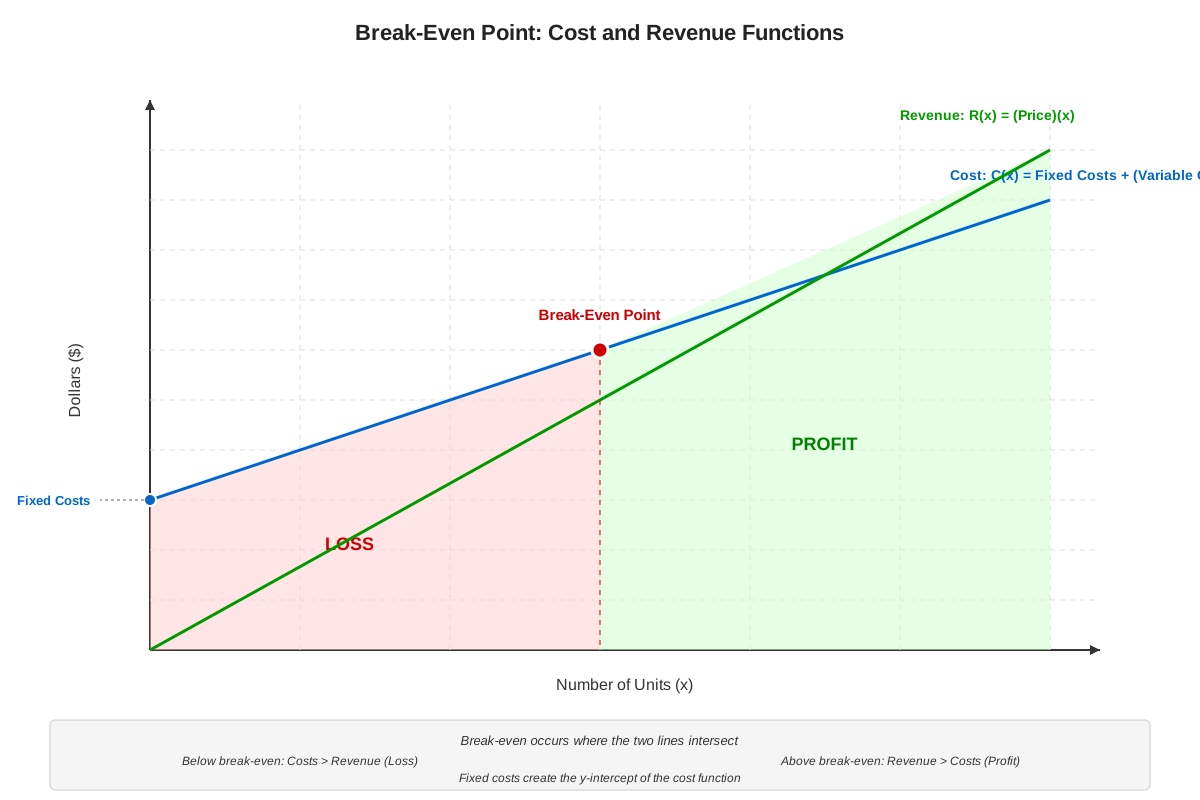
Revenue = Total CostsAt production levels below the break-even point, the business operates at a loss because costs exceed revenue. At levels above the break-even point, the business generates profit because revenue exceeds costs. The break-even point serves as the critical threshold separating these two financial states.
Cost Structure Components
Understanding break-even problems requires distinguishing between two types of costs:
Fixed costs (often denoted as F or C₀) are expenses that remain constant regardless of how many units are produced or sold. These include rent, insurance, equipment purchases, salaries for permanent staff, and initial setup expenses. If a company produces zero units or one thousand units, fixed costs remain unchanged.
Variable costs (often denoted as v or c) are expenses that change proportionally with production volume. These include raw materials, hourly labor, packaging, and shipping costs per unit. If variable cost per unit is $3, producing 100 units incurs $300 in variable costs, while producing 200 units incurs $600.
The total cost function combines these components:
Total Cost = Fixed Costs + (Variable Cost per Unit × Number of Units)
C(x) = F + vx
where x represents the number of units produced.
Revenue Function
Revenue represents the income generated from selling products. The revenue function depends on the selling price per unit:
Revenue = Price per Unit × Number of Units Sold
R(x) = px
where p is the price per unit and x is the quantity sold. This assumes all produced units are sold at the same price, a standard simplification in SAT problems.
Setting Up the Break-Even Equation
To find the break-even point, set the revenue function equal to the total cost function:
R(x) = C(x)
px = F + vx
Solving for x yields the break-even quantity:
px - vx = F
x(p - v) = F
x = F / (p - v)
The denominator (p - v) represents the contribution margin—the amount each unit sold contributes toward covering fixed costs after accounting for its variable cost.
Profit Function
The profit function expresses net income as a function of quantity:
Profit = Revenue - Total Costs
P(x) = R(x) - C(x)
P(x) = px - (F + vx)
P(x) = px - F - vx
P(x) = (p - v)x - F
At the break-even point, profit equals zero. For quantities greater than the break-even point, profit is positive. For quantities less than the break-even point, profit is negative (indicating a loss).
Graphical Interpretation
When graphed on a coordinate plane with quantity on the x-axis and dollars on the y-axis, the cost function appears as a line with y-intercept F (the fixed costs) and slope v (the variable cost per unit). The revenue function appears as a line through the origin with slope p (the price per unit). The break-even point is the x-coordinate of the intersection of these two lines.
| Function | Y-intercept | Slope | Interpretation |
|---|---|---|---|
| Cost | F (fixed costs) | v (variable cost per unit) | Starts at fixed costs, increases with production |
| Revenue | 0 | p (price per unit) | Starts at origin, increases with sales |
| Profit | -F (negative fixed costs) | p - v (contribution margin) | Starts negative, becomes positive after break-even |
Concept Relationships
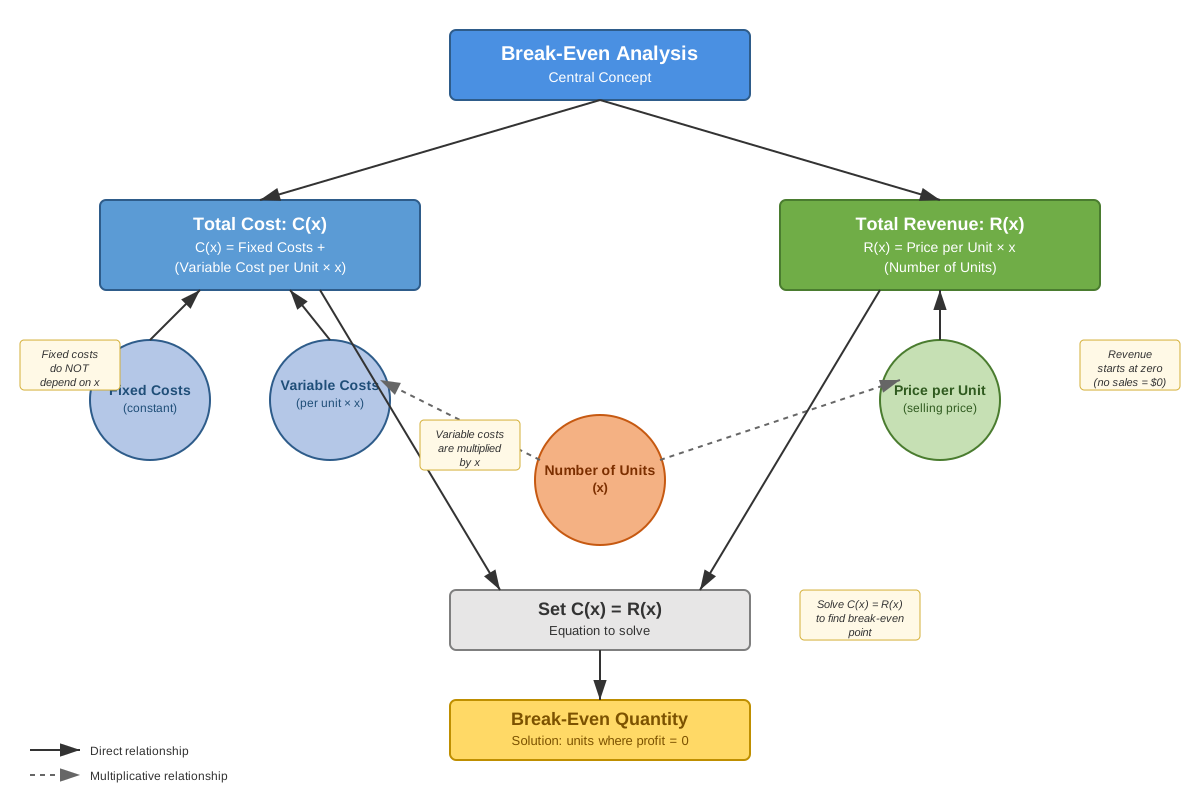
The components of break-even problems form an interconnected system where each element influences the others. Fixed costs and variable costs combine to create the total cost function, which represents one side of the break-even equation. Independently, the price per unit determines the revenue function, which forms the other side of the equation. When these two functions are set equal, the resulting equation can be solved to find the break-even point.
The contribution margin (price minus variable cost per unit) emerges as a derived concept that directly determines how quickly a business reaches break-even. A larger contribution margin means fewer units are needed to cover fixed costs, while a smaller margin requires higher sales volumes. This relationship connects to the profit function, which uses the contribution margin as its slope.
Break-even analysis builds directly on prerequisite knowledge of linear equations and systems of equations. The cost and revenue functions are both linear equations, and finding the break-even point is equivalent to solving a system of two linear equations. The graphical interpretation relies on understanding the coordinate plane and the meaning of slope and y-intercept in context.
This topic also connects forward to more advanced SAT problems involving inequalities (determining when profit exceeds a certain threshold), optimization (finding maximum profit), and piecewise functions (when pricing or costs change at different production levels). The logical structure of break-even problems—setting up equations from verbal descriptions, solving systematically, and interpreting results—transfers directly to other applied mathematics scenarios on the exam.
Relationship Map: Fixed Costs + Variable Costs → Total Cost Function → Break-even Equation ← Revenue Function ← Price per Unit; Break-even Equation → Break-even Point → Profit Analysis
High-Yield Facts
- ⭐ The break-even point occurs when Revenue = Total Costs, resulting in zero profit
- ⭐ Total Cost = Fixed Costs + (Variable Cost per Unit × Quantity)
- ⭐ Revenue = Price per Unit × Quantity Sold
- ⭐ Break-even quantity = Fixed Costs ÷ (Price per Unit - Variable Cost per Unit)
- ⭐ The contribution margin (Price - Variable Cost) determines how much each sale contributes to covering fixed costs
- Fixed costs remain constant regardless of production volume
- Variable costs change proportionally with the number of units produced
- At quantities below break-even, the business operates at a loss
- At quantities above break-even, the business generates profit
- The profit function is P(x) = (p - v)x - F, where p is price, v is variable cost, and F is fixed costs
- Graphically, the break-even point is where the cost line and revenue line intersect
- If price per unit equals variable cost per unit, break-even is impossible (parallel lines)
- Doubling the price per unit does not necessarily halve the break-even quantity (depends on contribution margin)
- The y-intercept of the cost function always represents fixed costs
- The slope of the revenue function is always the price per unit
Quick check — test yourself on Break-even problems so far.
Try Flashcards →Common Misconceptions
Misconception: Fixed costs change when production increases. → Correction: Fixed costs remain constant regardless of production volume. Only variable costs change with quantity. Rent, insurance, and equipment costs are examples of expenses that don't increase when you produce more units.
Misconception: The break-even point is when revenue equals variable costs. → Correction: The break-even point is when revenue equals total costs (both fixed and variable). Revenue must cover all expenses, not just variable ones, to achieve break-even status.
Misconception: Profit at the break-even point is equal to the fixed costs. → Correction: Profit at the break-even point is exactly zero. The business has covered all costs but hasn't generated any net income. Profit becomes positive only when production exceeds the break-even quantity.
Misconception: If a company sells 100 units and the break-even point is 80 units, profit equals revenue from 20 units. → Correction: Profit equals the contribution margin multiplied by the units above break-even: (price - variable cost) × 20. You must subtract variable costs from the revenue of those 20 units, not just count the full revenue.
Misconception: The break-even quantity is always a whole number. → Correction: Mathematically, the break-even point can be a decimal or fraction. In real-world contexts, you may need to round up to the next whole unit since partial units can't be sold, but the mathematical solution may not be an integer.
Misconception: Lowering fixed costs and lowering variable costs have the same effect on break-even point. → Correction: While both reduce the break-even quantity, they work differently. Lowering fixed costs reduces the numerator in the break-even formula, while lowering variable costs increases the denominator (contribution margin). The proportional impact differs based on the specific values.
Misconception: If the break-even point is 50 units, selling 51 units guarantees profit. → Correction: Selling 51 units guarantees profit only if all 51 units are sold at the assumed price. If some units are discounted or unsold, the actual break-even point shifts. SAT problems typically assume all produced units sell at the stated price unless otherwise specified.
Worked Examples
Example 1: Finding the Break-Even Point
Problem: A small business produces handmade candles. The fixed costs for equipment and rent total $1,200 per month. Each candle costs $3 in materials and labor to produce (variable costs). The business sells each candle for $11. How many candles must be sold each month to break even?
Solution:
Step 1: Identify the given information.
- Fixed costs: F = $1,200
- Variable cost per unit: v = $3
- Price per unit: p = $11
Step 2: Set up the cost and revenue functions.
- Total Cost: C(x) = 1,200 + 3x
- Revenue: R(x) = 11x
Step 3: Set revenue equal to total cost to find break-even.
11x = 1,200 + 3xStep 4: Solve for x.
11x - 3x = 1,200
8x = 1,200
x = 1,200 ÷ 8
x = 150Answer: The business must sell 150 candles per month to break even.
Verification: At 150 candles:
- Revenue = 11 × 150 = $1,650
- Total Cost = 1,200 + (3 × 150) = 1,200 + 450 = $1,650
- Profit = 1,650 - 1,650 = $0 ✓
This example demonstrates the core learning objective of applying break-even problems to solve SAT-style questions by systematically setting up equations and solving for the unknown quantity.
Example 2: Determining Profit Above Break-Even
Problem: A company manufactures phone cases with fixed costs of $8,000 and variable costs of $5 per case. Each case sells for $13. If the company produces and sells 1,500 cases, what is the profit?
Solution:
Step 1: Identify the given information.
- Fixed costs: F = $8,000
- Variable cost per unit: v = $5
- Price per unit: p = $13
- Quantity: x = 1,500
Step 2: Calculate total revenue.
Revenue = 13 × 1,500 = $19,500Step 3: Calculate total costs.
Total Cost = 8,000 + (5 × 1,500) = 8,000 + 7,500 = $15,500Step 4: Calculate profit.
Profit = Revenue - Total Cost = 19,500 - 15,500 = $4,000Alternative approach using the profit function:
P(x) = (p - v)x - F
P(1,500) = (13 - 5)(1,500) - 8,000
P(1,500) = 8(1,500) - 8,000
P(1,500) = 12,000 - 8,000 = $4,000Answer: The profit is $4,000.
Extension: We can verify this is above break-even by calculating the break-even point:
x = F ÷ (p - v) = 8,000 ÷ (13 - 5) = 8,000 ÷ 8 = 1,000 casesSince 1,500 > 1,000, the company is indeed operating above break-even, confirming that profit should be positive. This example addresses the learning objective of analyzing profit and loss regions relative to the break-even point.
Exam Strategy
When approaching SAT break-even problems, begin by carefully reading the problem to identify the three critical values: fixed costs, variable cost per unit, and price per unit. Trigger words to watch for include "initial investment" or "startup costs" (indicating fixed costs), "per unit" or "each item" (indicating variable costs or price), and "break even" or "no profit or loss" (indicating the target condition).
Create a systematic approach: write down F = [fixed costs], v = [variable cost per unit], and p = [price per unit] before setting up equations. This organization prevents confusion and helps catch errors. Then construct the equation px = F + vx and solve for x. Always check whether the question asks for the break-even quantity, the profit at a given quantity, or the total revenue/cost at a specific production level—these are distinct questions requiring different final calculations.
For process-of-elimination strategies, eliminate answer choices that don't make logical sense. If fixed costs are $1,000 and the contribution margin is $10 per unit, the break-even point must be 100 units—any answer significantly different from this can be eliminated. If a question asks about profit and you're operating below the break-even point, eliminate any positive profit values. Use estimation: if fixed costs are $2,400 and contribution margin is approximately $8, the break-even point should be around 300 units, allowing you to eliminate choices like 50 or 5,000.
Time allocation for break-even problems should be approximately 1.5-2 minutes for straightforward calculation questions and up to 3 minutes for multi-step problems requiring interpretation. If a problem involves a graph, spend 15-20 seconds analyzing the graph before reading the question—identify which line represents cost and which represents revenue by checking y-intercepts and slopes.
Watch for questions that ask about scenarios other than the exact break-even point. Some problems ask "How much profit if 200 units are sold?" or "At what quantity will profit equal $500?" These require additional steps beyond finding the break-even point. Always read the final question carefully to ensure you're answering what's actually asked, not just finding the break-even quantity by default.
Memory Techniques
Mnemonic for Break-Even Formula Components: "FiVe Pies" helps remember the break-even formula structure:
- Fi = Fixed costs (numerator)
- Ve = Variable cost (subtracted in denominator)
- Pies = Price (in denominator)
- Formula: x = F ÷ (P - V)
Visualization Strategy: Picture a seesaw or balance scale. On one side sits a heavy weight labeled "Fixed Costs" that never changes. On the other side, you're adding small weights labeled with dollar signs (revenue from each unit sold). The contribution margin determines how much each small weight helps. The break-even point is when the scale finally balances.
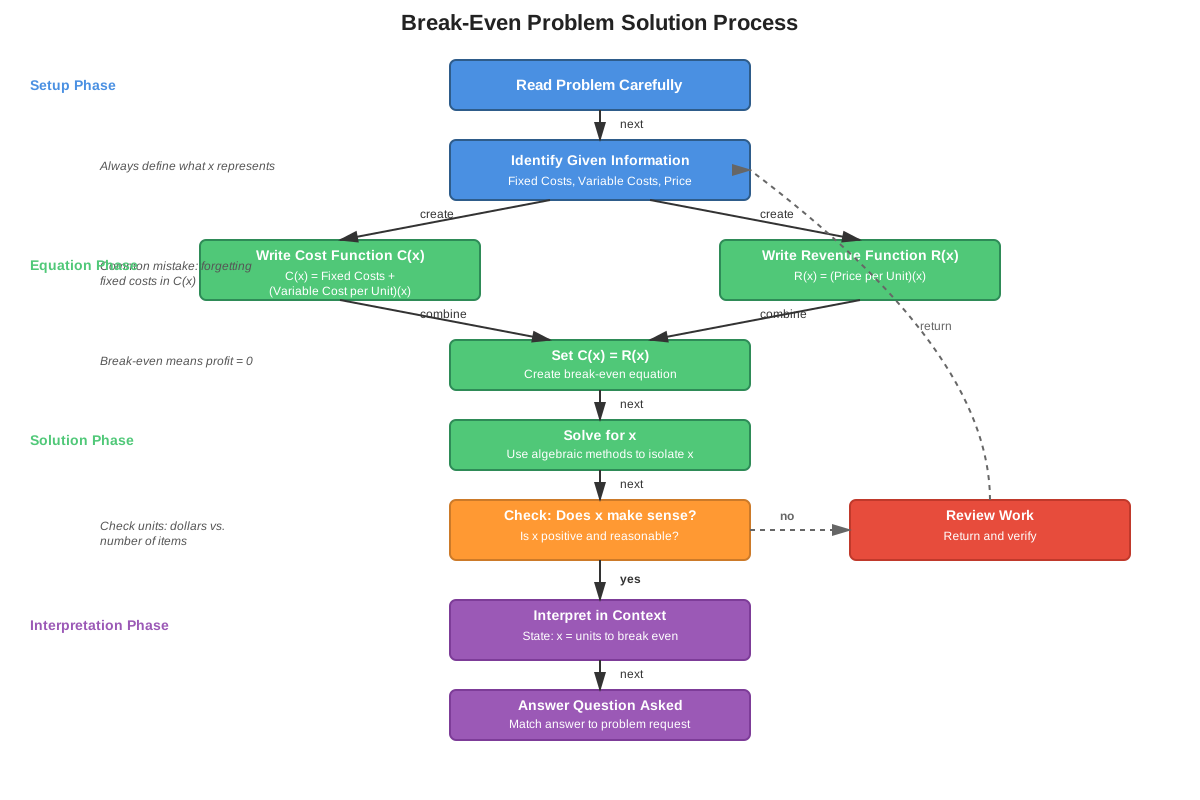
Acronym for Problem-Solving Steps: "ICSV" (pronounced "I see solve")
- Identify: Find F, v, and p in the problem
- Construct: Write cost and revenue equations
- Set equal: Create the break-even equation
- Verify: Check your answer makes sense
Memory aid for cost vs. revenue graphs: "Cost Climbs from a Cliff" (cost line has a y-intercept above zero), while "Revenue Rises from the Root" (revenue line starts at the origin). This helps you quickly identify which line is which when interpreting graphs.
Contribution Margin Reminder: Think "Price Pays for Production Plus Profit"—the price must first cover the variable production cost (p - v), and whatever's left contributes to fixed costs and eventually profit.
Summary
Break-even problems on the SAT require students to apply systems of linear equations to real-world business scenarios where total revenue equals total costs. The fundamental structure involves three key values: fixed costs (expenses that don't change with production), variable costs per unit (expenses that scale with quantity), and price per unit (revenue per item sold). The break-even point is calculated by setting the revenue function (px) equal to the total cost function (F + vx) and solving for quantity: x = F ÷ (p - v). This quotient represents how many units must be sold to cover all expenses without generating profit or loss. Below this quantity, the business operates at a loss; above it, profit is generated. Success on SAT break-even problems requires accurately translating word problems into algebraic expressions, systematically solving equations, and interpreting solutions within the business context. Understanding the contribution margin (price minus variable cost) is essential, as it determines how effectively each sale moves the business toward profitability. These problems test multiple competencies simultaneously: algebraic manipulation, contextual reasoning, and the ability to move between verbal descriptions and mathematical models.
Key Takeaways
- Break-even occurs when Revenue = Total Costs, resulting in zero profit: px = F + vx
- The break-even formula is x = F ÷ (p - v), where F is fixed costs, p is price per unit, and v is variable cost per unit
- Fixed costs remain constant regardless of production volume, while variable costs change proportionally with quantity
- The contribution margin (p - v) represents how much each unit sold contributes toward covering fixed costs
- Quantities below break-even result in losses; quantities above break-even generate profits
- On the SAT, carefully identify all three components (F, v, p) before setting up equations
- Graphically, the break-even point is where the cost line and revenue line intersect
Related Topics
Systems of Linear Equations with Two Variables: Break-even problems are a specific application of solving systems where two linear equations (cost and revenue) are set equal. Mastering break-even analysis provides a concrete context for understanding abstract systems.
Linear Inequalities: After finding the break-even point, students may encounter problems asking when profit exceeds a certain threshold (P(x) > k) or when costs remain below a budget (C(x) < B), extending break-even concepts into inequality territory.
Functions and Function Notation: Break-even problems reinforce understanding of functions by presenting cost, revenue, and profit as functions of quantity: C(x), R(x), and P(x). This notation appears throughout SAT Math.
Rate and Work Problems: These problems share the same problem-solving structure as break-even scenarios—setting up equations from verbal descriptions and solving for unknown quantities—making break-even analysis excellent preparation.
Graphing Linear Equations: Visualizing break-even scenarios on the coordinate plane strengthens understanding of slope, y-intercept, and intersection points, all fundamental graphing concepts tested on the SAT.
Practice CTA
Now that you've mastered the core concepts of break-even problems, it's time to solidify your understanding through active practice. Attempt the practice questions designed specifically for this topic, focusing on applying the systematic approach outlined in this guide. Use the flashcards to reinforce key formulas and definitions until they become automatic. Remember, break-even problems are high-yield SAT content—investing time here will directly improve your score. Each practice problem you solve builds the pattern recognition and confidence needed to tackle these questions quickly and accurately on test day. You've got this!
Sign up free to keep reading
Create a free AnvayaPrep account to finish this SAT guide on Break-even problems — plus flashcards and practice questions.