Overview
Comparing two plans is one of the most practical and frequently tested topics within Systems of Linear Equations on the SAT math section. This topic involves analyzing two different scenarios—typically pricing plans, payment structures, or cost models—and determining which option is more advantageous under various conditions. Students encounter these problems in real-world contexts such as choosing between cell phone plans, gym memberships, or service contracts, making this topic both relevant and highly testable.
On the SAT, comparing two plans questions assess a student's ability to translate verbal descriptions into algebraic expressions, set up and solve systems of equations, and interpret solutions within practical contexts. These problems test multiple skills simultaneously: reading comprehension, algebraic manipulation, graphical interpretation, and logical reasoning. The College Board frequently uses this topic because it demonstrates mathematical modeling—the ability to use mathematics to solve authentic problems.
Understanding how to compare plans connects directly to broader concepts in linear functions, including slope-intercept form, rate of change, and break-even analysis. This topic serves as a bridge between abstract algebraic manipulation and practical problem-solving, reinforcing why systems of equations matter beyond the classroom. Mastery of this concept ensures students can confidently tackle 2-3 questions per SAT exam, potentially adding 40-60 points to their math score.
Learning Objectives
- [ ] Identify key features of comparing two plans, including fixed costs and variable rates
- [ ] Explain how comparing two plans appears on the SAT in word problems and graphical representations
- [ ] Apply comparing two plans to answer SAT-style questions involving cost analysis and break-even points
- [ ] Construct linear equations from verbal descriptions of pricing structures
- [ ] Determine the conditions under which one plan becomes more economical than another
- [ ] Interpret the meaning of intersection points in the context of comparing plans
- [ ] Analyze graphs representing two plans to make informed decisions
Prerequisites
- Linear equations in slope-intercept form (y = mx + b): Essential for representing each plan as an equation where the slope represents the variable rate and the y-intercept represents the fixed cost
- Solving systems of equations: Necessary for finding the break-even point where two plans cost the same amount
- Graphing linear functions: Enables visual comparison of plans and identification of intersection points
- Substitution and elimination methods: Required techniques for solving systems algebraically
- Interpreting word problems: Critical for translating real-world scenarios into mathematical models
Why This Topic Matters
Comparing two plans represents one of the most practical applications of algebra that students will use throughout their lives. Whether evaluating streaming services, insurance policies, or rental agreements, the mathematical reasoning developed through these problems directly transfers to financial decision-making. This real-world relevance makes the topic particularly valuable for demonstrating mathematical literacy.
On the SAT, this topic appears with remarkable consistency. Approximately 2-3 questions per exam involve comparing plans, accounting for roughly 4-6% of the math section. These questions typically appear in both the calculator and no-calculator portions, with varying difficulty levels. The College Board favors this topic because it assesses multiple competencies: algebraic reasoning, problem-solving, and the ability to work with mathematical models.
Common exam presentations include: word problems describing two payment structures requiring students to determine which is cheaper under specific conditions; graphical representations where students must interpret intersection points; tables showing costs at different usage levels; and multi-step problems requiring both equation setup and solution interpretation. The topic frequently appears in questions worth 1 point in multiple-choice format, but also surfaces in student-produced response questions where partial credit isn't available, making accuracy essential.
Core Concepts
Understanding Plan Structure
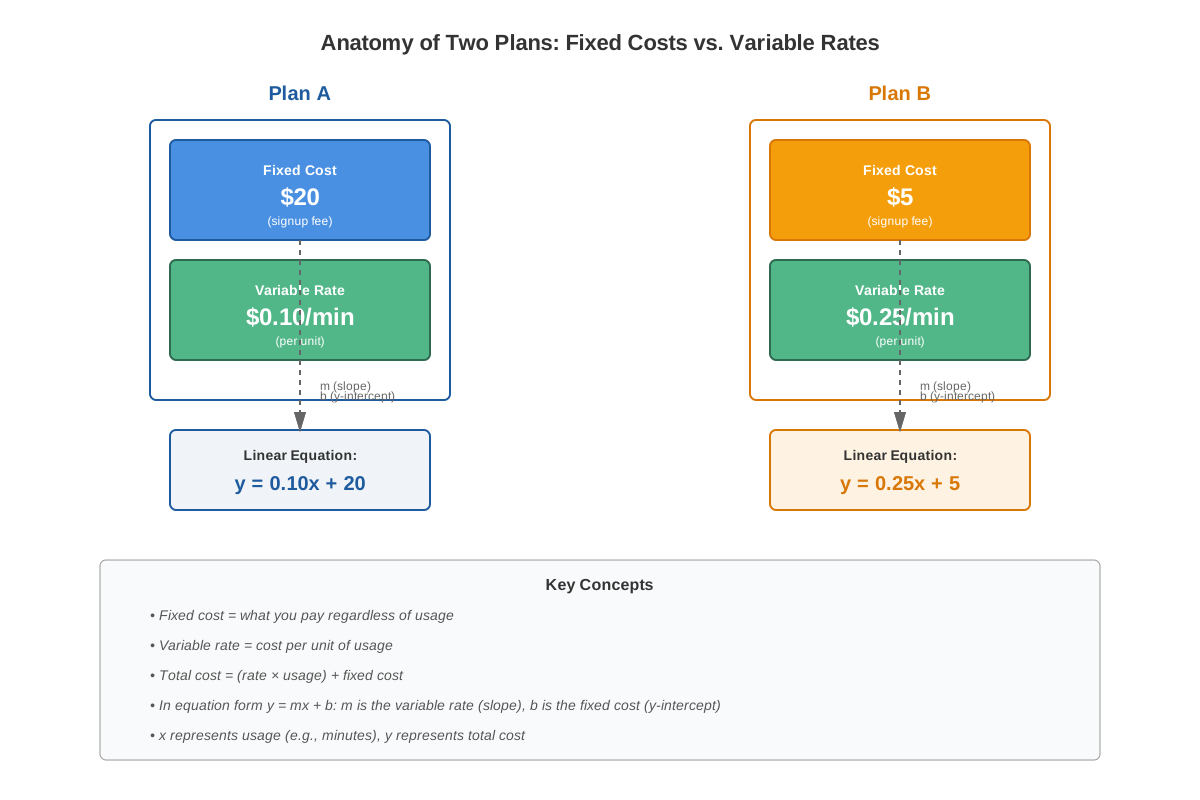
Every comparing two plans problem involves two distinct cost structures that students must analyze. Each plan typically consists of two components: a fixed cost (also called an initial fee, base charge, or flat rate) and a variable cost (a per-unit charge that depends on usage, time, or quantity). Understanding this structure is fundamental to setting up correct equations.
The fixed cost represents a one-time payment or recurring charge that doesn't change regardless of usage. Examples include membership fees, activation charges, or monthly base rates. The variable cost represents the rate charged per unit of consumption—per minute, per gigabyte, per item, or per hour. This rate multiplies by the quantity used to determine the variable portion of the total cost.
Translating Plans into Equations
The most critical skill in sat comparing two plans problems is converting verbal descriptions into algebraic equations. Each plan can be represented using the linear equation format:
Total Cost = Fixed Cost + (Variable Rate × Quantity)
or
y = b + mx
Where:
- y represents the total cost
- b represents the fixed cost (y-intercept)
- m represents the variable rate (slope)
- x represents the quantity or usage
For example, if Plan A charges a $20 monthly fee plus $0.10 per text message, the equation becomes: C = 20 + 0.10t, where C is total cost and t is the number of texts. If Plan B charges no monthly fee but $0.25 per text, the equation is: C = 0.25t.
The Break-Even Point
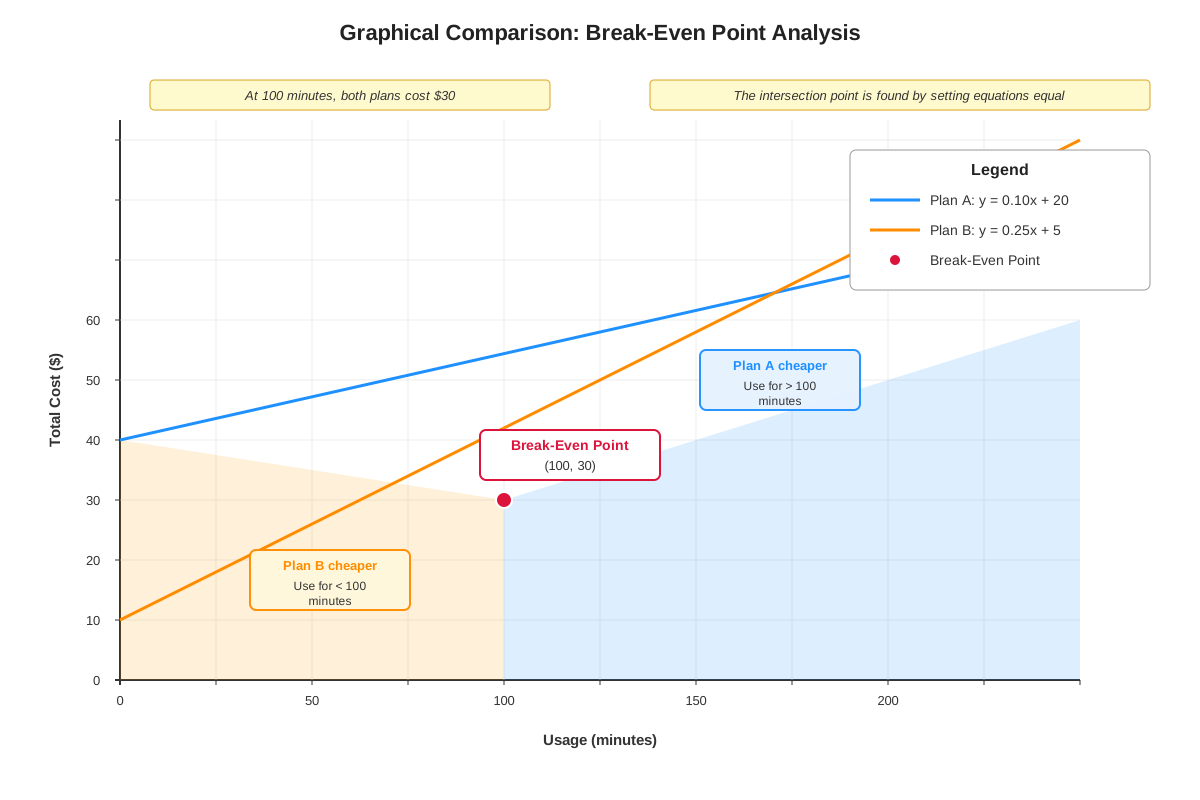
The break-even point is the usage level where both plans cost exactly the same amount. This point is found by setting the two cost equations equal to each other and solving for the quantity variable. The break-even point is crucial because it divides the usage spectrum into regions where one plan is superior to the other.
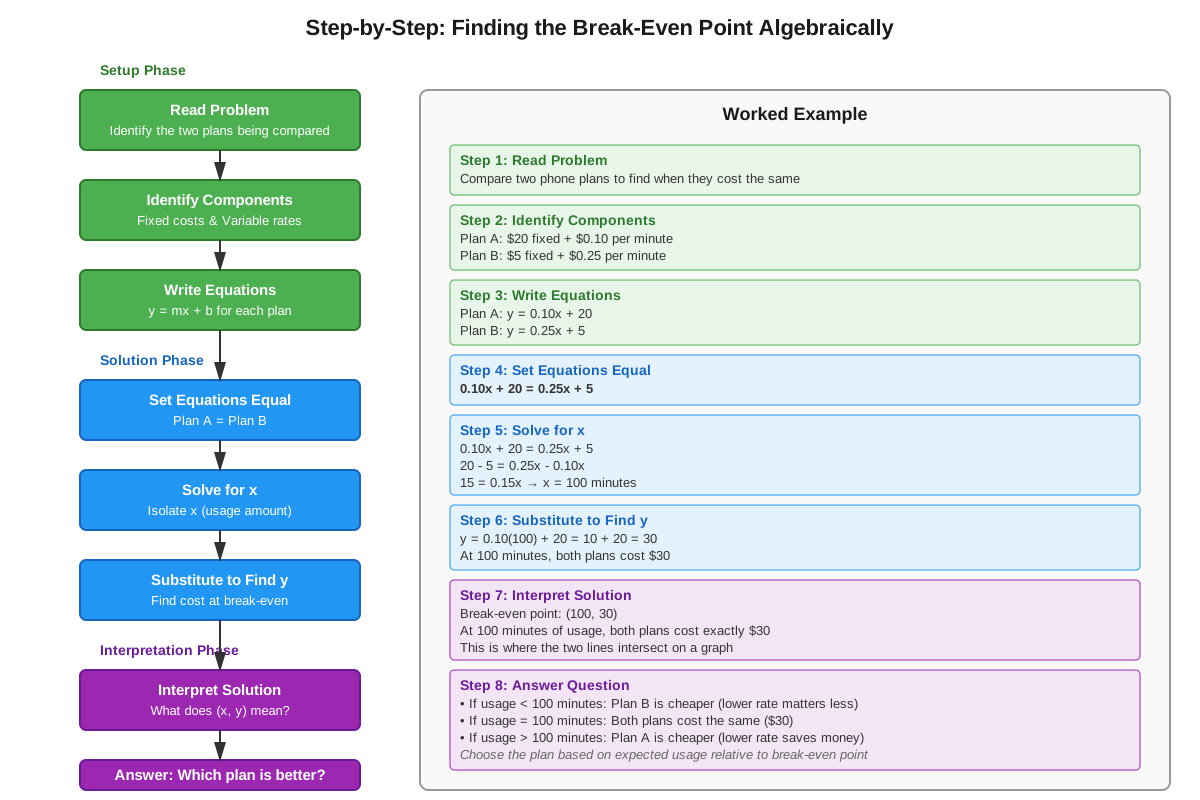
To find the break-even point algebraically:
- Write equations for both plans
- Set them equal to each other
- Solve for the variable (quantity/usage)
- Substitute back to find the cost at that point
Using the previous example:
20 + 0.10t = 0.25t
20 = 0.15t
t = 133.33 texts
At approximately 133 texts, both plans cost the same. Below this usage, Plan B is cheaper; above it, Plan A is more economical.
Graphical Interpretation
When comparing two plans graphically, each plan appears as a line on a coordinate plane. The x-axis typically represents quantity or usage, while the y-axis represents total cost. Key features to identify include:
| Feature | Meaning | Decision Impact |
|---|---|---|
| Y-intercept | Fixed cost of the plan | Higher intercept means higher starting cost |
| Slope | Variable rate per unit | Steeper slope means costs increase faster with usage |
| Intersection point | Break-even point | Usage level where plans cost the same |
| Line position | Relative cost at different usage levels | Lower line indicates cheaper plan at that usage |
A line with a higher y-intercept but lower slope starts more expensive but becomes cheaper at higher usage levels. Conversely, a line starting at the origin (no fixed cost) with a steeper slope is initially cheaper but becomes more expensive as usage increases.
Decision-Making Framework
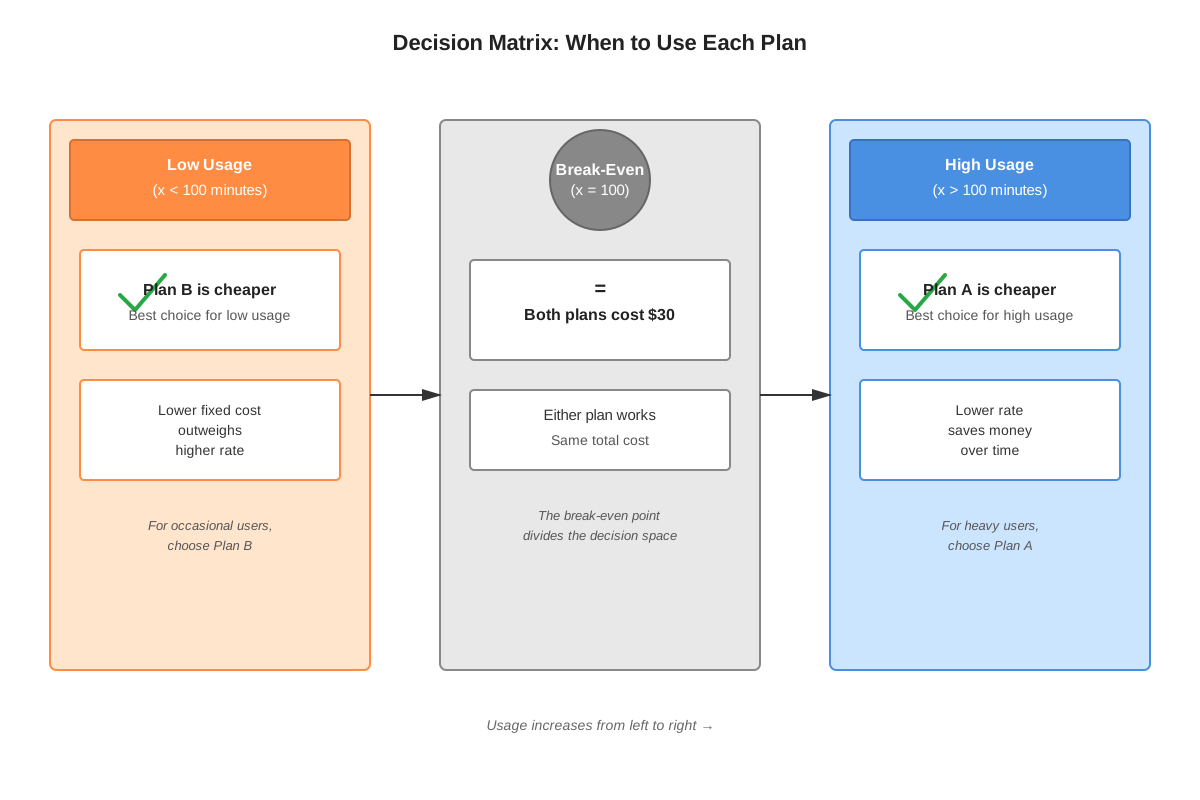
After establishing equations and finding the break-even point, students must interpret results to make recommendations. The decision framework follows this logic:
- Below break-even usage: Choose the plan with the lower or no fixed cost
- At break-even usage: Both plans cost the same; either choice is equivalent
- Above break-even usage: Choose the plan with the lower variable rate
This framework applies regardless of whether the problem asks "which plan is cheaper for 200 units?" or "for what usage levels is Plan A more economical?" The mathematical analysis remains consistent, but the question format varies.
Special Cases and Variations
Some SAT problems introduce variations that test deeper understanding:
Parallel plans: When two plans have the same variable rate but different fixed costs, their lines are parallel and never intersect. The plan with the lower fixed cost is always cheaper, regardless of usage.
Multiple break-even points: Occasionally, problems involve three plans, creating two break-even points and three decision regions.
Inequality constraints: Some questions ask for usage ranges where one plan is cheaper, requiring inequality notation (x < break-even point or x > break-even point).
Non-linear elements: Advanced problems might include tiered pricing or caps, though these are less common on the SAT.
Concept Relationships
The concepts within comparing two plans build upon each other in a logical progression. Understanding plan structure (fixed + variable costs) → enables translation into linear equations → which allows calculation of break-even points → leading to informed decision-making based on usage levels. Each step depends on the previous one, creating a problem-solving chain.
This topic connects directly to prerequisite knowledge of linear equations, where students learned that y = mx + b represents a line with slope m and y-intercept b. In comparing plans, this abstract form gains concrete meaning: the y-intercept becomes the fixed cost, and the slope becomes the variable rate. Systems of equations, another prerequisite, provide the tools for finding break-even points through substitution or elimination methods.
The relationship map flows as follows:
Linear Functions → provide the mathematical framework → Plan Structure Recognition → enables → Equation Construction → leads to → System of Equations → solved to find → Break-Even Point → which informs → Decision Analysis → resulting in → Optimal Plan Selection
This topic also connects forward to more advanced concepts like optimization, piecewise functions, and mathematical modeling in higher mathematics. The reasoning skills developed here—translating real situations into mathematical models and interpreting solutions contextually—form the foundation for calculus applications and economics.
High-Yield Facts
⭐ Every plan can be represented as y = fixed cost + (variable rate)(quantity), where y is total cost
⭐ The break-even point occurs where the two cost equations are equal; solve by setting them equal and solving for the quantity variable
⭐ Below the break-even point, the plan with the lower or no fixed cost is cheaper
⭐ Above the break-even point, the plan with the lower variable rate is cheaper
⭐ On a graph, the intersection point of two lines represents the break-even point
- The y-intercept of a cost line represents the fixed cost or initial fee
- The slope of a cost line represents the variable rate or per-unit charge
- If two plans have the same variable rate (parallel lines), the one with the lower fixed cost is always cheaper
- When a plan has no fixed cost, its line passes through the origin (0,0)
- The steeper the line, the faster costs increase with usage
- To determine which plan is cheaper at a specific usage level, substitute that value into both equations and compare
- Word problems often disguise fixed costs as "membership fees," "activation charges," or "monthly base rates"
- Variable costs appear as "per minute," "per item," "per mile," or "per unit" charges
- If asked for a usage range where one plan is better, use inequality notation based on the break-even point
- Always check that your answer makes logical sense in the context of the problem
Quick check — test yourself on Comparing two plans so far.
Try Flashcards →Common Misconceptions
Misconception: The plan with the lower total cost at one usage level is always cheaper at all usage levels.
Correction: The cheaper plan depends on usage relative to the break-even point. A plan that's cheaper at low usage may become more expensive at high usage, and vice versa. Always consider the entire usage spectrum.
Misconception: The break-even point represents the best choice between plans.
Correction: The break-even point represents where both plans cost the same, not necessarily the optimal choice. It's a decision boundary—below it, one plan is better; above it, the other is better. The "best" choice depends on expected usage.
Misconception: A higher fixed cost always means a more expensive plan overall.
Correction: A plan with a higher fixed cost but lower variable rate can become cheaper at higher usage levels. The total cost depends on both components and the usage level.
Misconception: When graphing, the line that starts higher on the y-axis is always more expensive.
Correction: While a higher y-intercept indicates a higher fixed cost, the line with the lower slope may eventually become cheaper as usage increases. The relative position of lines changes at the intersection point.
Misconception: If two equations are set equal and solved, the resulting value is the cost at the break-even point.
Correction: When solving two cost equations set equal to each other, the solution represents the quantity/usage at break-even, not the cost. To find the cost at break-even, substitute this quantity back into either original equation.
Misconception: Plans with no fixed cost are always better for low usage.
Correction: While plans with no fixed cost start at zero, they may have higher variable rates that make them expensive even at moderate usage. Always compare total costs at the specific usage level in question.
Worked Examples
Example 1: Cell Phone Plan Comparison
Problem: Company A charges a $30 monthly fee plus $0.05 per text message. Company B charges no monthly fee but $0.15 per text message.
a) Write equations representing the total monthly cost for each company.
b) Find the break-even point.
c) Which plan is cheaper if you send 250 texts per month?
Solution:
Part a: Setting up equations
Let C = total monthly cost and t = number of text messages
Company A: C = 30 + 0.05t
(Fixed cost of $30 plus $0.05 per text)
Company B: C = 0.15t
(No fixed cost, just $0.15 per text)
Part b: Finding the break-even point
Set the equations equal:
30 + 0.05t = 0.15t
30 = 0.15t - 0.05t
30 = 0.10t
t = 300 texts
The break-even point is 300 texts. At this usage level, both plans cost the same.
To verify, substitute t = 300 into both equations:
- Company A: C = 30 + 0.05(300) = 30 + 15 = $45
- Company B: C = 0.15(300) = $45 ✓
Part c: Comparing at 250 texts
Since 250 texts is below the break-even point of 300 texts, Company B (with no fixed cost) should be cheaper. Let's verify:
Company A: C = 30 + 0.05(250) = 30 + 12.50 = $42.50
Company B: C = 0.15(250) = $37.50
Company B is cheaper by $5.00 at 250 texts per month.
Connection to Learning Objectives: This example demonstrates equation construction from verbal descriptions, break-even calculation, and decision-making based on specific usage levels—all core skills for SAT success.
Example 2: Gym Membership Analysis with Graphical Interpretation
Problem: The graph below shows the total cost of two gym memberships over time. Gym X charges a joining fee plus a monthly rate. Gym Y charges a higher monthly rate but no joining fee. The lines intersect at (4, 200).
a) What does the point (4, 200) represent in this context?
b) If you plan to maintain membership for 6 months, which gym is more economical?
c) If Gym Y's line passes through (0, 0) and (4, 200), what is its monthly rate?
Solution:
Part a: Interpreting the intersection point
The point (4, 200) represents the break-even point where:
- 4 months is the time when both gyms cost the same total amount
- $200 is the total cost at both gyms after 4 months
This is the critical decision point: below 4 months, one gym is cheaper; above 4 months, the other is cheaper.
Part b: Determining the better choice for 6 months
Since 6 months is greater than the break-even point of 4 months, we need to identify which line is lower (cheaper) after the intersection point.
Gym X has a joining fee (higher y-intercept) but a lower monthly rate (less steep slope). After the intersection, Gym X's line will be below Gym Y's line, making it cheaper.
Therefore, Gym X is more economical for a 6-month membership.
Part c: Calculating Gym Y's monthly rate
Gym Y's line passes through (0, 0) and (4, 200), so we can find the slope:
slope = (y₂ - y₁)/(x₂ - x₁) = (200 - 0)/(4 - 0) = 200/4 = 50Gym Y charges $50 per month with no joining fee.
Connection to Learning Objectives: This example emphasizes graphical interpretation, understanding intersection points in context, and using slope to determine rates—essential skills for visual SAT problems.
Exam Strategy
When approaching comparing two plans questions on the SAT, follow this systematic process:
Step 1: Identify the components (30 seconds)
- Locate the fixed cost for each plan (may be zero)
- Identify the variable rate for each plan
- Determine what quantity is being measured (texts, hours, items, etc.)
Step 2: Set up equations (30 seconds)
- Write y = fixed cost + (variable rate)(x) for each plan
- Use clear variable definitions
- Double-check that units match (dollars, cents, etc.)
Step 3: Determine what the question asks (15 seconds)
- Break-even point? Set equations equal and solve
- Which is cheaper at a specific usage? Substitute and compare
- Usage range where one is better? Find break-even, then use inequality reasoning
Step 4: Solve and interpret (45 seconds)
- Perform calculations carefully
- Interpret your answer in context
- Check that your answer makes logical sense
Exam Tip: If the problem provides a graph, use it to estimate the break-even point before calculating. This helps you verify your algebraic answer and can save time.
Trigger words and phrases to watch for:
- "Monthly fee" or "membership charge" → fixed cost
- "Per unit," "per minute," "each additional" → variable rate
- "When do the plans cost the same?" → find break-even point
- "Which plan is more economical for..." → compare at specific usage
- "For what values is Plan A cheaper?" → inequality based on break-even
Process-of-elimination tips:
- Eliminate answers that ignore either the fixed cost or variable rate
- Rule out choices that suggest the same plan is always cheaper regardless of usage (unless lines are parallel)
- Eliminate break-even points that are negative or don't make sense contextually
- Cross out answers where units don't match the question
Time allocation: Allocate 90-120 seconds for standard comparing plans problems. If a question involves both algebraic setup and graphical interpretation, allow up to 2 minutes. Don't spend more than 2.5 minutes on any single problem—mark it and return if needed.
Memory Techniques
Mnemonic for equation setup: "FIX the VARY"
- FIX = Fixed cost (the constant, y-intercept)
- VARY = Variable rate (the coefficient, slope) times quantity
Acronym for break-even analysis: "SEES"
- Set equations equal
- Eliminate variables (solve)
- Evaluate by substituting back
- Select the better plan based on usage
Visualization strategy: Picture a race between two runners
- Runner with a head start (fixed cost) but slower pace (lower variable rate) = Plan with higher fixed cost, lower variable rate
- Runner starting at the starting line (no fixed cost) but faster pace (higher variable rate) = Plan with no fixed cost, higher variable rate
- The point where the faster runner catches up = break-even point
Remember the "Intersection = Decision" principle: The intersection point on a graph is where your decision changes. Below it, choose one plan; above it, choose the other.
For remembering which plan is better:
- Low usage → Lower fixed cost (or no fixed cost)
- High usage → Higher fixed cost (but lower variable rate)
Summary
Comparing two plans is a high-yield SAT topic that tests the ability to model real-world scenarios using systems of linear equations. Each plan consists of a fixed cost and a variable rate, which combine to form a linear equation in the form y = b + mx. The critical concept is the break-even point—the usage level where both plans cost the same—found by setting the two equations equal and solving. Below this point, the plan with the lower or no fixed cost is more economical; above it, the plan with the lower variable rate becomes cheaper. Graphically, plans appear as lines where the y-intercept represents the fixed cost, the slope represents the variable rate, and the intersection point marks the break-even. Success on SAT questions requires translating verbal descriptions into equations, performing accurate calculations, and interpreting results within the problem's context. This topic appears consistently on the exam, making mastery essential for achieving a competitive math score.
Key Takeaways
- Every plan equation follows the structure: Total Cost = Fixed Cost + (Variable Rate × Quantity)
- The break-even point is found by setting two cost equations equal and solving for the quantity variable
- Below break-even, choose the plan with lower/no fixed cost; above break-even, choose the plan with lower variable rate
- On graphs, the intersection point represents break-even, the y-intercept shows fixed cost, and the slope indicates variable rate
- Always interpret your mathematical answer in the context of the problem—numbers alone aren't sufficient
- SAT questions test both algebraic manipulation and real-world decision-making based on mathematical models
- Practice translating word problems into equations quickly and accurately—this is the most common source of errors
Related Topics
Linear Inequalities: After mastering plan comparison, students can extend their skills to problems involving constraints and feasible regions, where plans must satisfy multiple conditions simultaneously.
Piecewise Functions: Some advanced pricing structures involve different rates at different usage levels (tiered pricing), requiring piecewise function analysis that builds on the foundation of comparing simple linear plans.
Optimization Problems: Understanding which plan is better under various conditions prepares students for calculus-level optimization, where finding maximum or minimum values becomes the focus.
Rate Problems: The variable rate component in plan comparison connects directly to distance-rate-time problems and work-rate problems, all involving proportional relationships.
Systems of Inequalities: When comparing plans with restrictions or limitations, the analysis extends to systems of inequalities, graphing feasible regions, and identifying optimal solutions within constraints.
Practice CTA
Now that you've mastered the concepts behind comparing two plans, it's time to solidify your understanding through practice! Attempt the practice questions to test your ability to set up equations, find break-even points, and make informed decisions. Use the flashcards to reinforce key vocabulary and formulas until they become automatic. Remember, the SAT rewards both accuracy and speed—consistent practice with these problems will help you recognize patterns instantly and solve confidently under time pressure. You've got this!
Sign up free to keep reading
Create a free AnvayaPrep account to finish this SAT guide on Comparing two plans — plus flashcards and practice questions.