Overview
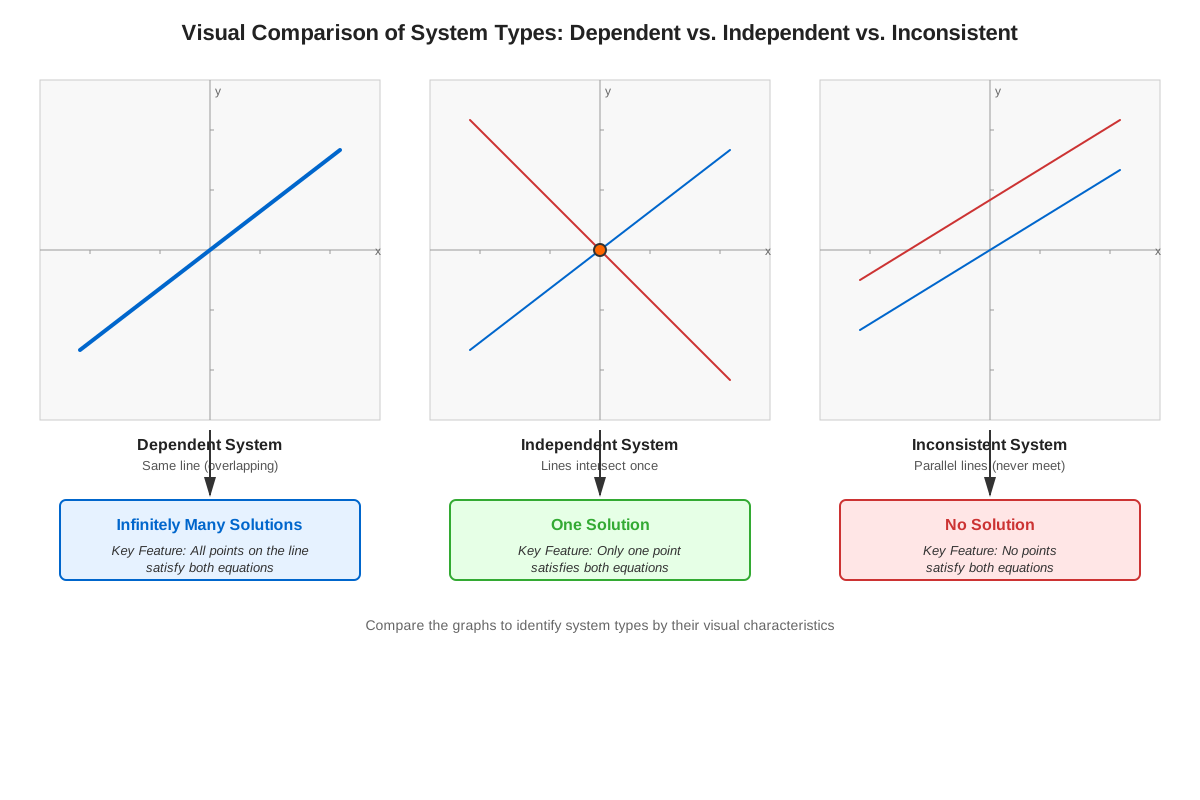
Dependent systems represent a special category of systems of linear equations where two or more equations describe the exact same line, resulting in infinitely many solutions. Unlike independent systems that intersect at a single point or inconsistent systems that never intersect, dependent systems are essentially multiple representations of the same linear relationship. When graphed, the equations in a dependent system produce overlapping lines that coincide perfectly along every point.
Understanding dependent systems is crucial for SAT success because the College Board frequently tests students' ability to recognize when equations represent the same line, particularly in algebraic form rather than graphical form. These questions assess conceptual understanding of linear relationships and the ability to manipulate equations to reveal their underlying structure. Students must recognize that dependent systems have infinitely many solutions—every point on the line satisfies all equations in the system.
This topic connects directly to fundamental concepts in algebra including slope-intercept form, standard form, equation manipulation, and the broader understanding of systems of linear equations. Mastery of dependent systems strengthens problem-solving skills across multiple math domains tested on the SAT, including linear functions, graphing, and algebraic reasoning. The ability to identify sat dependent systems quickly and accurately can save valuable time on test day and prevent common errors that lead to incorrect answer choices.
Learning Objectives
- [ ] Identify key features of dependent systems
- [ ] Explain how dependent systems appears on the SAT
- [ ] Apply dependent systems to answer SAT-style questions
- [ ] Determine whether a given system of equations is dependent by algebraic manipulation
- [ ] Calculate the relationship between coefficients in dependent systems
- [ ] Distinguish between dependent, independent, and inconsistent systems based on equation structure
Prerequisites
- Slope-intercept form (y = mx + b): Essential for converting equations to comparable forms to identify dependent systems
- Standard form of linear equations (Ax + By = C): Necessary for recognizing proportional relationships between coefficients
- Solving systems of equations: Provides context for understanding why dependent systems yield infinitely many solutions
- Properties of equality: Required for manipulating equations to reveal whether they represent the same line
- Graphing linear equations: Helps visualize what dependent systems look like geometrically
Why This Topic Matters
Dependent systems appear regularly on the SAT Math section, typically 1-2 times per test administration. These questions assess deeper conceptual understanding rather than mere computational ability, making them high-value targets for score improvement. The College Board uses dependent systems to test whether students truly understand what it means for equations to represent the same relationship versus simply memorizing solution procedures.
In real-world applications, dependent systems model situations where different measurements or formulations describe the same underlying relationship. For example, converting between units (miles to kilometers), scaling recipes, or expressing financial relationships in different currencies all create dependent systems. Engineers use dependent systems when working with equivalent circuit representations, and economists encounter them when expressing supply and demand relationships in various forms.
On the SAT, dependent systems most commonly appear in three formats: (1) questions asking how many solutions a system has, (2) problems requiring students to find a missing coefficient that makes a system dependent, and (3) word problems where students must recognize that two different descriptions represent the same constraint. These questions typically appear in both the calculator and no-calculator sections, with difficulty ranging from medium to hard. The College Board particularly favors questions where equations are presented in different forms (one in slope-intercept, one in standard form), requiring students to convert and compare.
Core Concepts
Definition of Dependent Systems
A dependent system consists of two or more linear equations that represent the exact same line. Every solution to one equation is also a solution to all other equations in the system. Mathematically, this means the equations are scalar multiples of each other—one equation can be obtained by multiplying every term of another equation by the same non-zero constant.
For example, the system:
2x + 4y = 8
x + 2y = 4
is dependent because the first equation equals the second equation multiplied by 2. Both equations describe the identical line, so they share all points in common, resulting in infinitely many solutions.
Identifying Dependent Systems Algebraically
The most reliable method for identifying dependent systems on the SAT involves comparing the ratios of corresponding coefficients. For two equations in standard form:
A₁x + B₁y = C₁
A₂x + B₂y = C₂
The system is dependent if and only if:
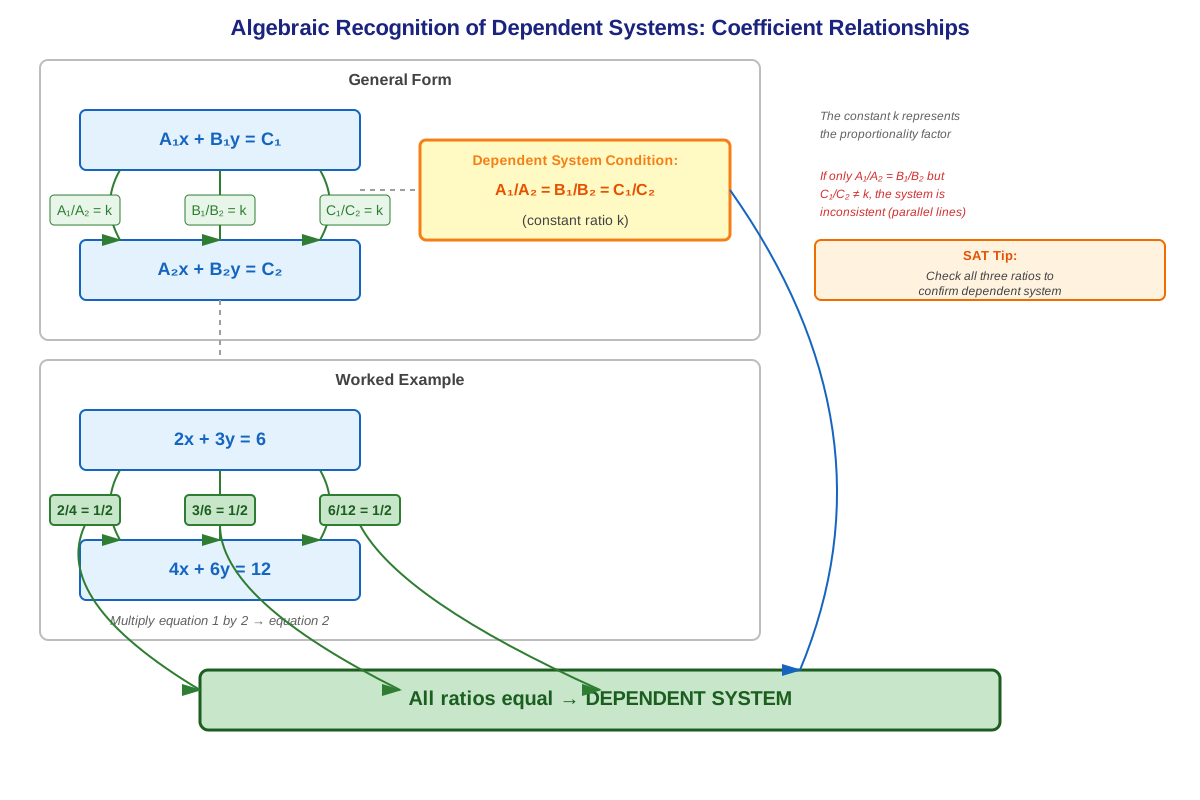
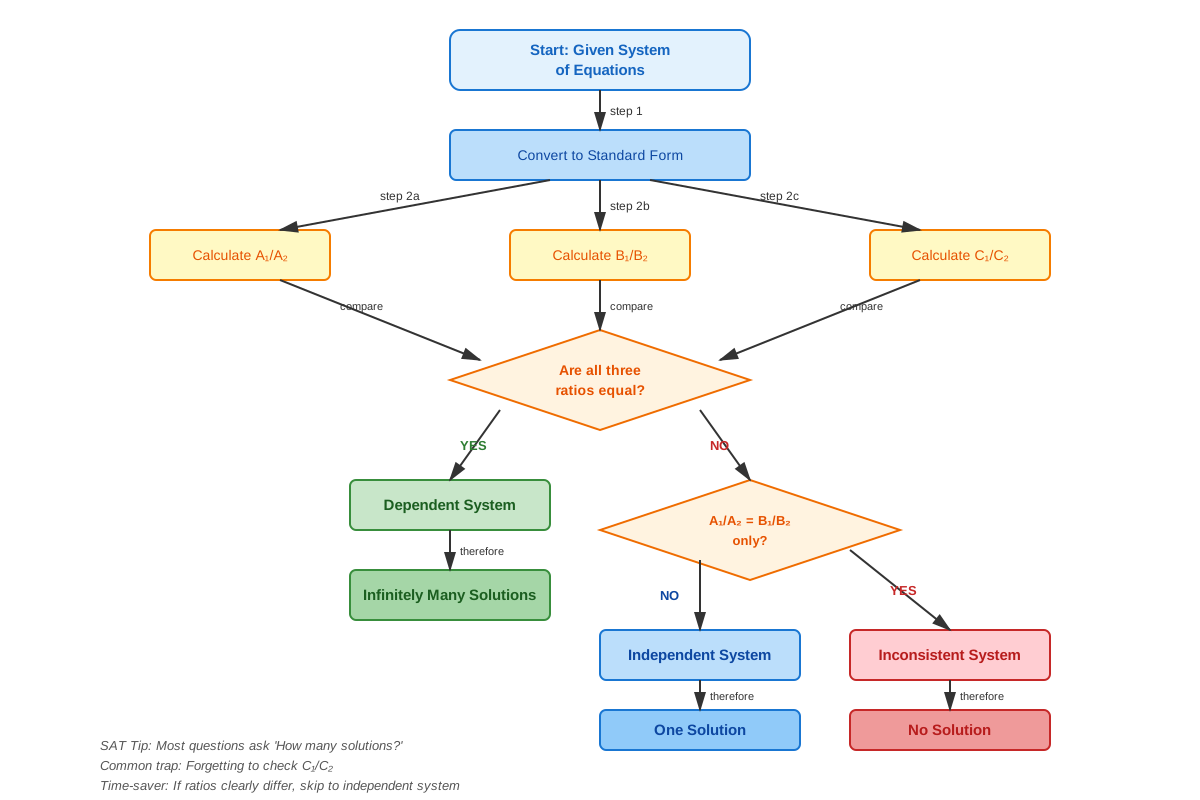
A₁/A₂ = B₁/B₂ = C₁/C₂All three ratios must be equal. If only the first two ratios are equal but the third differs, the system is inconsistent (parallel lines with no solution). If the ratios are not all equal, the system is independent (one unique solution).
Converting to Compare Forms
SAT questions often present equations in different forms to test whether students can recognize dependent systems. The key strategy involves converting both equations to the same form—typically slope-intercept form (y = mx + b) or standard form—then comparing.
Example conversion process:
Given:
3x - 6y = 12
y = (1/2)x - 2
Convert the first equation to slope-intercept form:
3x - 6y = 12
-6y = -3x + 12
y = (1/2)x - 2
Since both equations are identical in slope-intercept form, this is a dependent system.
The Coefficient Relationship
In dependent systems, there exists a constant k (where k ≠ 0) such that multiplying every term in one equation by k produces the other equation. This constant k represents the scalar multiple relating the two equations.
| System Type | Coefficient Ratios | Number of Solutions | Graphical Representation |
|---|---|---|---|
| Dependent | A₁/A₂ = B₁/B₂ = C₁/C₂ | Infinitely many | Coincident lines (overlap) |
| Independent | A₁/A₂ ≠ B₁/B₂ | Exactly one | Intersecting lines |
| Inconsistent | A₁/A₂ = B₁/B₂ ≠ C₁/C₂ | Zero | Parallel lines |
Finding Missing Coefficients
A common SAT question type provides a system with one unknown coefficient and asks students to find the value that makes the system dependent. The solution process involves:
- Set up the ratio equation using the coefficient relationship
- Cross-multiply to solve for the unknown
- Verify that all three ratios are equal
For instance, if given:
6x + 9y = 15
4x + ky = 10
To find k that makes this dependent:
6/4 = 9/k = 15/10From 6/4 = 15/10, we verify: 6/4 = 3/2 and 15/10 = 3/2 ✓
From 6/4 = 9/k:
3/2 = 9/k
3k = 18
k = 6
Graphical Interpretation
When graphed, dependent systems produce lines that lie exactly on top of each other. Every point on the line represents a solution to the system. This contrasts sharply with independent systems (lines crossing at one point) and inconsistent systems (parallel lines that never meet). Understanding this visual representation helps students quickly eliminate incorrect answer choices on graphing questions.
Solution Set Notation
The solution set for a dependent system can be expressed in multiple ways:
- "Infinitely many solutions"
- Parametric form: (x, y) where y = mx + b for all real x
- Set notation: {(x, y) | y = mx + b}
On the SAT, questions typically ask students to identify that there are "infinitely many solutions" rather than requiring formal notation.
Concept Relationships
Dependent systems connect to broader systems of equations concepts through a classification hierarchy: all systems of two linear equations fall into exactly one of three categories—dependent, independent, or inconsistent. Understanding dependent systems requires mastery of prerequisite topics like slope-intercept form and standard form because identifying dependence demands equation manipulation and comparison.
The relationship flow works as follows:
Linear Equations → Systems of Linear Equations → Classification by Solution Type → branches into three paths:
- Independent Systems (one solution)
- Dependent Systems (infinitely many solutions)
- Inconsistent Systems (no solution)
Within dependent systems specifically: Coefficient Ratios → Scalar Multiples → Identical Lines → Infinite Solutions
The concept also connects forward to more advanced topics. Understanding dependent systems provides foundation for:
- Linear dependence in vectors (Algebra 2/Precalculus)
- Rank of matrices (Linear Algebra)
- Constraint analysis in optimization problems
- Parametric equations
The coefficient ratio test for dependent systems directly parallels the slope comparison used to identify parallel lines, creating a conceptual bridge between single-equation analysis and systems analysis.
High-Yield Facts
⭐ A dependent system has infinitely many solutions because all equations represent the same line
⭐ For equations A₁x + B₁y = C₁ and A₂x + B₂y = C₂ to be dependent: A₁/A₂ = B₁/B₂ = C₁/C₂
⭐ If only A₁/A₂ = B₁/B₂ but C₁/C₂ differs, the system is inconsistent (no solution), not dependent
⭐ One equation in a dependent system can always be obtained by multiplying the other by a non-zero constant
⭐ Converting both equations to slope-intercept form is the fastest way to check for dependence on the SAT
- Dependent systems have identical slopes and identical y-intercepts when written in slope-intercept form
- The graphs of dependent systems are coincident lines (they overlap completely)
- If you attempt to solve a dependent system by elimination or substitution, you'll get a true statement like 0 = 0 or 5 = 5
- Dependent systems cannot be distinguished from independent systems by looking at only the x-coefficients or only the y-coefficients
- Every point (x, y) that satisfies one equation in a dependent system automatically satisfies all other equations
- The SAT never uses dependent systems with more than two equations
- Dependent systems preserve their dependence under any valid algebraic operation applied to both equations equally
Quick check — test yourself on Dependent systems so far.
Try Flashcards →Common Misconceptions
Misconception: If two equations have the same slope, they form a dependent system.
Correction: Same slope means the lines are parallel, but they only form a dependent system if they also have the same y-intercept. Same slope with different y-intercepts creates an inconsistent system with no solution.
Misconception: A dependent system has "no unique solution" which means zero solutions.
Correction: "No unique solution" means the system doesn't have exactly one solution—it could have zero solutions (inconsistent) or infinitely many solutions (dependent). Dependent systems specifically have infinitely many solutions, not zero.
Misconception: If solving a system yields 0 = 0, there's an error in the calculation.
Correction: Getting a true statement like 0 = 0 or 3 = 3 when solving indicates a dependent system with infinitely many solutions. This is the correct outcome, not an error.
Misconception: The coefficient ratios only need to be checked for x and y terms, not the constant term.
Correction: All three ratios (A₁/A₂, B₁/B₂, and C₁/C₂) must be equal for a dependent system. If only the first two are equal, the system is inconsistent.
Misconception: Dependent systems always have coefficients that are simple multiples like 2, 3, or 4.
Correction: The scalar multiple k can be any non-zero real number, including fractions, decimals, or irrational numbers. For example, multiplying by 2/3 or 1.5 still creates a dependent system.
Misconception: You can identify a dependent system just by looking at the equations without any manipulation.
Correction: While sometimes dependence is obvious, SAT questions deliberately present equations in different forms. You must convert to a common form or calculate coefficient ratios to reliably identify dependence.
Misconception: If two equations look completely different, they cannot be dependent.
Correction: Equations like 2x + 4y = 6 and -3x - 6y = -9 look different but are dependent (the second is the first multiplied by -3/2). Appearance doesn't determine dependence—mathematical relationship does.
Worked Examples
Example 1: Identifying a Dependent System
Problem: Determine whether the following system is dependent, independent, or inconsistent:
6x - 9y = 12
-4x + 6y = -8Solution:
Step 1: Identify the coefficients.
- Equation 1: A₁ = 6, B₁ = -9, C₁ = 12
- Equation 2: A₂ = -4, B₂ = 6, C₂ = -8
Step 2: Calculate the ratios of corresponding coefficients.
A₁/A₂ = 6/(-4) = -3/2
B₁/B₂ = (-9)/6 = -3/2
C₁/C₂ = 12/(-8) = -3/2
Step 3: Compare the ratios.
All three ratios equal -3/2, so A₁/A₂ = B₁/B₂ = C₁/C₂.
Step 4: Conclude.
Since all three ratios are equal, this is a dependent system with infinitely many solutions.
Verification: We can verify by multiplying the second equation by -3/2:
(-3/2)(-4x + 6y) = (-3/2)(-8)
6x - 9y = 12
This produces exactly the first equation, confirming dependence.
Connection to Learning Objectives: This example demonstrates how to identify key features of dependent systems (equal coefficient ratios) and apply the concept to classify a system—essential skills for SAT questions.
Example 2: Finding a Missing Coefficient
Problem: For what value of k does the following system have infinitely many solutions?
3x + 5y = 15
9x + ky = 45Solution:
Step 1: Recognize that "infinitely many solutions" means the system is dependent.
Step 2: Set up the coefficient ratio equation.
For a dependent system: A₁/A₂ = B₁/B₂ = C₁/C₂
3/9 = 5/k = 15/45Step 3: Simplify the known ratios.
3/9 = 1/3
15/45 = 1/3
Step 4: Set up the equation for k.
Since all ratios must equal 1/3:
5/k = 1/3Step 5: Solve for k.
Cross-multiply:
5 × 3 = k × 1
15 = k
Step 6: Verify the answer.
Check that all three ratios equal 1/3:
3/9 = 1/3 ✓
5/15 = 1/3 ✓
15/45 = 1/3 ✓Answer: k = 15
Alternative approach: Notice that 9 = 3 × 3 and 45 = 15 × 3, so the second equation is the first equation multiplied by 3. Therefore, k must equal 5 × 3 = 15.
Connection to Learning Objectives: This problem type appears frequently on the SAT and requires applying the coefficient relationship to find unknown values—a key application skill.
Exam Strategy
When approaching SAT questions on dependent systems, follow this systematic process:
Step 1: Identify the question type
- Look for phrases like "infinitely many solutions," "how many solutions," or "for what value of [variable] does the system..."
- Questions asking about "the same line" or "coincident lines" also signal dependent systems
Step 2: Choose your method
- Coefficient ratio method: Fastest for equations in standard form
- Conversion method: Best when equations are in different forms
- Elimination method: Useful when answer choices are far apart
Step 3: Execute efficiently
- Convert to the same form if needed (usually slope-intercept form is quickest)
- Calculate all three coefficient ratios, not just two
- Double-check that C₁/C₂ matches the other ratios
Exam Tip: If you're running short on time, convert both equations to slope-intercept form. If both the slope (m) and y-intercept (b) are identical, the system is dependent. This visual comparison is faster than calculating three ratios.
Trigger words and phrases to watch for:
- "Infinitely many solutions"
- "No unique solution" (could be dependent or inconsistent—check carefully)
- "The same line"
- "Coincident"
- "For all values of x"
- "Dependent system"
Process of elimination tips:
- Eliminate answer choices that would make the system inconsistent (same slope, different y-intercept)
- Eliminate choices that would make the system independent (different slopes)
- If a question asks "how many solutions," eliminate "zero" and "one" if you identify dependence
Time allocation:
- Spend 30-45 seconds identifying the system type
- Spend 45-60 seconds calculating the missing coefficient or verifying dependence
- Reserve 15-30 seconds for verification
Common trap answers:
- Values that make A₁/A₂ = B₁/B₂ but C₁/C₂ different (creates inconsistent system)
- Values that make only two of the three ratios equal
- Negative versions of the correct answer
Memory Techniques
Mnemonic for coefficient ratios: "ABC All Be Consistent"
- All three ratios (A, B, C coefficients)
- Be equal
- Consistent for dependent systems
Visualization strategy: Picture two identical transparent sheets with the same line drawn on each. When you overlay them, they match perfectly—that's a dependent system. If the lines are parallel but don't overlap, that's inconsistent. If they cross at one point, that's independent.
The "Triple Equal" rule: For dependent systems, think "===". All three coefficient ratios must show equality. If you see only "==" (two equal ratios), it's inconsistent, not dependent.
Acronym for solution types: DII
- Dependent = Infinitely many solutions
- Independent = One solution
- Inconsistent = Zero solutions
Rhyme for remembering: "Same slope, same intercept, dependent we detect. Same slope, different height, no solutions in sight."
The Multiplication Test: Ask yourself: "Can I multiply one equation by a single number to get the other?" If yes → dependent. If no → check further.
Summary
Dependent systems are systems of linear equations where all equations represent the same line, resulting in infinitely many solutions. The defining characteristic of dependent systems is that the ratios of corresponding coefficients are all equal: A₁/A₂ = B₁/B₂ = C₁/C₂. This means one equation can be obtained by multiplying every term of another equation by the same non-zero constant. On the SAT, dependent systems appear in questions asking about the number of solutions or requiring students to find missing coefficients that create dependence. The most efficient identification strategy involves converting equations to the same form—typically slope-intercept form—and comparing slopes and y-intercepts. If both match, the system is dependent. Alternatively, calculating the three coefficient ratios and verifying they're equal confirms dependence. Understanding dependent systems requires distinguishing them from independent systems (one solution, different slopes) and inconsistent systems (no solution, same slope but different y-intercepts). Mastery of this topic enables students to quickly classify systems and avoid common traps on test day.
Key Takeaways
- Dependent systems have infinitely many solutions because all equations describe the same line
- The coefficient ratio test (A₁/A₂ = B₁/B₂ = C₁/C₂) is the most reliable method for identifying dependent systems
- All three ratios must be equal; if only two are equal, the system is inconsistent, not dependent
- Converting to slope-intercept form allows quick visual comparison: same slope AND same y-intercept = dependent
- One equation in a dependent system is always a scalar multiple of the other
- SAT questions frequently ask for missing coefficients that create dependent systems
- When solving dependent systems algebraically, you'll get true statements like 0 = 0, indicating infinite solutions
Related Topics
Independent Systems: Systems with exactly one solution where lines intersect at a single point. Mastering dependent systems provides the contrast needed to quickly identify independent systems.
Inconsistent Systems: Systems with no solution where lines are parallel. Understanding the subtle difference between inconsistent and dependent systems (both have A₁/A₂ = B₁/B₂) is crucial for avoiding SAT traps.
Systems of Inequalities: While dependent systems involve equations, the concept of overlapping solution regions extends to inequality systems, where shaded regions might completely overlap.
Matrices and Determinants: In advanced mathematics, dependent systems relate to matrices with zero determinant, providing a foundation for linear algebra concepts.
Parametric Equations: The solution set of dependent systems can be expressed parametrically, connecting to more advanced representations of lines and curves.
Practice CTA
Now that you've mastered the core concepts of dependent systems, it's time to solidify your understanding through practice! Attempt the practice questions to test your ability to identify dependent systems, calculate missing coefficients, and distinguish between system types. Use the flashcards to reinforce the key definitions and coefficient relationships. Remember: recognizing dependent systems quickly and accurately can save you valuable time on test day and boost your SAT Math score. The more you practice identifying these patterns, the more automatic your response will become. You've got this!
Sign up free to keep reading
Create a free AnvayaPrep account to finish this SAT guide on Dependent systems — plus flashcards and practice questions.