Overview
Inconsistent systems represent a fundamental concept in algebra that appears regularly on the SAT Math section. An inconsistent system is a set of two or more linear equations that have no solution—meaning there is no point (x, y) that satisfies all equations simultaneously. This occurs when the lines represented by the equations are parallel, never intersecting on the coordinate plane. Understanding inconsistent systems is crucial for SAT success because the exam frequently tests whether students can identify when a system has no solution, one solution, or infinitely many solutions.
The SAT approaches this topic from multiple angles: algebraically through equation manipulation, graphically through slope-intercept analysis, and conceptually through word problems. Students must recognize that parallel lines have identical slopes but different y-intercepts, which creates the mathematical impossibility of a shared solution point. This topic connects directly to broader algebraic reasoning skills and appears in approximately 3-5 questions per SAT administration, making it a high-yield area for focused study.
Mastering inconsistent systems strengthens overall understanding of linear relationships, systems of equations, and algebraic problem-solving. This knowledge serves as a foundation for more advanced topics including consistent systems (with one or infinite solutions), linear programming, and matrix operations. The ability to quickly identify system consistency saves valuable time on the exam and prevents careless errors when solving multi-step problems.
Learning Objectives
- [ ] Identify key features of inconsistent systems
- [ ] Explain how inconsistent systems appears on the SAT
- [ ] Apply inconsistent systems to answer SAT-style questions
- [ ] Determine whether a system is inconsistent by comparing slopes and y-intercepts
- [ ] Recognize the graphical representation of inconsistent systems as parallel lines
- [ ] Solve for unknown coefficients that make a system inconsistent
- [ ] Distinguish between inconsistent systems, consistent independent systems, and consistent dependent systems
Prerequisites
- Linear equations in slope-intercept form (y = mx + b): Essential for identifying slope and y-intercept values that determine whether lines are parallel
- Solving systems of linear equations: Understanding solution methods helps recognize when no solution exists
- Graphing linear equations: Visualizing lines on the coordinate plane clarifies why parallel lines never intersect
- Properties of parallel lines: Knowing that parallel lines have equal slopes but different y-intercepts is fundamental to identifying inconsistent systems
- Basic algebraic manipulation: Required for converting equations to comparable forms and solving for unknown parameters
Why This Topic Matters
In real-world applications, inconsistent systems represent scenarios where competing constraints cannot be simultaneously satisfied. Engineers encounter inconsistent systems when design specifications conflict, economists identify them when market conditions create impossible equilibrium points, and project managers recognize them when resource requirements exceed availability. Understanding when no solution exists prevents wasted effort pursuing impossible outcomes.
On the SAT, inconsistent systems appear in approximately 2-4 questions per test administration, representing roughly 4-7% of the math section. These questions typically appear in both the calculator and no-calculator portions, with difficulty levels ranging from medium to hard. The College Board frequently embeds inconsistent system questions within the "Heart of Algebra" content domain, which comprises about 33% of SAT Math questions.
Common SAT question formats include: (1) identifying which value of a coefficient makes a system inconsistent, (2) determining how many solutions a given system has, (3) analyzing word problems where constraints create parallel relationships, and (4) matching systems to their graphical representations. The exam often presents these questions in multiple-choice format, though grid-in questions occasionally ask for specific parameter values that create inconsistency.
Core Concepts
Definition of Inconsistent Systems
An inconsistent system is a set of simultaneous equations that has no solution. For linear equations in two variables, this occurs when the equations represent parallel lines that never intersect. Mathematically, if we have two linear equations:
a₁x + b₁y = c₁
a₂x + b₂y = c₂
The system is inconsistent when the lines have the same slope but different y-intercepts. When converted to slope-intercept form (y = mx + b), inconsistent systems satisfy the condition: m₁ = m₂ but b₁ ≠ b₂.
Algebraic Identification
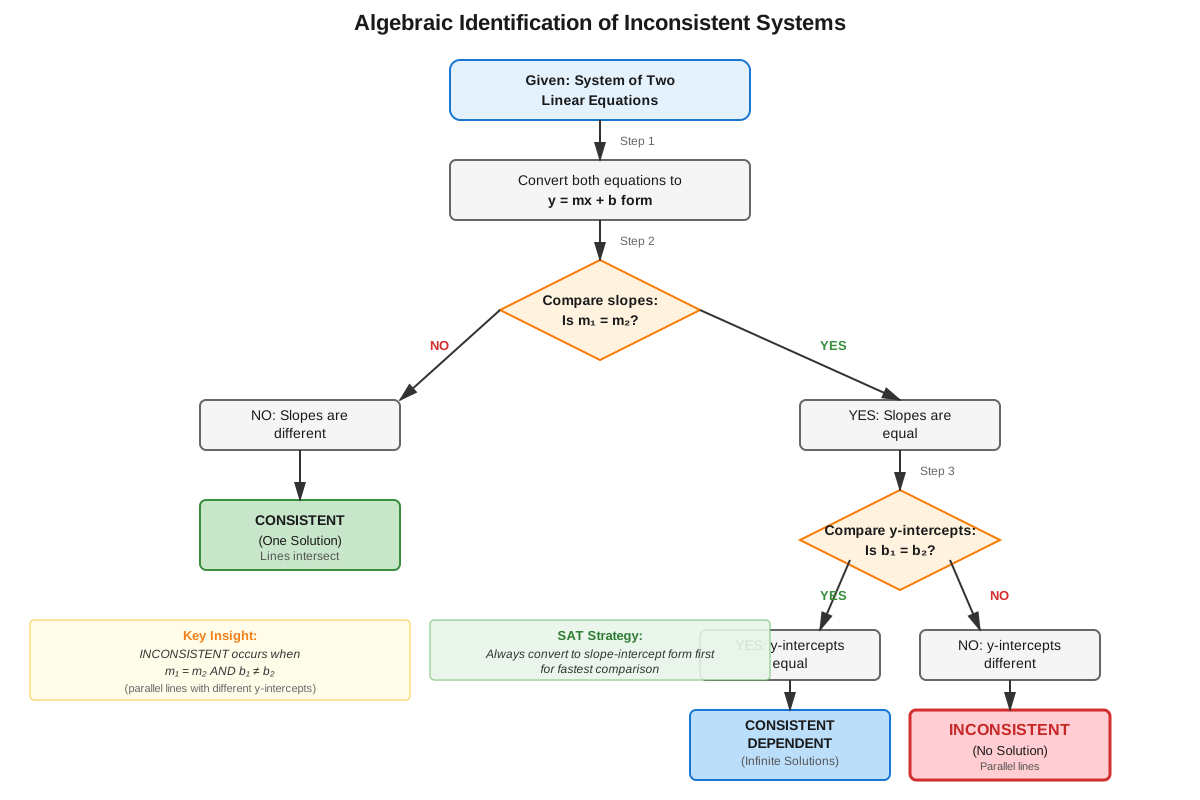
To determine if a system is inconsistent algebraically, convert both equations to slope-intercept form and compare:
- Solve each equation for y
- Identify the slope (coefficient of x) in each equation
- Identify the y-intercept (constant term) in each equation
- If slopes are equal AND y-intercepts are different, the system is inconsistent
For example, consider:
2x + 3y = 6
2x + 3y = 12
Converting to slope-intercept form:
- First equation: y = -⅔x + 2
- Second equation: y = -⅔x + 4
Both have slope -⅔, but different y-intercepts (2 and 4), confirming inconsistency.
Graphical Representation
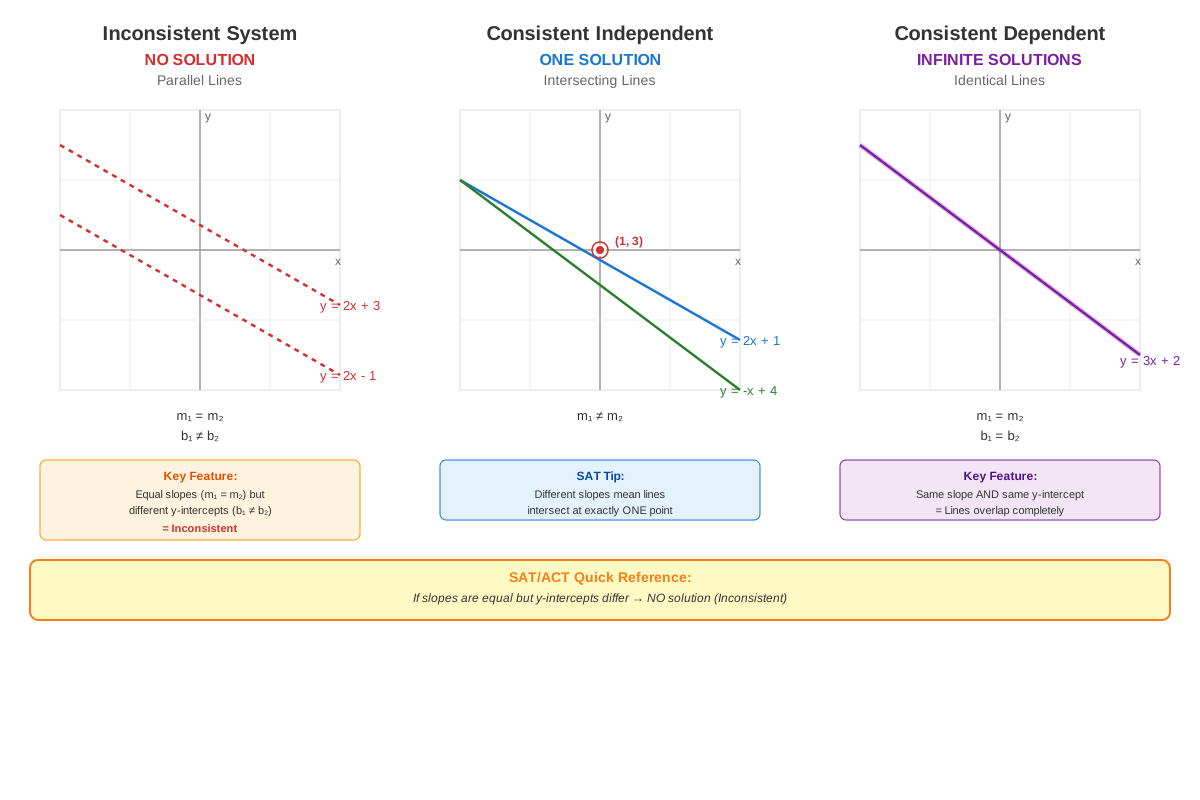
Graphically, sat inconsistent systems appear as parallel lines on the coordinate plane. Since parallel lines maintain constant distance and never meet, no point exists that lies on both lines simultaneously. This visual representation provides immediate confirmation of inconsistency and helps students verify algebraic conclusions.
Key graphical features:
- Lines have identical slopes (same steepness and direction)
- Lines have different y-intercepts (cross the y-axis at different points)
- Lines never intersect regardless of how far they extend
- The vertical distance between lines remains constant
Comparison with Other System Types
Understanding inconsistent systems requires distinguishing them from consistent systems:
| System Type | Number of Solutions | Graphical Representation | Algebraic Condition |
|---|---|---|---|
| Inconsistent | Zero (no solution) | Parallel lines | Same slope, different y-intercepts |
| Consistent Independent | One (unique solution) | Intersecting lines | Different slopes |
| Consistent Dependent | Infinite solutions | Coincident lines (same line) | Same slope, same y-intercept |
Finding Parameter Values for Inconsistency
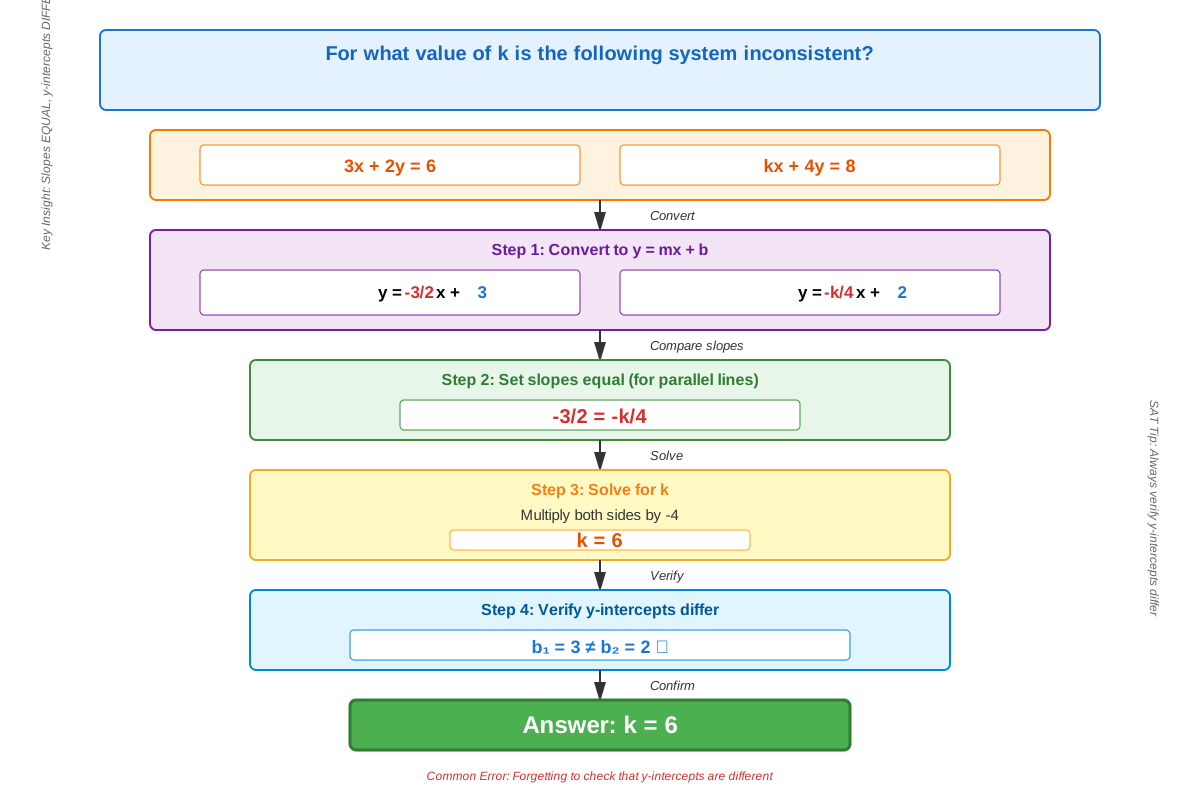
SAT questions frequently ask students to find coefficient values that make a system inconsistent. The process involves:
- Express both equations in slope-intercept form (may include unknown parameter)
- Set the slopes equal to each other
- Solve for the unknown parameter
- Verify that y-intercepts are different with this parameter value
Example: For what value of k is this system inconsistent?
3x + 4y = 12
kx + 8y = 20
Converting to slope-intercept form:
- First equation: y = -¾x + 3
- Second equation: y = -k/8·x + 5/2
For inconsistency, slopes must be equal: -¾ = -k/8
Solving: k = 6
Verify y-intercepts differ: 3 ≠ 5/2 ✓
Standard Form Analysis
When equations are in standard form (Ax + By = C), inconsistency can be identified without converting to slope-intercept form:
For equations:
a₁x + b₁y = c₁
a₂x + b₂y = c₂
The system is inconsistent if: a₁/a₂ = b₁/b₂ ≠ c₁/c₂
This ratio method provides a quick check, especially useful under time pressure on the SAT.
Concept Relationships
The concept of inconsistent systems builds directly on understanding linear equations and their graphical representations. Linear equations in slope-intercept form → provides the foundation for → identifying slopes and y-intercepts → which enables → determining system consistency.
Parallel lines (from geometry) → connects to → inconsistent systems (from algebra) → through the shared property of → equal slopes. This geometric-algebraic connection reinforces why inconsistent systems have no solution: geometric impossibility (parallel lines never meet) corresponds to algebraic impossibility (no (x,y) pair satisfies both equations).
The broader hierarchy flows: Basic linear equations → systems of equations → classification by solution count → which branches into → inconsistent systems (0 solutions), consistent independent systems (1 solution), and consistent dependent systems (infinite solutions). Understanding inconsistent systems requires distinguishing it from these alternatives, making comparison a critical skill.
Additionally, inconsistent systems connect forward to more advanced topics: matrix operations (where inconsistent systems produce contradictory row-reduced forms), linear programming (where inconsistent constraints indicate infeasible regions), and parametric equations (where parameter restrictions prevent solutions).
Quick check — test yourself on Inconsistent systems so far.
Try Flashcards →High-Yield Facts
⭐ An inconsistent system has exactly zero solutions—no point satisfies all equations simultaneously
⭐ Parallel lines have equal slopes but different y-intercepts, creating inconsistent systems
⭐ To identify inconsistency, convert equations to y = mx + b form and compare m and b values
⭐ In standard form Ax + By = C, check if a₁/a₂ = b₁/b₂ ≠ c₁/c₂ for inconsistency
⭐ SAT questions often ask for coefficient values that make a system inconsistent
- Graphically, inconsistent systems appear as parallel lines that never intersect
- Attempting to solve an inconsistent system algebraically produces a false statement like 0 = 5
- Multiplying one equation by a constant and getting different constant terms indicates inconsistency
- Inconsistent systems represent real-world scenarios where constraints cannot be simultaneously met
- The distance between parallel lines in an inconsistent system remains constant everywhere
- Inconsistent systems are one of three possible system classifications (along with consistent independent and consistent dependent)
- When solving by elimination, inconsistent systems yield contradictions after variable elimination
Common Misconceptions
Misconception: If two equations look different, the system must be inconsistent → Correction: Equations can appear different but represent the same line (consistent dependent) or intersecting lines (consistent independent). Only parallel lines with different y-intercepts create inconsistent systems.
Misconception: An inconsistent system means the equations are wrong or contain errors → Correction: Inconsistent systems are mathematically valid; they simply represent parallel lines. The equations are correct, but no point satisfies both simultaneously.
Misconception: If you can't easily solve a system, it must be inconsistent → Correction: Difficulty solving doesn't indicate inconsistency. Some consistent systems require complex algebraic manipulation. Inconsistency is determined by comparing slopes and y-intercepts, not solution difficulty.
Misconception: Multiplying an equation by a constant can make a consistent system inconsistent → Correction: Multiplying an equation by a non-zero constant creates an equivalent equation representing the same line. This operation cannot change system consistency.
Misconception: Inconsistent systems only occur with two equations → Correction: While SAT questions typically involve two equations, systems with three or more equations can also be inconsistent when no point satisfies all equations simultaneously.
Misconception: If slopes are equal, the system is automatically inconsistent → Correction: Equal slopes indicate parallel or coincident lines. If y-intercepts are also equal, the lines coincide (infinitely many solutions). Inconsistency requires equal slopes AND different y-intercepts.
Worked Examples
Example 1: Identifying Inconsistency
Problem: Determine whether the following system is inconsistent, consistent independent, or consistent dependent:
6x - 9y = 18
4x - 6y = 15Solution:
Step 1: Convert both equations to slope-intercept form.
First equation: 6x - 9y = 18
- Subtract 6x: -9y = -6x + 18
- Divide by -9: y = ⅔x - 2
Second equation: 4x - 6y = 15
- Subtract 4x: -6y = -4x + 15
- Divide by -6: y = ⅔x - 5/2
Step 2: Compare slopes and y-intercepts.
- Both equations have slope m = ⅔
- First equation has y-intercept b₁ = -2
- Second equation has y-intercept b₂ = -5/2 = -2.5
Step 3: Classify the system.
Since the slopes are equal (⅔ = ⅔) but the y-intercepts are different (-2 ≠ -2.5), the lines are parallel and never intersect.
Answer: The system is inconsistent (no solution).
Connection to Learning Objectives: This example demonstrates identifying key features of inconsistent systems (equal slopes, different y-intercepts) and applying the concept to classify a system.
Example 2: Finding Parameter Values
Problem: For what value of k does the following system have no solution?
2x + 5y = 10
kx + 15y = 25Solution:
Step 1: Convert both equations to slope-intercept form, keeping k as a variable.
First equation: 2x + 5y = 10
- Subtract 2x: 5y = -2x + 10
- Divide by 5: y = -⅖x + 2
Second equation: kx + 15y = 25
- Subtract kx: 15y = -kx + 25
- Divide by 15: y = -k/15·x + 5/3
Step 2: For no solution (inconsistent system), slopes must be equal.
Set slopes equal: -⅖ = -k/15
Step 3: Solve for k.
- Multiply both sides by -15: (-15)(-⅖) = (-15)(-k/15)
- Simplify: 6 = k
Step 4: Verify y-intercepts are different when k = 6.
- First equation y-intercept: 2
- Second equation y-intercept: 5/3 ≈ 1.67
- Since 2 ≠ 5/3, the system is indeed inconsistent when k = 6
Answer: k = 6
Connection to Learning Objectives: This example applies the concept to solve for unknown coefficients that create inconsistency, a common SAT question type requiring both conceptual understanding and algebraic manipulation.
Exam Strategy
When approaching SAT questions on inconsistent systems, follow this systematic process:
Step 1: Identify the question type
- Look for phrases like "no solution," "how many solutions," "for what value of [parameter]," or "which system is inconsistent"
- These trigger words indicate a system consistency question
Step 2: Quick visual check (if graphs provided)
- Parallel lines → inconsistent
- Intersecting lines → one solution
- Overlapping lines → infinite solutions
Step 3: Algebraic approach (if equations provided)
- Convert to slope-intercept form (y = mx + b)
- Compare slopes first (most efficient)
- If slopes equal, check y-intercepts
- Use the ratio method for standard form: a₁/a₂ = b₁/b₂ ≠ c₁/c₂
Time allocation: Spend 60-90 seconds on straightforward identification questions, up to 2 minutes on parameter-finding questions. If conversion to slope-intercept form becomes algebraically messy, try the ratio method instead.
Process of elimination tips:
- Eliminate answer choices where slopes are clearly different (these give one solution)
- Eliminate choices where all coefficients are proportional (these give infinite solutions)
- For parameter questions, plug answer choices back into the equations to verify inconsistency
Common trigger phrases:
- "No solution" → looking for inconsistent system
- "Infinitely many solutions" → looking for consistent dependent system
- "Exactly one solution" → looking for consistent independent system
- "Parallel lines" → indicates inconsistent system
- "For what value of k" → typically finding parameter that creates specific consistency type
Memory Techniques
Mnemonic for System Types: "ZIP"
- Zero solutions = Inconsistent (parallel lines)
- Infinite solutions = Consistent dependent (same line)
- Precisely one solution = Consistent independent (intersecting lines)
Slope-Intercept Memory Aid: "Same Slope, Different Height = Never Meet"
- Visualize two parallel roads at different elevations that never connect
Ratio Rule Acronym: "ABC Check"
- A₁/A₂ compared to
- B₁/B₂ compared to
- C₁/C₂
- If first two equal but third different → inconsistent
Visual Memory Technique: Picture railroad tracks (parallel lines) that represent an inconsistent system—they run alongside each other forever without meeting, just as parallel lines with different y-intercepts never intersect.
Finger Method: Hold up two fingers parallel to each other (inconsistent), crossed (one solution), or overlapping (infinite solutions) to quickly recall system types during the exam.
Summary
Inconsistent systems are sets of linear equations with no solution, occurring when equations represent parallel lines that never intersect. These systems are characterized by equal slopes but different y-intercepts when equations are written in slope-intercept form (y = mx + b). On the SAT, students must identify inconsistent systems through algebraic analysis, graphical interpretation, or by finding parameter values that create inconsistency. The key diagnostic test involves converting equations to comparable forms and checking whether slopes match while y-intercepts differ. Alternatively, for equations in standard form (Ax + By = C), the ratio test (a₁/a₂ = b₁/b₂ ≠ c₁/c₂) provides quick identification. Understanding inconsistent systems requires distinguishing them from consistent independent systems (one solution, intersecting lines) and consistent dependent systems (infinite solutions, coincident lines). This topic appears regularly on the SAT in various formats, making it essential for achieving high scores in the Heart of Algebra content domain.
Key Takeaways
- Inconsistent systems have zero solutions because they represent parallel lines that never intersect
- Equal slopes with different y-intercepts always indicate an inconsistent system
- Convert equations to y = mx + b form to quickly compare slopes (m) and y-intercepts (b)
- The ratio method (a₁/a₂ = b₁/b₂ ≠ c₁/c₂) provides fast identification in standard form
- SAT questions frequently ask for parameter values that create inconsistency—set slopes equal and solve
- Attempting to solve an inconsistent system algebraically produces false statements like 0 = 7
- Distinguish inconsistent systems from the other two types: consistent independent (one solution) and consistent dependent (infinite solutions)
Related Topics
Consistent Independent Systems: Systems with exactly one solution where lines intersect at a single point. Mastering inconsistent systems provides the foundation for understanding why different slopes guarantee intersection.
Consistent Dependent Systems: Systems with infinitely many solutions where equations represent the same line. Understanding the three system types together creates complete mastery of linear system classification.
Systems of Inequalities: Extends system concepts to inequality regions. Recognizing parallel boundary lines helps identify when inequality systems have no feasible region.
Linear Programming: Advanced application where inconsistent constraint systems indicate infeasible optimization problems. The foundational understanding of inconsistency transfers directly to this topic.
Matrix Methods for Systems: Row reduction techniques that reveal inconsistency through contradictory rows. Algebraic understanding of inconsistent systems prepares students for matrix approaches.
Practice CTA
Now that you've mastered the core concepts of inconsistent systems, it's time to solidify your understanding through active practice. Attempt the practice questions to apply these concepts to SAT-style problems, and use the flashcards to reinforce key definitions and identification strategies. Remember, recognizing inconsistent systems quickly and accurately can save valuable time on test day and boost your confidence in the Heart of Algebra section. Each practice problem you solve strengthens your pattern recognition and problem-solving speed—skills that directly translate to higher SAT Math scores. You've built the foundation; now practice makes permanent!
Sign up free to keep reading
Create a free AnvayaPrep account to finish this SAT guide on Inconsistent systems — plus flashcards and practice questions.